INTRODUCTION
In patients with schizophrenia (SZ), impulsive behaviors are common and associated with positive psychotic symptoms such as suspiciousness, delusions, and so on (Zhou et al., Reference Zhou, Zhong, Xiang, Chen, Cao, Correll, Ungvari, Chiu, Lai and Wang2016). Impulsivity reflects deficient inhibitory control, showing as difficulty of timely cancellation or restrain of inappropriate reactions (i.e., response inhibition). In SZ, response inhibition is a core deficit (Lipszyc & Schachar, Reference Lipszyc and Schachar2010; Wright, Lipszyc, Dupuis, Thayapararajah, & Schachar, Reference Wright, Lipszyc, Dupuis, Thayapararajah and Schachar2014), and its impairment is associated with impulsive behaviors (Krakowski et al., Reference Krakowski, De Sanctis, Foxe, Hoptman, Nolan, Kamiel and Czobor2016), causing serious consequences such as violent behaviors and suicide (Iancu et al., Reference Iancu, Bodner, Roitman, Piccone Sapir, Poreh and Kotler2010).
Recently, more attention is given to inhibitory control in an emotional context. In healthy populations, inhibition is found to be more difficult in emotional than neutral contexts (Allen & Hooley, Reference Allen and Hooley2015; De Houwer & Tibboel, Reference De Houwer and Tibboel2010; Herbert & Sütterlin, Reference Herbert and Sütterlin2011; Kalanthroff, Cohen, & Henik, Reference Kalanthroff, Cohen and Henik2013; Krypotos, Jahfari, van Ast, Kindt, & Forstmann, Reference Krypotos, Jahfari, van Ast, Kindt and Forstmann2011; Rebetez, Rochat, Billieux, Gay, & Van der Linden, Reference Rebetez, Rochat, Billieux, Gay and Van der Linden2015; Verbruggen & De Houwer, Reference Verbruggen and De Houwer2007; Yu et al., Reference Yu, Hung, Tseng, Tzeng, Muggleton and Juan2012). Similar results have been found in patients with SZ, who were particularly difficult in inhibiting emotional information (Vercammen et al., Reference Vercammen, Morris, Green, Lenroot, Kulkarni, Carr, Weickert and Weickert2012, Reference Vercammen, Skilleter, Lenroot, Catts, Weickert and Weickert2013), especially when the information were negatively valenced (Egashira et al., Reference Egashira, Matsuo, Nakashima, Watanuki, Harada, Nakano, Matsubara, Takahashi and Watanabe2015; Krakowski et al., Reference Krakowski, De Sanctis, Foxe, Hoptman, Nolan, Kamiel and Czobor2016). The difficulty of inhibiting emotional distractors is also reflected in decreased brain activations in a wide range of frontal and temporal regions in patients with SZ (Egashira et al., Reference Egashira, Matsuo, Nakashima, Watanuki, Harada, Nakano, Matsubara, Takahashi and Watanabe2015; Vercammen et al., Reference Vercammen, Morris, Green, Lenroot, Kulkarni, Carr, Weickert and Weickert2012, Reference Vercammen, Skilleter, Lenroot, Catts, Weickert and Weickert2013). Importantly, the urgency to act in context of strong emotions underlies impulsivity and predicts aggressive behaviors in patients with SZ (Hoptman, Antonius, Mauro, Parker, & Javitt, Reference Hoptman, Antonius, Mauro, Parker and Javitt2014).
While these studies consider emotions as distractions and emphasize detrimental effect of affective elements during response inhibition, a different line of research has indicated that emotions can improve response inhibition in healthy adults under specific situations (Derntl & Habel, Reference Derntl and Habel2016; Pawliczek et al., Reference Pawliczek, Derntl, Kellermann, Kohn, Gur and Habel2013; Pessoa, Padmala, Kenzer, & Bauer, Reference Pessoa, Padmala, Kenzer and Bauer2012; Xu et al., Reference Xu, Li, Fan, Sun, Ding, Li and Yang2016). The contrasting effects of emotions in inhibition can be explained by the dual competition theory (Pessoa, Reference Pessoa2009). The theory posits that emotional and cognitive control compete for limited attentional resources. Emotional stimuli tend to improve cognitive control when they are task relevant and enhance attention, but they often impair control when they are task irrelevant and distract attention. In the studies showing detrimental effect of emotions on inhibitory control, the emotional stimuli are task irrelevant and served as distracters (Allen & Hooley, Reference Allen and Hooley2015; De Houwer & Tibboel, Reference De Houwer and Tibboel2010; Egashira et al., Reference Egashira, Matsuo, Nakashima, Watanuki, Harada, Nakano, Matsubara, Takahashi and Watanabe2015; Herbert & Sütterlin, Reference Herbert and Sütterlin2011; Kalanthroff et al., Reference Kalanthroff, Cohen and Henik2013; Krakowski et al., Reference Krakowski, De Sanctis, Foxe, Hoptman, Nolan, Kamiel and Czobor2016; Krypotos et al., Reference Krypotos, Jahfari, van Ast, Kindt and Forstmann2011; Rebetez et al., Reference Rebetez, Rochat, Billieux, Gay and Van der Linden2015; Verbruggen & De Houwer, Reference Verbruggen and De Houwer2007; Vercammen et al., Reference Vercammen, Morris, Green, Lenroot, Kulkarni, Carr, Weickert and Weickert2012, Reference Vercammen, Skilleter, Lenroot, Catts, Weickert and Weickert2013; Yu et al., Reference Yu, Hung, Tseng, Tzeng, Muggleton and Juan2012). In contrast, when the emotional stimuli served as cues for stop, they may draw more attention to inhibitory control and improve inhibition (Derntl & Habel, Reference Derntl and Habel2016; Pawliczek et al., Reference Pawliczek, Derntl, Kellermann, Kohn, Gur and Habel2013; Pessoa et al., Reference Pessoa, Padmala, Kenzer and Bauer2012; Xu et al., Reference Xu, Li, Fan, Sun, Ding, Li and Yang2016).
This is consistent with recent perspective of utilizing emotional cues to facilitate cognitive functions (Inzlicht, Bartholow, & Hirsh, Reference Inzlicht, Bartholow and Hirsh2015; Lindstrom & Bohlin, Reference Lindstrom and Bohlin2011; Pessoa, Reference Pessoa2008; Yang et al., Reference Yang, Cui, Wang, Huang, Lui, Zhang, Cheung and Chan2018). However, almost no study has explored emotional enhancement effect in response inhibition in SZ except for Derntl and Habel (Reference Derntl and Habel2016). In their study, patients with SZ made consecutive responses to neutral or angry faces with white frames and stop when the white frame turned yellow in the stop trials. Angry faces improved response inhibition in patients with SZ relative to neutral faces, suggesting possibility of utilizing emotional cues to enhance response inhibition in patients with SZ.
However, three issues remained unclear in Derntl and Habel’s (Reference Derntl and Habel2016) study. First, the stop cues themselves were neutral (white frame) that accompanied by emotional “Go” stimuli (faces). We are interested to know the effect when the stop cues themselves were emotional (and the “Go” stimuli were neutral), as in Pessoa et al.’s (Reference Pessoa, Padmala, Kenzer and Bauer2012) study. Second, the effect of positive emotional cues on response inhibition was not examined in SZ. Pessoa et al. (Reference Pessoa, Padmala, Kenzer and Bauer2012) found that happy faces could also improve response inhibition in healthy adults. It is therefore worth examining the effect of positive stop cues on response inhibition in patients with SZ. Finally, in both Derntl and Habel (Reference Derntl and Habel2016) and Pessoa et al. (Reference Pessoa, Padmala, Kenzer and Bauer2012) study, emotional stimuli were faces with emotional expressions, which had social values. We wanted to test whether the emotional enhancement was limited to social–emotional stimuli or can be extended to other types of emotional stimuli such as emotional pictures.
To achieve these goals, we adapted the emotional stop-signal task in Pessoa et al.’s (Reference Pessoa, Padmala, Kenzer and Bauer2012) study and replaced emotional faces with emotional pictures. The task involved selective responses to “Go” stimuli and stopped response when positive, negative, or neutral stop picture cues occurred. Meta-analyses indicated medium-size impairment of response inhibition in SZ patients (Lipszyc & Schachar, Reference Lipszyc and Schachar2010; Wright et al., Reference Wright, Lipszyc, Dupuis, Thayapararajah and Schachar2014), thus we predicted that patients with SZ would have poorer performance on response inhibition than healthy controls. Based on Derntl and Habel’s (Reference Derntl and Habel2016) and Pessoa et al.’s (Reference Pessoa, Padmala, Kenzer and Bauer2012) study, we expect that emotional picture stop cues would also enhance response inhibition in patients with SZ. Finally, we explored the cognitive mechanisms of emotional enhancement effect in response inhibition by examining the performance of “Go” trials after the stop trials. If the emotional stop cues did draw more attention to inhibitory process, it would leave less cognitive resources for follow-up “Go” trials and impair the “Go” performance.
METHOD
The study was approved by the Ethics Committee of Institute of Psychology, Chinese Academy of Science, and the two health service centers and was completed in accordance with the Helsinki Declaration.
Participants
Thirty-six patients with SZ (14 females and 22 males) were recruited from the Department of Psychiatry at the Wanshou Road Community Health Service Center and Tiancun Road Community Health Service Center in Beijing, China. Inclusion criteria were (1) DSM-5 criteria for SZ and (2) age between 18 and 50. Exclusion criteria were (1) brain injury; (2) history of neurological diseases and other psychiatric disorders; (3) drug or alcohol dependence history; and (4) electroconvulsive therapy in recent 3 months. All the patients were outpatients and took antipsychotic medicine including clozapine, risperidone, olanzapine, sulpiride, aripiprazole, haloperidol, perphenazine, and quetiapine. Their dosages were transformed to chlorpromazine equivalents following the standard procedure (Andreasen, Pressler, Nopoulos, Miller, & Ho, Reference Andreasen, Pressler, Nopoulos, Miller and Ho2010).
Thirty-six healthy controls (19 females and 17 males) were recruited via advertisement from local community. The inclusion criteria were (1) age between 18 and 50 and (2) no substance abuse. The exclusion criteria were (1) the presence or history of any psychiatric or neurological illness; (2) psychiatric or neurological disorder in the first-degree relatives; and (3) taking psychotropic medication.
Design
It was a 3 stop cue condition (positive, negative, and neutral) × 2 group (SZ vs. healthy controls) mixed design. The dependent variables included the performance of Go trials (i.e., reaction time (RT) of correct Go trials, accuracy, after-stop omission error, and response error), stop trials (i.e., stop-signal RT, SSRT), and valence and arousal ratings of the picture stop cues.
Clinical Assessments
The psychiatric symptoms of patients were rated by the qualified psychiatrists using the Positive and Negative Syndrome Scale (PANSS) (Kay, Fiszbein, & Opler, Reference Kay, Fiszbein and Opler1987). The internal consistency reliability (Cronbach α) for the Chinese version was 0.87 (Si et al., Reference Si, Yang, Shu, Wang, Kong, Zhou, Li and Liu2004).
The level of impulsiveness of all participants was measured with the Barratt Impulsiveness Scale (BIS-11; Patton, Stanford, & Barratt, Reference Patton, Stanford and Barratt1995; Zhou, Xiao, He, Li, & Liu, Reference Zhou, Xiao, He, Li and Liu2006). It was a self-report questionnaire comprising three subscales. The attentional impulsiveness subscale measures stability of attention (score range: 6–24). The motor impulsiveness subscale reflects impulsiveness of action (score range: 9–36). The nonplanning impulsiveness subscale measures self-control and cognitive complexity (scores range: 10–40). For all subscales, larger score indicated higher level of impulsiveness. The internal consistency reliability (Cronbach α) for the Chinese version was 0.76.
Intelligence Quotient
General intelligence of all participants were estimated using the Chinese short version of the Wechsler Intelligence Scale for Adults (Gong, Reference Gong1992), which contained four subtests (i.e., common sense, arithmetic, similarity, and digit span).
Emotional Stop-Signal Task
The emotional stop-signal task was adapted from Pessoa et al. (Reference Pessoa, Padmala, Kenzer and Bauer2012). Basically, participants responded to Go trials and stopped response when seeing a stop cue. Go trials comprised curly and straight frames. Stop cues were pictures selected from the International Affective Picture System (Lang, Bradley, & Cuthbert, Reference Lang, Bradley and Cuthbert2005), including 36 negative pictures (valence mean = 3.13, SD = 0.75; arousal mean = 5.91, SD = 0.56), 36 positive pictures (valence mean = 7.53, SD = 0.41; arousal mean = 5.77, SD = 0.66), and 36 neutral pictures (valence mean = 4.89, SD = 0.32; arousal mean = 2.55, SD = 0.32). The ratio of Go trials and stop trials was set at 3 to 1, consistent with the classical stop-signal task (Logan & Cowan, Reference Logan and Cowan1984).
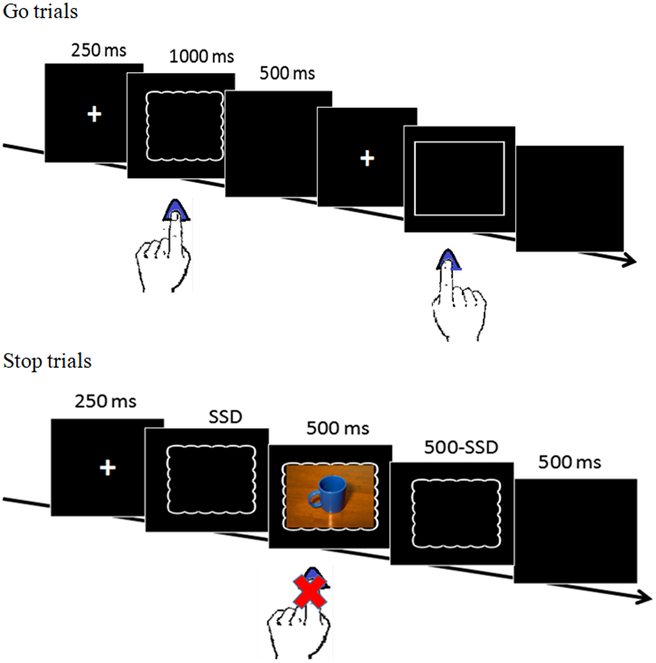
The task comprised three runs. Each run included three blocks and each block contained 54 Go trials and 18 stop trials (6 positive, 6 negative, and 6 neutral). The order of the trials was fixed and same for all participants. Each block lasted around 1 min, with a 30-s break between blocks. As shown in Figure 1, Go trials started with a 250-ms fixation in the center of a computer screen, followed by a curly or straight frame appearing for 1000 ms, and participants need to judge the shape of the frame using a gamepad within 1000 ms. This was followed by a blank screen of 500 ms until the next trial began. In the stop trials, a picture stop cue appeared inside the frame for 500 ms after a stop-signal delay (SSD). For all participants, SSD started from 250 ms and followed a staircase procedure. In specific, if a participant successfully withheld the response, SSD increased by 50 ms in the next stop trial, making it more difficult to stop; otherwise, SSD decreased by 50 ms. Each cue condition (i.e., positive, neutral, and negative) had its own staircase procedure and approximately 50 % stop rate was obtained in each condition.
The emotional stop-signal task paradigm. In the Go trials, participants made selective responses based on the shape of the frame. In a stop trial, a stop cue (a neutral, negative, or positive picture) appeared shortly after the Go stimulus, and participants need to withhold the response. For each type of stop cue, the SSD was updated based on a staircase procedure to maintain an approximately 50 % chance of stop.

After the emotional stop-signal task, participants were asked to rate the valence (1 = very unpleasant, 5 = neutral, 9 = very pleasant) and arousal level (1 = very calming, 9 = very arousing) of the picture stop cues on a 9-point Likert scale.
The SSRT was calculated using the integration method (Verbruggen, Chambers, & Logan, Reference Verbruggen, Chambers and Logan2013). SSRT was estimated by subtracting the mean SSD from the nth RT of Go trials, with n equaled the number of Go RTs in the RT distribution multiplied the corrected p (respond|cue). The p (respond|cue) equaled the percentage of failed stop trials (responded when stop cue occurred). The corrected p (respond|cue) was used because the omission of Go trials may induce lower p (respond|cue), and the corrected p (respond|cue) = p (respond|cue)/(1 − rate of omission error).
The performance of Go trials was reflected by Go accuracy, mean RT of correct Go trials, omission error, and response error. Omission error refers to failure of response to the Go stimulus, and response error is the incorrect response to the Go stimulus. In order to investigate the attentional resource used by the emotional stop cues, the rate of omission and response error of the Go trials after the stop trials was calculated. The rate of after-stop omission/response error was the number of omission/response trials divided by the total number of the stop trials.
Procedure
Statistical Analyses
The group comparisons of demographic, clinical information, PANSS, and impulsivity (BIS) were conducted using t tests. The effects of stop cue condition and group on response inhibition and emotional ratings were analyzed using the 2- group (SZ vs. healthy controls) × 3- stop cue condition (positive, negative, and neutral) analysis of variance (ANOVA) analyses. The Greenhouse–Geisser corrections were applied for violation of sphericity. The performance of three stop cue conditions was compared using the post hoc analyses with Bonferroni corrections. Significant interactions were explored using the simple effect analyses.
RESULTS
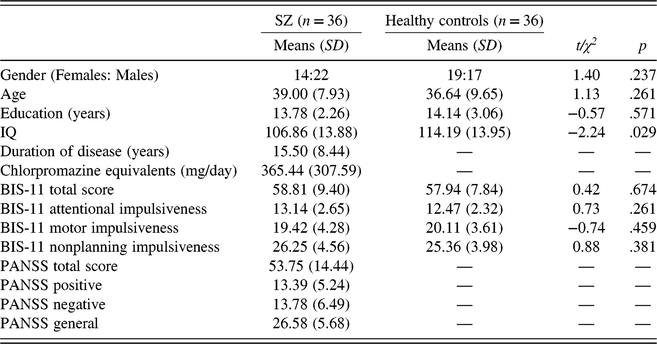
Demographic and clinical information are presented in Table 1. Two groups did not differ in age, ratio of gender, education years, and BIS scores (ps > .05), but patients with SZ had lower IQ scores than healthy controls (p = .029).
Means and SDs of demographic and clinical information, and clinical scales in patients with SZ and healthy controls

Note. BIS = Barratt Impulsiveness Scale; PANSS = Positive and Negative Syndrome Scale; SZ = Schizophrenia.
Performance of Go Trials
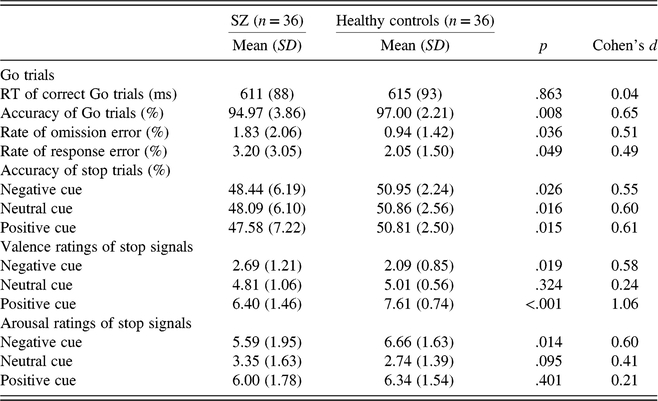
Descriptive results are displayed in Table 2. The two groups did not differ significantly on RT of correct Go trials (t (70) = −0.17, p = .863, Cohen’s d = 0.04), but patients with SZ had significantly lower accuracy of Go trials (t (70) = −2.75, p = .008, Cohen’s d = 0.65) and significantly higher omission error (t (70) = 2.14, p = .036, Cohen’s d = 0.51) and response error (t (70) = 2.02, p = .049, Cohen’s d = 0.48) than healthy controls.
Performance of emotional stop-signal task in SZ and healthy controls

Note. SZ = Schizophrenia.
Performance of Stop Trials
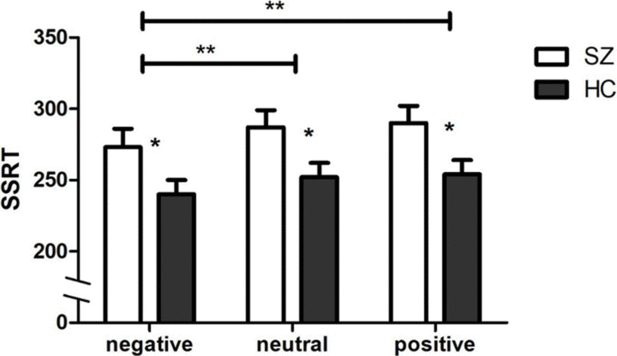
Descriptive results of stop accuracy are shown in Table 2, and descriptive results of SSRT are presented in Figure 2. There was a significant group difference (F (1,70) = 4.99, p = .029, η p2 = 0.07), showing as longer SSRT for patients with SZ than healthy controls. There was also a significant main effect of stop cue condition (F (2,140) = 13.19, p < .001, η p2 = 0.16). The SSRT was shorter in the negative cue condition compared with the neutral cue (t (70) = −4.12, p < .001, Cohen’s d = 0.25) and positive cue conditions (t (70) = −4.61, p < .001, Cohen’s d = 0.32), while there was no significant difference between neutral and positive cue conditions (t (70) = −0.86, p > .10, Cohen’s d = 0.06). The interaction between stop cue condition and group was not significant (F (2,140) = 0.12, p = .887, η p2 < 0.01).
Means of SSRT in negative, neutral, and positive stop cue conditions in patients with SZ and healthy controls. The error bars represent standard errors. HC = healthy controls; SZ = Schizophrenia. *p < .05, **p < .001.

Ratings of Emotional Stop Cues
A patient with SZ did not complete the ratings and the data were excluded from subsequent analysis. The descriptive results of valence and arousal ratings are shown in Table 2. Both groups had normal valence and arousal ratings for stop cues, showing as higher valence ratings for positive than neutral cues, which in turn was higher than negative cues (ps < .001), and higher arousal ratings for positive and negative cues than neutral cues (ps < .05), while the positive and negative cues had no difference in arousal ratings (p > .10).
However, there was a significant interaction between stop cue condition and group for valence ratings (F (2,138) = 18.15, p < .001, η p2 = 0.21). Patients with SZ rated negative cues as more pleasure (t (69) = 2.42, p = .019, Cohen’s d = 0.58) and positive cues as less pleasure than healthy controls (t (69) = −4.42, p < .001, Cohen’s d = 1.06). There was also a significant interaction between group and cue type for arousal ratings (F (2,138) = 6.81, p = .002, η p2 = 0.09), with SZ patients having lower arousal ratings for negative cues than healthy controls (t (69) = −2.52, p = .014, Cohen’s d = 0.60), whereas the two groups did not differ arousal ratings for neutral and positive cues (ps > .05).
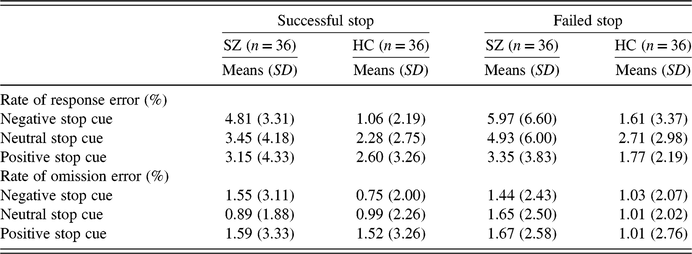
After-Stop Rate of Omission Error and Response Error
The descriptive results are shown in Table 3. Two separate 3 × 2 × 2 (stop cue condition × group × stop success) ANOVA analyses were conducted on the rate of response error and omission error. For the rate of after-stop omission error, there were no significant main effect of stop cue condition (F (2,140) = 1.36, p = .260, η p2 = 0.02), group (F (1,70) = 0.93, p = .338, η p2 = 0.01), and stop success (F (2,140) = 0.11, p = .738, η p2 = 0.002). There was no two- or three-way interaction (ps > .05).
The after-stop rate of response and omission error in percentage (standard deviations) as functions of group, stop cue condition, and stop success

Note. SZ = Schizophrenia; HC = Healthy controls.
For the after-stop rate of response error, there was a significant main effect of group, with higher rate of response error in patients with SZ than healthy controls (F (1,70) = 8.09, p = .006, η p2 = 0.10). There was no significant main effect of stop cue condition (F (2,140) = 2.03, p = .135, η p2 = 0.03) and stop success (F (2,140) = 1.62, p = .207, η p2 = 0.02). There was, however, a significant interaction between stop cue condition and group (F (2,140) = 11.88, p < .001, η p2 = 0.15). Compared with healthy controls, patients with SZ had higher rate of response error after negative cues (t (70) = 4.00, p < .001, Cohen’s d = 0.99), whereas the two groups had similar rate of response error after positive cues (t (70) = 1.75, p = .090, Cohen’s d = 0.39) and neutral cues (t (70) = 1.57, p = .132, Cohen’s d = 0.34). In patients with SZ, the rate of response error after the negative cues was significantly higher compared with neutral cue (t (35) = 3.75, p = .004, Cohen’s d = 0.39) and positive cue conditions (t (35) = 4.20, p = .001, Cohen’s d = 0.61), whereas the rate of response error was similar following the neutral and positive cues (t (35) = 0.75, p = .379, Cohen’s d = 0.34). In healthy controls, the rate of response error after neutral cues was significantly higher than that after negative cues (t (35) = 2.64, p = .031, Cohen’s d = 0.31), while there was no significant difference between other conditions (ps > .05). There was no other two- or three-way interaction (ps > .05).
Correlations Between SSRT, Impulsivity, and Clinical Assessments
Bivariate correlation analyses indicated that the correlations between SSRT scores and impulsiveness were not significant in both groups (all p values > .05). The correlations between SSRT and PANSS scores, dosage, and duration of illness were not significant in patients with SZ (all p values > .05).
DISCUSSION
This study examined the effect of emotional stop cues on response inhibition in patients with SZ. Overall, patients with SZ were impaired in response inhibition, but they obtained similar size of benefit from negative stop cues as healthy controls.
Compared with healthy controls, patients with SZ had longer RT to stop cues in all conditions, indicating an overall impairment of response inhibition. The finding is consistent with the large body of research indicating impaired response inhibition in patients with SZ (Lipszyc & Schachar, Reference Lipszyc and Schachar2010; Wright et al., Reference Wright, Lipszyc, Dupuis, Thayapararajah and Schachar2014). More importantly, it extends the impairment of response inhibition in SZ patients to situations when stop cues were emotional.
Despite deficient response inhibition, patients with SZ obtained similar size of benefit from negative stop cues as healthy controls. That is, the time to stop was shortened when individuals saw negative than neutral picture cues. The finding is consistent with previous studies, in which the stop cues were emotional faces (Pessoa et al., Reference Pessoa, Padmala, Kenzer and Bauer2012) or associated with emotional faces (Derntl & Habel, Reference Derntl and Habel2016). Together, these findings suggest that emotional stimuli (e.g., emotional faces or pictures) at the position of stop cues can facilitate response inhibition.
While similar emotional enhancement effects on response inhibition were obtained in the two groups, the rate of response errors of Go trials after negative stop cues was higher in the SZ group than healthy controls. According to Pessoa et al. (Reference Pessoa, Padmala, Kenzer and Bauer2012), emotional stimuli tend to draw more attentional resource to inhibitory process and facilitate response inhibition. This finding indicates that emotional stimuli (e.g., negative stop cues) may also impair subsequent performance in patients with SZ. We speculate that the adverse after-effect of negative cues may be associated with active attentional avoidance of negative information in SZ patients (Strauss, Llerena, & Gold, Reference Strauss, Llerena and Gold2011). Research has shown that SZ patients with low negative symptoms tend to disengage attention more quickly from unpleasant stimuli than healthy controls (Strauss, Llerena, & Gold, Reference Strauss, Llerena and Gold2011). In this study, SZ patients had low negative symptoms and may rapidly divert their attention away from the location of negative stop cues (i.e., pictures) after perception. Because the follow-up Go stimuli (i.e., the frames) would appear momentarily in the similar location of the previous stop cues, patients with SZ might not switch attention back to the Go stimuli in time and thus were more likely to commit response errors. Future study should replicate this novel finding and continue to explore the role of attentional control in response inhibition in patients with SZ.
Unlike negative stop cues, positive stop cues failed to show any effect on response inhibition in all individuals. This finding is inconsistent with Pessoa et al. (Reference Pessoa, Padmala, Kenzer and Bauer2012), in which happy faces as stop cues facilitated response inhibition in healthy individuals. It could be that happy faces in Pessoa et al. (Reference Pessoa, Padmala, Kenzer and Bauer2012) elicited stronger emotional responses than positive emotional pictures in the present study. However, as Pessoa et al.’s study did not report individuals’ emotional ratings for the faces, and this hypothesis needs further evidence. Future study should consider use happy faces as stop signals and test the effect of positive stop cues with social information on response inhibition in patients with SZ.
In the present study, patients with SZ can distinguish the valence and arousal of different types of stop cues properly but also rated negative cues as more pleasure and positive cues as less pleasure compared with controls. This finding is consistent with previous studies showing relatively normal but also ambivalent emotional responses to emotional stimuli that presented under controlled laboratory environment in SZ patients (Cohen & Minor, Reference Cohen and Minor2010; Docherty, Sponheim, & Kerns, Reference Docherty, Sponheim and Kerns2014; Trémeau et al., Reference Trémeau, Antonius, Cacioppo, Ziwich, Jalbrzikowski, Saccente, Silipo, Butler and Javitt2009). Moreover, individual differences in emotional perception should be noted. For instance, a recent study suggests that only those patients with SZ who had normal emotional perception of the cues showed emotional enhancement effect in prospective memory (Yang et al., Reference Yang, Cui, Wang, Huang, Lui, Zhang, Cheung and Chan2018), indicating that normal emotional reaction to the cues may be an important prerequisite for emotional enhancement effect in patients with SZ.
While these findings are intriguing, they may be limited to SZ patients with chronic duration of illness, who take regular medication and have mild clinical symptoms. Whether the enhancement effect of emotional stop cues can extend to SZ patients with more severe symptoms or first-episodic SZ patients free of medication remains to be investigated. The mild symptoms of SZ patients in the present study may also account for absence of increased impulsivity in patients with SZ (Kaladjian, Jeanningros, Azorin, Anton, & Mazzola-Pomietto, Reference Kaladjian, Jeanningros, Azorin, Anton and Mazzola-Pomietto2011) and lack of correlations between response inhibition and clinical symptoms.
In sum, the present study indicates that negative pictures as stop cues can improve response inhibition in SZ patients but have a cost for subsequent cognitive process. Future study should continue to explore the cognitive and neural mechanisms of emotional enhancement effect in SZ patients. These findings not only add on to the limited literature of utilizing emotional cues to improve executive control in patients with SZ (Derntl & Habel, Reference Derntl and Habel2016) but also suggest new ways of intervention in clinical populations.
ACKNOWLEDGMENTS
This study was supported by the Strategic Priority Research Program of Chinese Academy of Science Grant (XDB32020200), National Natural Science Foundation of China (31400873), the CAS Key Laboratory of Mental Health, Institute of psychology, Chinese Academy of Sciences (KLMH2015ZG02). These funding agents had no role in the study design, collection, analysis, and interpretation of the data; writing and submission of the manuscript. We thank Jing Sun and Hong–Mei Zhao for recruitment and evaluation of the patients with SZ in this study.
CONFLICT OF INTEREST
The authors do not have any conflicting interests that might be interpreted as influencing the views expressed in the article.
CONTRIBUTORS
Author Tian-Xiao Yang and Zheng Ye designed the study. Author Qi Zheng collected the data. Author Qi Zheng and Tian-Xiao Yang analyzed the data and wrote the manuscript. Zheng Ye conceptualized the research project and reviewed the statistical analysis and manuscript. All authors have approved the final manuscript.