The number of adults with congenitally malformed hearts is increasing. As a result of the great improvements in surgical correction, more patients survive today to becomes adults, and approximately one out of four adults with congenitally malformed hearts will require regular cardiac follow-up.Reference Wren and O’sullivan1–Reference Meberg, Otterstad, Froland, Lindberg and Sorland2 Guidelines from the European Society of CardiologyReference Deanfield, Thaulow and Warnes3 and the Canadian Cardiovascular SocietyReference Therrien, Dore and Gersony4–Reference Therrien, Warnes and Daliento6 recommend follow-up oriented towards both medical and psychosocial problems. At present, different programmes to provide these needs have been established in hospital outpatient clinics,Reference Williams, Pearson and Barst7–Reference Berg and Hertz16 but there is a lack of knowledge regarding how education, and psychosocial support, should be given, to achieve effects. Adults with congenitally malformed hearts have a poor level of knowledge regarding their cardiac condition.Reference Moons, De Volder and Budts17–Reference Kamphuis, Verloove-Vanhorick, Vogels, Ottenkamp and Vliegen20 To the best of our knowledge, no previous studies have explored the experiences of patients with regard to the information and education they have received about their cardiac malformation. The aim of our study, therefore, was to explore how adults with congenitally malformed hearts experience their educational needs concerning their congenital cardiac malformation.
Methods
Participants
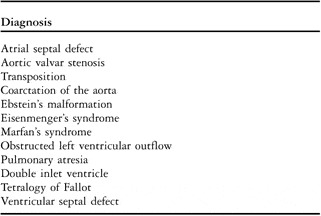
The selection of the adults with congenitally malformed hearts was theoretically sampled from a national registry in Sweden.21 We interviewed 16 adults, 8 men and 8 women, with a mean age of 34 years, ranging from 19 to 55 years, with different congenitally malformed hearts, some having undergone operative correction (see Table 1). Of the 16, 4 had symptoms equating to cardiac failure. Of the group, 12 were working full time, 2 worked part time, and 2 reported being on sick leave due to the cardiac malformation or another reason.
Diagnosis in the 16 adults with congenital heart disease.

Interviews
Written information about the study, including a reply letter and a prepaid envelope, were mailed to 23 adults with congenitally malformed hearts. Of these, 16 consented to be interviewed. At the start of the interview, participants were asked an open question, “Can you describe your experiences of follow-up for your congenital cardiac malformation?” We did not ask from where they had initially experienced the information and education. They described experiences of information about the congenital cardiac disease from childhood, as adults, to those surrounding them, such as healthcare professionals, family members, school, peers, and so on. Follow-up questions were asked to broaden or clarify their initial responses so as to provide a wider variety of experiences of information about the congenital cardiac malformation. The interview ended by the interviewer asking “Is there anything more you would like to tell me? “The interviews were tape-recorded and transcribed verbatim. They ranged in length between 30 and 90 minutes. The study has been approved by the ethical committee at Linköping University Hospital, Sweden.
Analysis of data
Interview data was coded, and the analysis was performed stepwise, starting with reading each transcribed interview in order to provide an overview of its contents. Comments were made in the margins. Selections were then made of the most significant statements, in all identifying 489 such statements. The statements were then compared to find sources of variation or agreement by focusing on similarities or differences. We then constructed preliminary groups, in the first instance providing 5 subcategories. All statements within the preliminary groups were compared and critically analysed, in order to find the central content within each group of statements. We ensured that the contents of each category were not too narrow or too wide, and we excluded obvious overlapping between the categories. Regrouping permitted the formation of one main category and two descriptive categories with eight subcategories. The formed categories, by considering their mutual relationship, were named in order to be a mirror of the content and compared with each other. The analysis was performed independently by two of the researchers. Approximately one-third of the statements were reviewed by an independent third researcher outside the study, who confirmed and correlated the results. Cohen’s Kappa was used, with K proving to be 0.67 in the subcategories, meaning that the inter-rater reliability was not satisfactory, a value of greater than 0.7 being required to provide satisfactory reliability.Reference Cohen22 Most differences occurred within the subcategory availability, which seemed unclear. When modified to educational opportunities, satisfactory agreement was established.
Results
Communication enables individualised education
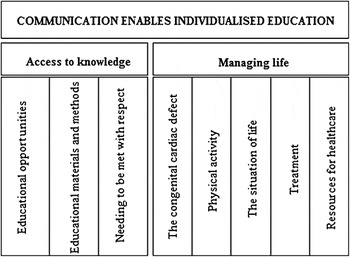
The main category describes how two-way communication is crucial for receiving individualised education, which gives access to knowledge and tools for managing life. If information was provided without good communication between the providers of healthcare and those with congenitally malformed hearts, the patients were unable to transfer the information so as to apply it to themselves.
Information should give access to knowledge by providing opportunities for education, supported by proper educational materials and methods, and with the material provided with suitable respect for the individual. Tools to manage important areas in life should be provided, such as the congenital cardiac malformation, the state of life, physical activity, treatment, and resources available for healthcare. This is facilitated if the education, by means of good communication, is tailored to the situation of the individual in a holistic fashion (Fig. 1).
The analysis resulted in one main category and two descriptive categories with eight subcategories describing how adults with congenitally malformed hearts experienced educational needs concerning their specific malformation.

Access to knowledge
Educational opportunities
Education should be provided on a regular basis, should be accessible, and adjusted to personal preferences and needs. Our patients indicated that information should be provided early, even at the start of schooling, but provision should be dependent on their perceived maturity. It should start on a small scale, and be built up during childhood and adolescence. They argued that the information should be individualised from the outset, being made available as soon as the individual is aware of the congenital malformation, depending of course of their individual situation. Information should not be supplied in universal fashion at one time, nor in acute situations. If surgery or treatment is planned, the suitable individualised education should be given irrespective of age. So as to continue the individualised nature of the education after transfer to adult healthcare, knowledge should be transferred about any earlier problems.
Our patients stated that, because most of the information during childhood is provided to the parents, new education is needed when transition is made to adult healthcare. This should be done independently of the earlier knowledge, and provided on a regular basis more-or-less throughout life, depending again on the needs of the individual. They described the need for increased information should their condition deteriorate, or when symptoms occurred, and during important periods of life such as planning a career or when starting a family. Regular meetings were identified as a means of increasing the transfer of knowledge. Opportunities for information became available during regular visits to the providers of healthcare, and/or during medical examinations. They also identified telephone consultations when questions arose, or the opportunities for additional appointments with the physician, as means of increasing knowledge. They indicated that telephone consultations could be with either a physician or a nurse. They expressed dissatisfaction, however, at having a number to call when they did not know who was going to answer.
When receiving the results of medical examinations, they identified the need to have time to ask questions face to face. In their opinion, results should not be given by telephone or mail, but at the same time, there can be periods when they do not wish to receive information, as opposed to other periods when they have increased needs of knowledge.
Well it is nothing that feels to be of immediate interest to dig into just now… is clear that if you begin to experience symptoms of deterioration, then of course you become more active, and start searching for information…. just now it feels a little far-away.
If they had asked me, when I was a teenager, if I wanted to come more often for a check up I would have said yes. It would have been nice to come twice a year. I had a lot of questions then.
Educational materials and methods
This subcategory describes the different educational materials and methods described by the patients. The information they had received had been given both verbally and through written material. The written material received had included pictures of the malformation, and cards with information about prophylaxis against endocarditis. None of the patients had received any books or pamphlets. Some mentioned receiving copies from the medical records as an alternative, and the written card with information about prophylaxis against endocarditis was described as a good resource to have in the wallet. Good written information was identified as a paramount need, making it possible for the patient to share the information with the people around them.
They argued that education could be given to the individual alone, together with family members, or in company with other persons having congenital cardiac malformations. They also highlighted the need to provide information to teachers and other school personnel. Not one of our patients had experienced formal group education together with other persons with congenital cardiac malformations. Despite this, they identified such group sessions as an alternative means of providing information, and they described experiences of informal meetings before group exercise training.
The internet was also identified as a potential source of information, albeit that some considered education through the internet as being of uncertain value, since it was difficult to validate the source of the information and its reliability. When searching the web for information, many lacked knowledge of features such as the name of their defect. This made it difficult to know if the information found was applicable to their situation. Most information available was in English. Despite the low mean age of our patients, this was identified as a barrier, since there was a lack of information in Swedish.
Needing to be met with respect
This subcategory describes the needs for being met with respect and appropriate treatment, to receive trustworthy information, to feel confident, and to be provided with an open climate for questions regarding care and treatment. They suggested that those providing the information should communicate knowledge and experiences, reply to questions continuously, and show active interest in helping them understanding their condition. They stressed the need for individualised education to be provided in a dedicated and truthful fashion in calm surroundings, preferably not in the examination room, where they experienced feelings of inferiority. In their opinion, the information needed to be provided by the healthcare professional using language understandable to them. They considered it appropriate for the professionals to acknowledge the situation should they have insufficient knowledge to answer a question or provide suitable education, and instead refer them to those having the requisite knowledge. Auscultation of a cardiac murmur often promoted reactions the patient would rather not experience.
They are listening to the heart murmur and then the panic starts, they called the physician who came and also listened, and – Oh that’s cool, you having a heart murmur, can I listen again? And then the circus started. Sometimes it was okay, but sometimes I would rather have been spared it.
Managing life
The congenital cardiac defect
This subcategory describes experiences of education about the malformation itself. The patients preferred that education should be individualised to their specific defect, relating to its aetiology, appearance, function and symptoms, and evolution since childhood. Such knowledge provided them with independence, and feelings of being more secure and in control, helping them to manage contact with society independently.
Before, maybe just one year ago, I did not have the information then. I would have had to tell you to phone home and talk to my parents. But now, thank God, I do not (laugh) have to do that…. And it’s superb, and it gives of course a sense of security.
Physical activity
This subcategory describes experiences of information on physical activity. They should be able to manage symptoms in different activities in daily life. But not everything is about education, since they also need to learn how to manage physical activity through their own experiences of daily life.
If they were not provided with individualised information about how much physical activity they could undertake without a negative affect on their heart, they experienced uncertainty about the physical activity, and had problems managing the physical aspect of their daily life. Some felt restricted and overprotected, while others overexerted themselves at the cost of becoming very tired and symptomatic.
The situation of life This subcategory describes experiences in education about different situations in life, such as having children, heredity, length of life, work, and self-care. They wanted the information to be on an individualised and comprehensive level that took into consideration their specific situation with regard to the family, work, and leisure time.
How should I plan for jobs and such things? What is it going to be like for someone like me, to have children, can I manage that? Is there any risk for the baby to have the heart defect and things like that….
Treatment
This subcategory describes experiences of information about diagnostics and treatment, such as medical examination, medication, before and after cardiac surgery or other procedures, such as direct current cardioversion of supraventricular tachycardia. Regular medical examinations confirm that everything is all right, or something has changed. Not to have adequate knowledge about medication complicates adherence and communication with those providing healthcare. Information before cardiac surgery or other treatment should not only consist of the preparations and the surgery or procedure, but also about the postoperative and rehabilitation phases.
Before the heart operation I would have liked to know what I could not do afterwards. I did have a divided chest after the operation and could not do anything. For a young person to be on sick leave for the first time during a long period of time was a new experience. I was not prepared for that.
The patients wanted knowledge about symptoms they might experience either directly or later so they could manage any such situations, along with their subsequent life. They also wanted details of scars that would be produced after treatment, which nobody had told them about, in particular what they would look like, and how they should handle them.
Resources for healthcare
This subcategory describes experiences of information about resources, such as availability of a physiotherapist, social worker, or psychologist. The knowledge about resources could improve independence and control, for example after cardiac surgery or in daily life. There were experiences of needs such as home help or physiotherapy when discharged from hospital after cardiac surgery. A physiotherapist could help with exercise training, a psychologist could help in handling the defect mentally, and a social worker could provide information regarding economical and practical help.
During the upper secondary school it was difficult, because then, I was heart operated twice. I didn’t get help to get back into my studies. I didn’t know who to turn to, to make them understand that I needed help and so that was quite tough.
Discussion
To our knowledge, this is the first study to describe the experience of adults with congenitally malformed hearts concerning the provision of information and education about their congenital cardiac malformation. Our results show that two-way communication is crucial in order to enhance knowledge in these adults. This type of communication facilitates individualisation, knowledge, and provided the tools needed to manage life. The World Health Organisation has stated that patients should receive information, and that participation in self-care shall be encouraged.23 According to the Swedish Healthcare Law, SFS.1982;763, all patients shall be informed of their state of health and about the treatment options available and take part in the decisions about their care and treatment. Our study also showed that if the information is given without specific consideration of the unique situation of the individual, they experience that it does not apply to them. Similar results have been reported from patients with chronic cardiac failure,Reference Eldh24 namely that experiences of non-participation followed one-way communication. If the adults did not receive individualised and good information, be it verbal or written, they felt that the knowledge was not accessible and that they could not communicate the information to other people, (such as friends, sports coaches, and their general practitioner). When providing patient education, healthcare professionals often focus mainly on delivering information, paying little heed to communication. The person who is the object of attention seldom initiates discussions regarding the information they require.Reference Makoul, Arntson and Schofield25, Reference Florin, Ehrenberg and Ehnfors26 Education concerning self-management should be focused on the situation of the individual, and concentrated on their individual needs.Reference Lorig and Holman27
Access to knowledge
In our study, we found different experiences of when the education should start. Most wanted it to start as soon as possible in early childhood, to build up, and to be adapted to the developmental stage of the child. Not to have sufficient knowledge was experienced as a barrier to take part in decisions about treatment, such as choice of medication. Other studies have also shown that it is important to get access to knowledge in order to be able to inform those around, such as family members, school, friends, sports coaches, or general practitioners.Reference Kendall, Sloper, Lewin and Parsons28–Reference Birks, Sloper, Lewin and Parsons30 In our study, we found few descriptions of what detailed information should be provided. Others have described the same phenomenon, namely that the individuals found it difficult to come up with new ideas on educational materials and methods if they were not given examples.Reference Coulter, Entwistle and Gilbert31 We found no descriptions of which healthcare professionals should provide the education. The patients focussed on the need to be met with respect, particularly with regard to how the information was given and adapted to their present needs, and how it should be given regularly, rather than by whom. There was a strong emphasis on information being provided truthfully, with personal engagement, and with an openness toward the situation of each individual. As with our study, Eldh et al.Reference Eldh24 also emphasised the importance of being respected as a human being.Reference Eldh24 The language used, as stressed by others,Reference Birks, Sloper, Lewin and Parsons30 should be clear and simple, without medical terms and Latin words. The use of such unfamiliar words can be one reason for misunderstanding and uncertainty. For example, this was experienced if the results from echocardiographic investigations showed either deterioration or recovery from the cardiac malformation. As has been discussed by Birks et al,Reference Birks, Sloper, Lewin and Parsons30 oftentimes it is the case that young persons with congenitally malformed hearts, unable to understand the information placed before them, are reluctant to pose questions to their physicians because they do not wish to be considered stupid.Reference Birks, Sloper, Lewin and Parsons30 As our patients stressed, information provided in inappropriate fashion, and without knowledge of those providing it on how to educate, is essentially wasted. Earlier reports on congenital cardiac malformations have recommended that information be provided in individualised fashion regarding the defect and its impact on health, but thus far, to the best of our knowledge, no guiding principles have been provided on how to give the education.Reference Skorton, Garson and Allen32, Reference Foster, Graham and Driscoll33 Ramsden, who has described principles of adult learning, points out that it is important to have a teaching schedule ready before starting any education.Reference Ramsden34 Previous knowledge and experiences, as well as individual learning preferences and goals, have to be assessed prior to planning an individualised education .The emphasis is on the importance of a joint plan for education, and the mutual agreement on the goals.Reference Ramsden34 The theories set out by Ramsden could, in our opinion, and based on the results from the present study, also be transferred to the education of adults with congenital cardiac disease. One way to determine the educational needs of the individual is to test the knowledge through an educational instrument developed for adults with congenitally malformed hearts. This instrument could then be used to communicate with patients about the knowledge they already possess, and possible barriers to learning.Reference Moons, De Volder and Budts17 The educational material could be interactive and computer-based. Such a strategy has already been shown to produce significant results in the transfer of knowledge.Reference Murray, Burns, See, Lai and Nazareth35
Managing life
Our study showed that patients desire individualised education about their specific cardiac lesion, its cause, appearance, impact on function, symptoms and progress since childhood, heredity, future aspects, optional work and leisure activities, self-care, and length of life. Experiences of information provided on physical activity showed that knowledge, and their own experiences, gave the patients tools to manage symptoms in different activities in daily life. Questions about length of life were not related to the prognosis of the individual. McMurray et al.Reference McMurray, Kendall and Parsons29 have found similar results among younger persons with complicated congenitally malformed hearts. Preparation for treatment, such as cardiac surgery, was identified as being particularly important, as was information about symptoms that could occur both directly after surgery and months later. Knowledge of the availability of resources, such as access to a physiotherapist, social worker, or psychologist was similarly identified as important. None of our patients had experienced interaction with a social worker or psychologist, yet expressed such experiences as an unfulfilled need. Problems with teachers in secondary school have already been identified in other studies with younger persons with congenitally malformed hearts.Reference Birks, Sloper, Lewin and Parsons30 Situations mentioned were the need to take some time off when visiting those providing healthcare, or in connection with interventions such as cardiac surgery. It was reported that the teachers did not understand these needs, and did not help the patients catch up with their schoolwork afterwards. Needs for economical advice were also stressed by our patients. As more people with complicated cardiac lesions reach adult age today, they are surrounded by increasingly complex situations. More resources for healthcare are needed, and these needs will almost certainly increase. Multidisciplinary teams with a physiotherapist, social worker, psychologist, physician and nurse need to work together to support the patient with a congenitally malformed heart, providing information in an individualised and holistic fashion.
Strengths and limitations
We purposely selected our participants so as to obtain as many different experiences as possible. The strengths of this approach were that there was a variation among the participants with regard to multiple conditions with varying severity, a wide age range, and an equal distribution in gender as in the overall population of adults with congenitally malformed hearts.21 A limitation of our study was that we made no strategic selection of minority ethnic groups. As a strategy to ensure rigour in the analysis, another experienced qualitative researcher examined the statements, to ensure the categories identified were true reflections of the data.
Relevance to clinical practice
It is well-known that adults with congenitally malformed hearts have a poor level of knowledge regarding their cardiac lesion, this fact underlining the importance of preparation of structured educational programmes for such patients.Reference Moons, De Volder and Budts17–Reference Kamphuis, Verloove-Vanhorick, Vogels, Ottenkamp and Vliegen20 There is currently a lack of knowledge regarding how structured programmes should be developed so as to transfer the required knowledge. Our results can now be used to develop such structured programmes, concentrating on the perspective of the individual, and hopefully be further tested in randomised trials.
Acknowledgements
We are indebted to Ingela Johansson for reviewing our results. This study was supported by grants from The Research Council in South-East Sweden (FORSS), the Heart-Lung Foundation, and Östergötland County Council. This study was supported by grants from The Research Council in South-East Sweden (FORSS), Heart-Lung Foundation and Östergötland county council.