Introduction
Adolescent and young adult (AYA) patients with chronic and life-limiting illnesses are a unique population that continues to report unmet support needs (D’Agostino et al. Reference D’Agostino, Penney and Zebrack2011; Holland et al. Reference Holland, Walker and Henney2021; Kent et al. Reference Kent, Smith and Keegan2013; Tsangaris et al. Reference Tsangaris, Johnson and Taylor2014), which are associated with lower health-related quality of life, worse mental health, and decreased psychosocial functioning (Abdelaal et al. Reference Abdelaal, Avery and Chow2022; Sawyer et al. Reference Sawyer, McNeil and McCarthy2017; Smith et al. Reference Smith, Parsons and Kent2013; Zebrack and Isaacson Reference Zebrack and Isaacson2012). Research suggests AYAs’ unmet support needs are attributed to the lack of age-specific healthcare programs and services that focus on psychosocial aspects of care (D’Agostino et al. Reference D’Agostino, Penney and Zebrack2011; Holland et al. Reference Holland, Walker and Henney2021; Richter et al. Reference Richter, Koehler and Friedrich2015). Age-appropriate social support programs are necessary to fully address the needs of this vulnerable group and mitigate adverse effects of the AYA patient experience (LeBeau et al. Reference LeBeau, Collins and Zori2023; Pennant et al. Reference Pennant, Lee and Holm2020; Richter et al. Reference Richter, Koehler and Friedrich2015).
Social support is crucial for AYAs, influencing autonomy, identity formation, and overall wellbeing (Allen et al. Reference Allen, Reda and Martin2022; Linebarger et al. Reference Linebarger, Ajayi and Jones2014). Frequent hospitalizations, alienation from healthy peers, and exclusion from normative socio-developmental experiences make maintenance of supportive relationships challenging and increases risks for negative outcomes (Allen et al. Reference Allen, Reda and Martin2022; Cheung and Zebrack Reference Cheung and Zebrack2017; Kent et al. Reference Kent, Smith and Keegan2013; Zebrack and Isaacson Reference Zebrack and Isaacson2012). Research demonstrates that chronically ill AYAs who develop supportive relationships and social connectedness report improved self-efficacy, psychological wellbeing, disease/illness coping, and quality of life (Abdelaal et al. Reference Abdelaal, Avery and Chow2022; Breuer et al. Reference Breuer, Sender and Daneck2017; Kaal et al. Reference Kaal, Husson and Van Dartel2018; Poku et al. Reference Poku, Caress and Kirk2018; Tsangaris et al. Reference Tsangaris, Johnson and Taylor2014; Zebrack and Isaacson Reference Zebrack and Isaacson2012). Support from same-age peers with similar diagnoses is especially valuable as it alleviates feeling abnormal; provides comfort knowing others can relate to experiences; and assists with processing illness experiences (Breuer et al. Reference Breuer, Sender and Daneck2017; Kent et al. Reference Kent, Smith and Keegan2013; Lea et al. Reference Lea, Martins and Morgan2018; LeBeau et al. Reference LeBeau, Collins and Zori2023; Mobley et al. Reference Mobley, Foster and Terry2018; Pennant et al. Reference Pennant, Lee and Holm2020; Rujimora et al. Reference Rujimora, Swygert and Walker2023; Tsangaris et al. Reference Tsangaris, Johnson and Taylor2014).
Facilitating opportunities for support can impact AYA care (Breuer et al. Reference Breuer, Sender and Daneck2017; Cheung and Zebrack Reference Cheung and Zebrack2017; Kent et al. Reference Kent, Smith and Keegan2013; Mobley et al. Reference Mobley, Foster and Terry2018; Rujimora et al. Reference Rujimora, Swygert and Walker2023), especially opportunities that minimize infection risks while maximizing peer relationships and support (Kohut et al. Reference Kohut, LeBlanc and O’Leary2018; Lazard et al. Reference Lazard, Collins and Hedrick2021; Lea et al. Reference Lea, Martins and Morgan2018; Rabin et al. Reference Rabin, Simpson and Morrow2013). Online health communities (OHCs) are virtual spaces that can be significant sources of support and empowerment for chronically ill AYAs. Support facilitated through OHCs can provide similar benefits to those of in-person relationships (Cheung and Zebrack Reference Cheung and Zebrack2017; Kohut et al. Reference Kohut, LeBlanc and O’Leary2018; Lea et al. Reference Lea, Martins and Morgan2018). Furthermore, social support found in offline settings also exists in online contexts (Kaal et al. Reference Kaal, Husson and Van Dartel2018; Kohut et al. Reference Kohut, LeBlanc and O’Leary2018; Lea et al. Reference Lea, Martins and Morgan2018; Nick et al. Reference Nick, Cole and Cho2018). Researchers recommend OHCs for chronically ill AYAs as an alternative to traditional modalities to facilitate support and promote positive health outcomes (Devine et al. Reference Devine, Monaghan and Schwartz2017; Kaal et al. Reference Kaal, Husson and Van Dartel2018; Kirk and Milnes Reference Kirk and Milnes2016; Kohut et al. Reference Kohut, LeBlanc and O’Leary2018; Rabin et al. Reference Rabin, Simpson and Morrow2013; Solberg Reference Solberg2014).
Clinical palliative care program
Streetlight at UF Health is a palliative care program helping chronically or terminally ill AYAs navigate the course of their illness and is often introduced early in their disease trajectory. Streetlight focuses on Designated Palliative AYA patients ages 13–30 living with cancer, cystic fibrosis, sickle cell disease, diseases requiring organ transplants, and other rare diseases, or who have been admitted at least 3 times in recent years. The Streetlight Gaming and Online Team (SGOT; at time of data collection, named the Streetlight Gaming League) is an OHC established as a complementary component of the larger Streetlight program (LeBeau et al. Reference LeBeau, Collins and Zori2023), in which AYAs are invited to join during hospital admissions and outpatient appointments. SGOT addresses psychosocial aspects of palliative care and enables continuity of relationships by extending beyond the inpatient setting.
SGOT involves inpatient gaming and virtual community. While hospitalized, patients have access to current generation gaming consoles equipped with online subscriptions, secure internet access, and a library of downloaded games. Additionally, patients can participate in virtual community through a private Discord (n.d.) server moderated by Streetlight staff and volunteers, featuring 36 interest-specific text channels and 6 voice channels. Patients can continue to access Discord following discharge and participate as desired. To maintain a safe environment for patients, Streetlight has several structures and safeguards in place for SGOT, including a behavioral code, Discord moderation, and crisis resources and emergency services (see Appendix 1 for more detail). Additional information about Streetlight and SGOT can be found on their website and in related publications (LeBeau et al. Reference LeBeau, Collins and Zori2023; Rujimora et al. Reference Rujimora, Swygert and Walker2023; Walker et al. Reference Walker, Marchi and Puig2022a, Reference Walker, Rujimora and Swygert2022b).
Objective
Despite knowledge regarding the delivery of programs for chronically ill AYAs and needs expressed by this population, we lack research on age-appropriate programs targeting AYAs’ psychosocial support needs that are delivered virtually and extend beyond the hospital setting. As part of a larger project and ongoing research efforts to manualize the Streetlight program (LeBeau et al. Reference LeBeau, Collins and Zori2023; Rujimora et al. Reference Rujimora, Swygert and Walker2023; Walker et al. Reference Walker, Marchi and Puig2022a, Reference Walker, Rujimora and Swygert2022b), we aimed to address the research gap of AYAs’ unmet support needs by investigating the existence and enactment of social support among chronically ill AYAs using an OHC. We also compared this with existing online social support categories to understand which support types are present in this online space.
Methods
A description of this study’s phenomenological qualitative research design has previously been described (LeBeau et al. Reference LeBeau, Collins and Zori2023). Briefly, we used a constructivist research paradigm and a hermeneutic phenomenological approach to investigate the lived experiences of SGOT participants, considering points of view from different patients and using all perspectives to represent the phenomenon (Neubauer et al. Reference Neubauer, Witkop and Varpio2019). We selected hermeneutic phenomenology because it facilitates in-depth exploration and interpretation of AYA patients’ lived experiences of social support and emphasizes meaning and meaningfulness as ascribed by participants (Bynum and Varpio Reference Bynum and Varpio2018; Neubauer et al. Reference Neubauer, Witkop and Varpio2019). Our study was guided by the COREQ checklist to ensure rigor, credibility, and trustworthiness (Tong et al. Reference Tong, Sainsbury and Craig2007). We obtained approval from the University of Florida Institutional Review Board (#202000235).
Data collection
Based on recommendations for phenomenological studies, we aimed to conduct at least 8 interviews (Vasileiou et al. Reference Vasileiou, Barnett and Thorpe2018). Recruitment for this study mirrored recruitment for Streetlight itself. As such, this study was not focused on a specific diagnosis; rather, the goal was to reach a sampling of various patients participating in the SGOT as there is value in investigating a variety of conditions and illnesses (McNeil et al., Reference McNeil, Egsdal and Drew2019). To understand the breadth of experiences, we recruited AYAs with various illnesses, such as cancer, cystic fibrosis, sickle cell disease, diseases requiring organ transplant, and other rare diseases. Eligible participants were Streetlight members; currently participating or had previously participated in SGOT; between the ages of 13 and 30 years; able to speak, read, and write in English; and cognitively able to participate. We recruited AYAs using purposeful and snowball sampling to ensure selection of information-rich cases and allow for any members to participate, regardless of disease trajectory and psychosocial history. Streetlight staff assisted with recruitment by posting the recruitment flyer to the Discord general chat and directly messaged AYAs inviting them to participate. Participants provided electronic informed consent (adults) or consent with assent (minors) via REDCap (Harris et al. Reference Harris, Taylor and Thielke2009). Data collection materials underwent an extensive vetting process, described previously (LeBeau et al. Reference LeBeau, Collins and Zori2023). We collected data between September 2020 and January 2021.
Participants completed a researcher-created questionnaire via REDCap (Harris et al. Reference Harris, Taylor and Thielke2009) capturing self-reported demographic characteristics. For accuracy, Streetlight staff provided data on length of Streetlight and SGOT membership for participants. Participants also completed a 30–60 minute one-on-one semi-structured interview with a female researcher (KL) trained in qualitative methodology. The interview guide consisted of 12 open-ended questions informed by online social support and AYA literature (Breuer et al. Reference Breuer, Sender and Daneck2017; Nick et al. Reference Nick, Cole and Cho2018), divided into 4 sections according to online social support types: esteem/emotional, social companionship/belonging, informational, and instrumental (Nick et al. Reference Nick, Cole and Cho2018) (Supplemental file 1). As interviews progressed, questions were added to address emerging references to experiences, and confirm or clarify themes described by participants (e.g., member-checking) (Pennant et al. Reference Pennant, Lee and Holm2020). We conducted and recorded interviews using Zoom©. We transcribed interviews via transcription software and reviewed for accuracy. No repeat interviews were conducted, and transcripts were not returned to participants for comment or correction. AYAs received a $25 electronic gift card for participating.
Data analysis
We analyzed demographic data using SAS Software (version 9.4) to describe sample makeup. We used a predominantly deductive approach to reflexive thematic analysis to analyze interview data, where existing research/theory provide the lens through which data are coded and interpreted (Braun and Clarke Reference Braun and Clarke2021, Reference Braun and Clarke2023). We referenced existing online social support categories to develop the initial coding scheme for analysis (Table 1) (Braun and Clarke Reference Braun and Clarke2021; Nick et al. Reference Nick, Cole and Cho2018).
Initial online social support coding scheme used for deductive approach to reflexive thematic analysis

Two researchers (KL, JMR) conducted analysis via Word and Excel using the 6-phase process, moving between phases as necessary: data familiarization; systematic data coding; generating initial themes; developing and reviewing themes; refining, defining, and naming themes; and writing the report (Braun and Clarke Reference Braun and Clarke2021, Reference Braun and Clarke2023). The researchers independently analyzed data during phases 1–3 using the coding scheme, wherein initial codes and themes were informed by existing online social support categories. After completing separate analyses, themes/subthemes were collaboratively compared and finalized during phases 4 and 5. We employed a more inductive approach for subtheme development, which comprised descriptive and interpretive elements, and involved querying our assumptions to produce a richer understanding (Braun and Clarke Reference Braun and Clarke2021). Data saturation was discussed during collaborative meetings about the analysis process. Themes do not represent distinct entities but rather are interrelated constructs that together capture the experiences of AYA participants.
Results
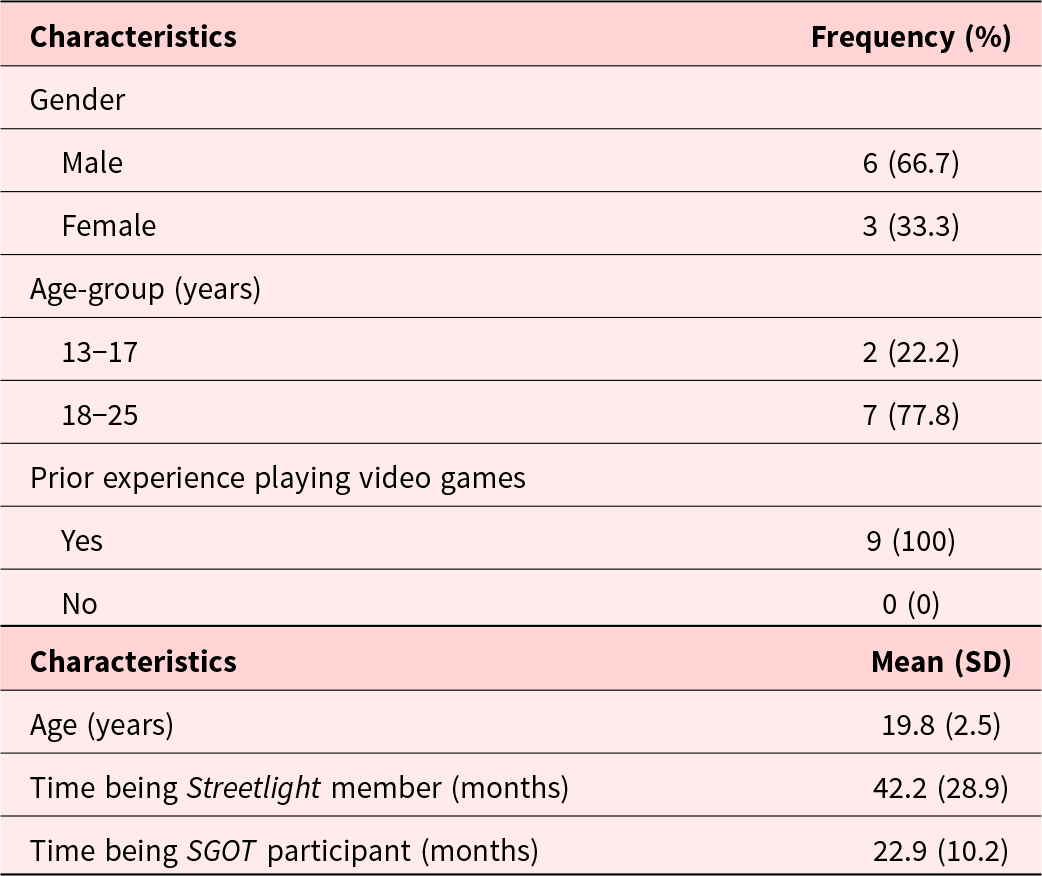
Nine AYAs participated in the study, with 6 identifying as male and 3 identifying as female. Mean age was 19.8 years (SD = 2.5), and 7 participants (78%) were between the ages of 18 and 25 years. On average, participants had been members of Streetlight and SGOT for 3.5 and 1.9 years, respectively (Table 2). AYAs consistently highlighted the existence and enactment of social support within SGOT. Participants perceived the 4 online social support categories, with all participants agreeing if they needed a certain type of support, they felt confident they could seek it out from other AYAs. Social companionship/belonging was the most prevalent support type experienced, followed by esteem/emotional and informational support. Instrumental support was the least prevalent (Table 3). Themes and subthemes are in Table 4. Supporting quotes are provided in Table 5.
Demographic characteristics and descriptive statistics of AYA participants (n = 9)

Coding frequencies and percentages for the 4 types of online social support

Online social support themes and subthemes with accompanying definitions

Quote numbersa and exemplary quotes for themes and subthemes

a Quote numbers are formatted with a # and the number of the quote. This is how quote numbers are referenced in the article, as well.
Social companionship and belonging
Experiences of social companionship/belonging support were captured into 4 subthemes: embeddedness, inclusivity and common interests, sense of community, and sense of normalcy. AYAs described being attached to others and deeply ingrained in the SGOT group, much of which was attributed to their connections and interactions with others, and a sense of closeness from these relationships (quote #1). Some mentioned others’ actions made them feel socially integrated and like they were a prominent part of each other’s lives, creating a sense of unity (#2).
Participants also discussed feelings of inclusivity, explaining others’ actions made them feel like there was a place for them (#3). Several AYAs mentioned SGOT’s welcoming nature added to its inclusivity and their sense of belonging (#4). Ensuring a welcoming environment was important to SGOT’s culture. AYAs were appreciative of being welcomed with no judgment and desired to do the same for others who join. Additionally, participants described support through shared interests (i.e., gaming, cooking, art, music, memes, anime, pets), and the time spent together engaging in leisure/recreational activities within SGOT (i.e., online gameplay). Participants mentioned sharing and enjoying many interests with others made them feel like they belong. More importantly, these commonalities provided pathways to build deeper relationships, encouraging mutual disclosure (#5).
Most participants expressed a sense of community, feeling fortunate to be part of a supportive group. The support and community from AYAs with shared experiences also alleviated feelings of isolation and loneliness (#6 and 7). Additionally, participants expressed that their sense of community often stemmed from being part of a group where people are going through the same thing. Shared experiences were related to their experiences as chronically ill AYAs, providing participants with a special bond, or form of kinship, which contributed to their feeling of community (#8).
Lastly, participants expressed a sense of normalcy that emerged from exposure to AYAs with similar health issues, explaining that it was comforting to see others talk about their illnesses because it made them feel more normal in their own illness experience (#9). Moreover, the commonality from which SGOT is based – living with chronic or life-limiting illness – provided the same “normal” baseline where AYAs could act like regular teens. Participants appreciated how normal it felt to talk about illness, making these conversations as normal as talking about the weather (#10). They also appreciated that SGOT participation alleviated the pressures of being defined by their illnesses, making the focus less about being sick and more about their own teenage-related interests and who they are as a person (#11).
Esteem and emotional
Esteem/emotional support fell into 3 subthemes: feeling cared for and listened to, acceptance and validation, and coping with and managing illness. Connections between AYAs were perceived as supportive, making AYAs feel cared for and listened to by others. Participants mentioned other AYAs improved their mood on days where they would otherwise feel stuck and alone (#12). Participants enjoyed developing friendships within SGOT where they could talk for hours with AYAs who understood the challenges associated with illness (#13 and 14).
Additionally, participants overwhelmingly described feeling accepted and validated through their SGOT interactions. Participants felt their contributions mattered and members responded with genuine care and interest (#15). Participants felt like they were part of a pseudo family where they could be themselves without worry (#16).
SGOT offered a space where AYAs could receive help in managing their emotional state and cope with and/or manage their illness, which helped with stress relief, mental health, isolation, and loneliness. Participants valued that they could speak about their illness as much or as little as they wanted, and when they wanted to talk, participants appreciated SGOT as an alternative to speaking with family members (#17). Moreover, SGOT provided relief from various aspects of illness. For many, knowing they shared experiences with AYAs contributed to feeling less alone in their illnesses and the accompanying uncomfortable experiences (#18). Not all participants were initially engaged to the full potential of SGOT, but through continued exploration they found their place and were grateful for SGOT participants keeping them sane on hard days (#19).
Informational
Most participants did not typically use SGOT for seeking information; however, they agreed that if they needed informational support, it would be available. Informational support had 2 subthemes: general information and recommendations and advice. Participants felt confident other AYAs could provide valuable knowledge and perspectives. They felt comfortable asking questions and trusted the responses of SGOT participants (#20 and 21).
Many participants also valued that they were receiving recommendations and advice from people they could trust and who had relevant life experiences, as opposed to Googling answers on the internet (#22). Recommendations and advice varied, and often centered around AYAs’ general interests or interests specific to the designated SGOT Discord channels (#23). Additionally, participants described being exposed to new topics they might otherwise have not come across (#24).
Instrumental
Instrumental support was comprised of 2 subthemes: tangible aid or assistance and perceived availability of instrumental support. Some participants mentioned the receipt of help from another participant in which that person directly assisted them with something, such as troubleshooting Discord issues or beating video game levels (#25 and 26). Most participants perceived the availability of instrumental support and if needed felt that SGOT members would be willing to help. Some also stated they would be willing to offer instrumental support if someone asked (#27 and 28).
Discussion
Our study demonstrates the existence and enactment of social support within SGOT, highlighting support type prevalence and demonstrating the relevance and meaningfulness to chronically ill AYAs. AYAs mostly used SGOT for social companionship/belonging, esteem/emotional, and informational support. Findings are consistent with research indicating AYAs desire opportunities for emotional, informational, and social companionship/belonging support (Breuer et al. Reference Breuer, Sender and Daneck2017; Cheung and Zebrack Reference Cheung and Zebrack2017; Lea et al. Reference Lea, Martins and Morgan2018; LeBeau et al. Reference LeBeau, Collins and Zori2023; Pennant et al. Reference Pennant, Lee and Holm2020; Rujimora et al. Reference Rujimora, Swygert and Walker2023). Our study adds to existing research by demonstrating that SGOT is an impactful OHC which can be used to meet AYAs’ psychosocial support needs.
AYAs experienced social companionship/belonging support through a strong sense of community wherein they felt like they belonged to a group who understood each other and provided authentic friendships. This sense of community reduced feelings of isolation and improved AYAs’ ability to cope with difficult events. The ability for SGOT to provide this type of support is especially valuable considering the isolation and loneliness resulting from living with chronic and life-limiting illnesses (Kent et al. Reference Kent, Smith and Keegan2013). This aligns with research demonstrating the importance of supportive relationships for AYA patients (D’Agostino et al. Reference D’Agostino, Penney and Zebrack2011; Kent et al. Reference Kent, Smith and Keegan2013; Lazard et al. Reference Lazard, Collins and Hedrick2021; LeBeau et al. Reference LeBeau, Collins and Zori2023; Rabin et al. Reference Rabin, Simpson and Morrow2013; Rujimora et al. Reference Rujimora, Swygert and Walker2023; Zebrack and Isaacson Reference Zebrack and Isaacson2012).
Facilitating a sense of normalcy was another way social companionship/belonging support was meaningfully experienced, which aligns with studies suggesting AYAs provide support through a sense of normalcy (Lazard et al. Reference Lazard, Collins and Hedrick2021; LeBeau et al. Reference LeBeau, Collins and Zori2023; Pennant et al. Reference Pennant, Lee and Holm2020). SGOT created an environment where everyone has an illness history, resulting in a new normal baseline where participants can be regular people instead of chronically ill patients, which alleviated feelings of abnormality and insecurity that often arise from being around non-sick peers (Pennant et al. Reference Pennant, Lee and Holm2020). AYAs appreciated SGOT was not strictly focused on having an illness but instead allowed participants to act like normal teenagers or young adults (LeBeau et al. Reference LeBeau, Collins and Zori2023; Pennant et al. Reference Pennant, Lee and Holm2020). Findings are consistent with research documenting the positive impact of same-aged peers (Cheung and Zebrack Reference Cheung and Zebrack2017; Mobley et al. Reference Mobley, Foster and Terry2018). When developing psychosocial programs for AYAs, the desire to feel normal and have access to programs that do not focus solely on illness-related factors should be considered to help facilitate healthy development and a sense of normalcy (Pennant et al. Reference Pennant, Lee and Holm2020).
AYAs perceived unique value in esteem/emotional support offered within SGOT because other AYAs can relate and provide perspective on illness and treatment in ways people without illness cannot, including managing illnesses and appraising situations as less threatening (D’Agostino et al. Reference D’Agostino, Penney and Zebrack2011). Having similar illness experiences contributed to ease in talking to others and feeling understood. These shared experiences also helped AYAs feel less intimidated by their illnesses, encouraging proactive coping (D’Agostino et al. Reference D’Agostino, Penney and Zebrack2011; Rujimora et al. Reference Rujimora, Swygert and Walker2023). Experiences of esteem/emotional support were not solely defined by illness. Participants expressed interest in what other AYAs had to say and what was going on in their lives and provided comfort for non-illness-related life events. Furthermore, SGOT acted as a judgment-free zone where AYAs did not have to worry about being anyone but themselves – illness and all. For some, this was one of the first times in their lives where they felt accepted and validated for who they were as a person, adding to the importance of esteem/emotional support in this OHC.
SGOT also provided a supportive space where AYAs could find relief from illness. Relief was generally discussed in 2 ways. First, SGOT participation provided relief in knowing other people understood what living with chronic illness encompasses without needing to explain, including the day-to-day difficulties and undesirable parts of treatments. AYAs appreciated being part of a group with such a deep level of understanding that did not require talking about their illness or feeling pitied. This aligns with research highlighting the value of AYA peers (Pennant et al. Reference Pennant, Lee and Holm2020) and a meta-analysis that found evidence supporting technology-assisted interventions that provide relief from treatments (Zhang et al. Reference Zhang, Zebrack and Acquati2022). Second, there was relief in knowing illness was not the focal point of their interactions. Access to SGOT was a much-needed relief from everything else going on in life and a supportive place where AYAs could dialogue about non-illness topics. Connecting to same-age peers with similar illness experiences has been shown to be a crucial type of support, sometimes more beneficial than support received from family and friends (Breuer et al. Reference Breuer, Sender and Daneck2017; D’Agostino et al. Reference D’Agostino, Penney and Zebrack2011; Kent et al. Reference Kent, Smith and Keegan2013; Mobley et al. Reference Mobley, Foster and Terry2018; Pennant et al. Reference Pennant, Lee and Holm2020; Rabin et al. Reference Rabin, Simpson and Morrow2013). As AYA research continues to develop, understanding the impact of a program like SGOT on caregiver/family burden for certain types of support is important, especially given their role in an AYA patient’s continuum of care and increased dependence on caregivers for support needs that chronically ill AYAs experience (Devine et al. Reference Devine, Monaghan and Schwartz2017; Pennant et al. Reference Pennant, Lee and Holm2020).
Many responses indicated social companionship/belonging and esteem/emotional support were interconnected. Some participants described being more emotionally engaged and vulnerable because they had developed close relationships and felt embedded in the SGOT community. Conversely, others explained the receipt of esteem/emotional support facilitated the development of deeper connections and relationships. Both support types seemed to influence each other in a cyclical way and provided opportunities for the other to exist. These support types may provide AYAs with necessary psychosocial resources to mitigate the adverse effects of illness and make life feel more meaningful and manageable.
We found SGOT was not primarily used to seek disease-related information. Most informational support was in relation to recommendations and advice outside of their needs as chronically ill AYAs. However, participants were confident that if they had disease-related questions, they would receive a trustworthy answer, which aligns with research suggesting chronically ill AYAs can be an important source of informational support (Lazard et al. Reference Lazard, Collins and Hedrick2021; Pennant et al. Reference Pennant, Lee and Holm2020). While platforms designed for meeting AYAs’ health information needs are important (Allen et al. Reference Allen, Reda and Martin2022; Lea et al. Reference Lea, Martins and Morgan2018; Rabin et al. Reference Rabin, Simpson and Morrow2013), our study suggests it is also important for AYAs to have space where they can be “normal” teens and young adults and access information related to those needs.
SGOT innovatively uses a Discord server as the main online platform. Discord is cost-effective (free) and available to anyone with internet and a computer/smartphone. Utilizing more popular online platforms can ensure access to programs that are relevant, meaningful, and age-appropriate in their delivery (Abdelaal et al. Reference Abdelaal, Avery and Chow2022; Cheung and Zebrack Reference Cheung and Zebrack2017). Our study provides evidence for Discord as a technological tool that can be utilized for AYAs in other hospital settings to facilitate psychosocial support through the development of similar online programming.
What makes SGOT unique and meaningful is its virtual delivery and extension beyond the hospital setting, wherein AYAs can conveniently maintain relationships. Treatments and numerous hospital admissions impact the ability to sustain relationships (Cheung and Zebrack Reference Cheung and Zebrack2017; Kent et al. Reference Kent, Smith and Keegan2013; Zebrack and Isaacson Reference Zebrack and Isaacson2012). Recognizing that AYAs require their own specialized supportive care services, many hospitals develop programs for patients while they are admitted, but these programs often do not continue after discharge. Because of its online delivery, AYAs can access SGOT anywhere and continue cultivating relationships. This is a novel way to continuously provide supportive/palliative care services after AYAs are discharged, finish treatment, or transition to older adult care settings. Online social support programs addressing AYAs’ psychosocial needs could lead to improved patient experiences and positive long-term outcomes. However, additional research is needed to evaluate the effects of such programs, and relevant mediators, on various outcomes of interest (i.e., quality of life differences between participants; differences in age of onset and prognosis of disease; effectiveness of social support by disease outcome; etc.). Understanding these relationships, as well as the mechanisms driving them, is an important next step for this field of research.
Limitations
Findings should be interpreted in the context of several limitations. First, this study describes a unique sample of AYA patients and findings cannot be generalized to all AYA populations. The small sample size also potentially limits generalizability of our qualitive findings. However, this initial single site study provides a pathway for larger studies to be performed that determine the applicability of such a program for wider dissemination across AYA hospital settings. Second, sampling methods could have resulted in selection bias which could further limit generalizability. Patient participants could be ones most in need of support, omitting other valid perspectives and experiences due to sample composition (Breuer et al. Reference Breuer, Sender and Daneck2017). Third, this study did not include a process for participants if a formal mental health evaluation was determined to be needed. Given the medical and psychosocial challenges experienced by AYAs, future studies involving AYAs should consider including mental health safeguards in their study processes. Fourth, participants largely represented older AYA patients; the experiences and needs of younger AYAs may differ from our findings. Other demographic variables might also be of interest for future research that were not collected for this study and currently are not regularly collected by Streetlight, including race, ethnicity, socioeconomic status, employment, and education. Additionally, there remains a need to expand diversity in AYA research to include AYA minorities and more types of chronic and life-limiting illnesses that impact this population and are underrepresented in existing research (Devine et al. Reference Devine, Monaghan and Schwartz2017). Fifth, it is possible that some AYAs may not have the means to continue SGOT engagement outside of their admission (e.g., lack of access to a smartphone, computer, or internet). Streetlight recently benefitted from a Federal Communications Commission grant where they received access to hotspots with unlimited data that could be issued to support SGOT involvement for patients who would not have access to internet otherwise. Similar initiatives could be helpful in reducing some access barriers. Lastly, this study was conducted during the COVID-19 pandemic, which impacted the lives of all participants in the study and likely impacted data collected from them.
Conclusions
SGOT is an impactful OHC dedicated to meeting AYAs’ social support needs. Care for AYA patients is inherently multifaceted. AYAs need spaces where they can access continuous support and feel normal, both inside and beyond the hospital. OHCs such as SGOT can be used to meet the unmet support needs of chronically ill AYAs by facilitating social support, providing access to same-aged AYAs with similar experiences, allowing space to experience relief from illness, and promoting normal life activities. This study enhances the current framework of understanding for AYA psychosocial support programs. Findings can be used by healthcare professionals to provide AYAs with the most relevant and meaningful social support programs and may be beneficial for pediatric and AYA hospital units across the country to implement similar programs.
Supplementary material
The supplementary material for this article can be found at https://doi.org/10.1017/S1478951524000208.
Acknowledgments
We would like to acknowledge Streetlight for making this study possible and thank them for their dedication and support. Thank you to all the Streetlight members for welcoming us into this space, sharing your stories, and embodying “we get to carry each other.” Thank you to Dr. Mark Hart, Dr. Jamie Pomeranz, Dr. Erik W. Black, and Dr. George Hack for all your guidance on this dissertation research.
Author contributions
Kelsea LeBeau: Conceptualization (lead); methodology (lead); verification (equal); formal analysis (equal); investigation (lead); resources (equal); data curation (lead); writing – original draft (lead); writing – review and editing (equal); visualization (lead); supervision (lead); project administration (lead). Jayne-Marie Raponi: Verification (equal); formal analysis (equal); writing – original draft (supporting); writing – review and editing (equal); visualization (supporting). Drew Walker: Conceptualization (supporting); software (lead); verification (equal); investigation (supporting); resources (equal); writing – review and editing (equal); visualization (supporting). Anna Swygert: Verification (equal); resources (equal); writing – review and editing (equal). Emily Marchi: Conceptualization (supporting); verification (equal); investigation (supporting); resources (equal); writing – review and editing (equal).
Funding
This research received no specific grant from any funding agency, commercial or not-for-profit sectors.
Competing interests
None.
Ethical approval
This study was reviewed and approved by the University of Florida Institutional Review Board (#202000235).