Introduction
Bulachite, from Neubulach, in the Black Forest region, Germany, was first described by Walenta (Reference Walenta1983) as having the ideal formula Al2(AsO4)(OH)3(H2O)3 and orthorhombic symmetry with unit cell parameters a = 15.53, b = 17.78 and c = 7.03 Å. The mineral occurs as surface coatings of white, ultrathin fibres. The structure remained undetermined until recently, when application of the low-dose electron diffraction tomography technique coupled with synchrotron powder X-ray diffraction (PXRD) established the correct formula and unit cell as [Al6(AsO4)3(OH)9(H2O)4]⋅2H2O with a = 15.3994(3), b = 17.6598(3), c = 7.8083(1) Å and space group Pnma (Grey et al., Reference Grey, Yoruk, Kodjikian, Klein, Bougerol, Brand, Bordet, Mumme, Favreau and Mills2020b). The structure is based on heteropolyhedral layers, parallel to (100), of composition Al6(AsO4)3(OH)9(H2O)4 and with H-bonded H2O between the layers. The layers contain [001] spiral chains of edge-shared octahedra, decorated with corner connected AsO4 tetrahedra, that are the same as in the mineral liskeardite (Grey et al., Reference Grey, Mumme, MacRae, Caradoc-Davies, Price, Rumsey and Mills2013).
In the course of our ongoing study of the structure and chemistry of minerals from the Cap Garonne copper mine (Favreau and Galea-Clolus, Reference Favreau and Galea-Clolus2014; Grey et al., Reference Grey, Mumme, Price, Mills, MacRae and Favreau2014; Mills et al., Reference Mills, Christy, Schnyder, Favreau and Price2014, Reference Mills, Christy, Colombo and Price2015, Reference Mills, Christy, Favreau and Galea-Clolus2017, Reference Mills, Christy and Favreau2018, Reference Mills, Missen and Favreau2019; Plášil et al., Reference Plášil, Petříček, Mills, Favreau and Galea-Clolus2018), one of us (G.F.) located fibrous coatings of a white mineral for which energy-dispersive X-ray analysis gave the same composition as reported for bulachite (Walenta, Reference Walenta1983). A PXRD pattern for the mineral had a number of sharp peaks in common with those for bulachite, but the pattern did not contain the strongest bulachite peak at 7.78 Å and it contained several broad peaks not present in the Walenta (Reference Walenta1983) pattern, with the strongest peak being at d ≈ 10 Å. Electron diffraction (ED) patterns obtained on individual fibres enabled the PXRD pattern to be indexed with a unit cell having the same b and c parameters as bulachite, but with a increased to ~19.9 Å. Thermo-crystallographic studies on the Cap Garonne specimen (Grey et al., Reference Grey, Yoruk, Kodjikian, Klein, Bougerol, Brand, Bordet, Mumme, Favreau and Mills2020b) showed that the PXRD pattern started transforming to that for bulachite at ~50°C and the transformation was complete above 75°C. This suggested that the Cap Garonne mineral was a higher hydrate with a layer structure related to the bulachite structure, so that mild heating results in loss of interlayer water accompanied by a large decrease in the interlayer separation along [100]. On this basis, a structural model was developed for the higher hydrate and refined using synchrotron PXRD data, leading to the development of a mineral naming proposal.
The new mineral and its name, galeaclolusite, were approved by the Commission on New Minerals, Nomenclature and Classification (CNMNC) of the International Mineralogical Association (IMA2020–052, Grey et al., Reference Grey, Favreau, Mills, Mumme, Bougerol, Brand, Kampf, MacRae and Shanks2020a). The name is for Valérie Galea-Clolus (born 18 November 1964) in recognition of her significant contributions to Cap Garonne mineralogy. She was President of the AAMCG (Friends of the mine) for many years and co-author of a book on the mine (Favreau and Galea-Clolus, Reference Favreau and Galea-Clolus2014). She was the first to map the uranium-rich zones and has found several new minerals and polytypes at the mine (e.g. gobelinite, Mills et al., Reference Mills, Kolitsch, Favreau, Birch, Galea-Clolus and Henrich2020). Importantly, she has encouraged dissemination of the mineralogy of Cap Garonne through the museum and public outreach as well as making scientific inspection of the mine possible. The holotype sample is housed in the mineralogical collections at Museums Victoria, GPO Box 666, Melbourne, Victoria 3001, Australia, registration number M55455. A cotype used for optical measurements is in the collections of the Natural History Museum of Los Angeles County, 900 Exposition Boulevard, Los Angeles, CA 90007, USA with catalogue number 74874.
Occurrence and paragenesis
Specimens of galeaclolusite were collected in Salle B, South mine, Cap Garonne, Var, France (43°4′53″N, 6°1′55″E; Favreau and Galea-Clolus, Reference Favreau and Galea-Clolus2014), close to a uranium-rich zone which yielded the type specimen of deloryite (Sarp and Chiappero, Reference Sarp and Chiappero1992). It occurs most commonly as patchy white crusts on yellow bariopharmacoalumite-Q2a2b2c (Grey et al., Reference Grey, Mumme, Price, Mills, MacRae and Favreau2014, Reference Grey, Yoruk, Kodjikian, Klein, Bougerol, Brand, Bordet, Mumme, Favreau and Mills2020b). Needle-like crystals of galeaclolusite are associated intimately with needles of bulachite in the crusts, with the latter localised at the surface of the crusts. In better crystallised specimens, it is present as small spheroids of radiating blades (Fig. 1). Other associated minerals are green cubes of bariopharmacosiderite, olivenite, pyrite and strongly etched mansfieldite.
Spheroids of galeaclolusite on bariopharmacoalumite. Field of view: 0.55 mm, photo Vincent Bourgoin, Museums Victoria specimen number M55455.

Galeaclolusite has probably formed from supergene alteration, with mansfieldite, Al(AsO4)⋅2H2O, providing the elements Al and As, because mansfieldite occurrences close to galeaclolusite at Cap Garonne are deeply etched. Frau and Da Pelo (Reference Frau and Da Pelo2001) have previously suggested that mansfieldite may be the source mineral for bulachite formation at Sa Bidda Beccia, southern Sardinia. Alternatively, galeaclolusite may have formed from alteration of bariopharmacoalumite, as evidenced by Fig. 2, showing fine needles of galeaclolusite growing out from fractured cubes of the bariopharmacoalumite.
SEM back-scattered electron image of galeaclolusite fibres protruding from fractured cubes of bariopharmacoalumite. Field of view: 20 μm. Photo Vincent Bourgoin/Association Jean Wyart, Paris, Museums Victoria specimen M52929.

Physical and optical properties
The crusts of galeaclolusite are comprised of small clumps of subparallel ruler-shaped white fibres that are typically up to 50 μm long by 0.4 μm wide and only 0.1 μm thick. Forms are only evident at high magnification in a scanning electron microscope (Fig. 2). The fibres are elongated along [001] and flattened on (100), as determined from transmission electron microscopy and ED. The density could not be measured due to the minute crystal size. The calculated density is 2.27 g⋅cm–3 based on the empirical formula and PXRD cell.
Optically, galeaclolusite is biaxial with the indices of refraction of α = 1.550(5), β not determined, γ = 1.570(5) (white light) and partial orientation: Z = c (fibre axis). The ultrathin character of the galeaclolusite fibres meant that the Becke lines were very difficult to discern, so that the indices of refraction are not well determined, as indicated by their relatively high uncertainties. It was not possible to measure 2V or β, so the optic sign could not be determined. The fibres have parallel extinction and are length slow, as was reported for bulachite (Walenta, Reference Walenta1983). Based on the layer structure and by analogy with bulachite, it is likely that the full optical orientation is X = a, Y = b and Z = c. The Gladstone–Dale compatibility index (Mandarino, Reference Mandarino2007) is −0.003 (superior) based on the empirical formula, calculated density and the average of the indices of refraction α and γ.
Infrared spectroscopy
Attenuated total reflection infrared spectroscopy on clumps of galeaclolusite crystals was conducted using a Bruker Equinox IFS55 spectrometer fitted with Judson MCT detector and Specac diamond ATR. A hundred co-added scans were employed at a spectral resolution of 8 cm–1. The infrared spectrum is shown in Fig. 3. In the OH-stretching region, a broad band has peaks at 2950 and 3425 cm–1 with a broad hump between them. The peaks correspond to H-bonded water molecules and hydroxyl ions with O⋅⋅⋅O H-bonded distances in the range 2.6 to 2.8 Å (Libowitzky, Reference Libowitzky1999); i.e. of strong to intermediate strength. A band corresponding to H–O–H bending vibrations for water molecules is at 1630 cm–1. The As–O stretching region has a main band at 845 cm–1, with a well-defined shoulder at 1015 cm–1. These are within the ranges of metal-coordinated AsO4 stretching vibrations (Myeni et al., Reference Myeni, Traina, Waychunas and Logan1998).
Infrared spectrum for galeaclolusite. a.u. = arbitrary units

Chemical composition
Electron microprobe analyses (EMPA) were made on sectioned and polished clumps of fibres using wavelength-dispersive spectrometry on a JEOL JXA 8500F Hyperprobe operated at an accelerating voltage of 10 kV and a beam current of 4 nA, with a defocused beam of 2 μm. Under these conditions, minimal beam damage was evident after each analysis. Analytical results (average of single analyses of seven dense clumps of fibres) are given in Table 1. The water content is from the crystal structure with 33 O atoms per formula unit. A PAP (Pouchou, Reference Pouchou1993) Phi-Rho-Z correction procedure (incorporating STRATAGem, Schafer et al., Reference Schafer, Donn, Atteia, MacRae, Raven, Pejcic and Prommer2018) was employed with oxygen added by stoichiometry. In a separate step, water was considered in the matrix correction. The low analysis total is probably a result of the electron beam interaction volume exceeding the extremely thin (0.1 μm) fibres.
Analytical data (wt.%) for galeaclolusite.

* H2O from crystal structure; S.D. – standard deviation
The empirical formula based on 33 O atoms is Al5.72Si0.08As2.88O33H34.12. No correlations in chemistry were observed between Al and Si or between As and Si, indicating no isomorphous substitutions of Si. The trace amount of Si in the chemical analysis may represent a surface impurity.
The ideal formula is [Al6(AsO4)3(OH)9(H2O)4]⋅8H2O, which requires Al2O3 32.28, As2O5 36.38, H2O 31.34, total 100 wt.%.
Crystallography
The galeaclolusite specimens consist of ultrafine fibres (Fig. 2), which were not suitable for single-crystal XRD studies. Information on the unit cell was obtained instead from electron diffraction (ED). Crystal aggregates were sonicated in ethanol and the suspension was dispersed onto a holey carbon grid for transmission electron microscopy (TEM). The TEM studies were conducted using a JEOL 4000EX microscope with a LaB6 source and a spherical aberration coefficient of 1.06 mm. The microscope was operated at 400 kV, using parallel illumination geometry to minimise beam damage. TEM images were recorded on a Gatan slow scan CCD camera.
The flattened fibres of galeaclolusite all tended to lie flat on the TEM grid, giving the same ED (0kl) reciprocal lattice pattern, as shown in figure 4 of Grey et al. (Reference Grey, Yoruk, Kodjikian, Klein, Bougerol, Brand, Bordet, Mumme, Favreau and Mills2020b). Indexing of the ED pattern gave cell parameters b = 17.7 Å and c = 7.8 Å, with the direction of the 7.8 Å axis parallel to the fibre length. Systematic absences in the pattern for (0kl) reflections with k + l = 2n + 1 indicated an n-glide plane, with possible space groups Pnma or Pn21a. TEM images confirmed that the direction of the 7.8 Å axis is parallel to the long dimension of the lath. a = 19.8 Å, normal to the flattened fibres, was obtained from PXRD by noting enhanced intensity of reflections involving h when preferred orientation was accentuated by floating the fibres onto a flat sample holder with ethanol solution.
PXRD data for a crystal structure analysis were collected at the Australian Synchrotron PXRD beamline. Preliminary laboratory PXRD scans showed that even light grinding of the galeaclolusite specimen resulted in loss of long-range ordering (severe peak broadening) so, for the synchrotron experiments, small unground clumps of subparallel fibres were packed into a 0.5 mm diameter quartz capillary. A 0.3 mm capillary was then inserted to the edge of the specimen, to prevent any specimen movement during rotation of the capillary. High-energy 21 keV X-rays were used to reduce fluorescence due to As. The wavelength was 0.59028(6) Å, calibrated to NIST standard LaB6 660b. The capillary was positioned in the diffractometer rotation centre and spun at ~1 Hz. The X-ray beam was aligned to coincide with the diffractometer centre and slits were used to restrict the beam width to 2 mm. The data were collected using a Mythen position sensitive detector covering 80° in 2θ with a step size of 0.00375° in 2θ.
Le Bail fitting of the PXRD data to obtain refined unit cell parameters was made using JANA2006 (Petříček et al., Reference Petříček, Dušek and Palatinus2014). Manual backgrounds were used with interpolation between 40 points and a pseudo-Voigt peak-shape function. The PXRD pattern for galeaclolusite has complex anisotropic peak broadening. All reflections with non-zero h are broadened and the reflections with h odd are broader than those with h even. This was dealt with by combining anisotropic Lorentzian particle size broadening (parameter LXe) with anisotropic peak broadening for reflections with h = 2n + 1. The PXRD data was truncated at 1 Å resolution (peaks were very weak and broad at higher resolution). The LeBail fit gave fit indices of Rp = 2.88, Rwp = 4.06 and GoF = 3.40. The indexed PXRD pattern is given in Table 2 and unit cell parameters refined from the powder data are given in Table 3.
Powder X-ray diffraction data for galeaclolusite (d in Å).

The strongest lines are given in bold
Synchrotron PXRD data collection and Rietveld refinement details for galeaclolusite.

Crystal structure determination and refinement
A model for the crystal structure of galeaclolusite in space group Pnma was constructed based on the assumption that it contained the same heteropolyhedral layers as in bulachite (Grey et al., Reference Grey, Yoruk, Kodjikian, Klein, Bougerol, Brand, Bordet, Mumme, Favreau and Mills2020b), with an increased separation between the layers (= 0.5a) from 7.7 Å to 9.9 Å, due to an increased number of interlayer H2O molecules in galeaclolusite. The x coordinates for the bulachite model were scaled by the ratio of the two a axes to establish the polyhedral layers in the a = 19.8 Å galeaclolusite cell. The PXRD pattern for this model was calculated and found to have only a fair agreement with the experimental pattern. We examined the possibility that the difference between the structures of bulachite and galeaclolusite involves not only a change in the interlayer spacing but also a sliding of the layers relative to one another, as we found in studies on other hydrated aluminium arsenate minerals (Grey et al., Reference Grey, Brand and Betterton2016). In space group Pnma, the layers can be displaced relative to one another along [001], with no distortion of the polyhedra, by changing the z coordinate for all atoms by the same amount. We ran a series of tests where the z coordinate for all atoms was changed in increments of 0.01. It was found that changing z in a positive sense improved the fit to the experimental PXRD pattern, and the profile R factors decreased with increasing Δz up to 0.09 then increased with further change in z. The value of Δz was then fixed at 0.09, and difference-Fourier maps were used to locate the interlayer water molecules.
In the Rietveld refinement, the heteropolyhedral layer atomic coordinates derived from the bulachite structure were kept fixed and only group temperature factors (one for water molecules and one for all other atoms) were refined. The profile parameters were refined by Le Bail fitting as described in the previous section. The final agreement factors for the Rietveld fitting of the PXRD data are given in Table 2. The fitted Rietveld pattern is shown in Fig. 4. The atomic coordinates, group B values and bond-valence sums (BVS, Gagné and Hawthorne, Reference Gagné and Hawthorne2015) are reported in Table 4. Polyhedral bond distances are given in Table 5. The wide range of Al–O distances (1.85 to 2.05 Å for Al2) is not unusual for hydrated aluminium arsenate minerals (Grey et al., Reference Grey, Mumme, MacRae, Caradoc-Davies, Price, Rumsey and Mills2013). The crystallographic information file has been deposited with the Principal Editor of Mineralogical Magazine and is available as Supplementary material (see below).
Rietveld observed (red points) and calculated (black line) PXRD patterns for galeaclolusite from Cap Garonne. Short bars show the positions of the Bragg reflections. The difference plot is in blue.

Atomic coordinates, isotropic displacement parameters and calculated bond-valence sums (BVS) for galeaclolusite.

* Occupancy = 50%
Polyhedral bond distances in galeaclolusite.

Discussion
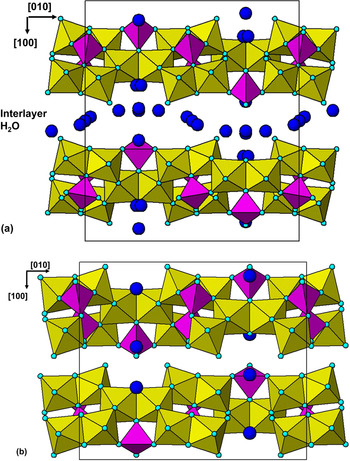
A projection of the crystal structure of galeaclolusite along the 7.8 Å axis is shown in Fig. 5a, where it is compared to the same projection of the bulachite structure in Fig. 5b, showing the higher interlayer H2O content in the former. Figure 6 shows a view of the structure normal to the (100) layers. This figure shows that the polyhedral layers are built from edge-shared Al-centred octahedra that form spiral chains along [001], the same as occurs in liskeardite (Grey et al., Reference Grey, Mumme, MacRae, Caradoc-Davies, Price, Rumsey and Mills2013). The spirals are joined along [010] by edge-sharing of octahedra in the mirror plane at y = ¼. The spirals are decorated with AsO4 tetrahedra that corner-connect to the AlO6 octahedra in the same manner as in liskeardite.
[001] projection of the layer structure for galeaclolusite (a) compared to bulachite (b). Blue spheres are interlayer water molecules, Al-centred octahedra are yellow and AsO4 tetrahedra are mauve.

Projection approximately along [100] of the structure of galeaclolusite, showing spirals along [001] of edge-shared Al-centred octahedra (yellow) and corner-connected AsO4 tetrahedra (mauve). Blue spheres are H2O.

The composition of the layers is readily established from the refinement using BVS values to distinguish the different anions. The values, in valence units, are given in Table 4. Considering the site multiplicities, they show that the layers contain 12 oxygens, 9 hydroxyls and 4 coordinated H2O groups per formula unit. This gives the layer formula Al6(AsO4)3(OH)9(H2O)4, with Z = 4. Adding in the H-bonded H2O (= W) gives the overall formula for galeaclolusite of Al6(AsO4)3(OH)9(H2O)4]⋅8H2O.
Galeaclolusite is closely related to bulachite, differing chemically only in the degree of hydration, and with the structures of both minerals being built from the same heteropolyhedral layers shown in Fig. 5. The properties of the two minerals are compared in Table 6. The ideal formula reported for bulachite from Neubulach, Germany, by Walenta (Reference Walenta1983), Al6(AsO4)3(OH)9⋅(H2O)9 (scaled by a factor of 3 for comparison), has an H2O content that is intermediate between that for bulachite from the crystal structure (Grey et al., Reference Grey, Yoruk, Kodjikian, Klein, Bougerol, Brand, Bordet, Mumme, Favreau and Mills2020b) and for galeaclolusite. This is consistent with our XRD study of the Neubulach type specimen that showed it comprised a mixture of the two minerals (Grey et al., Reference Grey, Yoruk, Kodjikian, Klein, Bougerol, Brand, Bordet, Mumme, Favreau and Mills2020b). Bulachite–galeaclolusite intergrowths were also observed on specimens from Sa Malesa, Sardinia, Italy; it is thus possible that both minerals are likely to be found together at all mineral localities where bulachite has been reported.
Comparison of galeaclolusite with bulachite.

* Optics for bulachite from Walenta (Reference Walenta1983).
Acknowledgements
Thanks to Cameron Davidson for EMP sample preparation and to Vincent Bourgoin, Association Jean Wyart, Paris for the images shown in Figs 1 and 2. Part of this research was undertaken at the powder diffraction beamline at the Australian Synchrotron, Victoria, Australia and we thank Anita D'Angelo for help with the data collection.
Supplementary material
To view supplementary material for this article, please visit https://doi.org/10.1180/mgm.2020.98