Introduction
The genus Echinococcus (Rudolphi, 1801) is a member of the family Taeniidae, an important group of cestodes causing worldwide zoonoses. Until recently, this genus contained four morphologically distinct species: Echinococcus granulosus, E. multilocularis, E. oligarthrus and E. vogeli (Thompson & McManus, Reference Thompson and McManus2002). However, based on recent molecular phylogenetic studies, the genus is now considered to consist of nine valid species: E. granulosus sensu stricto, E. equinus, E. ortleppi, E. canadensis and E. felidis (all of which previously comprised the species complex E. granulosus sensu lato), E. oligarthrus, E. vogeli, E. multilocularis and E. shiquicus (Nakao et al., Reference Nakao, Yanagida, Okamoto, Knapp, Nkouawa, Sako and Ito2010). Like other members of family Taeniidae, the life cycle of species of Echinococcus includes two mammalian hosts. Definitive hosts of Echinococcus spp. are mainly canids and some felids. Intermediate hosts are usually ungulates and rodents, which act as prey for the definitive hosts. The infection of intermediate hosts is a result of ingestion of parasite eggs shed in the faeces of definitive hosts, and the definitive host is infected by ingesting intermediate hosts harbouring Echinococcus spp. metacestodes.
The domestic cat Felis silvestris catus is known as a potential definitive host of E. multilocularis (Thompson et al., Reference Thompson, Kapel, Hobbs and Deplazes2006; Dyachenko et al., Reference Dyachenko, Pantchev, Gawlowska, Vrhovec and Bauer2008; Nonaka et al., Reference Nonaka, Hirokawa, Inoue, Nakao, Ganzorig, Kobayashi, Inagaki, Egoshi, Kamiya and Oku2008), although cats are considered much less susceptible to infection compared to canid definitive hosts (Kapel et al., Reference Kapel, Torgerson, Thompson and Deplazes2006). In contrast, it has been reported that E. granulosus s.l. did not mature fully in cats (Gorina, Reference Gorina1962). There are several reports of cats acting as intermediate hosts of E. granulosus s.l., resulting in the disease cystic echinococcosis (CE). There is a review describing eight CE cases in cats (Abuladze, Reference Abuladze1964), and two additional cases of CE in cats are described later in the literature: one domestic cat in Germany (von der Ahe, Reference von der Ahe1967) and one stray cat in Turkey (Burgu et al., Reference Burgu, Vural and Sarimehmetoğlu2004). Thus, only ten cases of CE in cats have been reported previously and the causative agent was not identified beyond E. granulosus s.l. for any of these cases. The larval stages of members of the E. granulosus s.l. complex are morphologically quite similar, and not well differentiated by morphometrics. To date, complete mitochondrial DNA (mtDNA) genomes have been sequenced and published for all valid Echinococcus species and some genotypes (Le et al., Reference Le, Pearson, Blair, Dai, Zhang and McManus2002; Nakao et al., Reference Nakao, Yokoyama, Sako, Fukunaga and Ito2002, Reference Nakao, McManus, Schantz, Craig and Ito2007; Hüttner et al., Reference Hüttner, Nakao, Wassermann, Siefert, Boomker, Dinkel, Sako, Mackenstedt, Romig and Ito2008). Therefore, molecular identification based on mtDNA sequencing is currently the most reliable way to identify Echinococcus species. In the present study, CE was confirmed from an indoor cat in Saint Petersburg, Russia, with the pathogen identified as E. granulosus s.s. (G1 strain), based on molecular analysis.
Methods and results
In 2006, a female cat was presented to a veterinary clinic in Saint Petersburg, Russia with polydipsia and a distended abdomen. No other health or behavioural issues were noted. The cat was reportedly kept indoors, with the exception of one incident 2–3 months earlier when the cat fell out of a window and spent several hours outside. The cat had no history of illness and had a diet that included previously frozen fish, fresh beef and some vegetables. Ultrasonography showed numerous abdominal cysts with hyperechoic walls and anechoic contents that measured from 5 to 30 mm in diameter. Surgical intervention was elected for treatment.
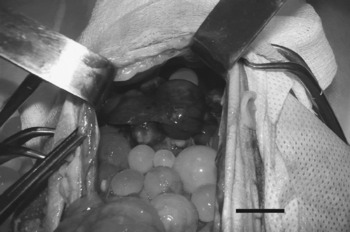
Inhalant anaesthesia was provided via a size 2.5 laryngeal mask and a mid-line abdominal incision was made. Upon entering the abdominal cavity, free cysts were visualized. In total, approximately 200 cysts were removed (fig. 1). Visual inspection of the abdominal cavity showed numerous cysts located within the liver parenchyma. However, these cysts were not surgically removed at this time. The cat recovered from surgery without incident. However, the need for additional surgery to remove the hepatic cysts was conveyed to the owners. Although abdominal distention was noted in the cat 6 months after surgery, the owners refused further surgical intervention. In the summer of 2010, the cat was admitted to another veterinary clinic due to vomiting. At this time, surgery was performed to remove the liver cysts. The cat died 3 days post-surgery.
The body cavity of the cat with fertile cysts of E. granulosus sensu stricto. Bar = 20 mm.

Eighteen cysts from 5 to 30 mm in diameter were obtained for morphological analysis. The cysts were fixed in 70% ethanol for histopathological observation. Examination of the contents of the cysts showed the presence of liquid containing protoscoleces. The protoscoleces were placed in Berlise medium for microscopic observation and large and small rostellar hooks were measured to evaluate protoscolex development. Protoscoleces were considered fully developed if their hooks had easily visible handles and guards. Linear measurements of the length of both small and large hooks were analysed according to the criteria of Karimi & Dianatpour (2008). Measurements were taken using a computer connected to a microscope (AxioVision, Zeiss, Tokyo, Japan), using image analysis software (AxioVision 3.1).
The cysts had white, semitransparent walls and contained opalescent liquid with ‘hydatid sand’. Examination of the contents of the ‘hydatid sand’ showed the presence of protoscoleces and daughter cysts. The number of protoscoleces in the cysts was relatively small. Most of the protoscoleces were not fully developed and had short, spine-like hooks in both rows. The proportion of fully developed protoscoleces was approximately 46% (n = 56). The average length of the large hooks was 21.8 ± 0.3 μm (n = 42) and the average length of the small hooks was 18.1 ± 0.5 μm (n = 30).
Parasite DNA was extracted from an ethanol-preserved cyst wall using a DNeasy blood and tissue kit (Qiagen, Tokyo, Japan), and was then used as a template for polymerase chain reaction (PCR). The mitochondrial DNA (mtDNA) fragments of cytochrome c oxidase subunit I (cox1) and cytochrome b (cob) were amplified by PCR as described previously (Hüttner et al., Reference Hüttner, Nakao, Wassermann, Siefert, Boomker, Dinkel, Sako, Mackenstedt, Romig and Ito2008). The PCR products were purified using ExoSAP-IT (GE Healthcare, Tokyo, Japan), and directly sequenced with a BigDye™ Terminator v3.1 and a 3500 DNA sequencer (Life Technologies, Tokyo, Japan). As a result, the complete sequences of cob (1068 bp; GenBank accession no. AB622276) and cox1 (1609 bp; GenBank accession no. AB622277) were determined and compared with available sequences in the GenBank database. Both cob and cox1 sequences showed more than 99.7% identity with those of E. granulosus s.s. (G1; AF297617), whereas the similarities with other Echinococcus spp. were lower than 91%.
Discussion
In the present study, cob and cox1 gene sequences demonstrated that the causative agent of CE in this cat was E. granulosus s.s. (G1). However, despite the fact that self-grooming can result in cats swallowing Echinococcus eggs, CE is a rare disease in cats. Experimental infection in dogs using protoscoleces obtained from a stray cat revealed that the protoscoleces could develop into adult worms. However, of the 71 adult worms obtained through the experimental infection, only five of them were mature (von der Ahe, Reference von der Ahe1967). In the Turkish case, protoscoleces obtained from the cat were alive and fully developed, but infectivity to dogs was not verified (Burgu et al., Reference Burgu, Vural and Sarimehmetoğlu2004). In the present study, experimental infections were not conducted to examine the infectivity of the obtained protoscoleces in dogs. However, morphological observation showed that half of the protoscoleces were fully developed. Biometric parameters were close to those of E. granulosus s.s. isolated from sheep (Karimi & Dianatpour, 2008). These data may support the belief that protoscoleces in cats can be fully developed and infective to dog definitive hosts. However, cats are apparently incidental hosts for E. granulosus. Although it is possible that these accidental infections occurred in immunosuppressed cats, immunological status was not examined in any of the reported cases in cats. Virological tests for feline immunodeficiency and feline leukemia viruses should be considered in future cases. Also, the infectivity of other species comprising the E. granulosus s.l. complex, (E. canadensis, E. ortleppi, E. equinus and E. felidis (both larval and adult form)), should be studied further by experimental infections with molecular identification.
CE in humans and animals has been found in all regions of Russia. In 2008, according to an official report of the Federal Service for Protection of Consumers Rights and Human Welfare ‘Rospotrebnadzor’, human CE cases were registered in all 63 Russian regions (Onishchenko, Reference Onishchenko2009). The population of Saint Petersburg, located in the Leningrad region, is about 4.6 million, making it the second most populated city in Russia. There are 3–4 CE cases recorded from residents of Saint Petersburg per year. Outside of the city, 11 human CE cases were reported in the Leningrad region from 1999 to 2009 (Gorbanev, Reference Gorbanev2010). Despite the fact that a large part of the Leningrad region is covered by forests, the city of Saint Petersburg and its surrounding towns are not adjacent to these forests. Thus, although data on Echinococcus spp. infection in wolves, foxes and other wildlife in the Leningrad region are absent, the most likely definitive host of E. granulosus inside the city is the dog. The current increase in the number of stray dogs is a serious public health problem in Saint Petersburg. According to the official website of the Administration of Saint Petersburg, in 2005, the number of stray dogs was estimated at approximately 5000. Animal slaughter inside the city can be practised exclusively by certain ethnic groups during religious holidays. Therefore, it is suspected that infection of dogs occurs primarily outside the city in agricultural areas where dogs have access to non-utilized viscera of sheep and other intermediate hosts. Soil inside the city can then be contaminated by free-roaming dogs that move from endemic areas outside of the city to the city. The problem of infection of people, livestock and companion animals with Echinococcus spp. in Russia cannot be solved without addressing the issue of free-roaming dogs.
Acknowledgements
We dedicate this case report to the memory of Professor Vladimir D. Gulyaev, Head of the Laboratory of Parasitology, Russian Academy of Science, Siberian Branch, who encouraged our joint projects but passed away on 14 April 2011. We sincerely thank the staff of the veterinary clinics ‘Vega’ and ‘Clinic of neurology, traumatology and intensive care’ (Saint Petersburg, Russia). This study was in part supported by the Japanese Society for the Promotion of Science International Research Fund (21256003) to A.I. We thank Dr Christine Budke for editing the manuscript.