Introduction
Recent climate change projections have global mean temperature increasing by 2–7°C for the mid-latitudes of North America (between 40°N and 60°N) by the end of the 21st century (Feng et al., Reference Feng, Hu, Huang, Ho, Li and Tang2014). Coupled with increasing uncertainty surrounding inter-annual variability of precipitation in the future (Kharin et al., Reference Kharin, Zwiers, Zhang and Hegerl2007), changes in plant population and community dynamics become an area of concern (McCarragher et al., Reference McCarragher, Goldblum and Rigg2011; Walck et al., Reference Walck, Hidayati, Dixon, Thompson and Poschlod2011). Noticeable shifts in species distributions have already been documented (Beckage et al., Reference Beckage, Osborne, Gavin, Pucko, Siccama and Perkins2008; Lenoir et al., Reference Lenoir, Gégout, Marquet, de Ruffray and Brisse2008), and are predicted to continue in the future (Zhu et al., Reference Zhu, Woodall and Clark2012) as species attempt to maintain their bioclimatic niches (Goldblum and Rigg, Reference Goldblum and Rigg2005; Iverson and Prasad, Reference Iverson and Prasad2010).
Tree migration will hinge on the successful germination, maturation and eventual reproduction at higher altitudes and latitudes (Loarie et al., Reference Loarie, Duffy, Hamilton, Asner, Field and Ackerly2009; Chen et al., Reference Chen, Hill, Ohlemüller, Roy and Thomas2011). A species that fails to migrate at fast enough rates will be subjected to increasing stress and will be forced to adapt to the new climatic regimes or it will decline. As a result, this could likely cause pockets of variable fitness and reproductive success within the current species range (Dangleish et al., Reference Dangleish, Koons and Adler2010; Walck et al., Reference Walck, Hidayati, Dixon, Thompson and Poschlod2011). Under the predicted changes, significant reductions in reproductive success among trees should be expected, especially when species-specific climate and temperature limitations exist (Chuine and Beaubien, Reference Chuine and Beaubien2001). A possible mismatch between genotype and the environment can bring into question the long-term persistence of the species, particularly in terms of successful reproduction (Hoeksema and Forde, Reference Hoeksema and Forde2008; Blanquart et al., Reference Blanquart, Kaltz, Nuismer and Gandon2013). Regional variability in reproductive success could become concerning, as species at the trailing and/or leading edge would be exposed to the highest pressures within forest transition zones (Hu and He, Reference Hu and He2006; Sexton et al., Reference Sexton, McIntyre, Angert and Rice2009).
Sugar maple (Acer saccharum Marshall) is a long-lived, deciduous and shade-tolerant tree species found on 12.4 million ha of the north-eastern part of North America (Godman et al., Reference Godman, Yawney, Tubbs, Burns and Honkala1990). A major ecologically and economically important tree species (it supports a C$200 million annual syrup industry; FPAQ, 2016), sugar maple could face significant declines in reproductive success because its seeds require very specific abiotic conditions to ensure germination (Bradford, Reference Bradford, Kigel and Galili1995; Caspersen and Saprunoff, Reference Caspersen and Saprunoff2005). It possesses a morphologically mature, yet dormant seed embryo that requires an extended period of stratification (i.e. cool and moist conditions) at near-freezing temperatures to break dormancy and ensure germination (Zasada and Strong, Reference Zasada, Strong, Bonner and Nisley2003). A dormant seed is one that is unable to germinate in a specified period of time due to any combination(s) of the following reasons: (1) immature embryos, (2) seed coats impermeable to water and/or gases, (3) inhibitors, (4) light requirement and (5) mechanical restrictions by the seed coat, which are otherwise favourable for its germination (Maguire, Reference Maguire and Thompson1984; Baskin and Baskin, Reference Baskin and Baskin2004). Typically, sugar maple seeds will develop and ripen by late summer (September–October), disperse by late fall (October–December) and remain dormant for the winter months before germinating in spring. Future climatic conditions could impact the specific time and temperature requirements needed for germination, ultimately impacting the long-term persistence of this tree species. It is predicted that climate change will lead to sharper seasonal changes, particularly in early spring, where temperature shifts are most abrupt. It also is the time of year where many of the earliest life-stage processes (i.e. germination and seedling establishment) take place. Climate warming will lead to earlier springs which, in return, will cause faster snow melt and reduced snow cover in northern altitudes and latitudes (Mankin and Diffenbaugh, Reference Mankin and Diffenbaugh2015). These abrupt changes could lead to a much smaller window of stratification and, in turn, reduce the likelihood of seed germination for sugar maple. Another concern with earlier snow melt is the potential for increased freeze–thaw events; which can expose seeds and seedlings to abrupt changes in colder temperatures that will increase early germinant mortality (Decker et al., Reference Decker, Wang, Waite and Scherbatskoy2003). Freeze–thaw events as a result of earlier springs have already been documented to severely impact other important processes, such as bud break, flower development and seed ripening, all of which could further reduce reproductive success (Chuine and Beaubien, Reference Chuine and Beaubien2001; Morin et al., Reference Morin, Viner and Chuine2008; Drescher, Reference Drescher2014).
Currently, little is known about the variability associated with climatic requirements for germination and the potential influence it may have across a species range (Hedhly et al., Reference Hedhly, Hormaza and Herrero2009). Sugar maple provides an ideal candidate to investigate these concerns, as it maintains a large range and is sensitive to climate (Goldblum et al., Reference Goldblum, Rigg and Napoli2010). While some studies have assessed germination percentage (directly or indirectly) within the sugar maple range, most have been limited to either a single seed origin or have only provided minimal insight into the influence of temperature on germination (Webb and Dumbroff, Reference Webb and Dumbroff1969; Simmonds and Dumbroff, Reference Simmonds and Dumbroff1974; McCarragher et al., Reference McCarragher, Goldblum and Rigg2011). To our knowledge, only limited research in Acer has been conducted at the northern range margin (Tremblay et al., Reference Tremblay, Mauffette and Bergeron1996; Graignic et al., Reference Graignic, Tremblay and Bergeron2014), while largely ignoring the mid- and southern species range. While it has long been known that seed germination is likely to be linked to seed origin (Mayer and Poljakoff-Mayber, Reference Mayer and Poljakoff-Mayber1975), this has yet to be thoroughly assessed with the influence of temperature and temperature shifts.
The general objective of this study was to perform an assessment of the impact of local adaptation, temperature and temperature shifting on seed germination. Such information is necessary to make more accurate predictions of future tree reproduction. We hypothesized that seed origin affects the range of temperature for optimal germination, due to local adaptation. More specifically, our primary objectives in this study were to: (1) identify the optimal incubation temperature across the species range, and for each seed origin; (2) identify the influence of warmer and cooler temperature shifts to simulate an early or late spring and its associated effects; and (3) identify the potential changes in future seed germination across the range of sugar maple under a series of warming climate scenarios. We did this by implementing a fully factorial experimental design to investigate the influence of nine constant incubation temperature treatments, 16 warm shift treatments and 16 cool shift treatments on seeds from seven different origins.
Materials and methods
Seed, source(s) and storage
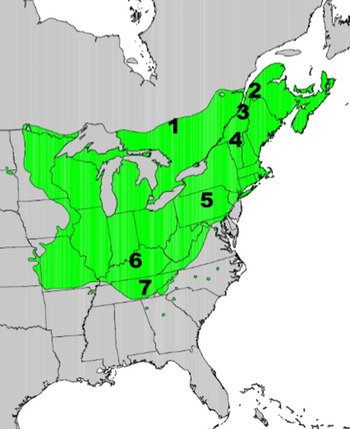
In this study 28,700 sugar maple seeds from seven origins across the current species range were used (Fig. 1, supplementary Table S1). All seeds were collected in the autumn of 2013 and were air dried at room temperature (20°C) until seed moisture content ranged between 9.5 and 15%. Once dried, the samaras were mechanically tumbled until the wing portion of the seeds was removed. Seeds were then passed through an air/gravity feed sorter, where filled seeds were separated from unfilled seeds, which ensured seed viability (filled seeds) above 95% for each seed origin. To further reinforce that seeds were filled, we used either X-rays on a subset of seeds from each origin or pressed the seeds between fingers during counting, prior to the commencement of the germination trials (Graignic et al., Reference Graignic, Tremblay and Bergeron2014). Seeds were stored at −3°C for 2 months before initiating the experiment (Yawney and Carl, Reference Yawney and Carl1974).
Approximate sugar maple seed origins used in the study: (1) Ville-Marie, Québec; (2) Rivière-du-Loup, Québec; (3) Montmagny, Québec; (4) Sherbrooke, Québec; (5) Pennsylvania, USA; (6) Kentucky, USA; and (7) Tennessee, USA. Seed origins are overlaid on the native species range of sugar maple, which is adopted from Little (Reference Little1971).

Treatments – constant incubation temperature
All seeds were soaked in tap water and kept at 3°C for 14 d (Janerette, Reference Janerette1979); a common treatment done to soften the hard seed coat and provide a period of water uptake, which increases overall germination success (Webb and Dumbroff, Reference Webb and Dumbroff1969). This process mimics the natural stratification that occurs during the cool, wet conditions of overwintering and early spring. Forty-one seed lots (100 seeds/lot) from each of the seven seed origins were prepared and individually wrapped in mesh screening and enclosed within moist Kimpak-cellulose wadding, and then wrapped in aluminium foil (Janerette, Reference Janerette1978b) to be used for all combination of treatments. Seed lots from each seed origin were placed within a series of growth chambers (CONVIRON, ATC26, Winnipeg, Canada), each maintained at the following six constant temperatures: 3°C, 5°C, 7°C, 9°C, 11°C and 13°C for 90 d. Since growth chambers present limitations for work at low temperatures (≤3°C), Sanyo MIR-154-PA incubators (SANYO Electric Biomedical Co., Osaka, Japan) were used for the three colder constant temperature treatments: −1°C, 0°C and 1°C. Nine out of the 41 seed lots/origin were selected at random from each of the seven origins (7 seed origins × 9 constant stratification temperatures). A HOBO Pendent temperature data logger (Onset, Bourne, Massachusetts, USA) was placed in each of the chambers and incubators, to ensure that the assigned temperatures remained consistent throughout the entire measurement period. Temperature was recorded hourly over the entire 90 d. Seed germination was monitored weekly, where germinated seeds were counted and discarded, yielding a temporal sequence of germination. Protrusion of the radicle through the seed coat was the criterion by which germination was deemed successful.
Temperature shifts
In addition to the nine constant incubation temperature treatments, we investigated the potential influence of temperature shifting on seed germination. Suddenly changing the incubation temperature during the experiment provides insight into abrupt changes in temperature that may occur in an early or late spring, once snow has melted (when present). We chose to change incubation temperature after 2 weeks (half the time period industrial nurseries use for germination trials), as a means of mimicking the influence of rapid temperature change, commonly seen in early spring. To conduct the shifting treatments, we placed seed lots in either a cool (−1°C, 0°C, 1°C, 3°C) or warm (7°C, 9°C, 11°C, 13°C) initial incubation temperature for 2 weeks. Seed lots were then shifted to one of the opposite treatments (i.e. seed lots initially placed in a cool incubation temperature were then shifted to one of the warm incubation temperatures, and vice versa) for the remainder of the study (11 weeks). For example, four individual seed lots from Kentucky that were initially placed at −1°C for 2 weeks, would be transferred to each of the warmer treatments (7°C, 9°C, 11°C and 13°C) and would be identified as a warm shift treatment. This would be repeated for each seed origin and each treatment combination for both the warm and cool shifts, using the remaining 32 seed lots/origin for a total of 224 seed lots (22,400 seeds).
Statistical analysis
Data were analysed following the recommendations of McNair et al. (Reference McNair, Sunkara and Frobish2012), where survival analysis is deemed the most appropriate method to quantify seed germination (Pérez and Kettner, Reference Pérez and Kettner2013). This statistical approach also allows for the analysis of individual seeds rather than cumulative germination percentages, while providing the flexibility to interpret multiple contributing factors simultaneously over repeated measures (McNair et al., Reference McNair, Sunkara and Frobish2012; Pérez and Kettner, Reference Pérez and Kettner2013). In our study, seeds that germinated (the event of interest) within the study period (90 d) were coded as 1. Seeds that did not germinate by the end of the study were considered to be ‘right-censored’ observations and coded as 0. Germination was estimated using the Kaplan–Meier non-parametric maximum likelihood estimator to calculate the survival function for each seed origin and temperature treatment. The survival function S(t) = Pr (T > t) determines the event time (i.e. the time required for a seed to germinate) for a random variable T that exceeds a given time t. S is the probability between 0 and 1, while T must be a positive number. Essentially, survivor curves will begin with S(t) = 1 when T is 0, and decrease in a step function as t increases. The Kaplan–Meier estimator of the survivor function Ṡ(t), is a non-parametric method that will allow inferences into censored data and make no assumptions about the distribution of time to germinate. If k distinct event times are denoted as t 1 < t 2 < … < t k , the Kaplan–Meier estimator Ṡ(t) for t 1 ≤ t ≤ t k would be given by:
 $$\eqalign{\dot S\left( t \right)\, = &\,\prod \left( {1{\rm }-{d_i}/{n_i}} \right) \cr & \,{\rm i}\!:{t_i}\, \le \,t}$$
where t i represents a distinct event time (week of stratification); n i are the number of individuals (seeds) at risk of the event (germination) at each t i ; and d i represents the number of individuals censored at time t i . Our study follows other standard germination experiments, where the observation scheme is commonly known as ‘periodic simultaneous observation’ – seeds were examined weekly rather than continuously (interval censored data). Although the Kaplan–Meier estimator calculates the survivor function when event times are assumed to be exact, it is safe and appropriate to apply this analysis to interval censored data when no seeds are lost during the weekly counts (McNair et al., Reference McNair, Sunkara and Frobish2012). Weekly germination in this study refers to the number of seeds germinated in a given week, whereas cumulative germination refers to the germination at the end of the study. The null hypothesis is that survival functions are the same for all seed origins and all temperature treatments. We assessed the influence of temperature by comparing: (1) constant incubation temperatures; (2) a warm temperature shift; and (3) a cool temperature shift for each seed origin. Additionally, we conducted pairwise comparisons to identify statistical differences between origins and treatments, using the Fleming–Harrington test (McNair et al., Reference McNair, Sunkara and Frobish2012). Supplemental one-way analyses of variance (ANOVAs) were conducted to compare cumulative germination percentages between sites and temperature treatments within sites. When data did not meet the assumptions of normality and homogeneity of variance, an inverse transformation (1/(1 + X)) was used. All post-hoc analyses for the cumulative germination data were performed using the Tukey–Kramer's test (Tukey HSD). All analyses were performed using the statistical software R v. 3.0.3 (R Development Core Team, 2015) with the ‘survival’ package (Therneau, Reference Therneau2015).
Climate warming scenarios
We used the North American Spatial Climate Model (McKenney et al., Reference McKenney, Hutchinson, Papadopol, Lawerence, Pedlar, Campbell, Milewska, Hopinson, Price and Owen2011) to help predict the potential influence of climate warming on sugar maple seed germination. Using the approximate location of each of the seven seed origins (supplementary Table S1), we placed a circular buffer (50 km radius) around the central point to calculate the local annual and monthly mean temperature for the years 1901–2010. We then calculated the local stratification temperature, determined by choosing the likely stratification window: approximately a period of 90 d of cool, moist conditions required for sugar maple seed to germinate (Janerette, Reference Janerette1979). This was done by taking the mean of 3 months, beginning with the first month closest to the freezing point, followed by the subsequent two following months in late winter/early spring (supplementary Fig. S1). To assess the influence of projected climate warming on seed germination success, we investigated three scenarios: (1) +2°C warming, (2) +5°C warming and (3) +7°C warming. These warming scenarios were then added to the initial stratification temperature determined at each site for 1901–2010. The resulting cumulative germination and per cent change (in relation to 1901–2010) were based on the findings of the constant incubation temperature treatments in the present study by seed origin.
Results
Effects of seed origin and constant incubation temperatures
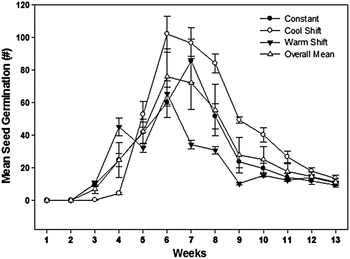
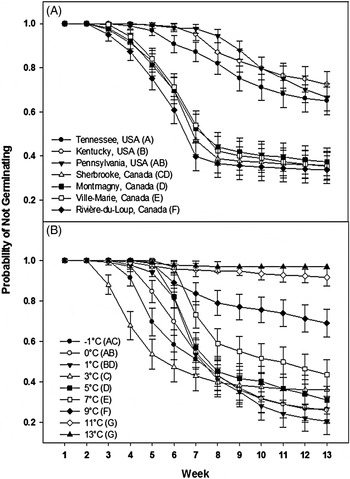
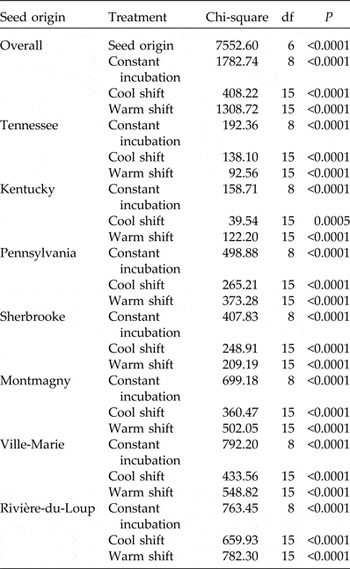
The cumulative germination percentage was on average (across all origins and all constant incubation temperatures) 51.4%, with weekly germination percentage peaking at week 7 (12.2% of total) (Fig. 2). The effect of seed origin on germination was found to have a stronger effect than constant incubation temperature (χ2 = 7552.60, P < 0.0001; Table 1). We found a clear dichotomy between the survival curves (Fig. 3A) and cumulative germination percentages (Fig. 4) for the northern (Sherbrooke, Montmagny, Ville-Marie and Rivière-du-Loup) and southern (Tennessee, Kentucky and Pennsylvania) seed origins (final cumulative mean germination: 70.2% and 32.1%, respectively). Northern seed origins also tended to peak in germination much faster (week 6) than those in the southern range, where germination peaked roughly 2 weeks later (supplementary Fig. S2A). We found that all seed origins showed statistically different survival curves, except for the following three pairs: Pennsylvania with (1) Tennessee and (2) Kentucky, and (3) Sherbrooke with Montmagny (Table 2, Fig. 3A). The best overall cumulative germination percentage by seed origin was from the most northern seed source, Rivière-du-Loup (75.1%), while the worst came from Kentucky (28.4%) (Fig. 3A).
Mean number of sugar maple seeds germinated per week and standard error bars by temperature treatment.

Kaplan–Meier mean estimates and 95% confidence intervals of survival functions for the probability of not germinating versus weeks of incubation for (a) seed origin and (b) incubation temperature. Seed origin and temperature treatments with the same letters were not significantly different (Fleming–Harrington test, α ≤ 0.05).

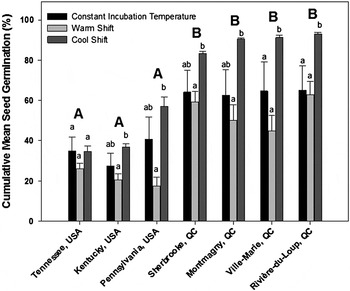
Mean cumulative sugar maple seed germination (%) by seed origin for constant incubation temperatures, warm and cool shift treatments. Capital letters refer to comparisons among sites, whereas lower-case letters refer to between-temperature differences within sites. Different characters are statistically significant (Fleming–Harrington test, α ≤ 0.05).

Effects of seed origin and temperature treatment on weekly germination rate of sugar maple seeds. P values were determined using a Fleming–Harrington test (α ≤ 0.05)

Pairwise comparisons for seed origin effect on sugar maple seed germination. Significant differences between origins are determined by the Fleming–Harrington test (α ≤ 0.05)

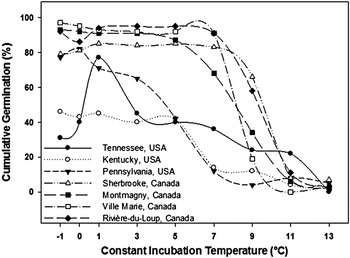
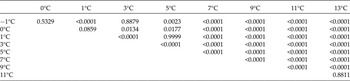
The effect of constant incubation temperature on germination was highly significant (χ2 = 1782.74, P < 0.0001; Table 1, Fig. 3B). When temperatures were maintained ≤5°C, cumulative germination was generally high (~74%) (Fig. 5). The poorest cumulative germination occurred at the highest incubation temperatures: 11°C (8.4%) and 13°C (4.1%) (Figs 3B and 5). All constant incubation temperatures >5°C were found to be significantly different from cooler temperatures (P < 0.0001, Table 3). (See supplementary Tables S3–S9 for pairwise comparisons of constant incubation temperature differences by seed origin.) Cooler constant incubation temperatures (≤7°C) also impacted the timing of peak germination, where they tended to germinate earlier than those at higher temperatures (supplementary Fig. S3A).
Cumulative sugar maple seed germination (%) by seed origin for several constant incubation temperatures.

Pairwise comparisons for overall constant incubation temperature effect on sugar maple seed germination. Significant differences between temperatures determined using the Fleming–Harrington test (α ≤ 0.05)

Effects of temperature shifting
Cool shifting significantly improved the cumulative germination percentage by 19.5% and caused earlier peak germination by 1 week when compared with the constant incubation treatments (χ2 = 408.22, P < 0.001; Table 1, Fig. 2). Cool shifting was increasingly beneficial to cumulative germination percentages as seed origin shifted northward (Fig. 4). Seeds originating in Tennessee experienced a slight decline (−0.2%) compared with constant incubation temperatures, but differences from constant incubation temperatures were statistically significant only for the two northernmost locations: Ville-Marie (+26.6%) and Rivière-du-Loup (+28.0%; Fig. 4). Cool shifting also tended to minimize the differences in cumulative germination between treatments within sites, where 6.3% was found to be the largest difference in germination between −10°C and −11°C (see supplementary Tables S10–S25).
Alternatively, warm shifting significantly reduced the cumulative germination percentage by 11.2% when compared to the constant incubation temperature treatments, and by 29.3% when compared to the cool shifting treatments (χ2 = 1308.72, P < 0.001; Table 1, Fig. 4). Warm shifting also caused earlier peak germination by 1 week when compared to the constant incubation temperature treatments (Fig. 2). Reducing the magnitude of warm shifting to ≤7°C on average resulted in reasonably high germination percentage (59%), while germination drastically declined at warmer (>7°C) shifts (34.5%) (supplementary Table S2). Reductions in germination percentage due to warmer shifts (when compared with constant incubation temperatures) were minimized the most for Tennessee and Kentucky, the southernmost seed origins (−8%). Concurrently, the most severe reductions in germination due to warmer shifts occurred within some of the northernmost latitudinal seed origins: Montmagny (−12.4%) and Ville-Marie (−19.9%) (Fig. 4).
Estimating possible future germination under climate warming
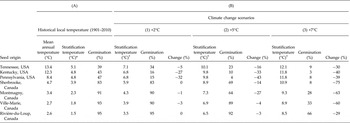
The stratification temperature for each seed origin also decreased with a northward latitudinal shift. In a warming scenario of +2°C, we found decreases in germination by as much as 27% and 32% in the seeds originating in Kentucky and Pennsylvania, respectively. Minimal reductions ( < 3%) in germination percentage occurred in seeds originating northward of Pennsylvania under the same warming scenario. Under the second climate warming scenario, +5°C, significant declines in germination occurred across the entire species range (Table 4). Again, however, the most northern seed origins (Ville-Marie and Rivière-du-Loup) experienced only slight declines (<4%), whereas all other origins experienced declines of ≥14%. In the most dire of climate scenarios (+7°C), cumulative germination was greatly reduced regardless of origin. Sharp declines (−20%) were seen across the range and by as much as 75% (Sherbrooke). Interestingly, under this scenario the least impacted cumulative germination occurred in the species' southern range (Tennessee, −30%) (Table 4).
(A) Local mean annual temperature (1901–2010) by seed origin, with the associated mean stratification temperature* and resulting estimated cumulative seed germination percentage for the seven sites included in this study. (B) Estimated cumulative seed germination and percentage change in germination under three climate change scenarios: (1) +2°C, (2) +5°C and (3) +7°C (seed germination % extrapolated from Fig. 5)

* Stratification temperature was determined from calculating a likely ‘stratification window’ (period for which sugar maple should generally germinate – approximately 90 d or average over 3 months), which was done by taking the first monthly temperature closest to the freezing point or below, followed by the subsequent 2 months.
† Stratification temperatures within the climate change scenarios were calculated by adding the associated increase due to projected climate change (+2°C, +5°C, +7°C) to the historical stratification temperature.
Discussion
This paper reports a novel experimental procedure to test for the effect of seed origin, constant incubation temperature and temperature shifting on seed germination. We were able to assess the potential deleterious impacts of future climate warming on sugar maple, which is known to have a very narrow temperature requirement to ensure successful germination (Zasada and Strong, Reference Zasada, Strong, Bonner and Nisley2003; McCarragher et al., Reference McCarragher, Goldblum and Rigg2011). We found strong evidence of local adaptation of seed germination to temperature and temperature shifting. We were also able to identify precisely the ideal stratification temperature, timing and temperature thresholds associated with germination for sugar maple throughout its range. When comparing to constant incubation temperatures, seeds originating in the southern range were much better adapted to warm shifting, while cool shifting was more beneficial to the seeds from northern latitudes (Fig. 4).
Effects of constant incubation temperature
The best cumulative germination percentage was observed at constant incubation temperatures below <1°C, coupled with subtle differences up until 5°C; considerable declines occur beyond 5°C regardless of seed origin (Table 3, Figs 3B and 5). These findings reinforce the fact that sugar maple does have the capacity to germinate under snow cover (Tubbs, Reference Tubbs1965), where temperatures are stable around the freezing point. We also found that sugar maple is capable of germinating below the freezing point, where cumulative germination reached 73% in the −1°C treatment (Fig. 3B), and potentially could germinate at colder temperatures. In this study, by using a large range of temperatures and by sampling seeds from a wide range of origins, we can now accurately report the influence of temperature and temperature shifting throughout the natural distribution of sugar maple. While McCarragher et al. (Reference McCarragher, Goldblum and Rigg2011) argued that 7°C provides the optimum incubation temperature, we consistently found that, regardless of seed origin, this temperature is systematically the beginning of germination decline (Fig. 5). Beyond an incubation temperature of 7°C, germination percentages decline further, and nearly cease beyond 13°C (4.1%) (Fig. 5). These findings coincide with those of other previous studies (Shih et al., Reference Shih, Dumbroff and Peterson1985; McCarragher et al., Reference McCarragher, Goldblum and Rigg2011), who found little (<3%) or no seeds germinating beyond this temperature. At these warmer temperatures, the level of inhibitors remains high and restricts the morphological and anatomical changes required for embryonic axis growth, thus reducing the likelihood of germination (Simmonds and Dumbroff, Reference Simmonds and Dumbroff1974). Increased seed respiration rates also occur, which have been shown to be responsible for loss of seed viability at higher temperatures (Simmonds and Dumbroff, Reference Simmonds and Dumbroff1974). We also found a much higher frequency of the presence and development of fungal communities, which were not present at cooler temperatures (<9°C). Fungal communities have been reported to colonize maple seeds at high temperatures and ultimately could contribute to increased contamination, leading to seed death (Shih et al., Reference Shih, Dumbroff and Peterson1985).
Shifting temperatures
Shifting the temperature in our treatments significantly influenced the cumulative germination percentage. We found that warm shifting significantly reduced germination for all seed origins, while only the magnitude differed (Fig. 4). The warm shifting treatments in our study were used to mimic what could essentially happen naturally in a warmer and earlier spring, where increased snow melt and reduced snow pack are predicted to occur with climate change (Mankin and Diffenbaugh, Reference Mankin and Diffenbaugh2015). Rapid spring warming would essentially impact seeds negatively in a number of ways: (1) a shorter period of overwintering stratification; (2) seeds and seedlings that are able to germinate would no longer be insulated by the snow cover and would be subjected to potentially multiple freeze–thaw events; (3) species lose the competitive advantage of early establishment over species unable to germinate/establish under snow; (4) a change in water supply: from slow, progressive to rapid snow melt; and finally (5) much earlier exposure of germinated seeds to herbivory, bacterial and fungal infection.
In contrast, for seeds exposed to cool shifting treatments we found that germination was generally greatly improved (Fig. 4). A longer, cooler spring can essentially prolong the stratification window (allowing seed development to break dormancy), delay snow melt, reduce the onset of competitors, and reduce bacterial and fungal infection. Surprisingly, the only seed source not to experience a net benefit of a cool shifting, Tennessee, came at the southern range of sugar maple. We suggest that this lack of improvement in germination was likely due to the seeds being adapted to a warmer climate and adapting more readily to warm shifting, which are much more likely to occur at these southern latitudes (supplementary Fig. S1).
Germination timing
It is extremely difficult to predict exactly when a seed will germinate, with so many factors that must be considered (abiotic and genetic), but this study reinforces the link between seed origin and peak germination. Slight variations in genetics could be playing a significant role in seeds breaking dormancy and germinating over the natural species range (Sexton et al., Reference Sexton, McIntyre, Angert and Rice2009). Variations in phenology were apparent within our study as differences occurred between seed origin and incubation temperature, with a number of subtle differences in time to germination. Seeds from all origins germinated after 4 weeks, which is consistent with most germination studies (Janerette, Reference Janerette1978a; Shih et al., Reference Shih, Dumbroff and Peterson1985). As a whole, germination followed the expected distribution: few seeds germinated early (before week 5), most in mid-weeks (6–9) and few beyond (Fig. 3). Unlike McCarragher et al. (Reference McCarragher, Goldblum and Rigg2011), who found that seeds from Illinois (central origin) tended to germinate earliest (within 25 d), we found that seeds from the northern range not only started to germinate earlier, but also peaked 2–3 weeks sooner (week 6) than those from the central range (week 10) or southern range (week 8–9) (supplementary Fig. S2). We suggest that sugar maple has adapted locally to temperature, where in cooler climates seeds will germinate earlier under snow to benefit from colonizing when competition is low. On the contrary, in warmer climates, the competitive advantage of germinating early under the snow or shortly after is minimized or lost, thus delaying germination proves to be advantageous; allowing competition to provide sugar maple with a protective cover from warmer temperatures and increased water stress (Berkowitz et al., Reference Berkowitz, Canham and Kelly1995).
While in this study we did perform pre-incubation treatments as a means of getting seeds to germinate uniformly (at least in terms of a starting point) (Janerette, Reference Janerette1978a), our study reinforces the fact that slight variations/abnormalities within the seed and seed structures of the same species may exist. As pointed out by Simmonds and Dumbroff (Reference Simmonds and Dumbroff1974), lower incubation temperatures help facilitate the production of gibberellins, cytokinins and the removal of inhibitors (abscisic and phenolic acids) in sugar maple seeds (Enu-Kwesi and Dumbroff, Reference Enu-Kwesi and Dumbroff1980). Attaining a full energy charge necessary for normal cellular function also occurs at lower temperatures, and could become limited if temperatures are too high. While considerable research has been conducted on the inner workings of the sugar maple seed (Shih et al., Reference Shih, Dumbroff and Peterson1985; Walker et al., Reference Walker, Roberts, Shih and Dumbroff1985), we speculate that differences within these processes are linked to seed origin and influenced by the local adaptation of the species to temperature. Ultimately, if temperatures remain, or become, high during a portion of the stratification period, seeds may experience dormancy induction (secondary dormancy). This occurs when seeds are supplied with water but are exposed to unfavourable conditions (i.e. high temperature, low oxygen) after breaking primary dormancy (Ellis et al., Reference Ellis, Hong and Roberts1985). This may have occurred within our study where seeds that were exposed to the warmest shifts germinated rapidly (supplementary Fig. S3C), followed by a rapid decline, presumably becoming dormant again because of the high temperature.
Global warming and future implications for germination
As temperature is predicted to increase by as much as +7°C in the mid latitudes (40–60°N) of North America by the end of the 21st century, drastic changes undoubtedly will occur in many key biological processes, in particular phenology, growth and productivity, and species interactions (Morin et al., Reference Morin, Viner and Chuine2008). Being able to predict accurately how each of these processes will change (alone and together) becomes extremely critical for future forest management strategies. This task will prove extremely difficult, as the time frame for the expected warming is to take place within one or two tree life cycles. This means that trees that are currently of reproductive age and their offspring will face these predicted rapid warming events. It thus becomes imperative to assess now the resilience and ability of different key species to successfully germinate, establish, grow and reproduce under the rapid warming expected by the end of this century (Kremer et al., Reference Kremer, Ronce, Robledo-Arnucio, Guillaume, Bohrer, Nathan, Bridle, Gomulkiewicz, Klein, Ritland, Kuparinen, Gerber and Schueler2012). Providing forest managers with this necessary information helps identify differences in germination within a species and allows for better prediction and strategies when identifying the ideal planting stock or adjusting expectations for natural seeding. Changes in initial life stages (seed germination and seedling establishment) could eventually become important at larger scales if they are not initially constrained maternally (flower, fruit and seed development). A lack of successful germination will slow future tree migration rates, a particular issue when considering the potential deleterious impacts of climate change (Zhu et al., Reference Zhu, Woodall and Clark2012).
According to our results, under the current temperature projections (+2°C–7°C), substantial decreases in successful germination of sugar maple seeds are expected to occur (Table 4). Under the most conservative warming predictions (+2°C), cumulative germination percentage could decrease by up to 32% in the mid-range of the species distribution (species range average: −9.7%). Under moderate warming (+5°C), and even upper threshold warming (7°C), substantial declines (up to 75%) are expected (Table 4). While we understand that these predictions are strictly due to temperature, and could be moderated to some degree by the amount of precipitation, geographic location and annual variability, we expect germination to decline at even higher rates. Morin et al. (Reference Morin, Viner and Chuine2008) predicted a significant reduction in southern populations of sugar maple due to decreases in fitness associated with fruiting maturation caused by later flowering as a result of a delay in dormancy break. Warmer temperatures should also be expected to increase drought stress on the ripening process and eventual seed maturation, which in turn will affect seed dormancy and the conditions required to break dormancy, and further impede the induction of germination. At an implied mean global warming of 3.2°C, Morin et al. (Reference Morin, Viner and Chuine2008) predicted a −25% reduction in species range, which approximates our findings in terms of reduction of germination success at moderate warming scenarios (Table 4). While warming is already occurring and is expected to continue, northern populations are believed to be particularly at risk since warming is occurring fastest and at a time (in the spring) when many key processes (flowering, fruit ripening, stratification) are occurring (Bekryaev et al., Reference Bekryaev, Polyakov and Alexeev2010; Feng et al., Reference Feng, Hu, Huang, Ho, Li and Tang2014). Ironically, even though seeds from the southern range had a lower cumulative germination percentage, they appeared to be better adapted to deal with warm shifts. However, as pointed out by Morin et al. (Reference Morin, Viner and Chuine2008), the southern populations could quickly become in dire straits if the number of cool stratification days are even further limited. Currently, the best germination occurs in the upper latitudes even under the worst of circumstances (+7°C) (Table 4). Although these severe declines in germination percentage are expected at the northern range, perhaps the current sugar maple regeneration dynamics at the southern range could provide insight into future management and germination expectations at the northern range.
Our study points to the sensitivity of sugar maple to temperature and temperature shifting across its species range with regard to seed germination. We find that sugar maple seeds need cooler temperatures (≤5°C) with minimal temperature shifting (≤7°C) to ensure successful germination in early spring, regardless of seed origin. Using different climate warming scenarios, we show that significant declines in cumulative germination across the sugar maple species range would occur. However, in a natural setting, the potential negative effect(s) that climate warming could have on the reproductive success of sugar maple will be compounded at each of the key stages of reproduction required to ensure the successful development of a viable seed in a given year.
Supplementary material
To view supplementary material for this article, please visit http://dx.doi.org/10.1017/S0960258516000040.
Acknowledgements
We owe a huge debt of thanks to Jean Pierre Faust and Michelle Bettez at the Berthierville nursery for their expertise and assistance with the project. We are grateful to Amanda Milek, Andreas Livathynos, Jonathan Brassard and Renaud McKinnon for helping with seed and germination counts; and to Guillaume Larocque and Steve Vissault for their help with data management and the climate model.
Financial support
Funding for this research was provided by the Natural Sciences and Engineering Research Council of Canada.
Conflicts of interest
None.