Introduction
The host–parasite relationship is an important parameter in the study of animal communities, as such relationships affect population dynamics and community structure (Rocha et al., Reference Rocha, Vrcibradic and Araújo2000; Anjos et al., Reference Anjos, Rocha, Vrcibradic and Vicente2005; Almeida et al., Reference Almeida, Ribeiro, Santana, Vieira, Anjos and Sales2009). The helminth fauna of lizards in South America has received greater attention in recent years, with many records of new hosts and localities as well as the description of new species (Goldberg et al., Reference Goldberg, Bursey and Morando2004; Bursey et al., Reference Bursey, Goldberg and Parmelee2005a, Reference Bursey, Goldberg and Vittb; Durette-Desset et al., Reference Durette-Desset, Anjos and Vrcibradic2006; Bursey & Goldberg, Reference Bursey and Goldberg2007; Vrcibradic et al., Reference Vrcibradic, Anjos, Vicente and Bursey2008; Ávila & Silva, Reference Ávila and Silva2010). Nevertheless, studies on helminth communities and ecological aspects of host–parasite relationships remain scarce in the literature (Rocha & Vrcibradic, Reference Rocha and Vrcibradic2003; Anjos et al., Reference Anjos, Rocha, Vrcibradic and Vicente2005) and greater knowledge on the parasitological and ecological features of different lizard species is needed.
The genus Enyalius Wied, 1821 is comprised of nine species (Sociedade Brasileira de Herpetologia, 2010) of diurnal, insectivorous lizards (Sousa & Cruz, Reference Sousa and Cruz2008; Barreto-Lima, Reference Barreto-Lima2009) well distributed throughout different biomes in Brazil, such as the Atlantic rainforest (Etheridge, Reference Etheridge1969; Vanzolini, Reference Vanzolini1972, Reference Vanzolini1974; Jackson, Reference Jackson1978), Amazon (Ávila-Pires, Reference Ávila-Pires1995; Vitt et al., Reference Vitt, Ávila-Pires and Zani1996), Caatinga (semi-arid brush) and Cerrado (savanna-like vegetation) (Bertolotto et al., Reference Bertolotto, Pellegrino, Rodrigues and Yonenaga-Yassuda2002; Rodrigues et al., Reference Rodrigues, Freitas, Silva and Bertolotto2006). Despite the wide distribution of Enyalius, few studies have addressed its helminth fauna and parasite ecology (Vicente et al., Reference Vicente, Rodrigues, Gomes and Pinto1993; Durette-Desset et al., Reference Durette-Desset, Anjos and Vrcibradic2006; Sousa et al., Reference Sousa, Lima and Oliveira2007; Vrcibradic et al., Reference Vrcibradic, Vicente and Bursey2007, Reference Vrcibradic, Anjos, Vicente and Bursey2008). Enyalius perditus Jackson, Reference Jackson1978 is a small tropical lizard restricted to the easternmost Atlantic rainforest in southern and south-eastern Brazil (Jackson, Reference Jackson1978; Lima & Sousa, Reference Lima and Sousa2006) that has been insufficiently studied with regard to many ecological and behavioural aspects (Lima & Sousa, Reference Lima and Sousa2006).
As infection parameters, such as the prevalence and number of parasites, may be influenced by the sex, age, size (Ribas et al., Reference Ribas, Rocha, Teixeira-Filho and Vicente1995) and diet composition (Goldberg et al., Reference Goldberg, Bursey and Tawil1993, Reference Goldberg, Bursey and Cheam1995) of the host, the aim of the present study was to analyse helminth fauna from the gastrointestinal tract of E. perditus and determine the relationship between ecological aspects of the host, such as body mass, sex and size, and the parasitic fauna.
Materials and methods
Host and parasite sampling
Lizards were collected with pitfall traps in a forest fragment of the Santa Cândida Municipal Biological Reserve (21°45′35″S, 43°20′50″W) in the city of Juiz de Fora, state of Minas Gerais, Brazil, between 2002 and 2003. The lizard species were identified based on Rodrigues et al. (Reference Rodrigues, Freitas, Silva and Bertolotto2006). Animals were weighed on a manual scale (accuracy: 0.10 g), euthanized with ether, fixed in a 10% formalin solution and stored in 70% ethanol. Snout–vent length (SVL), total body length (TBL) and tail length (TL) were measured with a caliper to the nearest 0.1 mm. Gonads were examined to determine the sex. The gastrointestinal tract (stomach, small and large intestines) was removed and examined for helminths under a stereomicroscope. Nematodes were removed, counted, treated with lactophenol for clarification and examined under an optical microscope (Leica® DM5000B), using the LAS software program (Leica Application Suite) for image analysis. The prevalence and mean intensity of infection of each nematode species were determined based on Bush et al. (Reference Bush, Lafferty, Lotz and Shostak1997).
Data analysis
Differences in body size and mean intensity of infection between sexes were determined using the Mann–Whitney test and Student's t-test, respectively. A test for proportions (Z-test) was used to determine whether there was a significant difference in overall prevalence between males and females (Zar, Reference Zar1999). A Spearman rank correlation (Zar, Reference Zar1999) was performed to evaluate the effect of host size (SVL) on the intensity of infection. A Spearman rank correlation was performed to evaluate the relationship between body mass and intensity of infection, using the residual values obtained from linear regression analysis between TL and body mass (Zar, Reference Zar1999). The discrepancy index (D) was calculated, as suggested by Poulin (Reference Poulin1993). This index has a minimum of zero (D = 0) when every host harbours the same number of parasites. When all parasites are found in a single host, aggregation is maximal (D = 1). This index was calculated using the Quantitative Parasitology 3.0 software program (Rózsa et al., Reference Rózsa, Reiczigel and Majoros2000). For all tests, the level of significance was α ≤ 0.05. Voucher specimens of the lizard hosts were deposited in the Herpetological Collection of the Zoology Laboratory of the Universidade Federal de Juiz de Fora (1–5s/n.2002/UFJF, 59–61.2002/UFJF, 233–240 CZ/UFJF, 243 CZ/UFJF, 245–255 CZ/UFJF, 257–275 CZ/UFJF) and parasite specimens were deposited in the Coleção Helmintológica do Instituto de Biociências de Botucatu (CHIBB Lotes nos 5099 and 6000).
Results
Forty-nine specimens of E. perditus (31 males and 18 females) were examined: 27 adult males (SVL = 72.2 ± 5.2 mm; mass = 8.7 ± 2.2 g), 15 adult females (SVL = 83.8 ± 6.9 mm; mass = 15.9 ± 6.4 g) and seven juveniles (SVL = 37.4 ± 5.7 mm; mass = 1.5 ± 0.9 g). Size and body mass were different between adult males and adult females (SVL: Z(U) = 3.5, P < 0.001; body mass = Z(U) = 2.2, P < 0.05).
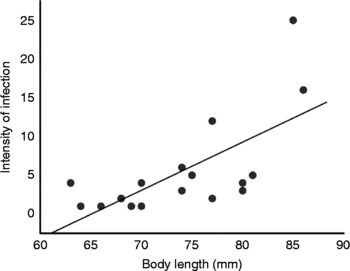
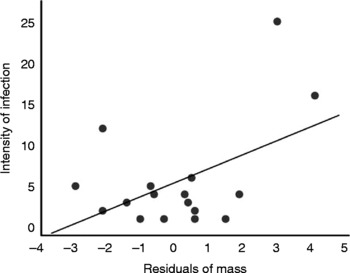
The overall prevalence of parasites was 55.1% (27/49): 70.4% in adult males, 40.0% in adult females and 28.6% in juveniles. The difference between the prevalence of parasites in adult males and adult females was non-significant (Z = 1.59, P = 0.11). Mean intensity of infection was 7.1 ± 6.8 (range: 1–26). The mean intensity of infection was 11.3 ± 8.9 in adult females and 6.3 ± 6.0 in adult males. However, this difference did not achieve statistical significance (t = 1.61, df = 23, P = 0.12). Two juvenile lizards were infected by two and four nematodes. The body size (SVL) of adult lizards was positively associated with the intensity of infection (F = 12.74, P = 0.003, r 2 = 0.423) (fig. 1). After adjusting for the effect of total body length (residual between TBL × mass), body mass of the adult hosts was positively associated with the intensity of infection (F = 4.68; P = 0.045; r 2 = 0.187) (fig. 2).
Regression between body length and intensity of infection of Enyalius perditus from Reserva Biológica Municipal Fazenda Santa Cândida, Juiz de Fora municipality, Minas Gerais state, Brazil.

Regression between mass (independent of total body length) and intensity of infection of Enyalius perditus from Reserva Biológica Municipal Fazenda Santa Cândida, Juiz de Fora municipality, Minas Gerais state, Brazil.

Two nematode species were found in the stomach, small intestine and large intestine of lizards: Oswaldocruzia burseyi Duretter-Desset, Anjos & Vrcibradic, 2006 (Molineidae) and Strongyluris oscari Travassos, 1923 (Heterakidae). The prevalence of O. burseyi was 62.7% (n = 17), with a mean intensity of infection of 3.1 ± 2.9 (range 1–12) and discrepancy index of 0.621. The prevalence of S. oscari was 74.1% (n = 20), with a mean intensity of infection of 6.75 ± 6.4 (range 1–25) and discrepancy index of 0.572. The prevalence of these two nematode species was similar (Z = 0.586; P = 0.558). However, S. oscari exhibited a significantly higher mean intensity of infection (t = − 2.3; P = 0.03). The discrepancy index (D) for both parasite species was 0.647 (O.burseyi, 0.621; S. oscari, 0.572).
Discussion
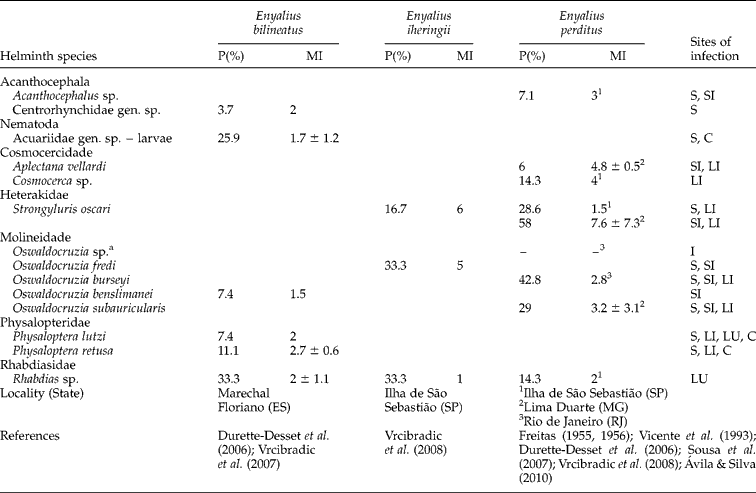
Lizards are hosts to a wide variety of gastrointestinal nematodes (Goldberg & Bursey, Reference Goldberg and Bursey1992). The cosmopolitan genus Oswaldocruzia Travassos, 1917 parasitizes amphibians (Durette-Desset et al., Reference Durette-Desset, Anjos and Vrcibradic2006) and lizards from several families, such as Gekkonidae, Gymnphthalmidae, Iguanidae, Leiosauridae, Polychrotidae, Teiidae and Tropiduridae (Ávila & Silva, Reference Ávila and Silva2010). Oswaldocruzia nematodes are common parasites of lizards and new species have been described infecting Enyalius, such as two new species of Oswaldocruzia sampled from the stomach and small intestine of E. iheringii and E. perditus on São Sebastião Island off the state of São Paulo, Brazil (Durette-Desset et al., Reference Durette-Desset, Anjos and Vrcibradic2006) (table 1). Vrcibradic et al. (Reference Vrcibradic, Anjos, Vicente and Bursey2008) reported that helminth assemblages in E. perditus and E. iheringii on São Sebastião Island were depauperate and dominated by generalist helminths with direct life cycles. It is important to note that the host species E. catenatus analysed by Freitas (Reference Freitas1955) was later described as E. perditus by Jackson (Reference Jackson1978) and its nematode species O. subauricularis was misidentified and is considered a species inquirenda by Durette-Desset et al. (Reference Durette-Desset, Anjos and Vrcibradic2006).
Helminth fauna of Enyalius spp. from Brazil; P(%), prevalence, MI, mean intensity of infection (±standard deviation).
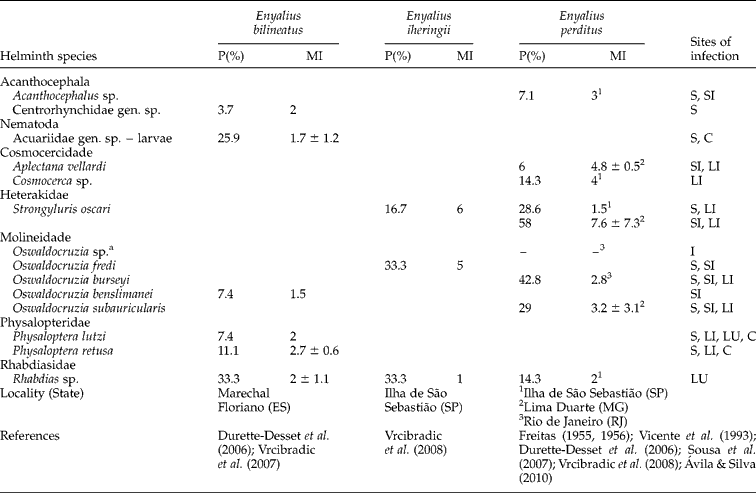
Sites of infection: S, stomach, SI, small intestine; LI, large intestine; I, intestine; C, body cavity; LU, lungs. Localities: ES, Espírito Santo State; MG, Minas Gerais; RJ, Rio de Janeiro State; SP, Sāo Paulo State. Rhabdias sp. was found in E. catenatus in the Ibateguara locality, Alagoas state, by Freire (Reference Freire2008): P(%) = 36.4, MI = 3.7( ± 6.3).
a Oswaldocruzia subauricularis from the host Enyalius catenatus (without data), in Freitas (1955 and, probably, 1956) are both considered as species inquirenda by Durette-Desset et al. (Reference Durette-Desset, Anjos and Vrcibradic2006), and Enyalius catenatus was described as Enyalius perditus by Jackson (Reference Jackson1978).
Oswaldocruzia burseyi was initially recorded for an island habitat (São Sebastião Island) (Vrcibradic et al., Reference Vrcibradic, Anjos, Vicente and Bursey2008) in an area of the Atlantic rainforest. The present study reports the first occurrence of O. burseyi in the state of Minas Gerais, extending its range of occurrence to the Brazilian mainland. The other species recorded in the present study, S. oscari, is a generalist parasite found in the stomach and intestine of different species of South American lizards: Ameiva ameiva, Anolis fuscoauratus, A. punctatus, A. transversalis, E. iheringii, E. perditus, Eurolophosaurus nanuzae, Mabuya agilis, Plica plica, P. umbra, Stenocercus caducus, S. roseiventris, Tropidurus sp. T. guarani, T. spinulosus, T. torquatus and T. melanopleurus (Sousa et al., Reference Sousa, Lima and Oliveira2007; Vrcibradic et al., Reference Vrcibradic, Anjos, Vicente and Bursey2008, Ávila & Silva, Reference Ávila and Silva2010).
The present study reports the lowest richness of helminth fauna associated with the gastrointestinal tract of species of Enyalius. Parasites and predators are the first groups to suffer from the environmental impact caused by human activities (Gibb & Hochuli, Reference Gibb and Hochuli2002; Laurence et al., Reference Laurence, Lovejoy, Vasconcelos, Bruna, Didham, Stouffer, Gascon, Bierregaard, Laurence and Sampaio2002). The Santa Cândida Municipal Biological Reserve, from which the lizards were sampled, is a small remnant of secondary Atlantic rainforest surrounded by human habitations. In the recent past, this area was covered by coffee plantations. According to McKenzie (Reference McKenzie2007), changes in anthropogenic land use affect the intermediate host fauna and, consequently, the helminth fauna. Thus, recent changes in the sampling area could have influenced the availability and abundance of prey, which may have reduced the richness of the helminth fauna in comparison to fauna in a typical natural forest (Vrcibradic et al., Reference Vrcibradic, Anjos, Vicente and Bursey2008).
Results of the present study confirm the hypothesis that the intensity of infection increases with the body mass and size of the lizard host, which corroborates findings described in previous studies (Ribas et al., Reference Ribas, Rocha, Teixeira-Filho and Vicente1995; Sousa et al., Reference Sousa, Lima and Oliveira2007). The prevalence of parasites was higher in male lizards than in females. Similar findings are described for Anolis sp. (Vogel & Bundy, Reference Vogel and Bundy1987), Cnemidophorus ocellifer (Ribas et al., Reference Ribas, Rocha, Teixeira-Filho and Vicente1995) and E. perditus (Sousa et al., Reference Sousa, Lima and Oliveira2007). However, a greater mean intensity of infection was found in females in the present study, which differs from findings reported for E. perditus by Sousa et al. (Reference Sousa, Lima and Oliveira2007). This may be explained by local differences in the specific characteristics of the host populations in each study area and the small number of adult female hosts sampled in the present study. Lizards acquire nematodes through the ingestion of arthropods infected with the larvae of these parasites (Goldberg & Bursey, Reference Goldberg and Bursey1992; Ribas et al., Reference Ribas, Rocha, Teixeira-Filho and Vicente1995). Thus, gender differences in the prevalence and intensity of helminths may be due to variations in body size and differences in prey consumption in qualitative and/or quantitative terms (Schoener, Reference Schoener1967; Fitch, Reference Fitch1981; Ribas et al., Reference Ribas, Rocha, Teixeira-Filho and Vicente1995).
The habitat for parasites is not spatially continuous, but rather consists of cells or discrete ‘islands’, i.e. the hosts represent patches of favourable habitats in an uninhabitable environment. Parasites are also not evenly distributed among these islands. Some hosts contain more parasites than average, others contain less, and many individuals in the population may be free of parasites. Whichever the index of aggregation chosen, the result is usually the same; parasite populations are much more aggregated among their hosts than if the parasites were randomly distributed (Poulin, Reference Poulin1993, Reference Poulin1997). In the present study on the parasite biology of E. perditus, the nematode species exhibited a more aggregated distribution pattern in this host population and O. burseyi was more aggregated than individuals of S. oscari.
Acknowledgements
We thank Dr Reinaldo J. da Silva who facilitated the helminthological analysis at the Laboratório de Parasitologia de Animais Silvestres (LAPAS), UNESP, and to Dr Bernadete M. de Sousa who initially facilitated the dissection of the lizards in one of the laboratories of the Postgraduate Program (PPG), Comportamento e Biologia Animal, UFJF. L.A.A. thanks Fundação de Amparo à Pesquisa do Estado de São Paulo (FAPESP) for financial support (postdoctoral scolarship, # 2008/50417-7). A.F.B.-L. thanks Coordenação de Aperfeiçoamento de Pessoal de Nível Superior (CAPES), and PPG, Comportamento e Biologia Animal, UFJF for support and facilities. Finally we thank City Hall of Juiz de Fora for permission to access the reserve, to Instituto Brasileiro dos Recursos Naturals Renováveis (IBAMA) for permission to collect the animals (227/2003, Fauna/MG) and to the Comissão de Ética na Experimentação Animal da Pró-Reitoria de Pesquisa, UFJF (47/2003). Finally we thank to Katherine Cameron and the two anonymous referees for providing us with constructive comments and suggestions.