INTRODUCTION
Studies of conservation impact are costly and challenging (Brooks et al. Reference Brooks, Wright and Sheil2009; Bowler et al. Reference Bowler, Buyung-Ali, Healey, Jones, Knight and Pullin2012; Geldmann et al. Reference Geldmann, Barnes, Coad, Craigie, Hockings and Burgess2013). Decentralized forest management approaches involve people who live in and around forest areas in their management. Promises of effective and equitable conservation have led to a spread in decentralized forest management over the past few decades, through legal reforms and implementation. Currently, c. 9–10 % of the world's total forest area is formally owned by communities and indigenous groups, and these groups have formal user rights over an additional 2–3% (Sunderlin et al. Reference Sunderlin, Hatcher and Liddle2008). These overall figures include countries and areas with wide differences in the extent of powers devolved, degree of local enforcement, and the types and sizes of forests under decentralized management (Balooni & Inoue Reference Balooni and Inoue2007; Dressler et al. Reference Dressler, Büsher, Schoon, Brockington, Hayes, Kull, McCarthy and Shrestha2010; Ribot et al. Reference Ribot, Lund and Treue2010).
Although decentralized forest management approaches are extensive and have a relatively long history in countries such as India, Nepal and Mexico, solid evidence of their conservation (and livelihood) impacts remains elusive. The existing evidence is based on case studies from a few selected countries, and many studies have either failed to measure forest condition and change in a convincing manner (Lund et al. Reference Lund, Balooni and Casse2009) and/or failed to attribute the observed change in condition to decentralized management, as opposed to other confounding factors (Lund et al. Reference Lund, Balooni and Casse2009; Waylen et al. Reference Waylen, Fisher, McGowan, Thirgood and Milner-Gulland2010; Bowler et al. Reference Bowler, Buyung-Ali, Healey, Jones, Knight and Pullin2012; Porter-Bolland et al. Reference Porter-Bolland, Ellis, Guaruiguata, Ruiz-Mallen, Negrete-Yankelevich and Reyes-Garcia2012). Thus, there is limited knowledge of the impacts of decentralized forest management and the conditions that may lead to sustainable forest management. This shortcoming is likely attributable to the substantial challenges involved in identifying conservation impacts of forest policies through measurements of change or difference in forest condition, and attributing any observed changes or differences to the change in policy. These issues are echoed in the broader literature on the impacts of conservation policies, although this literature contains large-scale studies using rigorous impact evaluation approaches (see for example Andam et al. Reference Andam, Ferraro, Pfaff, Sanchez-Azofeifa and Robalino2008; Nolte et al. Reference Nolte, Agrawal, Silvius and Soares-Filho2013; Nolte & Agrawal Reference Nolte and Agrawal2013).
The issue of attributing observed changes in ecosystem characteristics to changes in policy is particularly challenging in the context of area-based conservation and conservation policy. Many ecosystems respond slowly to changes in their management and use. Changes in forest condition in response to changes in management may take decades to materialize. Further, any observed changes to forest condition do not necessarily equal observed policy impact, as other confounding factors, like changes in market conditions for forest and agricultural products, may be responsible for the observed outcome. To overcome these challenges, Thomas and Koontz (Reference Thomas and Koontz2011) suggested approaches be adopted that aim to link changes in outcomes (namely forest condition) to changes in policy process-related outputs, such as increased intensity of forest patrolling or enhanced tree planting efforts. Andersson and Gibson (Reference Andersson and Gibson2006) provided a useful example of the value of this approach by demonstrating that, whereas unauthorized deforestation in Bolivia declined in areas where decentralized management schemes were enforced, the effect on total deforestation was indiscernible. The outputs or outcomes that are relevant to measure depend on local circumstance, but Andersson and Gibson (Reference Andersson and Gibson2006) argued that biophysical measurements (typically an outcome) should aim only at the changes that can be directly related to the policy change (in their example, unauthorized deforestation as opposed to total deforestation), and be supplemented with analyses of the changes in measures of control with forest management and use (in their example, forest rule enforcement). This promises a more effective linking of conservation outcomes to conservation policy change. Fulfilling this promise requires the adoption of a mixed methods approach to enable an understanding of the specific local-level changes in resource management practice that result from an overall change in conservation policy. Mixed methods here refer to the combination of qualitative and quantitative data and data analysis approaches in a policy evaluation (White Reference White2009).
In this paper, we use a mixed methods approach to evaluate the conservation impact of the implementation of decentralized forest management in two neighbouring villages in Tanzania. Decentralized forest management approaches were introduced in Tanzania in the early 1990s to address perceived problems of deforestation and forest degradation. The decentralized approaches follow two overall strands: (1) joint management agreements that set out terms for co-management of forests between the central and local government, and (2) the establishment of village land forest reserves (VLFR) that are managed by village councils (Lund & Nielsen Reference Lund, Nielsen, Charton and Médard2006). Extensive piloting of decentralized approaches was followed by legal reform and, from 2003 onwards, implementation under a national programme (Persha & Blomley Reference Persha and Blomley2009).
Our aim was to assess the resource sustainability of current forest use patterns, and to evaluate the impact of decentralized forest management on forest use patterns. By resource sustainability, we mean patterns of use that do not compromise the long-term capacity of the forest to supply goods and services. We provide detailed evidence on current forest condition and forest use patterns, as well as change in forest disturbance levels from before the implementation of decentralized forest management. We supplement this with detailed evidence on changes in forest management practices, to understand how the changes in forest condition and use patterns result from the implementation of decentralized forest management. Through this, we demonstrate the value of a mixed methods approach to evaluate conservation policy impacts and also provide important insights into why the policy change has had divergent impacts on the management, use and condition of the two forests in our study.
METHODS
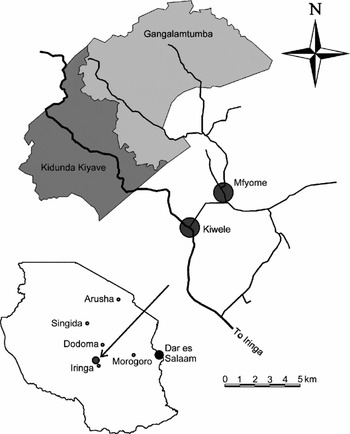
The neighbouring study villages of Kiwele and Mfyome are located in Iringa District, Tanzania (see Fig. 1), and set in a relatively flat landscape, lying 850–1500 m above sea level. Kiwele has 1200 and Mfyome 2400 inhabitants, average rainfall in the area is c. 600 mm yr−1, and the mean annual temperature is c. 21 °C. People in the villages depend on small-scale farming of maize, cowpeas, beans and groundnuts for subsistence, whilst tobacco, sunflowers and tomatoes are the most important cash crops. The villages manage the 4904 ha of Kiwele Village Land Forest Reserve (VLFR) and the 6065 ha of Mfyome VLFR. Both VLFRs consist of dry miombo woodland. This forest type is quite resilient to disturbances and regenerates through stump and root shoots (Frost Reference Frost and Campbell1996). Iringa town with c. 150000 inhabitants is situated 20–25 km from the villages and connected to these by an always accessible dirt road with regular bus service.
Location of the study villages.

Mfyome and Kiwele were established as tobacco-growing villages during the 1960s resettlement programmes. During the 1980s, the livelihoods of farmers in the area came under pressure owing to reductions in tobacco credit and extension services following Tanzania's structural adjustment programme. This, and growing demand for wood products from Iringa town, created increasing livelihood reliance on forest use. Some villagers in Mfyome, in particular, specialized in the production of charcoal and timber because they were living inside the forest with little access to water and agricultural extension services. In Kiwele, conversely, more villagers specialized in collection of dry firewood for sale because tobacco farmers only use the tree trunks and leave behind the crowns to dry, thereby providing a ready source of dry firewood. Thus, over time, Mfyome VLFR has become increasingly known for charcoal and, to a lesser extent, timber production, whereas Kiwele VLFR produces firewood for tobacco curing and sale.
Before the introduction of decentralized forest management, the two forests were under the jurisdiction of the district forest office, and forest management authority was exercised mainly by divisional forest officers posted in the villages. These officers’ means of law enforcement were limited. Further, since overly vigilant forest officers were met with threats, violence and damages to their property, the general level of forest rule enforcement was low. Accordingly, although people who were involved in illegal forest uses could face serious sanctions, including physical abuse, imprisonment, and confiscation of produce and tools, the risk of incurring these was low. Rather than control of forest use in the forests, the district forest officers focused their limited resources on maintaining control with commercially-driven forest use through checkpoints on the roads leading into Iringa town (Lund & Treue Reference Lund and Treue2008).
Decentralized forest management was introduced in the villages during 1999–2003 via a donor-supported project that provided support to community awareness campaigns, delineation and demarcation of VLFR boundaries, establishment of village natural resources committees (VNRCs), and formulation of forest management plans (Topp-Jørgensen et al. Reference Topp-Jørgensen, Poulsen, Lund and Massao2005). The VNRCs are subcommittees whose members are directly elected every five years by the village assembly, comprising all adult villagers, and are answerable to the elected local government institution at the village level, the village council. Under decentralized forestry, the VNRC has executive rights to implement the forest management plan, namely to plan and perform activities such as issuing permits for forest uses, patrolling, fire control, tree planting, arresting offenders and collecting forest use fees (Lund Reference Lund2007). Following the initial preparation period, actual forest management authority was vested in the VNRCs through the signing of management plans in 2002 by the District Executive Director, and from then on the VNRCs were responsible for management.
Our study has three overall components: (1) an assessment of current forest condition and growth and use levels based on forest inventories; (2) an assessment of change in forest disturbance from before the implementation of decentralized management based on Landsat imagery analyses; and (3) an analysis of changes in forest management and types and intensity of use based on interviews, personal observations, and a review of records conducted by Jens Lund. Component (1) of our study informs the resources sustainability under current decentralized management practices, whereas component (2) reveals whether forest disturbance has changed as compared to the period before decentralization was implemented. The role of component (3) is to provide understanding of changes in the use and management of the two forests over the period since before implementation of decentralized management, with a view to understanding the role of the decentralization policy in changing local use and management.
Assessment of current forest condition and growth and use levels is based on inventories made in 2007 and a re-measurement of permanent plots in 2008. The inventories involved measurements in 69 systematically distributed sample plots with 15 m radius for live trees and 20 m radius for stumps in each of the VLFRs, corresponding to sampling intensities of 0.08–0.10% for live trees and 0.14–0.17% for stumps. The higher sampling intensity for stumps reflects their being more scattered. In each plot, we recorded: (1) diameter at 1.3 m above ground ‘diameter at breast height’ (dbh), for all trees with dbh ≥5 cm; (2) diameter at 20 cm above ground for all stumps with a diameter ≥5 cm; (3) the total height and diameter 20 cm above ground for the tree located nearest to the plot centre and the thickest tree within the plot; and (4) evidence of browsing. The age of stumps was assessed (1–2, 3–5, 6–10 and > 10 years old) by local informants, based on the colour and degree of decay of the cut surface combined with their knowledge of the whereabouts of past harvesting activities. The sizes and ages of stumps were used to derive an average estimate of forest use level for the past 10 years, thus covering the entire period following the initiation of the implementation of decentralized management starting in 1999. We applied local forest-specific regression models relating stump diameter to dbh and total tree height in combination with existing volume functions for miombo woodlands (Malimbwi et al. Reference Malimbwi, Solberg and Luoga1994) to convert from stump size to harvested volume. To assess forest growth, 15 permanent plots (0.04–0.09 ha each, total of 0.8 ha), established and measured for the first time in 2002–2003, were remeasured in 2008.
The assessment of change in forest disturbance from immediately before to shortly after the implementation of decentralized forest management was by use of four Landsat scenes with near anniversary acquisition dates and times for the years 1999–2001 (before) and 2004–2006 (after). The scenes were corrected for clouds and cloud shadows through establishment of cloud masks. We used the disturbance index (DI) of Healey et al. (Reference Healey, Cohen, Zhiqiang and Krankina2005), a linear combination of tasselled cap (TC) transformations of Landsat data, brightness (B), greenness (G) and wetness (W) normalized relative to pure forest pixels in each scene. DI values close to zero indicate that pixels are forest covered, while higher values are interpreted as absence of forest cover. We used change maps with a DI threshold of three to detect disturbance within each specific two-year period. The final maps show delta DI, namely pixels that were defined as intact forest (DI < 3) in the first image from each period (images from 1999 and 2004) but disturbed (DI > 3) in the second image (2001 and 2006). We used the delta DI maps to calculate the area affected by disturbance within each two-year period (Supplementary Material, Appendix 1).
The analysis of changes in forest management and types and intensity of use was elicited through review of VNRC taxation records, semi-structured interviews with past and current forest officers, traders in forest products, village elders, forest users, VNRC members and patrol guards, and through observations of forest patrols, management procedures, meetings and general assemblies. Specifically, a total of 2932 entries of VNRC incomes and expenditures from the two villages over the period 2002–2010 were recorded from receipts and vouchers to form the basis of an analysis of forest-use patterns. In 2010, 24 forest users were identified with the help of local informants that were not members of the VNRCs, including 13 firewood collectors (four from Kiwele, nine from Mfyome), six charcoal producers (one from Kiwele, five from Mfyome), and five timber producers (all from Mfyome). These were interviewed about their perceptions of VNRC management and control, and personal experiences with VNRC enforcement. The remainder of the empirical work for this part of the study was carried out by Jens Lund during several visits to the villages, which lasted anywhere from a few days to several weeks during the period 2003–2010, namely the entire period since establishment of decentralized forest management.
RESULTS
Current forest condition, and growth and use levels
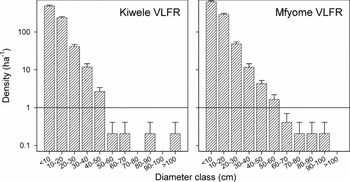
Mfyome and Kiwele VLFR had tree volumes of 47 and 63 m3 ha−1, respectively, the higher volume of Mfyome VLFR resulting from a greater stem density (Table 1), whereas tree sizes in the two forests were similar. The diameter distributions of both forests show a proliferation of individuals in the smaller classes (Fig. 2). Browsing was observed in 45% and 38% of the plots in Kiwele VLFR and Mfyome VLFR, respectively.
Basic data (tree dbh ≥5 cm) for the two forests: mean values with standard errors.

Stem diameter distributions (number of stems per ha, logarithmic scale).

The re-measurement of 15 permanent sample plots in 2008 revealed an average stem number in the plots of 1207 ± 186, an average basal area of 11.6 ± 1.3 m2 ha−1, and an average volume of 59 ± 7.4 m3 ha−1. In five plots, trees had been harvested in the period since the establishment of the plots in 2003, yet the harvested volumes were lower than 4% of the standing stock. The re-measurement showed a mean annual growth rate of 1.6 ± 0.19 m3 ha−1.
Stumps were found in 25% and 22% of the plots in Kiwele VLFR and Mfyome VLFR, respectively, and the conversion of stump diameter into harvested biomass results to estimated annual extraction levels of 706 ± 289 m3 yr−1 and 607 ± 224 m3 yr−1 for Kiwele and Mfyome VLFRs, respectively.
Change in forest disturbance
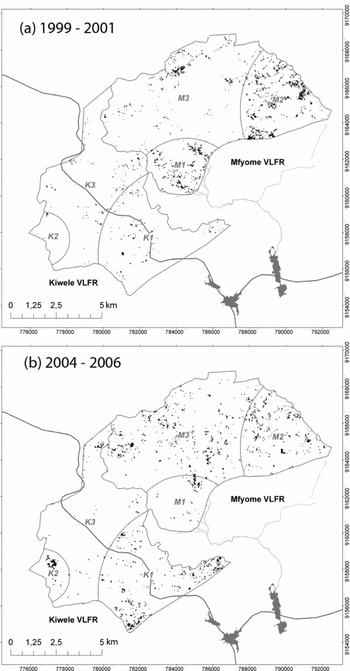
Forest disturbance before (1999–2001) and after (2004–2006) the introduction of decentralized forest management reveals divergent patterns between the two forests (Fig. 3). In Mfyome VLFR, the area of forest disturbance decreased from 193.1 ha (3.2% of the total forested area) in the period 1999–2001 to 147.2 ha (2.4%) in the period 2004–2006, yet there was substantial variation within the forest. In the southern part of Mfyome VLFR (Fig. 3, M1 and M2) located close to the main village, the area disturbed was reduced from 47.0 ha (M1) and 100.5 ha (M2) in 1999–2001 to only 12.7 ha (M1) and 53.1 ha (M2) in 2004–2006, while disturbance increased in more remote parts of the forest and along the northern forest border (M3). In Kiwele VLFR, the area disturbed increased from 33.1 ha in 1999–2001 to 92.8 ha in 2004–2006. However, this includes disturbance attributable to a planned expansion of a settlement in the north-western part of the forest in 2002 (Fig. 3, K2), as well as disturbance on the southern border of the forest (Fig. 3, K1) that is not part of the VLFR, which was revealed by walking along the VLFR border markers with a GPS (Supplementary Material, Appendix 1).
Geographic placement of DI >3 pixels in (a) 1999–2001 and (b) 2004–2006.

Changes in forest management, and in types and intensity of use
With the implementation of decentralized forest management, patterns of forest use and management changed as a consequence of the implementation of the more intimate setting with village-based forest managers and patrol guards. From a situation of very little enforcement targeting activities in the forests under the previous district-led management regime, the change implied a quota, up-front payment of license fees for certain forest uses, and detailed rules on forest use, specifying, among other items, what species and size of trees could be felled, as well as a maximum distance between trees that were left behind after the felling. This was all tightly enforced through frequent patrols and reliance on local informers. The VNRC members were monitoring extraction levels relative to the quota through the issued licenses. Forest patrols by villagers were being carried out in different parts of the forests between one and four times per month by a team of two to four patrol guards, who monitored forest condition and human activities, legal or illegal. Forest patrols were repeatedly observed, and the patrol guards possessed precise knowledge of on-going forest extraction in the forests. Furthermore, VNRC members were accompanying traders in forest products to the forest to oversee the sale and loading of forest products, reducing the risk of clandestine selling of illegal produce. The VNRCs were also cooperating with neighbouring villages to control access roads to the forests, and obtained information on forest disturbances from fellow villagers.
Of 24 forest users from Kiwele and Mfyome interviewed in 2009, 16 had experienced sanctions on one or more occasions by VNRC members since the introduction of decentralized forest management in 1998; typically confiscation of equipment or produce, or fines. This relative commonality of sanctioning is indicative of control with forest use, as are the initial resentment and resistance by many forest dependent households in the two villages to the change in management. In Kiwele, members of the first VNRC recalled how they were threatened by forest users when informing about the strict rules governing the selection of trees for production of charcoal. A VNRC member from Mfyome recalled an incident where a member of the VNRC had furniture stolen in 2003 and that her fellow villagers afterwards told her: ‘You have so many valuables in your house but do not wish that we can get the same. Now, you can keep the forest and then we take your valuables’.
Analysis of taxation data for the two VNRCs illustrates differences in patterns of forest use between the two villages. Over the period September 2002–March 2010, Mfyome and Kiwele VNRCs collected 21.6 and 17.6 million Tanzanian shilling (US$ 1 = TZS 1161, 1 January 2006) in forest taxation revenue, respectively. Yet, whereas almost 70% of Mfyome's taxation revenue came from charcoal production, a similar share of total taxation revenue from Kiwele came from firewood collection for tobacco curing and sale in Iringa town. Thus, the main drivers of forest degradation differ substantially between the two villages, with implications for the challenges facing the VNRCs when managing the forests and controlling their uses. Harvesting of trees for lumber production constitutes a mere 3–4 % of forest taxation revenue in the two villages. This is a consequence of the high fee rates stipulated for such trees, which implies that almost all lumber production is done illegally.
The major uses of Kiwele VLFR are relatively easily controlled by the VNRCs. Tobacco farmers’ extraction can be monitored because it is organized in groups and the wood is transported by tractor to the farmers’ homesteads where it is left in a big conspicuous pile, to be used slowly over weeks. Dry firewood for sale requires transport by truck or cart, which makes it difficult for traders to evade control. Charcoal production, the main use of Mfyome VLFR, is more difficult to control although the production usually lasts weeks and involves burning and smoke that is visible from a distance. Producers still evade control and taxation by hiding a few bags before the arrival of the buyer and a VNRC member who counts the bags and issues the final transport stamp. The hidden bags are then either transported to town during the night or sold in smaller quantities in the village. Aware of this, VNRC members have been counting the number of stumps around the kiln to estimate the likely yield of bags. In turn, charcoal producers have placed their kilns close together, making it difficult to separate the stumps between kilns. Attempts by the VNRC at investigating such fraud through house searches have been met with resentment and conflict, and, some level of rule breaking is therefore accepted.
The hand-sawing of lumber in the forest is even more difficult to control. Not only is the production period short (maximum two to three days for a large tree yielding 12–15 pieces of lumber), but the products can also be carried long distances on foot or bicycle and are easy to hide. One patrol guard explained: ‘Lumber producers have informants in the villages who call them on their mobile phones to tell them that the coast is clear whenever we have a VNRC meeting’. Therefore, when it comes to controlling the production of charcoal and lumber in particular, the VNRCs face a formidable challenge.
The challenge of controlling forest use differs between the two villages due to the much larger production of charcoal in Mfyome, as indicated by the taxation data. Yet, this data does not reveal the level of lumber production, as most of this, as mentioned, is done illegally. When asked to estimate how many people are involved in lumber production, the Kiwele village leaders did not believe that any such production took place in the VLFR, whereas in Mfyome the leaders believed that up to 30 timber producers were targeting their VLFR. This suggests that Mfyome's VNRC deals with a larger number of forest users involved in activities, which are relatively difficult to control. Furthermore, Mfyome's VNRC faces the additional problem that Mfyome VLFR can be accessed by roads that lead directly into Iringa town, without passing through Mfyome's main settlement. In Kiwele, the only road out of the forest goes through the main settlement.
DISCUSSION
The basal area estimates from the inventory of the two forests are comparable to estimates found in other dry (annual rainfall < 1000 mm yr−1) miombo woodlands subject to more or less use (Frost Reference Frost and Campbell1996). The crown cover and evidence of disturbance found in the plots indicate that the two forests are used, and the diameter distribution indicates that the intensity and type of use leave room for regeneration. Overall, the two forests thus appear in good condition. Given this, a harvest level that roughly equals growth appears to be a reasonable criterion for resource sustainability of management.
Re-measurement of the permanent plots indicates that they resemble the two forests, despite their higher stem number. The average annual growth rate of 1.6 m3 ha−1 is similar to annual increments in coppiced dry miombo woodland (Chidumayo Reference Chidumayo1988, cited in Frost Reference Frost and Campbell1996), suggesting growth rates of c. 2 m3 ha−1 yr−1. Based on this, we adopted a conservative estimate of 1.5 m3 ha−1 yr−1, implying a total annual volume increment of around 7000 m3 yr−1 and 9000 m3 yr−1 for Kiwele and Mfyome VLFRs, respectively. These total values are tempered by those parts of the total forest areas being taken up by rivers, streams, roads and human settlements.
The estimates of annual wood extraction for the two forests as indicated by the stump survey are both < 1000 m3 yr−1. The estimates may underrepresent the true harvest level for reasons of bias in the age estimation and decay of stumps. We have high confidence in the age estimates because legal harvesting, under the decentralized management regime, is directed by the VNRCs and thereby concentrated in larger ‘production areas’ that change every 1–2 years. Thus, the visual inspection of stumps could, in many cases, be supported by knowledge of the spatial location of the harvesting in the age assessment. Further, the decay of stumps is likely to be slow in this dry area. Examination of 30 stumps of one of the main charcoal species, Brachystegia spiciformis, showed that 11 were ≥10 years old and five were ≥40 years old (Ezekiel Mwakalukwa, unpublished data 2014). Yet, even if allowance is made for underestimation due to decay of stumps, the overall harvest levels are well within the harvest limit defined by the rates of increment, thus current management and use appears to sustain the overall resources of the two forests. Our results do not enable us to conclude anything about changes in the species composition, but only concern the balance between harvest and growth for the forests as a whole.
Between 1999–2001 and 2004–2006 the level of forest disturbance decreased in Mfyome VLFR, whereas it increased in Kiwele VLFR. The areas of disturbance are attributable to a number of processes. The decreasing level observed in Mfyome VLFR appears to be a direct consequence of the VNRC giving low priority to the forest-based livelihood activities of charcoal and lumber production, and firewood collection for sale. By setting and enforcing low quotas for these forest-based activities, the Mfyome VNRC has forced people to change their livelihoods, as evidenced by the attempts at evasion and resistance, and the high occurrence of sanctions incurred by forest users in violation of the rules. Conversely, in Kiwele VLFR, priority has been given to tobacco production and allowance for expansion of human settlements. Whereas the Kiwele VNRC has actively limited the production of charcoal through the setting and enforcement of a quota, there is no such restriction on the amounts of wood cut for tobacco curing, which, rather, is directed by the production of tobacco. Although both Kiwele and Mfyome VNRCs have collaborated with tobacco companies on tree nursery and tree plantation establishment, these do not yet constitute a viable substitute for the forests in supplying wood for tobacco curing (Sauer & Abdallah Reference Sauer and Abdallah2007).
The evidence from interviews and participant observations show that the establishment of decentralized forest management has enabled information about and control of forest use in both forests to be improved. Overall, use has been controlled by the introduction of quotas, licensing and taxation of products extracted from both forests; these have been made effective through patrols, local informants, and control of trade and access roads to the forests. Our claim of strengthened control is supported by previous studies, showing a sharp increase in registered taxation of forest products from villages implementing decentralized forest management in the area (Lund Reference Lund2007), and evidence of enforcement and resistance to the change in management regime (Lund & Treue Reference Lund and Treue2008; Nielsen & Lund Reference Nielsen and Lund2012). The decentralized management has thus meant more effective control of forest extraction and higher taxation of the same, even though the efforts needed to assert this control depend on various factors pertaining to the individual forests and their use histories. The challenge of decentralized forest management in the two villages, and of assuring control with forest use, appears greater for Mfyome VLFR, which is larger, has more access roads, and is used by more people in ways that are more difficult to control. In spite of this, the disturbance analysis indicates that Mfyome VNRC has been able to reduce use levels. Thus, the current use patterns appear to derive from the priorities set by the VNRCs of the two villages.
Our study provides empirical evidence of the conservation impacts of decentralized forest management in Tanzania. Blomley et al. (Reference Blomley, Pfliegner, Isango, Zahabu, Ahrends and Burgess2008) found improved forest conditions and lower disturbance levels in forests managed under decentralized forestry compared to government reserves and open access forests, but they did not examine whether the observed effects could be caused by confounding factors arising from the initial selection of forests by these projects. In the Eastern Arc Mountains, Persha and Blomley (Reference Persha and Blomley2009) found significantly lower levels of illegal harvesting in a communally-managed forest than in a national forest reserve, and the history of forest use indicated that this was attributable to greater tenure security and institutional autonomy in the communally-managed forest. Inventories of 12 forests and household surveys in neighbouring villages in Tanzania led Treue et al. (Reference Treue, Ngaga, Meilby, Lund, Kajembe, Iddi, Blomley, Theilade, Chamshama, Skeie, Njana, Ngowi, Isango and Burgess2014) to argue that decentralized forest management contributed towards sustainable management practices. A few studies have found that forests under decentralized forest management have greater forest condition and levels of biodiversity, based on the perceptions of informants in the managing villages (Meshack et al. Reference Meshack, Adhikari, Doggart and Lovett2006; Vyamana Reference Vyamana2009). Yet these studies have neither triangulated the perceived changes among informants, nor attended carefully to the issue of attribution, and the perceived changes could thus be a consequence of developments other than decentralization.
In addition to empirical evidence of the conservation impacts of decentralized forest management in Tanzania, our results illustrate how a mixed methods approach combining biophysical measurements with review of records, interviews, and participant observations can improve understanding of the conservation impacts of conservation initiatives. On their own, the inventory and disturbance analysis would have done little other than show that the current use levels appear sustainable and that trends in disturbance levels have diverged between the two forests over the period during which decentralized forest management was introduced. Further, the relevance of the disturbance analysis was contingent on border walk to align the Landsat imagery analysis to the local realities, and the interpretation of the analysis depended on knowing that part of the disturbance was due to the planned expansion of a settlement in Kiwele as opposed to, for instance, uncontrolled illegal forest destruction. This illustrates the point that even in the presence of carefully selected control forests, the potential number of factors contributing to change in forest condition over a decade implies great uncertainty as to the role of decentralized forest management in shaping any observed differences in the absence of evidence to support biophysical measurements. By situating the results of the inventory and remote sensing analyses (policy outcomes) in the local context of the villages, including documenting changes in control with forest extraction (policy outputs) through interviews, we are able to indicate a causal chain linking policy inputs to outputs and outcomes. Thus the decentralized forest management policy has evidently had a number of impacts on forest management practices, which has affected forest use patterns and, ultimately, the biophysical state of the forests.
The mixed methods approach further provided evidence of whether the observed outcomes reflect the intentions of the VNRCs or not. The two forests were actively managed by the VNRCs who appeared to wield considerable discretion. The divergent patterns of change in forest disturbance did thus not result from differences in the ability to control and manage; Mfyome faces a more challenging setup in terms of forest uses. Rather, differences in priorities between the villages explain the divergence; Kiwele VNRC has given priority to one of their forest-based livelihood activities (tobacco farming) and has allowed the expansion of human settlements in parts of the forest, while both VNRCs have actively limited charcoal production. This indicates whether increased conservation in response to the policy change is the result of capacity constraints and/or prioritization through the use of discretionary powers. Thereby it informs on-going debates about the capacity and willingness of different actors in society to manage and conserve natural resources given the context in which conservation is pursued (see for example Bradshaw Reference Bradshaw2003; Rodríguez-Izquierdo et al. Reference Rodríguez-Izquierdo, Gavin and Macedo-Bravo2010). In our case, both recipients of management authority had the capacity to conserve, yet Kiwele VNRC apparently chose to allow a higher level of disturbance in pursuit of other development objectives.
A central point of this study is that on-the-ground mechanisms of access control brought about by national-level policy changes are conditioned by context variables that are specific in time and space (see also Treue et al. Reference Treue, Ngaga, Meilby, Lund, Kajembe, Iddi, Blomley, Theilade, Chamshama, Skeie, Njana, Ngowi, Isango and Burgess2014). Generally, impact evaluation approaches favour a strategy of levelling this rich variation by statistical processing of larger samples of treatment and control sites. Yet, within conservation policy, the procurement of evidence from large numbers of sites, even with remote sensing imagery analyses, is a highly resource demanding task, which is likely to be the reason for the high prevalence of studies that either fail to characterize the policy and outcome empirically and/or do not demonstrate how impact is established (Lund et al. Reference Lund, Balooni and Casse2009; Bowler et al. Reference Bowler, Buyung-Ali, Healey, Jones, Knight and Pullin2012; Geldmann et al. Reference Geldmann, Barnes, Coad, Craigie, Hockings and Burgess2013).
CONCLUSION
This paper illustrates the value of a mixed methods approach to evaluate the conservation impact of the implementation of decentralized forest management in two neighbouring villages in Tanzania. Current forest condition and forest use patterns showed that the two forests were in good condition and that the overall use level was within the limits of forest increment, but forest disturbance levels diverged after the implementation of decentralized forest management, increasing in Kiwele and decreasing in Mfyome. Decentralized management led to more effective controls and higher taxation on forest extraction, although the efforts needed to assert this control depended on local factors pertaining to the individual forests and their use histories. Although decentralized forest management would appear to face greater challenges in Mfyome VLFR, due to its size and accessibility, Mfyome VNRC had been able to reduce disturbance levels, whereas Kiwele VLFR had seen an increase. Thus, rather than being an issue of (lack of) capacity to manage the forests and control their use, the divergence in current use (disturbance) patterns apparently derived from the varying priorities set by the VNRCs. Using a mixed methods approach enabled evaluation of conservation policy impacts, even in the absence of control sites, linking policy outcomes to policy outputs.
ACKNOWLEDGEMENTS
We thank the villagers of Kiwele and Mfyome for welcoming us and assisting us with our research. We also thank the Iringa District Lands and Natural Resources Office for supporting the implementation of this study. The present manuscript benefited from comments by Dr Kerstin Pfliegner and several reviewers and editors. Part of the research was financed by the Tanzanian Ministry of Natural Resources and Tourism and the Danish Council for Development Research (LIFE 725).