The composition of the fat globule surface layer makes a significant contribution to the physical properties of many dairy products (Anderson et al. Reference Anderson, Cheeseman and Wiles1977; McCrae & Muir, Reference McCrae and Muir1991; McKenna et al. Reference McKenna, Lloyd, Munro and Singh1999). The composition of this surface layer differs largely because of different processing treatments. An increase in the homogenization pressure increases the protein load on the fat globule surface but the protein load decreases as the temperature of homogenization increases (Walstra, Reference Walstra and Fox1995; Cano-Ruiz & Richter, Reference Cano-Ruiz and Richter1997). However, the protein load is higher when heated milk (>80°C) is homogenized (Walstra, Reference Walstra and Fox1995), because casein micelles may aggregate into large particles during heating (Dalgleish et al. Reference Dalgleish, Pouliot and Paquin1987; Mohammad & Fox, Reference Mohammad and Fox1987; Singh & Creamer, Reference Singh and Creamer1991).
Most of the previous work on the influence of homogenization conditions on fat globules has been carried out on whole milk. No information on highly concentrated milks (>45%) is available. Homogenization of concentrated milk either before or after heating is carried out in the manufacture of whole milk powder to reduce the amount of free fat in the powder and to improve its reconstitution properties (Oldfield & Singh, Reference Oldfield, Singh and Onwulata2005). The changes in the fat globule surface proteins, as a result of the differences in the conditions of homogenization, have been suggested to influence the reconstitution properties of whole milk powder in water (Mol, Reference Mol1975; McKenna et al. Reference McKenna, Lloyd, Munro and Singh1999).
Our previous work has shown that changes in the fat globules and the fat globule surface proteins occur during the preheat treatment and evaporation (Ye et al. Reference Ye, Singh, Taylor and Anema2004a, Reference Ye, Singh, Oldfield and Anemab). Preheat treatment by direct steam injection (DSI) caused a decrease in the fat globule size and an increase in the surface protein concentration to ~1·8 mg m−2 because of adsorption of casein micelles at the fat globule surface and association of whey proteins with the milk fat globule membrane (MFGM). In subsequent evaporation, the size of the milk fat globules decreased whereas the amount of total surface proteins on the fat globules increased as the milk passed through each effect of the evaporator. The major original MFGM proteins, xanthine oxidase, butyrophilin, PAS 6 and PAS 7, did not change during evaporation; however, PAS 6 and PAS 7 decreased during preheating. The objective of this work was to examine the effects of homogenization conditions (temperature, pressure and placement of the homogenization step, i.e. before or after heat treatment) on the milk fat globules and the surface proteins of both low-preheated and high-preheated concentrated milks in the manufacture of whole milk powder.
Materials and methods
Materials
Bulked whole milk, obtained from the Fonterra Co-operative Group, New Zealand, was standardized to 34 g fat, 32 g protein, 48 g lactose, 119 g total solids (TS) and 85 g solids-non-fat l−1 in the pilot plant at Fonterra, Palmerston North, New Zealand. The milk was pasteurized at 72°C for 15 s before further processing.
All the chemicals used were of analytical grade and were obtained from either BDH Chemicals (BDH Ltd, Poole, England) or Sigma Chemical Co. (St. Louis, MO, USA) unless specified otherwise.
Preheating and concentration of milk
Samples of bulked whole milk and standardized milk were collected for analysis. Preheating was carried out using a two-stage DSI process to bring the milk to the desired temperature (70°C for low preheating and 95°C for high preheating). The milk was then passed through holding tubes (residence time 20 s) to the vacuum vessel, where it was flash cooled to approximately 70°C prior to entry into the first stage of the evaporator.
For each process run, about 1750 l standardized milk was passed through a three-effect, pilot-scale, falling film evaporator (Wiegand, Karlsruhe, Germany) with a nominal evaporative capacity of 1600 l/h. The temperature of the milk in the first, second and third effects was approximately 70, 63 and 51°C respectively. The milk was evaporated to approximately 50% TS.
Homogenization and heat treatment of the concentrates
The concentrated milk samples obtained after evaporation were homogenized in a single-stage homogenizer using a pressure of either 4 or 7 MPa at 50, 65 or 79°C. In some experiments, the samples, homogenized at 50°C, were heated to 65 or 79°C in a heat exchanger (no holding time) and then cooled immediately to about 30°C in a water bath before further analysis.
Determination of average fat globule size and specific surface area of fat globules in the concentrated milk
A Malvern MasterSizer MSE (Malvern Instruments Ltd, Worcestershire, England) was used to determine the fat globule size distribution, as described by Ye et al. (Reference Ye, Singh, Taylor and Anema2002). The concentrated milks were dispersed in 20 g SDS/l and 50 mm-EDTA solution (pH 6·8) to dissociate the casein micelles and any aggregation of fat globules.
Isolation and analysis of milk fat globule surface material
Milk fat globule surface material was isolated from standardized milk and diluted concentrated milk by centrifugation at 15 000 g for 20 min at 20°C, as described by Ye et al. (Reference Ye, Singh, Taylor and Anema2002). The total protein content and the fat content of the cream samples were determined using the Kjeldahl method (AOAC, 1974) and the Mojonnier method (IDF, 1987) respectively.
The individual proteins in the washed cream were determined by polyacrylamide gel electrophoresis (PAGE), as described by Ye et al. (Reference Ye, Singh, Taylor and Anema2002). The proteins of the MFGM were identified by comparison with results reported previously (Keenan & Dylewski, Reference Keenan, Dylewski and Fox1995; Mather, Reference Mather2000).
Transmission electron microscopy
The method used was that described by McKenna et al. (Reference McKenna, Lloyd, Munro and Singh1999). The sample was mixed with warm melted (35–40°C) 3% low-temperature gelling agarose in a 1:1 ratio and was further treated and analysed as described by McKenna et al. (Reference McKenna, Lloyd, Munro and Singh1999).
Statistical analysis
All experiments were carried out at least twice. The results were analysed statistically using the Minitab 12 for Windows package (Minitab Inc., State College, PA, USA). Analysis of variance (ANOVA) was used to determine if the means of responses were significant (P<0·05).
Results
Heating the concentrate before homogenization
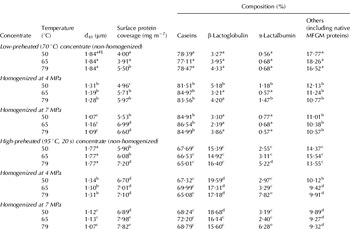
The average fat globule size (d43) of concentrated milk decreased from ~1·80 μm to ~1·3 and ~1·1 μm after homogenization at 4 and 7 MPa respectively (Table 1). Homogenization of the concentrates caused an increase in the surface protein concentration from ~4 to ~6 mg m−2 at 4 MPa and to ~7 mg m−2 at 7 MPa in the low-preheated concentrates (Table 1). In the high-preheated concentrates, the surface protein concentration increased from ~6 to ~7 mg m−2 at 4 MPa and to ~8 mg m−2 at 7 MPa depending on the temperature of homogenization. The surface protein concentrations were higher when the concentrate was homogenized at 65 or 79°C than when the concentrate was homogenized at 50°C at both 4 and 7 MPa, but there was no significant difference between 65 and 79°C. The surface protein concentrations of the high-preheated concentrates after homogenization were 1–2 mg m−2 higher than those of the low-preheated concentrates in most cases (Table 1).
Total surface protein concentration and composition of the milk fat globules in homogenized concentrates (TS~49%) that were heated at different temperatures before homogenization

# Different superscripts within a column indicate significant differences (P<0·05)
§ Data are means calculated from two samples that were produced from the raw milk
The protein composition of the fat globule surface, obtained from quantitative analysis of the SDS-PAGE patterns, showed no significant differences in the surface protein composition of low-preheated concentrates before and after homogenization at a given temperature, except for a decrease in the native MFGM proteins (Table 1). Changes in the homogenization pressure (4 or 7 MPa) and temperature (50, 65 or 79°C) did not significantly affect the relative proportions of the surface proteins. When the low-preheated concentrates were homogenized, caseins constituted approximately 85% of the total surface protein and <5% of the surface protein was whey proteins (Table 1). However, when the high-preheated concentrates were homogenized, the proportion of whey proteins at the fat globule surface increased to >20% (Table 1). Higher proportions of α-lactalbumin (α-la) (~7·0%) were found at the surface of high-preheated concentrates that were homogenized at 79°C than at the surface of high-preheated concentrates that were homogenized at 50 and 65°C (Table 1).
Heating the concentrate after homogenization
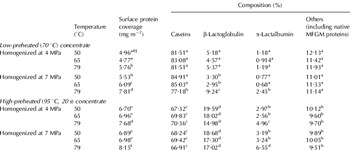
No significant change in the surface protein concentration was observed when both low-preheated and high-preheated concentrates were heated to 65°C after homogenization (Table 2). However, heating at 79°C after homogenization caused an increase (about 1 mg m−2) in the surface protein concentration for both low-preheated concentrates and high-preheated concentrates.
Total surface protein concentration and composition of the milk fat globules in homogenized concentrates (TS~49%) that were heated at different temperatures after homogenization

# Different superscripts within a column indicate significant differences (P<0·05)
§ Data are means calculated from two samples that were produced from the raw milk
Comparison of the surface protein concentrations in the concentrate that was heated at 79°C before (Table 1) or after (Table 2) homogenization at 7 MPa showed that the surface protein concentrations were significantly higher in the concentrates that were heated after homogenization. This result indicated the association of whey proteins with casein micelles that were already adsorbed at the surface. Sharma & Dalgleish (Reference Sharma and Dalgleish1993) also reported that the amounts of whey proteins present in the fat globule membrane were greater in milk that had been homogenized and then heated than in milk that had been heated and then homogenized.
The proportions of β-lactoglobulin (β-lg) and α-la in the low-preheated concentrates heated at 79°C after homogenization (Table 2) were higher than those in the low-preheated concentrates heated at 79°C before homogenization (Table 1). For example, the proportion of β-lg in the low-preheated concentrates heated at 79°C after homogenization at 7 MPa was ~9·0% (Table 2) compared with ~4% in the low-preheated concentrates heated at 79°C before homogenization at 7 MPa (Table 1). However, the proportions of β-lg and α-la in the high-preheated concentrates heated after homogenization (Table 2) were similar to those in the high-preheated concentrates heated before homogenization (Table 1).
Cream washed with a dissociating buffer
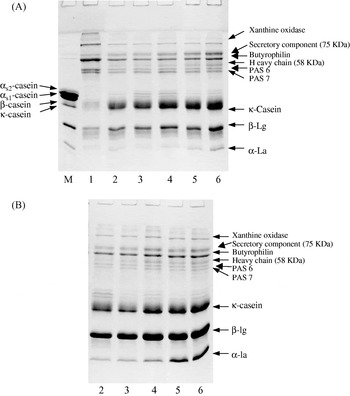
When the isolated MFGM material (cream) was washed in urea and ETDA buffer, the casein micelles adsorbed at the fat globule surface were dissociated and washed away. The protein molecules adsorbed directly at the interface of fat globules and the protein molecules bound to the interfacial protein layer via covalent bonds remained on the surface of the fat globules (Ye et al. Reference Ye, Singh, Taylor and Anema2004a). The SDS-PAGE patterns of the washed cream samples are shown in Fig. 1. Among the caseins, κ-casein was present in high concentrations in the SDS-PAGE patterns of homogenized concentrates. This indicated that only κ-casein from the casein micelle directly adsorbed on to the fat globules, and that other casein molecules (αs1-, αs2-caseins and β-casein) were not directly adsorbed. The intensity of κ-casein increased in the concentrates homogenized at 7 MPa (Fig. 1). In addition, homogenization at 7 MPa at 79°C further enhanced the intensities of the κ-casein, β-lg and α-la bands (Fig. 1B).
SDS-PAGE patterns (15% acrylamide gel), under reducing conditions, of fat globule surface material isolated from low-preheated (70°C) (A) and high-preheated (95°C, 20 s) (B) concentrates before or after homogenization at different pressures and temperatures. Lane 1, standard milk; lane 2, concentrate; lane 3, concentrate homogenized at 4 MPa and 50°C; lane 4, concentrate homogenized at 7 MPa and 50°C; lane 5, concentrate homogenized at 4 MPa and 79°C; lane 6, concentrate homogenized at 7 MPa and 79°C; M, whole milk.

Changes in the homogenization pressure and temperature did not affect the intensity of the bands of the major native MFGM proteins, including xanthine oxidase, butyrophilin, PAS 6 and PAS 7, in the low-preheated concentrates (Fig. 1A). However, the PAS 6 and PAS 7 bands became very faint in the high-preheated concentrates (Fig. 1B). Furthermore, the SDS-PAGE patterns showed a protein band with a molecular weight (Mr) of ~75 kDa and a faint band with an Mr of ~58 kDa located between butyrophilin (Mr 66 kDa) and PAS 6 (Mr 50 kDa) in both low-preheated and high-preheated homogenized concentrates (Fig. 1). The intensity of these two bands in the homogenized concentrates was greater than that in the concentrate before homogenization and it increased with homogenization pressure from 4 to 7 MPa. The intensities of these bands were fairly similar in the low-preheated and high-preheated concentrates (Fig. 1). This suggested that these proteins were directly adsorbed at the fat globule surface during homogenization.
Electron microscopy
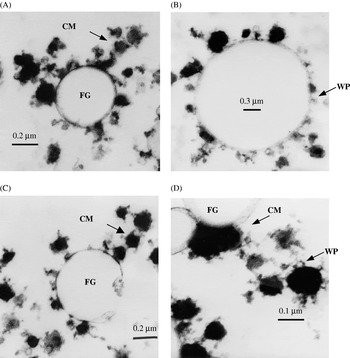
Transmission electron micrographs of both low-preheated and high-preheated concentrates homogenized at 7 MPa showed that casein-micelle-like particles were adsorbed at the fat globule surface (Fig. 2), although not all of the fat globule surface was covered by casein. In the concentrates homogenized at 79°C or heated to 79°C after homogenization, many adsorbed micelles were joined with the adjacent micelles in the serum to form chains. In the high-preheated homogenized concentrates, it was observed that the thread-like material between the casein micelles was involved in the formation of these micelle chains (Figs. 2C, 2D), indicating that the non-micellar material between the casein micelles may be involved in the formation of these casein micelle chains. Hair-like structures have been observed on the surface of casein micelles in heated milks (Davies et al. Reference Davies, Shankar, Brooker and Hobbs1978; Mohammed & Fox, Reference Mohammad and Fox1987) and have been described as κ-casein/β-lg complexes (Singh & Fox, Reference Singh and Fox1987).
Transmission electron micrographs of low-preheated (70°C) (A, B) and high-preheated (95°C, 20 s) (C, D) concentrates homogenized at 7 MPa and 79°C (A, C), and concentrates homogenized at 7 MPa and 50°C and then heated to 79°C (B, D). FG: fat globules, CM: casein micelles, WP: whey protein. Magnification:×48 600.

In the low-preheated homogenized concentrates, the amount of thread-like material between the casein micelles was much less although chains of casein micelles were still observed, particularly at the fat globule surface; these chains appeared to be the micelles in contact with each other (Figs. 2A, 2B). McKenna et al. (Reference McKenna, Lloyd, Munro and Singh1999) also reported that the micelles adsorbed at the fat globule surface aggregated with adjacent micelles, and became more electron dense, suggesting that there was some change in the structure of the micelles as they adsorbed to the fat globule surface.
Discussion
Any heat treatments during processing, including preheating of the raw milk, and heating before and after homogenization, result in the association of whey proteins or whey protein/casein micelle complexes with the fat globule surface proteins and subsequently lead to an increase in the total fat globule surface protein concentration (Dalgleish & Banks, Reference Dalgleish and Banks1991; Houlihan et al. Reference Houlihan, Goddard, Nottingham, Kitchen and Masters1992; Ye et al. Reference Ye, Singh, Taylor and Anema2004a). During high-temperature preheating, serum proteins associate with the native MFGM proteins and the casein micelles via disulfide bonds; these casein micelle/serum protein complexes are subsequently adsorbed on to the surface of the fat globules during homogenization, resulting in greater amounts of surface serum proteins and greater total surface protein concentrations (Tables 1 and 2). During preheating, only about 1·2 mg whey protein/g fat associates with the native MFGM (Ye et al. Reference Ye, Singh, Oldfield and Anema2004b). This amount of whey protein is relatively small compared with the total surface protein (~60 mg g−1 fat or 6−8 mg m−2) after homogenization, in which whey protein constitutes about 12 mg g−1 fat. This effect arises mainly because of the adsorption of the casein micelle/whey protein complexes formed during preheating, including casein micelle aggregate chains linked by whey proteins (Fig. 2).
A higher surface protein concentration in the concentrate homogenized at high temperature than in the concentrate homogenized at low temperature was observed in the present study. This result is different from the observations on normal milk, in which the protein load decreases upon homogenization at high temperature (Oortwijn & Walstra, Reference Oortwijn and Walstra1979) because the adsorbed casein micelles spread over the fat−water interface and the spreading rate appears to increase with temperature (Walstra, Reference Walstra and Fox1995). However, during homogenization of the concentrate, a high temperature may cause more adsorbed casein micelles to aggregate with adjacent micelles in the serum (Fig. 2). When the temperature is higher than the temperature of whey protein denaturation, the associations of whey proteins with the surface also result in an increase in the surface protein.
The results (Fig. 1) for the protein composition of the surface material, washed in the dissociation buffer, also showed an increase in the amount of surface β-lg and α-la after homogenization, indicating that the directly adsorbed κ-casein was likely to be present as κ-casein/serum protein complexes. This suggested that the association of β-lg and α-la with κ-casein induced by high-temperature preheating did not influence the adsorption of κ-casein on to the fat globule surface during homogenization.
Further increases in the total surface protein concentration and the surface serum proteins (Table 2) were observed when the heat treatment was carried out after homogenization, indicating that further interaction between the adsorbed micelles (low preheated) or adsorbed micelle/whey protein complexes (high preheated) and whey proteins or micelle/whey protein complexes could take place. During the heat treatment of homogenized concentrates, β-lg bound to casein micelles may have further associated with the β-lg that had already bound at the fat globule surface as a result of heating and adsorption. This also caused an increase in the amount of casein at the fat globule surface. Meanwhile, α-la was associated with the fat globule surface together with the casein micelles that had already associated with β-lg during preheating (95°C).
The amounts of β-lg and α-la associated with adsorbed κ-casein, induced by heating of the concentrates after homogenization, were higher than those of the concentrates heated before homogenization (Tables 1 and 2). This result suggests that the association of whey proteins with adsorbed casein micelles via disulphide bonds during heat treatment after homogenization could not be inhibited by the adsorption of casein micelles during homogenization. This result is in agreement with observations in normal milk (without concentration) by Sharma & Dalgleish (Reference Sharma and Dalgleish1993), who showed that casein micelles can associate with more serum proteins after adsorption at the fat globule surface. Sharma & Dalgleish (Reference Sharma and Dalgleish1994) suggested that more binding sites for the serum proteins become available as the casein micelles are spread over the fat surface rather than being in their native configuration.
In the present work, the SDS-PAGE analysis of the surface protein material washed with urea and EDTA showed the proteins adsorbed directly at the surface. Only κ-casein directly adsorbed at the surface when casein micelles were adsorbed at the fat globule surface (Fig. 1). This phenomenon did not change when casein micelles spread over the surface at higher homogenization pressure. Homogenization at higher pressure and temperature led to more κ-casein directly adsorbing at the surface (Fig. 1). This may be attributed to more casein micelles adsorbed at the surface and broadly spreading over the surface of the fat globule. This implies that the casein micelles are not disintegrated during homogenization and consequently are adsorbed on to the fat interface as “intact” micelles. However, results reported by previous workers (Anderson et al. Reference Anderson, Cheeseman and Wiles1977; Darling & Butcher, Reference Darling and Butcher1978; Sharma et al. Reference Sharma, Singh and Taylor1996) show that a number of casein monomers or sub-units of micelles are also present at the fat interface of homogenized cream or recombined milk.
The authors gratefully acknowledge financial support from the Fonterra Co-operative Group.