Introduction
Rising atmospheric CO2 levels associated with fossil fuel use pose serious social and environmental concerns across the globe. One particularly appealing mitigation strategy involves recycling the CO2 into industrially relevant chemicals, such as CH4, C2H2, or syngas for Fischer–Tropch processes.[Reference Whipple and Kenis1, Reference Hori, Vayenas, White and Gamboa-Aldeco2] Electrochemical CO2 conversion is especially appealing because it can be done at ambient temperature and pressure using excess or “stranded” renewable energy.[Reference Hori, Vayenas, White and Gamboa-Aldeco2–Reference Ganesh5] Carried out on a large scale, the technology could potentially recycle sizeable percentage of CO2 from emissions produced from the industrial process.
Large-scale deployment of electrochemical CO2 conversion systems will require developing improved electrocatalysts with lower energy requirements. CO2 can be theoretically converted to CO, alcohols, and hydrocarbons at very low applied potentials, but the experimental work has shown that realistic systems require large overpotentials to promote the CO2 reduction reaction (CO2RR).[Reference Benson, Kubiak, Sathrum and Smieja6] Another related concern is that the large overpotentials allow competitive H2 evolution reaction (HER) from water splitting, thus reducing overall efficiency and product selectivity.
Experiments have indicated that Au nanoparticle (NP) electrocatalysts demonstrate higher CO2RR activity than bulk, polycrystalline metals. Studies of 4–10 nm diameter mono-dispersed Au NPs for CO2 to CO conversion showed that the 8 nm yields the highest selectivity with ~90% Faraday efficiency (FE) at −0.67 V versus RHE.[Reference Zhu, Michalski, Metin, Lv, Guo, Wright, Sun, Peterson and Sun7] Density functional theory (DFT) calculations showed that steps on (211) facets were more active than closed packed surfaces. These under-coordinated surface sites significantly stabilized COOH, which explains why nanostructured catalysts have lower overpotentials than planar, bulk surfaces. On an Au13 NP model, much stronger binding of the other relevant CO intermediate was predicted. This result suggests less favorable product liberation since NP active sites must stabilize COOH more than CO for the catalyst to show desirable activity and product selectivity. Similarly, fabricated 1–8 nm Au NPs[Reference Mistry, Reske, Zeng, Zhao, Greeley, Strasser and Roldan Cuenya8] displayed increased activity with decreasing size, but NPs smaller than 5 nm preferentially evolved H2. DFT calculations predicted that COOH was stabilized noticeably from Au(111), Au(211), Au55 to Au38 models, while CO is not significantly chemisorbed. However, the smaller particle also stabilized H stronger than COOH. They argued that the higher surface density low-coordinated sites preferentially stabilized adsorbed H and promoted H2 production over CO2RR.
Similar structure dependence was also found for Cu nanocatalyst.[Reference Reske, Mistry, Behafarid, Cuenya and Strasser9] Bulk Cu produces a mixture of products, including CO, CH4, C2H4, and H2. The presence of under-coordinated sites on small Cu NPs improved overall current density and CO selectivity compared with bulk Cu, but preferential H2 evolution (60%–70%) was observed for particles smaller than ~20 nm. Using cuboctahedral models, it was hypothesized that small NPs contained a higher surface density of under-coordinated atoms that improved intermediate binding and enhanced CO and H2 production compared with bulk Cu. Size effects were also reported for CO2RR on 2.4–10.3 nm Pd NPs.[Reference Gao, Zhou, Wang, Miao, Yang, Wang, Wang and Bao10] The 3.7 nm NPs was found to possess the highest CO FE of about 91% at −0.9 V versus RHE compared with merely ~6% for the 10.3 nm. DFT calculations reveal that the formation of COOH intermediate becomes more facile from Pd(111), Pd(211) to Pd55, and Pd38 and the formation of CO was consistently exothermic. As in the previous studies for the corresponding Au,[Reference Mistry, Reske, Zeng, Zhao, Greeley, Strasser and Roldan Cuenya8] the trend was correlated to the presence of under-coordinated atoms.
In what follows, we further explored the use of metal NP for catalyzing CO2RR and analyzed the impact of the competing HER. The reaction mechanism and associated potential-determining steps were elucidated on different size particles. Toward this goal, we present DFT studies of these reactions on Au, Ag, Cu, Ir, Ni, Pd, Pt, and Rh NPs. Some of these metals were selected because there is either no or limited experimental electrocatalytic studies to date. Further study of these materials would determine its suitability for CO2RR applications and may lead to improved catalysts.
Methodology
DFT calculations were performed using the Vienna Ab Initio Simulation Package code.[Reference Kresse and Hafner11, Reference Kresse and Furthmüller12] The generalized gradient approximation (GGA) formulation of Perdew, Burke, and Enzerhoff (PBE) was used[Reference Perdew, Burke and Enzerhof13] with core states described by projector-augmented wave potentials.[Reference Kresse and Joubert14] Model icosahedron NPs between ~0.5 to 2.0 nm diameter (N = 13, 55, and 309 atoms) were considered (see the online Supporting Information, Fig. S1). All the atoms including the adsorbates were relaxed until the forces are below 0.03 eV/Å. Only adsorption on one fundamental site—the “facet” site with geometry similar to the closed-packed (111) surfaces of the metals—was considered. As well as making the calculations much more tractable, focusing on the facets allowed us to establish a baseline for isolating the effects of varying the metal types and particle size. Corner and active sites are assumed to be poisoned during the reaction[Reference Tang, Zhang and Henkelman15] as they tend to bind CO and H more strongly. We also note that there are no systematic studies of the properties of facet site of the various metal NP studied here as a function of system size.
The most stable adsorption configurations were used to calculate the free energy of adsorption and the free-energy diagram. The free energy of adsorption of an adsorbate is calculated as ΔG = G ads − G bare − G gas, where G ads, G bare, and G gas are the free energies of the NP with adsorbate, the bare NP and gas phase species. The term G is determined by adding zero point energy, heat capacity term, and entropic term to the electronic energy:  $G = E + {\rm ZPE} + \int {C_{\rm p}} {\rm d}T - {\rm TS}$.[Reference Cramer16] The vibrational modes were calculated by fixing the NP in their relaxed positions and computing the normal mode frequencies of the adsorbate atoms vibrating harmonically about their binding sites. The reaction mechanisms considered here are based on those utilized previously. For CO2RR, the following steps were suggested[Reference Peterson, Abild-Pedersen, Studt, Rossmeisl and Norskov17, Reference Hansen, Varley, Peterson and Norskov18]:
 $${\rm C}{\rm O}_2 + {\rm H}^ + _{({\rm aq})} + e^ - + ^{*} \to ^{*}\!\!{\rm COOH}$$
 $$^{*}{\rm COOH} + {\rm H}^ + _{({\rm aq})} + e^ - \to ^{*}\!\!{\rm CO} + {\rm H}_2{\rm O}$$
 $$^{*}{\rm CO} \to {\rm CO} + ^{*}$$
For the HER, the following two consecutive proton–electron pair steps were adopted[Reference Mistry, Reske, Zeng, Zhao, Greeley, Strasser and Roldan Cuenya8, Reference Zhu, Zhang, Zhang, Lv, Li, Michalski, Peterson and Sun19]:
 $${\rm H}^ + _{({\rm aq})} + e^ - + ^{*} \to ^{*}\!\!{\rm H}$$
 $$^{*}{\rm H} + {\rm H}^ + _{({\rm aq})} + e^ - \to ^{*} + {\rm H}_2$$
Results and discussion
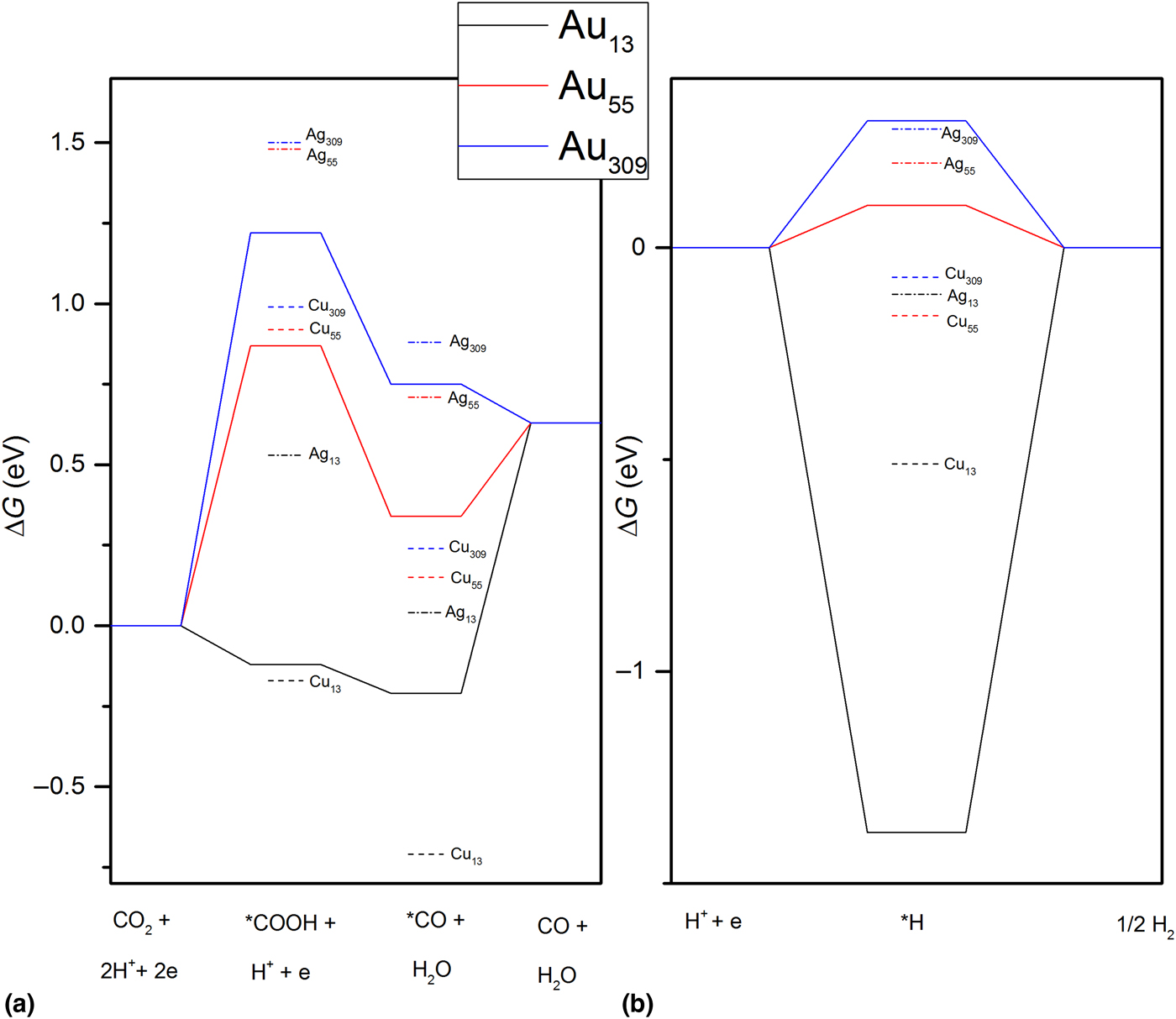
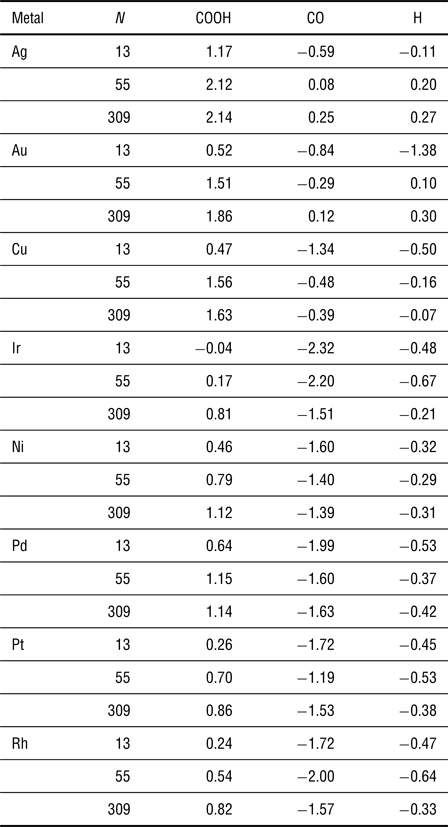
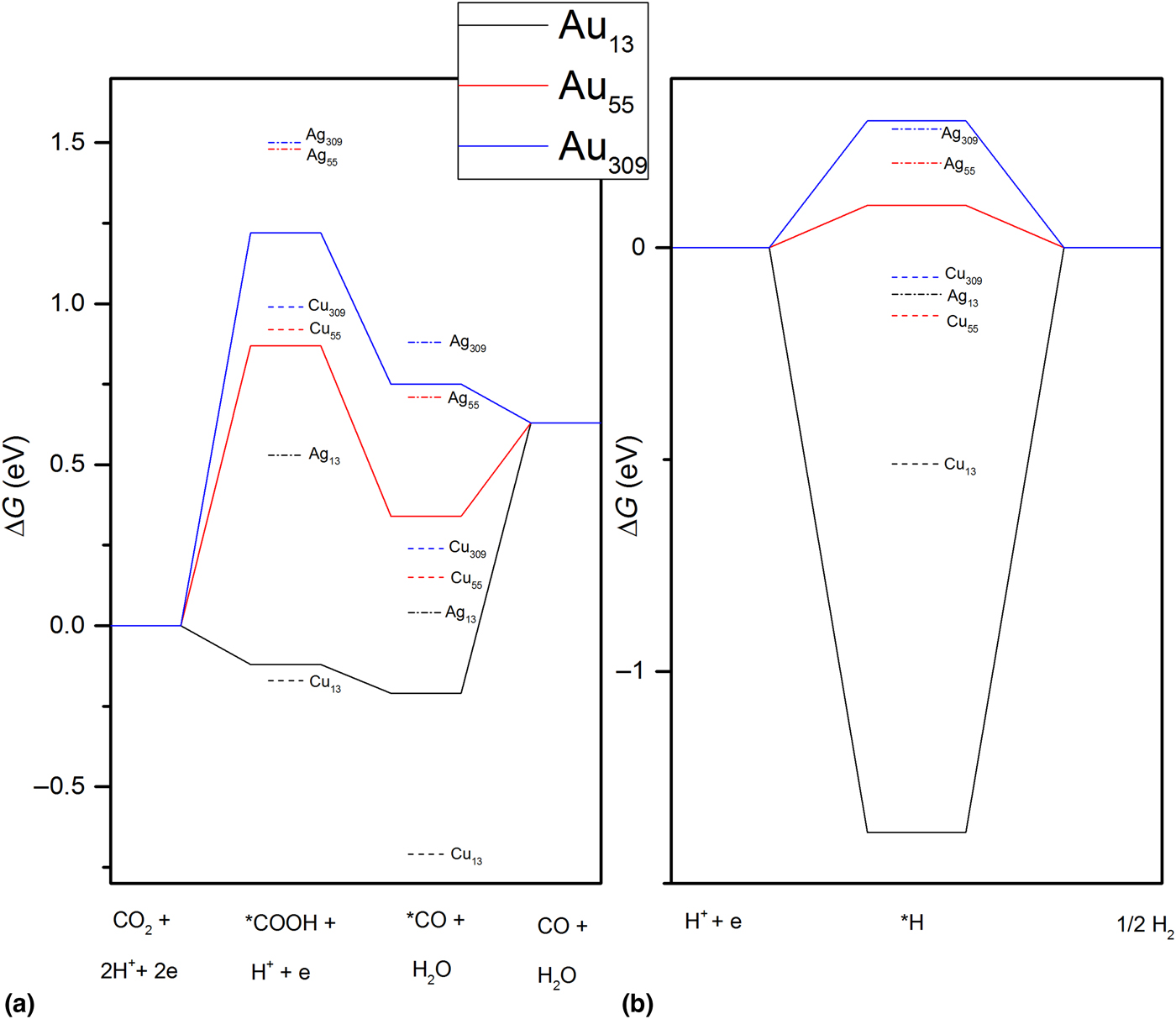
We begin our analysis by looking at the CO2 electro-reduction on the Au13, Au55, and Au309 clusters. The calculated free energies of adsorption of COOH and CO as a function of cluster size at 298 K and 0 V are tabulated in Table I. The trend that was found is that the adsorption of the intermediates becomes stronger as the particle becomes smaller, though the degree to which it is enhanced varies. The relatively much stronger binding on Au13 points to a more pronounced finite size effect for cluster smaller than 55 atoms. Figure 1(a) shows the size dependence of the free energies of the electrochemical CO2RR reaction including the CO desorption event at zero applied bias versus SHE. For Au309, the most endoergic step is the protonation of CO2 to from adsorbed *COOH calculated here as ΔG = 1.22 eV. For the smaller Au55, *COOH formation is also the most difficult step although the thermodynamic barrier is 0.35 eV lower. This corresponds to an onset potential of 1.22 V for Au309 compared to 0.87 V for Au55 which is the voltage required to facilitate the most difficult proton–electron transfer in the pathways. The lower predicted value for Au55 suggests a higher activity in CO2 reduction on this cluster compared with Au309.
Free-energy diagrams for (a) CO2RR and (b) HER on model Ag, Au, and Cu NPs.
Predicted free energy of adsorption (in unit eV) for the CO2RR and HER intermediates at 298 K for various metal NP studied.

On the Au13 cluster, the required ΔG to form the *COOH intermediate is significantly lower and this step is predicted to be spontaneous even under zero bias. This difference is a reflection of the aforementioned increase in the stability COOH with decreasing particle size. One might hypothesize that CO2 reduction activity is favorable on Au13 cluster since the *COOH formation should be fast. It should be noted that this step is not thermodynamically limiting the reduction process. In this case, the most difficult reaction step is the thermochemical liberation of CO. As this step does not involve the transfer of a proton–electron pair, it is not affected by voltage change. The stabilization of *CO on this cluster is predicted to be pronounced making it hard to liberate. *CO could remain on the surface, reducing the number of active sites for reaction or it could be potentially reduced to hydrocarbons and/or alcohols.
From the H free energies of adsorption in Table I, similar stabilizing trend is seen as the Au particle size decreases. The values are 0.30, 0.10, and −1.38 eV for Au309, Au55, and Au13. We find this trend reflected in the free-energy diagrams for HER shown in Fig. 1(b). The *H intermediate in this case is stabilized from ΔG = 0.30 eV on Au309 to ΔG = 0.10 eV on Au55, and further to ΔG = −1.38 eV on Au13. For Au55 and Au309, CO2RR proceeds through the *COOH intermediate and therefore the competition between the stability of *H and *COOH would provide insights on the selectivity toward the two reaction products, CO, and H2. Moreover, as both the elementary step leading to the formation of *H and *COOH is electrochemical, the difference in their stability is not sensitive to voltage change. For each cluster, HER should proceed first because it possesses a smaller thermodynamic barrier compared with CO2RR. With Au309 as the baseline, the predicted extent of stabilization of *COOH on Au55 is more pronounced compared with the corresponding stabilization of *H intermediates. That is, the degree of stabilization of the *COOH energy on Au55 is larger than that of *H. [(ΔG *COOH,Au309 − ΔG *COOH,Au55) ~ 0.4 eV versus (ΔG *H,Au309 − ΔG *H,Au55) ~ 0.2 V] suggesting an improvement in the selectivity of CO2 RR from Au309 to Au55.
The Au13 cluster stabilizes *H much more strongly than either Au55 or Au309. Moreover, the ΔG of *H on the Au13 is way below the ΔG of *COOH, suggesting that CO2 activity would be severely hindered. However, the extremely large ΔG for *H formation (−1.38 eV) suggests extremely strong intermediate binding, and Au13 may also be poor for H2 evolution catalyst. The pronounced stabilization of *H also suggests that this intermediate might be present at relatively high coverages on Au13.
The CO2RR and HER on icosahedral Au13 NP were previously modeled by DFT in conjunction with the revised PBE (RPBE) electron correlation functional.[Reference Zhu, Michalski, Metin, Lv, Guo, Wright, Sun, Peterson and Sun7, Reference Hammer, Hansen and Norskov20] The CO2RR free-energy diagram showed slightly endergonic *COOH formation and exergonic *CO formation at low coordination sites. The most difficult step was desorption of strongly bound *CO. When compared with HER, the ΔG of *H is below that of *COOH. It was suggested that CO2RR would be suppressed on this cluster particularly at low applied bias. Our results are consistent with these trends except for the energetics of *COOH formation, which we found in our work to be a downhill process. This could be due to the some differences not only between the calculational details (e.g., GGA functional), but also the adsorption mode underlying these studies. A onefold adsorption mode where COOH bind to Au13 through the C fragment was reported in the previous DFT studies. In contrast, the most preferred adsorption structure we found for *COOH consists of adsorption through C and terminal O atoms, both of them on a top position. This twofold adsorption mode is predicted to be energetically favorable by ~0.5 eV compared with the onefold mode.
The NP size effect at cuboctahedral Au55 and truncated-octahedron Au38 NPs was also modeled using DFT–PBE.[Reference Mistry, Reske, Zeng, Zhao, Greeley, Strasser and Roldan Cuenya8] Reduced ΔG for *COOH and *CO was found compared with Au(111) and Au(211), and *CO accumulation with decreasing NP size was suggested. Preferential HER was predicted because the ΔG of *H formation is less positive than that of *COOH formation. Presently, we also found stabilization of *COOH and *CO intermediates, with likely increased H2 evolution from smaller particles.
Analysis of trends for the CO2RR and HER processes were extended to Ag, Cu, Ni, Pd, Pt, Rh, and Ir to assess the generality of the size effects; results are summarized in Table I. The adsorption trend predicted on Ag and Cu are similar to Au and both *COOH and *CO binding become more favorable with decreasing particle size. Similar to Au NPs, increased stabilization was found at smaller NPs. Ag NPs adsorb intermediates more weakly than Au and Cu, whereas stronger binding was observed at Cu NPs.
Figure 1(a) compares the size-dependent CO2RR and HER free-energy diagrams for Ag, Cu, and Au NPs. *COOH formation was found to be the most energetically demanding step at 55 and 309-atom Ag and Cu NPs. *COOH formation becomes more thermodynamically favorable as the particle becomes smaller, at which point *CO desorption or further reduction of *CO becomes the most energetically demanding for Ag13 and Cu13 NPs. A similar trend was observed for the Au NPs. In almost all cases, *COOH was more stabilized at Cu55 and Cu309, and they are expected to more efficiently reduce CO2 into COOH compared with Ag and Au. We note again that stabilization of *COOH is accompanied by concomitant stabilization of *CO, an effect seen in Au and Ag clusters as well. Though *COOH formation remains the most difficult step on Cu55 and Cu309, they are less prone to produce CO as the corresponding desorption event becomes more uphill.
The *H free energies of adsorption versus the system size are also summarized in Table I, and smaller NPs demonstrate stronger H binding. The *H adsorption affinity for Ag55 and Cu55 is enhanced by ~0.1 eV compared with Ag309 and Cu309. For Ag13 and Cu13, the affinity is more profoundly enhanced by ~0.4 eV. To illustrate the effects of the changes in the affinity on HER, the free-energy profiles are constructed and shown in Fig. 1(b). Similar to Au, the H+ + e − → *H step becomes more favorable with decreasing the particle size. For the smallest clusters, the reduction step becomes spontaneous and the desorption step becomes uphill. In contrast, the first step is downhill for all Cu NPs sizes due to strong *H adsorption.
The comparative binding of *COOH, *CO, and *H on icosahedral Au and Ag NP were investigated with DFT–RPBE.[Reference Back, Yeom and Jung21] Systematic studies of adsorption of the intermediates on the corner sites with different sizes (N = 13, 55, 147, 309) were conducted. Their results reveal a general pattern of strong binding with decreasing size with the adsorption on Au more favored compared with Ag. Quantum size effects are found to be significant particularly for the smallest size 13-atom clusters. Studies of CO2RR to CO and HER processes on both Au309 and Ag309 reveal the preference to bind *H over *COOH, so that these NP are more prone to produce H2. All these predicted trends are seen in our results.
We further look at the trend across the other transition metals: Ir, Ni, Pd, Pt, and Rh. The free energies of adsorption for the key intermediates as a function of different particle size are given in Table I. In the majority of cases, our results show that *COOH adsorption becomes more favorable with decreasing particle size. Interestingly, this process becomes spontaneous at all the 13-atom NPs. Though *COOH formation is more facile on the transition metals, it does not necessarily translate to higher CO2RR activity. As in the coinage metal NPs, we found that increased *COOH stabilization is accompanied by increasingly difficult *CO desorption and stronger *CO-binding affinity. Previous DFT calculations also predicted enhanced *COOH and *CO binding at cuboctahedral Pd55 and truncated-octahedron Pd38, with *CO desorption the most difficult step compared with bulk surfaces.[Reference Gao, Zhou, Wang, Miao, Yang, Wang, Wang and Bao22]
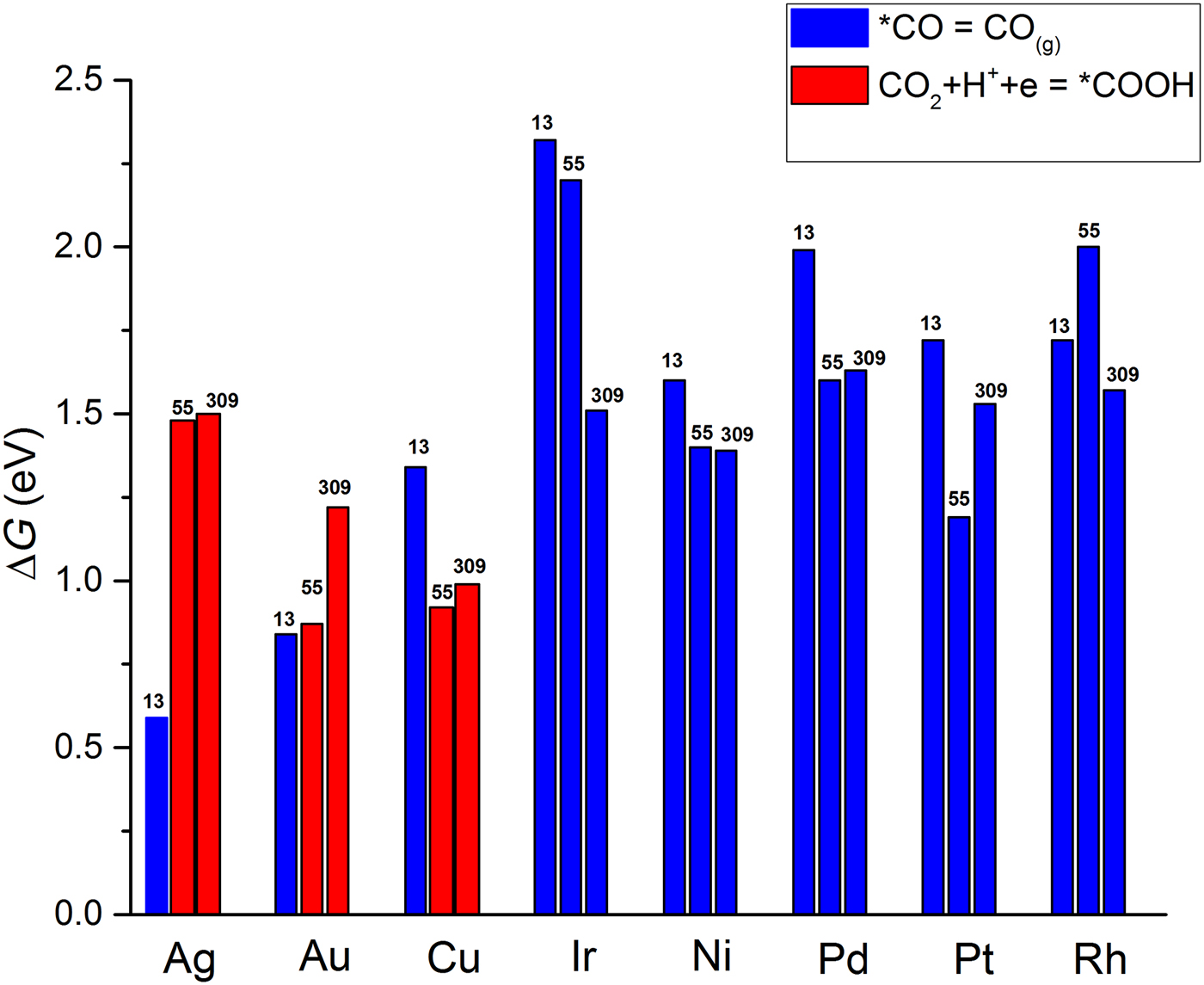
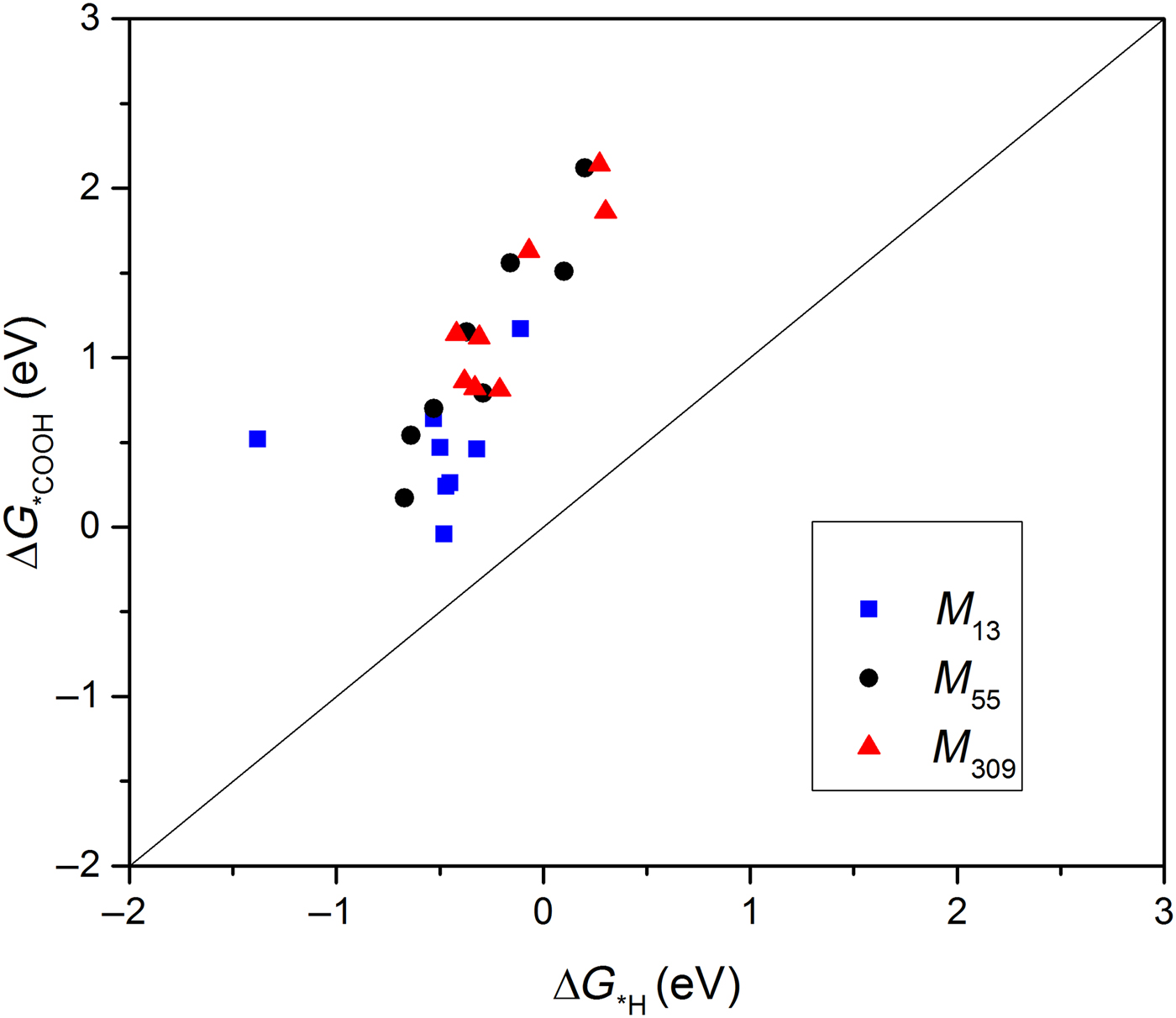
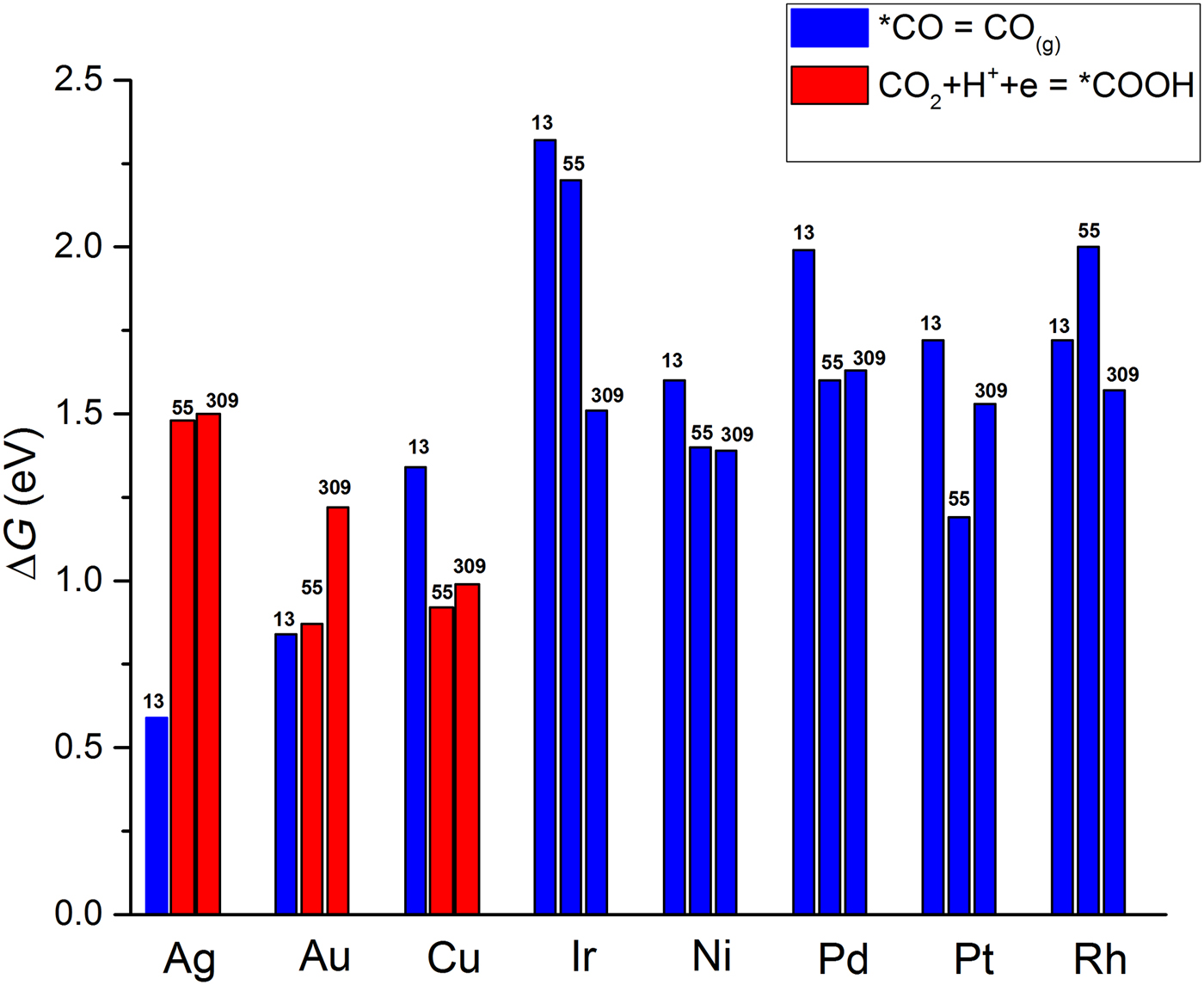
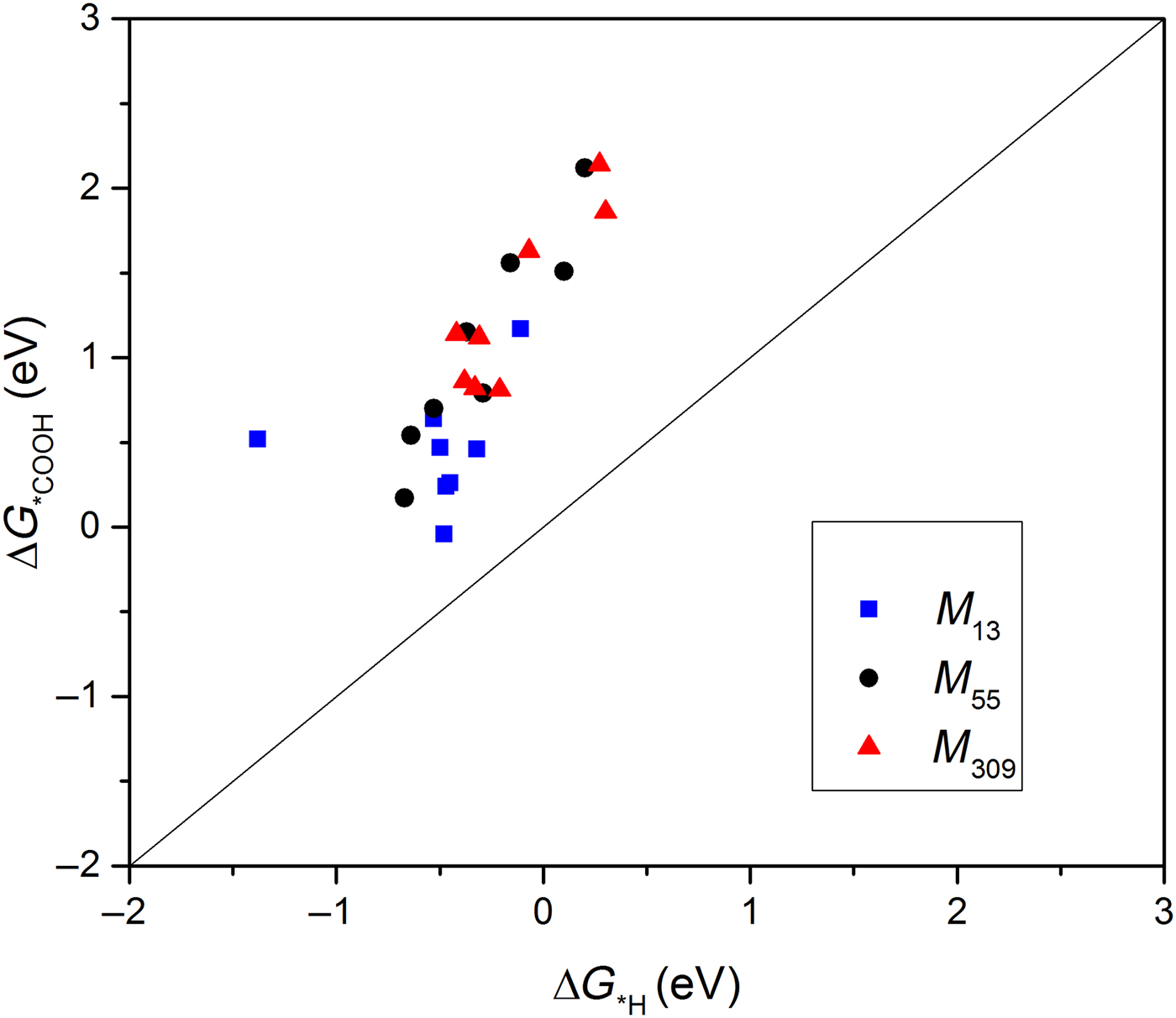
Figure 2 shows the most difficult step in the CO2RR pathway at all NPs. These results predict the release of gaseous CO to be the most energy demanding step for all transition metal NPs and 13-atom Au, Ag, and Cu NPs. We followed the example reported by Tripkovic et al.,[Reference Tripkovic, Vanin, Karamad, Bjorketum, Jacobsen, Thygesen and Rossmeisl23] to predict CO2RR versus HER selectivity. For example, Fig. 3 compares the ΔG for *H and *COOH formation at all NPs. These two steps are the initial process in both CO2RR and HER. The data points are all located in the upper half of the graph (ΔG *COOH > ΔG *H). These results indicate energetically favorable *H formation and predict all NPs will preferentially evolve H2 at cathodic potentials. With these findings in mind, we suggest that these materials may be potential candidates for electrocatalytic HER. In particular, NP with *H free-energy adsorption that approaches 0 V would be a good catalyst since strongly bound *H poisons the active sites, while the too weakly bound counterpart is not susceptible to activation by the active sites. Inspection of Table I indicates a number of candidates whose energetics are a compromise between these two extremes. These include Ag13, Au55, and Cu309 with ΔG *H of −0.11, 0.10, and −0.07 eV. Further experimental works are needed to test whether these systems would in reality be active for HER.
Calculated free-energy barrier for the most difficult step in the reduction pathway for each metal. The blue and red bars correspond to *CO desorption and *COOH formation, respectively. For each metal, the left, center, and right bars represent 13, 55, and 309 atom clusters.
Selectivity criteria defining preference toward CO2RR or HER. Adsorption energies of the first intermediates in CO2RR (*COOH) and HER (*H) on all the NPs studied plotted against each other. All the points fall on the upper part of the graph, which indicates that HER is more selective than CO2RR. M = Ag, Au, and Cu.
Conclusions
The present work was undertaken to improve our understanding of CO2RR on model Au, Ag, Cu, Ir, Ni, Pd, Pt, and Rh NPs for a range of particle sizes. The calculations predict that *COOH and *CO intermediates are generally stabilized with decreasing size. The extent of energetic stabilization of the intermediates dictates different high-energy steps. On the 55 and 309 atom coinage metals, protonation of CO2 to form adsorbed COOH formation is found to be the step that dictates potential requirements while for the smallest 13-atom cluster, non-electrochemical desorption of CO is the limiting one. For all the transition metal NP, CO desorption is the most difficult step. The competing HER was also examined to gain insights on its impact on the CO2RR. It is predicted that selectivity of CO2RR would be affected by H adsorption in all of the systems investigated.
Supplementary material
The supplementary material for this article can be found at https://doi.org/10.1557/mrc.2017.67.
Acknowledgments
This report was prepared as an account of work sponsored by an agency of the US Government. Neither the US Government nor any agency thereof, nor any of their employees, makes any warranty, express or implied, or assumes any legal liability or responsibility for the accuracy, completeness, or usefulness of any information, apparatus, product, or process disclosed, or represents that its use would not infringe privately owned rights. Reference herein to any specific commercial product, process, or service by trade name, trademark, manufacturer, or otherwise does not necessarily constitute or imply its endorsement, recommendation, or favoring by the United States Government or any agency thereof. The views and opinions of author(s) expressed herein do not necessarily state or reflect those of the US Government or any agency thereof.