Brevundimonas diminuta is a non–lactose-fermenting gram-negative bacillus that is ubiquitous in the environment but rarely causes clinical infections.Reference Han and Andrade 1 , Reference Lee, Huang and Liao 2 To date, Brevundimonas species have not been associated with a hospital outbreak. Herein, we describe a pseudo-outbreak of B. diminuta that was likely caused by contamination of vials of a supplement added to culture bottles inoculated with sterile fluid samples.
METHODS
Setting
The University of Alabama at Birmingham (UAB) Hospital is a 1,157-bed tertiary care center in Birmingham, Alabama.
Epidemiological Investigation
The Department of Infection Prevention and Control (IPC) was notified by clinicians of a cluster of B. diminuta isolated in patients in June 2015. A case was defined as B. diminuta isolated from a sterile site between June 1, 2015 and August 31, 2015. Case patients were identified through a review of the microbiology database for the year prior to isolation from the index case.
Microbiological Evaluation
The MicroScan WalkAway automated antimicrobial identification system (Beckman Coulter, Inc) is used for initial identification and antimicrobial susceptibility of all clinical isolates. Identification is confirmed via matrix-assisted laser desorption/ionization time of flight mass spectrometry (MALDI-TOF MS, bioMérieux, Athens, GA). Susceptibility results are interpreted using breakpoints defined by the Clinical and Laboratory Standards Institute (CLSI).
Molecular Analysis
DNA were extracted from isolates using the UltraClean Microbial DNA Isolation Kit (MoBio Laboratories, Carlsbad, CA). Polymerase chain reaction (PCR) amplification was performed using the DiversiLab (bioMérieux) Pseudomonas fingerprinting kit, and rep-PCR amplicons were separated by electrophoresis on microfluidic chips and analyzed with an Agilent 2100 Bioanalyzer (Agilent Technologies, Santa Clara, CA). The band patterns were compared using Pearson’s correlation, and isolates that were 95% similar were considered genetically related.
Processes of Care Investigation
An investigation of clinical practices was performed and all sterile supplies and lot numbers were compared to determine whether product contamination was involved. Samples of unopened culture media bottles of similar lot numbers were tested for possible contamination. Procedure kits, antiseptic solutions, anesthetic solutions, and culture medium supplement were obtained and were subsequently inoculated into culture bottles. Microbiology laboratory procedures were reviewed and laboratory personnel were interviewed to determine if deviations from the routine processes occurred.
RESULTS
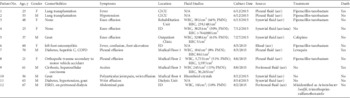
A summary of the patients from whom the clinical samples were isolated is listed in Table 1. In total, 12 clinical isolates were identified between June 1, 2015, and August 18, 2015. A single additional isolate was cultured from the inoculation of a culture bottle using the Fields reagent alone.
Demographic and Clinical Characteristics of Patients From Whom Clinical Samples Were Obtained

NOTE. CICU, cardiac intensive care unit; WBC, white blood cell count; PMN, polymorphonuclear leukocytes; RBC, red blood cell count; R4N; ED, emergency department; aer, aerobic culture; ana, anaerobic culture; COPD, chronic obstructive pulmonary disease; ESRD, end-stage renal disease.
Processes of Care Investigation
The IPC department reviewed the providers’ procedures and techniques for collecting body fluid samples. All providers reported that they disinfected the tops of the culture bottles with alcohol prior to inoculation. The IPC department also obtained samples of unused vials of lidocaine and betadine. Because the outbreak involved samples collected from disparate locations within the Health System, culture medium contamination was suspected. Uninoculated culture bottles of similar lot numbers were sequestered and were found to be negative. The microbiology lab also performed internal validation of each laboratory technician’s technique and space. To improve the yield of body fluid cultures, the microbiology staff routinely add BD Difco Fildes Enrichment medium (DFEM, Becton Dickinson, Franklin Lakes, NJ) to all body fluid specimens that are inoculated in culture bottles. The supplement is manufactured and packaged in 24 single-use vials. The culture bottles inoculated with the DFEM alone were found to be positive for B. diminuta. Unfortunately, the vial that was positive for B. diminuta was the last one of the lot number implicated in the pseudo-outbreak. Supplement reagent with different lot numbers were tested and were found negative for B. diminuta. No further cases have been identified to date.
Characterization of Bacterial Isolates
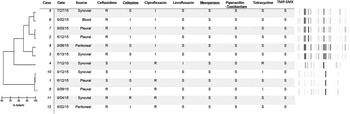
The MicroScan WalkAway system identified 4 of the 12 species as either Acinetobacter lwoffii (cases 6 and 12) or a Pseudomonas species (cases 7 and 11). All isolates were definitively identified as B. diminuta by MALDI-TOF. Antimicrobial susceptibility profiles of all isolates are noted in Figure 1. Molecular typing was performed on all isolates except the isolates from patients 11 and 12, and the DFEM supplement. Molecular typing of the available isolates revealed 5 distinct patterns: isolates from cases 5 and 6 were identical, as were isolates 2 and 7, with 2, 5, 6, and 7 being closely related; isolates from cases 3 and 9 were identical and distinct from others; isolates from cases 1, 8, and 10 were identical and distinct from others; the isolate from case 4 also had its own distinct molecular pattern.
Antimicrobial susceptibility and molecular typing of available clinical isolates.

DISCUSSION
Our findings suggest that patients were not truly infected with B. diminuta, although 8 of 12 patients had been treated with a course of antibiotics since the events occurred before the investigation. All body fluid cultures were enriched with culture medium supplement. Notably, 1 aerobic blood-culture bottle from patient 6 was positive for B. diminuta that was molecularly identical to another strain. The IPC reviewed the laboratory processes: The culture media supplement was added to fluid culture bottles only under a hood, whereas blood cultures were placed directly into the BD BACTEC incubation system. Thus, accidental enrichment of blood-culture bottles with the supplement was unlikely to occur. All the clinical isolates of B. diminuta were genetically similar (% relatedness) by rep-PCR, but not all were identical. While it is possible that contamination occurred in the microbiology laboratory, the reagent is manufactured and packaged as 24 single-use vials, not multi-use vials. Furthermore, the 4-week interval between the first 3 clinical cultures and the rest of the cases suggests that the reagent was delivered already contaminated. Brevundimonas diminuta is used by certain manufacturers as part of quality control to check the integrity of packaging membranes and filters; however, the manufacturer indicated that B. diminuta in not used in the manufacturing process.
Pseudo-outbreaks are treated as true outbreaks until proven otherwise because of the associated additional costs and unnecessary treatment.Reference Perez, Deshpande, Kundrapu, Hujer, Bonomo and Donskey 3 – Reference Pereira, Chan and Ng 6 Other pseudo-outbreaks have involved contamination of laboratory culture media, supplement media, saline solution, and even incubators in clinical laboratories.Reference Perez, Deshpande, Kundrapu, Hujer, Bonomo and Donskey 3 – Reference Calfee, Kornblum and Jenkins 7 A few pseudo-outbreaks have also implicated contaminated culture supplements.Reference Perez, Deshpande, Kundrapu, Hujer, Bonomo and Donskey 3 , Reference Ashford, Kellerman and Yakrus 5 , Reference Calfee, Kornblum and Jenkins 7 Multidose vials can easily be contaminated during inoculation and have been implicated in several investigations but, in this case, the supplement is delivered in single vials.Reference Perez, Deshpande, Kundrapu, Hujer, Bonomo and Donskey 3 , Reference Ashford, Kellerman and Yakrus 5 , Reference Pereira, Chan and Ng 6 , Reference Mattner and Gastmeier 8
We also discovered through our investigation that the MicroScan Walkaway system misidentified 4 isolates as either Pseudomonas species or A. lwoffii, which were subsequently identified by MALDI-TOF MS as B. diminuta. Non-Enterobacteriaciae gram-negative bacilli can be difficult to accurately identify using biochemical tests; antibiotic susceptibility profiles and their interpretation can be highly divergent depending on the genus. Our findings confirmed those of investigators who previously reported a pseudo-outbreak in which automated systems misidentified Acinetobacter lwoffii, thus leading to a time-consuming investigation.Reference Apisarnthanarak, Kiratisin, Thongphubeth, Yuakyen and Mundy 9 MALDI-TOF MS is a rapid and accurate method for the identification of bacteria and has accurately identified B. diminuta and other gram-negative bacilli with high reproducibility.Reference Westblade, Garner and MacDonald 10 Thus, the availability of MALDI-TOF MS in our microbiology lab resulted in rapid identification of this pseudo-outbreak.
In summary, our experience demonstrates the possibility of contamination of supplemental reagents as a source of a pseudo-outbreak. Until the source of the outbreak can be ascertained, it is essential to perform a detailed investigation to identify the source.
ACKNOWLEDGMENTS
We would like to thank the infection preventionists for their assistance in this outbreak investigation.
Financial support: No financial support was provided relevant to this article.
Potential conflicts of interest: All authors report no conflicts of interest relevant to this article.