MEDICAL DEVICE PRICES IN ECONOMIC EVALUATIONS
Sales in the medical device market in Canada were approximately $6.8 billion in 2013, roughly one quarter the size of the prescription pharmaceutical market (1). Prices for patented medicines in Canada are regulated by the Prescription Medicines Price Review Board whereas there are no price regulation mechanisms for medical devices. Decisions to pay for medical devices are largely the responsibility of hospital or regional administrators who are allocated a global budget. As a result, the use of economic evaluation and incremental cost-effectiveness ratios that reflect provincial health ministry perspectives have much less importance in purchasing decisions. Rather, opportunity cost from a hospital perspective is a primary consideration.
Despite the absence of a policy framework that systematically incorporates cost-effectiveness measures for medical devices in Canada (2), economic evaluations are increasingly used for larger purchasing decisions and there have been studies done on them. For example, the province of British Columbia has recently developed a provincial health technology assessment framework for new technology requests that incur considerable investment (3). The provinces of Alberta (4) and Ontario (5) have similar frameworks. Economic evaluations are also conducted by the Canadian Agency for Drugs and Technologies in Health (CADTH), Canada's National HTA body (6). Several groups (Reference Robinson and Bridy7) have commented on the difficulties that result from documenting unit prices for medical devices. To the extent that this is true, it may be in part due to prices negotiated confidentially across different procurement authorities or to agreements that bundle the prices of devices with capital equipment or other devices that make it difficult to disaggregate. Because of the importance of devices in the Canadian market, and the increasing reliance on HTA processes to make decisions, we conducted a literature review to examine the way that prices have been included in published Canadian economic evaluations of medical devices.
METHODS
We obtained a list of the eleven most implanted medical devices in the United States in 2011 (Reference McIntyre8) assuming this would reflect a similar pattern of sales in Canada. There was no comparable sales usage data for Canadian devices. We then conducted a search of all economic evaluations published from a Canadian perspective.
We performed a literature search using a combination of subject headings, keyword terms, economic and clinical queries for each of these medical devices in Medline (EBSCO version). The search was conducted in September 2014. We limited the scope of the search to only Canadian studies. We did not limit the search by year. Only English studies were included in our search. Regarding inclusion and exclusion criteria, we included only primary studies. Abstracts, systematic reviews, editorials, and thesis submissions were excluded. Also, we excluded studies which did not include device price data. Details on the rationale for inclusion/exclusion criteria are available upon request. To identify relevant articles, search results were screened first by title and abstract, then, in the final screening process by full-text review. The full texts of potentially relevant articles were screened independently by two reviewers (P.J. and I.A.). Only Canadian economic analyses reporting device costs of the eleven most implanted (U.S. Data) medical devices included in this study. In our review, we were examining methods, not outcomes, so we did not do a quality assessment.
We abstracted the following variables from the retained articles: author, device, the procedure accompanying the device, method of costing the device (buyer price, seller list price, not specified), whether a sensitivity analysis was conducted on the price, the range of prices and how the range was defined, estimated lifetime of the device, and if the analyst amortized multi-year costs according to the method recommended in Drummond et al. (Reference Drummond, O’Brien, Stoddart and Torran9, page 75). By seller's price we mean the seller's list price. By buyer price we mean the price actually paid by the purchaser, after discounts. The economic significance of the device price is underscored by the ratio of the price of the device to the total cost of all initial medical services that are associated with the device. We, therefore, also included the ratio of the device price to the cost of the immediate treatment. A descriptive analysis was conducted for these variables. The methods of reporting this review are intended to conform to the Preferred Reporting Items for Systematic Reviews and Meta Analyses (PRISMA) Statement guidelines.
RESULTS
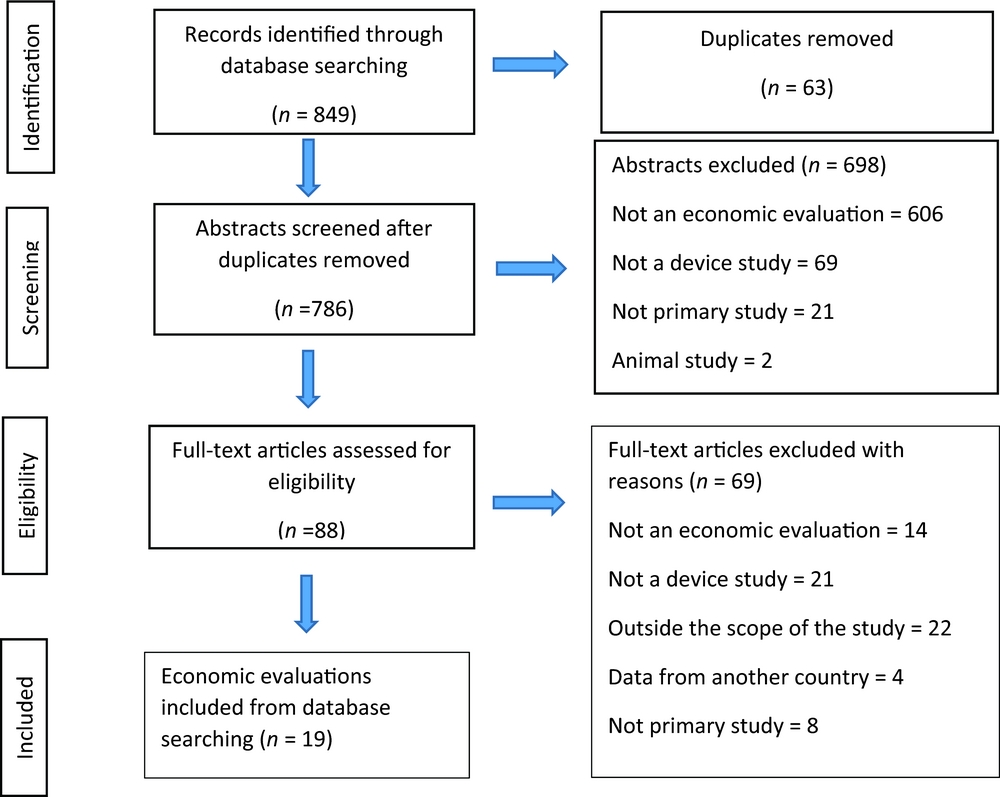
The literature search initially identified 849 potentially relevant citations. Of the eleven devices chosen for analysis, we found Canadian economic studies for five. We selected eighty-eight full articles for review; nineteen of these met the selection criteria. Figure 1 outlines the selection of studies in our review.
PRISMA flow diagram for literature review.

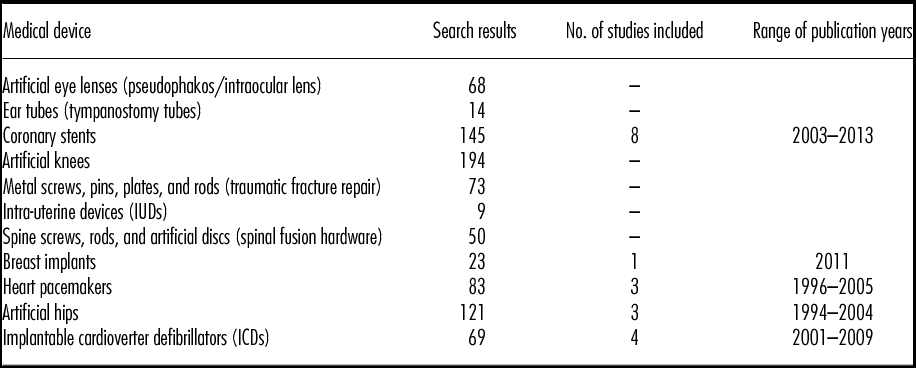
The studies were analyzed for the type of device they evaluated, as shown in Table 1. The inclusion criteria were fulfilled by eight studies (Reference Brophy and Erickson10–Reference Wijeysundera, Tomlinson, Ko, Dzavik and Krahn17) which evaluated the use of coronary stents, four studies (Reference Filion, Xie, van der Avoort, Dendukuri and Brophy18–Reference O’Brien, Connolly and Goeree21) evaluating ICDs, three studies (Reference Antoniou, Martineau and Filion22–Reference Laupacis, Bourne and Rorabeck24) for artificial hips, three studies (Reference Gillis25–Reference Rinfret, Cohen and Lamas27) for heart pacemakers, and one study (Reference Jansen and Macadam28) analyzing breast implants. No economic articles were identified for the remaining six of the eleven top devices.
Medical Devices Included in the 11 – Top List and Number of Economic Evaluations Published

Of the nineteen studies, eight used the buyer's price as the device cost (Reference Brophy and Erickson10;Reference Poulin, Rinfret and Gobeil13;Reference Rinfret, Cohen and TahamiMonfared14;Reference Wijeysundera, Tomlinson, Ko, Dzavik and Krahn17;Reference O’Brien, Connolly and Goeree21;Reference Antoniou, Martineau and Filion22;Reference Rinfret, Cohen and Lamas27;Reference Jansen and Macadam28), while five used the manufacturer's list price (Reference Goeree, Bowen and Blackhouse11;Reference Shrive, Manns, Galbraith, Knudtson and Ghali15;Reference Wang, Rokoss, Dyub, Gafni and Lamy16;Reference Gillis25;Reference O’Brien, Blackhouse and Goeree26). Six studies did not specify the method of estimating the device's cost. Also of the nineteen studies, eight included a sensitivity analysis for the device cost (Reference Brophy and Erickson10;Reference Goeree, Bowen and Blackhouse11;Reference Shrive, Manns, Galbraith, Knudtson and Ghali15–Reference Filion, Xie, van der Avoort, Dendukuri and Brophy18;Reference O’Brien, Connolly and Goeree21;Reference Jansen and Macadam28). None of the sensitivity analyses were based on actual price distributions. Only three (Reference Filion, Xie, van der Avoort, Dendukuri and Brophy18;Reference Gillis25;Reference Rinfret, Cohen and Lamas27) of the nineteen studies presented the lifetime of the device, but none of these amortized the device cost over the life of the equipment.
The ratio of device price to total procedure cost (including device price) ranged from 6.8% to 95%, with 17.9%, 44.1%, 57.6% for the first, second, and third quartiles, respectively.
Overall, the device costs were important components of total procedure cost, with an average ratio of device to total cost of 44.1%. Observational estimates of the device costs were obtained from buyers or sellers in thirteen of the nineteen studies. The devices frequently lasted for more than 1 year, but standard costing methods for capital equipment were never used.
DISCUSSION
We conducted a review of how Canadian economic analyses reported and used device costs in published economic evaluations of the eleven most used (U.S. Data) medical devices. Our review focuses on the implications of the methods that were used when the authors conducted economic evaluations of the most implanted medical devices. We included only economic evaluations that have been published, although others may have been conducted. Based on our findings, for these most implanted medical devices there were few economic evaluations published. This may be the result of the lack of use of economic evaluations in making choices about the use of devices.
The choice intervention/comparator in all studies was care with a device versus care with no device.
The U.S. Government Accounting Office (29) has noted that there are considerable differences in prices and quality between brands of devices. Yet these differences did not form the basis for any published economic evaluations.
Analysts used any of seller's (list) price, buyer price, and assumed price.
Manufacturers often give discounts to buyers. These may vary for the same device between buyers, with the buyers signing confidentiality agreements. As a result, the buyer's price will vary from the manufacturer's list price. The appropriate price in an economic evaluation is the actual transaction price, which is the buyer's price, but this price was only used in eight of the nineteen studies.
Drummond et al. (9, page 75) provide a formula for the measurement of the equivalent annual cost which includes the capital price of the device, depreciation over the useful life of the device, and the opportunity cost of capital. In fact, most studies that we reviewed treated the capital cost as a fixed expenditure in the base year. They did not consider whether or not providing the appropriate costing method would make a difference to the cost-effectiveness ratio.
In addition to this, prices will likely differ between subclasses of devices, so a conceptual analysis of subclasses of products and an analysis of how prices differ between sub-classes would provide additional important information, but the numbers of the studies and devices studied were too small to support such an analysis.
In our analysis, the sample was based on a United States news report, and so the device list is not comprehensive. Nevertheless, the devices identified are all well-known ones, and even for devices on the list, most devices had not been studied. This is not entirely unexpected. Although there is an informal mechanism in place in Canada which incorporates health technology assessment studies into decisions relating to pharmaceutical provision, no such mechanism exists for medical devices. Economic evaluations are supported in four provinces, but there is no formal decision-making mechanism in place to use the results in any prescriptive way.
CONCLUSION
In a country which has used, if not embraced, cost-effectiveness analysis in public decisions, economic evaluations for medical devices are not universally conducted, and when they are, they do not follow recommended rules for conducting them. Our analysis provides suggestions for improvements in how the evaluations are done. However, of course, unless the decisions are made within a rigorous framework, complete with study rules and thresholds, then economic considerations will be marginalized.
CONFLICTS OF INTEREST
The authors report they have no potential conflicts of interest.