The use of consultation to involve ‘the public’ in the work of government has played a prominent role in the governance agenda within the last decades. It can be defined as the process through which ‘government asks for and receives citizen’s feedback on policy-making’ by gathering the views of either individual citizens or various collective actors, such as interest groups, companies and other public authorities. Even though many countries have a long-established culture of consultation, the relevance and frequency of written consultation is growing (Bozzini Reference Bozzini2007). As early as 1995 the OECD spoke of a ‘strong trend towards renewal and expansion of public consultation in the regulatory environment’ (OECD 1995; see also Hagendijk and Irwin Reference Hagendijk and Irwin2006; Kane and Bishop 2002; Kerley and Starr Reference Kerley and Starr2000).
Such consultation is expected to have several positive benefits. The expertise gathered may help improve the quality of public policy. It may also strengthen political responsiveness to citizen concerns and in this way increase trust in government and democracy more generally (Chabanet and Trechsel Reference Chabanet and Trechsel2011; OECD 2001; UK Government 2012). According to Holland (Reference Holland2002: 76), ‘Consultation is supposed to be a touchstone in modern democracy. It is supposed to make government both more response to the community and more legitimate in the eyes of that community.’
Nowadays, consultation has become the rule rather than the exception in liberal democracies when new policies are adopted and a large number of different tools of consultation have proliferated. For decades the interest group literature has drawn a clear distinction between corporatist societies with strong bonds between a few selected groups and the state and pluralist societies with more open and varied access. An interesting trend is that countries with such differences in state–society structures are using similar tools for civil society involvement in practice (OECD 1995, 2001). A good example is the spread of written government consultation, which provides a formal channel of access for citizens and associations to voice their views on new government initiatives (Bozzini Reference Bozzini2007).
At the same time, little is known of whether these seemingly similar instruments are designed and used in the same way in practice. A crucial element of the conduct of written consultation is participant selection. According to the OECD handbook of consultation (2001: 60), an important aspect of any consultation exercise is to secure ‘openness and equal access’ since ‘if citizens and participants are not selected representatively, but are chosen because of their closeness to the government or its officials, then results will be flawed and can lead to mistrust’. The aim here is therefore to examine systematically participation in written government consultation procedures. The article starts by theorizing how participation can be expected to vary between political systems and different types of actors. Next, it tests those predictions on a data set of approximately 5,000 responses to consultations in Denmark and the UK and by reviewing official sources on the conduct of written consultation in these systems.
The findings show that, despite the alleged weakening of the corporatist model in European politics (see, for example, Crepaz Reference Crepaz1994; Lindvall and Sebring Reference Lindvall and Sebring2005; Öberg et al. Reference Öberg, Svensson, Christiansen, Norgaard, Rommetvedt and Thesen2011), there is cross-national variation in participation in written consultations between neo-corporatist Denmark and the neo-pluralist UK even when controlling for the policy areas of activity. Danish consultations are dominated by interest group participants whereas companies make up a considerably higher share of the British participants. Moreover, within the interest group category, the overall share of specialist interest groups representing business, labour, occupational and institutional associations is higher in Denmark than in the UK.
A detailed investigation of the Danish data shows that this trend is reinforced by the fact that corporatist interest group types are also more likely to respond to an invitation to participate in written consultations than groups representing public and other interests. Overall, the findings indicate that the results of consultation are heavily conditioned by the design of these processes, which is in turn constrained by the historical legacy of state–society structures of the political system in question.
Written Government Consultations
As already mentioned, consultation refers to the process through which a ‘government asks for and receives citizens’ feedback on policymaking’ (OECD 2001: 15). Many different institutional mechanisms for hearing the public have developed in modern liberal democracies (Bishop and Davis Reference Bishop and Davis2002). Kane and Bishop (2002: 87) explain how ‘“Consultation” has been one of the key notions in administrative policy for some years’, and that ‘In every policy cycle the expectation is that provision will be made for stakeholder identification and subsequent consultation’. Building on Pateman (Reference Pateman1970) and Thomas (Reference Thomas1990, Reference Thomas1993), Bishop and Davis (Reference Bishop and Davis2002) propose a sliding-scale model in which public participation can be situated between solely providing information to the public at one end and providing the public with complete control at the other. Such mechanisms range from exercises in which everyone can participate, such as open online consultations and conferences, to restricted consultations, such as hearings of members of advisory committees (see, for example, European Commission 2002). Written government consultations serve as one of the most important ways of hearing the views of external stakeholders (Bozzini Reference Bozzini2007; Rasmussen and Toshkov Reference Rasmussen and Toshkov2013). They are, of course, only one form of public participation and stand in contrast to deliberative forms of consultation. It is important to bear in mind that all the different forms of consultations do not substitute but complement personal and informal contacts on policy proposals. However, written government consultations are one of the most important forms of public consultation in Western democracies and have gained increased relevance and use in the last decades in a large number of countries and international organizations (Alexandrova et al. Reference Alexandrova, Lindeboom and Rasmussen2011; Bozzini Reference Bozzini2007; Rasmussen and Alexandrova Reference Rasmussen and Alexandrova2012; Rasmussen and Carroll Reference Rasmussen and Carroll2014; Rasmussen et al. Reference Rasmussen, Carroll and Lowery2014). In this way, they can be perceived as providing an important link between state and society.
There is no lack of criticism of the use of consultation and participatory exercises in general (see, for example, Ballamingie Reference Ballamingie2009; Hagendijk and Irwin Reference Hagendijk and Irwin2006; Holland Reference Holland2002; Irvin and Stansbury Reference Irvin and Stansbury2004). It is clear that we cannot equate participation in a consultation with the exercise of real influence. In fact, some scholars argue that stakeholder participation may not have much effect in practice and thus may not contribute to democracy in the desired way. However, Jordan and Greenan (Reference Jordan and Greenan2012: 71) present a more positive view by arguing that ‘If such contact is all window dressing rather than evidence of real group influence, as skeptics suggest, it is fooling the campaigning groups themselves who continue to make such efforts’. The model of Bishop and Davis (Reference Bishop and Davis2002: 22) also rests on the basic assumption that ‘those being consulted have the capacity not only to comment, but to influence the final disposition of the policy proposal’.
Selection procedures are one of the most crucial elements of the design of consultations. To a great extent, the success and legitimacy of a public consultation rest on who participates in it (Ballamingie Reference Ballamingie2009; OECD 2001). Typically, written government consultations do not restrict access but are in principle open to participation from a broad range of actors, including private individuals, interest groups, companies and public authorities. However, in practice special efforts are often made to encourage participation from certain stakeholders by sending invitations to stakeholder lists and so on.
Who participates in written consultations is still something we know very little about. Hence, whereas there is an emerging literature on public participation and its normative implications, there is a general lack of systematic research on the types of actors represented and the selection procedures in written consultation procedures. This is surprising since who participates is likely to have important implications for the broader impact of the consultation exercises. In its consultation guidelines, the OECD states:
Whom to select for consultation is not only crucial for the quality of answers received through consultation, it is also crucial for the effectiveness of consultation. If citizens and participants are not selected representatively, but are chosen because of their closeness to the government or its officials, then results will be flawed and the exercise may lead to mistrust rather than more trust in government. Setting, publishing and following clear rules and conducting selection transparently can help. (OECD 2001: 60)
What Explains Who Participates?
Our goal here is therefore to systematically examine participation in consultation procedures. We theorize that both system- and actor-level characteristics may influence the ease and willingness of different actors to participate.
Overall Differences between Actor Types
Consultations can attract a range of different actor types, such as public entities, companies, interest groups, individuals and so on. However, we would not necessarily expect the representation of these actors to be equally strong. Our prediction is that interest groups may have certain advantages. First, it is generally much easier for a public authority conducting a written consultation to identify the relevant interest groups than the individuals or private companies with interests at stake. Second, the government may also make more effort to invite relevant interest groups than other actors. This involves fewer transaction costs because such groups often represent a higher number and broader range of interests. Public bureaucracies are under significant pressure to ensure that they spend public money efficiently and effectively (Irvin and Stansbury Reference Irvin and Stansbury2004) and may therefore be inclined to establish links with actors most likely to represent large populations. By involving interest groups, the public bureaucracies are able to fulfil their tasks quickly and effectively. Moreover, one of the specific purposes of conducting consultations is to give such external interests an opportunity to voice their views in order to increase the legitimacy of policy-making. Interacting with specific companies may be regarded as less legitimate by government officials since they represent a narrower range of interests than the groups do. Special emphasis should also be put on interacting with interest groups rather than other types of actors, such as political parties and other public authorities. Political parties often become involved later in the decision-making processes anyway, and the views of other public authorities can be taken into account in other ways.
Third, interest groups themselves may be particularly keen to participate in written consultations. Compared with individuals, they are generally able to rely on organizational expertise and staff that help them fulfil the requirements of participation. Interest groups frequently draw their expertise from a high degree of specialization in specific issue areas (Baumgartner and Leech Reference Baumgartner and Leech2001). Moreover, lobbying is likely to be more important in the work of an interest group than for companies and public authorities. Groups do, of course, do many things other than lobbying (Schmitter and Streeck Reference Schmitter and Streeck1999), but they generally have a narrower set of tasks than companies and public authorities. The definition of an interest group is typically that it is an association of individuals or organizations, and its core task is to attempt to influence public policy.Footnote 1 Our first hypothesis is therefore:
Hypothesis 1: Interest groups submit a higher share of the consultation contributions than other actor types.
We can also distinguish between the different types of interest groups that participate. Here a key distinction in the literature is between groups representing specific interests – such as business groups and unions – and ‘cause groups’ representing more diffuse interests, such as public interest groups and identity groups (see, for example, Binderkrantz Reference Binderkrantz2005). We would not necessarily expect that these group types would have equal participation in the consultation. First, there may be variation in the resources of these different group types. Labour and business groups will often have more resources than other group types, such as those representing minorities or diffuse public interests. Interest group studies show that a group’s level of resources is crucial for determining its degree of access to decision-makers (see, for example, Eising Reference Eising2007). The literature on bias in interest representation generally finds that business dominates representation (for example, Baumgartner and Leech Reference Baumgartner and Leech2001; Gais Reference Gais1996; Rozell and Wilcox Reference Rozell and Wilcox1999; Schlozman Reference Schlozman1984, Reference Schlozman2010) and typically argues that resources play an important role predicting these patterns. Trade unions, which have successfully monopolized the function of employee representation in many parts of the world, can also be expected to have some resource advantages. Like business groups, they also represent interests of core concern to the national economy and have a high number of members who pay substantial contributions to the work of the organizations. Interest groups representing institutional interests, such as the major ones organizing sub-national authorities, can be included in this category of groups possessing a high level of resources. Even if participation in written consultations does not require a substantial amount of resources, the resource advantages of these groups might increase the likelihood that they will participate.
Irrespective of resource levels, groups representing diffuse interests may be less inclined to use participation in national government consultations as a lobbying strategy than other group types. The interest group literature distinguishes between so-called insider and outsider strategies (for example, Binderkrantz Reference Binderkrantz2005, Reference Binderkrantz2008; Grant Reference Grant2001, Reference Grant2004; Kollman Reference Kollman1998). Insider strategies focus on getting direct access to the decision-makers whereas outsider strategies rely on indirect strategies of pressure where the public is mobilized to seek influence. Participation in written government consultations is part of the repertoire of insider strategies. There is not necessarily a trade-off between insider and outsider strategies; many groups use both. However, we see that ‘cause groups’ representing public and identity interests are somewhat more likely than other group types to use outsider strategies and less likely to contact the administration directly (see, for example, Binderkrantz Reference Binderkrantz2005; Gais and Walker Reference Gais and Walker1991).
Our second hypothesis is therefore:
Hypothesis 2: Groups representing business, labour, occupational and institutional interests account for the majority of the interest group contributions in the consultations.
System-Specific Differences between Actor Types
In addition to these overall differences in how strongly different actor types participate in consultations, we can also expect some system-level differences in how influential a role different actor types play. As far as political systems are concerned, a key distinction is between corporatist and pluralist systems. A literature review indicates how corporatism ‘matters for the way interest organizations behave and it matters for the contents of public policy’ (Blom-Hansen Reference Blom-Hansen2001: 177). Corporatist systems have typically been characterized by strong relationships between the state and interest groups, some of which have privileged access to the state (Kenworthy Reference Kenworthy2003; Schmitter Reference Schmitter1979; Streeck and Kenworthy Reference Streeck and Kenworthy2005). According to Rommetvedt et al. (Reference Rommetvedt, Thesen, Christiansen and Nørgaard2013: 460), corporatism is the ‘institutionalized and privileged integration of organized interests in the preparation and implementation of public policy’. In pluralist systems, the institutionalized bonds between the state and groups are weaker. No major barriers impede mobilization and the idea is that policy is to a greater extent fleshed out in open debate and deliberation (Truman Reference Truman1951; McFarland Reference McFarland2007). No system ever fitted one of these ideals fully (Christiansen Reference Christiansen2012; Damgaard and Eliassen Reference Damgaard and Eliassen1978), and labels such as neo-corporatism and neo-pluralist were invented to refer to the modified versions of these ideal types (see, for example, Marks Reference Marks1985; McFarland Reference McFarland2007). Moreover, evidence shows that corporatism has declined in many European countries since the 1970s (see Blom-Hansen Reference Blom-Hansen2001; Crepaz Reference Crepaz1994; Lindvall and Sebring Reference Lindvall and Sebring2005; Öberg et al. Reference Öberg, Svensson, Christiansen, Norgaard, Rommetvedt and Thesen2011; Rommetvedt et al. Reference Rommetvedt, Thesen, Christiansen and Nørgaard2013). At the same time, differences in state–society structures still remain in the degree of privileged integration of organized interests in policy preparation and integration.
Such differences in the legacies of state–society relationships in different systems can be expected to influence participation in consultations. First, we may expect a higher share of contributions to come from organized interest groups in a neo-corporatist than in a neo-pluralist system. The whole philosophy of a neo-corporatist system is that the government should work towards establishing close bonds with such organized interests because this is the most effective way of reconciling policy matters and ultimately what is best for the economy (Schmitter Reference Schmitter1979). There may be fewer groups in a neo-corporatist than a neo-pluralist system, but maintaining frequent contacts with organized interests is a useful and desirable objective for government officials. In contrast, pluralist systems put a higher emphasis on maintaining open and equal access, not just for different types of interest groups but also for actors in general, including individuals and companies.
Second, we know that even if counting and locating relevant stakeholders in a corporatist system is not always easy, it can generally be expected to be somewhat easier in a neo-corporatist than a neo-pluralist one. Recent research by Christiansen (Reference Christiansen2012: 174–5) argues that the reason for this is that the institutionalized system of representation of corporatism tends to produce ‘a high awareness of the structure of interests’ and ‘a materialization of this awareness in the form of list, registers, or directories of interest groups’. As emphasized by Jordan and Halpin (Reference Jordan and Halpin2012: 246), this means that, ‘paradoxically, counting groups may be more difficult in open democracies than in some other situations’. The consequence is that it should be easier for government officials to maintain close links to and involve relevant organized interests in written consultations in a neo-corporatist than in a neo-pluralist system.
Third, interest group participants in a neo-corporatist system may also place a higher value on participation in consultation than do groups in a neo-pluralist system. We know that even if parliaments have gained increasing importance in many neo-corporatist settings (Rommetvedt Reference Rommetvedt2005; Rommetvedt et al. Reference Rommetvedt, Thesen, Christiansen and Nørgaard2013), the government is typically regarded as a more important point of contact in such systems than in neo-pluralist ones. Moreover, interest groups may feel more obliged to participate in a neo-corporatist system than in a neo-pluralist system, which has more loosely coupled links between stakeholders and the government. Based on these considerations, Hypothesis 3 is therefore:
Hypothesis 3: The share of contributions from organized interests participating in written government consultations is higher in a neo-corporatist system than in a neo-pluralist one.
We may also expect some variation in the different types of participating interest groups in consultations between neo-corporatist and neo-pluralist systems. First, we know that even if a neo-corporatist system distinguishes itself from a neo-pluralist one by having institutionalized links to organized interests, it is the major groups in the economic area, such as business and labour, which often have privileged access to the state. Officials can also be expected to play a particularly strong role involving such actors in a corporatist setting. The idea in a corporatist setting is that their support and expertise is crucial for securing good quality policy in line with the views of the voters, with a high chance of successful implementation. In a corporatist system, the leading economic groups are regarded as crucial stakeholders for reaching compromises on significant policies, which are often adopted through tripartite representation between government, labour and business (see, for example, Thomas Reference Thomas2001).
Second, the reason that such ‘corporatist interest groups’ may be more strongly represented in a neo-corporatist system may be that it is easier to locate those group types and encourage them to participate to begin with. An important finding from Christiansen’s mapping of the Danish group population (2012) was that, even though we expect group counting to be relatively easier in a corporatist than in a pluralist setting, corporatist settings also include policy areas with group types with less institutionalized links to the state in which it is hard to map the population of groups. Analysing the Danish case, he argued that ‘it is probably no coincidence that the best lists of interest groups were produced in the agricultural sector and the labour market sector’ (Christiansen Reference Christiansen2012: 175), both of which were heavily corporatized. Hence, the government should have an easier time mapping and inviting the interest group types that play a prominent role in the corporatist areas. As already mentioned, such groups typically do not only include the major peak groups in the economic area but also many interest groups representing institutional interests, such as those organizing sub-national authorities.
In sum, Hypothesis 4 is:
Hypothesis 4: The share of contributions from groups representing business, labour, occupational and institutional interests is higher in a neo-corporatist system than in a neo-pluralist one.
Research Design And Hypotheses
To examine whether participation is affected by the outlined system- and actor-level effects, we examine consultation contributions and official consultation policies in Denmark and the UK. Denmark and the UK have been selected because they are countries with different traditions of state–society structures. Denmark was one of the five examples of societal corporatism mentioned by Schmitter (Reference Schmitter1979: 2) and thus represents an ideal typical case of continental, corporatist history of interest representation, despite declines in corporatist structures. In contrast, the UK legacy of state–society interaction is clearly pluralist with a considerably lower level of institutionalization of state–society interaction (Lijphart and Crepaz 1991; Siaroff 1999). Hence, our comparison serves to contrast the different uses of public consultations as well as to discover whether similarities or comparable mechanisms exist in political systems with corporatist and pluralist legacies. As such, a comparison of public consultations in Denmark and the UK represents a most-dissimilar systems design (Seawright and Gerring 2008: 299–302).
We use a mixed-methods design to test our hypotheses. For the qualitative analysis, we rely on official documents from the countries and the OECD describing the conduct of written government consultations, such as codes of conduct, reviews of consultation practices and so on, as well as a few secondary sources on consultation within these systems. For the quantitative analysis, we have constructed a database of information available online about actor contributions to a large number of Danish and British national government consultations issued in the first half of 2008.Footnote 2 Faced with the trade-off of choosing to examine either a shorter period and all policy areas or a longer period but only a few policy areas, we opted for the latter. Hence, including a broad range of policy areas is very important since we can expect both the number of actors and diversity of different actor types to vary considerably between policy areas. The policy area of the consultation in question therefore serves as a very important control in all our analyses. Moreover, even though the quantitative part of our analysis focuses on consultations from the first half of 2008, it is based on a high number of consultation responses. Altogether, our data set contains 1,629 contributions from 119 Danish consultations conducted under 17 different ministerial jurisdictions and 3,303 contributions from 69 British consultations conducted by 20 different public authorities.
The first half of 2008 was the most recent half-year period when we started the data collection. This was an advantage since we relied on information about these consultations published online. Second, the period was not one marked by elections in either of the two systems. We wanted to avoid gathering data from an election year, where the conduct of consultations might differ, both in terms of frequency and in which external actors are invited and choose to participate. Third, analysing information from 2008 had the advantage that we examined a period of time some years after the new consultation practices of the UK Blair government were launched. In this way, we allowed these new practices some time to become institutionalized before putting them under scrutiny.
We singled out Danish consultations by visiting the web page ‘Hoeringsportalen’ (http://borger.dk/forside/lovgivning/hoeringsportalen). This is an official web page which contains information about consultations and it is typically possible to see which organizations the ministries have invited to participate and which organizations have responded. It is the individual ministries themselves that upload the information to this web page and they have been obliged to do so since 15 June 2005. In the UK we relied on the consultation web pages of the different government departments (www.direct.gov.uk/en/Governmentcitizensandrights/UKgovernment/PublicConsultations/DG_170463). These vary in format, but typically contain a list of consultations and in many cases also information about participating actors.
In both countries coders went through the web pages of the participating actors to determine the actor type. We distinguished between: companies; public authorities; private persons, action groups or client councils; interest groups; and other actors. The last category includes groups such as political parties and advisory councils to the government, which often have a mixed membership consisting of actors from multiple categories. An interest group was defined here as ‘a formally organized, non-governmental association of individuals and/or groups that attempts to influence public policy’. In contrast to an action group, which consists of a loosely connected number of individuals united around a common cause, an interest group represents a more institutionalized form of cooperation with a formal structure.
Coders determined the type of interest group by using a coding scheme developed in the Interarena project (www.interarena.dk) and distinguished between the following main categories: trade unions; business associations; associations representing institutional interests (for example, organizations of public institutions and regional and local authorities); occupational associations; identity groups (for example, organizations representing women, older people, lesbians/gays, patients and students); public interest groups (such as environmental, consumer, government reform, civil liberties and humanitarian groups); and other interest groups (including hobby and leisure groups and religious groups).Footnote 3 Finally, the policy area of the consultation to which a contribution was submitted was coded by using the policy codes from Baumgartner and Jones’s agenda-setting project, whose codebooks have been adapted to the national contexts in Western Europe in a recent project.Footnote 4 The coding was carried out by two individual coders and ‘disagreements’ checked by an experienced coder.
The first part of the quantitative analysis compares participation across actor and interest group types in the two systems across the 4,932 contributions. In a second step, we conduct a detailed investigation of the Danish data, examining what the likelihood is that different actor/interest group types invited to participate in government consultations actually respond. This allows us to see how different actor/interest group types respond to the efforts of governments to encourage their participation. We focus on Denmark since a special feature of the Danish system of consultation is the heavy reliance on so-called ‘consultation lists’ where relevant respondents are singled out beforehand. This part of the analysis includes all Danish consultation invitations recorded in the data set where we also had a list of participants available when the data was collected – 5,871 cases from 117 consultations.Footnote 5 It uses logistic regression since the dependent variable (response versus non-response) is binary.
Analysis
Both Denmark and the UK have long traditions of consulting external stakeholders in the preparation of new policies (OECD 2010a, 2010b). At the same time, we can identify important differences in the conduct of consultation between the two. The OECD (2010b: 77/79) explains, ‘The United Kingdom has an established culture of open consultations aimed at maximizing transparency in the process’, and ‘this can be contrasted with a very different approach in many other European Countries, which have more closely structured traditions of consultations that particularly engage the social partners’. Denmark is closer to the latter. According to the OECD (2010a: 61), consultation is an essential part of Danish culture and its ‘approach takes advantage of the small size of the country and small closely connected ministries where “everybody knows each other”’. However, it is important to be aware that consultation in Denmark combines small informal consultations with large-scale formal ones.
This means that both the UK and Denmark use written government consultations. In the UK, the Blair government (1997–2007) decided to put a specific emphasis on this form of consultation (Fishkin et al. Reference Fishkin, Luskin and Jowell2000; Grant Reference Grant2004; Martin Reference Martin2008). In 2000, it adopted its first code of conduct on consultation, which presented the government’s approach to the conduct of written consultations (Chabanet and Trechsel Reference Chabanet and Trechsel2011; OECD 2010b). It was subsequently revised in 2004 and 2008 (UK Government 2004, 2008). As a part of Civil Service reform, it was updated in 2012 in a series of consultation principles (UK Government 2012), which were revised in 2013 (UK Government 2013). Neither the code nor the principles have legal force, but establish common standards for the conduct of consultation across the different branches of the government (Chabanet and Trechsel Reference Chabanet and Trechsel2011).
In Denmark, there is no formalized code of conduct for the consultation process. However, tradition and internal government guidelines provide for a highly institutionalized system for the conduct of consultations (OECD 2000, 2010a). Moreover, the Guidelines on Quality of Regulation issued by the Ministry of Justice and updated in 2005 (Ministry of Justice 2005) and Lovprocessguide Footnote 6 describe the procedures for public consultations before a draft law is tabled before parliament. Since 2005, there has also been a mandatory central database of all consultations, which is provided by the online portal ‘Hoeringsportalen’ (OECD 2010a). This portal usually contains additional information on the consultation as well as a list of consulted organizations and respondents. The practice is to conduct consultations not only on draft laws, but also on a broad range of other acts, such as draft executive orders, guidelines, technical standards, policy and strategy papers and so on (OECD 2010a).
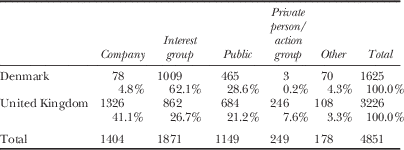
Tables 1 and 2 present an overview of the consultation contributions across actor and interest group types in the two countries. In Table 1, we see that interest groups make up the largest actor category of all responses as a whole, as we expected in Hypothesis 1. This supports the idea that governments should be particularly keen to involve groups in consultation exercises and that the groups should value participation in consultation exercises highly. A binomial test reveals that the share of interest groups is significantly higher (p<0.01) than that of companies, which make up the second largest actor category of consultation participants. In addition to groups and companies, we also see that a substantial share of national government consultation contributions come from other public authorities rather than from external stakeholders.
Actor Types

Note: Pearson chi-square sign below 0.01.
Interest Group Types

Note: Pearson chi-square sign below 0.01.
Table 2 presents strong evidence for Hypothesis 2 that interest group participation is dominated by organizations representing business, labour, occupational and institutional interests. Governmental decision-makers may indeed do more to involve such groups, whose resource advantages and position in the political system in general may also stimulate participation. These categories of groups account for 75 per cent of the interest group contributions which were sent.
Interestingly, we find quite substantial differences in the distributions between actor and interest group types between the UK and Denmark, which are again statistically significant. In line with Hypothesis 3, the share of interest group contributions in neo-corporatist Denmark is more than double the level found in neo-pluralist UK. In contrast, direct firm participation plays a much stronger role in the UK than in Denmark and accounts for over 40 per cent of the UK consultation contributions. Moreover, in line with Hypothesis 4, we see that the share of interest groups representing business, labour, occupational and institutional interests is 18.5 percentage points higher in neo-corporatist Denmark than in neo-pluralist UK. Trade unions and organizations representing institutional interests especially are more strongly represented in Denmark than in the UK.
We have conducted additional tests which show that these differences in the representation of actor and interest group types between Denmark and the UK are generally robust to controlling for the policy area of the consultations. The distributions across actor types were significantly different between Denmark and the UK for all policy areas. Furthermore, interest groups accounted for a higher share of the participants in all policy areas in Denmark than in the UK except for agriculture and law, crime and family issues, where public authorities play a strong role in the Danish context. We also saw that the joint representation of labour, business, occupational and institutional interests was stronger in Denmark than in the UK in two-thirds of the nine examined policy areas.Footnote 7
Not only the actual distributions between actor and interest group types but also the policy documents and policy reviews from Denmark and the UK reveal differences in the conduct of written consultations between the two systems. The strong Danish emphasis on interacting with organized groups is, for example, reflected in Chabanet and Trechsel’s recent review of Danish consultation practices (2011: 42), which states how ‘Cooperation between public institutions adopting official decisions and civil society is seen and felt in every sphere of the political life of Denmark’. In contrast, the strong presence of companies in the British context, where they account for 41 per cent of all contributions in the examined period, is in line with the explicit policy of the government of the time. According to the preface written by then Prime Minister Tony Blair to the 2000 code, the Labour government had ‘made a special effort to work better with business’ (UK Cabinet Office 2000: 1).
Interestingly, we also see that, despite the high number of company contributions, the participation of business interest groups in the UK context is not weaker than in the Danish one. In fact, adding company and business group contributions demonstrates a stronger business dominance in the UK than in the Danish system. Criticism of the UK has suggested that even if ‘the stated intention of the code was to make written consultations more effective, opening decision-making to as wide a range of people as possible’, a clear hierarchy has existed between different types of organizations which the government listens to (Grant Reference Grant2004: 411/412). When revising the code of consultation in 2008, the Better Regulation Executive (2008) also suggested a list of societal groups that were in danger of being excluded, or, in its own words, ‘that may warrant particular attention’ and emphasized the need to reach out beyond a group of ‘usual suspects’.
However, this does not change the fact that overall the participation of different actors in the UK is more pluralistic, in the sense that there is a more equal distribution of a broader range of actor types than in Denmark. A Hirchmann–Herfindal index, calculated as the sum of squared proportions that fall in the different categories, shows a higher concentration of contributions in the different actor categories in Denmark than in the UK. Hence, even if access is clearly not equal for the different actor types in the UK, the system shows greater diversity between the examined actor types than in Denmark. Most noteworthy is that more ‘private persons, action groups or client councils’ are involved in the UK system than in Denmark, where they are virtually non-existent. We also see that within the pool of active interest groups there is a higher share of public and identity interest groups in the UK than in Denmark, exactly as we would expect in a neo-pluralist system.
Some of these differences may result from differences in the underlying societal structures of the two countries. The reason we see more identity and public interest groups in the UK may simply be that the share of such groups in the population of interest groups as a whole is higher in the UK than in Denmark. However, it is unlikely that such societal differences alone explain the differences found here. Moreover, they clearly cannot explain the overall differences between actor types, such as individuals versus organized interests. It is more likely that they are linked to differences in the consultation policies of the two systems. Hence, even if the goals are not necessarily achieved, there is a stronger emphasis on ensuring that many different types of actors participate in the British than in the Danish consultation policy.
All British consultation codes have very explicitly promoted a very inclusive approach to participation and have sought to ensure that consultation is conducted beyond a group of ‘usual suspects’ and encouraged departments to ‘reach beyond’ these. A culture of open and transparent consultation processes exists (OECD 2010b: 77) with the encouragement to consider how proposals affect ‘the wide range of private, public and independent groups and individuals’ (Better Regulation Executive 2008). Government departments need to justify their reasoning if they do not consult widely and decide to follow a different approach to the code set out (OECD 2010b). In line with this, the 2012 UK code states that ‘Policy makers should think carefully about who needs to be consulted and ensure the consultation captures the full range of stakeholders affected’ (UK Government 2012: 2). The revised version of these guidelines from October 2013 even strengthens these provisions somewhat by stating that ‘Policy makers should be able to demonstrate that they have considered who needs to be consulted and ensure that the consultation captures the full range of stakeholders affected. In particular, if the policy will affect hard to reach or vulnerable groups, policy makers should take the necessary actions to engage effectively with these groups’ (UK Government 2013: 2).
The Danish approach to interacting with external stakeholders has been criticized by the OECD for its lack of openness and lack of transparency of the widely used informal consultation practices. Its 2000 review asked Denmark to ensure that ‘individuals and relatively less well-organized groups have adequate access to the process’ (OECD 2000). The more recent OECD review of Denmark is much more positive and praises the efforts made to spread knowledge of the written government consultations, but emphasizes that ‘Progress in ensuring transparency needs to be consolidated’ (OECD 2010a). The practice is that relevant ministries maintain gross lists of the active groups in their area, from which they choose a selected set of groups that are invited to participate in each written government consultation. As already mentioned, hardly any guidelines for the conduct of written consultation exist and there is generally much less emphasis on ensuring that a broad range of actors participate in the Danish context. The guidelines for the drafting of legislative proposals for civil servants (‘Lovprocesguide’) state, ‘it is obviously not possible to specify in general terms who needs to be consulted on a new draft law, but that, as a general rule, public authorities and private organizations etc. which will be affected by the proposal (either from a practical or more principle point of view) should be consulted. It is preferable to consult too many rather than too few.’Footnote 8 The formulation in the regulation on law quality is even shorter but almost identical (Ministry of Justice 2005).
These formulations leave it unclear whether Danish consultations are fully ‘open’ in practice. In fact, if one goes to the Hoeringsportalen web page, where all consultations are announced, it is stated that the purpose of the portal is ‘to give the public digital access to draft laws, draft executive order etc. and hearing responses in order to increase transparency in the legislative process. In this way, interested citizens, companies and organizations can monitor which rules are in the pipeline, who has been consulted and which hearings responses have been submitted.’Footnote 9 In other words, it is not stated that the purpose of announcing these consultations publicly is for individual citizens and companies to be involved but rather for them to be informed about what is going on.
At the same time, there are no rules preventing actors that do not appear on the consultation lists from sending responses. Key informants in the Danish Ministries of Finance and Justice were contacted; they stated that it is unlikely that uninvited participants would be rejected access if they sent a response. At the same time, our quantitative data set reveals that only 6.4 per cent of the responses received in Denmark were from actors that were not on the consultation lists to begin with.Footnote 10
In the UK, lists of potential consultees are also used, but government departments do not have as exhaustive ‘gross lists’ of stakeholders as the Danish ones do, partly because the systematic use of written government consultations is of a more recent nature. This makes it more likely that ‘uninvited responses’ are received, as does the fact that a much higher share of companies and ‘private persons, action groups or client councils’ participate. They are less likely to be placed on a list of potential stakeholders to begin with because mapping them is harder and it may be less ‘legitimate’ to invite them, as already discussed. A high share of pre-invited Danish responses does not necessarily indicate a lack of transparency, of course. At the extreme all respondents could be pre-invited, but the processes could still be open and transparent because the government had a perfect overview of all stakeholders. Regardless, this shows that the practices of involving external actors in similar consultations vary considerably between neo-corporatist Denmark and the neo-pluralist UK.
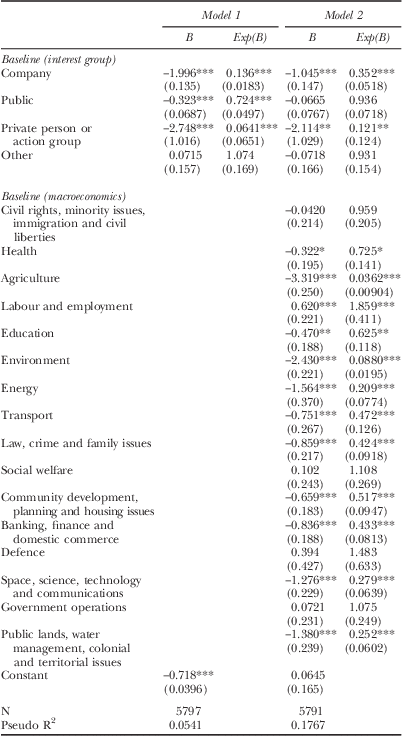
The Danish practice of ‘pre-invitation’ deserves further attention. We have been able to conduct an analysis that compares the invited actors with the respondents for the consultations for which lists of respondents were available at the time the data were collected. It shows that the actor and interest group types that tend to dominate in the responses are also the ones that are most likely to respond once invited. Our logistic regressions in Table 3 look at all actor types and Model 1 indicates that interest groups are more likely to respond to invitations than companies, ‘private persons and actions groups’ and public authorities. Model 2 demonstrates that the first two effects are robust to controlling for policy areas. In other words, when companies and ‘private persons and action groups’ manage to get an invitation to participate by being placed on a consultation list, their response rate is lower than that of interest groups. In substantive terms, the odds of responding to an invitation in Model 2 are 65 per cent lower for a company and 88 per cent lower for ‘private persons or action groups’ than for interest groups. Such actors may have fewer resources available or refrain from participating because they regard it as unlikely that their views are taken into account anyway. Companies have substantial resources, but may prefer to be represented through the interest groups of which they are members or rely on other ways of lobbying.
Responses by Invited Actor Types in Denmark (logistic regression)

Note: Standard errors in parentheses, *p<0.10, **p<0.05, ***p<0.01.
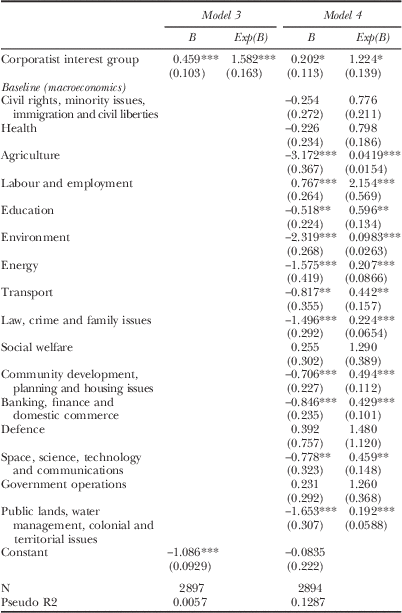
In Table 4 we focus on the interest group invitations and responses only. Here we see in Model 3 that all the strong corporatist players (the groups representing business, labour, occupational and institutional interests) are also more likely to respond to invitations than other types of interest groups (public, identity and other interest groups). The odds of actors from these group types responding to invitations are 58 per cent higher than for actors from the remaining interest group types. The advantage enjoyed by corporatist groups diminishes somewhat in Model 4 when we control for policy areas. However, it is still the case that the odds for corporatist players responding are 22 per cent higher than for non-corporatist ones (p=0.074). As discussed in our theory section, different factors may play a role here, such as the resources of these groups and how much they think their participation will be valued. What these results show very clearly is that the dominance of interest groups in general, and certain interest groups in particular, does not only reflect the eagerness of the Danish government to involve them. Once invited, these actors are also more likely to respond. This underlines how the patterns of representation result from a two-way exchange relationship between civil servants and external actors.
Responses by Invited Interest Group Types in Denmark (logistic regression)
Note: Standard errors in parentheses *p<0.10, **p<0.05, ***p<0.01.
Conclusion
The practice of conducting written government consultations on new pieces of policy is spreading across a broad range of liberal democracies. Although participation in a consultative exercise is no guarantee of actual legislative influence, such consultations act as important ways of hearing the voices of external stakeholders in many national systems. Little is known about the factors that influence the conduct and participation in public consultations in practice.
Our analysis of Denmark and the UK demonstrates that there are overall and system-specific differences in the types of actors that participate in these exercises. Even if public consultations distinguish themselves by reaching out to a broad range of actors, in practice interest groups are more likely to make use of this tool than other actor types. Consultation exercises are dominated by organized interests and public authorities, whereas private persons play a small role. In this way, our findings echo critical voices that argue that consultation does not result in the expected benefits for democracy.
However, these findings show that the effect of seemingly similar consultation tools is highly conditional on the system in which they are used. Despite the alleged weakening of the corporatist model in European politics, we find considerable cross-national variation in the conduct of and participation in public consultations between neo-corporatist Denmark and the neo-pluralist UK. The historical bonds between the Danish state and organized civil society can help explain the much higher share of participants representing organized civil society in this system than in the UK. In contrast, companies and ‘private persons and action groups’ play a stronger role in the UK than in Denmark. This does not mean that the representation of different actor types is equal in the UK at all, but it demonstrates a higher degree of diversity than the Danish case does.
We also see that those interest groups that represent business, labour, occupational and institutional interests play a more important role in the Danish than in the UK case, in line with what we would expect. The corporatist model, of which the Danish case is an example, has been characterized by a well-established and long-standing relationship between the state and exactly these societal stakeholders. Finally, we find differences not only in actual participation but also in the policies used for the conduct of written consultations between the two systems. The UK policy puts a stronger emphasis on securing open and equal access than the Danish one, which relies more on an established system of pre-inviting organized stakeholders. This does not necessarily mean that the Danish model is less transparent than the British one. The Danish authorities may simply have better lists of relevant stakeholders to begin with, which creates less of a need for ‘uninvited’ actors to participate. However, it shows clearly that the practices for involving external actors vary considerably between the two systems.
In this way, our findings indicate that changes in state–society structures in European systems have not transformed fundamental differences in the institutional logics between them, which influence the design and practical conduct of consultation. Participation depends heavily on specific structures and institutional arrangements, which persist and still influence state–society bonds despite recent reforms. Future research should expand on our line of research here by examining the content of the individual consultation responses in more detail, which may vary from short standard formulations to extensive contributions on the policy matter. Moreover, it should systematically examine whether system-level differences also affect participation in other mechanisms for consulting the public, especially those of a more deliberative nature. Our findings indicate that comparative research sensitive to such differences is absolutely crucial for understanding the conduct of consultations.