A central question for SLA researchers has been the extent to which similarities and differences between the first language (L1) and the second language (L2) affect the development and use of the L2. It is not surprising that this question has also been of importance in the small but burgeoning field of L2 real-time sentence processing. In this field, research has often focused on whether observed differences between L2 learners' and native speakers' online processing can be explained by certain contrasting linguistic properties, parsing preferences, or both between the L1 and the L2. An overview of the literature shows that whereas L2 learners might be under the influence of their L1 at the lexical level, particularly where verb subcategorization preferences differ between the two languages (Altarriba, Kambe, Pollatsek, & Rayner, Reference Altarriba, Kambe, Pollatsek and Rayner2001; Frenck-Mestre & Pynte, Reference Frenck-Mestre and Pynte1997; Juffs, Reference Juffs1998), research concentrating on syntactic processing has found mixed results. For instance, a range of studies has investigated how L2 learners resolve relative clause (RC) attachment ambiguities such as The man saw the servant of the actress who was on the balcony, in which the RC can be attached either to the first nominal phrase (NP) the servant or the second NP the actress. This type of construction is of interest because there is a difference in how speakers of different languages prefer to resolve the ambiguity. Some have found that L2 learners apply the parsing preference of their L1 in resolving these ambiguities, at least at lower proficiency levels (Dussias, Reference Dussias2003; Frenck-Mestre, Reference Frenck-Mestre, Sorace, Heycock and Shillcock1997, Reference Frenck-Mestre, Heredia and Altarriba2002); similarly, bilinguals might apply the preference of their most dominant language (Dussias, Reference Dussias and Nicol2001; Fernández, Reference Fernández, Klein and Martohardjono1999). Other studies of L2 learners' processing of such RC adjuncts have found no L1 influence (Felser, Roberts, Gross, & Marinis, Reference Felser, Roberts, Gross and Marinis2003). Furthermore, L2 learners have been found to perform differently than native speakers even when the parsing preference is the same in both the L1 and the L2 (Papadopoulou & Clahsen, Reference Papadopoulou and Clahsen2003). Research into L2 learners' processing of syntactic dependencies has, in general, found no effect of the L1. For example, in the processing of English wh-dependencies, L2 learners appear to pattern together irrespective of whether their L1 instantiates wh-movement or whether ultimately the learner groups perform online like native speakers. Studies that have used online reading methods combined with a metalinguistic task show that L2 learners pattern together with native speakers (Juffs & Harrington, Reference Juffs and Harrington1995; Williams, Möbius, & Kim, Reference Williams, Möbius and Kim2001), whereas results from online studies of reading for comprehension alone find that L2 learners process such dependencies differently than native speakers, even though they ultimately understand the experimental items (Felser & Roberts, Reference Felser and Roberts2007; Marinis, Roberts, Felser, & Clahsen, Reference Marinis, Roberts, Felser and Clahsen2005). The results of these latter studies suggest that the observed differences between L2 learners' and native speakers' online performance might be better attributed to differences in processing procedures rather than to differences in language background. Some authors assume this explicitly, suggesting that L2 learners are less able to use syntactic information effectively online in contrast to native speakers and that they overrely on lexical, pragmatic, or contextual information, or a combination of these, to compensate (Clahsen & Felser, Reference Clahsen and Felser2006; Marinis et al., Reference Marinis, Roberts, Felser and Clahsen2005; Papadopoulou & Clahsen, Reference Papadopoulou and Clahsen2003). Given the evidence, this hypothesis is plausible. However, the constructions used in studies that have found no L1 effect are often necessarily highly complex—for instance, long distance dependencies in which the dependency between the dislocated wh-item and its subcategorizer spans more than one clause. It might be the case that L2 learners differ from native speakers only when online processing demands are high, and so the question arises as to whether such differences between native speakers' and L2 learners' online processing will be observed with less complex dependencies.
In the current study, we explore the online processing and offline interpretation of subject pronouns in Dutch discourse, which are fairly simple everyday syntactic dependencies with which the L2 learners will no doubt have had much experience. We investigate L2 learners whose L1 is either a null subject language (Turkish) or not (German). In nonnull subject languages, such as Dutch and German, the use of overt subject pronouns is obligatory, whereas in null subject languages, they are optional, with the relative distribution of null subjects to overt subjects governed by discourse-pragmatic constraints. Our study contrasts with other studies that have investigated the acquisition and use of subject pronouns in the L2 by L2 learners from nonnull-subject backgrounds learning a null subject language. The syntactic contrast in the L2 learners' respective L1s allows us to tease apart potential effects of the L1 from potential general L2 processing effects. Additionally, even though the constructions under investigation involve simple referential dependencies in a language with obligatory subjects, resolving such dependencies in discourse requires the integration of both syntactic and discourse-pragmatic information, and therefore we can assess whether L2 learners will be influenced by such constraints to the same extent as native Dutch speakers. Before we report the current experiment, we will summarize the factors thought to be involved in the resolution of pronominals in discourse and then give a brief overview of the findings from research into the acquisition and use of pronominals by L2 learners.
RESOLVING PRONOUNS IN DISCOURSE
In most contexts, language comprehension involves connecting phrases and clauses together such that comprehension of coherent discourse can be achieved. Establishing coherence in normal discourse often requires repeated reference to the same discourse entity by use of anaphoric or referring expressions such as definite descriptions (the dog), proper names (Peter), pronominals (he), and null anaphors. Much research has focused on the form and complexity of the referring expression or anaphor and how the choice of a particular referring expression depends on the current discourse focus.Footnote 1 The general finding is that there is an inverse relation between the amount of information in an anaphor and the salience of the discourse referent; that is, the most reduced referring expressions, such as null pronominals and unstressed pronouns in nonnull subject languages, signal coreference with the most highly salient or accessible antecedent in the current discourse representation (Ariel, Reference Ariel1990, Reference Ariel, Sanders, Schilperoord and Spooren2001; Chafe, Reference Chafe and Li1976, Reference Chafe1994; Givón, Reference Givón1983), most likely because they are lexically transparent and thus cannot always uniquely identify their referent (Gernsbacher, Reference Gernsbacher1989). This is illustrated in the examples in (1), with the unstressed pronoun in the Dutch example (1a) and the zero pronoun (pro) in the Turkish example (1b) coreferring with the local referent NP Peter, which is currently the most salient or accessible referent available. In (1c), the Turkish overt subject pronoun o “he” cannot corefer with this local referent and instead corefers with the NP Hans in the earlier discourse.
(1) Peter and Hans are in the office. While Peter is working, he is eating a sandwich.
a. Dutch: Unstressed pronoun
Peter en Hans zitten in het kantoor. Terwijl Peter iaan het werk is, eet hij ieen boterham.
b. Turkish: Zero pronoun
Peter ve Hans jofiste oturuyorlar. Peter içal̅ş̅rken, pro i/*jsandeviç yiyor.
c. Turkish: Overt subject pronoun
Peter ve Hans jofiste oturuyorlar. Peter içal̅ş̅rken, o *i/jsandeviç yiyor.
The properties that influence the accessibility for coreference of a potential antecedent have also been intensively investigated. In cases in which morphosyntactic information, such as gender or number, cannot disambiguate the relationship between a pronominal and a potential antecedent, various (often interacting) factors have been found to affect the prominence or cognitive accessibility of an antecedent. For instance, empirical evidence shows that an ambiguous pronoun will prefer as its antecedent one that is most recently mentioned (Gernsbacher, Reference Gernsbacher1989; Gernsbacher & Hargreaves, Reference Gernsbacher and Hargreaves1988; Gernsbacher, Hargreaves, & Beeman, Reference Gernsbacher, Hargreaves and Beeman1989) or topicalized (Anderson, Garrod, & Sanford, Reference Anderson, Garrod and Sanford1983; Hudson, Tanenhaus, & Dell, Reference Hudson, Tanenhaus, Dell and Clifton1986), or one that appears in the subject position of the previous clause rather than in the object position (Caramazza, Grober, Garvey, & Yates, Reference Caramazza, Grober, Garvey and Yates1977; Gordon, Grosz, & Gilliom, Reference Gordon, Grosz and Gilliom1993; Gordon & Scearce, Reference Gordon and Scearce1995; Grosz, Joshi, & Weinstein, Reference Grosz, Joshi and Weinstein1995; Hudson et al., Reference Hudson, Tanenhaus, Dell and Clifton1986; Stewart, Pickering, & Sanford, Reference Stewart, Pickering and Sanford2000), or one that has identical or parallel grammatical functions or assigned thematic roles to the pronoun (Chambers & Smyth, Reference Chambers and Smyth1998), or a combination of these. Pronominals are also more attracted to a referent that has been introduced by a proper name rather than a definite NP (Sanford, Moar, & Garrod, Reference Sanford, Moar and Garrod1988), because this entity is likely to be considered a topic of the current discourse. Thus, it appears that the primary function of referential pronouns, and zero pronouns in nonnull subject languages, is to maintain reference to topicalized antecedents, and, as such, they serve as default devices signaling that no change of topic has taken place (Arnold, Eisenband, Brown-Schmidt, & Trueswell, Reference Arnold, Eisenband, Brown-Schmidt and Trueswell2000; Garrod, Reference Garrod, Clifton, Frazier and Rayner1994; Karmiloff-Smith, Reference Karmiloff-Smith, Kreiman and Ojeda1980; Marslen-Wilson, Levey, & Tyler, Reference Marslen-Wilson, Levey, Tyler, Jarvella and Klein1982; Marslen-Wilson, Tyler, & Koster, Reference Marslen-Wilson, Tyler and Koster1993).
The exact underlying mechanism at work in pronoun resolution has prompted debate, but it seems clear that on encountering a pronoun in a stretch of discourse, the set of potentially available antecedents in the discourse representation is immediately reactivated, and a reader or hearer must select the appropriate referent from this set, basing the decision on an integration of information from multiple sources (Nicol & Swinney, Reference Nicol, Swinney and Barss2002). Research into the time course of pronoun resolution overwhelmingly suggests that, even in cases in which the pronoun is ambiguous and the discourse context does not narrow down the set of potentially available antecedents, resolution takes place quickly, either at the pronoun itself or in its immediate vicinity (Garrod, Freudenthal, & Boyle, Reference Garrod, Freudenthal and Boyle1994; Gordon & Scearce, Reference Gordon and Scearce1995; Nicol, Reference Nicol1988; Shillcock, Reference Shillcock1982; but compare Greene, McKoon, & Ratcliff, Reference Greene, McKoon and Ratcliff1992).
ACQUISITION AND USE OF OVERT SUBJECT PRONOUNS IN THE L2
Most research on the acquisition and use of pronominals has focused on learners from a nonnull subject background (e.g., English) learning a null subject language (e.g., Spanish, Italian, Turkish). Studies of English near-native speakers of Italian and Greek, for example, have found that although these bilinguals appear to have acquired the distributional properties of null subjects in their L2, they are not nativelike in their use of overt pronouns; that is, they tend to overuse overt pronouns when a native speaker would use a null pronominal, such as when there is no contrast or topic shift (e.g., Sorace & Filiaci, Reference Sorace and Filiaci2006). Parallel findings have been observed in studies on L1 attrition, with Greek, Italian, Spanish, and Turkish being affected by the nonnull subject language English (Gürel, Reference Gürel, Liceras, Zobl and Goodluck2003, Reference Gürel2004; Kim & Montrul, Reference Kim and Montrul2003; Montrul, Reference Montrul2004; Sorace, Reference Sorace, Howell, Fish and Keith-Lucas2000; Tsimpli, Sorace, Heycock, Filiaci, & Bouba, Reference Tsimpli, Sorace, Heycock, Filiaci, Bouba, Beachley, Brown and Conlin2003) as well as in bilingual L1 studies (Serratrice & Sorace, Reference Serratrice, Sorace, Beachley, Brown and Conlin2003; Serratrice, Sorace, & Paoli, Reference Serratrice, Sorace and Paoli2004). Therefore, it appears that the acquisition and use of pronouns in null subject languages is relatively problematic, and, interestingly, this might be the case even when the learners' L1 is also a null subject language. Bini (Reference Bini and Liceras1993), for example, reported that less proficient Spanish L2 learners of Italian used more overt pronouns than did native speakers of either language, even though Spanish is a null subject language like Italian. This suggests that the observed L1-L2 difference might lie at the processing level rather than at the representational level—that is, at the level at which different pieces of information need to be coordinated and integrated.
Very few studies have looked specifically at the acquisition and use of overt subject pronouns in a nonnull subject language by L2 learners whose L1 is a null subject language. Findings that have addressed this issue (e.g., Phinney, Reference Phinney, Roeper and Williams1987) suggest that at the early stages of acquisition of a language such as English, L2 learners whose L1 allows null subjects are more prone to incorrectly accept sentences with no subject than are those whose L1 is a nonnull subject language. In contrast, sentences with overt subjects are not rejected, leading to the conclusion that L2 learners come to realize very early on that overt subjects are obligatory in languages like English (e.g., Phinney, Reference Phinney, Roeper and Williams1987; White, Reference White1985, Reference White and Cook1986). These studies are within the generative framework and aim to address the more general question of whether L2 learners have access to Universal Grammar. To address this question, they focus on the acquisition of clusters of properties thought to be associated with the pro-drop parameter.Footnote 2 Thus, research has been less concerned with L2 learners' interpretation and use of overt subjects in nonnull subject languages, and the underlying assumption of these studies is that the acquisition of overt subjects should be less problematic than the acquisition of the relative distribution of null and overt subjects in null subject languages.
Diaconescu & Goodluck (Reference Diaconescu and Goodluck2004) specifically investigated the interpretation of subject pronouns by L2 learners of English from a psycholinguistic perspective. The authors investigated whether Romanian (a null subject language) L2 learners of English would show the same pronoun attraction effect for discourse-linked wh-phrases (such as which brother) as has been found for native English speakers (Frazier & Clifton, Reference Frazier and Clifton2002). English speakers preferentially corefer an embedded subject pronoun (he, in [2]) with the wh-phrase rather than with the subject of the main clause (Rick) when the wh-phrase is discourse-linked (which brother), as in (2b). This is accounted for by assuming that, on meeting a discourse-linked phrase in the input, the processor postulates very quickly a discourse entity as its referent, and thus a discourse-linked phrase is a much more attractive antecedent for a pronoun than an indefinite wh-phrase, as in (2a), where no such discourse entity is postulated.
- (2)
a. Rick knew who Janice sang a song to before he went to bed.
b. Rick knew which brother Janice sang a song to before he went to bed.
The majority of the L2 learners in Diaconescu and Goodluck's study performed like the native English control group; they also preferred a discourse-linked phrase rather than a non-discourse-linked phrase for the antecedent of a pronoun. However, although nativelike in their interpretations of the pronouns, as the authors stated, it is not clear whether the L2 learners would have been as nativelike if another, sentence-external, referent had been available for the pronoun, given that, in a null subject language like Romanian, coreferring an overt pronoun with a sentence-internal referent is highly dispreferred.
In sum, although it is clear that L2 learners have no trouble recognizing that a subject is required in languages like English and might resolve pronouns like native speakers when only sentence-internal referents are provided, there is no evidence that L2 learners' interpretation of subject pronouns is nativelike; namely we do not know whether L2 learners from a null subject language treat overt subjects in a nonnull subject L2 like null pronouns, or, given the option, whether L2 learners treat overt pronouns as contrastive or signaling topic shift, as in their L1 (Lujàn, Reference Lujàn, Eilfort, Kroeber and Peterson1985, Reference Lujàn, Farley, Farley and McCullough1986). In the current study, we attempt to address this question. Unlike earlier studies, we focus on both the interpretation and the real-time processing of subject pronouns by L2 learners. Furthermore, the experimental items are set in discourse rather than in isolated sentences and, by manipulating the accessibility and number of potential referents for the pronoun, we investigate whether there is a null subject L1 influence in the resolution of subject pronouns by L2 learners of the nonnull subject language Dutch.
RESEARCH QUESTIONS
In the present study, our goal is to investigate the following research questions:
1. Do advanced L2 learners of Dutch resolve subject pronouns in discourse like native Dutch speakers?
2. If not, is there an influence of the L1 on the resolution of subject pronouns in L2 discourse?
METHOD
Participants
Fourteen Turkish L2 learners of Dutch and 16 German L2 learners of Dutch participated in the experiment, together with a control group of 30 Dutch native speakers (see Table 1). The Dutch native speakers and the German L2 learners were selected predominantly from the graduate and undergraduate population of the Radboud University Nijmegen and the Turkish L2 learners were predominantly from the Turkish communities of Nijmegen, Arnhem, and Amsterdam. Therefore, the L2 learners no doubt differed in their educational experience and socioeconomic background; however, all of the L2 learners were either working or studying in The Netherlands at the time of the experiment, and all undertook a standardized placement test in Dutch to ensure that they were matched for proficiency in the L2. All had normal or corrected-to-normal vision and were paid a small fee for their participation. The L2 learners took a standardized Dutch placement test and filled out a language background questionnaire in which they provided information on their language knowledge and use (http://www.mpi.nl/research/research/projects/Multilingualism). Most of the L2 learners reported Dutch as the foreign language in which they were most highly proficient. One Turkish and five German L2 learners reported equal or higher proficiency in English, but none reported high proficiency in a null subject L2.
L2 learners' language background and biographical information

To see whether there were any differences between the learners' L2 language backgrounds, independent samples t tests were run on the mean scores obtained from the language background questionnaire and the Dutch placement test. Although there was a difference in the daily use of Dutch between the German and the Turkish groups, t(19.2) = 2.268, p < .04, with the Turkish L2 learners reporting nearly twice as much daily use of Dutch than the German L2 learners, there was no difference in the amount of time each group spent reading Dutch per day, t(15.5) = 1.641, p = .121. Crucially, there was no difference in the two groups' scores for either self-reported proficiency, t(28) = −0.357, p = .724, or their scores on the Dutch placement test, t(28) = 0.682, p = .501; thus, the two L2 learner groups were matched for proficiency level in Dutch.
Experimental Tasks
All participants undertook three experimental tasks, in which exactly the same experimental items appeared to allow for a better comparison of the results across tasks. The session began with an eye-tracking experiment that was designed such that the texts were read purely for meaning. Then an offline acceptability judgment task (AJT) was administered, during which participants read each text and were asked to rate each one on a scale from 1 (least acceptable) to 6 (most acceptable). Finally, the participants completed a comprehension questionnaire. This was chosen as the last task because it specifically probed the participants' preferred referent for the subject pronoun, whereas the other two tasks did not. Therefore, we ensured, as far as possible, that while performing the eye-tracking task and the AJT, the participants would remain ignorant of the constructions under investigation. At the end of the session, a language background questionnaire was completed. The whole session took 1–1.5 h, because participants could take breaks of any length between tasks.
Stimuli
All experimental tasks contained the same items. Twenty-four experimental texts were constructed (see the Appendix), each comprising an introductory context sentence that contained either a plural NP, as in (3a) and (3b), or two singular NPs (always proper names), as in (3c), in subject position. An adverbial clause followed, which contained a proper noun in subject position and a main clause (the target clause) with a subject pronoun. Thus, for each text, three experimental conditions were designed as three resolution types: local resolution, disjoint resolution, and optional resolution. An explanation of these resolution types follows the examples in (3).Footnote 3
(3) Resolution Types: Sample Texts
a. Local Resolution
De werknemers zitten in het kantoor. Terwijl Peter aan het werk is, eet hij een boterham. Het is een rustige dag.
“The workers are in the office. While Peter is working, he is eating a sandwich. It is a quiet day.”
b. Disjoint Resolution
De werknemers zitten in het kantoor. Terwijl Peter aan het werk is, eten zij een boterham. Het is een rustige dag.
“The workers are in the office. While Peter is working, they are eating a sandwich. It is a quiet day.”
c. Optional Resolution
Peter en Hans zitten in het kantoor. Terwijl Peter aan het werk is, eet hij een boterham. Het is een rustige dag.
“Peter and Hans are in the office. While Peter is working, he is eating a sandwich. It is a quiet day.”
The first two resolution types should yield either a local or a disjoint interpretation for the pronoun. In (3a), the context sentence contains a plural NP De werknemers, and because the verb and subject pronoun are singular, the singular pronoun should corefer with the sentence-internal singular NP Peter. In (3b), the context sentence is the same as in (3a), but the verb and pronoun are plural; therefore, resolution is pushed toward the sentence-external plural NP De werknemers, which appears in the earlier discourse context. In the final resolution type (3c), the singular pronoun can corefer with either the sentence-internal local singular NP Peter or the sentence-external singular NP Hans. Thus, in this final condition, both a local and a disjoint interpretation for the pronoun are available.
The Dutch native speakers were predicted to find conditions (3a) and (3c) the easiest. In both, the discourse bias strongly favors the sentence-internal local referent Peter, and the syntactic features of the pronoun constrain the pronoun toward coreference with this discourse entity. However, because proper NPs have been found to be more accessible for subject pronoun resolution than definite NPs, and a maintained referent is a more prominent discourse referent than one that is newly introduced into the discourse, resolution should be easiest of all in condition (3c). Pronoun resolution in the disjoint resolution condition (3b) was predicted to be less preferred or less easy than in (3a) or (3c) because, following the initial context sentence in which the plural NP De werknemers is presented, a new referent Peter is introduced in the adverbial clause. Therefore, in (3b), we predict that the reader would expect the subject pronoun in the main clause to refer to this new discourse entity, which is now the current discourse topic. However, the verb and pronoun are in the plural; thus, the morphosyntactic features of the pronoun force resolution with the distant plural NP. We thus expected the Dutch native speakers to exhibit more difficulty in the resolution process in (3b), which reflects the conflict between the current state of discourse focus biased toward the newly introduced referent Peter and the verb-pronoun selection constraint in favor of the sentence-external plural referent De werknemers. These predictions also hold for the German L2 learners, because German patterns like Dutch with respect to subject pronouns.
The optional resolution condition (3c) is important for the research question regarding potential L1 influence, because it is designed to directly assess the issue of the choice of referent for the subject pronoun. Furthermore, if the Turkish L2 learners are under the influence of their L1 in preferring to interpret a Dutch (overt) subject pronoun as coreferring with a nontopic, then we might expect the Turkish L2 learners to prefer the disjoint condition (3b) over the local condition (3a), in contrast to both the Dutch native speakers and the German L2 learners. This preference would be reflected in the Turkish group's higher acceptability ratings and less time spent reading the disjoint condition in comparison to the local resolution condition, which provides only a sentence-internal referent for the subject pronoun and would be highly unacceptable in Turkish.
Twenty-four experimental texts were constructed. Three versions of each of the 24 experimental texts were then created: one for each of the three conditions (local, disjoint, and optional). The experimental items were interspersed among 32 filler texts of different types, for a total of 56 items per test per participant. Crucially, each participant saw the same number of experimental items in each condition, but no participant saw the same item more than once.
RESULTS
Offline Tasks
Acceptability Judgment Task
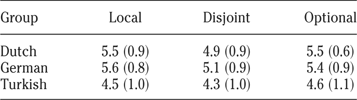
The AJT was a pencil-and-paper task in which the 24 experimental texts were set among 32 filler texts, and all were randomized. A scale appeared under each text and participants were required to read and to judge the acceptability of each text on a scale from 1 (least acceptable) to 6 (most acceptable). Every participant saw each experimental item but never in more than one condition. Table 2 shows the three groups' mean scores for each of the three conditions or resolution types. We assume that comparatively higher acceptability ratings reflect the participants' preferred resolution for the subject pronoun.
Mean (SDs) ratings on the acceptability judgment task
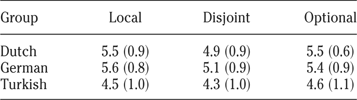
As can be seen from the mean ratings, although the Turkish group was more conservative overall in their judgments of the experimental items, acceptability ratings were relatively high across conditions. This is not surprising, because none of the experimental texts was ungrammatical. For all three groups, the pattern of results is very similar, with the disjoint resolution condition considered less acceptable than the other two, although the difference between the conditions is very small for the Turkish L2 learners.
An ANOVA with the within-subjects factor resolution type (local, disjoint, optional) and the between-subjects factor group (German L2 learners, Turkish L2 learners, Dutch native speakers) was run on the mean scores. There was a main effect of resolution type, F 1(2, 112) = 9.143, p < .001, partial η2 = .14; F 2(2, 138) = 20.741, p < .001, partial η2 = .23, and group, F 1(2, 56) = 7.223, p < .002, partial η2 = .20; F 2(2, 69) = 45.615, p < .001, partial η2 = .57, but no interaction between the two (p > .5 for both). For all groups, the disjoint condition was considered significantly less acceptable than both the local, t 1(59) = −4.38, p < .001; t 2(71) = −5.68, p < .001, and the optional conditions, t 1(59) = −3.79, p < .001; t 2(71) = −4.86, p < .001. Thus, when asked to make metalinguistic judgments of the experimental items, both L2 learner groups performed like the Dutch native speakers.
Whereas it appears clear from the judgment scores that all groups found the constructions most acceptable when the subject pronoun is forced to corefer with the local antecedent in the local condition, compared to the sentence-external antecedent in the disjoint condition, we cannot ascertain which referent was chosen for the pronoun in the optional condition because coreference with both the local and sentence-external antecedent is possible. The comprehension task probed this information specifically.
Comprehension Questionnaire
To elicit participants' preferred referent for the pronoun in each of the resolution types, a comprehension questionnaire was created. Each experimental text, as in (4a), was followed by a statement in the passive voice that required participants to specify their preferred referent for the pronoun, as in (4b). No filler items were included.
- (4)
a. Peter en Hans zitten in het kantoor. Terwijl Peter aan het werk is, eet hij een boterham. Het is een rustige dag.
“Peter and Hans are in the office. While Peter is working, he is eating a sandwich. It's a quiet day.”
b. Er wordt een boterham gegeten door _______.
“A sandwich is eaten by _____.”
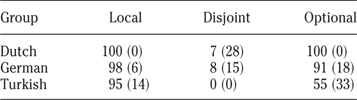
In Table 3, the scores indicate how often the participants chose to corefer the pronoun with the sentence-internal referent in each of the three resolution conditions: The higher the percentage, the more often the local referent was chosen. Three one-way between-groups ANOVAs were run on the data to compare the groups' mean scores in each of the three conditions.
Mean (SDs) percentage of sentence- internal referent chosen
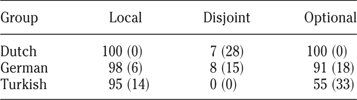
In the local resolution condition, all groups overwhelmingly chose the local referent, and in the disjoint condition, they chose the sentence-external NP as referent for the pronoun. This result is supported by the statistical comparisons, which found no difference between the groups in their mean scores for either condition (p > .1 for both). The pattern of results diverges in the optional resolution condition in which both the local and the sentence-external disjoint referent is grammatically available, with a significant difference between the groups' mean scores, F(2, 57) = 29.23, p < .001. Post hoc Bonferonni tests confirmed that the Turkish group significantly differed from both the German L2 learners and the Dutch native speakers, preferring to resolve the pronoun locally only half the time. In fact, the majority of the Turkish L2 learners—11 of the 14 participants—chose the sentence-external referent for the pronoun at least once. In contrast to the results of the AJT, in which the three groups performed similarly, the comprehension task results suggest an L1 influence on the Turkish L2 learners' interpretations of the pronoun.
Online Experiment: Eye-Tracking During Reading
Given the simplicity of the experimental constructions, we required a task that was sensitive enough to pick up early online comprehension processes; thus, eye-tracking during reading was chosen. The assumption underlying this task is that the time spent reading the region in which pronoun resolution takes place is a measure of the accessibility of the referent and, thus, of the (comparative) ease of the pronoun resolution process.
Procedure
Each of the pseudorandomized experimental and filler texts was divided into lines of text as illustrated in (5).
(5) De werknemers zitten in het kantoor.
Terwijl Peter aan het werk is, eten zij een boterham.
Het is een rustige dag.
The target clause was the main clause containing the verb and subject pronoun and it always appeared on the second line. Because the verb and pronoun of the main clause constituted the critical region, care was taken to ensure that they were placed as centrally on the screen as possible and never at the end of a line.Footnote 4 The third line included the final wrap-up context sentence. Two blank lines were inserted between each line of text to aid later fixation analysis. Participants sat approximately 60 cm from a personal computer as they read the texts on the screen.
The experiment was run using an Eyelink II head-mounted eye tracker. Binocular recordings were taken, but only the locations of the right eye were analyzed. The tracker monitored gaze location every 2 ms, and the software sampled the tracker's output to establish the positions of eye fixations and their start and finish times. Before the experiment began, each participant was required to fixate a series of squares that appeared at different points on the screen to test accuracy of calibration. If calibration was inaccurate, the eye tracker was recalibrated until accuracy was achieved. Participants were presented with four practice texts prior to the start of the experiment. During the experiment, after reading each text, the participant pushed a button on a push-button box to bring up a yes/no comprehension question that appeared immediately underneath the text. Responses were recorded via the push-button box, with a right push recording yes responses and the left button recording no responses. Once the comprehension question was answered, the text was replaced with a fixation cross for 3 s, followed by the presentation of the next text. After blocks of four trials, the participant was required to fixate a point, which allowed the experimenter to check calibration accuracy throughout the experiment. If calibration was accurate at this point, the experimenter pushed a button to bring up the next block of texts. The aim of the comprehension questions was to ensure that the participants read each text for meaning and, to avoid focus on the experimental manipulation, the questions that followed the experimental items never probed the referent for the subject pronoun. Accuracy was extremely high for all three groups: 98% for the Dutch natives, 98% for the Turkish L2 learners, and 99% for the German L2 learners.
Data Analysis
Fixations shorter than 100 ms that fell within one character of the immediately preceding or the immediately following fixation were incorporated into larger fixations within one character. Any other fixations of less than 100 ms were deleted, because readers cannot gather much information during such short fixations (Rayner & Pollatsek, Reference Rayner and Pollatsek1989). In 4.12% of the trials (distributed evenly across conditions and groups), tracker loss and eye blinks made it impossible to determine the fixation patterns around the critical region, and these trials were removed from the analysis.
In Table 4, we report means and statistical analyses on the critical region that contained the verb and the subject pronoun. A number of different eye-movement measures were gathered, and an ANOVA with resolution type (local, disjoint, optional) as the within-subjects factor and group (German L2 learners, Turkish L2 learners, Dutch natives) as the between-subjects factor was run on the means for each reading measure.
Mean (SDs) fixation times (ms) by group and condition

First-Pass Measures
First-pass fixation durations are obtained by calculating the sum of fixations in the region from the first time the eyes enter the critical region (the first fixation) until the eyes leave the region either to the right or to the left. The only effect found for these early measures was one of group (first-fixation durations: F 1(2, 57) = 12.24, p < .001, partial η2 = .30; F 2(2, 69) = 6.20, p < .004, partial η2 = .15; first-pass durations: F 1(2, 57) = 11.70, p < .001, partial η2 = .29; F 2(2, 69) = 5.67, p < .006, partial η2 = .14), because both of the L2 learner groups read the critical region more slowly than the native speakers.
Later Measures
We also report later reading measures, when participants returned to the critical region to reread it for a second time (second-pass durations) or more. For second-pass durations, the measure does not include any fixations from the first pass through the critical region. Therefore, if the region was not revisited a second time, a value of 0 ms was entered into the dataset, as is common practice in eye-tracking during reading studies (see, e.g., Sturt, Reference Sturt2003). Thus, the mean duration times for the second pass are much shorter than for other measures. To obtain total fixation durations, all fixations on the critical region were summed, including all first-pass fixations and any subsequent refixations once the gaze had exited to the right. Finally, we report the mean percentage of items that induced regressions back into the critical region—that is, the measure of how often the critical region was refixated, once it had been exited to the right.
As can be seen from the mean duration times in Table 4, the fixation patterns on these three later measures were comparable, with the most striking overall result that the L2 learners patterned together.
There was a significant interaction between resolution type and group for the second pass, F 1(4, 114) = 3.46, p < .02, partial η2 = .11; F 2(4, 138) = 2.36, p < .06, partial η2 = .06, and total fixation durations, F 1(4, 114) = 6.50, p < .001, partial η2 = .19; F 2(4, 138) = 3.53, p < .01, partial η2 = .09, as well as for the percentage of regressions back into the critical region, F 1(4, 114) = 5.00, p < .002, partial η2 = .15; F 2(4, 138) = 4.01, p < .005, partial η2 = .10. For all three groups, fixation times were shorter for the local than for the disjoint resolution condition although not significantly so (all ps > .1). Thus, there was only a suggestion in the data that the relative unacceptability of the disjoint condition, which was evident in the AJT data, was reflected as an online reading disadvantage for this condition.
Of particular interest is the contrast between the local and the disjoint resolution condition, on the one hand, and the optional resolution condition, on the other. In the latter condition, the groups' fixation patterns diverge in second and total fixation times. Both the Turkish and the German L2 learners spent more time reading the critical region in the optional condition than in the local and disjoint resolution conditions. The comparison was significant between the local condition and the optional condition (where the verb and pronoun were identical) in both the second-pass fixation data—German: t 1(15) = −2.31, p < .04, t 2(23) = −2.45, p < .03; Turkish: t 1(13) = −2.75, p < .02; t 2(23) = −2.42, p < .03—and the total fixation time data—German: t 1(15) = −2.70, p < .02; t 2(23) = −2.11, p < .05; Turkish: t 1(13) = −4.05, p < .002; t 2(23) = −2.30, p < .04.
In contrast to the L2 learners' fixation time disadvantage in the optional resolution condition, the Dutch native speakers displayed a reading time advantage: The optional condition gave rise to the shortest fixation times overall, with total fixation durations significantly shorter than both the disjoint resolution condition, t 1(29) = −3.48, p < .003; t 2(23) = −3.04, p < .007, and the local resolution condition, t 1(29) = −3.37, p < .003; t 2(23) = −3.11, p < .006. This pattern was also in evidence for the Dutch in the second pass and the regressions back into the critical region, with statistically significant differences for the latter measure—optional versus disjoint: t 1(29) = −2.35, p < .03; t 2(23) = −2.30, p < .04; optional versus local: t 1(29) = −2.49, p < .02; t 2 (23) = −2.43, p < .03. Therefore, an L1 effect in the optional resolution condition was found in the results of the comprehension questionnaire task, with the Turkish L2 learners differing from the other two groups and choosing both the local and the sentence-external referent for the pronoun. In contrast, in the eye-tracking study, it was the two L2 learner groups who patterned together, both displaying a processing disadvantage for this condition in contrast to the processing advantage observed in the Dutch native speakers.
DISCUSSION
The purpose of this study was to investigate whether there is an influence of the L1 in the offline interpretation and real-time processing of subject pronouns in L2 discourse for learners whose L1 is a null subject language. Three different patterns of results were obtained across the three different experimental tasks:
1. There were no differences between the three groups in their metalinguistic judgments of the experimental items. All found the disjoint resolution condition less acceptable than both the local and the optional conditions. Thus, there was no evidence of any L1 influence in the results of this task.
2. When the participants were specifically asked for their preferred antecedent for the subject pronoun, the Turkish L2 learners showed more variation in their interpretation for the subject pronoun when both a local and a sentence-external referent were grammatically available. Hence, in the optional resolution condition, the majority of the Turkish group provided the sentence-external referent for the subject pronoun at least once. This was in contrast to the German L2 learners, who patterned like the Dutch native speakers in their overwhelming preference for local resolution of the pronoun. Therefore, unlike their performance in the AJT, there was evidence of an influence from the Turkish group's null subject L1.
3. The online data revealed a different pattern, with the two L2 groups showing the same processing disadvantage for the optional condition in comparison to the two other resolution conditions. The native speakers, on the other hand, displayed a processing advantage for this condition over the other two.
Influence From the L1
By comparing the Turkish L2 learners to a group of German L2 learners of Dutch, we were able to address the question of whether Turkish learners' null subject L1 would influence their subject pronoun resolution in Dutch. We found a clear L1 effect in the offline comprehension task: The German group, like the Dutch native speakers, overwhelmingly chose the current topic as referent for the pronoun when there was a sentence-external referent also available. In contrast, this was the case only 55% of the time for the Turkish L2 learners, with 11 of the 14 Turkish participants choosing the sentence-external referent at least once. This suggests that the Turkish L2 learners might optionally treat (unstressed) subject pronouns in Dutch as contrastive or as signaling a change in topic, as they would Turkish overt subject pronouns. These results suggest that referential dependencies might pose an acquisition problem for learners whose L1 contrasts in this respect, even for learners such as ours, who were all highly proficient in Dutch and all living and working or studying in The Netherlands at the time of the experiment.
It is interesting to note that this observed L1 effect was not in evidence in the online processing data. We predicted that if the Turkish learners were under the influence of their null subject L1, they might show a processing advantage for the condition that forced resolution toward the sentence-external referent—the disjoint resolution condition—at least in comparison to the condition forcing local resolution. The opposite pattern was expected for Dutch native speakers and German L2 learners, who were predicted to show an across-the-board local preference for pronoun resolution. We did not find this predicted L1 effect in the Turkish data. Instead, like the German L2 learners and the Dutch native speakers, the Turkish learners spent a longer time reading the disjoint condition versus the local condition, although the difference was greater for the German (48 ms) than for the Turkish L2 learners (12 ms). Hence, rather than the predicted L1 effect, the online data of all groups suggested a dispreference for a disjoint interpretation of the pronoun that was also found in the AJT. However, it might be that our initial prediction for the Turkish L2 learners was rather simplistic: We assumed that a L1 influence would mean that Turkish L2 learners might treat an overt subject pronoun in Dutch as they would an overt subject pronoun in Turkish, as signaling coreference with a nontopic (cf. Lujàn, Reference Lujàn, Eilfort, Kroeber and Peterson1985, Reference Lujàn, Farley, Farley and McCullough1986); of course, this is certainly possible. Nonetheless, recent work on how native speakers of null subject languages interpret subjects suggests that they show more flexibility in their interpretation of overt pronouns in comparison to null pronouns (e.g., Alonso-Ovalle, Fernández-Solera, Frazier, & Clifton, Reference Alonso-Ovalle, Fernández-Solera, Frazier and Clifton2002; Carminati, Reference Carminati2002, Reference Carminati2005; see also the native Romanian speakers in Diaconescu & Goodluck, Reference Diaconescu and Goodluck2004). Specifically, native speakers appear to be less rigid in their bias to corefer an overt pronoun with a nontopic than in their bias to corefer a null subject with the topic (Carminati, Reference Carminati2002). Therefore, although we did indeed observe a L1 effect for the Turkish L2 learners in their treatment of overt subject pronouns in Dutch during the comprehension task, this L1 influence might be different than what we had originally envisaged. Under the assumption that Turkish behaves like other null subject languages, the L1 influence might have manifested itself as an optionality in the interpretation of overt subject pronouns in general rather than as a L1 influence. This optionality causes the L2 learners to corefer the overt pronoun with a nontopic some of the time and to perform like Dutch native speakers the remainder of the time, preferring local coreference with the topic.Footnote 5 Of course, the fact that Turkish native speakers might behave like (Romance) null subject language speakers in this respect needs to be tested independently; monolingual Turkish speakers are currently being examined on Turkish versions of the tasks reported here.
However, irrespective of what might underlie the L1 influence from Turkish observed in the comprehension task, both L2 learner groups differed from the Dutch native speakers in the online processing of the optional resolution condition, and because they patterned together, we cannot appeal to a L1 influence. Rather, the fixation data point to a general L2 processing effect.
General L2 Processing Effects
One of the most striking findings in this study was the online processing disadvantage seen for L2 learners in their processing of the optional resolution condition. Because the German and the Turkish L2 learners patterned together in this respect, it is highly unlikely that the difference between the L2 learners and the native speakers in online processing can be attributed to the L1 influence found in the offline interpretation task. If one were to look at the Turkish L2 data alone, the offline variable interpretation for subject pronouns could be seen as the cause for the online disadvantage in the optional resolution condition. However, the German L2 fixation data would seem to rule out this explanation. Although the German L2 learners have the same interpretation for the subject pronoun as the Dutch native speakers, all L2 learner groups showed a similar processing disadvantage of the optional resolution condition. The question arises as to what underlies the difference between the L2 learners and the native speakers in the processing of this condition.Footnote 6
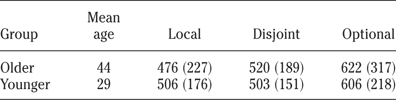
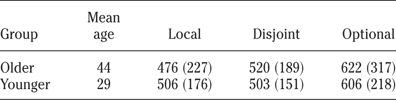
A potential reason for the L1-L2 processing difference is that the L2 learners had difficulty understanding the experimental materials. This is unlikely, however, because the L2 groups were both highly proficient in Dutch and they were extremely accurate in their responses to the comprehension questions that followed the experimental items. Moreover, the materials did not differ across conditions and the learners had no trouble with the other two resolution conditions. Another potential reason for the observed difference is the overall greater variability, general slower processing speed, or both seen in the L2 learners' fixation data. However, this appears to be a doubtful explanation because the L2 learners did not simply fail to show the same effect as the native speakers, who displayed a facilitation for the optional versus the local resolution condition; rather, they showed a robust effect in the opposite direction. Another potential reason underlying the L2 fixation time disadvantage in the optional resolution condition is that the two L2 learner groups were older than the native Dutch group. Older comprehenders might have more difficulty with syntactic integration in online sentence processing than younger participants, as shown in previous studies (e.g., Christianson, Williams, Zacks, & Ferreira, Reference Christianson, Williams, Zacks and Ferreira2006).Footnote 7 To investigate this, we age-matched the German L2 learners with the Dutch native speakers by removing the three oldest German (45, 49, and 51 years old) and the three youngest Dutch participants (18, 18, and 19 years old). We found no difference in the pattern of fixation times when compared with the original groupings: The German L2 learners still showed a processing disadvantage for the optional resolution (602 ms) versus the local (459 ms) and the disjoint condition (485 ms), and the Dutch had the same advantage for the optional (312 ms) versus the other two conditions (local, 406 ms; disjoint, 420 ms). There were no such age outliers in the Turkish group, and a median split (38 years) found no age effect (no interaction between age group and resolution type, F(2, 24) = 0.16; p = .811), because both groups patterned together, as shown in Table 5. Thus, like all of the German L2 learners, the Turkish L2 learners showed the same processing disadvantage for the optional versus the other two resolution conditions irrespective of their age.
Mean (SDs) total fixation times (ms) of two Turkish age groups
Thus, the question remains as to what might be the cause of the difference between the two learner groups and the native speakers in this respect. In the texts, in both the local and optional resolution conditions, the discourse bias and the syntactic features of the subject pronoun converge on the same local referent: The singular NP in the subject position of the most recent clause is the most accessible antecedent in the current discourse. The discourse bias is stronger in the optional resolution condition because this referent is both recently mentioned and maintained from the earlier discourse context, thus making it an extremely attractive antecedent. This fact explains the facilitation effect found for the Dutch native speakers in the comparison between the two conditions. Hence, although resolution is of course unproblematic for native speakers in the local resolution condition, the stronger discourse bias in the optional resolution condition makes the accessible referent more available for coreference with the pronoun. To account for the difference between the learners and the native Dutch groups, we can appeal to another difference between the two conditions: the ambiguity of the pronoun's referent in the optional resolution condition. In this condition, the discourse bias is very strong; however, there are still two grammatically available referents (singular NPs, both proper nouns; sentence-internal or sentence-external). Therefore, whereas the discourse creates a bias against the nonlocal NP as referent for the native speakers, it is still a grammatically available option for resolution. In fact, if the subject pronoun were stressed when reading aloud, a disjoint interpretation would easily be obtained. In the other two conditions, the pronoun is not ambiguous and can only grammatically corefer with one referent. We would argue that it is this syntactic ambiguity of the pronoun in the optional resolution condition that causes the observed processing disadvantage for the L2 learners in contrast to the native speakers and makes the online integration of syntactic information with the appropriate discourse representation more demanding. It is interesting to note that this appears to be the case irrespective of the final interpretation of the pronoun and, therefore, the two L2 groups patterned in the same way. This result is perhaps less surprising when considering the findings of some studies of L2 learners' processing of syntactic dependencies and ambiguities (Felser et al., Reference Felser, Roberts, Gross and Marinis2003; Marinis et al., Reference Marinis, Roberts, Felser and Clahsen2005). These studies have suggested that the online integration of information from multiple sources might be more difficult for L2 learners than for native speakers, in particular when both syntactic and semantic or pragmatic information must be coordinated, even when the L1 and the L2 pattern in the same way (Papadopoulou & Clahsen, Reference Papadopoulou and Clahsen2003). Our results show that this might be the case even when processing very simple and everyday dependencies.
Subject Pronouns in the L2
Because the rules governing the use of the pronominal system can be viewed as less complex in languages such as Dutch, which have obligatory subjects, acquisition might be comparatively unproblematic if one's L1 is more complex in this respect, like in Turkish, in which overt subject pronouns are optional. However, as discussed earlier, interpreting a pronoun in discourse in any language requires computing and integrating syntactic and discourse-pragmatic information. Summarizing research from the fields of attrition and bilingual L1 acquisition and adult SLA that investigated null subject languages, Sorace (e.g., Reference Sorace, Cornips and Corrigan2005) suggested that the residual optionality sometimes observed in the grammar of these populations affects phenomena that lie at the interface levels—for instance between the syntax and discourse-pragmatics—causing problems in the area of overt subject pronouns, among others. She further asked whether the underlying cause for this optionality in the system is best viewed as a representational or a processing problem. Our results speak to these issues: We would argue that our data support a processing account, because the L2 learners, irrespective of whether their L1 was a null subject language, showed the same online processing disadvantage with the same condition and yet had different offline interpretations for the pronoun.Footnote 8 Although we would agree that the coreferential restrictions that apply to null subjects in languages like Turkish and Italian do not apply to pronominal forms in Dutch or English, coordinating information from different sources to interpret an anaphoric device appears to be more problematic for L2 learners, irrespective of the properties of their L1.
CONCLUSIONS
The results of this study show that resolving pronominals in a L2 might be subject to L1 influences, even at high levels of proficiency and even when the L2 learner might be assumed to be learning a less complex system. Much psycholinguistic research has shown that the processing of overt subjects in discourse in any language requires the assessment, coordination, and integration of discourse-pragmatic and syntactic information. Our results suggest that L2 learners find it more difficult to integrate necessary syntactic and discourse-pragmatic information online when there is a syntactic ambiguity to resolve. Given that the ultimate resolution for the subject pronoun in these ambiguous cases appears to be influenced by the L1, it can be concluded that this L1 influence hinges on the use of pragmatics. The observed problem is thus caused by syntax and must be resolved by pragmatics, and it is at the level of pragmatics that the L1 appears to exert its influence.
APPENDIX: EXPERIMENTAL ITEMS
1. De werknemers/Peter en Hans zitten in het kantoor. Terwijl Peter aan het werk is, eet hij/eten zij een boterham. Het is een rustige dag.
2. De klanten/Teun en Rob wachten in een rij op het postkantoor. Terwijl Teun in de rij staat, praat hij/praten zij met iemand. Mensen moeten lang wachten.
3. De leerlingen/Martin en Michiel studeren in de bieb. Terwijl Martin een artikel leest, neemt hij/nemen zij een slokje water. Het is heel stil in de bieb.
4. De kinderen/Thijs en Niek spelen in de speeltuin. Terwijl Niek met zand speelt, pakt hij/pakken zij een schepje. De moeders zitten met elkaar te kletsen.
5. De hardlopers/Saskia en Anneke trainen in het park. Terwijl Saskia rent, luistert zij/luisteren zij naar muziek. Het is mooi weer.
6. De arbeiders/Koen en Walter zijn een fietspad aan het maken. Terwijl Walter zijn gereedschap haalt, rookt hij/roken zij een sigaret. Ze zullen vandaag hard werken.
7. De muzikanten/Remco en Simon geven vanavond een concert. Terwijl Remco zijn gitaar stemt, zingt hij/ zingen zij een liedje. Het wordt vast heel leuk.
8. De gasten/Jan en Erik staan in de woonkamer. Terwijl Jan een sigaar rookt, drinkt hij/drinken zij een glas wijn. Het is een leuk feest.
9. De verpleegsters/Ann en Wilma zorgen voor de zieken in de kliniek. Terwijl Ann met patiënten praat, geeft zij/geven zij de medicijn. De patiënten wachten op de dokter.
10. De DJ's/DJ Flux en DJ Marco staan klaar om te draaien. Terwijl DJ Flux platen uitzoekt, praat hij/praten zij met een meisje. Er worden vaak feestjes georganiseerd door deze DJ's.
11. De toeschouwers/Anneke en Rikkie zitten in de schouwburg. Terwijl Anneke naar de voorstelling kijkt, zoekt zij/zoeken zij kauwgom. Het is een goede voorstelling.
12. De onderzoekers/Marianne en Freda werken op de universiteit. Terwijl Marianne een stuk typt, drinkt zij/drinken zij een kopje thee. Ze hebben het altijd druk.
13. De koks/Chris en Hans staan in de keuken. Terwijl Chris uien snijdt, kookt hij/koken zij de aardappelen. Het is heel warm in de keuken.
14. De obers/Jeroen en Michiel hebben het vanavond druk. Terwijl Jeroen een jus d'orange klaarmaakt, praat hij/praten zij met een klant. Het is vandaag druk in het café.
15. De kassameisjes/Anna en Jorike bij de Aldi vervelen zich. Terwijl Anna in een tijdschrift bladert, kijkt zij/kijken zij naar buiten. Er zijn vaak geen klanten op woensdagochtend.
16. Parkeerwachters/Joop en Sander lopen rond op de parkeerplaats. Terwijl Joop rondloopt, steekt hij/steken zij een sigaretje op. Het is een stille nacht.
17. De vertalers/Kees en Thomas werken vandaag op kantoor. Terwijl Kees een tekst vertaalt, maakt hij/maken zij thee. Het is bijna tijd om naar huis te gaan.
18. De kinderen/Gijs en Roy kijken TV. Terwijl Gijs naar een tekenfilm kijkt, zit hij/zitten zij te tekenen. Ze kijken naar Japanse tekenfilms.
19. De monteurs/Sander en Martijn prepareren de auto's voor de race. Terwijl Sander de banden verwisselt, houdt hij/houden zij de tijd in de gaten. Ze mogen geen tijd verspillen.
20. De jongens/Rogier en Karel zijn aan het voetballen. Terwijl Rogier naar de keeper kijkt, trapt hij/trappen zij de bal. Het is een mooie dag.
21. De boeren/Rob en Jan gaan het graan oogsten. Terwijl Rob de machines voorbereidt, zingt hij/zingen zij een bekend liedje. Het is vroeg om te oogsten.
22. De mensen/Sandra en Gerda in het museum kijken naar de schilderijen. Terwijl Sandra rondloopt, maakt zij/maken zij foto's. Het zijn mooie kunstwerken.
23. De muzikanten/Paul en Stijn hebben hun plaatsen ingenomen. Terwijl Paul naar het publiek kijkt, speelt hij/spelen zij gitaar. Ze spelen volksmuziek.
24. De vissers/Theo en Guido bevinden zich op zee. Terwijl Theo naar de lucht kijkt, zingt hij/zingen zij een zeemansliedje. Vandaag schijnt de zon.