The Court's authority – possessed of neither the purse nor the sword – ultimately rests on sustained public confidence in its moral sanction.
(Justice Frankfurter in Baker v. Carr [1962])
The role of the court system in national policymaking has long excited controversy among legal and political specialists. The influence of the judiciary compared to other political institutions has been the central issue. Dahl (Reference Dahl1957: 281–3) offers two competing views of this relationship: the ‘criterion of Right or Justice’ and the ‘majority criterion’. In contrast to the traditional view of the judiciary as the protector of minorities, there is a burgeoning literature that holds that all political institutions must obtain some level of popular confidence in order to maintain their legitimacy (Swanson, Reference Swanson2007; Wenzel et al., Reference Wenzel, Bowler and Lanoue2003). From a democratic standpoint, while the judiciary differs from the legislature and the executive in its political characteristics, it still needs to obtain public support (Benesh, Reference Benesh2006; Gibson et al., Reference Gibson, Caldeira and Spence2003; Mondak and Smithey, Reference Mondak and Smithey1997; Nicholson and Howard, Reference Nicholson and Howard2003).
Adopting this realist view, this study analyses public opinion on the court system in Taiwan based on the concept of public support; specifically, it gauges the level of popular confidence in the judiciary relative to other governmental institutions, and tries to determine whether being a supporter or opponent of the national electoral majority influences an individual member of the public's level of support for the judiciary. The factors that influence political support for the judiciary in Taiwan were identified by means of a national survey. Specifically, this study asks the following questions: what is the public's evaluation of the judicial system compared to other political institutions? And more importantly, does the variable of party identification exert a significant influence on this evaluation?
Taiwan's judiciary has its roots in the judicial systems of Japan, Germany, and even the Roman Empire, rather than in the Anglo-American (common law) system, and it is therefore referred to as a Romano-Germanic law (civil law) system. The court system in Taiwan has three levels: district courts that hear civil and criminal cases in the first instance, high courts at the intermediate level that hear appeals against judgments of the district courts, and the highest appellate level of the Supreme Court that reviews judgments by the lower courts to ensure compliance with pertinent laws or regulations. Issues of fact are decided at the first and second levels, while only issues of law are considered by the Supreme Court. Systems with a civil law heritage are strikingly different from their Anglo-American counterparts. While in the United States a final verdict in many cases is reached after only one trial, most civil and criminal cases in Taiwan require three trials.
This study examines public support for the judicial system in Taiwan, and in order to do this it explores four interrelated issues. It first of all discusses theoretical frameworks for examining the role of the courts, specifically the traditional view and the realist one. Second, it introduces the theory of public support and the way in which it is measured, and this is followed by a brief outline of how the variable of party identification affects public support, clarifying the research insights in more detail. Third, it takes advantage of a 2014 survey to assess the factors influencing public support for the court system. In particular, it seeks to ascertain the level of popular confidence in the courts and other judicial institutions, and then classifies the public's evaluations into four categories: ‘judges are trustworthy and honest’, ‘judges are fair’, ‘courts provide equal justice’, and ‘decisions based on facts and law’. The study concludes by discussing the implications of the empirical results for public trust in the judiciary in Taiwanese society.
Debate over the ‘countermajoritarian institution’
It is generally accepted that democracy essentially comprises a number of critical principles, including popular sovereignty, political equality, the separation of powers and checks and balances, majority rule, federalism, limited government, and judicial review. Yet these principles depend on one fundamental requirement: the rule of law (Benesh, Reference Benesh2006: 697). In order for the rule of law to endure and function effectively, the court system must both implement it, and adhere to it. To make sure that the rule of law remains feasible, the public needs to trust the political institution (i.e., the courts) charged with upholding it. For this reason, it is important to ascertain what drives citizens’ support for the courts.
The relationship between the courts and society has always been a key issue in the study of judicial politics. Two contending theories have been offered to explain interaction between the judiciary and other political institutions (Caldeira and Gibson, Reference Caldeira and Gibson1992; Hoekstra, Reference Hoekstra2000; Hoekstra and Segal, Reference Hoekstra and Segal1996; Johnson and Martin, Reference Johnson and Martin1998; Wu, Reference Wu2008). The most frequently cited authority is Dahl (Reference Dahl1957: 281–3) who provides two competing viewpoints: the criterion of Right or Justice (the ‘traditional view’) and the majority criterion (the ‘realist view’).
The criterion of Right or Justice frames the court system as a ‘countermajoritarian institution’. The position of the courts in the political system is, in essence, different from that of the legislature and the executive. The legislature and the executive symbolize the ideals of majoritarian rule, as their members and leaders are directly elected by the people. The court system, in contrast, is the last line of defense against social injustice (Bickel, Reference Bickel1962; Casper, Reference Casper1976; Funston, Reference Funston1975; Mishler and Sheehan, Reference Mishler and Sheehan1993), tasked with protecting the rights of minorities and individuals while curbing any tendency toward tyranny of the majority.
With regard to the courts’ role in protecting minorities, Wasserman (Reference Wasserman1997: 197) underlines that the legitimacy of the judiciary is not based on its popularity with the public. The judiciary is not elected and does not directly answer to the citizens. Instead, its responsibility is to the constitution; it guarantees civil rights and civil liberties and guards against abuses of power by the government. The judiciary protects the rights of the people by opposing sociopolitical majorities. For the courts to function in the political system, and for their decisions to be implemented, they must obtain the cooperation of other institutions of the government. In brief, the judiciary has its own legitimacy that must be independent and beyond the control of political power. Not only does it not need popular support, it actually needs to oppose the majority in order to restrain other institutions.
Advocates of the majority criterion, in contrast, believe that the judiciary, as a component of the political system, must function in accordance with changes in the social environment and people's expectations. More specifically, they hold that in a democracy based primarily on majority rule, when the judiciary persistently opposes the majority and can only obtain the support of minority groups, its legitimacy will ultimately face serious challenges. Accordingly, it is necessary for the judiciary to take up mainstream values in order to preserve itself. According to Dahl (Reference Dahl1957: 283), ‘the view of the Court as a protector of the liberties of minorities against the tyranny of majorities is beset with other difficulties that are not so much ideological as matters of fact and logic’.
Focusing on the United States, Dahl identifies the ‘lawmaking majority’, or the majority in the House of Representatives and the Senate, as well as the White House, as the standard measure for the ‘national majority’. Underlining the consistency between the courts and the lawmaking majority, Dahl refers to the Supreme Court of the United States as a ‘national policymaker’. The majority criterion view regards the judiciary as not only a legal decision maker, but also a political one. After all, the judicial system cannot exist outside the social mainstream, so it must avoid conflicts with electoral coalitions and respect the sociopolitical majority in order to obtain lasting popular confidence.
In comparing the two contending theories, some legal and political scholars examine the constitutional history of the United States and hold that the majoritarian criterion is more in tune with political realities on the ground (Barnum, Reference Barnum1985; Casper, Reference Casper1976; Page and Shapiro, Reference Page and Shapiro1983; Marshall, Reference Marshall1989). According to this theory, interaction between the courts and public opinion is highly significant and close, and it has become a key issue among judicial specialists (Gibson et al., Reference Gibson, Caldeira and Spence2003; Hausegger and Riddell, Reference Hausegger and Riddell2004; Hetherington and Smith, Reference Hetherington and Smith2007; Meng and Lu, Reference Meng and Lu2015; Nicholson and Howard, Reference Nicholson and Howard2003; Price and Romanta, Reference Price and Romanta2004; Swanson, Reference Swanson2007). Although the empirical findings of these scholars seem to run contrary to the traditional view concerning the institutional legitimacy of the court system, it may yet be possible to reconcile these two positions.
It can be argued that the traditional view adopts a more normative perspective which emphasizes that the actions of the judiciary are aimed at defending the rights of some minority or other against a tyrannical majority, while those who adopt the realist view are concerned with evaluating the influence of the public on court decisions. Of course, political institutions require a certain amount of political support to persist and flourish. For the judiciary, this support is especially important, for, as noted by Benesh (Reference Benesh2006) and Caldeira and Gibson (Reference Caldeira and Gibson1992), the courts are vulnerable institutions and as such they need to inspire popular confidence if they are to persist and function adequately.
Measurement, hypotheses, and methodology
The public's perception of the legitimacy of any given political system originates from the belief that this system is capable of correctly and appropriately handling and resolving political issues (Easton, Reference Easton1965: 278). From a theoretical perspective, political support can be divided into ‘specific support’ and ‘diffuse support’. The former implies output-directed evaluation, while the latter denotes a generalized satisfaction with the existing political system.Footnote 1 Some studies concentrate on specific support for the court system (Johnson and Martin, Reference Johnson and Martin1998; Hetherington and Smith, Reference Hetherington and Smith2007), while others are concerned with both specific and diffuse support (Gibson et al., Reference Gibson, Caldeira and Spence2003; Price and Romanta, Reference Price and Romanta2004; Swanson, Reference Swanson2007; Wenzel et al., Reference Wenzel, Bowler and Lanoue2003).
In addition to the distinction between modes of support, scholars also disagree on how to measure public support for the judiciary. Cann and Yates (Reference Cann and Yates2008) review the existing literature on public evaluation of the court system and classify public evaluation into four categories: ‘judges are trustworthy and honest’, ‘judges are fair’, ‘courts provide equal justice’, and ‘decisions are based on facts and law’. This typology seems fairly comprehensive, so I employ it in this exploration of public opinion regarding the court system.
In this study, one of the main tasks is to assess the connection between party identification and popular confidence in the Taiwanese court system. In theory, party identification, which is closely related to political involvement (Campbell et al., Reference Campbell, Converse, Miller and Stokes1960; 142–5; Conway, Reference Conway1991: 59–60; Miller and Shanks, Reference Miller and Shanks1996: 87–8, 95–7), is defined as how closely a person identifies with one of the major parties. It is a key part of an individual's belief system and is characterized by long-term stability. Party identification has long been considered in Taiwan studies to be the most significant determinant of political behavior (Wu and Huang, Reference Wu and Huang2007; Wu, Reference Wu2008).Footnote 2 Adopting Dahl's realist perspective that the courts are an element of the ruling national majority, I propose the following two hypotheses:
-
Hypothesis 1. Compared with other political institutions, the judicial system enjoys a relatively high degree of political support.
-
Hypothesis 2. Supporters of the policymaking majority (i.e., supporters of the pan-Blue coalition, which was the majority at the time of the survey) tend to hold positive and supportive attitudes toward the judiciary, whereas opponents of the ruling coalition (i.e., pan-Green supporters) generally exhibit lower levels of support for the courts, ceteris paribus.
The data for this study come from the research project, ‘Politics and Judiciary: The Assessment of the Political Impacts of Court Decisions in Taiwan’, conducted by Taiwan Indicators Survey Research. This is a survey of a nationally representative probability sample of adults living in the 17 counties and cities of Taiwan and Fujian provinces, as well as the five municipalities of Taipei, New Taipei, Taichung, Tainan, and Kaohsiung. Telephone interviews were conducted from 21 September to 29 September 2014, and a total of 1,800 eligible respondents were successfully interviewed. The respondents were all 20 years of age or above and residents of the abovementioned areas. Details of the relevant questions and the scale scores for the measures are presented in the appendix.
Preliminary analysis
The purpose of this study is to assess Dahl's majoritarian criterion, and to examine the extent of popular confidence in the courts and other judicial institutions using Cann and Yates’ (Reference Cann and Yates2008) categories of public support: ‘judges are trustworthy and honest’, ‘judges are fair’, ‘courts provide equal justice’, and ‘decisions are based on facts and law’. The first research hypothesis states that, compared with other political institutions, the courts inspire a relatively high degree of popular confidence. The second hypothesis states that being a supporter or an opponent of the ruling coalition influences one's level of political support for the judicial system, and therefore that the variable of party identification is closely correlated with the sense of diffuse support for the courts.
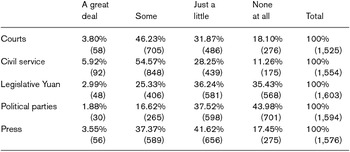
To offer a systematic assessment of popular confidence, the survey recorded respondents’ trust evaluations of five political institutions: the courts, the civil service, the Legislative Yuan, political parties, and the press. This institution typology is one that is generally used in comparative studies (Diamond et al., Reference Diamond, Plattner and Chu2013; Diamond and Shin, Reference Diamond and Shin2014). As shown in Table 1, the trust index of the courts is relatively high, similar to that in some developed and developing countries.Footnote 3 The figures reveal that approximately 50% of respondents hold positive attitudes (including ‘a great deal’ of trust and ‘some’ trust), meaning that the courts are trusted slightly less than the civil service (about 60% positive), but far more than the press (roughly 41%), the legislature (about 28%), and the political parties (18.5%).
Popular confidence in political institutions

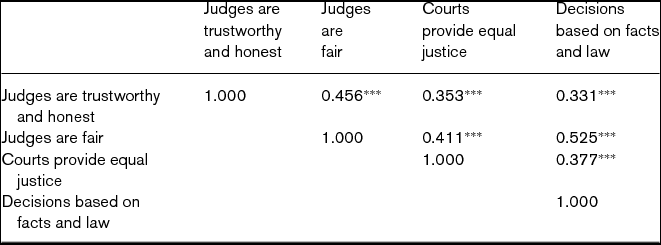
The dependent variable, court legitimacy, is typically conceptualized as an indicator of the quality of public officials, the efficiency of governance, and the correctness of its decisions. As stated previously, various ways of systematically measuring political support may be found in previous research (cf. Gibson et al., Reference Gibson, Caldeira and Spence2003; Hetherington and Smith, Reference Hetherington and Smith2007). In this study, four items are employed as indicators of ‘public support’. Before going further, it is necessary to estimate the reliability of these items. The correlations of Cronbach's alpha between the four items indicate that there is a tendency for measurements of court legitimacy to be consistent and reliable, as presented in Table 2. Although the coefficients for the indexes ‘judges are fair’ and ‘decisions based on facts and law’ (0.525) and the indexes ‘judges are trustworthy and honest’ and ‘judges are fair’ (0.456) are much higher than those for the indexes ‘judges are fair’ and ‘courts provide equal justice’ (0.411), the others are approximately 0.350. The results show that, at the very least, we have made an encouraging initial step toward a persuasive measurement of popular support for the courts.
Correlation coefficient (Cronbach's alpha) matrix between indexes for measuring court legitimacy

Notes: Cronbach's Alpha = 0.712; ***p < 0.001; one-tailed test of significance.
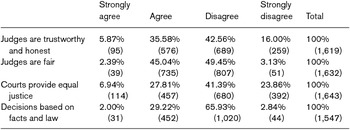
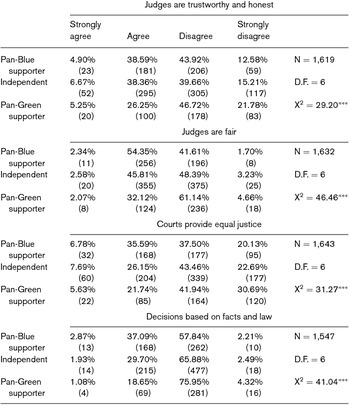
Descriptive statistics for the four indicators are displayed in Table 3. The scales show that the statement ‘decisions based on facts and law’ is the one that attracts the most disagreement (68.77%), closely followed by ‘courts provide equal justice’ (65.25%). The statements that attract the most support are ‘judges are fair’ (47.43%) and ‘judges are trustworthy and honest’ (41.45%). Cross-tabulation analyses involve the division of the respondents into subgroups according to party identification, as shown in Table 4.Footnote 4 A chi-square test reveals significant differences between pan-Blue supporters, independents, and pan-Green supporters in the distribution of the degree of legitimacy they accord the courts.
Items in court legitimacy scale

Court legitimacy scale by party identification

Notes: ***p < .001; one-tailed test of significance.
Viewed from Dahl's perspective, the study regards pan-Blue supporters as the winners and pan-Green supporters as the losers. The results to some extent support this hypothesis: support for the judiciary among pan-Blue supporters is consistently high, and this group is the most likely to agree strongly with the statement ‘judges are fair’. On the flip side, the degree of legitimacy accorded to the courts by pan-Green supporters is relatively low. They generally hold an unfavorable attitude toward the courts, especially regarding the indexes ‘decisions based on facts and law’ and ‘courts provide equal justice’.
The above analysis confirms the research hypothesis, at least initially. Supporters of the policymaking majority (i.e., pan-Blue supporters) generally show favorable attitudes toward the judiciary, whilst supporters of the losing electoral coalition (i.e., pan-Green supporters) tend to express lower levels of support for the courts. The data yield some interesting findings, but cross-tabulation analyses – although illuminating – are not an effective technique for examining a number of variables simultaneously. These relationships may be spurious when other control variables are considered. The relative impacts of different variables on the dependent variables may be better determined through multivariate analyses.
Discussion of findings
Behavioral research on political attitudes has found that political support is significantly associated with a wide range of political behavior (Campbell et al., Reference Campbell, Converse, Miller and Stokes1960; Chen, Reference Chen2002, Reference Chen2003; Conway, Reference Conway1991). Beyond the variable of party identification, the behavioral literature suggests that public confidence is a complex function of various other factors. In relation to this, some other determinants of political support are considered. Individual-level variables, including gender, age, education, ethnicity, and Taiwanese/Chinese consciousness, are taken into consideration as control variables. The reason for employing sociodemographic characteristics as explanatory variables is the presumption that an individual's social background is central to his/her political attitudes, including confidence in the judiciary.
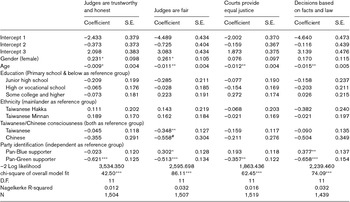
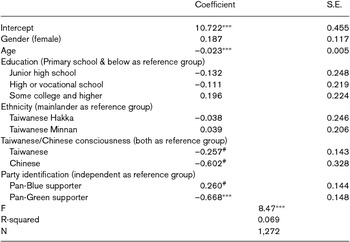
The methodology adopted in this study involves two steps. The first step is the use of ordered logit analyses.Footnote 5 As previously mentioned, the four indicators of political support are four-category ordered polytomous variables, with a distinction being made between ‘strongly agree’, ‘agree’, ‘disagree’, and ‘strongly disagree’, with ‘strongly agree’ being employed as the reference group. The second step is to merge the four indicators in a single item of judicial support, creating a 16-point scale which can be analyzed with a linear regression in order to evaluate the simultaneous effect of several independent variables on the dependent variable. With regard to the independent variables, while age is treated as a continuous variable, the rest are categorical or ordinal variables. The data are analyzed using STATA 11.0.
The results of the multivariate estimates are displayed in tables 5 and 6. Taken as a whole, the chi-squared statistics of overall model fit show, at the very least, an encouraging initial step toward a persuasive and respectable explanation of court legitimacy. Three coefficients consistently reach statistical significance, and most of them run in the expected directions.Footnote 6 Each variable will be discussed below.
Ordered logit regression estimates for court legitimacy

Notes: #p < 0.10; *p < 0.05; **p < 0.01; ***p < 0.001; two-tailed test of significance.
Ordinary least squares regression estimates for court legitimacy

Notes: #p < 0.10; *p < 0.05; **p < 0.01; ***p < 0.001; two-tailed test of significance.
The empirical evidence reveals that the variable of age is likely to be correlated with public confidence in the court system. According to ‘life-cycle effect’ theory, political information and experience increase steadily with age (Campbell et al., Reference Campbell, Converse, Miller and Stokes1960: 485–7; Conway, Reference Conway1991: 19–24; Milbrath and Goel, Reference Milbrath and Goel1977: 114–16). From the early 1950s through the mid-1980s, the Kuomintang regime in Taiwan was characterized as an authoritarian one-party state with elements of totalitarianism on account of its comprehensive domination of the ruling mechanism. Accordingly, the judiciary, including the prosecution and court systems, could not avoid penetration by the ruling party (Tien, Reference Tien1989: 179, 193). For decades, the KMT used its political advantage to intervene in the judicial system through such means as personnel management, job transfers, the allocation of expenditure, and internal organizational administration. For this reason, the general public still tends not to trust the courts to be free of political influences (Bosco, Reference Bosco and Rubinstein1994: 129). As the data show, the variable of age has a significant effect on the level of court legitimacy. To be more precise, as age increases, the extent of people's support for the judiciary gradually decreases. This result fits Taiwan's political context. One possible explanation is that, lacking any sociopolitical experience of authoritarianism, the younger generation tends to exhibit a higher degree of confidence in judges and the courts, whereas older citizens exhibit less confidence.
Taiwan/Chinese consciousness, or what is sometimes termed ‘national identity’, is widely regarded as an important variable in research on Taiwan's politics (Hsiau, Reference Hsiau2000; Hughes, Reference Hughes1997; Wu and Hsiao, Reference Wu and Hsiao2006). Over the decades when Taiwan was ruled by a KMT-controlled, mainlander-dominated authoritarian regime, a China-centered ideology and Chinese identification were the mainstream values. However, since the beginning of the democratization process in the mid-1980s, a Taiwan-centered consciousness and Taiwan identification have gradually risen to prominence. As the figures reveal, those who identify as either Taiwanese or Chinese are inclined to hold a negative view of judicial legitimacy (exhibiting a low degree of support for the item ‘judges are fair’ in particular), compared to those who identify themselves as both Taiwanese and Chinese.
The main purpose of this study is to evaluate popular confidence in the court system in Taiwan. According to Dahl's realist view, because the judiciary is part of the dominant policymaking alliance, it is important to determine whether or not supporters of the dominant electoral/political coalition have more confidence in the courts than do opposition supporters. As shown in tables 5 and 6, the coefficients for the variable of party identification are statistically significant, exerting an expected influence on political support. The findings of this study suggest that party identification retains a consistent connection with public support. More explicitly, the results confirm the assumption that those who identify as pan-Blue supporters exhibit a relatively high degree of support for the courts, whereas the degree of support for the courts among pan-Green identifiers is relatively low, and lower than that of independents.
The role of the court system has long been a subject of debate among legal and political scholars. In a democracy, any given branch of government needs public support as the basis of its institutional legitimacy, and the judiciary is no exception. There is at least one important reason for focusing on public support for the court system in Taiwan. Taiwan is a robust, growing country undergoing social, economic, and political transition. Specifically, it has been in the process of transition from a one-party authoritarian system to a nascent democratic regime with aspects of institutionalized electoral competition since the late 1980s (Tang, Reference Tang2012). From the perspective of political development, understanding the public's opinion of the judiciary not only helps us to identify the factors that can promote democratic consolidation in Taiwan but also aids comparative analysis in this field.
This study evaluates the influence of the judiciary compared to other institutions, and more importantly, it by and large confirms Dahl's ‘national lawmaking majority’ perspective in the case of the judiciary in Taiwan. Nevertheless, it is worthwhile to note that the empirical findings are based on a cross-sectional analysis, and I am of the opinion that longitudinal analyses would be more valuable in examining public attitudes to the courts. In addition, it may be possible to carry out cross-national comparisons using Dahl's perspective. Obviously, there is still potential for future research in this field.
About the author
Chung-li Wu is a research fellow at the Institute of Political Science, Academia Sinica, Taiwan. He received his Ph.D. in Political Science from the University of New Orleans in 1997. His current research interests are American politics, comparative politics, urban and minority politics, electoral studies, and judicial politics. He is the author of articles published in Party Politics, China Quarterly, Parliamentary Affairs, Japanese Journal of Political Science, International Relations of the Asia-Pacific, Journal of Black Studies, Asian Survey, and other professional journals.
Appendix: Survey questions and coding of variables
Popular confidence in political institutions. ‘I am going to name a number of institutions, including the courts, civil service, the Legislative Yuan, political parties, and the press. For each one, please tell me how much trust you have in them. Is it a great deal, some, just a little, or none at all?’ (1 = a great deal; 2 = some; 3 = just a little; 4 = none at all)
Judges are trustworthy. ‘Some people say ‘judges are honest and trustworthy’, but some people disagree. Do you agree or disagree?’ (1 = strongly agree; 2 = agree; 3 = disagree; 4 = strongly disagree)
Judges are fair. ‘Some people say ‘judges are fair and impartial’, but some people disagree. Do you agree or disagree?’ (1 = strongly agree; 2 = agree; 3 = disagree; 4 = strongly disagree)
Courts provide equal justice. ‘Some people say ‘the court system works equally for all citizens’, but some people disagree. Do you agree or disagree?’ (1 = strongly agree; 2 = agree; 3 = disagree; 4 = strongly disagree)
Decisions based on facts and law. ‘Some people say ‘judges make decisions based more on facts and law’, but some people say ‘judges make decisions based more on politics and pressure from special interests’. Which view do you tend to hold?’ (1 = all judges make decisions based more on facts; 2 = most judges make decisions based more on facts; 3 = most judges make decisions based more on politics and pressure from special interests; 4 = all judges make decisions based more on politics and pressure from special interests)
Gender. Respondent's gender. (1 = male; 0 = female)
Age. Respondent's age measured in years. (The continuous variable is regenerated as an ordinal variable divided into five categories: 20–29 years, 30–39 years, 40–49 years, 50–59 years, over 60 years)
Education. Respondent's level of educational attainment measured on a four-tier scale and then transformed into an ordinal variable. (1 = primary school and below [through 6th grade]; 2 = junior high school [grades 7 to 9]; 3 = high or vocational school; 4 = some college and higher)
Ethnicity. ‘Are you a Taiwanese Hakka, a Taiwanese Minnan, a mainlander, or an aboriginal?’ (1 = Taiwanese Hakka; 2 = mainlander; 3 = Taiwanese Minnan)
Taiwanese/Chinese consciousness. ‘Do you think you are Taiwanese, Chinese, or both?’ (1 = Taiwanese; 2 = Chinese; 3 = both)
Party identification. ‘There are many political parties in Taiwan; do you think of yourself as close to any particular political party?’ (1 = pan-Blue supporter [Kuomintang, People First Party, New Party, and leaning toward pan-Blue]; 2 = pan-Green supporter [Democratic Progressive Party, Green Party, Taiwan Solidarity Union, and leaning toward pan-Green]; 3 = independent [vote for candidate rather than party and none of the above])