INTRODUCTION
Tropical ocean regions are oligotrophic, with a low primary productivity and, consequently, an even lower secondary productivity. However, despite low overall biomass and densities, a great diversity of zooplankton is present (Boltovskoy, Reference Boltovskoy1981), but the majority of species is rare (Piontkovski et al., Reference Piontkovski, Williams, Ignatyev, Boltachev and Chesalin2003). Zooplankton exhibits a great diversity in size, swimming capability and feeding methods. This variety of characteristics and their wide geographical distribution make zooplankton a heterogeneous community (Palma & Kaiser, Reference Palma and Kaiser1993). Due to this great diversity, the zooplankton community has a key ecological role. It serves as a link between phytoplankton and many carnivores, such as crustaceans and fish from commercial interests. In addition to this significant role in nutrient cycling and energy transport (Lenz, Reference Lenz, Harris, Wiebe, Lenz, Skojoldal and Huntley2000) zooplankton also includes the larval stages of some non-planktonic organisms, such as echinoderms. In the tropical Atlantic the zooplankton community is poorly studied (Schnack-Schiel et al., Reference Schnack-Schiel, Mizdalski and Cornils2010), and large areas have not been sampled (Neumann-Leitão et al., Reference Neumann-Leitão, Eskinazi-Sant'anna, Gusmão, Nascimento-Vieira, Paranaguá and Schwamborn2008).
Zooplankton organisms are characterized by very short life cycles, on the order of weeks or even months (Parsons et al., Reference Parsons, Maita and Lalli1984; Boehlert & Genin, Reference Boehlert, Genin, Keating, Fryer, Batiza and Boehlert1987; Denman et al., Reference Denman, Freeland and Mackas1989). For example, Kiørboe & Sabatini (Reference Kiørboe and Sabatini1995) claim that the developmental stage of Copepoda is on average 25 days long. Furthermore, predation within the zooplankton community can cause changes in community dynamics and species composition over time; a process that can occur in less than a week (Rippingale & Hodgkin, Reference Rippingale and Hodgkin1974).
Plankton in general and zooplankton in particular undergo vertical migrations, which can vary daily, seasonally and ontogenetically (McLaren, Reference McLaren1963; Zaret & Suffern, Reference Zaret and Suffern1976; Uye et al., Reference Uye, Huang and Onbe1990). In the daily vertical migration, organisms feed at the surface during the night and return to deeper waters during the day (Bougis, Reference Bougis1974; Haney, Reference Haney1988; Pearre, Reference Pearre2003). The cause of these migrations was initially believed to be a response to light intensity (Fernández, Reference Fernández1977; Forward, Reference Forward1988). However, it has subsequently been ascribed to other environmental stimuli, such as temperature (McLaren, Reference McLaren1963; Mayzaud, Reference Mayzaud1973), salinity (Marshall, Reference Marshall1973), food availability (Atkinson et al., Reference Atkinson, Ward, Williams and Poulet1992), variation of tidal stages (Schlacher & Wooldridge, Reference Schlacher and Wooldridge1995) and turbulence (Strickler, Reference Strickler1985; Alcaraz et al., Reference Alcaraz, Saiz, Marrasé and Vaqué1988, Reference Alcaraz, Estrada and Marrasé1989; Rothschild & Osborn, Reference Rothschild and Osborn1988).
In this way, the dynamics of the physical environment regulate the interactions within zooplankton communities that will determine its structure and function (Haury et al., Reference Haury, Yamazaki and Itsweire1990). The location of the zooplankton in the water column directly reflects the vital functions of each organism (Levinton, Reference Levinton1995), provides metabolic advantages (such as respiration and reproduction), impacts trophic relationships (such as the accessibility of food and escape from predators) (Frost & Bollens, Reference Frost and Bollens1992; Incze et al., Reference Incze, Hebert, Wolff, Oakey and Dye2001) and affects dispersal strategies (Epifanio, Reference Epifanio1988). Zooplankton groups of different species were distributed in different layers in the vertical plane through the thermocline (Longhurst & Pauly, Reference Longhurst and Pauly1987).
This vertical migration of zooplankton carries a substantial amount of biomass along the water column. The turnover of matter and energy from the upper layers to the bottom is an important influence on the higher trophic levels (Angel, Reference Angel and Rankin1985, Reference Angel, Berger, Smetacek and Wefer1989; Bourdillon, Reference Bourdillon1989; Bonecker et al., Reference Bonecker, Bonecker, Bassani, Pereira and Soares-Gomes2002). Thus, the vertical distribution of zooplankton is a complex combination of the specific tolerance of the species and the environmental conditions in coordination with dietary requirements and other factors (Fernández-Álamo & Färber-Lorda, Reference Fernández-Álamo and Färber-Lorda2006).
Islands and seamounts are responsible for disruptions in oceanic hydrodynamics, provoking the so-called ‘island effect' where a combination of recirculating currents and upwelling causes moderate depth waters, rich in nutrients, to rise into the photic zone (Doty & Ogury, Reference Doty and Ogury1956). Upwelling contributes to an increase in planktonic biomass around these areas (Uda & Ishino, Reference Uda and Ishino1958; Boehlert, Reference Boehlert1988). These morphological features can also change the surface currents and the distribution of planktonic organisms near the surface (Genin et al., Reference Genin, Green, Haury, Wiebe, Gal, Kaartveldt, Meir, Fey and Dawson1994).
The complex interactions between water movement and topography lead to the formation of recirculation currents or Taylor columns. The recirculation processes may be a possible mechanism for maintaining communities that live near abrupt topography (Shomura & Barkley, Reference Shomura and Barkley1980; Boehlert & Genin, Reference Boehlert, Genin, Keating, Fryer, Batiza and Boehlert1987; Dower & Perry, Reference Dower and Perry2001). Thus, variations in topography, physiography, depth and location of such formations influence the structure of local communities (Boehlert & Genin, Reference Boehlert, Genin, Keating, Fryer, Batiza and Boehlert1987; Rogers, Reference Rogers1994; Genin, Reference Genin2004).
Also typical pelagic species are less common around the islands and the seamounts than in the open ocean (Wilson & Boehlert, Reference Wilson and Boehlert1993); and, there is also a trend of reduced abundance of pelagic zooplankton species (Nellen, Reference Nellen1973; Genin et al., Reference Genin, Green, Haury, Wiebe, Gal, Kaartveldt, Meir, Fey and Dawson1994). This finding suggests that the interactions between physical forces and community behaviour are key factors in the formation of community aggregations in regions of abrupt topography (Genin, Reference Genin2004).
Within this context, the present study aims to identify spatial and daily variations in mesozooplankton, and indicators of the island effect in the Saint Peter and Saint Paul Archipelago (SPSPA). We consider factors such as vertical migration and the interaction of currents with the topography.
MATERIALS AND METHODS
Study area
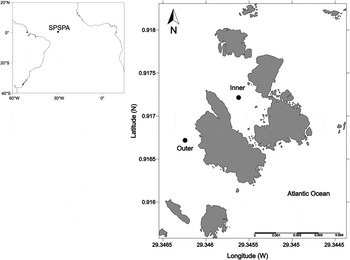
The SPSPA is formed by a set of rocky islands located to the north of the Equator (0°55′06"N and 29°20′48"W) (Pinheiro, Reference Pinheiro2004) and lying approximately 960 km off the north-eastern coast of Brazil (Edwards & Lubbock, Reference Edwards and Lubbock1983) (Figure 1). The SPSPA is formed from the Mid-Atlantic Ridge and extends 4000 m deep with a maximum altitude of 18 m (Vaske Jr et al., Reference Vaske, Lessa, Nóbrega, Montealegre-Quijano, Marcante Santana and Bezerra2005).
Sampling station locations (Inner and Outer) on Saint Peter and Saint Paul Archipelago, Brazil.

The three larger islands (Belmonte, Saint Peter and Saint Paul) form a horseshoe cove with average depth of 8 m. These islands are separated by narrow channels where there is water flow.
The phytoplankton is characterized by a floristic composition typical of stable, transparent and oligotrophic waters, with a dominance of dinoflagellates (Tiburcio et al., Reference Tiburcio, Koening, Macêdo and Melo2011). The area presents a small variation in the surface temperature and a permanent thermocline, which forms an ecological barrier, reducing the renewal of nutrients between the superficial and deep layers, limiting the primary production (Macedo et al., Reference Macedo, Flores-Montes, Costa and Hazin2009).
The oceanic dynamics that act on the SPSPA include the Equatorial South Stream (ESS) and the Sub-Equatorial Current (SEC) (Araújo & Cintra, Reference Araújo, Cintra and Hazin2009). The former flows east–west, while the SEC flows in eastbound over the equator and just beneath the surface of the ocean (Stramma, Reference Stramma1991). The SEC divides in the immediate vicinity of Cape St Roque and gives rise to the Northern Brazil Current (NBC) and the Brazil Current (BC) (Richardson & Walsh, Reference Richardson and Walsh1986). The NBC, which is the stronger current and carries most of the water from the SEC, follows the Brazilian coast and flows toward the northern hemisphere.
The abrupt topography interacts with the currents near the SPSPA and produces vortices, disturbances of the thermohaline structure and possible mechanisms of local resurgence (Araújo & Cintra, Reference Araújo, Cintra and Hazin2009).
Due to its great distance from the coast and its strategic position in the middle of the Equatorial Atlantic Ocean, the SPSPA has a great importance as a migratory route and feeding location for a large number of species of fish. It is an important fishing area in the exclusive economic zone (EEZ) of north-eastern Brazil (Pinheiro, Reference Pinheiro2004). Furthermore, it has a high degree of endemism, which is studied mainly in the fishes of the region (Campos, Reference Campos2004).
Zooplankton collection
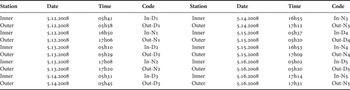
Day and night collections were carried out in the rainy season of May 2008 during 5 consecutive days in two fixed stations. The Inner station (In) was located in the bay formed by the main archipelago islands (Barão de Teffé, Saint Peter, Saint Paul and Belmonte). It is characterized as a sheltered area (up to 15 m deep) for the purposes of this study. The other station, Outer (Out), was located in an exposed external area on the west side of Belmonte Island (18–50 m deep) (Esteves et al., Reference Esteves, Moraes, Muricy and Amaral2002) (Table 1).
Sample details from Enseada and Cabeço da Tartaruga, Saint Peter and Saint Paul Archipelago, Brazil. The Code column is composed of sampling day (Number), station (EN, Enseada; CA, Cabeç da Tartaruga), and time of sample collection (D, daytime; N, night-time).

Mesozooplankton samples were collected with sub-surface hauls at 2 to 3 knots of vessel velocity. Hauls were 10 minutes in duration and were conducted with standard plankton net that had a 300 µm mesh size and was 0.30 m in mouth diameter. The net was fitted with a flowmeter.
The samples were placed in 250 ml plastic bottles and fixed with 4% formaldehyde neutralized with Borax (5 g l−1), following the technique described by Newell & Newell (Reference Newell and Newell1963). In the laboratory, the samples were weighed in a precision balance for biomass determination through the sestonic wet weight (Omori & Ikeda, Reference Omori and Ikeda1984).
Each sample was placed in a beaker and diluted with water. Then, the sample was homogenized, and three subsamples of 5 ml each were taken with a ‘Stempel' pipette and poured into a Bogorov counting plate. Aliquots containing a minimum of 300 individuals per sample were analysed under a stereomicroscope for identification and enumeration. Morphological structures of systematic characteristics essential for the identification of organisms and dissections were carried out, and the dissected parts were observed with a compound microscope. The zooplankton was counted based on the lowest possible taxonomic unit, based on Trégouboff & Rose (Reference Trégouboff and Rose1957), Björnberg (Reference Björnberg and Boltovskoy1981), Bradford-Grieve (Reference Bradford-Grieve1994) and Bradford-Grieve et al. (Reference Bradford-Grieve, Boyd, Chang, Chiswell, Hadfield, Hall, James, Nodder and Shushkina1999).
Data analysis
The density of organisms (ind. m−3), relative abundance and frequency of occurrence (F) were calculated. Relative abundance values follow the classification: dominant (>70%), abundant (70–40%), low abundant (40–10%) and rare (≤10%). The frequency of occurrence is classified as very frequent (>70%), frequent (70–40%), infrequent (40–15%) and sporadic (≤15%).
The Shannon diversity index was applied to estimate the community diversity (Shannon, Reference Shannon1948), and the evenness index was calculated according to Pielou (Reference Pielou1966).
The community density was compared two by two with the Mann–Whitney test to verify the vertical migration of organisms (daytime and night) and to observe differences in the community in different circulation conditions (sheltered and exposed areas). Spearman's correlation coefficient was applied to verify the degree of association between the values of sestonic biomass and organisms densities.
The statistical tests were conducted using the package BioEstat 3.0 (Ayres et al., Reference Ayres, Ayres, Ayres and Santos2003), and P values <0.05 were considered significant differences.
The similarity between the samples was tested based on the Bray–Curtis similarity coefficient using the density matrix. The taxa with less than 15% frequency of occurrence were removed from this analysis to avoid meaningless results. A log (x + 1) transformation was applied to the data. Cophenetic analysis was conducted to measure the goodness of fit of the data. A value > 0.8 indicates well-adjusted data (Rohlf & Fisher, Reference Rohlf and Fisher1968).
These calculations were carried out using the computer programs NTSYS (Numerical Taxonomy and Multivariate Analysis System) from Exeter Software—USA and PRIMER 6 (Plymouth Routines In Multivariate Ecological Research).
RESULTS
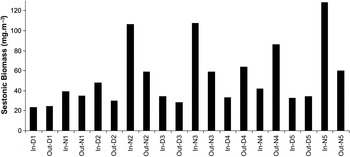
The sestonic biomass had an average value of 53.85 (±30.65) mg.m−3, varying between 23.61 mg.m−3and 128.28 mg.m−3 (Figure 2). A greater biomass was observed at night in comparison with diurnal collections at the two stations. There was also an increase in biomass over time.
Sestonic biomass (mg.m−3) in samples from Inner and Outer stations, Saint Peter and Saint Paul Archipelago, Brazil.

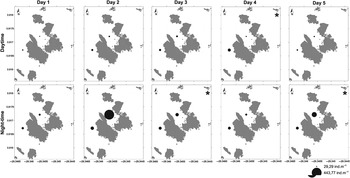
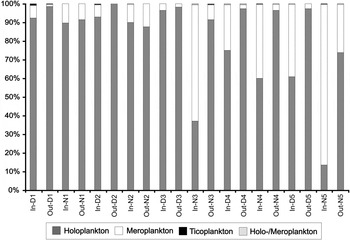
The density average in the Inner was 118.94 (± 128.07) ind.m−3, ranging from 29.29 to 443.77 ind.m−3. In Outer, the average was 99.66 (± 34.94) ind.m−3, and the range was from 41.35 to 148.71 ind.m−3 (Figure 3). Higher densities were registered nightly in both seasons. In comparisons between stations, only three Inner samples had higher densities where just one taxa dominated: Clausocalanus furcatus at In-N2, Scolecithrix danae at In-N3, and eggs of Exocoetidae at In-N5. This variation in dominance is an indication of a strong dynamics in the environment, without any taxon dominating for long, being possibly exported to the adjacent area.
Community density (ind.m−3) in samples from Inner and Outer stations, Saint Peter and Saint Paul Archipelago, Brazil. The symbol (✱) in the upper right of maps indicates significant differences between sampling stations (P < 0.05).

Significant differences were observed between the two stations in the daytime collection on the fourth day (Mann–Whitney, P = 0.0163) and in the night collections on the third (Mann–Whitney, P = 0.0203) and fifth days (Mann–Whitney, P = 0.0498). When samples from the different times were compared, no significant differences were observed between any collections.
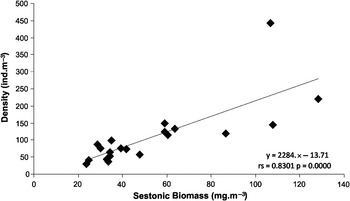
There was a significant positive correlation between the density and the sestonic biomass (Figure 4), indicating that the values of sestonic biomass are representative of the community.
Spearman correlation (rs) between sestonic biomass (mg.m−3) and density (ind.m−3) of samples from Inner and Outer stations, Saint Peter and Saint Paul Archipelago, Brazil.

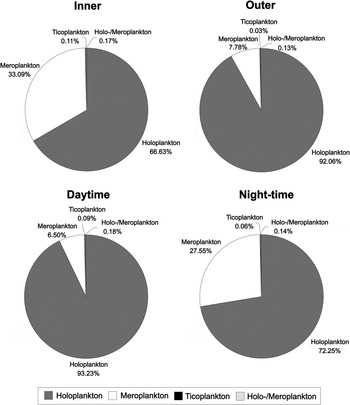
A total of 153 taxa were identified (Tables 2 & 3). Of these, 103 occurred in both stations. In Inner station, 123 taxa were observed, and 133 taxa were observed in Outer station. The holoplankton dominated both stations with 70% at Inner and 92% at Outer (Figures 5 & 6). Additionally, it was observed that the holoplankton were more dominant in the day samples. Among the identified taxa, Copepoda was the most abundant, except in the stations In-N3 and In-N5 where it was outranked by Chordata (mostly Exocoetidae eggs) (Figure 7).
Zooplankton community with plankton permanence highlighted from Inner and Outer stations, Saint Peter and Saint Paul Archipelago, Brazil.

Relative abundance of mesozooplankton sampling, highlighting plankton permanence, on Inner and Outer stations, Saint Peter and Saint Paul Archipelago, Brazil.

Phylum relative abundances, with the plankton permanence highlighted, in samples from Inner and Outer stations, Saint Peter and Saint Paul Archipelago, Brazil.

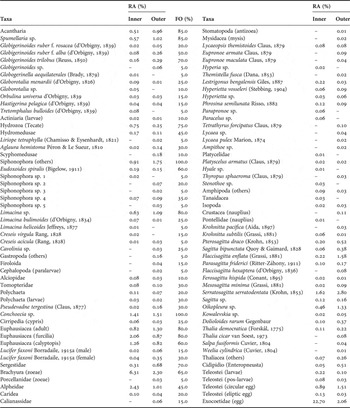
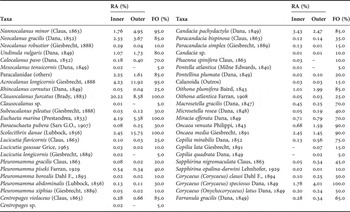
Species composition, relative abundance (RA) and frequency of occurrence (FO) (except Copepoda) in samples from Enseada and Cabeço da Tartaruga, Saint Peter and Saint Paul Archipelago, Brazil.

Copepoda species composition, relative abundance (RA) and frequency of occurrence (FO) in samples from Enseada and Cabeço da Tartaruga, Saint Peter and Saint Paul Archipelago, Brazil.

The most abundant Copepoda species were Clausocalanus furcatus at Inner station and Acrocalanus longicornis and Scolecithrix danae at Outer (Tables 2 & 3). The genera Lucicutia and Pleuromamma were observed only during day samplings.
Overall, 21.5% of the taxa (33) occurred very frequently (Tables 2 & 3). Of these, 7 occurred in all samples: (Siphonophora–others, Conchoecia sp., Clausocalanus furcatus, Euchaeta marina, Scolecithrix danae, Corycaeus (Corycaeus) speciosus and Serratosagitta serratodentata). Among the other organisms, 18 taxa were observed frequently, 34 less frequently and 68 sporadically.
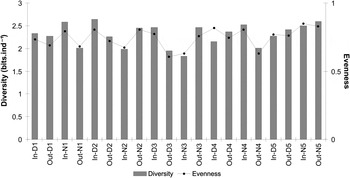
The diversity index was considered low in three samples, In-N2 (1.98), Out-D3 (1.95) and In-N3 (1.82). Other samples had diversity indices above 2 bits. ind−1, with a maximum value of 2.64 bits. ind−1 (Figure 8). These diversity values are classified as medium diversity. The evenness presented a similar pattern, with a minimum of 0.60 and a maximum of 0.84. These values indicate a balanced community.
Diversity index (bits ind−1) and evenness of samples from Inner and Outer stations, Saint Peter and Saint Paul Archipelago, Brazil.

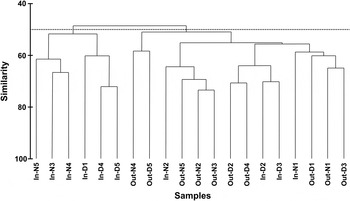
The Bray–Curtis similarity coefficient indicated that the observations comprised two main groups (A and B) (Figure 9). The cophenetic correlation provided a good fit to the data (r = 0.8018), indicating that the samples were separated into distinct groupings. Group A was composed of Inner samples, and it was subdivided into two groups. A1 was defined as the three previous night collections, which were dominated by Exocoetidae (egg). A2 was composed of diurnal samples from the first, fourth and fifth days, which contained numerous Clausocalanus furcatus and a large amount of Exocoetidae (egg), mainly in the fourth and fifth days.
Cluster analysis of mesozooplâncton sampled on Inner and Outer stations, Saint Peter and Saint Paul Archipelago, Brazil. The Bray–Curtis similarity coefficient gives r = 0.8018.

Group B was divided into three sub-groups. Subgroup B1 was composed of samples without any remarkable dominance, except by Scolecithrix danae in Out-N4. Subgroup B2, formed from nocturnal samples, was marked by alterations in dominance, but always for a certain group of species: Brachyura (zoeae) and Copepoda Clausocalanus furcatus, Acrocalanus longicornis, Euchaeta marina and Scolecithrix danae. B3 was composed of samples from the first three days, and it was mainly dominated by Clausocalanus furcatus and Acrocalanus longicornis.
DISCUSSION
The zooplanktonic community consisted of 153 taxa, which is greater than that found in studies on the continental shelf of north-eastern Brazil carried out by Cavalcanti & Larrazábal (Reference Cavalcanti and Larrazábal2004) and Neumann-Leitão et al. (Reference Neumann-Leitao, Gusmao, Silva, Nascimento-Vieira and Silva1999), who found 63 and 141 taxa, respectively. However, in the north-east oceanic and coastal region, Neumann-Leitão et al. (Reference Neumann-Leitão, Eskinazi-Sant'anna, Gusmão, Nascimento-Vieira, Paranaguá and Schwamborn2008) identified 151 taxa.
The complexity of hydrodynamic mechanisms associated with seamounts, islands and oceanic banks can be sources of spatial heterogeneity. This heterogeneity can influence community factors such as predation and zooplankton mortality, reproduction, feeding and species diversity (Haury et al., Reference Haury, Yamazaki and Itsweire1990; Hunt et al., Reference Hunt, Pakhomov and McQuaid2002). These structures promote the creation of unique habitats for many species (De Forest & Drazen, Reference De Forest and Drazen2009). Therefore, the regions of oceanic islands are considered amplification zones for such processes (Navatov & Ozmidov, Reference Navatov and Ozmidov1988; Lueck & Mudge, Reference Lueck and Mudge1997). They have higher diversities than open ocean regions. In comparison to the study by García-Díaz (Reference García-Díaz2007), which was also conducted in SPSPA, the present study showed lower diversity. However, the previous study found 183 taxa during the dry and rainy seasons. The probable cause of this difference may be due to the presence of species that prefer the dry period, which was not studied in our work.
For the Chaetognatha, our study identified higher richness (11 additional species) than the Garcia-Diáz (Reference García-Díaz2007) study. That study did not find the following species: Sagitta bipunctata, Parasagitta friderici, Mesosagitta minima, Kronitta pacifica and K. subtilis. However, S. serratodentata was the most abundant species in both studies and was also the most important in a study conducted by Gusmão (Reference Gusmão1986) that investigated the oceanic region of north-eastern Brazil. Serratosagitta serratodentata occurs in all oceans (Redfield & Beale, Reference Redfield and Beale1940) and along with P. draco is an indicator of warm water (Reyssac, Reference Reyssac1963). Another important species in this study was F. hexaptera, a bathypelagic species, which was present in surface samples. Its presence indicates upwelling. This species occurred only in samples from the Outer station. Among the other species registered, all were epipelagics.
Some taxa have dominance in a particular time period. This finding is related to the vertical migration these organisms undergo throughout the day. The most common pattern is that they are present in food-rich surface waters at night and retreat to deeper waters during the day (Forward, Reference Forward1988). The genera Lucicutia and Pleuromamma exhibit this behaviour (Björnberg, Reference Björnberg and Boltovskoy1981) and were represented by L. flavicornis, L. gaussae, L. longicornis, P. gracilis, P. piseki, P. borealis, P. abdominalis and P. xiphias. However, these species switched to appearing exclusively during the day, which can be related to collection time. Because sampling was carried out immediately after dawn, this unexpected trend most likely indicates that these species require more time to descend in the water column.
Another species with the same features is Scolecithrix danae (Björnberg, Reference Björnberg and Boltovskoy1981), which was collected mainly in the second, third and fourth days. The density values of nightly samples are much higher than the daily samples, indicating that this organism tends to be at the surface mostly during the night.
Zooplanktonic communities in marine environments are commonly dominated by holoplanktonic organisms (Boltovskoy, Reference Boltovskoy1999). In this study, we observed holoplankton dominance in both stations. In Outer station, this dominance was more conspicuous than in Inner. In Inner station, there is a greater availability of substrate for meroplanktonic organisms to attach to, and it is more colonized by species with a larval planktonic stage. The increment of meroplankton in Inner station on the third day of sampling is due to a large amount of Exocoetidae (eggs), indicating a recent reproductive period. Vaske Jr et al. (Reference Vaske, Nóbreca, Santana, Lessa, Ribeira, Pereira, Andrade, Vaske, Lessa, Nóbrega, Amaral and Silveira2006) suggested that this period occurs between November and May, when large shoals are concentrated in SPSPA for spawning. This increase in Inner station may be due to the need of the eggs for a substrate to continue their development, as they have filaments for the purpose of attachment (Hunte et al., Reference Hunte, Oxenford and Mahon1995; Ichimaru et al., Reference Ichimaru, Mizuta and Nakazono2006). Lessa et al. (Reference Lessa, Mafalda, Advincula, Lucchesi, Bezerra and Vaske1999) found that Exocoetidae is the dominant icthyoplankton in archipelago, with higher abundance in the stations closer to the SPSPA and night-time samples. Of the four species of this family that occur in the area, Cypselurus cyanopterus is the most representative. The adults of this species are very important to the region because they are a common food item for species of commercial interest.
Levinton (Reference Levinton1982) mentions the importance of meroplankton in tropical regions, where the percentage of invertebrate species that have planktonic larvae is significantly higher than in other regions. We observed these components of the meroplankton community in nocturnal samples. They were mainly represented by Exocoetidae (egg) and Brachyura (zoeae), which are taxa that spawn during this period and typically during the full moon (Schwamborn & Bonecker, Reference Schwamborn and Bonecker1996).
Copepoda dominates marine holoplankton and can represent more than 70% of a tropical oceanic community (Boxshall, Reference Boxshall1977; Longhurst & Pauly, Reference Longhurst and Pauly1987). This predominance was also observed by Cavalcanti & Larrazábal (Reference Cavalcanti and Larrazábal2004) in north-eastern Brazil's Economic Zone. The same authors showed that Chaetognatha was the second phylum in terms of importance; however, in their study, these were less abundant than Crustacea (others), especially Euphausiacea larvae (furcilia stages and calyptopis) and Brachyura larvae (zoea). Brandão (Reference Brandão2007) highlights the dominance of Euphausiacea larvae in relation to adults in the vicinity of SPSPA, and Gibbons et al. (Reference Gibbons, Spiridinov, Tarling and Boltovskoy1999) observed that this group has dominance in areas of high productivity. Vaske Jr et al. (Reference Vaske, Nóbreca, Santana, Lessa, Ribeira, Pereira, Andrade, Vaske, Lessa, Nóbrega, Amaral and Silveira2006) found that Grapsus grapsus was the most abundant Brachyura species in the archipelago. Studies on Decapoda larvae from this area showed that the decapods larvae community was divided into benthic and pelagic assemblages and also differences were registered between the inlet and the waters surrounding the archipelago (Koettker et al., Reference Koettker, Freire and Sumida2010).
In general, our diversity values were in accordance with the expected diversity values for zooplanktonic communities in tropical oceanic environments (Boltovskoy, Reference Boltovskoy1981). The exception was during Exocoetidae spawning times, when a large amount of eggs resulted in a decrease in diversity.
According to Margalef (Reference Margalef1958), the number of species may vary depending on the stability of the environment. A more stable environment implies a greater degree of organization and food web complexity, with the environment featuring more niches, and thus more species. Starting from this assumption, we would expect to find a greater number of species in Inner station, which is a sheltered, more stable environment. However, we did not observe this. One explanation for the unexpectedly low diversity value may be the presence of three channels between the main islands that communicate with the external environment (Campos et al., Reference Campos, Virgens Neto, Amorim, Hartmann and Petta2003). These create a constant flow within of the bay and may thus cause instability in the environment.
Dower & Mackas (1996) mention that it is possible in shallow seamounts for the zooplankton production to be exported outside. The flux created carries the species from the Inner to the Outer station (located at the western portion of SPSPA downstream of the Equatorial South Stream), thus it was not possible to find significant differences between the studied areas in relation to stability and species occurrence. This idea can be confirmed because the stations could only be considered significantly different (P < 0.05) three times.
The expected lack of striking differences between community and collection stations between the day and night periods, is an indication that non-biological factors are important for structuring of this community. Haury et al. (Reference Haury, Fey, Newland and Genin2000) described the physical forces related to size and depth of seamounts as possibly more important factors in controlling the formation of ‘spots' in these environments than the daily vertical migration behaviour of many of the zooplanktonic organisms. Meanwhile, Tzella & Haynes (Reference Tzella and Haynes2007) show that this process is due to biological interaction between species coupled with fluid movements.
Oceanic environments typically have zooplankton biomass values well below those found in coastal regions and platform breaks (Rakhesh et al., Reference Rakhesh, Raman and Sudarsan2006). However, areas with important morphological features stand out as places where biomass values are generally higher (Saltzman & Wishner, Reference Saltzman and Wishner1997). The observed biomass values for SPSPA were similar to those found by Martin & Christiansen (Reference Martin and Christiansen2009) at the Ampère seamount (50–80 mg m−3) in the north-eastern Atlantic, between Portugal and the Azores, except for some higher values due to high biomass of Exocoetidae (egg). We observed the highest values of biomass during the night, a situation also described by Nishikawa et al. (Reference Nishikawa, Matsuura, Castillo, Campos and Nishida2007).
Some authors such as Uda & Ishino (Reference Uda and Ishino1958), Dower et al. (Reference Dower, Freeland and Juniper1992), Dower & Mackas (1996) and Mourino et al. (Reference Mourino, Fernández, Serret, Harbour, Sinha and Pingree2001) propose that increased biomass is caused by modifications to the current regime that cause topographic resurgence. However, direct evidence of this connection is still scarce and more complete and prolonged studies are needed for these environments. Genin (Reference Genin2004) concludes that upwelling caused by the presence of banks, seamounts and oceanic islands can have a significant impact on the zooplankton community. To have an effect, these topographical features need to cause upwelling strong enough to reach the photic layer and last for the time needed to increase local biomass of phytoplankton (1 to 2 days). This increase in biomass in turn will affect the zooplankton biomass (on the order of weeks). Long-term observational studies are needed to confirm the presence of this effect in SPSPA.
Travassos et al. (Reference Travassos, Hazin, Zagaglia, Advincula and Schober1999) found no evidence of upwelling from interactions between the currents and the topography in SPSPA, while Von Bröckel & Meyerhöfer (Reference Von Bröckel and Meyerhöfer1999) did not observe either surface enrichment or another biological parameter that could indicate productivity sustained by upwelling in SPSPA. However, Araújo & Cintra (Reference Araújo, Cintra and Hazin2009) mention that the interaction of currents with the topography of SPSPA can cause physical processes such as the production of vortices, disturbances of the thermohaline structure and possible local upwelling mechanisms. This finding justifies in our study the presence of Phaenna spinifera and Flaccisagitta hexaptera, which are species normally found in mesopelagic waters (Bradford-Grieve et al., Reference Bradford-Grieve, Boyd, Chang, Chiswell, Hadfield, Hall, James, Nodder and Shushkina1999; Casanova, Reference Casanova and Boltovskoy1999). The zooplankton community in the Anaximenes Mountain region in the northern Levantine Basin (eastern Mediterranean) seems not to be influenced by a local seamount effect, despite the difference in standing stocks between the seamount and the Rhodes Basin. This seems to be driven by larger-scale upwelling and downwelling structures of cyclones and anticyclones, dominating the circulation in the area (Denda & Christiansen, Reference Denda and Christiansen2010).
Higher density values in samples in both stations during the night collections indicate an increase in the size of the aggregates during the night. This finding may be caused by the rise of organisms during this time (Wiebe, Reference Wiebe1970). However, Genin et al. (Reference Genin, Haury and Greenblatt1988, Reference Genin, Green, Haury, Wiebe, Gal, Kaartveldt, Meir, Fey and Dawson1994) proposed that the increased pressure of predation during the day by resident fishes may be responsible for minor evidence of the effect of abrupt topography on migration. We note this possibility in the present study, where no statistically significant differences were observed. Haury et al. (Reference Haury, Fey, Newland and Genin2000) also noted a low migratory activity in four studies of north-eastern Pacific seamounts. These low density values, coupled with the presence of indicator species such as Undinula vulgaris, Nannocalanus minor, Corycaeus (Corycaeus) speciosus, Euchaeta marina and Oithona plumifera (Boltovskoy, Reference Boltovskoy1981), indicate the oligotrophic characteristic of the area.
The dynamics of the zooplankton community in SPSPA demonstrate that a key group alters its proportions within the community. This community stands out by having physical forces as an important structuring factor. These forces act on the distribution and migration patterns of species. The changes in community parameters (biomass, diversity and abundance) reaffirm this phenomenon and justify the continuous monitoring efforts in the area.
ACKNOWLEDGEMENTS
We thank Dr J.F. Souza-Filho who helped with the Amphipoda identification. This work was funded by the CNPq (The National Council for Scientific and Technological Development). The authors also thank the Brazilian Navy for important support during the stay in the Saint Paul and Saint Peter Arquipelago.