1. Introduction
The pre-Mesozoic basement of Western Europe was built during the Variscan Orogeny which took place during Carboniferous time, from the Caucasus to the east, to the southern Appalachians and Ouachitas of North America, to the west. Despite extensive dismembering during subsequent strike-slip and rifting episodes, relics of the Variscan Orogen are well known in some places of Europe and several studies reveal their complex evolution during Palaeozoic times (e.g. Matte, Reference Matte2001; Martínez Catalán, Reference Martínez Catalán2011; Stampfli et al. Reference Stampfli, Horchard, Vérard, Wilhem and VonRaumer2013). These relics are composed of late Proterozoic and Palaeozoic rocks affected by several Variscan deformation and metamorphic events. In addition, the Variscan Orogeny of western Europe was accompanied by a great volume of intrusive granitoids (e.g. Pin & Duthou, Reference Pin and Duthou1990; Fernández-Suárez et al. Reference Fernández-Suárez, Gutierrez-Alonso, Johnston, Jeffries, Pastor-Galán, Jenner and Murphy2011). As a consequence of overprinting by geological events related to the Alpine cycle, the correlation of the Variscan terrains of western Europe remains a topic of interest and controversy (Stampfli et al. Reference Stampfli, Horchard, Vérard, Wilhem and VonRaumer2013).
Sm–Nd isotope systematics, combined with geochemical, petrological, structural and stratigraphic data, allow useful constraints on geodynamic reconstructions of orogenic belts to be established when applied to (meta-) igneous complexes or sedimentary sequences. The utility of the Sm–Nd method in crustal evolution studies stems from the observation that Sm/Nd fractionation occurs largely during extraction of melts from the mantle to the crust, whereas the intracrustal processes such as erosion, sedimentation, diagenesis, metamorphism and magmatism do not fractionate the light rare Earth elements (LREE) appreciably (e.g. McCulloch & Wasseburg, Reference Mcculloch and Wasserburg1978; DePaolo, Reference DePaolo1981).
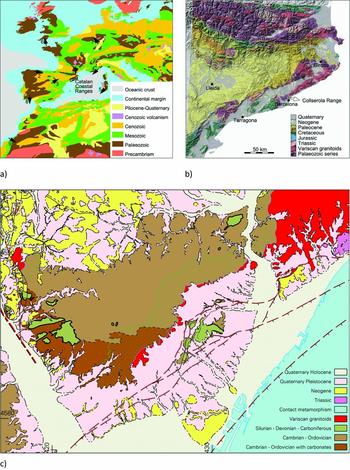
In western Europe and neighbouring areas (Fig. 1a) numerous studies have addressed the provenance of pre-Mesozoic sedimentary rocks and the Palaeozoic geodynamic evolution using Sm–Nd systematics (e.g. Nägler et al. Reference Nägler, Schäfer and Gebauer1995; Simien, Mattauer & Allegre, Reference Simien, Mattauer and Allegre1999; López-Guijarro et al. Reference López-Guijarro, Armendariz, Quesada, Fernández-Suárez, Murphy, Pin and Bellido2008). However, at present there are still large areas of the Variscan mountain chain without systematic determinations of their whole-rock Sm–Nd isotope signatures. This is the case for the Palaeozoic blocks of the Catalan Coastal Ranges (Julivert & Durán Reference Julivert and Durán1990a , Reference Julivert and Durán b ). These blocks define a discontinuous band along 200 km of the Mediterranean coast of NE Iberia, between the Pyrenees and the mouth of the Ebro River (Fig. 1b). In the context of the Variscan Belt, many authors interpret the Palaeozoic basement of the Catalan Coastal Ranges as part of the southern foreland basin of the mountain belt (e.g. Matte, Reference Matte2001). The pre-Mesozoic rocks in the Catalan Coastal Ranges exhibit important stratigraphical affinities with those outcropping in the Eastern Pyrenees, Montagne Noire, Sardinia and Iberian Range (Julivert & Duran, Reference Julivert and Durán1990a ). Palaeogeographic reconstructions predict that the Catalan Coastal Ranges were located in a transitional area between the northern branch of the Ibero-Armorican arc and the core of the arc (Julivert & Durán, Reference Julivert and Durán1990b ). This means that, regarding the tectonostratigraphic zones of the Iberian Massif, the largest and best-preserved segment of the Variscan Belt (the Catalan Coastal Ranges) could be related to the West Asturian – Leonese Zone or even the Central Iberian Zone.
(a) Location of the Catalan Coastal Ranges in a synthetic regional geological map of the Western Mediterranean Basin and neighbouring areas derived from the Geological Map of the World (CGMW, 2009). The arrows indicate the vergence of the nappes of the Variscan Belt of western Europe and NE Africa based on Matte (Reference Matte2001). 1. Montagne Noire/Pyrenees; 2. Asturian–Leonese zone/Cambrian zone; 3. Central Iberian Zone/Iberian Range; 4. Massif des Maures; 5. Sardinia; 6. North Brittany – Cornubia; 7. Saxo-Turingian Zone/Rheno-Hercynian Zone; 8. Ossa Morena Zone/South Portuguese Zone; 9. Anti Atlas. (b) Geological map of Catalonia with the location of the Collserola Range. (c) General geological map of the Collserola Range (coordinates are expressed in kilometers, UTM coordinate system zone 31N and with the geodetic datum ED50).

The Collserola Range, located in the metropolitan area of Barcelona, includes a representative Palaeozoic stratigraphic section (Cambro-Ordovician – Carboniferous) of the central part of the Catalan Coastal Ranges (Fig. 1c). The age of the pre-Silurian succession in the Collserola Range remains unknown. It is classically known as Cambro-Ordovician, but it might include late Neoproterozoic materials. Along with the Montnegre and Garraf massifs, the Collserola Range constitutes a NE–SW horst related to the development of the western Mediterranean Neogene rift and passive margin (Gaspar-Escribano et al. Reference Gaspar-Escribano, Garcia-Castellanos, Roca and Cloetingh2004).
The purpose of this study is to present an up-to-date review of the stratigraphy and structure of the Palaeozoic rocks of the Collserola Range and provide major- and trace-element and Sm–Nd data to constrain the pre-Mesozoic crustal evolution of this sector of the Variscan Belt of western Europe.
2. Palaeozoic stratigraphic sequence and structure
The detailed lithostratigraphical and structural characterization of the Palaeozoic rocks of Collserola Range was carried out in the framework of the project Urban Geological Map of Catalonia at the 1:5000 scale of the Institut Geològic de Catalunya (IGC, 2009–2012). Among previous studies, it is worth noting the contributions of R. Vaquer (unpub. Ph.D. thesis, University of Barcelona, 1973), Meléndez & Chauvel (Reference Meléndez and Chauvel1981), Julivert et al. (Reference Julivert, Duran, Rickards and Chapman1985), A. Abat (unpub. geological map, 1988), Gil Ibarguchi & Julivert. (Reference Gil Ibarguchi and Julivert1988), Almera (Reference Almera1900), Enrique (Reference Enrique1990), García-López et al. (Reference García-López, Julivert, Soldevila, Truyols-Massoni and Zamarreño1990), Gil Ibarguchi, Navidad & Ortega (Reference Gil Ibarguchi, Navidad and Ortega1990), Julivert & Durán (Reference Julivert and Durán1990a , Reference Julivert and Durán1990b ), Alías, Aulinas & Tubau (Reference Alías, Aulinas and Tubau2008) and Santanach et al. (Reference Santanach, Casas, Gratacós, Liesa, Muñoz and Sàbat2011).
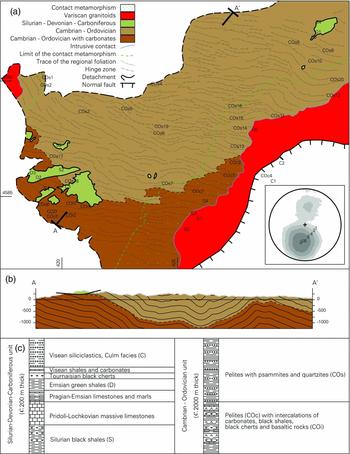
The Palaeozoic stratigraphical sequence in the Collserola Range can be divided into two units separated by a major discontinuity: (1) the Cambro-Ordovician unit (CO) and (2) the Silurian–Devonian–Carboniferous unit (SDC). As outlined above, it is important to note that the age of the CO unit is unknown and might even include Precambrian materials. The CO unit is affected by greenschist-facies Variscan regional metamorphism and the SDC unit is unmetamorphic or of very low grade. The CO unit constitutes >90% of the Palaeozoic basement of the Collserola Range (Fig. 2). However, the SDC unit refers to small bodies of Silurian, Devonian and Carboniferous sediments, overlying the CO unit in the SW (Molins de Rei, el Papiol, Santa Creu d’Olorda, Turó de Castellví), the NE (Montcada and turó de la Qüestió) and the SE (Turons de Barcelona).
(a) Geological map representing the trace of the regional cleavage in the CO materials, derived from the intersection of about 5000 measurements with the digital terrain model. Note that the slaty cleavage trends east–west and is affected by folds (see hinge zones). The boundary of the CO sequence with carbonates is oblique with respect to the trace of the slaty cleavage, and the traces of the regional cleavage do not continue inside the blocks of SDC materials. The aureole of contact metamorphism related to the intrusion of late-Variscan granitoids overprints the traces of the regional cleavage. The contour density stereoplot (inset) shows the general trend of the poles of the regional cleavage of the CO unit. (b) Cross-section revealing the folded structure of the regional cleavage of the CO unit, and the general structure of the subsurface of the study area. Note the geometric relationship between the regional cleavage, the intra-CO boundary and the detachment of SDC materials. (c) Stratigraphic column split into two parts: the SDC (left), c. 200 m thick, and the CO unit (right), c. 2000 m thick. Source: Geological map sheets and related information from the project Urban Geological Map of Catalonia at the 1:5000 scale of the Institut Geològic de Catalunya (IGC, 2009–2012).

The CO unit comprises grey pelites with intercalations of carbonate rocks, psammites, quartzites, black cherts, graphite-rich pelites and undated volcanic rocks. Widespread pelitic areas (in some cases >1 km2), without any correlable marker layer occur in this unit. Based on the analysis of the geological map of A. Abat (unpub. data, 1988) and further studies performed within the scope of the geological mapping project of the urban area of Barcelona (IGC, 2009–2012), the CO unit defines a stratigraphic sequence of c. 2000 m thickness. In the southern part of the range, it is possible to differentiate a domain rich in discontinuous carbonate lenses interbedded with pelites that defines a mappable strip of c. 2000 m width between Barcelona and Molins de Rei. This domain is also characterized by the presence of graphite-rich pelites, thin layers (1–5 cm) of black cherts and sills and interlayered bodies (metric to decametric in thickness) of basaltic rocks (Gil Ibarguchi & Julivert, Reference Gil Ibarguchi and Julivert1988; Gil Ibarguchi, Navidad & Ortega Reference Gil Ibarguchi, Navidad and Ortega1990; Alías, Aulinas & Tubau, Reference Alías, Aulinas and Tubau2008). To the north, the boundary of this carbonate-rich domain is marked by a discontinuous quartzite bed. Outside this domain carbonates are very scarce, mafic igneous rocks are absent and discontinuos thin intercalations of psammite and quarzite are predominant.
The bottom of the SDC unit is formed of strongly deformed Silurian graptolitic black shales with thin layers of black chert (Julivert et al. Reference Julivert, Duran, Rickards and Chapman1985). These shales contain abundant sulphides and turn white with coloured streaks when weathered. In the western sector of the Collserola Range, the Silurian black shales define a thick succession of c. 50 m (IGC, 2009–2012). These black shales are similar to those prevailing throughout the Iberian Massif and most of western Europe during Silurian time. They are overlain by a c. 80 m thick carbonate series (García-López et al. Reference García-López, Julivert, Soldevila, Truyols-Massoni and Zamarreño1990) including, from bottom to top: c. 40 m of Pridoli–Lochkovian massive nodular limestones with some thin beds of red and black shales, c. 20 m of alternating limestones and marls of Pragian–Emsian age and finally c. 20 m of green shales of Emsian age. This Siluro-Devonian succession corresponds to the pelagic carbonate facies type prevailing in the western Mediterranean area (Julivert & Durán, Reference Julivert and Durán1990a ). Carboniferous strata overlie the Lower Devonian beds through a paraconformity. They begin with c. 10 m of black cherts of Tournaisian age, followed by c. 10 m of Visean reddish shales interlayered with thin carbonate beds and finally c. 50 m of Visean greywackes, sandstones, shales and conglomerates of Culm facies.
In addition to the CO and the SDC units, the Palaeozoic basement of the Collserola Range also includes late-Variscan magmatic rocks related to the granite batholith of the Catalan Coastal Ranges (Enrique, Reference Enrique1990), specifically, the Barcelona granodiorite, the Mina Berta granodiorite and a SW–NE-trending swarm of dykes of granitic porphyries. Despite their high level of igneous emplacement, the granodiorites induced a contact metamorphism aureole of width >2 km (Gil Ibarguchi & Julivert, Reference Gil Ibarguchi and Julivert1988), suggesting that the sedimentary sequences form the roof of a large pluton (Enrique, Reference Enrique1990).
The CO rocks show a regional penetrative slaty cleavage related to the Variscan deformation. The analysis of more than 5000 measurements throughout the range shows that the slaty cleavage trends east–west and dips at c. 45° towards the north (Fig. 2). This is especially well developed in pelites, and generally less penetrative in carbonate and sandstone beds. In many sections bedding planes are difficult to determine, especially in the homogeneous pelitic domains. Where a depositional layering exists, it is observed that the intersection lineations between bedding and slaty cleavage are generally subhorizontal. Folds related to the slaty cleavage can be frequently observed at the outcrop scale, especially affecting competent layers of sandstones and carbonates. The kinematic analysis of these folds suggests a southern vergence, in agreement with the dominant pattern in the Palaeozoic rocks of the Catalan Coastal Ranges (Julivert & Durán, Reference Julivert and Durán1990b ). The regional slaty cleavage is often affected by several superimposed minor structures, such as crenulations, chevron folds or minor faults, that do not affect its regional trend significantly. The main mappable structures that affect the slaty cleavage of the CO unit are a train of east–west-trending open folds in the northern limb of Collserola (Fig. 2).
Above the CO rocks, the Silurian, Devonian and Carboniferous sediments show a markedly different tectonic style. In this case, bedding is the reference surface and cleavage is irregularly developed, mainly in the softer rocks of the sedimentary succession. The traces of the cleavage of the CO unit do not continue to the SDC unit, where the orientation of cleavage is much more variable. The analysis of the orientation of the bedding planes reveals the superposition of several deformative folding phases. The internal structure of the SDC blocks is governed by south directed thrusts detached above the Silurian black shales. The development of the thrusting phase affecting SDC rocks is interpreted to reflect shortening with formation of the pervasive cleavage of the CO rocks (Julivert & Durán, Reference Julivert and Durán1990b ; Santanach et al. Reference Santanach, Casas, Gratacós, Liesa, Muñoz and Sàbat2011). These structures correspond to the main Variscan deformation phase that affects the pre-Mesozoic basement of the Catalan Coastal Ranges. The late-Variscan igneous rocks cut the traces of the regional cleavage and the associated contact metamorphism overprints the regional metamorphism, demonstrating that they intruded well after the development of the main Variscan tectono-metamorphic phase.
The boundary between the SDC blocks and the underlying CO rocks is defined by a highly deformed zone including cataclastic rocks that truncates the regional slaty cleavage and the Variscan thrusts. The geological map and the cross-section of Figure 2 show how these detachment zones truncate the traces of the regional cleavage of the CO rocks. The base of the SDC blocks varies from the Silurian black shales to the Carboniferous siliciclastic rocks. SDC blocks lie indistinctly over the CO carbonate-rich domain or the rest of the Cambro-Ordovician materials. These structural features suggest that the SDC–CO contacts in Collserola are low-angle normal faults related to late- or even post-Variscan deformations as depicted in several geological map sheets and cross-sections in IGC (2009–2012).
In the absence of biostratigraphic control or absolute dating (e.g. detrital zircon or interlayered volcanic rock U–Pb ages), the precise age of the Cambro-Ordovician unit of the Collserola Range remains unknown. Structural analysis suggests that the carbonate-rich domain rocks represent the oldest materials of the Collserola Range, as previously stated by Julivert & Duran (Reference Julivert and Durán1990a ). The oldest faunas available, of Asghilian age, have been found in Montcada, the eastern part of Collserola (Meléndez & Chauvel, Reference Meléndez and Chauvel1981). Julivert & Durán (Reference Julivert and Durán1990a ) proposed an Asghillian age for the carbonate-rich domain and ascribed the rest of the succession to the Silurian. These authors further proposed that the CO succession (of Silurian age in their interpretation) defines a stratigraphic pile of c. 400 m. Our data suggest that the thickness is considerably larger, c. 2000 m. From a regional point of view, the assignment of much of the early Palaeozoic succession of the Collserola Range to Silurian age is problematic, because it is quite difficult to correlate these materials with the Silurian strata of the neighbouring Palaeozoic massifs. From both lithological and structural points of view it is easier to consider that, as a whole, the pelites with interlayered sandstones and carbonates found in the Collserola Range are the southern correlatives of the classically known Cambro-Ordovician successions that form wide outcrops in most of the Palaeozoic massifs of the Catalan Coastal Ranges (e.g. Julivert & Durán, Reference Julivert and Durán1990a ) and the eastern Pyrenees (e.g. Laumonier, Reference Laumonier, Barnolas and Chiron1996). Recent radiometric dating of interlayered volcanic rocks indicate that some of these Cambro-Ordovician successions may include late Neoproterozoic materials (Castiñeiras et al. Reference Castiñeiras, Navidad, Liesa, Carreras and Casas2008).
3. Sampling and analytical techniques
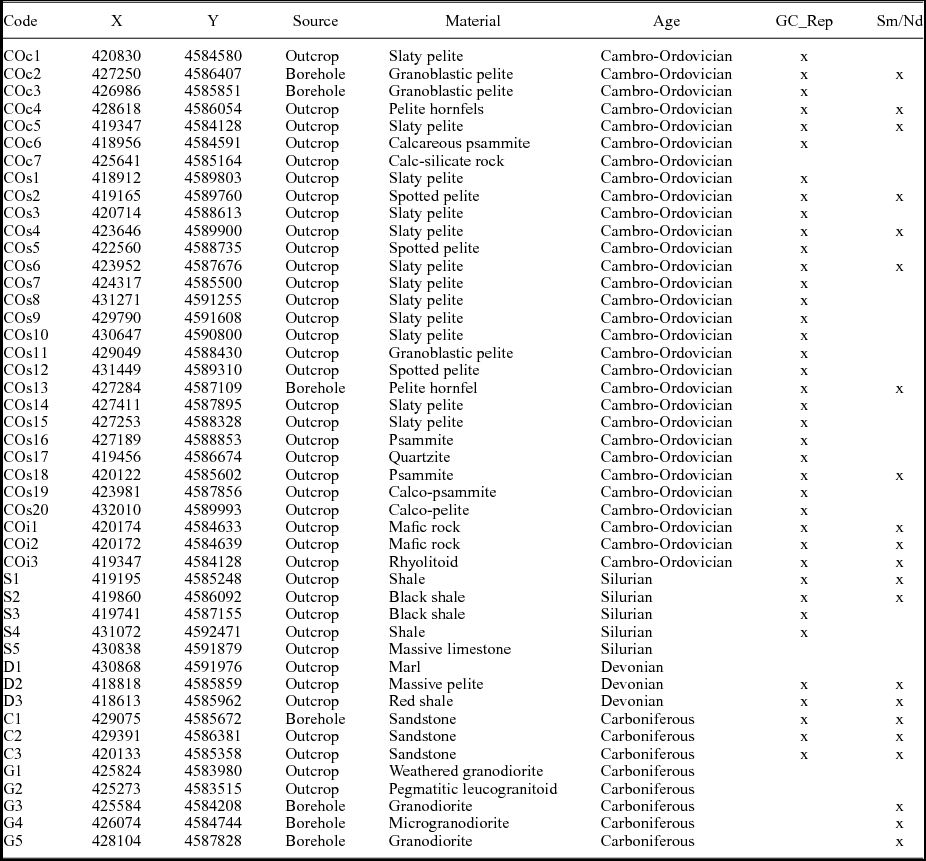
A total of 46 representative samples of the Palaeozoic basement of the Collserola Range, taken from outcrops and borehole logs, have been studied for whole-rock major- and trace-element concentrations. These include pelites, metasandstones and metavolcanics of the CO unit, shales and sandstones of the SDC unit and some Variscan granitoids. In order to facilitate data handling and discussion, the samples of the CO unit have been subdivided into those that belong to the domain rich in carbonate intercalations (identified with the label COc) and the siliciclastic domain without carbonate intercalations (COs). The SDC samples have been grouped into the Silurian (S), Devonian (D) and Carboniferous (C). A short description of the samples analysed is provided in Table 1. The geochemical analyses were carried out in the Actlabs Laboratory (Ancaster, Canada) using the commercial analytical package 4Litho. This method employs a LiBO2 fusion digestion technique, prior to determination of major and trace elements using inductively coupled plasma optical emission spectrometry (ICP-OES) and ICP mass spectrometry (MS), respectively.
Locations and lithologies of samples analysed. GC_Rep column specifies those samples represented in the geochemical figures. Sm/Nd column indicates those samples where Sm/Nd data have been measured. The locations are expressed in metres, UTM coordinate system zone 31N and with geodetic datum ED50.

Based on the major- and trace-element compositions, 21 representative samples have been selected for whole-rock Sm–Nd isotope measurements. Specifically, we have analysed two pelites of the Cambro-Ordovician carbonate-rich domain, five pelites and one psammite of the rest of the Cambro-Ordovician succession, two Silurian shales, two Devonian shales, three greywackes of the Culm facies, three late-Variscan (c. 300 Ma) granodiorites and two mafic igneous rocks and one felsic metavolcanic sample representative of the Cambro-Ordovician magmatism.
The Sm–Nd isotopic analyses were carried out in the CNRS laboratory of geochemistry of the Département de Géologie of Université Blaise Pascal of Clermont-Ferrand (France), following techniques adapted from those described by Pin & Santos (Reference Pin and Santos1997) and Le Fèvre & Pin (Reference Le Fèvre and Pin2002). The samples were decomposed by fusion with a LiBO2 flux at c. 1150°C in an induction furnace, and the resulting melt was quenched in dilute HCl after addition of a mixed 149Sm–150Nd-enriched tracer. A LREE fraction was then separated from other elements by a method combining cation exchange (AG50×4 resin, Bio-Rad) and extraction chromatography (TRU resin, Eichrom). Nd and Sm fractions suitable for mass spectrometry were isolated by extraction chromatography (Ln resin, Eichrom). The Sm concentrations were detetermined by isotope dilution thermal ionization mass spectrometry (ID-TIMS) with an upgraded, fully automated VG54E instrument, with the sample loaded in a drop of phosphoric acid on a single tantalum filament. Nd concentrations and 143Nd/144Nd isotope ratios were measured with a Triton mass spectrometer operated in static multicollection mode at Laboratoire GIS, Université de Nîmes, with the sample loaded on a double rhenium filament assembly. The 143Nd/144Nd ratios are given relative to a value of 0.512110 for the JNdi-1 isotopic standard (Tanaka et al. Reference Tanaka, Togashi, Kamioka, Amakawa, Kagami, Hamamoto, Yuhara, Orihashi, Yoneda, Shimizu, Kunimaru, Takahashi, Yanagi, Nakano, Fujimaki, Shinjo, Asahara, Tanimizu and Dragusanu2000) and the 147Sm/144Nd ratios are precise to ±0.2%.
4. Major-element geochemistry
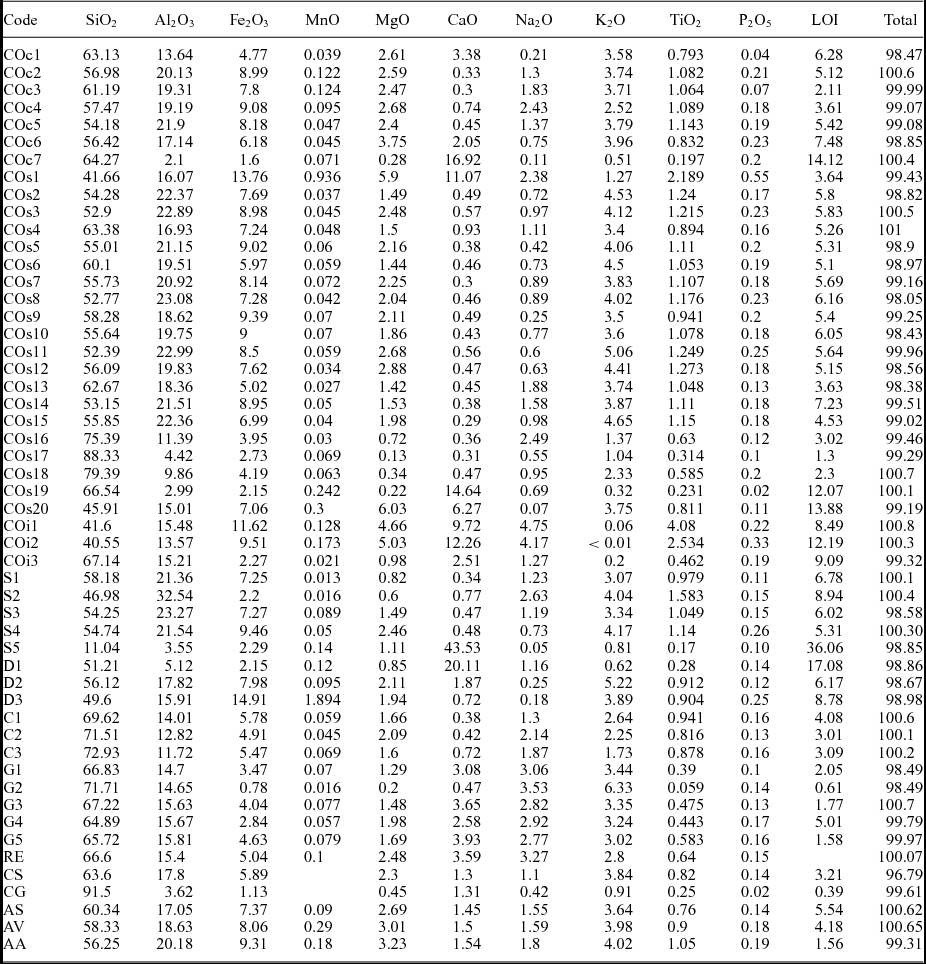
Major-element compositions of the analysed samples of sedimentary, metamorphic and igneous rocks of the Collserola Range are given in Table 2. For purposes of comparison, worldwide reference compositions are also listed. The selected reference compositions include: (1) the average composition of shales (CS) and sandstones (CG) proposed by Condie (Reference Condie1993); (2) the average compositions of shales and slates (AS), greenshists facies pelites (AV) and amphibolite facies pelites (AA) proposed by Ague (Reference Ague1991); and (3) the average composition of the upper Earth crust (RE) compiled by Rudnick & Gao (Reference Rudnick, Gao and Rudnick2003).
Major-element compositions. All values are in wt%. Reference compositions: AS – shale/slate from Ague (Reference Ague1991); AV – greenshists-facies pelites from Ague (Reference Ague1991); AA – amphibolite-facies pelite from Ague (Reference Ague1991); CS – Phanerozoic shale from Condie (Reference Condie1993); CG – Phanerozoic sandstone from Condie (Reference Condie1993); RE – upper Earth's crust from Rudnick & Gao (Reference Rudnick, Gao and Rudnick2003).

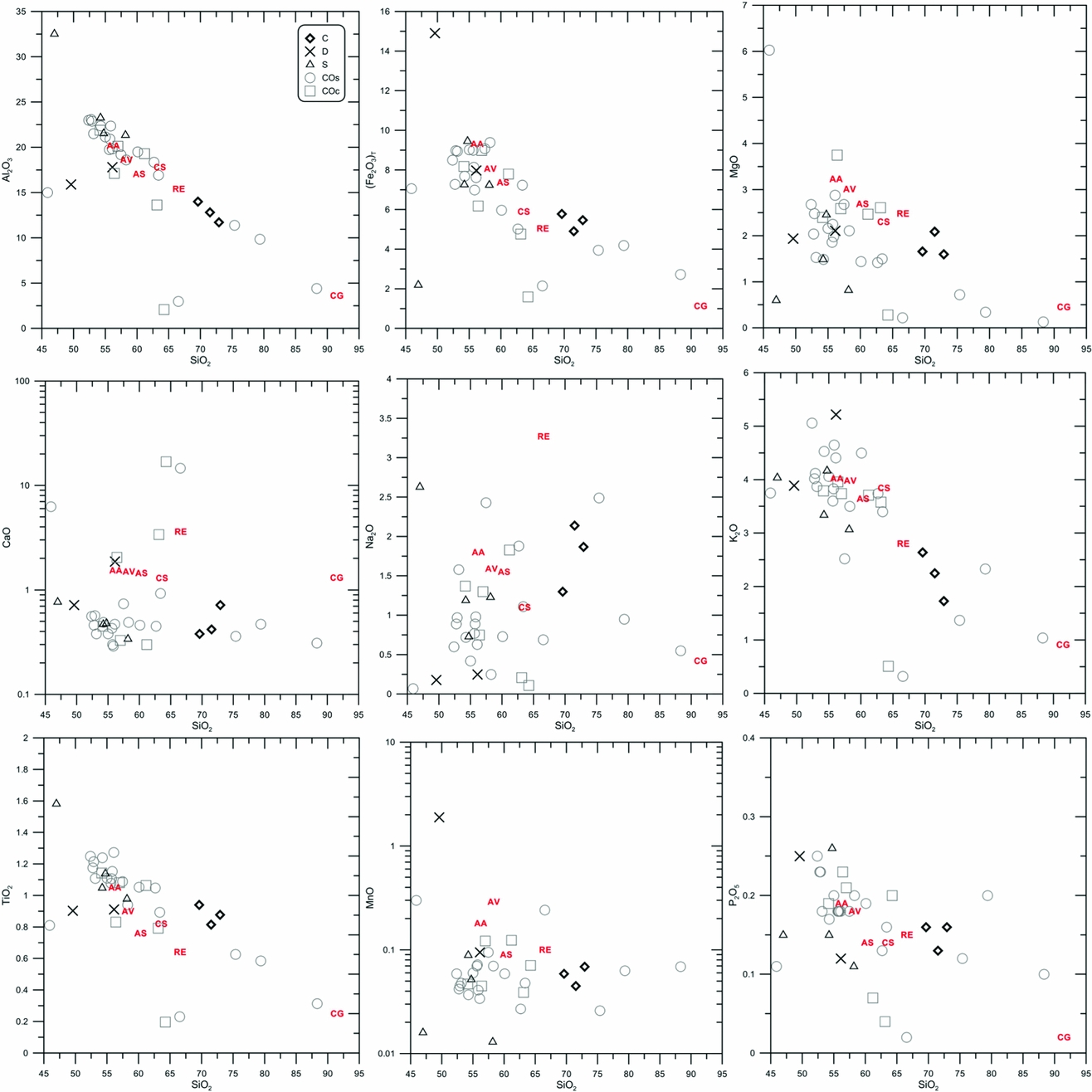
Harker variation diagrams for major elements are given in Figure 3. SiO2 is chosen as the reference oxide because it exhibits a wide variation range. In order to facilitate the reading of the Harker diagrams, the carbonate-rich samples COc7, S5 and D1 and the Cambro-Ordovician metavolcanic rocks, as well as the late-Variscan granitoids, were omitted.
Harker variation diagrams of SiO2 v. Al2O3, Fe2O3, MgO, CaO, Na2O, K2O, TiO2, MnO and P2O5 (wt%) for Palaeozoic sedimentary and metasedimentary rocks from the Collserola Range samples. C – Carboniferous; D – Devonian; S – Silurian; COs – Cambro-Ordovician siliciclastic domain; COc – Cambro-Ordovician carbonate-rich domain. Reference compositions: AS – shale/slate (Ague, Reference Ague1991); AV greenschists-facies pelites (Ague, Reference Ague1991); AA – amphibolite-facies (Ague, Reference Ague1991); CS – Phanerozoic shale (Condie, Reference Condie1993); CG – Phanerozoic sandstone (Condie, Reference Condie1993); RE – upper Earth's crust (Rudnick & Gao, Reference Rudnick, Gao and Rudnick2003).

The SiO2 concentration of the samples of CO sedimentary and metasedimentary rocks (COc and COs) varies between 45 wt% and 88 wt%. Overall, the COc samples are less siliceous than the COs samples. CO pelites mainly have a SiO2 concentration of 52–64 wt%, lower than the average composition of the upper crust (RE). The SiO2 content of the reference pelites (CS, AA, AV and AS) falls within this compositional range. CO psammites have SiO2 concentrations of >64 wt%, slightly lower than the reference sandstone CG. The samples of the SDC have a SiO2 concentration within the range displayed by the CO unit. Specifically, the Silurian and Devonian pelites have an overall concentration of 46–56 wt% while the Carboniferous sandstones have a concentration of c. 70 wt%.
In the SiO2–Al2O3 diagram, the analysed samples as a whole roughly define an inverse linear relationship. Only four samples depart from this trend, namely the calcareous psammites COc6 and COs19, the calcareous pelite COs20 and the Devonian red shale D3. In the SiO2–CaO plot, the Cambro-Ordovician carbonate-rich samples are clearly identified by their high calcium content. Additionally, the calcareous pelite COs20 is significantly enriched in MgO in comparison to the rest of the samples (see SiO2–MgO diagram), suggesting the presence of dolomite. The Devonian red shales are highlighted in the Fe2O3–SiO2 and the MnO–SiO2 diagram by their high Fe2O3 and MnO content, respectively. If these four samples are discarded, it is observed that the SiO2 of the rest of the samples and the reference compositions define linear inverse relationships with Fe2O3, K2O and TiO2. These linear trends can be interpreted as a result of a mineral fractionation process, basically controlled by quartz, micas and ilmenite. In the case of MgO, CaO, Na2O, MnO and P2O5 the relationships to SiO2 define more scattered distributions. In general, our pelites are depleted in MgO, CaO, Na2O and MnO with respect to the pelitic reference compositions, while their P2O5 concentrations are similar.
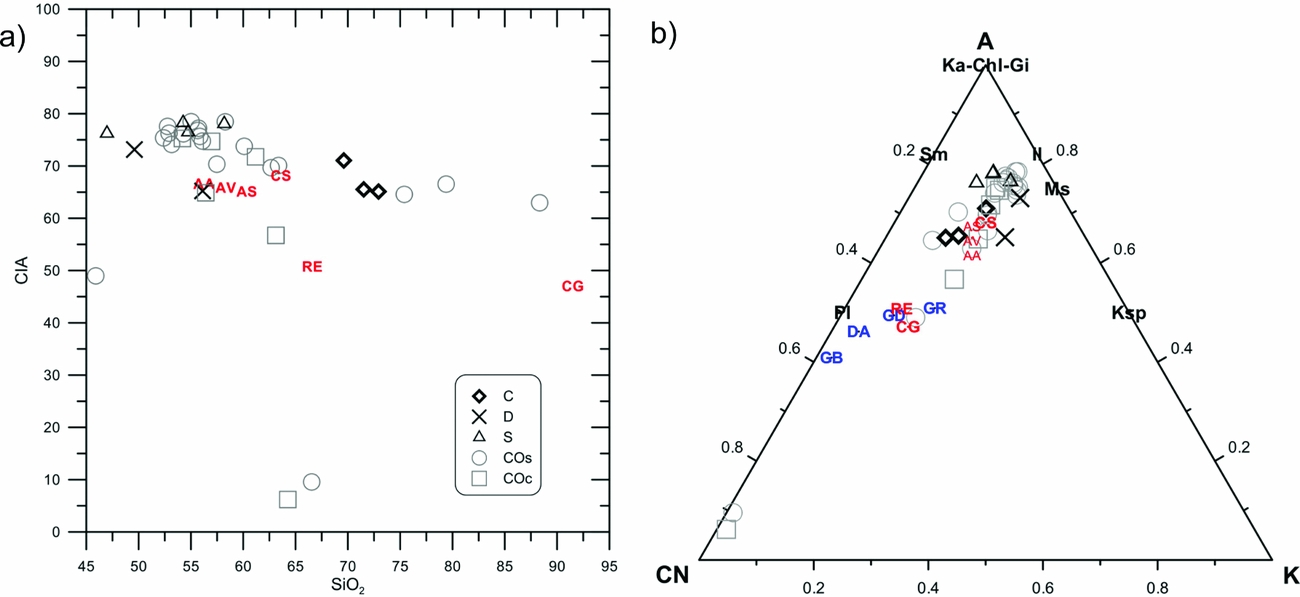
In order to determine the degree of source area weathering, we have computed the Chemical Index of Alteration (CIA) proposed by Nesbitt & Young (Reference Nesbitt and Young1982). The CIA index is defined as (Al2O3×100)/(Al2O3+CaO*+Na2O+K2O) (in molecular proportions), where CaO* is the amount of CaO incorporated in the silicate fraction of the rock. In the present work, it is assumed that all the CaO of the analysed samples and the reference compositions comes from the silicate fraction. Figure 4a displays the SiO2–CIA relationship of the Collserola samples. Omitting the carbonate-rich samples (COs19, COs20 and COc6), it is observed that the CIA index of the Cambro-Ordovician samples is inversely proportional to the SiO2 concentration from 80 (for SiO2 c. 50 wt%) to 65 (for SiO2 c. 90 wt%). The siliciclastic samples of the COc domain define a distribution that does not allow their discrimination from the rest of the Cambro-Ordovician samples. In comparison with the Cambro-Ordovician pelites, the CIA values of the Silurian and the Devonian samples are slightly higher and slightly lower, respectively. The pelites and psammites of Collserola, which derive from sedimentary recycling, have CIA notably higher than the average upper Earth's crust composition (RE), as expected. The CIA values of the reference pelites (AA, AV, AS and CS) fall below the SiO2–CIA trend defined by the Collserola samples, indicating that the Palaeozoic siliciclastic succession of Collserola were fed by highly weathered source areas and/or reworked earlier sedimentary sources.
(a) SiO2 v. CIA for analysed sedimentary and metasedimentary rocks of the Collserola Range. (b) Ternary A–CN–K diagram (Nesbitt & Young, Reference Nesbitt and Young1982) for analysed sedimentary and metasedimentary rocks of the Collserola Range. Pl – plagioclase; Ksp – K-feldspar; Sm – Smectite; Ka – Kaolinite; Gi – Gibbsite; Chl – Chlorite. Reference igneous rock compositions: GB, DA, GD and GR represent the average compositions estimated by Le Maitre (Reference Le Maitre1976) of gabbro, diorite, granodiorite and granite, respectively.

In Figure 4b the Collserola pelite and psammite data are plotted on the A–CN–K diagram of Nesbitt & Young (Reference Nesbitt and Young1982) where A is the mole fraction Al2O3, CN is the sum of the mole fractions CaO and Na2O in the silicate components and K is the mole fraction K2O. This ternary diagram allows us to compare the measured compositions with the compositions of the major silicate sedimentary minerals. Additionally, in this diagram the average composition of gabbros (GB), diorites (DA), granodiorites (GD) and granites (GR) compiled by Le Maitre (Reference Le Maitre1976) are also represented. The A–CN–K diagram shows that the Collserola pelites define a dominant compositional field close to that of illite and muscovite, revealing a considerable degree of weathering of the source area. The majority of the Collserola samples compositions plot far from the average composition of the RE estimate for the upper Earth's crust, the reference sandstone CG and the reference igneous rocks (GB, DA, GD and GR). Overall, the Cambro-Ordovician pelites and psammites of Collserola Range define a roughly linear trend towards the plagioclase field, suggesting that sedimentary sorting of plagioclase might have occurred. The Silurian, Devonian and Carboniferous samples and the reference compositions of pelites AP (including AA, AV and AS) and CS and sandstones CS roughly project on this linear trend.
5. Trace-element geochemistry
Trace-element analyses of the Palaeozoic rocks of the Collserola Range are provided in online Supplementary Table S1 (available at http://journals.cambridge.org/geo), which also includes global reference compositions. The selected reference compositions are: (1) the average composition of shales (CS) and sandstones (CG) proposed by Condie (Reference Condie1993); and (2) the average composition of the upper Earth's crust (RE) proposed by Rudnick & Gao (Reference Rudnick, Gao and Rudnick2003).
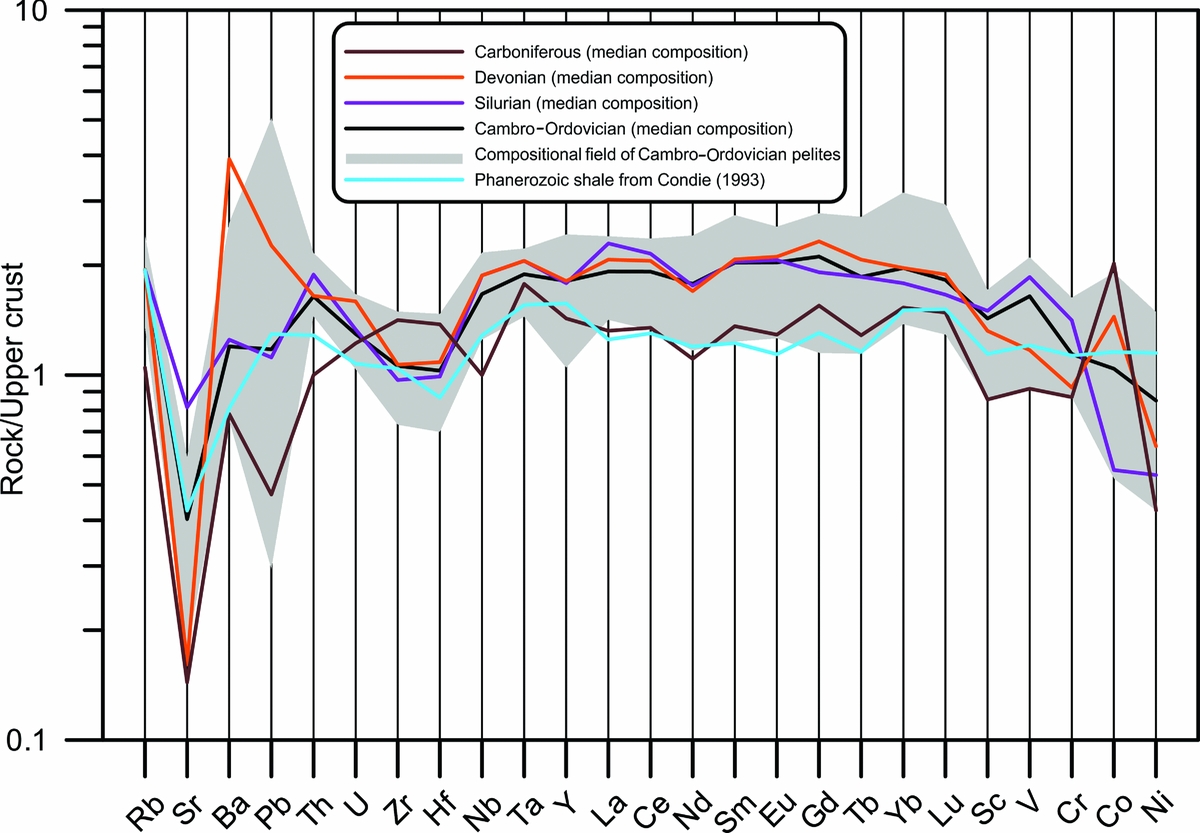
The multi-element diagram (Fig. 5) summarizes the trace-element distribution of the siliciclastic Palaeozoic rocks of the Collserola Range. The trace-element concentrations are normalized to the average composition of the upper Earth's crust proposed by Rudnick & Gao (Reference Rudnick, Gao and Rudnick2003). The multi-element diagram reveals that the Cambro-Ordovician siliciclastic rocks, as a whole, are enriched in Rb, Th, U, Nb, Ta, Y, La, Ce, Nd, Sm, Eu, Gd, Tb, Yb and Lu and depleted in Sr compared to the upper crust. These rocks are relatively enriched in light rare Earth elements (La, Ce, Nd, Sm and Eu) with respect to the reference pelite CS, in agreement with their high Chemical Index of Alteration, but the rest of the trace-element data of the Cambro-Ordovician samples are similar to those of average shales. Most of the trace-element median concentrations of the Silurian and Devonian pelites fall near the median concentration of the Cambro-Ordovician rocks. The main compositional features of the Silurian shales are their enrichment in Sr and their depletion in Co. In the case of the Devonian samples, Ba and Pb enrichments and Sr depletion can be noted. These compositional differences between Silurian and Devonian rocks might be related to the sampling bias, but in any case the median compositions fall inside or near the compositional field of the Cambro-Ordovician rocks. The Carboniferous materials, which are sandier than the majority of the Cambro-Ordovician samples, are depleted in Rb, Sr, Ba, Pb, Th, rare Earths, Sc, V, Cr and Ni as a result of dilution by the quartz component.
Plot of average compositions of the Palaeozoic sedimentary and metasedimentary rocks of the Collserola Range normalized to the upper crustal compositional estimate of Rudnick & Gao (Reference Rudnick, Gao and Rudnick2003).

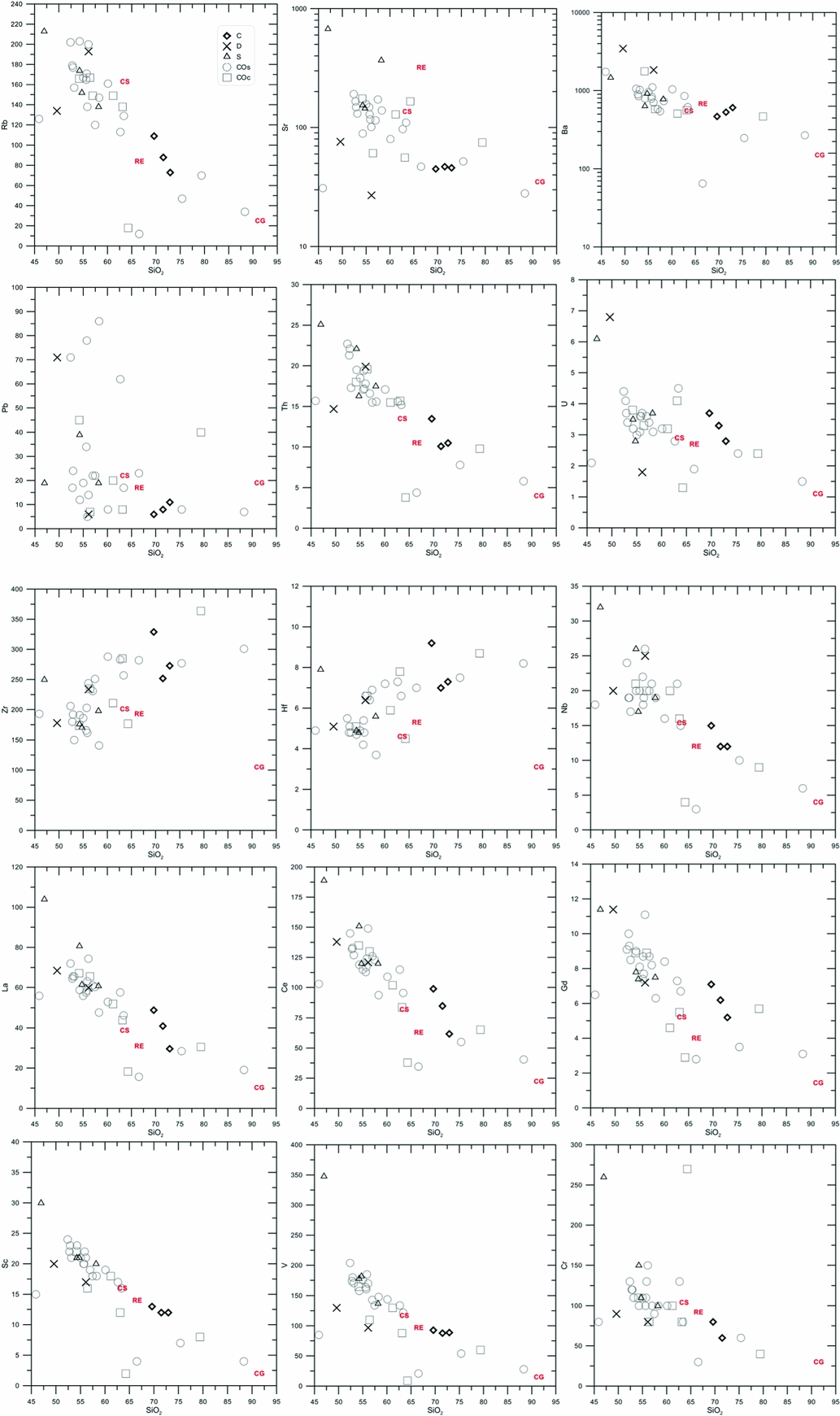
Harker variation diagrams for trace elements are given in Figure 6. In order to facilitate reading, the carbonate-rich samples COc7, S5 and D1 and the Variscan and Cambro-Ordovician magmatic rocks were not represented. The diagrams for the Silurian, Devonian and Carboniferous samples do not show significant deviations from the trends defined by Cambro-Ordovician siliciclastic rocks. The concentrations of Rb, Ba, Th, Nb, La, Ce, Gd, Sc and V broadly define a negative correlation with SiO2, suggesting that their distribution is mainly controled by phyllosilicates. There is no clear relationship between Sr, Ba and Pb and SiO2, as expected for trace elements linked to several mineral phases. Uranium shows a higher dispersion than Th, possibly reflecting the occurrence of the two species U4+ (immobile) and U6+ (mobile), probably as a consequence of variable contents in organic matter. The Zr–SiO2 and Hf–SiO2 diagrams show a similar pattern, in line with their similar geochemical behaviour. Specifically, Zr and Hf present a high correlation coefficient with a mean Zr/Hf ratio of c. 35, characteristic of zircon crystals (Murali et al. Reference Murali, Parthasarathy, Mahadevan and Sankar Das1983; Bauluz et al. Reference Bauluz, Mayayo, Fernandez-Nieto and Gonzalez-López2000), implying that both elements are controlled by zircons. High concentrations of Zr and Hf in the Cambro-Ordovician sandstones contrast with the sandstone reference CG. Unlike the other transition trace elements (Sc and V), chromium shows a weak correlation with SiO2, suggesting that apart from the presence of phyllosilicates other significant factors control the Cr distribution.
Harker variation diagrams of SiO2 v. a selection of representative trace elements. Acronyms as for Figure 3. COi – Cambro-Ordovician igneous rocks; VG – Variscan granitoids.

6. Sm–Nd isotopes
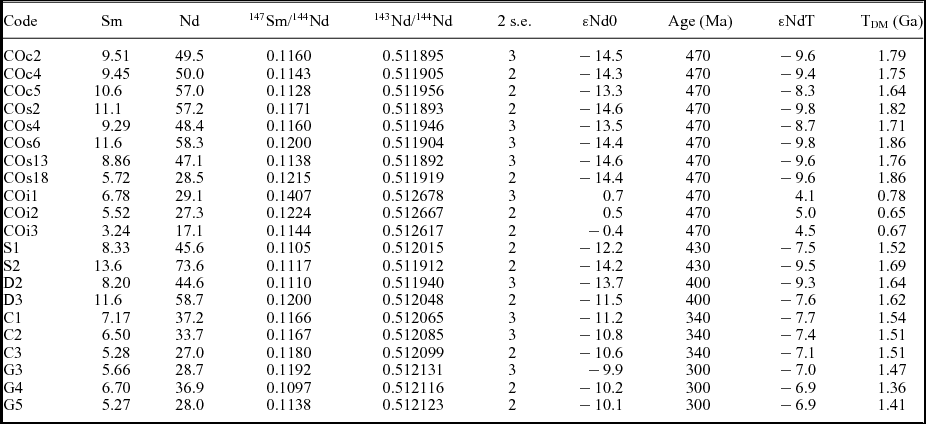
The 143Nd/144Nd and 147Sm/144Nd isotopic ratios are listed in Table 3, along with the Sm and Nd concentrations determined by isotope dilution thermal ionization mass spectrometry. The isotopic initial ratios expressed in terms of εNdT have been calculated from stratigraphic ages estimated from a geologic time scale (Gradstein, Ogg & Smith, Reference Gradstein, Ogg and Smith2004) and the average ‘crustal residence’ Nd model ages TDM (DePaolo, Reference DePaolo1981). Despite the great uncertainty regarding the age of the Cambro-Ordovician succession, an age of 470 Ma has been assumed. However, a ±25 Ma uncertainty of the age would be reflected by a shift of no more than 0.3 epsilon-units, which would not change the geological interpretation of the data appreciably.
Results of Sm–Nd isotope analyses. Column ‘Age (Ma)’ indicates the assumed ages of sedimentary deposition and magmatic emplacement used to calculate εNdT values.

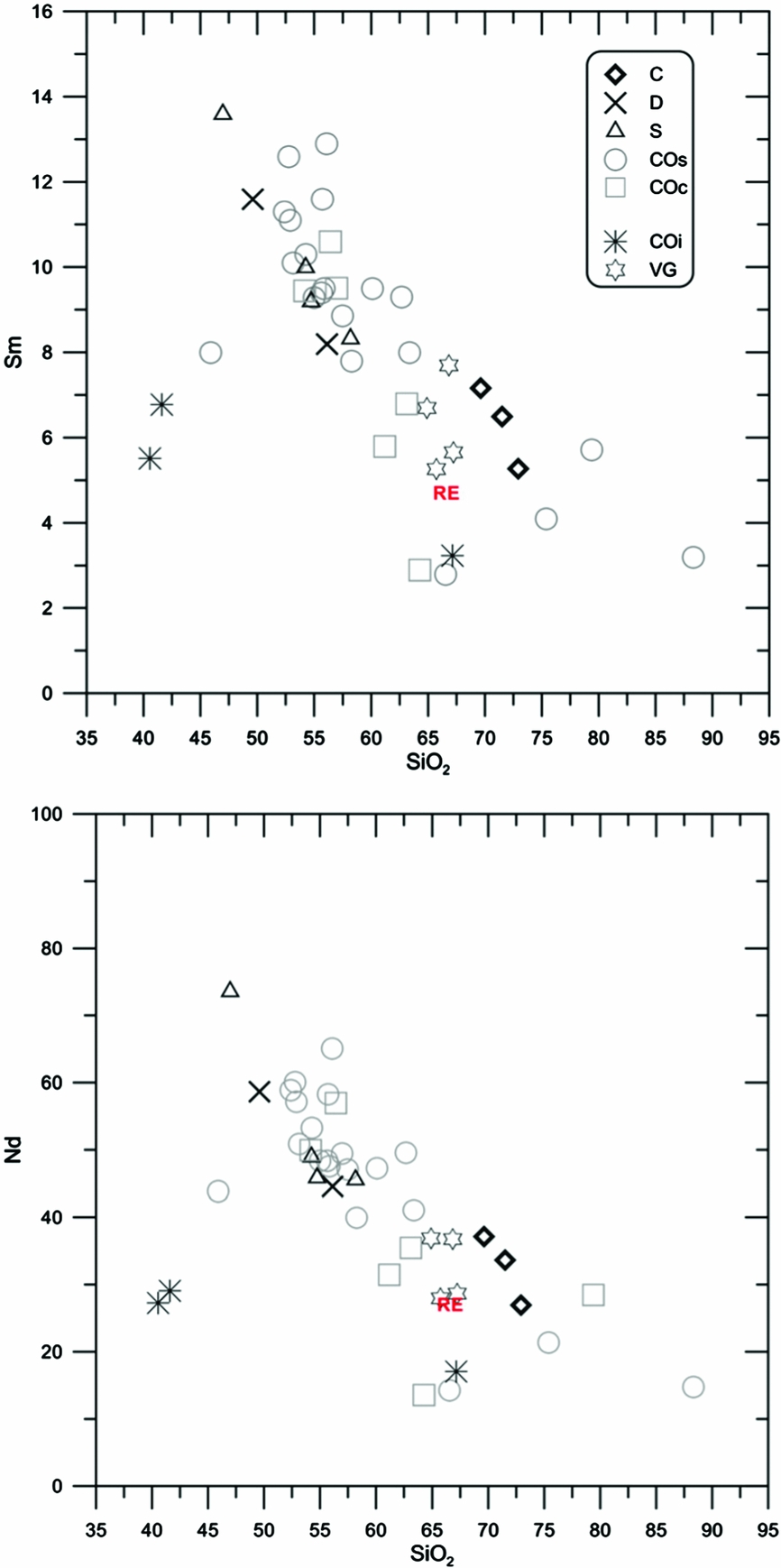
The Sm and Nd concentrations of the siliciclastic rocks from the Collserola Range gradually decrease with increasing SiO2 (Fig. 7), reflecting the diluting effect of quartz, as also observed for La and Ce in Figure 6. The Variscan granitoids plot on the linear trend defined by the siliciclastic rocks observed in Figure 7. The Cambro-Ordovician mafic meta-igneous rocks have lower contents of Sm and Nd.

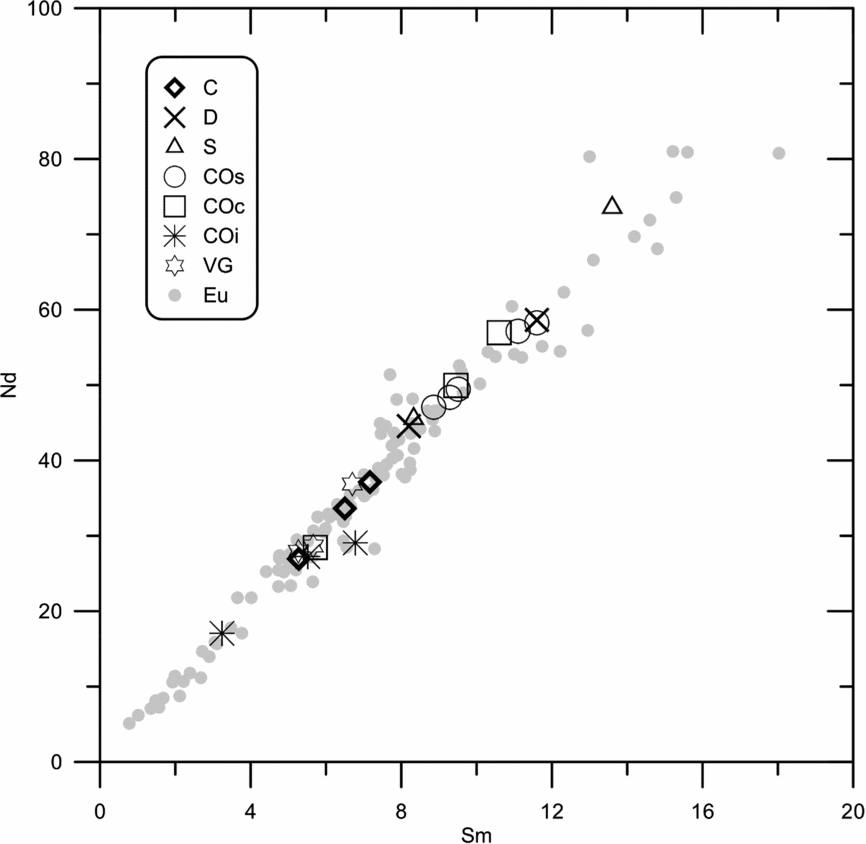
The Sm and Nd concentrations determined by ID-TIMS are represented in the binary diagram of Figure 8. This diagram also includes representative compositions of Palaeozoic and late Proterozoic silicilastic rocks (mainly fine-grained) of neighbouring areas of SW Europe (small grey dots), specifically from the Montagne Noire (Simien, Mattauer & Allegre, Reference Simien, Mattauer and Allegre1999), the Eastern Pyrenees (Vilà et al. Reference Vilà, Pin, Enrique and Liesa2005), the Cantabrian Zone (Nägler et al. Reference Nägler, Schäfer and Gebauer1995) and the Central Iberian Zone (Nägler et al. Reference Nägler, Schäfer and Gebauer1995; Ugidos et al. Reference Ugidos, Valladares, Recio, Rogers, Fallick and Stephens1997; López-Guijarro et al. Reference López-Guijarro, Armendariz, Quesada, Fernández-Suárez, Murphy, Pin and Bellido2008). The diagram shows that the Sm and Nd concentrations of the siliciclastic rocks of Collserola Range and the whole of the reference samples of SW Europe define a good positive linear correlation with a Nd/Sm ratio of c. 5.
Nd versus Sm diagram of the Collserola Range samples and a representative selection of sedimentary and metasedimentary Palaeozoic rocks from SW Europe (grey dots, Eu).

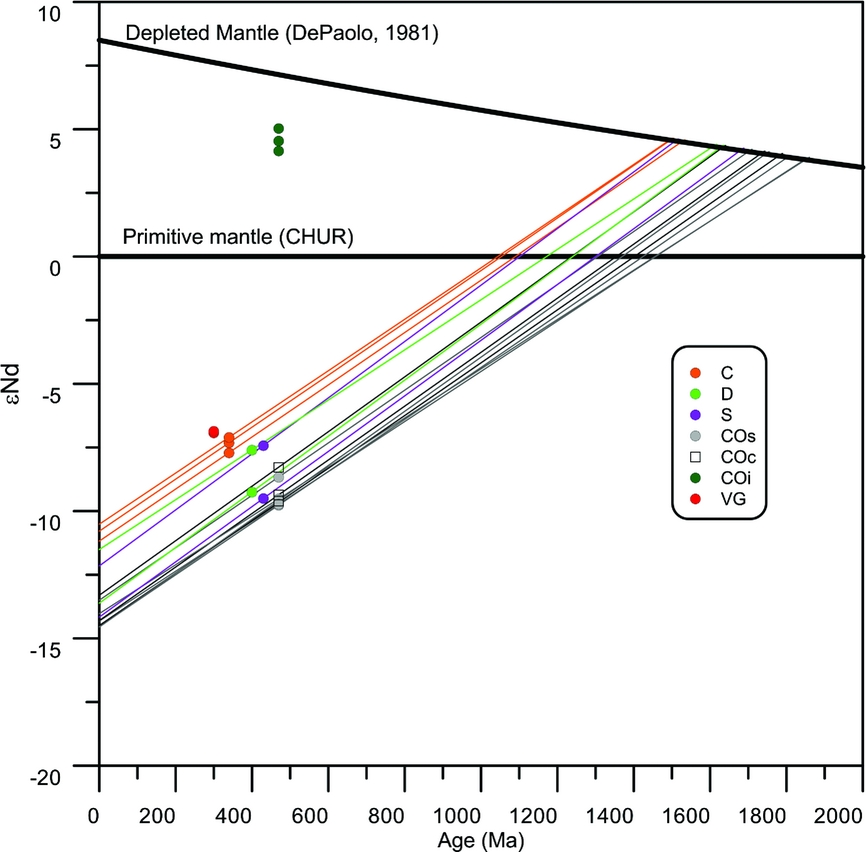
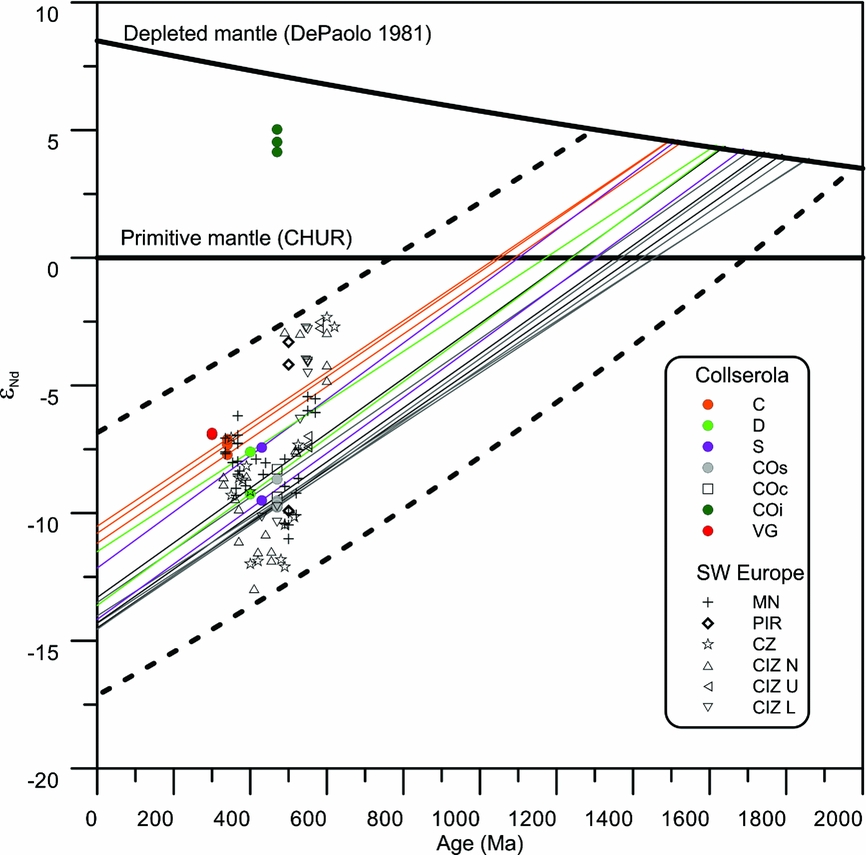
The εNdT values of the Collserola siliciclastic rocks range from –9.8 to –7.1. There is a certain decrease of the εNdT values with decreasing age of sedimentation of rocks but, with the available data, the COc rocks and COs rocks cannot be distinguished objectively based on Sm–Nd systematics. The εNdT of the Cambro-Ordovician siliciclastic rocks is lower than –8.3 and, except for two samples, lower than –9, reflecting largely unradiogenic Nd sources. The Silurian rocks have a εNdT from –9.5 to –7.5, the Devonian –9.3 to –7.6 and the three samples of Carboniferous <–7.8. The εNd versus age diagram (Fig. 9) shows the εNd evolution of the siliciclastic rocks. The diagram reveals that the crustal model ages TDM (the intersections with the depleted mantle model of DePaolo, Reference DePaolo1981) of the siliciclastic rocks of Collserola Range vary over the range c. 1.9–1.5 Ga. The TDM tends to decrease from the Cambro-Ordovician to the Carboniferous.
εNd v. age diagram (DePaolo, Reference DePaolo1981) for the Collserola Range samples. εNdT values have been calculated assuming an age of sedimentation of 470 Ma for the probable Cambro-Ordovician rocks, and 430, 400 and 300 Ma for the Silurian, Devonian and Carboniferous rocks, respectively. An age of magmatic emplacement of 470 Ma has been assumed for the supposed Cambro-Ordovician magmatic rocks and 300 Ma for the late-Variscan granodiorites.

The Sm–Nd isotopic data of the three representative samples of the late-Variscan granodiorites, emplaced at c. 300 Ma, present a very homogeneus crustal signature with εNdT values of c. –7.0 and TDM of c. 1.4 Ga. These Nd isotopic signatures show that the late-Variscan granodiorites were derived from partial melting of crustal materials which were isotopically less mature than those that constitute the source area of sediments of the Cambro-Ordovician succession. Alternatively, the isotopic signatures show that their petrogenesis involved a minor, but clearly detected, component with more juvenile Nd isotope signature, possibly mantle magmas which triggered crustal melting.
The Cambro-Ordovician metavolcanic rocks have a Sm–Nd isotopic signature strikingly different from the rest of the lithological groups. Specifically, the three samples analysed (two metabasalts and one rhyolitic sample) are all characterized by strongly positive εNdT values (from 4.1 to 5.0), indicative of a source reservoir that was depleted in LREE on a time-integrated basis. This contrasts with the strongly LREE-enriched patterns of these samples, and implies that the long-term depleted mantle source reservoir of these mafic magmas experienced an enrichment shortly before the igneous event. The strongly positive εNdT value measured in the felsic sample COi3 rules out an origin as a crustal partial melt. Instead, it suggests a derivation from the associated mafic rocks, essentially through closed-system fractional crystallization.
7. Discussion: geodynamic implications
In many tectonic reconstructions of the pre-Mesozoic terrains of SW Europe, the Palaeozoic rocks of the Catalan Coastal Ranges belong to the southern margin of the Variscan Belt (e.g. Julivert & Durán, Reference Julivert and Durán1990b ; Matte, Reference Matte2001). These reconstructions suggest that from a palaeogeographic point of view the Palaeozoic rocks of the Catalan Coastal Ranges are related to those that crop out in neighbouring Palaeozoic terranes: the Pyrenees, the southernmost French Massif Central, the Iberian Cordillera (east of the Iberian Massif), the Corsica–Sardinia block and the northern part of West Africa. These terranes were part of the Northern Gondwana margin before the closure of the Rheic Ocean (Nance et al. Reference Nance, Gutiérrez-Alonso, Keppie, Linnemann, Murphy, Quesada, Strachan and Woodcock2010) and the subsequent Variscan amalgamation.
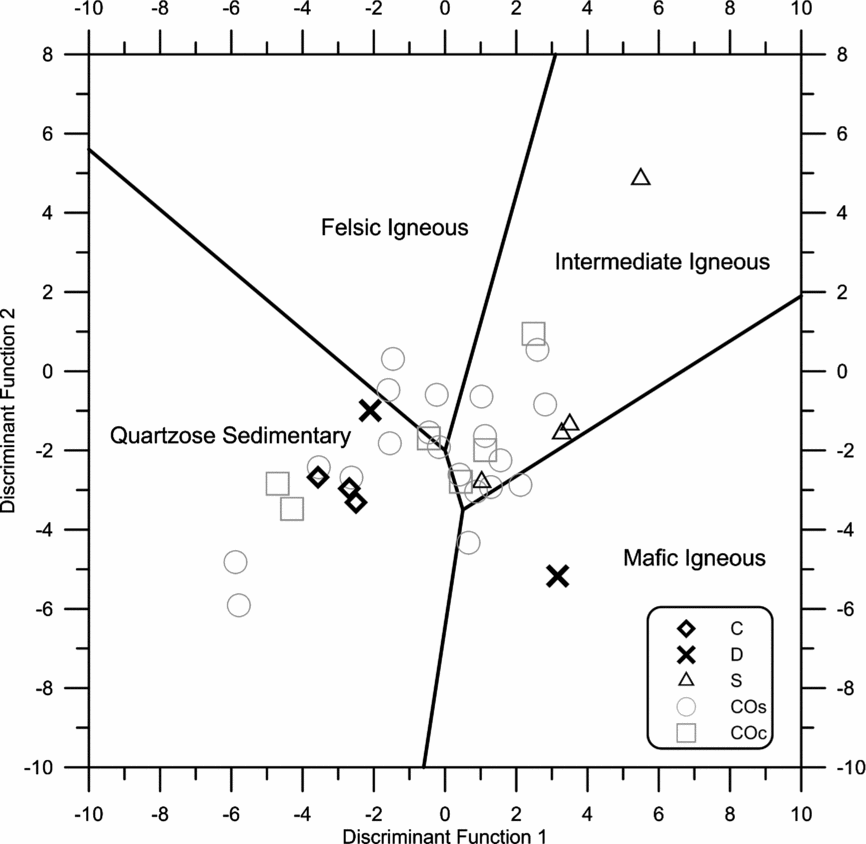
A first step in addressing the pre-Mesozoic geodynamic evolution of this sector of SW Europe is to determine the provenance signature of the siliciclastic rocks. In Figure 10 we have projected the major-element compositions of the Collserola Range rocks in the discriminant function diagram of Roser & Korsch (Reference Roser and Korsch1988). Fields for dominantly mafic, intermediate and felsic igneous provenances are shown, together with the field for a quartzose sedimentary provenance. The Cambro-Ordovician samples show considerable spread, mainly inside the quartzose sedimentary and the intermediate igneous fields, suggesting heterogeneous source areas of sediments or a source with detrital and felsic igneous rocks interbedded. This scenario is observed in the Caradoc rocks of the Catalan Coastal Ranges and also in the upper Neoproterozoic succession of the eastern Pyrenees (Castiñeiras et al. Reference Castiñeiras, Navidad, Liesa, Carreras and Casas2008; Navidad et al. Reference Navidad, Castiñeiras, Casas, Liesa, Suarez, Barnolas, Carreras and Gil-Peña2010; Martínez et al. Reference Martínez, Iriondo, Dietsch, Aleinikoff, Peucat, Cirès, Reche and Capdevila2011). Three Silurian samples plot in the intermediate igneous field and three Carboniferous samples as well as one Devonian sample plot in the quartzose sedimentary field, indicative of recycling of older sediments. The Devonian D3 sample plots in the mafic igneous field but this is clearly a spurious result for this mudstone with syngenetic iron-rich precipitates.
Discriminant function diagram for the provenance signatures of sandstone-mudstone suites using major-element data (after Roser & Korsch, Reference Roser and Korsch1988). Discriminant Function 1 = –1.773TiO2+0.607Al2O3+0.76Fe2O3 –1.5MgO+0.616CaO+0.509Na2O – 1.224K2O – 9.09. Discriminant Function 2 = 0.445TiO2+0.07Al2O3 – 0.25Fe2O3 – 1.142MgO+0.438CaO+1.475Na2O – 1.426K2O – 6.861.

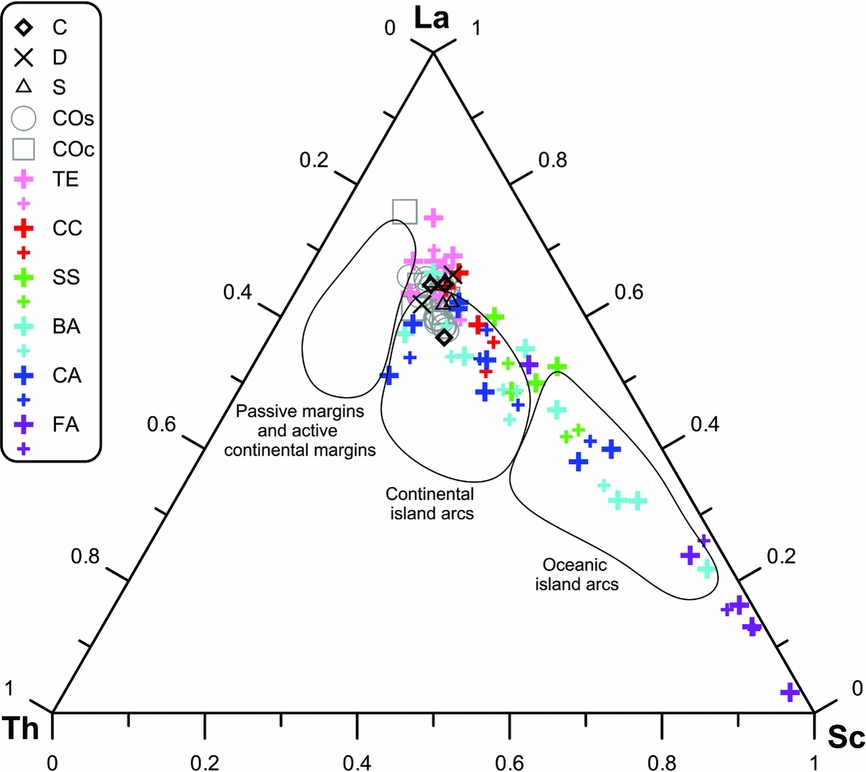
Trace-element discrimination diagrams are commonly used to address the palaeotectonic environment of sedimentary rocks (Ryan & Williams, Reference Ryan and Williams2007). Figure 11 displays the data plotted on the La–Th–Sc discriminant diagram of Bhatia & Crook (Reference Bhatia and Crook1986). The pre-Silurian siliciclastic rocks from the Collserola Range define a cluster that mainly plots inside the continental island arcs field, near the passive margins and active continental margins field. The Silurian, Devonian and Carboniferous siliciclastic rocks plot inside the same cluster defined by the Cambro-Ordovician samples. As expected, all the Collserola Range samples plot far from the field of the oceanic island arcs. In the La–Th–Sc diagram we have included the reference compositions of the deep-sea turbidites (sand fraction and mud fraction) of McLennan et al. (Reference Mclennan, Taylor and Mcculloch1990) representative of the major tectonic settings. As can be seen, the modern turbidites define a linear array with a relatively constant La/Th c. 0.2 and a variable Sc/(La+Th+Sc) from c. 0.2 to c. 0.9, grossly overlapping the La–Th–Sc fields defined by Bhatia & Crook (Reference Bhatia and Crook1986). The siliciclastic rocks of the Collserola Range show La–Th–Sc ratios comparable with those of the passive margin deep-sea turbidites. Our La–Th–Sc data also overlap the field of some turbidites from continental collision basins, continental-arc basins and back-arc basins, but these sedimentary environments mainly display high Sc/(La+Th+Sc) ratios, unlike our samples.
La–Th–Sc diagram of Bhatia & Crook (Reference Bhatia and Crook1986). Crosses represent deep-sea turbidites from different tectonic settings compiled by McLennan et al. (Reference Mclennan, Taylor and Mcculloch1990). TE – trailing edge margins; CC – continental collision basins; SS – strike-slip margins; BA – back-arc basins; CA – continental arcs; FA – forearc basins. Small and large crosses represent muddy and sandy samples, respectively.

The Nd isotope system provides robust information on the pre-Mesozoic crustal evolution and the sediment provenance of this sector of SW Europe. In the εNd versus age diagram (Fig. 12), the compositions of the Collserola Range rocks are compared with other published data of Palaeozoic and Late Proterozoic (600–300 Ma) fine-grained siliciclastic rocks from Montagne Noire (Simien, Mattauer & Allegre, Reference Simien, Mattauer and Allegre1999), the Eastern Pyrenees (Vilà et al. Reference Vilà, Pin, Enrique and Liesa2005), the Cantabrian Zone (Nägler et al. Reference Nägler, Schäfer and Gebauer1995) and the Central Iberian Zone (Nägler et al. Reference Nägler, Schäfer and Gebauer1995; Ugidos et al. Reference Ugidos, Valladares, Recio, Rogers, Fallick and Stephens1997; López-Guijarro et al. Reference López-Guijarro, Armendariz, Quesada, Fernández-Suárez, Murphy, Pin and Bellido2008). The εNd of the Collserola Range siliciclastic rocks lie within the range of values defined by the whole set of compiled samples. The different pre-Mesozoic regions of SW Europe define large domains, which overlap each other. No clear trend of εNd through time in any of the regions is observed. The envelopes of Nd compositions intersect the depleted mantle model of DePaolo (Reference DePaolo1981) at 2.1–1.3 Ga, pointing to a major contribution of old crustal sources. The Cambro-Ordovician detrital rocks from the Collserola Range, with TDM of 1.9–1.7 Ga, fall within this envelope. These average crustal residence ages are compatible with a sediment source ultimately derived from NW African cratonic provinces with TDM crustal residence ages of 2.3–2.0 Ga (Nance & Murphy, Reference Nance and Murphy1994; C. Pin, unpub. data, 2015). From Silurian to Carboniferous times, the younger crustal model ages and decreasing εNd values suggest an increase in the amount of more ‘juvenile’ material. In the absence of any evidence for contemporaneous igneous activity, the origin of these materials can be related basically to the recycling of older domains containing rocks with a more radiogenic Nd isotope signature. Such segments were built during two main geodynamic periods, accompanied by copious igneous activity: (1) the late Neoproterozoic Avalonian–Cadomian arc activity (e.g. Nance & Murphy, Reference Nance and Murphy1994; Rodríguez-Alonso et al. Reference Rodríguez-Alonso, Peinado, López-Plaza, Franco, Carnicero and Gonzalo2004; Castiñeiras et al. Reference Castiñeiras, Navidad, Liesa, Carreras and Casas2008; Sánchez-García et al. Reference Sánchez-García, Pereira, Bellido, Chichorro, Silva, Valverde-Vaquero, Pin and Solá2014); and (2) the Cambro-Ordovician break-up of the Northern Gondwana margin, which led to the opening of the Rheic Ocean (e.g. Pin, Ortega Cuesta & Gil Ibarguchi, Reference Pin, Ortega Cuesta and Gil Ibarguchi1992; Valverde-Vaquero & Dunning, Reference Valverde-Vaquero and Dunning2000; Castiñeiras et al. Reference Castiñeiras, Navidad, Liesa, Carreras and Casas2008; Navidad et al. Reference Navidad, Castiñeiras, Casas, Liesa, Suarez, Barnolas, Carreras and Gil-Peña2010; Martínez et al. Reference Martínez, Iriondo, Dietsch, Aleinikoff, Peucat, Cirès, Reche and Capdevila2011).
εNd v. age diagram comparing the Collserola Range samples with representative samples of Palaeozoic and late Proterozoic (600–300 Ma) fine-grained siliciclastic rocks from SW Europe. MN – Montagne Noire (Simien, Mattauer & Allegre, Reference Simien, Mattauer and Allegre1999); PIR – Eastern Pyrenees (Vilà et al. Reference Vilà, Pin, Enrique and Liesa2005); CZ – Cantabrian Zone (Nägler et al. Reference Nägler, Schäfer and Gebauer1995); CIZ N/U/L – Central Iberian Zone (Nägler et al. Reference Nägler, Schäfer and Gebauer1995; Ugidos et al. Reference Ugidos, Valladares, Recio, Rogers, Fallick and Stephens1997; López-Guijarro et al. Reference López-Guijarro, Armendariz, Quesada, Fernández-Suárez, Murphy, Pin and Bellido2008, respectively). The discontinuous black lines represent the envelope of Nd isotopic compositions defined by the compiled samples from SW Europe.

The summary of the U–Pb zircon ages of orthogneisses and volcanic rocks exposed in the Catalan Coastal Ranges and the Eastern Pyrenees described by Martínez et al. (Reference Martínez, Iriondo, Dietsch, Aleinikoff, Peucat, Cirès, Reche and Capdevila2011) indicates that the Cambro-Ordovician magmatism in this part of the Variscan Belt spanned c. 40 Ma during late Cambrian – Late Ordovician time. During Early Ordovician time, the felsic magmatic rocks preserve the arc signature of late Neoproterozoic time (Navidad & Carreras, Reference Navidad and Carreras1995); during Late Ordovician time however, contaminated mantle melts coexist with aluminous crustal melts (Navidad et al. Reference Navidad, Castiñeiras, Casas, Liesa, Suarez, Barnolas, Carreras and Gil-Peña2010). According to Martínez et al. (Reference Martínez, Iriondo, Dietsch, Aleinikoff, Peucat, Cirès, Reche and Capdevila2011), the Sm/Nd isotopic signature of the Cambro-Ordovician orthogneisses and volcanic rocks (εNd of –5.2 to –2.1 at 450 Ma and TDM of 1.6–1.3 Ga) is a result of melting of Neoproterozoic arc-related rocks, contaminated by older components. The Sm–Nd isotopic data of the late-Variscan granodiorites of the Collserola Range (εNd of –7.0 to –6.9 at 300 Ma and TDM of 1.47–1.36 Ga) indicates that they could be derived from the same protoliths.
Although subordinate in volume, the bodies of basaltic rocks interlayered in the Cambro-Ordovician sequence of the Collserola Range are important because their geochemical characteristics may be used to determine the tectonic regime that prevailed during the deposition of the Cambro-Ordovician succession. In the present study, only three representative samples of these igneous bodies have been analysed (see results of samples COi1, COi2 and COi3 in Tables 2 and 3 and supplementary Table S1 available at http://journals.cambridge.org/geo). Previously, the whole-rock geochemistry of the metabasites from the Collserola Range has been studied by Gil Ibarguchi, Navidad & Ortega (Reference Gil Ibarguchi, Navidad and Ortega1990) and Alías, Aulinas & Tubau (Reference Alías, Aulinas and Tubau2008). In general, major- and trace-element data of the basaltic rocks reflect an alkaline affinity (e.g. high TiO2, P2O5, Nb and Ta and low K and Rb contents, as well as light rare Earth elements) that can be related to a lithospheric thinning period. This hypothesis is compatible with the Sm/Nd isotopic data presented in the previous section. Specifically, the strongly positive εNdT values indicate the involvement of igneous rocks extracted from a long-term depleted mantle reservoir that was recently enriched by low-degree partial melts from deeper mantle sources, as commonly observed in basaltic rocks associated with lithospheric stretching events. It is therefore envisaged that an extensional tectonic regime prevailed during the early Palaeozoic sedimentation, in good agreement with the geochemical characteristics of its clastic components.
8. Conclusions
The Palaeozoic stratigraphical sequence of the Collserola Range can be divided into two main lithostratigraphical units separated by a major tectonic discontinuity: (1) the Cambro-Ordovician unit composed of a thick (c. 2000 m) pelitic-rich succession which correlates with the Cambro-Ordovician materials that form widespread outcrops in most of the Palaeozoic massifs of the Catalan Coastal Ranges and the eastern Pyrenees; and (2) the Silurian–Devonian–Carboniferous condensed unit of c. 200 m thickness with facies similar to those prevailing in the western Mediterranean area. We interpret the boundary between these units as low-angle normal faults related to late- or even post-Variscan deformative episodes, according to several detailed geological maps and cross-sections recently published (IGC, 2009–2012). With the available data, it cannot be excluded that the Cambro-Ordovician unit includes Silurian or Neoprerozoic rocks. The absolute dating of the interlayered metavolcanic rocks or the identification of fossils would constrain the age of the unit.
Comparison of the major-element compositions with worldwide average compositions of pelites indicates that the siliciclastic succession of the Collserola Range was fed by a relatively mature heterogeneous source of sediment, mainly comprising quartz-rich sediments to intermediate igneous rocks.
The pelites of the Collserola Range in general have trace-element concentrations similar to those of worldwide averages, but display relatively high LREE abundances as a result of their high chemical index of alteration, indicative of highly mature sources and/or multiple sedimentary recycling. The La–Th–Sc ratios indicate that the siliciclastic rocks of the Collserola Range show great affinity with those of passive margin geodynamic settings, albeit some features are reminiscent of continental volcanic arcs.
The Palaeozoic siliciclastic rocks of the Collserola Range have εNdT values ranging from –9.8 to –7.1 and crustal model ages of 1.9–1.5 Ga. This Sm–Nd signature is compatible with those of the Palaeozoic and late Proterozoic fine-grained siliciclastic rocks of the neighbouring outcrops of the Variscan Belt of SW Europe. These signatures, together with palaeotectonic reconstructions, suggest a sediment source ultimately derived from the North African cratonic provinces.
There is a certain decrease of the εNdT with decreasing age of sedimentation. From Silurian to Carboniferous times, decreasing crustal residence model ages and increasing εNd values of the siliciclastic rocks of the Collserola Range suggest an increasing (albeit minor) input of more juvenile material. The lack of evidence of contemporaneous igneous activity indicates that the origin of this material could be related to the recycling of either: (1) Cambro-Ordovician bimodal igneous rocks formed during break-up of the Northern Gondwana margin as a prelude to the opening of the Rheic Ocean; or (2) even older calc-alkaline rocks formed during late Neoproterozoic Avalonian–Cadomian arc magmatism, or both.
The presence of small volumes of basaltic rocks with a clear alkaline affinity interlayered in the Cambro-Ordovician unit provides evidence for the input of juvenile material in the early Palaeozoic basin and confirms that an extensional tectonic regime prevailed during the Cambro-Ordovician sedimentation.
Concerning the geodynamic reconstructions of the pre-Mesozoic terrains of SW Europe, our results further substantiate the view that the Palaeozoic rocks of the Catalan Coastal Ranges were part of the Northern Gondwana margin before the closure of the Rheic Ocean and the subsequent Variscan Orogeny after the border between Devonian and Carboniferous time.
Acknowledgements
This work was supported by the project ‘Mapa Geològic de Catalunya’ of the Institut Geològic de Catalunya. We like to thank Roser Pi and Gonzalo Zaragoza for their collaboration. We are grateful to two anonymous referees and Phil Leat (Editor of Geological Magazine) for their constructive reviews of the manuscript.