1 IntroductionFootnote 1
There seems to be a general consensus among linguists from different theoretical backgrounds that English proforms correspond to semantic or syntactic units of analysis. In formalist theories proforms are typically regarded as replacing constituents in underlying structure (i.e. phrases or clauses; e.g. Burton-Roberts Reference Burton-Roberts1986: 55; Radford Reference Radford1988: 79, 175, Reference Radford1997: 109; Huddleston & Pullum et al. Reference Huddleston and Pullum2002: 1462–3; Aarts & Haegeman Reference Aarts, Haegeman, Aarts and MacMahon2006: 130; Déchaine & Wiltschko Reference Déchaine, Wiltschko, Coene and D'hulst2003), while non-formalist approaches, including traditional (descriptive) grammars, usually make the somewhat weaker claim that proforms take the place of linguistic (semantic or syntactic) units (including words) (e.g. Wales Reference Wales1996: 5; Saxena Reference Saxena and Brown2006: 131).
The aim of the present article is to challenge this assumption. It will be demonstrated that a great many fully acceptable uses of English proforms turn out to be quite problematic for the generally accepted view of proforms as corresponding either to constituents or to other kinds of semantic and/or syntactic units of analysis. Instead, it will be argued that in order to account for the actual use of pronouns, a flexible system is required, allowing proforms to replace, or correspond to, combinations of elements that do not form a linguistic unit. Authentic examples from a variety of sources will be used to determine the exact circumstances in which the use of a particular English proform is syntactically, semantically and pragmatically acceptable.Footnote 2
Next, it will be argued that the theory of Functional Discourse Grammar (Hengeveld & Mackenzie Reference Hengeveld, Rijkhoff and García-Velasco2008) offers the kind of flexibility needed to deal with English proforms in a consistent and unified manner, and an FDG treatment will be proposed which is believed to be more in accordance with their actual use. To this end, a brief introduction to the relevant aspect of the theory of FDG will be provided.
Finally, although the flexible system proposed offers a solution for the problems identified, it needs to be constrained in some way, since obviously there are restrictions on which linguistic elements, and which combinations of linguistic elements, can be replaced by a proform. In particular, the fact that in general a verb can be replaced along with its complement(s) needs to be accounted for. An attempt will be made to explain this constraint, as well as some of the other restrictions on the pronouns discussed.
As it will clearly be impossible to present a detailed discussion of all English proforms, the focus in this article will be on a selection of frequently used proforms, including (i) the indefinite pronoun one, (ii) the predicative proform do so, (iii) the demonstrative pronouns that and those and (iv) certain uses of the personal pronouns we/us and you.
2 Traditional and theoretical approaches
2.1 Traditional accounts
Traditionally third-person proforms have been regarded as a class of closed items that have ‘low semantic content’ (Wales Reference Wales1996: 5), which serve as indicators to the addressee to retrieve the relevant semantic content elsewhere. In addition, proforms are described as ‘function words that replace (lexically empty or nearly so) syntactic units of a particular category’ (Saxena Reference Saxena and Brown2006: 131);Footnote 3 they are words ‘used instead of a noun or name, to avoid repetition of it’ (ibid., quoting Webster's 1913 dictionary). In (1), for instance, the personal pronouns he and it behave syntactically like NPs,Footnote 4 and can be seen as ‘replacing’ the NPs John and a new car, while the indefinite pronoun one in sentence (2) takes the position of a head noun, ‘replacing’ the noun head:
(1) John has bought a new car. He says he got it cheap.
(2) Can't trade my head in for a new one. (COCA)
Proforms are, however, also used outside the nominal domain. In (3a–d), for instance, the proform (do) so can be used instead of a verbal, adjectival, prepositional and clausal unit, respectively:
- (3)
(a) They planned to reach the mountain, but nobody knows if they did so. (Quirk et al. Reference Quirk, Greenbaum, Leech and Svartvik1985: 875)
(b) Prices at present are reasonably stable, and will probably remain so. (Quirk et al. Reference Quirk, Greenbaum, Leech and Svartvik1985: 879)
(c) Edward Pitt's name was on his own private list of suspects. But so too was that of Court himself. (BNC)
(d) I think she'll be there – I certainly hope so. (Huddleston & Pullum et al. Reference Huddleston and Pullum2002: 1463)
It thus seems that proforms can be defined in terms of two basic features (e.g. Huddleston & Pullum et al. Reference Huddleston and Pullum2002: 1461):
(a) Proforms are semantically (nearly) empty, relying for their interpretation on information provided elsewhere (the previous discourse or the immediate discourse situation);
(b) Proforms ‘replace’ (‘stand for’, ‘substitute for’) a syntactic unit (the antecedent).
Similar definitions can be found in textbooks on English or linguistic handbooks, including some very recent ones. Some of these emphasize both properties: Leech (Reference Leech2006: 95), for instance, defines a proform as
a substitute form, that is a word or expression which has no detailed meaning of its own but has the function of ‘standing in the place’ of another (often more complex) expression.
Other textbooks simply concentrate on the substituting function of proforms. Pearce (Reference Pearce2007: 148), for instance, describes the category of proforms as ‘items that can stand in for a phrase, clause constituent or clause’ (cf. Leech & Svartvik Reference Leech and Svartvik1994: 56; Finch Reference Finch2005: 108). A logical next step has been to use replacement by proforms as a test for constituency. Thus, Burton-Roberts (Reference Burton-Roberts1986: 15) states that
if you can replace a sequence of words in a sentence with a single word without changing the overall structure of the sentence, then that sequence functions as a constituent of the sentence and is therefore a phrase (original emphases).Footnote 5
2.2 Theoretical approaches
In generative grammar in particular a great deal of attention has been given to the distribution and analysis of proforms. In most generative approaches, proforms are taken to replace a full phrase (DP, NP, VP, AP, PP, etc.) or a constituent within a phrase (a bar-level or subphrase),Footnote 6 resulting, in some cases, in the use of the term ‘pro-constituent’ (see Radford Reference Radford1997: 524). Aarts & Haegeman (Reference Aarts, Haegeman, Aarts and MacMahon2006: 130) observe that ‘[i]n the literature there seems to be a consensus that proforms typically replace constituents, even though this assumption is not always made fully explicit’, and proceed to explicitly adopt ‘the assumption that a proform replaces a constituent’. Since it is only phrases and bar-levels that form constituents, but not the heads of these phrases and bar-level constituents, the prediction is that proforms can replace a head together with its complement(s) and/or modifier(s), but not the head without its complement(s). Examples like those in (4) and (5) have been used to support this claim:
- (4)
(a) John left the office yesterday; Mary did so too.
(b) John left the office yesterday; Mary did so today.
(c) *John left the office, and Mary did so the house.
- (5)
(a) John bought a big bar of chocolate yesterday. Mary bought one too.
(b) John bought a big bar of chocolate yesterday. Mary bought a small one.
(c) John bought a bar of chocolate yesterday. *Mary bought one of soap.
The sequences in (4a, b) and (5a, b) are grammatical: here the predicative proforms did so and one replace entire phrases (the a-sentences) or bar-level constituents (the b-sentences). In (4c) and (5c), however, the proforms replace just the head, resulting in an ill-formed sentence.
As a consequence of this approach, the idea of using pronominalization as a constituency test also figures prominently in much of the generative literature (see Aarts & Haegeman Reference Aarts, Haegeman, Aarts and MacMahon2006). Radford (Reference Radford1988: 175), for instance, explicitly states that ‘only a unitary constituent can be replaced by a proform – and indeed only a phrasal constituent of some sort’ (see also Radford Reference Radford1988: 186, 234, Reference Radford1997: 109; cf. Van Valin Reference Van Valin2001: 121; Déchaine & Wiltschko Reference Déchaine, Wiltschko, Coene and D'hulst2003: 71–89).
3 The use of anaphoric proforms: problematic data
3.1 Some acknowledged exceptions to the rule
It is generally acknowledged that there are exceptions to the rule that proforms correspond to units in underlying structure. Some examples are given in (6) (examples from Quirk et al. Reference Quirk, Greenbaum, Leech and Svartvik1985: 352–3; see also Huddleston Reference Huddleston1984: 273; Wales Reference Wales1996: 11, 12; Huddleston & Pullum et al. Reference Huddleston and Pullum2002: 430):
- (6)
(a) we doctors, you people
(b) we who have pledged allegiance to the flag
(c) you there, we here
(d) we of the modern age, you in the raincoat
(e) you yourself, he himself
(f) we all, they each, you both
Here the personal pronouns clearly do not function as entire NPs; nor can they straightforwardly be analysed as heads of the entire NPs, modified by what follows. It is true that occasionally proforms can function as heads (e.g. Is your dog a he or a she? (Wales Reference Wales1996: 10); Democrats have their hes and shes mixed up (Internet)), in which case they indeed behave as real nominal heads: unlike the proforms in (6), they can be pluralized and co-occur with a determiner.Footnote 7
A similar problem can be found in constructions with the demonstrative pronouns that and those (examples – including paraphrases – from Quirk et al. Reference Quirk, Greenbaum, Leech and Svartvik1985: 872):
- (7)
(a) Towards the end of his life, Schubert wrote two remarkable trios: that [= the trio] in B-flat, and that [= the trio] in E-flat.
(b) The paintings of Gauguin's Tahiti period are more famous than those [= the ones] he painted in France.
Huddleston & Pullum et al. (Reference Huddleston and Pullum2002: 1504) propose an analysis in which the demonstratives that and those in these constructions ‘function as fused determiner-head in NP structure’. They are therefore not regarded as pronouns, but as determiners that occur in head position. The same kind of analysis is provided for one where it is used to replace an entire indefinite NP, as in (8):
(8) I haven't got a pen; can you lend me one? (Huddleston & Pullum et al. Reference Huddleston and Pullum2002: 412)
Despite these exceptions, however, the traditional idea of a pronoun as ‘a word used instead of a noun’ has continued to figure prominently in the various definitions of pronouns. According to Huddleston (Reference Huddleston1984: 274), for instance, ‘there can be no doubt that something along the lines of the traditional criterion should figure prominently in a general definition of pronouns’, despite the fact that ‘a very significant proportion’ of the pronouns he discusses do not satisfy this criterion.
3.2 Pronominalization as a constituency test
Some linguists have expressed doubt about the validity of pronominalization as a universal test for constituency. Broadly speaking, two approaches can be found. The first is to assume that pronominalization is indeed a universally valid test (together with other tests, such as permutation (extraction), ellipsis and coordination). If the tests fail in some languages but not in others, this is taken as evidence that the constituents involved are not universal. Van Valin (Reference Van Valin2001: 119ff.), for instance, concludes that the ‘VP’ ‘is not universally valid across the languages of the world’: it is only in those languages in which a verb and its complements act as one unit in terms of substitution, permutation and coordination, that we need to assume the presence of a VP (Van Valin Reference Van Valin2001: 121–2).
The second approach is to assume that pronominalization is not a universally valid constituency test. An exponent of this view is Croft (Reference Croft2001), who, after looking at the use of proforms in various languages concludes that
The criteria for constituency described in this section [pronominalization, ellipsis, coordination] fail as cross-linguistically valid criteria for a global constituent structure. The tests do not necessarily exist in all languages. Different test constructions give different results . . . A decision to choose one construction over another as a ‘test’ for constituency is opportunistic. (Croft Reference Croft2001: 189)
It will be clear that if we cannot find any reliable cross-linguistic criteria for constituency structure, it is no use speculating about which units or levels may or may not be present in all languages. Once again, however, this does not mean that these tests cannot be successfully applied to individual languages. The examples in (4) and (5) might still lead to the conclusion that in English pronominalization can be regarded as a reliable test for constituency. The aim of this article is to show that, given the number and the nature of the exceptions, even this claim is unjustified.
4 Additional data
This section will present a detailed discussion of a number of authentic examples from two large corpora (the British National Corpus (BNC) and the Corpus of Contemporary American English (COCA)), providing further evidence for the view that proforms do not serve to replace semantic or syntactic units, and confirming the need for a different general definition of English proforms.
4.1 The indefinite pronoun one
As pointed out before, the predicative pronoun one can represent either just the head of an NP (example (9a)), or the head together with its complement(s) (example (9b)) and/or any modifier(s) (example (9c)):Footnote 8
- (9)
(a) Well how can well how can go without his keys? He's got a spare one. (BNC)
(b) Science, for instance, does not offer a better or more accurate description of reality than fiction, only a different one. (COCA)
(c) First, because formal institutionalized procedures generally attract more publicity than informal ones, . . . (BNC)
As we have seen, it is generally assumed that the pronoun one can replace a head without its modifiers (when present), but not a head without its complements. Huddleston & Pullum et al. (Reference Huddleston and Pullum2002: 441), however, point out that this claim is too strong, as one can be used to replace a head noun without its complement(s) if this head noun is a derived noun. The examples they provide are given in (10), where one replaces the deverbal nouns ban and proof, respectively; in both cases, however, the original complement is replaced by a new one.
- (10)
(a) I support the ban on smoking, but not the one on alcohol.
(b) The proof of Pythagoras’ theorem is more clearly formulated than the one of Parseval's equality. (Huddleston & Pullum et al. Reference Huddleston and Pullum2002: 441)
Some attested examples are provided in (11): in (11a) one, on both occurrences, replaces the deverbal head challenge without its complement; in (11b) one, replacing the head noun view, is provided with its own complement:
- (11)
(a) The challenge of bagging a deer with archery gear is a big one, but one that is well worth meeting. (COCA)
(b) These notions were easy enough to compare to Indian views of prana and Chinese ones of qi. (COCA)
Where the head noun is a non-derived relational noun, however, Huddleston & Pullum et al. (Reference Huddleston and Pullum2002: 1515–16) maintain that one cannot take its own PP-complement (e.g. *The one [= king] of Belgium, *The one [= sleeve] of the dress). Data from the corpus show that this is, indeed, largely correct, though exceptions can again be found. This is illustrated in (12), where one is used to substitute basic relational nouns (see also Keizer Reference Keizer2004, Reference Keizer2007: 239–41):
- (12)
(a) His dark eyes meet the watery blue ones of the other in the rearview mirror. (COCA)
(b) whether the frail backs of the poor, and the callused ones of the middle class, bear the nation's heaviest fiscal baggage. (COCA)
A different kind of problem is illustrated in example (13), which shows that one can also replace combinations of elements in underlying structure which do not form a syntactic or semantic unit.
(13) So Paul had a big blue felt marker for days and a red one for nights. (BNC)
Clearly, the pronoun one in this example, as replacing the head together with a combination of non-adjacent modifiers,Footnote 9 does not replace any unit, or level, within the NP.
Yet another difficulty is presented by the examples in (14), where the pronoun one picks up part of a compound. Although this may lead to questionable results in some cases (Is that the morning star? ??No, that's the evening one), the examples in (14) – which all seem to involve a relatively low degree of conventionalization or lexicalization – seem to be acceptable:
- (14)
(a) Poetry class was just about the only one Remi really liked. (COCA)
(b) That's when the jokes about the missing bit started, for ring doughnuts look just like traditional ones with a bit taken out of the middle. (BNC)
(c) I was expecting a science book and got a history one instead. (Internet)
A final challenge to existing theories can be found in the following example:
- (15)
(a) During the late nineteenth century, black Southerners waged campaigns to increase their control over black colleges and to replace white administrators and teachers with black ones. (COCA)
(b) For every tragic death that occurs, how many close calls go unreported and how many responsible skiers and drivers are scared out of their wits by the reckless ones?
In both (15a) and (15b) the plural pronoun ones replaces a coordinated unit. To account for this use of ones, it may therefore be claimed that the pronoun replaces one head, consisting of two coordinated nouns (and as such a syntactic unit). Semantically speaking, however, coordination at the level of the head (or property) is unlikely: the members of the set referred to by the NP white administrators and teachers are not at the same time administrators and teachers. Instead, the set as a whole consists of two subsets: a set of administrators and a set of teachers, with the property ‘white’ applying to the members of both subsets. On this reading, the proform ones replaces the heads of both these subsets – a combination of elements that does not form a separate level within the phrase.
4.2 The predicative proform do so
The use of the predicative proform do so in (16), as a pro-VP, is unproblematic for generative accounts:
- (16)
(a) Americans who ignored this warning clearly did so at their own risk and on their own responsibility. (COCA)
(b) The Government wanted to create a property-owning democracy, and they did so, . . . (BNC)
The same is true for the examples in (17), where do so includes modifiers (as a means of birth control in (17a), critically in (17b)):
- (17)
(a) Clearly the legislators who supported abortion as a means of birth control and the governors who did so are going to be held to account in the November elections. (COCA)
(b) In this study, preservice teachers who had the desire and ability to reflect critically did so regardless of the type of feedback they received. (COCA)
An example like (18), however, does pose a problem: it shows, as in the case of one, that the elements captured by do so need not be adjacent:
(18) The teacher expressed concern that, although he could write quite well in English, he only did so when writing collaboratively with his friend (who was absent). (BNC)
4.3 The demonstrative pronouns that and those
Like one/ones, the demonstrative pronouns that and those, when followed by a PP or clause, can replace a determiner and a head, without any complements or modifiers:
- (19)
(a) Perhaps the best-known example is that of the Heel Stone at Stonehenge. (BNC)
(b) It is likely that the Scottish experience will be exactly the same as that in England. (BNC)
(c) Students, especially those in high school, too often get the message that the contents of the library are more important than the clients. (COCA)
That and those may also include a modifier (example (20a)) or a complement (example (20b)). Predictably, it is also possible for that and those to cover the complement, but not the modifier (example (20c)):
- (20)
(a) However, we have no choice about developing an educational enterprise as effective as that in Germany. (COCA)
(b) This suspicion was only strengthened by expressions of cultural imperialism such as that in 1896 by Theodor Herzl in Der Judenstaat. (COCA)
(c) These findings suggested that the MHC susceptibility to PV gene among Iranians derived from the same ancestor as that in the Ashkenazi Jews. (COCA)
As it turns out, however, the complement need not be included: that and those may take their own complement. This is true for derived heads as well as for relational basic heads (examples (21a, b), respectively), including kinship and body-part nouns (examples (21c, d), respectively):
- (21)
(a) He said staunch Tory newspapers were calling for the resignation of Chancellor Norman Lamont –; to follow that of David Mellor. (BNC)
(b) Zulema's life and that of other female drug lords, (COCA)
(c) Our children will suffer —; but not those of rich parents who can afford to send them to public schools. (BNC)
(d) While some of us have sought to help, the real weight of responsibility has fallen on his shoulders and those of his wife. (BNC)
Moreover, as the following examples show, it is even possible for that and those to include head and modifier, but not the complement. In (22), that corresponds to the head image and its modifier public (and also covers the definite article; see section 5.3.2.3), but not the original genitival complement (Party):Footnote 10
(22) Since anti-Semitism was such a prominent feature of the Party's public image, and that of its leader, . . . (BNC)
4.4 Personal pronouns as heads
Although the constructions in (24) have been ignored in most studies on apposition,Footnote 11 I have argued elsewhere (Keizer Reference Keizer2010) that, since constructions comply with the general definition of close appositions, they are to be analysed as yet another subtype of close apposition. Like other types of close appositions (e.g. the poet Burns, Burns the poet, the name Algernon), they are therefore provided with an internal head−modifier structure (see also Keizer Reference Keizer2007). On such an analysis, the pronouns in these constructions do not form a separate phrase within the overall construction.
- (24)
(a) In fact it is how we Brits are seen by the French. (BNC, newspaper)
(b) ‘You English girls are so cruel’, he was saying. (BNC, prose fiction)
(c) ‘In every way, you see, I'm Helen Winslow, based on me the person, but synthesised and evolved into my present form by the AIM system. I'd prefer you call me Helen, because that's who I am, but I'll accept Annie if you like.’ ‘But you are an artificial intelligence system,’ said Maxwell. (COCA, fiction)
A completely different use of constructions with a pronominal first element can be found in (25), where they are used as vocatives. Once again, however, the personal pronoun you in these examples seems to function as a head rather than an entire NP:Footnote 12
- (25)
(a) ‘You fools, what are you doing?’ (COCA, magazine)
(b) Clean it yourself, you lazy whatsit! (Internet)
5 A brief introduction to FDG
5.1 General characterization and organization of the model
Functional Discourse Grammar (FDG) is a typologically based model of language use that takes into account only linguistically relevant, i.e. formally expressed, aspects of language (Hengeveld & Mackenzie Reference Hengeveld and Mackenzie2008). As the successor to Simon Dik's Functional Grammar (FG; Dik Reference Dik1978, Reference Dik1997), it shares many of FG's underlying principles, in particular its strong emphasis on pragmatics, i.e. on language as a form of verbal interaction between a speaker and an addressee, and the idea that form – however indirectly or inconsistently – reflects communicative function. At the same time FDG is primarily an account of linguistic facts, concerned only with those linguistic phenomena that are encoded in the grammar of a language. This means that within the functional paradigm, FDG takes a moderate position: it is characterized by Hengeveld & Mackenzie (Reference Hengeveld and Mackenzie2008: 39) as a form-oriented ‘function-to-form’ approach to grammar; using Van Valin's (Reference Van Valin and Van Valin1993) terminology, FDG qualifies as a ‘structural-functional’ theory of language (see Butler Reference Butler2003: 30−1).
Compared to other functional frameworks, FDG has a number of distinctive features:
(i) FDG has a top-down organization starting with the formulation of the speaker's intention and then working its way down to articulation.
(ii) FDG takes the Discourse Act as its basic unit of analysis. As such, FDG can accommodate regular clauses, as well as units larger or smaller than the clause.
(iii) (iii) FDG analyses Discourse Acts in terms of four independent, but interactive levels, dealing with pragmatics, semantics, morphosyntax and phonology.
(iv) FDG systematically interacts with three other components:
The conceptual component is seen as the driving force behind the grammatical component; it contains the prelinguistic conceptual information relevant for linguistic analysis.
The output component receives its input from the grammatical component and converts it into acoustic, orthographic or signed output.
The contextual component contains information about the immediate discourse context that affects the form of a linguistic utterance.
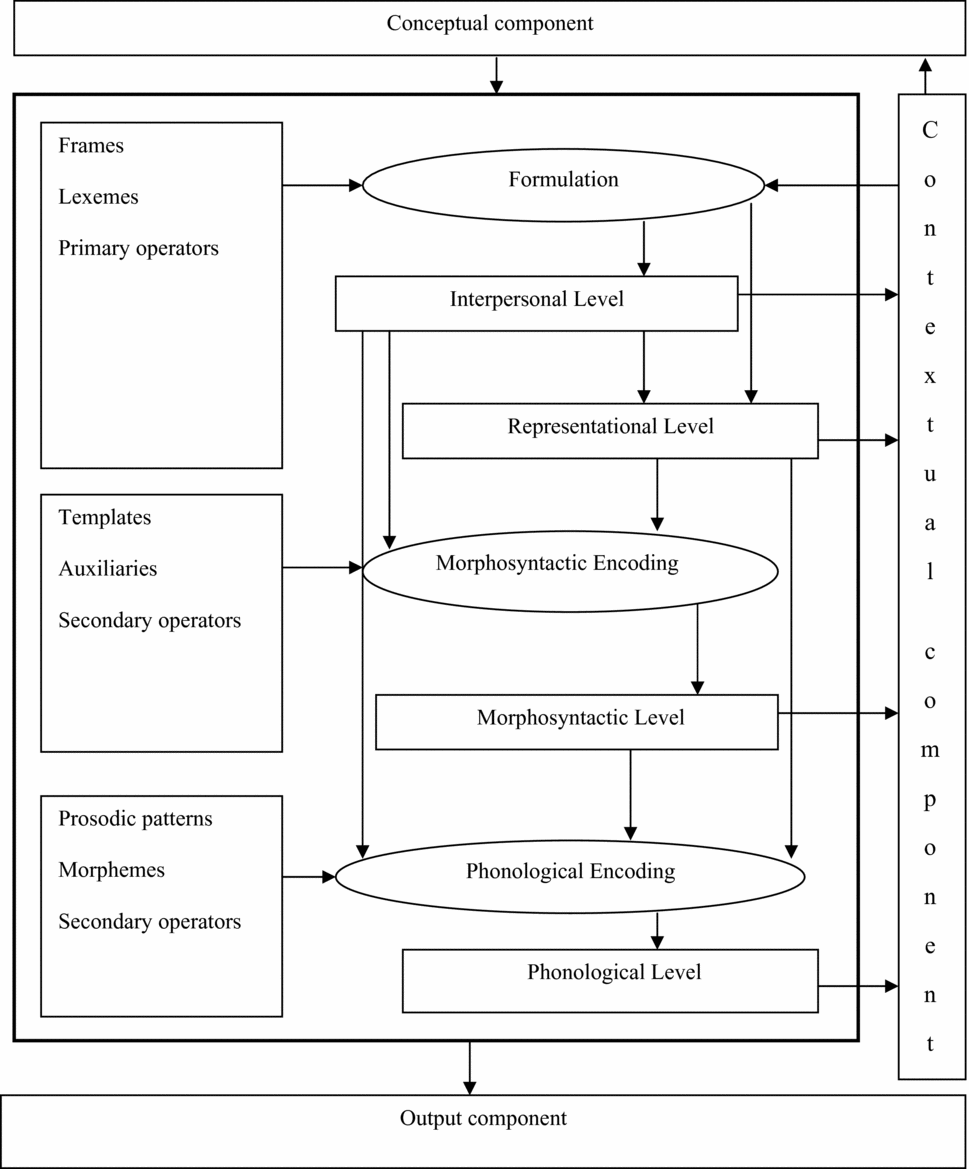
Figure 1 gives the general architecture of the model.
This architecture reflects the idea that every linguistic communication starts with some communicative intention at the prelinguistic conceptual level. This information is subsequently fed into the grammatical component where the operation of formulation converts it into interpersonal (pragmatic) and representational (semantic) representations. Next, the operation of encoding translates these into morphosyntactic and phonological representations, which, in turn, feed into the output component.
FDG: general layout
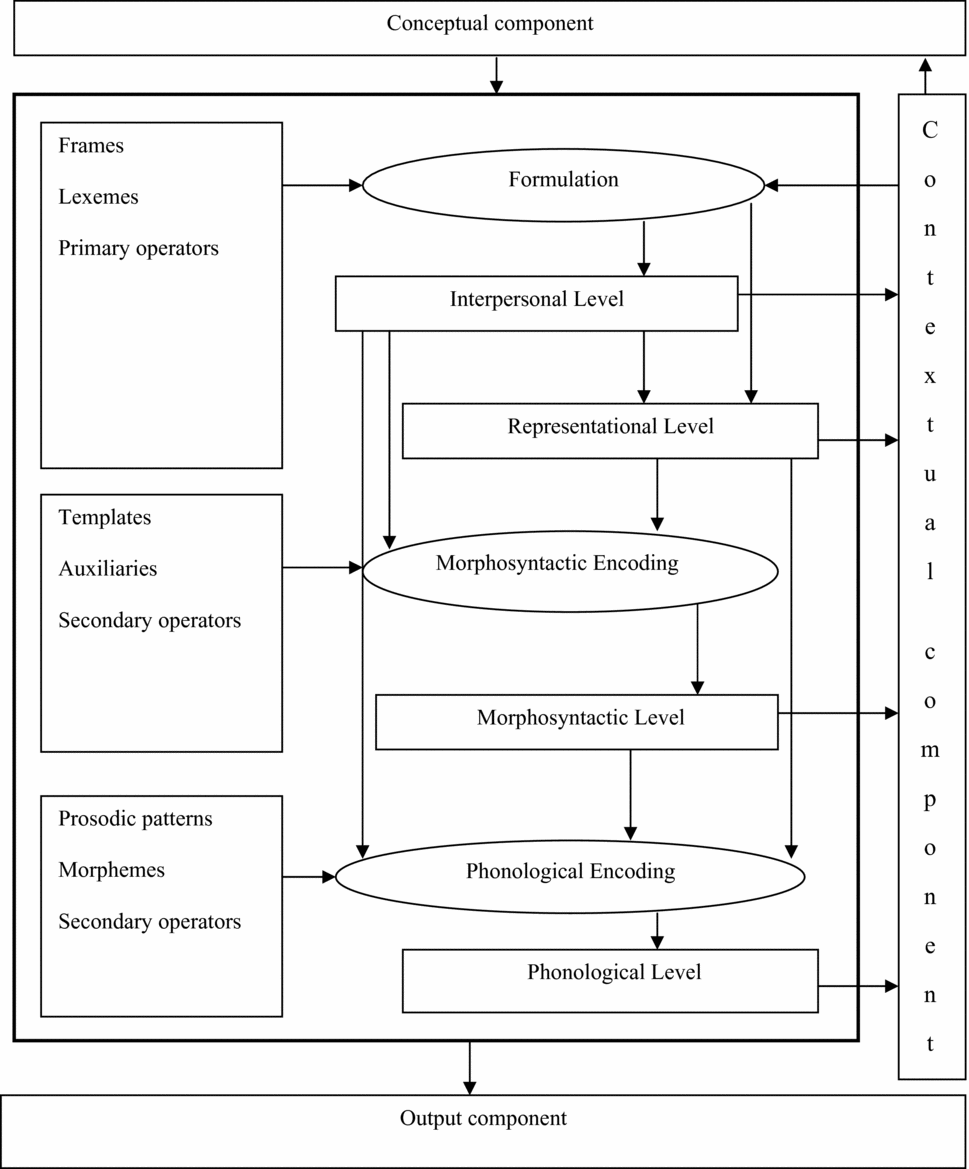
At each level, the construction of a linguistic expression begins with the selection of a number of language-specific primitives. These primitives come in three kinds. First, there are the structuring primitives, which define the possible combinations of elements at each level (frames or templates). Next, there are the relevant linguistic elements at each level (lexemes, free morphemes and phonemic forms). Finally, each level has its own set of operators for the expression of grammatical information.
The remainder of this section will provide some more details about the first three levels of analysis, as these are relevant for the analysis of proforms to be presented in sections 5.2 and 5.3.
The Interpersonal Level
The Interpersonal Level deals with all the formal aspects of a linguistic unit that reflect its role in the interaction between speaker and addressee. Some of the relevant units at this level are:
• Discourse Act (A): the smallest identifiable unit of verbal communication (cf. Kroon Reference Kroon1995: 65).
• Illocution (F): conveying the speaker's communicative intention.
• Speech Participants (P1 and P2): the functions of Speaker and Addressee, for the expression of linguistically relevant properties of the speech participants.
• Communicated Content (C): the totality of what the Speaker evokes in the communication.
• Ascriptive Subact (T): Speaker's evocation of a property (e.g. ‘tall’, ‘eat’, ‘car’)
• Referential Subact (R): Speaker's evocation of an entity.
Units at this level typically have the (simplified) frame in (26):
(26)


A partially instantiated frame is provided in (27b):
- (27)
(a) (What did the dog chase?) The dog chased a huge wasp.
(b) (AI: [(FI: DECL (FI)) (PI)S (PJ)A (CI: [(TI) (+id RI: (TJ))Top (-id RJ: [(TK) (TL)])Foc] (CI)] (A1))
Here we have a declarative Discourse Act (AI) with a Communicated Content consisting of three subacts: (TI), representing the evocation of the property ‘chase’; (+id RI: (TJ))Top, representing the evocation of an identifiable and topical entity characterized by another Ascriptive Act, evoking the property ‘dog’; and (-id RJ: [(TK) (TL)])Foc, representing non-identifiable referent, focal entity characterized by two Ascriptive Acts, evoking the properties ‘huge’ and ‘wasp’.
The Representational Level
The Representational Level deals with the semantic aspects of a linguistic unit; i.e. with descriptions of entities as they occur in some non-linguistic world. The units at this level differ with respect to the type of entity they denote; each entity type is represented by a different variable. Some of the relevant units are:
A simplified example of a representational frame can be found in (28):
(28)
A partially instantiated frame is provided in (29):
- (29)
(a) The dog chased a huge wasp.
(b) (past ei: [(fi: chaseV (fi)) (1xi: (fj: dog))A (1xj: (fk: wasp): (fl: huge))U] (ei))
Here we find a SoA (symbolized by the variable e) which took place in the past, in which two participants (both singular individuals, symbolized by the variable x), with the semantic roles of Actor and Undergoer, are involved in the action of chasing (symbolized by the variable f). Both individuals are described lexically; i.e. the lexemes dog, wasp and huge are used to describe properties of the individuals in question.
The Morphosyntactic Level
The Morphosyntactic Level accounts for the linear and formal properties of a linguistic unit. The major units of analysis of this level are Words, Phrases, Clauses and Linguistic Expressions; the general schema is given in (30):
(30)
The largest unit, that of the Linguistic Expression, can contain one or more Clauses, which, in turn, may consist of one or more Words, Phrases and Clauses. Phrases, too, may contain one or more Words, Phrases or Clauses, etc. The different possible combinations lead to a large number of templates, which can be reduced to a limited number of macrotemplates. A sentence like (31a), for instance, would satisfy the macrotemplate in (31b) (Hengeveld & Mackenzie Reference Hengeveld and Mackenzie2008: 295):
- (31)
(a) The dog chased a huge wasp.
(b) (Cli: [(Npi: [(Gwi: the (Gwi)) (Nwi: dog (Nwi))] (Npi)) (Vpi: (Vwi: chased (Vwi)) (Vpi)) (Npj: [(Gwj: a (Gwj)) (Api: (Awi: huge (Awi)) (Api)) (Nwj: wasp (Nwj))] (Npj))] (Cli))
As we can see in (31b) a distinction is made between lexical Words and grammatical Words: lexical Words correspond to content elements at the Interpersonal and Representational Levels (lexemes), whereas Grammatical Words express lexically empty elements (i.e. operators; e.g. determiners, auxiliaries etc.).
5.2 Proforms in FDG
5.2.1 General characterization
As in most linguistic theories, in FDG, too, proforms are assumed to correspond to pragmatic or semantic units in underlying representation. This view was more or less inherited from FDG's predecessor, Simon Dik's Functional Grammar, where proforms were assumed to correspond to units in underlying representation. Here, however, the units in question were semantic rather than syntactic units (e.g. Dik Reference Dik1997: 225−6). The personal pronouns and the indefinite pronoun one, for instance, were seen as replacing units designating Individuals (persons or objects), the pronouns it, this or that as replacing units designating states-of-affairs, so and that as replacing units designating propositions, and one, so and such as replacing units designating properties. It was the introduction of the f-variable to represent Properties that made it possible to represent the anaphoric relation in the case of one and (do) so, as illustrated in the following examples (where A is an operator indicating anaphoricity):
- (32)
(a) John had bought a blue car and I will buy a new one.
(b) (i 1 xi: (fi: carN (fi)) (xi)ø: (fj: blueA (fj)) (xi)ø)
‘a blue car’
(i 1 xj: (Afi) (xj)ø: (fk: greenA (fk)) (xj)ø)
‘a green one’ (Hengeveld Reference Hengeveld1992: 54; cf. Keizer Reference Keizer1992a: 126, Dik Reference Dik1997: 224−5)
- (33)
(a) Snoopy is sleeping. So is Woodstock.
(b) (Pres ei: [(Afi) (xi: Woodstock)ø]) (Keizer Reference Keizer1992a: 124−6)
It was soon pointed out that the absence of further internal layers within the predication (i.e. the absence of the equivalent of a VP or V-bar constituent) and the term (e.g. the absence of units consisting of a head and one, but not all of its modifiers) formed a problem for this kind of approach (e.g. Keizer Reference Keizer1992a: 127, fn. 8, Reference Keizer, Anstey and Mackenzie1992b: 23, fn. 6; Van der Auwera Reference Van der Auwera and Fortescue1992), but a satisfying solution was never offered. We will return to this issue in the sections to follow.
FDG has adopted the FG analysis of proforms as corresponding to units in underlying representation. However, since FDG distinguishes between an Interpersonal, a Representational and a Morphosyntactic Level, a complete analysis of proforms in FDG will have to take each of these levels of representation into consideration.
5.2.2 Representation at the Interpersonal Level
At the Interpersonal Level, deictic personal pronouns are regarded as ‘essentially similar to proper names’: they function as a grammatical device for naming oneself, one's Addressee or a third party present in the immediate situation. They are, therefore, regarded as directly reflecting the abstract head of a Referential Subact at IL (Hengeveld & Mackenzie Reference Hengeveld, Rijkhoff and García-Velasco2008: 118). The English pronominal system allows for the following combinations of features (where [±S] means ‘involving the Speaker or not’ and [±A] means ‘involving the Addressee or not’; note that number distinctions are made at the Representational Level):
(34)
A simple sentence like (35a) will therefore have the IL representation given in (35b):
- (35)
(a) I love you.
(b) (AI: [(FI: DECL (FI)) (PI)S (PJ)A (CI: [(TI) (R1: [+S, -A] (RI)) (RJ: [-S, +A](RJ)) (CI))Φ] (AI))
Anaphorically used personal pronouns are not analysed as abstract heads of Referential Subacts. At IL they are simply represented as headless Referential Subacts, as demonstrated in (36):
- (36)
(a) They like him.
(b) (AI: [(FI: DECL (FI)) (PI)S (PJ)A (CI: [(TI) (R1) (RJ) (CI))Φ] (AI))
Anaphoric pronouns can also correspond to Ascriptive Subacts (Hengeveld & Mackenzie Reference Hengeveld and Mackenzie2008: 121). Examples are pronouns functioning as non-verbal predicates and pronouns functioning as the Ascriptive head of a Referential Subact. Examples are given in (37) and (38), respectively:
- (37)
(a) (John is a pilot.) So is Jane.
(b) (AI: [(FI: DECL (FI)) (PI)S (PJ)A (CI: [(TI) (R1) (CI))Φ] (AI))
- (38)
(a) (A: I bought a car yesterday.) B: A new one?
(b) (AI: [(FI: DECL (FI)) (PI)S (PJ)A (CI: [(R1: [(TI) (TJ)]) (CI))Φ] (AI))
5.2.3 Representation at the Representational Level
At the Representational Level, participants in the SoA (whether arguments or modifiers) typically have a lexical head. It is, however, also possible for the heads of, for instance, Individual-designating units, to be empty or even absent. Some examples are given in (39)−(41) (Hengeveld & Mackenzie Reference Hengeveld, Rijkhoff and García-Velasco2008: 143, 237−8):
(39) Lexical head:
(a) The man painted the door.
(b) (1 xi: [(fi: man (fi)) (xi)Φ])
(40) Empty head:
(a) Mary wants a good-looking man but I prefer an honest one.
(b) (1 xi: [(fi) (xi)Φ]: [(fj: honest (fj)) (xi)Φ])
(41) Absent head:
(a) The man cleaned the windows and Ø/he painted the door.
(b) (1 xi)
In (39a) the head position of the expression the man is occupied by a nominal lexeme, represented as (fi) in (39b). In (40a), the pronoun one is coindexed with the Property man (fi) mentioned earlier in the same sentence (see also Hengeveld & Mackenzie Reference Hengeveld and Mackenzie2008: 167). As can be seen in (40b), there is a head position within the x-layer, but it is filled with only a Property variable (fi), which itself lacks a head. In (41a) the anaphoric relation is indicated either by the pronoun he or by zero-realization; in both cases the Individual-designating unit the man functions as the antecedent, as indicated by the presence of a coindexed x-variable in (41b). In this case, the x-variable has no head at all.
5.2.4 Representation at the Morphosyntactic Level
At the Morphosyntactic Level, a distinction is made between lexical Words, which correspond to lexemes at the Interpersonal or Representational Level, and grammatical Words, which ‘either correspond to an operator or a function at the Interpersonal or Representational Level or are introduced as dummies or support elements’ (Hengeveld & Mackenzie Reference Hengeveld, Rijkhoff and García-Velasco2008: 401). In addition, grammatical Words may represent ‘units with an abstract head at the Interpersonal or Representational Level’ (ibid.). Pronouns, representing abstract heads at the Interpersonal Level and empty or absent heads at the Representational Level, are thus introduced as grammatical Words at the Morphosyntactic Level. The pronoun one, for instance, corresponds to the empty head (fi) of an Individual-designating unit at the Representational Level. As we have seen, it is possible for this empty head to combine with a modifier. At the Morphosyntactic Level, however, Noun phrases cannot occur without a head; the pronoun one is therefore introduced at this level to function as the head of the Np (Hengeveld & Mackenzie Reference Hengeveld and Mackenzie2008: 392).
5.2.5 Conclusion
Although the present treatment of proforms in FDG is both innovative and insightful, reflecting the different functions of proforms at the three levels, it nevertheless seems to suffer from the same major flaw as other theories, as it fails to account for the counterexamples provided in sections 3 and 4. Further examination suggests that FDG may even have an additional weakness: as the descriptions of the three levels provided in the previous sections make clear, the verb and its complement(s) do not form a unit at any of these levels. At the Interpersonal Level the Communicated Content consists of a number of unordered and ungrouped Subacts, while at the Representational Level States-of-Affairs are represented as units headed by a Configurational Property consisting of a predicate and all its arguments. At the Morphosyntactic Level the (verbal) predicate tends to correspond to a Verbal phrase (Vp), while the arguments typically appear as Nominal phrases (Nps) and Adpositional phrases (Adps). Together with other (modifying) Phrases and grammatical Words (e.g. conjunctions), these phrases form Clauses. There are, however, no further layers between that of the Phrase and the Clause (there is no higher-order ‘superphrase’ (Hengeveld & Mackenzie Reference Hengeveld and Mackenzie2008: 299)).
This means that at none of the three levels does FDG distinguish a layer corresponding to what in Generative Grammar is known as the VP, or to any layers within the VP (V-bar levels). Much the same is true for Phrases. These, too, consist of a number of non-hierarchically ordered units (Words, as well as embedded Phrases and Clauses), as illustrated in (42):
- (42)
(a) John likes that big black French car.
(b) (Npi: (Gwi: that (Gwi)) (Awi: big (Awi)) (Awj: black (Awj)) (Awk: French (Awk)) (Nwi: car (Nwi)) (Npi))
Once again, there are no further layers between the Np and the individual words. This means that the combinations of elements replaced by the pronoun one in (43) – French car, black French car and big black French car, respectively – do not form separate layers (‘N-bar’ levels) within the Np. Nor do they correspond to units at the Interpersonal and Representational Levels.
- (43)
(a) Jane likes the small red one.
(b) Jane likes the small one.
(c) Jane likes this one.
5.3 Proforms in FDG: a new proposal
5.3.1 The function of proforms
In section 2 it was concluded that most accounts of proforms, be they descriptive or theoretical, describe proforms in terms of two features, one pragmatico-semantic, the other syntactic:
- (44)
(a) Proforms are semantically (nearly) empty, relying for their interpretation on information provided elsewhere (the previous discourse or the immediate discourse situation);
(b) Proforms replace (stand for, substitute) a syntactic unit (the antecedent).
On the basis of the data discussed in the previous section, however, it seems that the second criterion is no longer tenable: there are too many cases where the proform does not replace a syntactic unit. This leaves us with the semantic property given in (44a).Footnote 13
In what follows, it will be assumed that, in an adapted form, this first feature is indeed in itself enough to define the class of proforms. Nevertheless it is believed that a definition in terms of morphosyntactic behaviour is possible as well as useful, provided we take a somewhat different perspective: rather than defining proforms in terms of the syntactic unit (or layer in underlying representation) they replace (clause, phrase, bar-level), proforms can be defined in terms of the position they take in a morphosyntactic template. Instead of the definition in (44), the following FDG definition of proforms will therefore be proposed:
- (44′)
(a) Proforms correspond to elements at the Interpersonal or Representational Level which do not contain lexical information; as such they are themselves semantically (nearly) empty. For their interpretation proforms therefore rely on information provided elsewhere (the previous discourse or the immediate discourse situation). The elements they correspond to need not form a separate unit (or layer) at the Interpersonal or Representational Level.
(b) At the Morphosyntactic Level proforms are grammatical Words filling an obligatory position in the selected template, either at the level of the Clause (typically Subject) or at the level of the Phrase (typically the head).
Let us consider this second condition in some more detail.Footnote 14
As pointed out before, FDG makes use of morphosyntactic templates (clauses and phrasal) for the ordering of linear elements at the Morphosyntactic Level. Some of the positions in these templates have to be filled. In the case of clausal templates, for instance, English typically requires the Subject position (as well as the Object position in the case of a transitive verb) and the position for the finite verb to be filled. In Phrasal templates, the position of the head must be filled, as well as the positions for any complements of the head. In some cases, however, the Interpersonal and Representational Levels do not provide the lexical material to fill these positions; in that case, proforms can be used. The following example illustrates the use of proforms at the clausal and phrasal levels, respectively:
- (45)
(a) I bought a new car last week, but it wouldn't start this morning.
(b) a red car and a blue one (Hengeveld & Mackenzie Reference Hengeveld, Rijkhoff and García-Velasco2008: 392)
In (45a) the third-person pronoun it corresponds to a unit at the Interpersonal Level (a Referential Subact) and Representational Level (an Individual-designating unit). However, since neither of these corresponding units provides the necessary lexical information, the proform it is used to fill the Subject position at the Morphosyntactic Level. In (45b) the pronoun one also corresponds to a Subact at the Interpersonal Level (in this case an Ascriptive Subact) and to a semantic unit at the Representational Level (a property). Neither the Interpersonal nor the Representational Level, however, provides the lexical information needed to fill the head position of the nominal Phrase at the Morphosyntactic Level. Since every Phrase must have a head, the proform one is inserted. Nor is it only the indefinite pronoun one that can function as the head of the nominal Phrase in the presence of a modifier; this function can also be fulfilled by a personal pronoun (as in He who has the pen, has the power (BNC)), or as, we have seen before, by a demonstrative pronoun (typically that or those + clause or PP). The proform do so, finally, performs a similar function at the Morphosyntactic Level, the only difference being that in this case the proform functions as the head of a verbal Phrase.Footnote 15
It will be clear that, according to the definition of proforms given in (44′), dummy expressions such as weather-it, anticipatory it and existential there are not regarded as proforms. In example (46), for instance, the element it does not express a Subact at the Interpersonal Level. At the Representational Level, the sentence is analysed as involving a zero-place predication frame, which means that it does not correspond to any argument either. Thus, neither the Interpersonal nor the Representational Level provides the material to fill the Subject position at the Morphosyntactic Level. Since this position needs to be filled, the dummy element it is inserted (Hengeveld & Mackenzie Reference Hengeveld and Mackenzie2008: 347):
(46) It is raining.
Moreover, it will be clear that dummy it does not function as an instruction to the Addressee to look for lexical information elsewhere. Its sole function is to fill an obligatory position in the morphosyntactic template. Such elements will therefore not be regarded as proforms, but merely as dummies. Similarly, according to the definition of proforms provided, do so qualifies as a proform, whereas the auxiliary do functions as a dummy. This explains why the two forms can be combined (cf. Quirk et al. Reference Quirk, Greenbaum, Leech and Svartvik1985: 874) and why they display different syntactic behaviour.Footnote 16
5.3.2 The representation of proforms
5.3.2.1 The indefinite pronoun one. At the Interpersonal Level, the pronoun one, as an anaphoric pronoun, is represented as a headless Ascriptive Subact:
- (47)
(a) (A: I bought a car yesterday.) B: A new one?
(b) (AI: [(FI: DECL (FI)) (PI)S (PJ)A (CI: [(-id R1: [(TI) (TJ)]) (CI))Φ] (AI))
At the Representation Level, one is represented as an f-variable (designating a property) without a head:
- (48)
(a) a big car and a small one
(b) (1 xi: [(fi: carN (fi)) (xi)Φ]: [(fj: bigA (fj)) (xi)Φ]) & (1 xj: [(fi) (xj)Φ]: [(fk: smallA (fk)) (xj)Φ])
Note that in this approach it is assumed that the headless unit at the Representational Level is coreferential or codesignating with a single previously introduced semantic unit, as indicated through coindexation on the variables. Thus, in (48b), two different objects are designated (xi and xj). Both are described in terms of two properties, one of which, ‘car’ (fi), is shared. The second time the property ‘car’ is designated, it is represented as a co-indexed, headless f-variable (the result being an empty-headed x-variable). In combination with the relevant information from the Interpersonal Level, where the corresponding unit is an Ascriptive Subact, this leads to the insertion of the pronoun one in the head position of the corresponding Np at the Morphosyntactic Level. This is illustrated in example (49) (from Hengeveld & Mackenzie Reference Hengeveld and Mackenzie2008: 393):Footnote 17
(49) (Npi: [(Gwi: a (Gwi)) (Adjpi: (Adjwi: bigA (Adjwi)) (Adjpi)) (Nwi: car-sg (Nwi))] (Npi)) &
(Npj: [(Gwj: a (Gwj)) (Adjpj: (Adjwj: smallA (Adjwj)) (Adjpj)) (Nwj: one-sg (Nwj))] (Npi))
As we have seen, however, one does not necessarily correspond to a single designating unit (a head) at the Representational Level. Consider in this respect the following examples (cf. examples (42) and (43)):
- (50)
(a) John likes that big black French car.
(b) Jane likes the small one.
In this case the pronoun one does not express a single unit at the Representational Level; instead it corresponds to a combination of properties (‘black’, ‘French’ and ‘car’), as reflected in the following representation:
- (51)
(a) (dis 1 xi: [(fi: carN (fi)) (xi)Φ]: [(fj: FrenchA (fj)) (xi)Φ]: [(fk: blackA (fk)) (xi)Φ]: [(fl: bigA (fl)) (xi)Φ])
(b) (1 xj: [(fi) (xj)Φ]: [(fj) (xj)Φ]: [(fk) (xj)Φ]: [(fm: smallA (fm)) (xj)Φ])
In (51), the second object, xj, is described in terms of four properties, three of which (‘black’, ‘French’ and ‘car’) it shares with the previously designated object xi. This is captured in (51b) by the use of three headless f-variables, coindexed with the codesignating f-variables in (51a). It is now the combination of these headless, coindexed variables that leads to the insertion of the pronoun one at the Morphosyntactic Level. Note that although the pronoun does not replace any particular unit in underlying representation, it still complies with the definition of proforms provided in (44′): (a) it corresponds to non-lexical elements at the Interpersonal and Representational Levels, and serves as an instruction to retrieve lexical information from elsewhere; and (b) it fills an obligatory position at the Morphosyntactic Level.
Note that on this approach it is irrelevant whether the pronoun one replaces a whole noun phrase, a subphrase (bar-level), or just a head. As long as the combination of lexical items can be assumed to be accessible to the hearer, one can be used as an instruction to retrieve them. This means that constructions such as (52) are no longer problematic either:
- (52)
(a) white administrators and teachers with black ones. (COCA) (cf. (15a))
(b) (m xi: [(fi: [(m xj: (fj: administratorN (fj)) (xj): (fk: whiteA (fk)) (xj)) & (m xk: (fl: teacherN (fl)) (xk): (fk) (xk))] (fi)) (xi)) &
(m xl: [(fm: [(m xm: (fj) (xm): (fn: blackA (fn)) (xm)) & (m xn: (fl) (xn): (fn) (xn))] (fm))] (xl))
It is the combination of the two codesignating, headless f-variables, fj and fl (representing the properties ‘administrator’ and ‘teacher’), in the second representation in (52b) that triggers the use of the pronoun ones at the Morphosyntactic Level, heading the Np corresponding to the unit represented by xl.
Given the analysis of proforms presented here, FDG can also deal with those cases where one picks up part of a compound, as in (53):
(53) Poetry class was just about the only one Remi really liked. (COCA) (= (14a))
As indicated before, use of one in these cases is only allowed when the compound in question involves a relatively low degree of conventionalization or lexicalization. In FDG compounds are analysed as having a complex head, consisting of two separate lexemes at the Representational Level (Hengeveld & Mackenzie Reference Hengeveld and Mackenzie2008: 216). For the compound poetry class this results in the representation in (54a), where the complex head fi consists of the lexeme class, restricted by the lexeme poetry. Given this analysis, the use of one in (53) no longer poses a problem: it can be represented as a headless property fi, codesignative with the previously mentioned property ‘class’ (see (54b)):
- (54)
(a) (xi: (fi: (fj: classN (fj): (fk: poetryN (fk)) (fj)) (fi)) (xi)) poetry class
(b) (xj: (fl: (fj: (fm: onlyA (fm)) (fj)) (fl)) (xj)) only one
The fact that this is not possible with all compounds suggests that compounds with a very high degree of lexicalization or conventionalization (e.g. teapot, headmaster) are no longer analysed as having a complex head, but as being restricted by a single lexeme.
5.3.2.2 The predicative proform do so. At the Interpersonal Level, the proform do so corresponds minimally to a headless Ascriptive Subact within the Communicated Content, but may also include one or more Referential Subacts. An example is given in (55), where do so captures a combination of Ascriptive and Referential Subacts. After all, the properties ‘buy’ and ‘car’ are evoked, even if they are not lexically expressed:
- (55)
(a) A: My sister bought a car. B: So did I.
(b) (AI: [(FI: DECL (FI)) (PI)S (PJ)A (CI: [(TI) (R1) (RJ)]) (CI))Φ] (AI))
At the Representational Level, constructions with do so can be dealt with in more or less the same way as the pronoun one. Consider the simple sentence in (56a):
- (56)
(a) I caught a fish and Bill did so too.
(b) (Past epi: (ei: (fi: [(fj: catch) (xi)A (1 xj: (fk: fish) (xj))U] (fi)) (ei)) (epi))) &
(Past epj: (ej: (fl: [(fj) (xk)A (1 xl: (fk))U] (fl)) (ej) (epj)))
Coindexed parts together (i.e. the properties ‘catch’ fj and ‘fish’ fk) are expressed as do so, which expresses the Tense operator. This results in a new Episode epj and a new SoA ej, with different Actor and Undergoer participants (xk and xl). This kind of analysis can obviously be applied to any occurrence of do so, irrespective of which combination of elements it covers and irrespective of whether these elements appear in adjacent positions in the morphosyntactic template.
5.3.2.3 The demonstrative pronouns that and those. Constructions with that/those followed by a clause or PP may seem to be more of a challenge, as here the pronoun replaces both the determiner and the head. Note that an analysis in which that and those function as demonstrative determiners followed by an empty head is not an option. First of all, such an analysis would predict that explicit mention of the head would still be possible; as shown in (57), however, this leads to unacceptable (at best unintended) results:
- (57)
(a) Perhaps the best-known example is that (*?example) of the Heel Stone at Stonehenge. (adapted from (19a))
(b) Zulema's life and that (*life) of other female drug lords . . . (adapted from (21b))
As we have seen, in FDG anaphoric proforms are represented at the Interpersonal Level as headless subacts. In these particular constructions with that/those, however, there is a modifier, which means we also need a head. This is possible if we provide these constructions with the same underlying representation as constructions with the pronoun one/ones:
- (58)
(a) Zulema's life and that of other female drug lords . . .
(b) (+id R1: [(TI) (TJ: . . . (TJ))])
Although not lexically expressed, the property ‘life’ is evoked, and as such represented at the Interpersonal Level as a head (TI) modified by a complex lexical modifier (TJ).
At the Representational Level the relevant units in example (59b) can be represented as follows:
(59)
Note that it is only the property ‘life’ fj that is shared by the two expressions; all the other designations (that of the unit as a whole and of the Ref element) are replaced by new ones. Moreover, as the examples in (57) already make clear, the pronouns here do not have a demonstrative function, which also explains the absence of the distal/proximate opposition. We can now assume that the forms that and those are triggered by a combination of information from the Interpersonal Level (an identifiable Referential Subact consisting of a head and a modifier) and the Representational Level (the presence of a headless coindexed f-variable).
5.3.2.4 Personal pronouns as heads. Unlike the proforms discussed so far, the first elements of a pronominal apposition like we teachers are always deictic (first- or second-person) pronouns. As we saw in section 5.2, deictic pronouns are represented at the Interpersonal Level as the abstract head of a Referential Subact, consisting of a combination of the features [±S] and [±A]. English first and second pronouns are thus represented as follows:
(60)
The difference between simple deictic pronouns and pronominal appositions is that in the latter the Referential Subact consists not only of an abstract head, but also contains an Ascriptive Subact. As in the case of that/those, these constructions must therefore be analysed as containing a head and a modifier at the Interpersonal Level. This may lead to the following possible respresentations:Footnote 18
- (61)
(a) we women
(b) (RI: [[+S,-A] (TI)] (RI))
- (62)
(a) we the women
(b) (RI: [[+S,-A] (+id TI)] (RI))
At the Representational Level the constructions in (61) and (62) are provided with the same underlying representation:Footnote 19
(63) (xi: [(mxj): (mxk)] (xi))
Vocatives like you fools!, which fulfil a completely different function, are provided with a different representation. In FDG Vocatives are analysed as a special subclass of Interactive Acts (Hengeveld & Mackenzie Reference Hengeveld and Mackenzie2008: 78). If the Vocative is used to gain the Addressee's attention, this may be done by means of an invariant lexical item, such as hey as in (64a). If the Vocative consists of the pronoun you, this pronoun will be analysed as restricting the variable representing the Addressee. In that case, the F-variable has an abstract head (Interpellative) (example (64b)):
- (64)
(a) Hey!
(a′) (AI: [(FI: hey (FI)) (PI)S (PJ)A] (AI))
(b) You!
(b′) (A1: [(F1: interp (F1)) (P1)S (PJ: [-S,+A] (PJ))A] (A1))
The construction in (65a) will be analysed as in (64b), but now expanded with a Communicated Content consisting of one Ascriptive Subact (corresponding to the property ‘fool’):
- (65)
(a) You fool!
(b) (AI: [(FI: interp (FI)) (PI)S (PJ: [-S,+A] (PJ))A (CI: [(TI)] (CI))) (A1))
Vocatives are regarded as fulfilling a purely interpersonal function: they do not refer to or designate an extralinguistic entity. As such, they lack a representation at the Representational Level. All information needed to trigger the right form of the proform at the Morphosyntactic Level is provided at the Interpersonal Level.
6 Constraints on the use of English proforms
So far it has been argued that, contrary to what has been claimed in most of the literature on the subject, English proforms do not necessarily replace constituents in underlying representation. Instead, it has been demonstrated that pronouns can capture many different combinations of elements that do not form a unit at any level of analysis. It was then concluded that, in a sufficiently flexible system like FDG, this need not be a problem, and that all the uses of English pronouns mentioned in this article can quite easily be dealt with.
At the same time, however, it will be clear that pronouns cannot just replace any combination of linguistic elements. In other words, although we need a flexible system, there must also be constraints to prevent any unacceptable or ungrammatical uses of proforms. In this section some of these constraints will be briefly discussed.Footnote 20
Since the proforms one and do so seem to perform very similar functions in the nominal and verbal domain, respectively, they will be dealt with in one section. We will start by looking at the predicative proform do so, as it is in the verbal domain that the constraints on the use of proforms seem to be strongest.
Although, as demonstrated in section 4.2, there are many exceptions to the claim that do so must replace a constituent (‘VP’ or ‘V-bar’) in underlying representation, it cannot be denied that in most cases replacing a verb without its complement(s) leads to an ungrammatical construction. One quite obvious reason for this constraint is that – as pointed out many times before – the verb and its complement(s) form one semantic unit, and that the relation between the two is, indeed, very strong, the result being that the meaning of the verb is incomplete without the presence of the complement(s). This is, of course, largely due to the function of the verb in the predication: a two- or three-place verb serves to indicate a relation between a first (‘external’) argument and one or more other (‘internal’) arguments; in order to be able to do so, these other arguments need to be mentioned explicitly. This strong semantic relation between verb and (internal) argument is reflected in morphosyntactic behaviour. Thus, cross-linguistically, the internal arguments (typically realized as objects) tend to immediately precede or follow the verb, while omitting them usually results in an ungrammatical construction.Footnote 21 This has led many linguists to believe that morphosyntactically, too, the verb and its complement must form a unit. The fact that, on the whole, the proform do so could only be used to replace this unit as a whole, and not just the verb, has been seen as further confirmation of this view.
Subsequently, this approach was extended to the nominal domain. Several studies have emphasized the parallels between the internal structure of verb phrases and noun phrases (e.g. Abney Reference Abney1987; Rijkhoff Reference Rijkhoff2002; Broekhuis & Keizer forthcoming). When we compare the syntactic behaviour of the pronoun one with that of the proform do so, such a unified approach seems justified: both can be used to replace the head together with its complement(s) and modifier, whereby the complements, if present, have to be covered by the proform. The examples in section 4.1, however, convincingly show that, unlike in the verbal domain, the pronoun one need not include the complement of the noun it replaces, and may be used in combination with a new complement. Now, one may of course conclude that in those cases the element in question is not a complement but a modifier of the noun – a conclusion that may not be entirely unjustified. As demonstrated in Keizer (Reference Keizer2004), it is not always easy to distinguish between prepositional complements and modifiers within the noun phrase. Thus it turns out that application of the various tests defined to determine the status of a postnominal PP (e.g. Huddleston Reference Huddleston1984; Radford Reference Radford1988; Huddleston & Pullum et al. Reference Huddleston and Pullum2002), including replacement by the pronoun one, yields equivocal results, and that only very few nouns can be qualified as truly relational. Instead, the evidence presented suggests that it is only PPs designating concepts that are intrinsically and strongly connected to the concept designated by the head noun that have to be included in the reference of the proform one (see Keizer Reference Keizer2004: 346).
It therefore seems justified to conclude that there is no reason to assume that the proform one must replace a noun along with its complement. In some cases this may definitely be preferred, due to the strong intrinsic relation between noun and complement. But what we see is a tendency rather than a hard and fast syntactic rule.
So why is it that so many linguists, for so many years, have held on to the idea that the proform one must replace a head noun and its complement(s)? It may well be that this view is largely inspired by the wish to find parallels between the verbal and the nominal domain, as well as by a (usually theory-specific) wish to provide all phrases with the same basic underlying structure. In other words, if in the verbal domain the proform do so must replace a verb and its complement(s), then its nominal equivalent one must have the same function in the nominal domain.
We can, however, also turn this argument around. If there is no solid basis for the assumption that the proform one must correspond to a noun and its complement(s), then there is no reason to assume that proforms in general, including do so, substitute constituents. What the data tell us is that when there is a very strong, intrinsic semantic relation between a head and its complement, it is likely, and sometimes necessary, for both the head and the complement to be included in the reference of the proform. This is virtually always the case in the verbal domain, as here the bond between head and complement is presumably the strongest. The same may be true for some relational nouns, but certainly not for all of them.
It will be clear that once we let go of the requirement that proforms correspond to units in underlying structure, all other problematic uses of the proforms do so and one described in section 4, in particular those in which the proform replaces two or more elements that do not form a constituent, can easily be accounted for – as was indeed shown in section 5.
So far, we have looked solely at the role of the intrinsicness of the semantic relation between head and complement to account for possible constraints on the use of proforms. Other semantic relations, however, also apply. Let us concentrate on some of these further restrictions within the nominal domain.
When we compare the use of one with the use of that, we find that there is a certain amount of overlap between the two pronouns. In the following examples, for instance, the pronouns the one(s) can be replaced by that/those:
- (66)
(a) I support the ban on smoking, but not the one/ that on alcohol (cf. (10a)).
(b) They were open stairs like the ones/those in the house his Mum and Dad were buying (BNC, fiction prose; adapted). (Huddleston & Pullum et al. Reference Huddleston and Pullum2002: 441)
Unlike that, however, one can only be used with countable nouns (see Huddleston & Pullum et al. Reference Huddleston and Pullum2002: 1508):
- (67)
(a) Their political knowledge surpassed that/*the one of the members of the party cell. (BNC, adapted)
(b) Normal lung tissue and that/*the one from patients with focal fibrosis expressed very little ET-1. (BNC; adapted)
Moreover, that seems to be the preferred choice with countable abstract nouns, as in example (68):
- (68)
(a) Perhaps the best-known example is that/??the one of the Heel Stone at Stonehenge. (BNC; adapted) (cf. (19a))
(b) It was also weighing on Bernard's mind that they were opening more and more shops in Europe and yet the European commercial scene was not as stable as that/?the one in the UK. (BNC; adapted)
The pronoun one, on the other hand, can be used to denote animate entities. This is not possible with that, although the plural form, those, does allow for this use:
- (69)
(a) By March, he'd won the right to remove incompetent principals –; like the one/*that in the Bronx who had been convicted of possessing crack cocaine. (BNC; adapted)
(b) Two men –; including the one/*that in the photograph –; were cleared of her murder. (BNC; adapted)
(c) Students, especially the ones/those in high school, too often get the message that the contents of the library are more important than the clients. (COCA; adapted) (cf. (19c))
Finally, when we consider appositional constructions with a pronominal first element (section 4.4), we see that these constructions only freely allow first- and second-person plural pronouns (we/us and you). These are typically followed by a bare plural noun (example (70), here repeated for convenience), but may also be followed by a definite NP. In the latter case, the determiner can only be the definite article or a possessive determiner (example (71)):
- (70)
(a) In fact it is how we Brits are seen by the French. (BNC, newspaper)
(b) ‘You English girls are so cruel,’ he was saying. (BNC, prose fiction)
(c) He never lay a hand on any of us children. (BNC, oral history)
- (71)
(a) This follows the American tradition: ‘We the people of the United States . . . do ordain and establish this constitution’. (BNC, broadsheet newspaper)
(b) Marshal, here are we before you, O savior of France. We your little buddies swear to follow where you advance. (COCA, fiction)
The first-person singular pronoun does occur in these constructions, but only sporadically, and only when followed by a definite NP (example (72a)); the second-person singular pronoun seems to occur somewhat more frequently (example (72b)):
- (72)
(a) . . . ‘In every way, you see, I'm Helen Winslow, based on me the person, but synthesized and evolved into my present form by the AIM system. I'd prefer you call me Helen, because that's who I am, but I'll accept Annie if you like.’ ‘But you are an artificial intelligence system,’ said Maxwell. (COCA, fiction)
(b) You will not feel the guilt you have felt these almost eleven years, you the man who broke up a family. (COCA, fiction)
No examples, however, could be found with any of the third-person singular pronouns (*she/he (the) doctor; *it (the) child); the third-person plural pronouns them and they do occur, but, as argued in Keizer (Reference Keizer2010), in those cases the pronoun does not function as the head of the construction, but rather as a kind of all-purpose definiteness marker (see also note 10).
As for the vocative constructions discussed in section 4.4, it will not come as a surprise that in these constructions we only find the (singular or plural) pronoun you.
7 Conclusions and implications
The aim of this article has been to provide a definition of English proforms that captures all their various uses and functions. It has been argued that proforms can be defined in terms of two basic functions, one pragmatico-semantic, the other syntactic in nature. Prototypically, proforms exhibit both functions; under clearly definable circumstances, however, the second requirement need not be fulfilled.
What distinguishes this definition from previous definitions of proforms is that proforms are no longer defined in terms of substitution of a pragmatic, semantic or syntactic unit. It is true that in many cases anaphoric proforms share their reference or designation with a phrasal or clausal antecedent. This tendency, together with the fact that proforms appear as one form at the Morphosyntactic Level, filling one position in a morphosyntactic template, has prompted the belief that this is a necessary feature of proforms. As it turns out, however, this is merely an accidental feature, not an absolute requirement.
Subsequently, an alternative analysis, in which proforms can replace units smaller and larger than constituents, was shown to be possible within the theory of Functional Discourse Grammar. The analysis proposed was based on the idea that, if proforms can be defined morphosyntactically at all, this should not be done in terms of substitution, but in terms of the position they take in a morphosyntactic template: in the absence of a lexical element, they fill an obligatory position at clause or phrase level. An obvious further advantage of this approach is that by replacing the substitution criterion by the positional criterion it has become possible to suggest a treatment of proforms that can be applied to all proforms: definite and indefinite, referential and predicative, phoric and deictic.
Finally, the proposal also has an important broader implication. As we have seen, in many linguistic theories substitution by means of proforms (or pronominalization) is regarded as one of the most reliable tests for determining constituency. The data presented in this article show this assumption to be ill-founded. This does not mean that substitution cannot be used as a constituency test at all; it does mean that it has to be applied with caution and always in combination with other tests.