The expansion of democracy over the past century has been driven by turbulent bursts of reform, sweeping across many countries in a relatively short time—what Huntington famously called “democratic waves.”Footnote 1 Moments of dramatic upheaval, not steady and gradual change, have been the hallmark of democratic evolution.
The presence of democratic waves has often been noted, but not easily explained. Huntington himself did not seek to provide a theory of democratic waves, only to describe what he thought were the varied causes of the last bout of reforms. As he wrote in the introduction, the book was “an explanatory, not a theoretical work,” and though the argument was “enticing in scope and seductive in its pretense,” one reviewer noted, “its eclecticism does not give way to theoretical integration.”Footnote 2
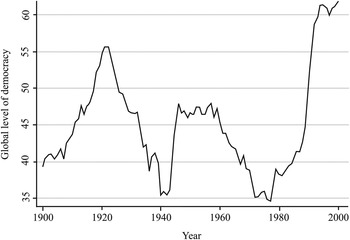
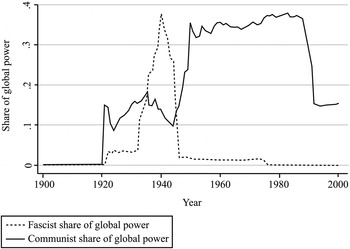
This article builds on Huntington's insight by proposing a unifying framework for the timing, intensity, and content of institutional waves during the twentieth century. In doing so it provides an explanation for two related questions. First, why do democratic transitions occur in waves that cluster in space and time? Second, why do regime transitions of all types appear to occur in waves, including communism and fascism? Figure 1 illustrates the first question by showing the global average of the Polity IV index since 1900.Footnote 3 While nondemocratic regimes lack well-developed quantitative indices such as Polity, Figure 2 charts fascist and communist waves by measuring the percentage of world power held by these states.Footnote 4
Global average level of democracy, 1900–2000

Communist and fascist shares of global power, 1900–2000

While traditional explanations for democratization focus on the role of domestic factors such as economic growth or civil society, I argue that volatility in the international system, manifested through abrupt hegemonic transitions, has been a major catalyst for domestic institutional reforms. Specifically, periods of sudden rise and decline of great powers, or “hegemonic shocks,” create powerful incentives and opportunities for sweeping waves of domestic transformations. The fortunes of democracy, communism, and fascism in the twentieth century have been shaped by the outcomes of these geopolitical cataclysms.
Although rare and fleeting, hegemonic shocks have left a deep footprint on the path of institutional development, and in the process transformed accepted notions of what constitutes a legitimate regime. Departing from theories that focus on the internal determinants of domestic reforms, I argue that regime success in the twentieth century is deeply tied to rapid changes in the global distribution of power—a relationship often obscured by the vivid particularities of local transformations.
Moving beyond work that examines the general influence of powerful states,Footnote 5 I identify and test three sets of causal mechanisms—coercion, influence, and emulation—that link hegemonic shocks to domestic transformations. In this way the intuitive but vague concept of great power influence can be usefully disaggregated. Namely, the outcomes of shocks (1) produce windows of opportunity for regime imposition by temporarily lowering the costs of external occupations; (2) enable rising great powers to quickly expand networks of trade and patronage, and in doing so to exogenously shift the institutional preferences and capabilities of many domestic actors and coalitions; and (3) inspire imitation by credibly revealing hidden information about relative regime effectiveness to foreign audiences.
The argument is tested using a variety of statistical analyses that measure the effects of hegemonic transitions on domestic reforms in the twentieth century. The results suggest that changes in the share of power among leading states have a strong and statistically significant effect on the domestic evolution of regimes, even when accounting for other variables commonly associated with political development such as economic development, regime history, neighborhood diffusion, or national culture. The results are consistent across different measures of democracy and under a variety of robustness checks, suggesting that current quantitative studies of democratization, which rarely include hegemonic power as a salient variable, should reconsider the exclusion of hegemony from their statistical models.
In examining the effects of systemic transitions, this article contributes to a growing literature that focuses on external influences and cross-border diffusion as causes of domestic transformations.Footnote 6 However, theories of diffusion often suffer from underspecified causal mechanisms and neglect the factors that spark diffusion in the first place.Footnote 7 In contrast, I emphasize the impact of vertical influences and shifts in the global distribution of power rather than neighborhood contagion.Footnote 8 More generally, in contrast to much of the “second-image reversed”Footnote 9 literature, I focus on the sources of democratic waves rather than external democratization in general. While foreign aid, for example, likely conditions domestic reforms, it cannot explain the clustering of regime transitions without recourse to some other variables. That is, even assuming that foreign aid affects domestic development, the presence of waves suggests that this influence varies widely over time—and this itself is a puzzle to be explained. For instance, the end of the Cold War enhanced the credibility of threats and conditions attached to foreign aid, since powerful donors such as the United States were no longer bound by geo-strategic considerations that had previously undermined conditionality. Outside assistance thus became a more effective tool for promoting domestic reforms in the wake of the Soviet collapse.Footnote 10 The impact of foreign aid on democracy, in other words, is itself contingent on the outcome of a hegemonic shock.
While there have been a number of qualitative and historical studies of waves, their causal dynamics have generally been undertheorized; as a result, their origins are typically examined in an ad hoc manner, with each wave treated as a unique phenomenon.Footnote 11 By linking seemingly different instances of domestic transformations through shared causal mechanisms, this article highlights the parallels among institutional waves and shows that these commonalities can be traced back to the consequences of hegemonic shocks, offering a way to combine explanations for both democratic and nondemocratic waves into a single theoretical framework.
Defining Hegemonic Shocks
The word hegemon is used ambiguously in international relations, referring to either a paramount state or one of several great powers. I adopt the latter definition of a hegemon as a state that comprises a pole in the international system—a state with the capacity to impose regimes, to influence other great powers, and to inspire institutional imitators.Footnote 12
I define a hegemonic shock as a sudden shift in the distribution of relative power among the leading states in the international system. The term expands on the notion of hegemonic war to include nonmilitary shocks such as economic crises or imperial collapses—any period in which the power of one hegemon rises or declines significantly against the others.Footnote 13 By producing clear winners and losers, shocks clarify the balance of power and allow opportunities for the creation of new global orders. In doing so, they become the graveyards and incubators of competing regime types.
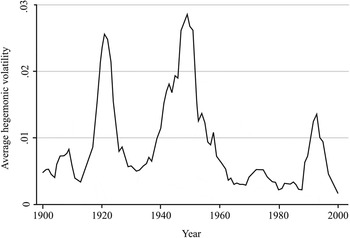
Selecting cases of hegemonic shocks requires an index of hegemonic volatility. This was measured by the average annual change in relative power, as measured by the CINC index, among hegemonic states.Footnote 14 (See Figure 3.) The measure captures hegemonic shocks by tracking how quickly the distribution of relative power among major states changes over time, and in doing so improves on measures that rely on dichotomous variables for predesignated shock years.Footnote 15
Average hegemonic volatility, 1900–2000

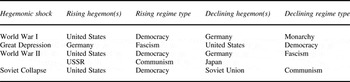
The figure reveals three immediately visible spikes of volatility: 1917–1922, 1940–1947 (with some reverberations into the 1950s), and 1989–1995. These represent the three hegemonic shocks of the world wars and the Soviet collapse. A fourth, the Great Depression, is added to the analysis for two reasons. First, because of the way the CINC index is constructed, it is likely to underestimate economic change in favor of military and geopolitical factors. Second, consistent with the demands of the theory, even when measured via CINC, relative US power declines dramatically after 1929, while German power rapidly increases after Hitler's ascent to power in 1933. The period of the Great Depression thus provides a test case of a democratic hegemon in decline, offering greater variation on the dependent variable. Table 1 identifies the rising and declining hegemons in the wake of each transition.
Hegemonic shocks and regime outcomes

In each case, the regime type of the rising hegemon shaped the content of the institutional wave that followed the shock. Rising great powers are more able to impose their regimes on others through brute force, to influence the institutional choices of states more indirectly through patronage and trade, or to simply sit back and watch the imitators climb onto the bandwagon. And because hegemonic competition is a game of relative gains and losses, the rise in status of one great power is necessarily accompanied by the decline of another. Declining great powers thus face an equally powerful but countervailing set of factors: their capacity to coerce erodes, their ability to influence and maintain allies through trade and patronage declines, and the legitimacy of their regime as a model of emulation evaporates, revealed to be inadequate under duress. After World War II, for example, both the United States and the Soviet Union emerged with their relative power and global prestige greatly strengthened by the triumph over the Axis powers. Despite the profound differences in their content, both regime waves propagated through a mixture of coercion (through occupation and nation-building), influence (via the expansion of trade, foreign aid, and newly built international institutions), and emulation (by outsiders impressed with the self-evident success of the two systems).
Hegemonic Shocks and Mechanisms of Coercion
The first way in which shocks lead to waves is by increasing the likelihood of external impositions. By producing stark but temporary disparities in relative power, shocks create windows of opportunity for rising hegemons to impose their regimes on other states. Namely, hegemonic shocks resulting from major wars temporarily increase the legitimacy of external interventions while lowering the cost of occupations. Because great powers face very different incentives during these periods, they behave very differently in the wake of such shocks. They are more likely to intervene in other states, and when they do so they are much more likely to impose their own regimes than in other periods.
Postshock interventions occur at a time when rising great powers are not only most committed to reshaping other regimes, but also when they are most capable of doing so. Examples of coercive transformations that contributed to institutional waves include the Soviet takeover of Eastern Europe and North Korea after World War II, or the American occupation of Japan and Germany until 1952 and 1955, respectively. Stalin's remark about the division of Europe after World War II is a distillation of this coercive element of postshock reforms: “Whoever occupies a territory also imposes on it his own social system. Everyone imposes his system as far as his army can reach. It cannot be otherwise.”Footnote 16
Great powers face a variety of incentives to export their regimes.Footnote 17 Nevertheless, forcible promotion is a risky and costly endeavor; if imitation cannot be secured, loyalty will suffice. During the Cold War, for example, the United States installed and supported a number of dictatorial regimes because it favored stability over democracy.Footnote 18 Democracy promotion is rarely altruistic; it is “opportunistic, not principled”Footnote 19 —that is, contingent on low expected costs. Hegemonic shocks shape the preferences of the imposing states precisely because they temporarily lower the costs of foreign intervention. In the aftermath of military hegemonic shocks, the coercive apparatus needed for occupation has already been mobilized, and thus the fixed cost of mobilization required for territorial control has already been met. Moreover, in suspending the normal rules of the international order, hegemonic shocks provide a window of legitimacy for foreign military occupations. Thus, in his book Embracing Defeat, the historian Dower argued that the success of the US occupation of Japan after World War II was made possible at least in part by the nature of the war that proceeded it, and the decisive defeat that brought the war to its end.Footnote 20 Likewise, the US occupation of Germany encountered little native opposition at least in part because of the nature of the war and the total defeat that accompanied its conclusion. The Soviet occupation of Eastern Europe in the early aftermath of World War II was legitimized by the nature of the Soviet victory in that conflict. Before it became an instrument of oppression, the Red Army was seen as a welcome symbol of liberation. In 1945, according to Kundera, the people of Czechoslovakia “showed great enthusiasm for Russia—which had driven the Germans from their country—and because they considered the Czech Communist Party its faithful representative, they shifted their sympathies toward it.”Footnote 21
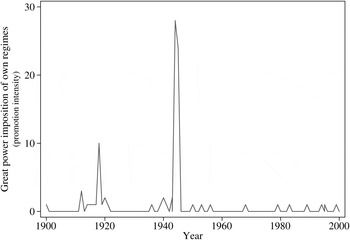
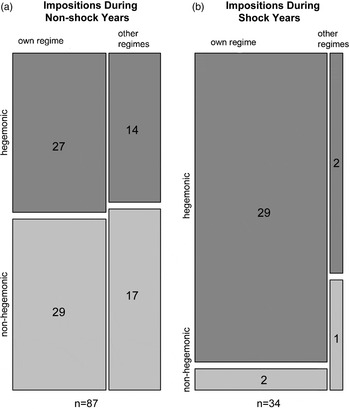
Hegemonic shocks thus create both material and normative incentives for coercive impositions of the hegemon's own regime—factors that simply do not come into play with interventions that occur in the absence of major transitions. Studies of external impositions, however, generally do not distinguish between impositions that occur in the immediate wake of hegemonic shocks and those that occur in the course of normal politics. If these arguments are correct, military hegemonic shocks should increase the likelihood of great powers temporarily choosing to promote their own regimes rather than securing mere loyalty. This can be tested empirically by looking at the rates and types of regime promotions over the twentieth century. As Figures 4 and 5 show, the likelihood of great powers imposing their own regimes increases significantly in the wake of military hegemonic shocks.Footnote 22
Impositions of their own regime by great powers, 1900–2000

External impositions, 1900–2000, classified by type

During the twentieth century, great powers are responsible for seventy-two of the 121 external impositions (about 60 percent). However, great powers nearly monopolize regime promotion in the wake of military hegemonic transitions, when they are promoters in thirty-one of thirty-four cases.Footnote 23 Moreover, great powers are far more likely to promote their own regimes in the wake of military shocks, when they promoted their own regimes in 94 percent of the cases (compared with 66 percent in nonshock years).Footnote 24
In short, when it comes to regime imposition, great powers behave very differently in the wake of hegemonic shocks. They become more likely to impose regimes during hegemonic transitions, and when they do so, they are much more likely to impose their own regimes than during nonshock years. This occurs because the immediate aftermath of military shocks changes the incentives for regime promotion by temporarily legitimizing external interventions and lowering the cost of occupations.
During the past decade or so, perhaps inspired by the American experience in Afghanistan and Iraq, the literature on regime promotions has been pessimistic about the effect of regime impositions on democratization.Footnote 25 Yet the material and ideational costs and benefits associated with impositions change dramatically in the wake of hegemonic transitions. Quantitative studies of interventions would thus benefit from disaggregating postshock interventions from other types of external impositions.
Hegemonic Shocks and Mechanisms of Influence
Another mechanism by which shocks produce institutional waves is by enabling rising great powers to rapidly expand their networks of trade and patronage within a number of different states at once. Shocks thus create opportunities to exogenously shift the capabilities and institutional preferences of domestic actors and coalitions. By contrast, countries that suffer sudden relative decline as a result of the shock will quickly lose their ability to exercise influence beyond their national borders. The Soviet collapse, for example, disrupted patronage networks in many African states in the early 1990s, which both diminished the policy options available to elites and led citizens to question the legitimacy of pro-Soviet rulers. “The winds from the east,” proclaimed Gabon's ruler Omar Bongo in 1990, “are shaking the coconut trees in Africa.”Footnote 26 Moreover, hegemonic transitions create opportunities to reconstruct international institutions—to dramatically restructure the global infrastructure through which great powers exercise their influence. While institution-building is normally a laborious and inertia-laden process, the brief periods after hegemonic shocks temporarily wipe the slate clean, facilitating the creation of new global orders and institutions.
Comparative analyses of democratization often focus on the nature of class cleavages and domestic coalitions. But in the wake of hegemonic shocks such coalitions are themselves shaped by great powers seeking to bolster or undermine particular domestic groups to further their influence. In these periods, hegemonic competition becomes mirrored at the domestic scale through shifting party rivalries and coalition realignments. With the Soviet and American entry into World War II, for example, both superpowers began to support the formation of broad antifascist coalitions in Latin America. But with the end of the war, the collapse of the Allies was reflected at the domestic level by the split of these broad coalitions into procommunist and prodemocratic parties in countries around the region. As the onset of the Cold War sharpened domestic rivalries, the left was suppressed or excluded from Latin American governing coalitions. The nature of hegemonic rivalry thus found itself replicated in the changing structure of domestic coalitions, and it was this systemic rivalry rather than domestic conditions that shaped interparty realignments in the wake of the war.
Shifts in hegemonic power therefore create opportunities to restructure the evolution of class coalitions and institutional preferences within states. Immediately after World War II, for example, communist parties appeared to be gaining ground in France and Italy. In response, the US Marshall Plan shifted the institutional preferences of Western European voters away from communism and toward liberal democracy, so that by 1948, with the influx of American money and institutional infrastructure, Communist parties had lost much of their support. “The United States spent little of its hegemonic power trying to coerce and induce other governments to buy into American rules and institutions,” notes Ikenberry. “It spent much more time and resources trying to create the conditions under which postwar European governments and publics would remain moderate and pro-Western.”Footnote 27
The Marshall Plan became the most prominent way in which the United States exercised its influence and promoted liberal democratic regimes in the years following the war. Its biggest impact resided not in the amount of the disbursements but in the conditions attached to them. Along with collaborators in Western Europe, US aid officials sought to prevent national politicians “from being tempted to fall back on state intervention, planning, and closed economies.”Footnote 28 In doing so, Marshall aid nudged center-left parties toward social democracy rather than communism. It was “an economic program but the crisis it averted was political,” writes Judt.Footnote 29 Across Europe, US patronage reduced the attraction of Soviet-style reforms and communist institutions by providing a means for general economic recovery. The democratic wave in Western Europe was thus made possible by the rare combination of American influence and commitment in the years following the war. Beyond Europe, the rise of American influence created incentives for democratization even in the absence of direct influence. Karpat argues that Turkey's transition from a one-party regime to a multiparty system after World War II “was made imminent” by the country's “need to adjust her political regime to political philosophies made dominant by the victory of the democracies in the second World War.”Footnote 30
The aftermath of World War II also provided a dramatic illustration of how rising great powers can take advantage of hegemonic shocks to advance the construction of global institutions that act as conduits for their influence. In destroying old hierarchies, shocks also create opportunities for new global and regional orders. In the wake of the war, both the Soviet Union and the United States used their rising power to construct a new institutional architecture that helped them perpetuate control and influence over the states embedded within it. Shocks thus temporarily increase rising great powers' ability to manipulate the preferences of domestic actors via both direct influence and international conduits.
Conversely, in cases of sudden decline, shocks undermine the hegemon's ability to wield influence in other states through aid, patronage networks, or international institutions. In doing so, they shift domestic groups' institutional preferences away from the hegemon's regime. For example, the collapse of the Soviet Union led to a number of changes in the incentives of both African elites and outside actors with ties to African regimes. Most directly, the collapse of the Soviet Union undercut the legitimacy of state-led development as a viable path for African states. The elimination of Soviet patronage damaged the neopatrimonial elite networks that had already suffered from the economic crises and structural adjustment of the 1980s. Most importantly, the Soviet collapse shifted Western incentives regarding foreign aid and security assistance. Powerful states such as the United States no longer had to prioritize anticommunism over democracy promotion, increasing pressure on African autocrats who had used superpower rivalry to stave off reforms. At the same time, international financial institutions and aid donors became more focused on supporting accountable government, making outside assistance contingent on democratic reforms. As F.W. de Klerk recalled in his memoirs:
The decline and collapse of communism in Eastern Europe and Russia put a new complexion on things. The ANC was formerly an instrument of Russian expansion in Southern Africa; when that threat fell away, the carpet was pulled from under the ANC; its base of financing, counseling and moral support had crumbled.Footnote 31
As a result, Dunning notes, the end of the Cold War “marked a watershed in the politics of foreign aid in Africa.”Footnote 32 Within African states, the successes of democratization abroad legitimized and galvanized local prodemocracy movements. In the immediate wake of the collapse, dictatorial elites faced immense external pressures to transform their regimes. As Levitsky and Way argue, “Western liberalism's triumph and the Soviet collapse undermined the legitimacy of alternative regime models and created strong incentives for peripheral states to adopt formal democratic institutions.”Footnote 33
One method of testing the impact of such influence directly is to measure the effect of trade with great powers on democratic development during years of hegemonic transitions. Overall, there is little consensus about the impact of trade on democratization. Li and Reuveny, for example, and Rigobón and Rodrik find an inverse relationship between trade and democratization, while López-Córdova and Meissner find a positive effect, but only after World War I.Footnote 34 Regardless of trade's overall effect, the salient test of hegemonic influence involves examining the impact of trade with the United States on democracy during hegemonic shocks compared with its impact in other years. Because leading powers have the greatest latitude to effect institutional change following hegemonic shocks, we would expect that trade with the United States has a positive effect on democratization in the years following hegemonic transitions, but less so in other years.
Assessing this distinction requires the use of an interaction model. Table 2 shows the results of a regression that examines the effects of US influence, as proxied by trade with the United States, on country-level democratic development. To distinguish the effects of trade during hegemonic shocks from other periods, the model includes an interaction term (trade × shock), a product of a measure of US trade and a variable designating years of hegemonic transition.Footnote 35 A fixed-effects regression was used to account for within-country influences. The table includes three models; Model 1 examines the overall influence of trade with the United States on democratization, without accounting for the distinction between hegemonic shocks and other periods. Model 2 includes the interaction term to account for such differences; Model 3 uses an alternative measure of trade that examines the effects of US exports and imports over the previous five years. This alternative measure accounts for sustained shifts in trade relations, and mitigates the potential effects of endogeneity by averaging changes in trade over the five years before the current level of democracy.
The effects of US trade on democratization, 1900–2000

Notes: The table shows the effects of US trade using two alternate measures of trade: sum of the country's exports and imports to the United States (Model 2); and the same measure averaged over the past five years to account for sustained shifts in trade (Model 3). trade × shock is an interaction term that distinguishes between trade with the US in shock and nonshock years. The table shows unstandardized regression coefficients, with robust standard errors in parentheses.
*p < .10; **p < .05; ***p < .01.
A number of factors commonly associated with democratization are also included as control variables. These include economic development, measured by per capita gross domestic product (GDP) and GDP growth; regional diffusion dynamics, measured by the country's proportion of democratic neighbors and the number of neighbors that had transitioned to a democracy over the previous year; and previous regime history, measured as the number of years a country had existed as a democratic or autocratic regime.Footnote 36
Consistent with previous findings, the general effects of trade (Model 1) are inconclusive—trade has a slightly negative impact on democratization, but this effect is not statistically significant. In Models 2 and 3, however, the interaction term is both positive and statistically significant, suggesting that the effects of US trade are conditional on the time period in question—namely, that trade after hegemonic shocks may have a stronger positive effect. A full interpretation of trade's impact, however, requires the calculation of the marginal effects of trade, as detailed in Brambor, Clark, and Golder.Footnote 37
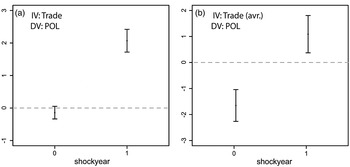
Figure 6 shows the marginal effects of trade in nonshock versus shock years, derived from Models 2 and 3 in Table 2. The results are consistent with the theory's expectations—in each case, trade has either zero or negative impact on democratization in nonshock years, while trade following hegemonic shocks has a significant positive effect on democratization. Increases in trade during those periods lead to an average one- to two-point increase in the Polity score. Although these results should be treated with caution, they suggest that examining the impact of trade would benefit from disaggregating both its origins (that is, the regime of the trading partner) and its timing with respect to hegemonic volatility. As in the case of coercion, the immediate aftermath of hegemonic shocks intensifies the channels through which great powers affect institutional development around the world.
The marginal effects of US trade on democratization—Comparison of shock and non shock years

Hegemonic Shocks and Mechanisms of Emulation
A third way that shocks create waves is by encouraging states to adopt the domestic institutions of the rising hegemon. I define institutional emulation as the process whereby a state deliberately and voluntarily imitates particular domestic institutions of successful and powerful states. Though great powers frequently attempt to persuade others of their virtues, shocks are unique in dramatically demonstrating which regimes perform better under duress, and thus credibly reveal hidden information about relative regime efficiency to foreign audiences. In doing so, they legitimize certain regimes and make them more attractive to would-be emulators. Shocks thus encourage imitation both by highlighting successful regime models and offering a way to gain favor with a rising hegemon. “If the Danubian States begin now to put on the Nazi garb,” wrote the British Home Secretary in 1938, observing the spread of fascist influence in central Europe, “it will be because imitation is the sincerest form of flattery and because they want to ingratiate themselves in time with their future master.”Footnote 38 By contrast, great powers whose fortunes suddenly decline because of a hegemonic shock will find their regimes discredited and abandoned by former followers and sympathizers. Success is contagious, in other words, but only failure demands inoculation.
Emulation is a strategy that can increase the adopting state's security and legitimacy through both internal strengthening and external bandwagoning. First, emulation can be used to strengthen the state against both internal and external threats. Emulating states hope to repeat some of the rising hegemon's dramatic success and in doing so improve their institutional fitness.Footnote 39 In that sense institutional emulation is a strategy of internal strengthening.
Second, imitating a more powerful peer can allow a state to curry favor with it and to participate in the international system that the hegemon creates and maintains. From that perspective, emulation is a strategy of external bandwagoning, though a looser one than signing treaties or forging official alliances. As Markoff puts it, “Weak states depend on stronger ones and may bid for favor by mimicking their political structures.”Footnote 40 For instance, America's dramatic rise to superpower status after World War II encouraged democratization in a number of Latin American states, who sought to accommodate themselves to the US policy of promoting democratic institutions. In Mexico, for example, the government of Avila Camacho introduced a number of major reforms: the military was pushed out of politics and electoral reforms were introduced that seemed to signal the emergence of a multiparty system. These reforms were undertaken to “prepare the country to meet the challenges of a new distribution of world power,” writes Loaeza. “They sought to accommodate the country to the post war transformation of the United States” to superpower status.Footnote 41
Yet emulation, as the diffusion of best practices, is an ongoing historical process. Why should hegemonic shocks make such emulation more likely? They do so by removing uncertainty about the relative effectiveness of competing regime types. Despite the potential benefits of reforms, leaders face considerable uncertainty when choosing to rebuild their domestic institutions. Shocks encourage such reforms by dramatically demonstrating which regime types perform better under duress. In bargaining theory, war is said to reveal private information about actors' capability and resolve—information that cannot be credibly verified through ex ante cheap talk. Similarly, hegemonic shocks reveal information about the relative strength of competing regime types. Hidden vulnerabilities become obvious, failed institutional models lose their legitimacy, and the giant's clay feet are revealed for all to see. In these periods, power breeds its own legitimacy. When Turkey ended a long period of single-party rule in 1945 and began a stormy transition to multiparty democracy, future premier Adnan Menderes explained the shift in terms that clearly revealed the informational consequences of hegemonic shocks: “The difficulties encountered during the war years uncovered and showed the weak points created by the one-party system in the structure of the country,” he declared. “No country can remain unaffected by the great international events and the contemporary dominating ideological currents. This influence was felt in our country too.”Footnote 42
While great powers often attempt to attract followers by proclaiming the superiority of their regime, in the absence of crises this information is likely to be perceived as cheap talk. During the Cold War, for example, both sides extolled the virtues of their governments to encourage converts from economically developing states. But the true condition of Soviet domestic institutions, and the country's ability to uphold a communist system outside its borders, did not become apparent to world audiences (and most scholars) until after the system's dramatic collapse in 1989. Similarly, both world wars offered a large-scale test of war-fighting effectiveness between democratic and nondemocratic states. In both cases the democratic side (and in one case the communist side as well) triumphed, despite de Tocqueville's oft-echoed assertion that democratic regimes would prove inferior to centralized ones on the theater of battle. “If the Axis had prevailed in World War II,” argues Starr, “it would have confirmed the ancient belief in the weakness and incompetence of democracies.”Footnote 43 The outcomes of shocks thus provide compelling and credible demonstrations of regime quality.
Hegemonic emulation is therefore more than a purely constructivist process driven by persuasion or socialization. But in contrast to realist approaches, emulation is also not merely a byproduct of international competition.Footnote 44 Waves of emulation are spurred by the reduction of uncertainty and the demonstration effects that accompany hegemonic shocks, not the increased competition in the international system that precedes them. Shocks thus create powerful incentives for foreign observers to learn from the successes and failures of others. In these periods, power breeds its own legitimacy. Yet rational learning is invariably filtered through cognitive biases and does not guarantee that leaders always learn the right lessons. For instance, shocks can encourage over-optimistic imitation inside states that lack the necessary domestic conditions for democratic consolidation, leading to democratic rollback as the effects of the shock begin to fade. Moreover, the process is at least in part a social one—the dramatic nature of hegemonic shocks changes perceptions of what norms or institutions ought to be considered appropriate or desirable. Institutional emulation in the wake of shocks involves the pursuit of both efficiency and legitimacy, mobilizing both rational learning and ideational, cognitively driven socialization on the part of other states.
Although democracy has been the central model of emulation in recent decades, states have admired and mimicked a variety of other regimes, particularly those that had emerged triumphant in other hegemonic shocks. Until 1939, the interwar wave of fascism was driven not by conquest but by the increasing appeal of fascist institutions. This appeal, in turn, stemmed from the economic success of Nazi Germany, particularly at a time when the major democratic states were mired in economic depression and increasingly perceived as corrupt and inefficient. Similarly, the Soviet Union inspired followers after World War II because its victory over Nazi Germany, “a country most observers had seen in 1939 and 1940 as an industrial giant, suggested that the Soviet system had considerable real-world vigor.”Footnote 45 This victory, which “legitimated and reinforced the Stalinist system,”Footnote 46 played a key role in communism's attraction in the years following the war. The rise of Soviet power meant not only the power to coerce, but also the power to attract, both through the allure of communism and the perceived deficiencies of the alternative. “No one can deny … [that] the ruthlessness of the Soviet leaders paid dividends,” wrote Hicks, a lapsed Marxist who had renounced Communism after the Molotov-Ribbentrop pact. “I grow impatient with those who argue that the Soviet regime must be virtuous because it triumphed in war, but there can be no argument about its power.”Footnote 47
By the end of the century, democracy's challengers exited from the stage defeated, discredited, and ready to adopt the institutions of their former rival. Neither fulfilled its self-appointed destiny to forge a new world on the ruins of the old. Yet the triumphant narrative of democracy's ascent risks ignoring those periods when capitalist democracy really did seem bound for the dustbin of history.
Testing the Effects of Hegemonic Shocks
Focusing on the effects of hegemonic shocks produces some testable hypotheses about their influence on domestic regimes. Namely, a rise in the power of the democratic hegemon will lead to increased democratization both within individual countries and in the international system as a whole. A decline in the power of the democratic hegemon, on the other hand, should lead to a decrease in democratization, as should a rise in the relative power of nondemocratic hegemons.
To test these hypotheses I examined the effects of hegemonic shifts on the magnitude and direction of domestic reforms over the twentieth century. Shifts in hegemonic power were measured by calculating change in the amount of power (as measured by CINC) held by each of the three leading hegemons as a proportion of total hegemonic power in that year.Footnote 48 Two alternative measures for changes in American power were used as a robustness check: first, an annual change in the US share of hegemonic power, lagged by a year; and second, the average of the annual change in that power over the previous five years, to account for sustained shifts in hegemonic power. To track the changes in German and Soviet power, I measured the annual change in their share of hegemonic power during the years that they represented alternative institutional bundles.
The dependent variable in the analysis is national level of democracy, as captured by two alternate measures of democracy—a country's Polity IV score, rescaled from 0 to 20 and a dichotomous measure of democracy based on Przeworski and colleagues and extended by Boix, Miller, and Roasto.Footnote 49 The latter is a particularly tough test of the theory because it deliberately excludes partial democratic reforms that are posited to be one of the consequences of hegemonic shocks.
A number of other factors traditionally associated with democracy were included as control variables. These include economic development, previous regime history, institutional diffusion, geographical region, colonial history, and national culture (proxied by religion). Economic development was measured using the log of per capita GDP and annual GDP growth.
Previous regime history, also frequently linked to capacity for democratization, was also measured with two variables—the number of years a country had existed as a democratic regime, and the number of years it had existed as an autocratic regime (regime history (autocracy) and regime history (democracy) in the models.). In addition, common regional factors could create the illusion of international influences; to account for such “false diffusion,” regional designations were included in the analysis.Footnote 50 Finally, colonial history (and British colonialism in particular) as well as Islamic national culture are thought to be associated with democracy.Footnote 51 These were coded as british colony and muslim state, respectively.
Since diffusion represents the alternative systemic explanation for waves, I took care to account for potential diffusive dynamics in the regression models. Diffusion was captured in three ways: as the country's proportion of democratic neighbors (proportion of democratic neighbors), the number of neighbors that had transitioned to a democracy over the previous year (neighbor transitions to democracy), and the number of democracies as a proportion of all states in the world (global proportion of democracies). The first two measures capture democratic diffusion at the regional level, while the latter incorporates its global dimension.Footnote 52
Given current theories of democracy and previous statistical findings, these control variables are expected to be very strongly associated with democratization; their inclusion thus provides a stringent test of the independent effects of hegemonic power. The regression results are displayed in Table 3.
Determinants of democracy, 1900–2000

Notes: The table shows the effects of changes in the share of US hegemonic power on democratization. us share of hegemonic power measures annual change in the relative US share of hegemonic power, lagged by one year. The regression table shows results for two measures of democracy: Polity IV (Models 1a to 1c) and Przeworski/Boix, Miller, and Rosato Reference Boix, Miller and Rosato2013 (Models 2a to 2c). For each measure of democracy, three model specifications were used: the first (Models 1a and 2a) includes the variables shown in the figure; the second (Models 1b and 2b) incorporates additional controls in the form of regional variables and national culture proxies, as described in the paper; and the third uses an alternate specification of hegemonic power, a five-year average of changes, to capture the effects of sustained shifts in hegemonic power.
*p < .10; **p < .05; ***p < .01.
The regression table shows results for two measures of democracy: Polity IV (Models 1a to 1c) and the dichotomous Przeworski/Boix measure (Models 2a to 2c). For each measure of democracy, three model specifications were used: the first (Models 1a and 2a) includes the variables shown in the figure; the second (Models 1b and 2b) incorporates additional controls in the form of regional variables and national culture proxies, as described earlier (not shown); and the third uses an alternate specification of hegemonic power, an average of changes over the past five years, to capture the effects of sustained shifts in hegemonic power.Footnote 53
The results suggest that shifts in the share of US hegemonic power have an important independent effect on democratization under different model specifications and measures of democracy.Footnote 54 The variable is statistically significant under five of the six model variations, and shows a positive and relatively large effect on democratization. For example, in Model 1a, a 20 percent jump in the share of US power is associated with over a half-point increase in the average country's Polity score. Most importantly for comparative studies of democracy, shifts in hegemonic power appear to have a stronger influence on democratization than either per capita GDP or previous democratic history. The five-year average of changes in hegemonic power, which captures sustained shifts, has a particularly large effect on democracy.
In sum, the effects of changes in the US share of hegemonic power remain significant under a number of specifications and when other variables strongly associated with democratization are included in the model. In line with previous findings, economic development has a positive and statistically significant effect (as measured by per capita GDP though not by GDP growth), as does regional diffusion and regime history. (As expected, autocratic duration has a negative effect on democratization while democratic duration has a positive effect, though both are substantively small.) Muslim states are associated with lower levels of democratization, while British colonialism appears insignificant and global diffusion intermittently so. Geographic region and national culture vary in significance (they have been omitted from the display to simplify the presentation.) The importance of regional diffusion suggests that the two mechanisms may in fact be complementary: hegemonic transitions create reforms that subsequently create regional spillover. The results also demonstrate that the sources of democratic waves go beyond regional or systemic diffusion, and are rooted in the unique dynamics produced by hegemonic shocks.
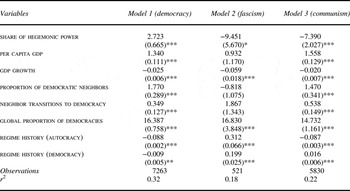
To control for the persistent institutional inertia within countries, Model 1 in Table 3 was replicated with a fixed-effects specification for each of the three hegemonic powers (see Table 4). In each of the three models, the independent variable measures changes in the relative share of power of the three hegemons of the twentieth century—the United States (Model 1—democracy), Nazi Germany (Model 2—fascism), and the Soviet Union (Model 3—communism). The dependent variable measures the effects of shifts in hegemonic power of these three states on the level of democracy in countries around the world (with country-year as the unit of measurement).
Determinants of democracy across hegemonic powers, with fixed effects; DV = Polity

Notes: share of hegemonic power is the annual change in the share of three hegemonic powers: the United States (Model 1), Nazi Germany (Model 2), and the Soviet Union (Model 3), lagged by one year. The dependent variable is Polity IV.
*p < .10; **p < .05; ***p < .01.
As in the previous results, the main independent variables—changes in the hegemonic power of each leading state—have a significant effect on domestic regimes. Moreover, consistent with the expectations of the theory, this effect is contingent on the regime of the rising great power. Increases in the US share of hegemonic power are associated with increases in democratization at the individual country level, even when accounting for domestic influences and within-country fixed effects. At the same time, an increase in the power of nondemocratic great powers produces a decline in domestic democratization: the coefficients associated with Germany and the Soviet Union are significant but with a negative sign.Footnote 55 In sum, the rise and fall of great powers over the twentieth century has a predictable effect on institutional outcome even when controlling for domestic factors or processes of diffusion. These results strongly suggest that future quantitative analyses of democratization should consider accounting for the rise and decline of leading states in the international system as an external factor that contributes to shaping domestic regime outcomes.
As a complement to the statistical analysis, the following two case studies of hegemonic shocks—World War I and the Great Depression—demonstrate the ways in which both shocks catalyzed waves of domestic reforms.
The Alchemy of War: A Case Study of World War I
The first democratic wave of the twentieth century found an unexpected origin in the immense destruction of the Great War. At the onset of the conflict, Europe had only three states that could be called democracies; by the end, the number had grown to sixteen.Footnote 56 Between 1917 and 1922, more than a dozen newly born European states emerged from the ruins of collapsed empires and adopted democratic institutions like parliaments, civil liberties, and universal suffrage. At the same time, semi-democracies such as Britain and Belgium expanded voting rights to previously excluded groups such as women and working-class men. The spirit of postwar democratic optimism was so strong that a year after the armistice, British politician and historian James Bryce wondered whether the “trend toward democracy now widely visible is a natural trend, due to a general law of social progress.”Footnote 57 In the space of a few years, the alchemy of war had transformed the laborer into a union worker, the housewife into a suffragette, the emperor into a relic.
America's entrance onto the postwar stage as a great power, along with the corresponding collapse of the monarchical alternative, had an immense impact on the institutional preferences of local actors. The war's outcome not only drastically undermined the power and legitimacy of monarchy but also demonstrated that democratic institutions could be efficient and resilient in a crisis, and could challenge and even defeat modern autocracies on both the battlefield and the factory floor. In the wake of the war, leaders all across Europe thus came to see democracy as a way to modernize their societies, acquire domestic and international legitimacy, harness the spirit of national self-determination, and attract American support and protection. For these states, America served as the model of emulation: “We accept the American principles as laid down by President Wilson,” wrote the Czech nationalist leaders in their country's 1918 Declaration of Independence, “the principles of liberated mankind … and of governments deriving their just power from the consent of the governed.”Footnote 58
Through its armies, loans, and supplies of materiel, the United States had determined the outcome of the war and now appeared poised to shape its aftermath. Its power loomed large on the continent; its regime appeared to offer a potent combination of stability, legitimacy, and strength. Among the victors, the United States was the greatest beneficiary of the war—in fact, the only great power besides Japan to benefit from the fighting.Footnote 59 According to Ikenberry, “The new postwar distribution of power left the United States as the preeminent state,”Footnote 60 and this shift was widely noted by contemporaries: “The change since 1914 in the international position of the United States,” wrote the financial editor of The New York Times in 1926, “[is] perhaps the most dramatic transformation of economic history.”Footnote 61
The postwar change in the distribution of power made democratic regimes more powerful, more able to exercise global influence, and more appealing all at once. It was the Great War, argues Stern, “that saw the elevation of democracy into a universal ideal.”Footnote 62 This outcome seemed far from inevitable in 1914. The conventional wisdom of the day argued that democracy was paralyzed by checks and balances and stymied by fickle public opinion. (Variants of these criticisms resurfaced in the 1930s and indeed after 2008—any period in which democracy appeared unable to deal with a crisis.) As the war began, even democracy's supporters admitted that its benefits “are not secured without very considerable sacrifices,” as the US Assistant Secretary of War for Industrial Relations claimed in 1916. “As a political system it is clumsy and inefficient in all material ways.”Footnote 63 As the United States prepared to enter the fight, American sociologist Giddings summed up the stakes:
So, at last, the giant democracies of western Europe and the giant absolutisms of central Europe confronted each other on the fields of France and Flanders in life and death grapple… Democracy or dynasty will be sovereign, from this time on.Footnote 64
If the war offered a powerful test of these rival regimes, its outcome supplied a clear and dramatic answer. Germany's defeat dealt “a last blow to the ancient institutions of monarchy and aristocratic feudalism.”Footnote 65 Democracy, on, the other hand, emerged as the clear winner. Only democracies had endured the conflict with their political systems intact, and “now stood alone in appearing to maintain political continuity,” notes Markoff. As a result, “the power and prestige associated with democratic institutions were greatly enhanced.”Footnote 66 By joining the democratic camp, the new states also hoped to secure American financial assistance and security guarantees from the ostensible champion of the new democratic order.
The dramatic shift in the distribution of hegemonic power was accompanied by a shift in public rhetoric about the value of democracy. The alternatives appeared either moribund (in the case of monarchical absolutism) or volatile (in the case of communism). Beyond its inherent normative appeal, democracy now emerged as “desirable in itself, or [as] the mark of respectability in the international arena.”Footnote 67
The hegemonic shock thus forged a moment when both material and ideological factors converged to bolster democracy's appeal and legitimacy.Footnote 68 Given America's reticence to use coercion or influence to promote democratic regimes, the post–World War I wave was driven almost entirely by emulation. For a brief time, this appeared sufficient. America's rhetorical embrace of self-determination sparked movements far beyond Europe—in Egypt's 1919 revolution, the Rowlatt Satyagraha in India, China's May Fourth movement, Korea's March First uprising, and elsewhere.Footnote 69 Yet the postwar wave was unprecedented both in the audacity of its aspirations and the near-complete failure of these aspirations in the face of later crises. New democracies formed from imperial ruins saw failures and reversals in the late 1920s and the 1930s. “Purged and humbled,” wrote a scholar in 1927, “democracy presents itself for revision.”)Footnote 70 Fledgling democracies fell in Russia (1917), Hungary (1919), Italy (1922), Bulgaria (1923), Poland (1926), Portugal (1926), Lithuania (1926), and Yugoslavia (1929). The optimistic period after the war, Ikenberry writes, “was a democratic high tide rather than a gathering flood.”Footnote 71
These failures, moreover, stemmed from causes inherent in the dynamics of the initial wave. First, the war's aftermath brought together extraordinary domestic alliances that supported democratic reforms. These ad hoc coalitions could not be sustained once the immediate crisis had passed and Europe entered what Polanyi called the counterrevolutionary phase of the postwar period. “Hardly had the acute danger of dissolution passed and the services of the trade unions became superfluous,” he wrote, “than the middle classes tried to exclude the working class from all influence on public life.”Footnote 72
A second reason for the failure was the overexpansion of democratic institutions into countries that lacked domestic preconditions associated with democratic consolidation—factors like a large and powerful middle class, economic stability, or previous history with democratic governance. Caught up in the wave of democratic optimism and Wilson's rhetoric, leaders of new states adopted institutions that had little chance of being consolidated in an atmosphere of economic uncertainty, political fragmentation, and ethnic strife. Parliamentary coalitions everywhere were short-lived, unstable, and ineffective. Interwar Romania, for example, saw coalitions fall on average every sixteen months.Footnote 73
Hegemonic shocks thus set the conditions for regime transitions but did not guarantee regime consolidations. The abrupt ascents of democratic hegemons create incentives for reforms that are both powerful and temporary. Once the unique pressures created by shock began to fade, domestic factors increasingly shaped the viability of European institutional reforms. The spirit of postwar enthusiasm inflated unrealistic expectations in countries where prospects for democracy faced a number of tough challenges. While the war's outcome created political space for immense domestic transformations, the rising hegemon failed to use its power to consolidate those reforms. With external pressures shifting away from democracy, the disappearance of ad hoc prodemocracy coalitions and the absence of favorable domestic conditions meant that the momentum for democratization could not be sustained. By producing a period of democratic overstretch, the postwar hegemonic transition shaped both the democratic wave and its disappointing aftermath.
A Low Dishonest Decade: A Case Study of the Great Depression
The fascist wave, culminating in a string of Nazi conquests, began well before World War II and was driven by shifts in relative power among leading states in the 1930s (Auden's “low dishonest decade”)Footnote 74 , particularly between Germany and the United States. It may be easy to dismiss the temporary success of fascism as a byproduct of conquest, but to do so ignores the rapid expansion of Germany's economic influence and the surprisingly widespread imitation of the country's institutions during the 1930s, including in ostensibly democratic states. The growing legitimacy and acceptance of fascist institutions was the result of a growing disparity in power between the declining democratic states—Britain, France, and especially the United States—and the rise of Nazi Germany.
The Great Depression was the only hegemonic shock of the twentieth century in which democracy did not emerge as one of the winners. Instead, it was widely perceived to be its culprit. Drained of vitality and plagued by corruption, inequality, and economic distress, democracy began to appear as unsuited for modern mass society as feudalism had become for industrializing states centuries earlier. The Depression, writes Dickstein, “not only challenged America's economy and its political system, but also undermined the central myths and beliefs on which the system was founded.”Footnote 75
Amid the decay and fear of this period, Nazi Germany rapidly became a model of success for leaders and masses alike. It had loudly rejected the conventional politics and economics of democratic states and achieved great success in doing so. If 1989 was the great turning point for modern democracy, 1933 would prove to be the fascist annus mirabilis. The ascent of the National Socialists in Germany to power inaugurated a long period of national recovery, economic expansion, and the quick end of unemployment. Between January 1933 and July 1935, employment rose from 11.7 million to 16.9 million. By 1939, policies of full employment resulted in a labor shortage of approximately two million people. Meanwhile, industrial production had more than doubled. “In 1933 Germany was a disarmed and isolated power,” notes Sontag, but “by 1939 all Europe trembled in fear of German power.Footnote 76
As the relative power of democratic regimes declined, democracy increasingly became seen as stagnant, outdated, and inefficient. “The 1930s and 1940s were the period of fascist success,” writes Seton-Watson. “Inevitably fascist policies and institutions were aped by others.”Footnote 77 As Schivelbusch notes:
In the wake of global economic disaster, there was no particular reason to prefer the political system most closely associated with capitalism—liberal democracy—to new systems that promised a brighter future. On the contrary, people were more inclined to ask themselves whether democracy was inevitably doomed by the economic breakdown of liberal capitalism.Footnote 78
While Britain and France concentrated on cutting public spending, Hermann Goering declared: “We do not recognize the sanctity of some of these so-called economic laws.” Instead, the Nazis pursued an active policy of massive state intervention in the economy, including deficit spending and mass employment.Footnote 79 Foreign observers, in turn, concluded that Germany's economic miracle (Wirtschaftswunder) was the result of Nazi institutional innovations, which had vividly set the regime apart from the stagnating liberal democracies, and would therefore work best in a system that abandoned the chaos of democracy for the order and stability of fascism. Its success then allowed fascist ideas to metastasize across Europe and around the world. “The mere efficiency of such a system, the elimination of waste and obstruction, is obvious,” wrote Orwell in 1941. “However horrible this system may seem to us, it works.”Footnote 80 And in the preface to the 1936 German edition of his General Theory, Keynes suggested that his own policies were “much more easily adapted to the conditions of a totalitarian state” than to a democracy.Footnote 81
In the space of a few years Hitler had been transformed from a flouncing martinet to the prophet of a new age. Even would-be liberals were persuaded by the seemingly miraculous German recovery. “In my view what China needs is an able and idealistic dictator,” wrote a Chinese political scientist in 1934. “There are among us some people, including myself, who have undergone long periods of liberal education. These people naturally find undemocratic practices extremely distasteful. But if we want to make China into a strong modern nation, I fear there is no alternative except to throw aside our democratic conviction.”Footnote 82 Like their European counterparts, Japanese intellectuals also began to desert democratic principles in favor of a fascist solution. “These intellectuals were drawn to European fascist ideas because of their repugnance for contemporary party politics and the free market economy,” writes Lebow. “They imagined that fascism would be more efficient, avoid debilitating clashes between unions and companies and strengthen Japan internationally.”Footnote 83 Japanese theorist of fascism Nakano Seigo argued that democracy had “lost its spirit and decayed into a mechanism which insists only on numerical superiority without considering the essence of human beings,” insisting that the Italian and German models offered a superior alternative.Footnote 84
Meanwhile, the growing economic power of Germany meant that it could gain followers through the expansion of its trade ties, especially in regions such as Latin America and central Europe that did not have established relations with Western powers. In Latin America, for example, Germany's share of imports grew from 7.3 to 16.2 percent between 1932 and 1938.Footnote 85 The decline of the export-import development model associated with the Depression allowed philofascist military dictatorships to replace traditional oligarchs.Footnote 86 Such influence also enabled Germany to intervene in the economic affairs of its trading partners; as German power revived, neutrality became a difficult proposition.Footnote 87 In Eastern Europe, for example, it forced Romania to reserve its mineral oils for German export and sought to prevent the region's economic integration.
In interwar democracies the diffusion of fascist institutions manifested itself not in the often-small vote shares of fascist movements, but in the absorption of their ideas by mainstream political parties. In these countries, Germany's ability to solve the problems of unemployment and social cohesion attracted a great deal of interest and admiration. As Mannheim wrote in 1940: “Competition with [the totalitarian] states compels the democracies to make use of some, at least, of their methods.”Footnote 88 After 1933, political leaders all over the world began emulating fascist institutions such as national labor services designed to relieve unemployment, state-directed economies, systems of social welfare, mass political mobilization, and strong executive rule—all hallmarks of statist innovations that took hold in the 1930s and later became essential components of modern mixed economies. Berman, in her study of the evolution of social democracy, concludes: “Several critical ‘innovations’ championed by fascists and national socialists—such as the notion of a ‘people's party’ and an economic order that aimed to control but not destroy capitalism—became central features of Europe's postwar order.”Footnote 89
Even the United States was not immune to such institutional mimicry. The only categorically fascist party in the country was the German-American Bund, a tiny organization whose members never stood a chance of winning actual political office. Instead, fascist influence manifested itself through open interest in successful German institutions by leading policy-makers.Footnote 90 A number of American intellectuals, civil servants, and politicians expressed admiration for Nazi reforms while rejecting the racial, authoritarian, and aggressive aspects of that regime.Footnote 91 As late as 1938, Roosevelt ordered a report on the German labor service, as “a source of information and inspiration.” Thanking the American ambassador in Berlin for the report, he wrote: “All of this helps us in planning, even though our methods are of the democratic variety!”Footnote 92 Unsurprisingly, such syncretic imitation proved politically toxic after the beginning of the war, and any hint of German influence was expunged from official statements.
The timing of the fascist wave also highlights the importance of hegemonic power, rather than ideology alone, in influencing domestic reforms. Benito Mussolini seized power in 1922 (although his Italian regime was not consolidated until several years later and opposition newspapers continued until 1925). But as with the Russian revolution of 1917, a new ideology alone could not inspire an institutional wave without a rising hegemon that embodied its principles and pushed the wave forward. Although a number of imitators sprung up in Mussolini's wake, very few of these movements achieved any measure of popularity until after 1933. The historian Payne concludes that “the major diffusion of fascist movements throughout Europe occurred during the following decade, in the aftermath of Hitler's triumph.”Footnote 93 In both 1917 and 1922, institutional innovation alone was insufficient, requiring an ideology buttressed by impressive material power to forge a wave of domestic transformations.
Besides attracting countless overt and covert imitators, fascism expanded its influence via increasing economic power and later forcing a number of states under fascist rule. Under attack from both the extreme left and the extreme right, capitalist democracy survived by emulating the successful elements of its competitors. But until the turn of the tide in World War II, the hegemonic shift that accompanied the Depression had a direct and powerful influence on the timing and content of antidemocratic domestic transformations of the later interwar period.
Conclusion: Beyond the Great Plateau
The period between 1919 and 1991 marked a series of struggles between competing visions of the modern state. The turbulent evolution of domestic regimes—and particularly the retreat and spread of democracy over the twentieth century—cannot be understood without examining the role of abrupt hegemonic transitions in shaping the incentives, preferences, and perceptions of domestic actors around the world.
Studies of hegemonic transitions have generally neglected the effects of power shifts on domestic regimes, focusing instead on the causes of major wars and their implications for foreign policy. Yet the critical junctures produced by hegemonic shocks have not only transformed the hierarchy of great powers but also exercised a profound influence on the evolution of domestic institutions, and the forces unleashed by these transitions have been a crucial but often-ignored factor in explaining democratization. Through the mechanisms of coercion, influence, and emulation, hegemonic shocks have created powerful opportunities for domestic reforms. In this they have been, to borrow Marx's description of revolutions, the midwives of modern history.
World War I marked the last breath of Europe's absolutist empires, but in failing to resolve the major dilemma of the twentieth century—the design and legitimacy of the modern nation-state—it became the first in a series of confrontations between democracy and alternative institutional arrangements. Democracy was the war's short-lived offspring, but communism and fascism became its enduring progeny. These challengers—the two “great totalitarian temptations”Footnote 94 —offered alternative paths to modernity that at various points seemed poised to overtake an ailing, stagnant, and corrupt democracy. The economic rise of Nazi Germany and the crisis of liberal capitalism in the Great Depression inaugurated a fascist wave in the 1930s. During this period fascist institutions penetrated the governments of many self-proclaimed authoritarians but also left a lasting legacy on the structure of modern democratic regimes. While Germany's defeat crushed any possibility of fascism as a legitimate regime path, the war's outcome produced two rising great powers, and their joint victory created opportunities for two waves of reforms, one toward democracy and another toward communism. Yet less than five decades after helping democracy expunge the fascist alternative, communism itself left the world stage with a quiet implosion. “Today it is hard to realize that they are such recent ideologies,” writes Furet, “for they seem outmoded, absurd, deplorable, or criminal, depending on the case. Nonetheless, they permeated the twentieth century.”Footnote 95
Far from being buried in the struggles of the past, the lessons of hegemonic shocks continue to resonate today. The Soviet collapse created powerful but temporary outside pressures for autocrats to adopt formal trappings of democracy. But in many countries, domestic conditions could not sustain actual democratization. A history of authoritarianism, lack of a middle class, poverty, and absence of civil society all contributed to these incomplete transitions. Competitive autocracies might therefore be viewed as the residue of the initial wave sparked by the post-1991 hegemonic transition. While theories of democratic consolidation generally ignore external influences, the causes of failed transitions inherent in democratic waves can offer a new perspective on the spread of these hybrid regimes.
By the end of the twentieth century democracy appeared to have decisively defeated its challengers. The number of democracies around the world stood at an all-time high. Yet since 1995, and despite occasional outbursts, the level of democracy in the world appears to have reached a great plateau. And after a period of unchallenged unipolarity during the 1990s, the hegemon that has embodied democracy around the world once again finds itself facing the prospect of a new ideological struggle over the prevailing archetype of a modern state. The Great Recession that began in 2008 revived the possibility of a search for alternatives. A slew of observers began to suggest that democratic capitalism was in the process of being replaced by state capitalism—an institutional bundle embodied by China and characterized by a capitalist system of production undergirded by state ownership and guidance.Footnote 96 If the lessons of past hegemonic shocks can tell us anything about the future, it is that a gradual Chinese ascent poses a much less threatening challenge to liberal democracy than a sudden rise in China's relative power (brought on, for instance, by US economic collapse). For better or for worse, the future of global democracy is tied to the future of American power.
For today's policy-makers, examining the causes of these waves is essential not only for understanding how democracy spreads but also for judging the efficacy of external regime promotion pursued by the United States and other great powers. Much of US policy during the Cold War, for example, was guided by the fear of a communist wave. More recently, the 2003 invasion of Iraq by the United States and its allies was motivated at least in part by President George W. Bush and his administration's belief in their ability to spark democratic waves through forced regime change. Given the importance of democracy promotion in contemporary foreign policy, the causes and dynamics of democratic waves can provide important insights into the sources of external regime change. It may be insufficient or even counterproductive to focus on the needs and preferences of domestic actors inside any single country if domestic reforms are embedded within a larger framework of global or regional power shifts.
The dynamics of hegemonic shocks also challenge the triumphalist reading of modern history as one of steady democratic progress. Though the metaphor of waves invokes a powerful force, democracy's success has been predicated on the ability of leading democratic states to weather enormous crises, and to emerge triumphant in their wake. When democracies fail to do so, as during the Great Depression, the tide of popular and elite opinion shifts just as readily and just as naturally against democratic institutions. The consecration of democratic triumph is forged by the outcomes of fierce and often uncertain struggles. The contingency and fragility of democratic success is the ultimate lesson of hegemonic shocks.
Supplementary material
Supplementary materials and replication data are available at http://dx.doi.org/S0020818314000113.