Introduction
The extinct genus Pareuthychaeta Hennig (Diptera: Schizophora) was erected to accommodate two species preserved in Eocene Baltic amber, Pareuthychaeta minuta (Meunier) and Pareuthychaeta electrica Hennig (Hennig Reference Hennig1965). It was placed in the family Diastatidae since the two species bore some distinctive features with the Recent genera Diastata Meigen, Campichoeta Macquart, and Euthychaeta Loew. Diastatidae s.l. is most diverse in the Northern Hemisphere, though some species of Diastata and Campichoeta occur in southern Africa (Barraclough Reference Barraclough1992) and South America (D. Grimaldi, unpublished). Diastata contains approximately 40 described species, many of which have strikingly patterned wings; Campichoeta contains nine species; and the monotypic genus Euthychaeta contains just the European species Euthychaeta spectabilis Loew.
All three of the Recent genera have traditionally been classified within Diastatidae (e.g., Duda Reference Duda1934; McAlpine Reference McAlpine1962), as they are treated here, but Griffiths (Reference Griffiths1972) proposed placing Diastata into Ephydridae (on the basis of possessing sclerotized ventral receptacles) and placing Campichoeta into its own family, Campichoetidae. The ventral receptacle is uniformly heavily sclerotized and U-shaped in Diastata (the spermathecae are vestigial and unsclerotized), but in Campichoeta the ventral receptacle is more globular and possesses a fine, tightly spiraled tubular extension (spermathecae are also sclerotized) (Kotrba Reference Kotrba2006). Chandler (Reference Chandler1987), in his revision of the Palearctic species of these genera, alternatively placed Diastata in Diastatidae, and Campichoeta plus Euthychaeta in Campichoetidae. Grimaldi (Reference Grimaldi1990) placed Campichoetidae as the sister group to Diastatidae + Camillidae + Risidae + Ephydridae, partly on the basis of ventral receptacle structure. McAlpine (Reference McAlpine1989) and Barraclough (Reference Barraclough1992) retained all three of the above genera in Diastatidae. Further comments on the classification of these genera are in the section ‘‘Discussion’’.
Against this context of controversial relationships is Pareuthychaeta. Despite the incompleteness usually associated with fossils, most Pareuthychaeta specimens are preserved with taxonomically important details quite visible, such as the number of abdominal spiracles, structure of male genitalia, femoral ctenidia, etc. Indeed, the presence of large, spine-like setae on male tergite VII in Pareuthychaeta is a distinctive feature of E. spectabilis and some Recent species of Campichoeta and Diastata. Other features that Pareuthychaeta shares with these genera are described below, along with unique features of the fossil species.
This paper was initiated for two reasons: (1) the senior author's interest in the early Paleogene radiation of Schizophora, particularly divergence times within Ephydroidea (e.g., Grimaldi Reference Grimaldi1990, Reference Grimaldi2008; Grimaldi and Engel Reference Grimaldi and Engel2005) and (2) the unexpected discovery of another species of Pareuthychaeta, in Cambay amber from Gujarat, western India (Rust et al. Reference Rust, Singh, Rana, McCann, Singh and Anderson2010).
It is a pleasure to dedicate this paper in honor of the dipterists, past and present, of the Canadian National Collection of Insects and Arachnids. Their collections, research, and publications are an enduring and inspiring legacy to those of us so fascinated by the most ecologically diverse and morphologically disparate order of insects.
Materials and methods
The amber specimens examined for this study derived from two major deposits of Eocene amber, one of which, Baltic amber, has been exploited for centuries; Cambay amber from western India was discovered recently. Baltic amber was formed in a subtropical conifer forest at a paleolatitude of 47–52°N; Cambay amber was formed in a fully tropical dipterocarp forest at approximately the paleoequator. The Baltic amber specimens were purchased from dealers, who acquired the material in Jantarnyi (formerly Palmnicken), Samland Peninsula, western Russia. Though Baltic amber deposits (and redeposits formed by Pleistocene glaciation) occur throughout much of northern Europe, Jantarnyi is commercially exploited because it is the largest amber deposit in the world. Age of the material at Yantarnyi varies from Early Eocene (Ypresian), ca. 49–52 Ma, to Late Eocene (Bartonian, ca. 37–38 Ma), but the great concentration of the amber comes from the Blau Erde stratum, which is Lutetian (40–45 Ma) (Ritzkowski Reference Ritzkowski1997). The amber was formed in humid, warm temperate to subtropical forests dominated by pines, but with some oaks and other angiosperm trees. A pinaceous origin is indicated by the types of cones and the anatomy of wood fossilized within the amber, as well as by abundant vesiculate pollen within the amber and sediments. The most recent chemical analysis suggests that Baltic amber was formed by an extinct relative of the living umbrella-pine, Sciadopitys Siebold & Zucc. (Sciadopityaceae) (Wolfe et al. Reference Wolfe, Tappert, Muehlenbachs, Boudreau, McKellar and Basinger2009). Schizophoran flies are rare in this amber. Von Tschirnaus and Hoffeins (Reference von Tschirnaus and Hoffeins2009) reported that only 0.5%–1.85% of all Baltic amber Brachycera inclusions (and <0.01% of all insect inclusions) were Schizophora. These authors summarized the acalyptrate diversity in Baltic amber, comprising some 217 species, only 56 of which are apparently described. That overview was based, incredibly, on 1141 acalyptrate specimens from three museum and (mostly) seven private collections. Such a yield probably required screening through more than a million pieces of Baltic amber.
Cambay amber was collected by the authors from large lignite mines (Vastan and Tadkeshwar) in the western Indian state of Gujarat. It occurs in upper strata of the Cambay Shale, dated to early Ypresian (50–52 Ma) (Rust et al. Reference Rust, Singh, Rana, McCann, Singh and Anderson2010). Thus, it is maximally older than most Baltic amber by some 10 Ma. The amber is a “Class II”, cadinene-based (dammar-type) fossil resin, which gives it distinctive chemical and physical characteristics. Botanical origin is Dipterocarpaceae, a family of tropical forest canopy trees that are diverse and numerically dominant in southeast Asia today.
When trimming into the amber it is often slightly tacky, and it readily dissolves in organic solvents (allowing extraction of inclusions, though they are extremely fragile and often fragment); these features indicate that Cambay amber is poorly crosslinked and polymerized. For this reason, Cambay amber should be completely embedded in artificial resin/epoxy (see below), to prevent surface degradation as well as to improve visibility of inclusions.
Cambay amber is very abundant and highly fossiliferous. Among the nearly 1000 insect inclusions found thus far, representing 14 orders and 55 families, only two Schizophora specimens have been found, one of them the Pareuthychaeta reported here, and the other one similar to the living family Natalimyzidae from southern Africa (which also occurs in Baltic amber [von Tschirnaus and Hoffeins Reference von Tschirnaus and Hoffeins2009]).
Amber preparation followed the methods described in Nascimbene and Silverstein (Reference Nascimbene and Silverstein2000). This included preliminary trimming with a very fine, water-fed, circular diamond saw and polishing with a series of coarse to fine wet emory papers on a flat lapidary wheel. Pieces were then embedded in Buehler epoxy under vacuum (which allows the fluid epoxy to penetrate fine cracks). When the epoxy hardened, the piece was further trimmed and polished close to the surface of the amber, but with epoxy completely surrounding the amber piece.
Von Tschirnaus and Hoffeins (Reference von Tschirnaus and Hoffeins2009) reported that more than 50 specimens of Pareuthychaeta exist in private collections of Baltic amber in Germany. These were not available for this study, and their study will obviously require major effort. Baltic specimens of two species in the American Museum of Natural History (AMNH) collection provided sufficient comparisons to study the species from India. Morphological terminology follows McAlpine (Reference McAlpine1981). The term “ipsilateral” (vs contralateral) is borrowed here from neuroanatomy, which refers to the half of paired structures that occur on one side of bilaterally symmetrical organisms, for example, the ipsilateral orbital setae in flies. Abdominal sternite and tergite numbers are abbreviated, for example, as sVIII, tVIII. The following abbreviations are used here in reference to setae:
ant., anterior; post., posterior. HEAD: FOS (fronto-orbital seta[e]), IV (inner vertical seta), OV (outer vertical seta), PRO (proclinate FOS), REC (reclinate FOS). THORAX: DC (dorsocentral seta[e]), ADC (anterior dorsocentral), PDC (posterior dorsocentral), NS (notopleural seta), SAS (supra-alar setae), SC (scutellar seta).
Systematics
Pareuthychaeta Hennig
Pareuthychaeta Hennig, Reference Hennig1965: 191. Type species P. electrica Hennig, Reference Hennig1965.
Diagnosis
Schizophoran flies with pubescent arista, bare eyes, two pairs of FOS (PRO, post. REC [ant. REC lacking]); profemur with ctenidial spinules; wing with row of fine erect costal spinules (except in Pareuthychaeta eoindica sp. nov.); crossvein dm–cu close to edge of wing (distal segment of CuA1 equal to or slightly longer than length of dm–cu); male with tV enlarged (except in P. eoindica sp. nov.); distal margin of dorsal surface of male tVII with two to four large, stiff setae; male terminalia with surstylus broadly attached to epandrium, postgonites a pair of slender, sclerotized, pointed lobes.
Pareuthychaeta electrica Hennig
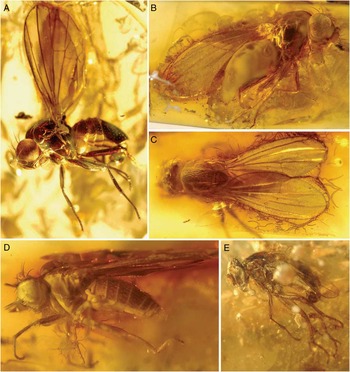
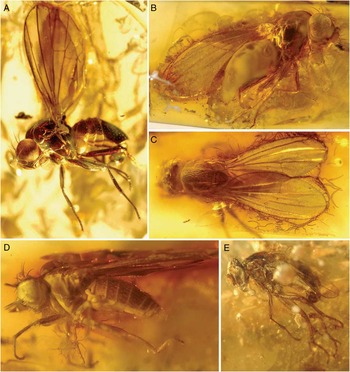
Photomicrographs of Pareuthychaeta in Eocene ambers (all to the same scale). (A) Pareuthychaeta electrica Hennig in Baltic amber (male, AMNH Ba-JH68). Body length 2.57 mm. (B) P. electrica in Baltic amber (female, AMNH Ba-JH75). Body length 2.90 mm. (C–D) Pareuthychaeta mcalpinei sp. nov., in Baltic amber (holotype female, AMNH Ba-JVe1010). Body length 2.50 mm. (C) Dorsal view. (D) Lateral view. (E) Pareuthychaeta eoindica in Cambay amber from Gujarat, western India (holotype male, Tad227). Body length 1.57 mm. AMNH, American Museum of Natural History.
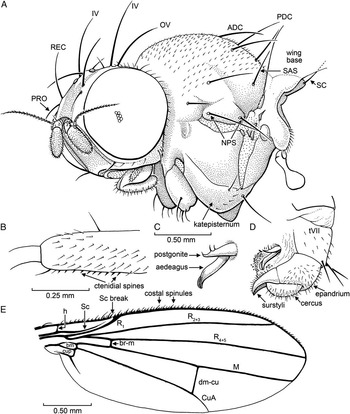
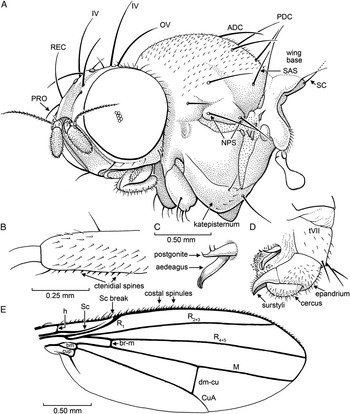
Pareuthychaeta electrica (AMNH Ba-JH68). (A) Oblique lateral view of head and thorax. (B) Detail of anterior half of profemur, showing ctenidium. (C) Detail showing aedeagus and postgonite. (D) Male terminalia, left lateral view. (E) Wing. AMNH, American Museum of Natural History.
Pareuthychaeta electrica Hennig, Reference Hennig1965: 191. Baltic amber.
Diagnosis
Antennal arista with very short pubescence; first flagellomere shorter, apex distant from oral margin; eye subcircular in lateral view (ventrally narrower); frontal and vertical setae long (length of inner verticals 0.65× depth of eye); gap between ipsilateral FOS small, almost 2–3× diameter of setal socket; no prescutellar setae; with long, erect spinules on costa; distal segment of vein CuA1 approximately equal to length of crossvein dm–cu; row of 8–10 ctenidial spinules on anterior half of profemur; tV in males approximately twice the length of tIV; tVII in males with three long setae on posterior margin; aedeagus scoop-shaped, postgonite apically pointed, with two short, stiff setulae on ventral margin.
Type material
Holotype: male, no number, mentioned by Hennig (Reference Hennig1965) as being in the Universität Königsberg collection (now in Universität Göttingen).
Other specimens
New specimens that were examined are AMNH Ba-JH68 (male: Figs. 1A, 2) and AMNH Ba-JH75 (female: Fig. 1B), both purchased from Mr. Jens von Holt and deriving originally from Yantarnyi, Samland Peninsula, Russia. Slight differences between Hennig's description and the two AMNH specimens are the following: costal vein between apices of R4 + 5 and M very thin; apex of wing slightly pointed (vs rounded); three (vs two) large setae on male tVII, tips of surstyli pointed (vs blunt and knobbed), and ventral margin of postgonite with two small, stiff setae (vs none).
Pareuthychaeta minuta (Meunier)
Helomyza minuta Meunier, Reference Meunier1904: 24. Baltic amber.
Pareuthychaeta minuta (Meunier): Hennig, Reference Hennig1965: 192.
Diagnosis
(Based on description by Hennig Reference Hennig1965.) Antennal arista with very short pubescence; first flagellomere longer, nearly reaching level of oral margin; eye ovoid in lateral view (posterior margin flattened); frontal and vertical setae long; distance between ipsilateral FOS small, only 2× diameter of setal socket (cf. Hennig Reference Hennig1965: figs. 291–292); pair of small prescutellar setae present; ant. SC very long, tips reaching to level of post. scutellar setal tips; costal vein with sparse, erect spinules on proximal half; distal segment of vein CuA slightly shorter than crossvein dm–cu; male with enlarged tV (von Tschirnaus and Hoffeins 2009: fig. 3).
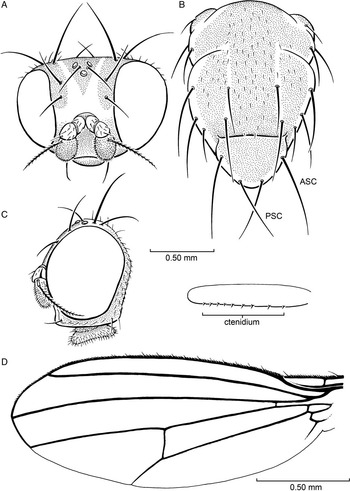
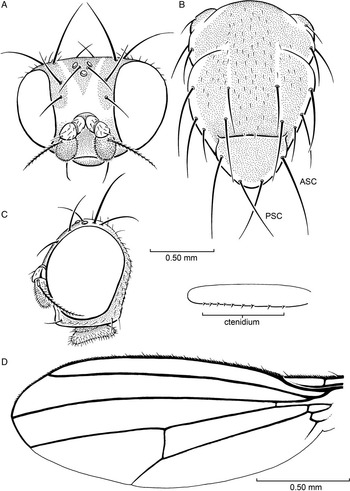
Pareuthychaeta mcalpinei holotype (AMNH Ba-JVe1010). (A) Dorsofrontal view of head. (B) Dorsal view of thorax. (C) Lateral view of head. Mesal view of profemur (other setae omitted). (D) Wing. AMNH, American Museum of Natural History.
Type material
Lectotype: female, Nr. Z9942 designated by Hennig (Reference Hennig1965), mentioned as being in the Universität Königsberg collection (now in Universität Göttingen). Von Tschirnaus and Hoffeins (Reference von Tschirnaus and Hoffeins2009: fig. 3) provided a photograph of a specimen of this species showing red eyes (Hoffeins coll. no. 671-5).
Pareuthychaeta mcalpinei Grimaldi, sp. nov.
Diagnosis
Distinguished from other two Baltic amber species by: gap between ipsilateral FOS large, distance = 0.5–0.65× length of PRO; FOS setae short relative to vertical setae; distal segment of vein CuA1 relatively long, 1.50× length of dm–cu; crossvein dm–cu oblique to veins M and CuA1 (vs perpendicular to at least M). Differs further from P. minuta by first flagellomere short, apex distant from oral margin; lack of prescutellar setae. Similar to P. minuta in body size and the very short br–m crossvein.
Description
Head: Of moderate depth, ratio of height:width = 1:1.34. Ocellar triangle and posterior two-thirds of frontal vittae pollinose gray (rest of head light). Eye suboval in lateral view; width 0.80× the height; bare of interfacetal setulae; facets not differentiated. Antennal pedicel with dorsolateral cleft; first flagellomere suboval in frontal view, relatively short, apices distant from oral margin, bearing setulae approximately equal in length to those on arista; antennal arista with pubescence relatively short. Frons relatively long, with two pairs of FOS: pair of post. REC and slightly shorter pair of PRO (all four setae somewhat lateroclinate); no anterior RECs (not even minute ones); distance between ipsilateral FOS large, equal to 0.5–0.65× length of PRO. Ocellar setae divergent, bases within ocellar triangle, length slightly greater than PRO; postocellars 0.7× length of ocellars, cruciate for 0.5× their length. IV very long, erect, slightly reclinate; length IV 1.6× that of REC. OV setae very divergent and reclinate, length 0.75× that of IV. REC seta slightly medial to line between ipsilateral PRO and IV. Gena shallow, depth 0.10× that of eye; one pair small vibrissae present, length 0.8× that of PRO. Thorax: Length 1.75 mm. Scutum and scutellum largely light, pollinose gray; with lighter areas at margins, pair of light stripes through DC setae and anterior to these. Acrostichals scattered, not in defined rows; no prescutellar setae present. DC setae well developed, ADC 0.7× length of PDC, distance between ipsilateral DCs, 0.6× length of ADC; base of ADC slightly more medial than is base of PDC. One small postpronotal seta; two notopleural setae; large lateral presutural seta present, length equal to that of anterior notopleural. Three SAS present, posterior one shortest, anterior one longest. Scutellum with two pairs SC, no setulae; ant. SC very long, apex reaching to level of tip of apical SC; length ant. SC 1.4× that of apical SC; apical SCs cruciate for 0.5× their length. Anepisternum bare; katepisternum with two setae, anterior seta ca. 0.5× the length and thickness of posterior seta. Legs: Profemur with row of nine small, fine ctenidial spinules along most of ventromedial surface, anterior five spinules slightly thicker; with slightly raised, dorsal, preapical seta. Pro- and metatibiae with small distal comb of 6 min setulae on mesal surface. Mesotibia with one stout dorso-preapical and one stout ventroapical seta. Metafemur with one stout dorso-preapical seta, one pair of longer ventro-preapical setae. Wing: 1.60 mm length, greatest width 0.43× length, completely hyaline (no infuscation or markings). Vein C with Sc break, slightly weakened area on C just distal to h; C ends at apex of vein M; C with row of approximately 12 fine, erect spinules. Vein Sc incomplete, apically evanescent. R2 + 3 0.87× length of R4 + 5. Tip of vein R4 + 5 ends at apex of wing. Crossvein br–m very short, length only 2.5× thickness of M. Distal segment of vein CuA relatively long, 1.50× length of dm–cu; crossvein dm–cu oblique to veins M and Cu. Cell bm complete, base of cell cup incomplete; vein A1 short; anal lobe highly reduced. Abdomen: Female tV ca. 1.5× length of tIV, ca. 2× length of tVI. Tergites setulose, with row of 6–10 thicker setae on posterior margins. Cercus slender, bearing setae slightly longer than cercus. Spiracles not visible.
Etymology
Patronym in honor of J. Frank McAlpine, former dipterist of the Canadian National Collection of Insects, Arachnids, and Nematodes, who was also an organizer of and major contributor to the masterful work, Manual of Nearctic Diptera.
Type material
Holotype: female: AMNH Ba-JVe1010, Baltic amber: Russia: Samland Peninsula: Yantarny. Purchased from Jürgen Velten. In AMNH. Type was embedded in epoxy, and then trimmed into a small block 5 × 5 × 3.5 mm for a full dorsal, lateral, and frontal view of the fly. Epoxy remains on only one surface.
Pareuthychaeta eoindica Grimaldi, sp. nov.
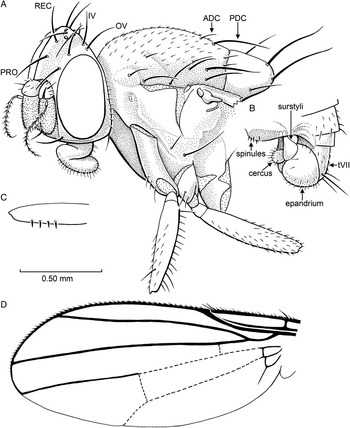
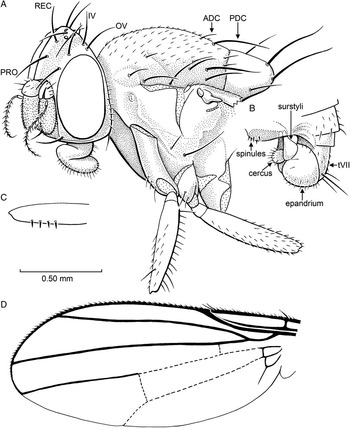
Pareuthychaeta eoindica holotype (Tad227). (A) Oblique lateral view of head and thorax (slightly reconstructed). (B) Left lateral view of male terminalia. (C) Mesal view of profemur (anterior half), showing ctenidium (other setae omitted). (D) Wing.
Diagnosis
Distinguished from the three Baltic amber species by the significantly smaller size (1.2 mm thorax length, 1.70 mm wing length); longer pubescence on antennal arista; first flagellomere long, apex reaching to oral margin; eye deep, narrow, vertical; frontal and vertical setae relatively short; gap large between ipsilateral FOS (also occurs in P. mcalpinei), pair of (small) prescutellar setae (also occurs in P. minuta); ant. DC short; erect spinules on costa lacking; distal segment of vein CuA1 (also occurs in P. mcalpinei) relatively long, 1.25× length of dm–cu; four short ctenidial spinules confined to anterior third of profemur. Further distinguished from at least P. electrica (for which males are also known) by a ventral row of long setae on the metatibia, a small group of fine spinules on sVIII, and tVI of unmodified size.
Description
Head: Deep, narrow from anterior to posterior. Eye deep, slender, vertical; width 0.55× the depth; without interfacetal setulae; facets not differentiated. Antenna with pedicel having dorsolateral cleft; first flagellomere long, apex nearly at level of oral margin, with short setulae; arista with long pubescence (short, numerous branches with lengths several times the thickest diameter of aristal trunk). Frons with two pairs FOS: pair of PRO, pair of post. REC, no ant. REC; FOS approximately equal in length; distance between bases of ipsilateral FOS 0.5× length of seta. Pair of ocellar setae, base within ocellar triangle, length 0.7× that of FOS; very small pair of cruciate postocellars present. One pair IV, one pair OV present; IVs convergent, OVs divergent and slightly longer than IVs. REC in line with ipsilateral IV and PRO. Gena very shallow, depth 0.05× the depth of eye. One pair vibrissae present, length 0.8× that of PRO. Thorax: Scutum apparently flattened, not domed (though partially collapsed in unique holotype). Acrostichals scattered, not in defined rows; pair of small prescutellar setae present, length slightly shorter than ADC. ADC very short and fine, length and width 0.30× that of PDC. PDC long, base thick, length slightly less than that of apical SC. Distance between bases of ipsilateral ADC and PDC 0.85× the length of ADC. One fine postpronotal seta; two NS, situated close to notopleural suture; ant. NS slightly longer than post. NS. Very small, fine lateral presutural seta present, barely differentiated from acrostichals. Two SAS present, post. SAS is larger, length 0.70× that of PDC. Scutellum with two pairs SC, no setulae; ant. SC slightly divergent, relatively short, 0.5× length of apical SC; apical SCs parallel. Anepisternum bare; katepisternum with two setae, a finer, shorter anterior seta 0.28× the length of posterior seta. Legs: Male profemur with ventral row of fine, stiff setae, lengths 0.5–0.9× the greatest diameter of femur; row of four stout ctenidial spinules on anterior third of profemur, spinules evenly separated by distance approximately equal to spinule length. Fore femur with erect preapical dorsal seta; hind tibia with pair of semierect, preapical ventral setae; each tibia with erect, preapical dorsal seta; mesotibia and metatibia with two ventral, longitudinal rows of fine, stiff setae (lengths slightly greater than diameter of tibia), and pair of short, ventroapical spurs. Metabasitarsomere and metatarsomere 2 with 6 and 4 transverse rows, respectively, of minute setal combs. Pretarsal claws well developed; pulvilli well developed. Wing: fairly broad (greatest width is 0.46× length), completely hyaline (no infuscation or markings). Vein C with fine Sc break, no h break; C ends at apex of vein M, without fine, erect spinules. Sc incomplete (not connected to C), apically evanescent. R2 + 3 0.81× length of R4 + 5. Tips of veins R4 + 5 and M meet C on each side of wing apex. Crossvein br–m fairly long, length 0.4× that of dm–cu. Distal section of CuA (from where it joins with dm–cu) is 1.25× length of dm–cu. Small bm and cup cells present; vein A1 a short spur, apically evanescent. Anal lobe highly reduced. Abdomen: Tergites setose, with longer setae on posterior margins; tV not significant larger than tIV; tVII with three large, thick, stiff setae on posterodorsal margin, lengths of setae approximately equal to length of tVII. tVII and epandrium curled ventrad. Male terminalia: Epandrium rounded, bulbous, with sparse, short, fine setae; surstylus well developed, with broad base and very narrow apex, articulating with epandrium (not fused, with fine suture) [aedeagus not visible]; cercus small and rounded; sVIII(?) with group of five small, sclerotized spinules on anterior margin.
Etymology
From Eocene, the geological epoch of origin; and -indica referring to India, the country of origin.
Type material
Holotype: male, Tad-227, in amber from Gujarat State, western India, Tadkeshwar lignite mine, N 21°21.400, E 073°04.532. To be deposited in the University of Lucknow, India. The amber piece containing the holotype is dark yellow, slightly turbid, and was trimmed to a piece 9 × 5 mm, embedded in epoxy and then trimmed again at angles that maximize dorsal, lateral, and frontal views of the fly. The holotype is entirely preserved, although portions of scutum, eyes, abdomen, and to less extent the frons, are collapsed. Wings are folded, requiring that the venation be reconstructed in a drawing (Fig. 4D).
Discussion
Given the distance between the Baltic and Cambay amber deposits, the discovery of a basal ephydroid with the distinctive features of Pareuthychaeta was unexpected. There is substantial evidence to align the Cambay amber species with the Baltic amber species, based on the very similar shape and structure of the surstylus in P. electrica and P. eoindica; the large, erect setae on the posterior margin of tVII of all the fossil species (which also occurs in Euthychaeta [two setae only], and in some Campichoeta and Diastata) and the position of the proclinate orbital setae anterior to the (posterior) reclinate setae in all four fossil species. This latter character, however, is probably plesiomorphic with respect to Recent Diastatidae sensu lato, which have the proclinate setae distinctively lateral and dorso/posteriad to the reclinate orbital seta (in fact, this may be a synapomorphy for Campichoeta + Euthychaeta + Diastata). Pareuthychaeta eoindica is further similar to Diastatidae s.l. by possessing spinules on male sVII, which also occurs in some Recent species of Campichoeta. The Cambay amber P. eoindica, however, lacks costal spinules and has short orbital and vertical setae, which are features plesiomorphic to all Recent and fossil Diastatidae. This species is further plesiomorphic to the Baltic amber Pareuthychaeta by having male tV not enlarged.
Relationships among the one fossil and three Recent genera can be summarized in two hypotheses:
A. P. eoindica + Baltic Pareuthychaeta (Campichoeta (Euthychaeta (Diastata))), or
B. P. eoindica (Baltic Pareuthychaeta (Campichoeta (Euthychaeta (Diastata)))).
Chandler's (Reference Chandler1987) classification notwithstanding, in almost every aspect the features of Diastata are derived/apomorphic with respect to Campichoeta and Euthychaeta. These include the following: wing somewhat fusiform, with narrow base and apex; anal lobe extremely reduced; costal vein with subcostal and humeral breaks (vs just Sc break); crossvein dm–cu less than its length from wing margin; arista with short plumosity (vs pubescence); male with ctenidia on fore and mid femora (fore femur only in female); male sVI divided into two sclerites, male abdominal segment VII with spiracles lost; sursyli bilobate; epandrium bulbous; spermathecal capsules vestigial, unsclerotized. Euthychaeta is distinctive for its sexually dimorphic FOS, wherein the male has very small posterior reclinates. Euthychaeta and Diastata appear to be sister groups based on the loss of the anterior reclinate orbital setae and a long first flagellomere. Campichoeta is excluded from Euthychaeta + Diastata because it plesiomorphically possesses a crossvein dm–cu that is distant from the wing margin (by greater than or equal to twice its length), and by retaining a pair of anterior reclinate orbital setae. A feature that defines the monophyly of Campichoeta is the very faint, minute vein A1 (which is virtually lost), and a pair of sclerotized ventral receptacles. The family Diastatidae can be defined by one to two pairs of large, erect, stiff setae on male tVII and by the presence (in all species except P. eoindica) of erect costal spinules.
The biogeographic implication of hypothesis A is that Pareuthychaeta extended at the very least from northern Europe to the Indian subcontinent in the Early Eocene. Such a distribution is consistent with the distributions of other Eocene fossils from India, including terrestrial vertebrates and other insects in amber (Rust et al. Reference Rust, Singh, Rana, McCann, Singh and Anderson2010). Given that the vertebrates and amber from the Cambay Shale Formation are equal or slightly older than the age in which India supposedly docked with Asia (at 49 Ma), the existence of widespread taxa like Pareuthychaeta suggests that India was not so isolated at this time (e.g., connected to Asia via land bridges or islands), or that India collided earlier with Asia.
In either hypothesis A or B, Pareuthychaeta is clearly a stem group to Recent Diastatidae s.l. The discovery of this genus in a deposit so distant and paleoecologically distinct from the Baltic amber deposits reinforces the view that Eocene Schizophora were almost all stem-group members of Recent families and generic groupings (Hennig Reference Hennig1965, Reference Hennig1967, Reference Hennig1969). Thus far, definitive Schizophora are unknown from the uppermost Cretaceous, and the only Cretaceous Cyclorrhapha are stem-group species of the basal cyclorrhaphan families Lonchopteridae, Platypezidae, Sciadoceridae, and Phoridae (Grimaldi and Cumming Reference Grimaldi and Cumming1999; Grimaldi and Engel Reference Grimaldi and Engel2005; D. Grimaldi, unpublished).
Almost certainly the Paleocene, perhaps also the latest Cretaceous, was when the Schizophora experienced a massive radiation, similar to that of modern orders of mammals. Such estimates correspond with recent molecular estimates of the divergence times of flies (Wiegmann et al. Reference Wiegmann, Trautwein, Winkler, Barr, Kim, Lambkin and Bertone2011). A radiation that resulted in nearly 80 Recent families and 70,000 described species (not including the many undescribed species), condensed into a period of 10–15 Ma, may explain why relationships among Schizophora families are so challenging to determine. Continued exploration of the Cambay amber will allow us to further test the hypothesis of an early Paleogene radiation of the schizophoran flies.
Acknowledgments
The senior author thanks Jens von Holt and Jürgen Velten for providing select specimens of Baltic amber for purchase; Paul C. Nascimbene for his dedication to and skill with amber at the AMNH, including finding and preparing the specimen of P. eoindica; Steve Thurston (AMNH) for assembling and labeling the plates; Isabelle Vea (AMNH) for the French translation of the abstract; Brad Sinclair for the invitation to contribute to this Festschrift; and Stephen Gaimari and an anonymous reviewer for helpful comments on the manuscript.