Introduction
Livestock production systems may be affected in various ways and changes in productivity are inevitable (Thornton and Gerber, Reference Thornton and Gerber2010). Livestock production both contributes to and is affected by climate change (Hoffmann, Reference Hoffmann2010). Livestock and environmental trade-offs are currently substantial and will increase significantly as a result of the increased demand for livestock products from the growing population (Herrero et al., Reference Herrero, Thornton, Gerber and Reid2009a). Livestock in the pastoral systems depends to a great extent on the productivity of the rangelands, which is predicted to decline and become more erratic due to climate change (FAO, 2007b). Genetically diverse livestock populations are an important resource to be drawn upon as production systems change and develop. The prospect of future challenges such as adapting to global climate change underlines the importance of retaining a diverse portfolio of livestock breeds (FAO, 2007b). Climate change requires more efficient animal production systems, careful husbandry of natural resources and measures to reduce waste and environmental pollution (FAO, 2010).
In addition to the physiological effects of higher temperatures, climate change increased risk that geographically restricted rare breed populations will be badly affected by disturbances (Hoffmann, Reference Hoffmann2010). The IPCC (2007) predicts that by 2100 the increase in global average surface temperature may be between 1.8 and 4.0 °C. With global average temperature increases of only 1.5–2.5 °C, approximately 20–30 percent of plant and animal species are expected to be at risk of extinction (FAO, Reference Pilling and Reshow2007a). Climate change may have also significant impacts on the livestock number, emergence, spread and distribution of livestock diseases (IFAD, 2009). For example, the distribution and impacts of vector-borne diseases of animals such as Rift Valley fever, African horse sickness, and bluetongue vary considerably with seasonal and longer-term climatic variations (Baylis and Githeko, Reference Baylis and Githeko2006; Middison, Reference Middison2006). Moreover, genetic mechanisms influence fitness and adaptation (Hoffmann, Reference Hoffmann2010). Barker (Reference Barker, Van der Werf, Graser and Frank ham2009) defined adaptedness as the state of being adapted, the ability of breeds to produce and reproduce in a given set of environments, or the choice of particular breeds for specific environments.
Breeding and selection aim to improve the use value of animal genetic diversity. Climate change projections suggest that further selection for breeds with effective thermoregulatory control may be needed (Hoffmann, Reference Hoffmann2010). Animal breeding indices should include traits associated with thermal tolerance, low-quality feed and disease resistance, and give more consideration of genotype-by-environment interactions (G × E) to identify animals most adapted to specific conditions (Hoffmann, Reference Hoffmann2010). NMSA (2001) indicated that mean temperature and precipitation in Ethiopia have been changing over time. Accordingly, the average annual minimum temperature over the country has been increasing by about 0.25 °C every 10 years, while the average annual maximum temperature has been increasing by about 0.1 °C every decade. The average annual rainfall of the country showed a very high level of variability over the past few years even though the trend remained more or less constant (NMS, 2007). Over the past 60 years, some of the years have been characterized by dry rainfall conditions resulting in drought and famine, whereas the others are characterized by wet conditions (Kefyalew and Tegegn, Reference Kefyalew and Tegegn2012). Droughts in Ethiopia can shrink household farm production by up to 90 percent of a normal year output (World Bank, 2003). The effect of climate change/variability Ethiopia in general and the Amhara regional state in particular expected to have significant effects on livestock population dynamics, genetic diversity and breed distribution patterns and as a result variability in diversity and breed distributions patterns were expected and needed investigations. Therefore, the objectives of the study were to assess the impact of climate variability livestock population dynamics, the perceptions of community about climate change impacts and to quantify the trends breed distribution as compared to climate variability of the region.
Materials and methods
Description of the study area
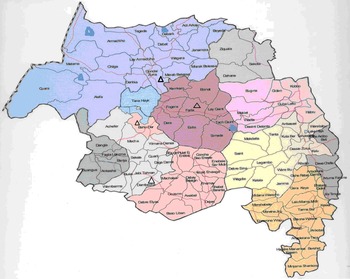
The study was conducted on three zones of the Amhara regional state, namely North Gondar, South Gondar and West Gojjam zones. From each zone one district was considered and hence a total of three districts were included in the study namely, Gondar Zuria from North Gondar, Farta from South Gondar and Bahir Dar Zuria from West Gojjam zones (Figure 1).
Map of the study area: The study districts are indicated with triangular shape.

Farta district has the mean annual rainfall of 1 651 mm. The mean monthly average temperature is 18.4 °C. The altitudes range from 1 500 to 4 135 m above sea level. Gondar Zuria district is also found in ANRS, the North Gondar zone and has also tepid moist to cool mountains. The altitude ranges from 1 966 to 2 133 m above sea level. The mean annual rainfall is 1 161 mm. The average temperature is 19.1 °C. Bahir Dar Zuria district is found in West Gojam zone of ANRS, which is tepid moist to cool plain with altitude ranging from 1 786 to 1 969 m above sea level. Mean annual rainfall of 1 224 mm and the mean annual daily temperature recorded is 18.5 °C. The main crops produced in these three study areas are barely, wheat, teff and other pulse crops. The average length of growing period of the plants in all study sites ranges from 120 to 270 days.
Sites selection techniques
The study was conducted in the three agro-climatic zones. From each agro-climatic zone one district was selected based on agro-ecology and livestock potential. Similarly, from each district two Peasant Associations (PAs) were purposively selected.
Tools and design
The study was based on multi-approaches tools to gather important information on the climate change issues. Collection of secondary data, desk reviews of different documents and studies, focused group discussions, key informants interviews and different models were used.
Desk reviews and secondary data collection
Previous studies, guidelines, manuals and literatures reviewed were used to assess the effect of climate change on population dynamics and breed distribution pattern. Secondary data were collected pertaining to the investigated issues from different concerned bodies. Routine activities and reporting formats were developed and thoroughly assessed at different pertinent offices. Based on the assessments of secondary data, desk reviews were conducted with pertinent bodies.
Focused group discussion and interviews
The focus group discussions were formed by selecting communities of the targeted population. One focus group discussions were conducted at each selected PA. Therefore, a total of three focus group discussions were conducted during the study period. The in-depth information was collected using interviewing key informants who have deep knowledge on climate change and animal breed distribution pattern in the area. The questionnaires were introduced to the farmers and completed by the sort of staff indicated for the farmers involved. Therefore, a total of 103 respondents, three districts and three grouped key informants including professionals were considered. The interview was considered livestock officers, animal sciences assistants and veterinarians/officers who are working in government agriculture offices and nongovernmental participates in animal science and veterinary services.
Climate data
The climatic data for the region were taken from regional metrological agency and livestock data were taken from Central Statistical Agency (CSA) of Ethiopia and regression model was be used to see the trends of the effect.
Empirical models for perceptions, trends of livestock and climate variability
Since the probability of an event must lie between 0 and 1, it is impractical to model probabilities with linear regression techniques. The linear regression model allows the dependent variable to take values >1 or <0. The probit analysis model is a type of generalized linear model that extends the linear regression model by linking the range of real numbers to the 0–1 range. Adaptation to climate change involves a two-stage process: first perceiving change and then deciding whether or not to adapt by taking a particular measure. This leads to sample selectivity problem since only those who perceive climate change will adapt, where as it need to infer about the adaptation by the population (Middison, Reference Middison2006). The linear regression model was also used to show the trends of climate change and breed distribution pattern with the trends of climate variability treating livestock and breed distribution pattern as dependent variable and climate variability (maximum temperature and rainfall) as predictor. This relationship is described in the following formula.
 $$Y_i = {\rm} b_0 + b_{1 \times 1} + b_{2 \times 2} + b_{3 \times 3} + b_{4 \times 4} + \cdots + b_n x_n $$
where Y i is the response variable (livestock trend); b 0, the intercept; x 1, x 2, … , x 4 are the explanatory variables such as temperature, rainfall, humidity and sunshine, respectively; b 1, b 2 and b4 are regression coefficients of the variables x 1, x 4.
e i , the residual random error.
Both for the qualitative and quantitative data analyses were undertaken at the field work such as descriptive statistics, ANOVA and other related using available version of SPSS (SPSS, 2011).
Results and Discussions
Socio-economic characteristics of the respondents
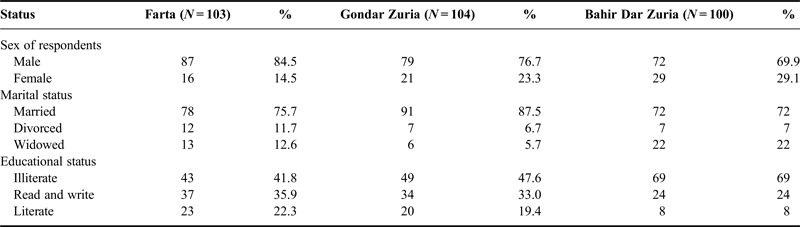
About 99 percent of interviewed households were fully involved in mixed crop–livestock traditional production systems. While, livestock production is the main sources of income for immediate expenses such as purchasing salt, coffee, cloth and animals’ medicine. The majority of the respondents were males (Table 1). About 8, 19.4 and 22.3 percent respondents from Bahir Dar Zuria, Gondar Zuria and Farta districts were literate, respectively.
Overall situation of the peoples.

Impacts of climate variability on breed distribution pattern
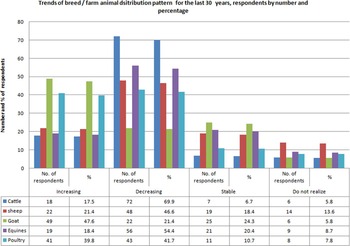
The impact of climate variability on livestock population/breed/species distribution pattern in relation to maximum temperature and rain fall variation are presented in Figure 2. Respondents noted that when there is an increase in temperature, cattle stop grazing and walking for searching pasture and water, no interest for breeding and of course decrease in milk production. About 70 percent of respondents stated that trends of livestock breed distribution varied from year to year and from agro-ecology to agro-ecology. The respondents also stressed that number of cattle (69.9 percent) and equines (54.5 percent) are decreasing due to shortage of feeds and water that might be linked with climate variability (Figure 2). The farmer underlined that the contribution of groundwater and zero-grazing systems with a forestation are becoming more important in the future to tackle climate change. According to NRC (1981) the farmer water intake increases from 3 kg per kg DM intake at 10 °C ambient temperature to 5 kg at 30 °C and 10 kg at 35 °C.
Trends of breed distribution pattern for the last 30 years and number of respondents.

About more than 80 percent of the interviewed farmer reported that that most evident and important effects of climate change on livestock production are mediated through changes in feed resources and livestock dynamics. The farmers also stated that direct effects of climate change on feed resources can have a significant impact on livestock productivity, the carrying capacity of rangelands, the buffering ability of ecosystems and their sustainability, prices of stoves and grains, trade in feeds, changes in feeding options, greenhouse gas emissions and grazing management. The main pathways in which climate change can affect the availability of feed resources for livestock are temperature increases and rainfall increases or decreases or land use and systems changes, changes in the primary productivity of crops, forages and rangelands, changes in species composition and quality of plant material.
Impact of climate variability livestock population dynamics
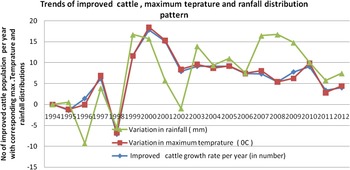
The improved cattle population trend was increasing from 1997 to 2005 but decreased in the year 1998, 2002 and 2008. The reason may be shortage of rainfall, increments of temperature and feed shortage (Figure 3).
Trends of improved/crossbred cattle number in Amhara region from 1994 to 2012.

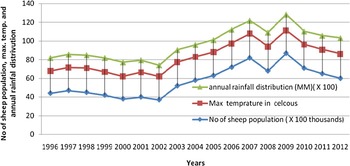
The result also showed that climate change has a negative impact on improved cattle population than indigenous cattle and in sheep (Figure 4).
Sheep population, max temperature and annual rainfall distribution in Amhara region.

Trends of livestock and climate variability
This study revealed that climate affected cattle and sheep in 1985, 1993 and 1998 and cattle numbers dropped by 37 percent after the drought of 1983–1985. The herd then quickly grew to about 85 percent of the previous peak size by 1990. Another crash occurred in the early 1990s with a 42 percent reduction in cattle numbers, but interestingly the corresponding change in annual rainfall was less apparent in the early 1990s compared with that observed in 1983–1985 (Solomon et al., Reference Solomon, Workalemahu, Jabbar, Ahmed and Hurissa2003). The cattle population dynamics resembled a “boom and bust” pattern where longer periods of gradual herd growth were punctuated by sharp crashes in 1983–1985, 1991–1992 and 1998–1999 when 37–62 percent of the cattle population perished (Solomon et al., Reference Solomon, Workalemahu, Jabbar, Ahmed and Hurissa2003). Rainfall variability greatly influenced herd dynamics under the communal and ranch management in terms of herd die-offs and lower birth rates, which also considerably affected milk production for household consumption (FAO, 2009). Droughts of the 1980s and 1990s caused 49 percent herd losses under the communal land use, while 57 percent of the cattle mortality under ranch management was attributed to droughts of the 1990s (Table 2).
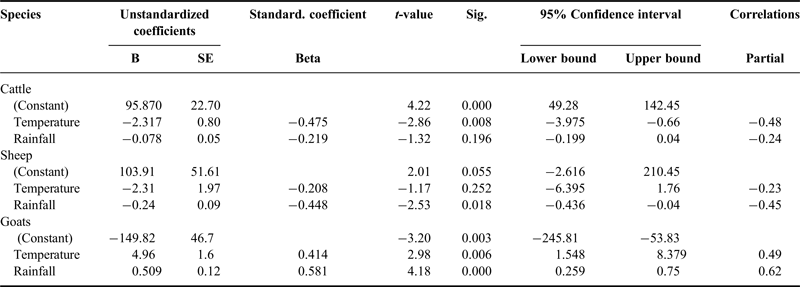
Relationship between ruminant livestock dynamics and climate change.

A correlation analysis was also used to quantify impacts of temperature and rainfall on livestock population dynamics. The analyses revealed that sheep (r = 0.535, P < 0.05) and cattle (r = 0.512, P < 0.05) were negatively affected by climate change. Whereas goats were having positive relationship (r = 0.345, P < 0.001) (Tables 2 and 3). As the average maximum temperature steadily increases, the population dynamics ruminant livestock fluctuated after the year 1996. The population of goat have shown boom after that year and the population of sheep and cattle have shown dramatic increase and revived again.
Correlations among dependent variables (cattle, sheep and goat) and the predictors (rainfall and temperature).

a Correlation of predictors – rainfall and temperature and dependent variable – cattle, sheep and goats.
Farmers’ perception towards climate change
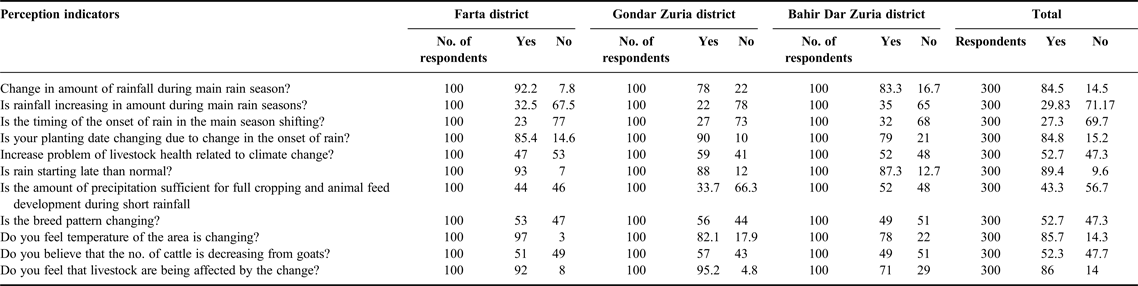
About 92.2, 78 and 83.3 percent respondents in Farta, Gondar Zuria and Bahir Dar Zuria districts, respectively said that there is a change in amount of rainfall distribution during the main rainy seasons due to climate change. About 84.5 percent of respondent in the three districts believe that climate change made variation in rainfall distribution (Table 4).
Farmers’ perception of climate change and its effect on livestock based on the last 20–30 years’ experience (% of respondents).

Coping strategies from community-based knowledge
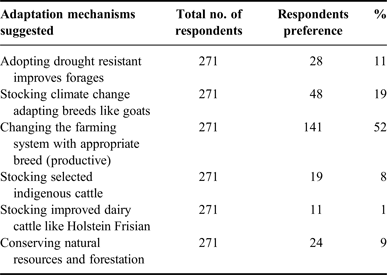
About 52 percent of the respondents suggested that if livestock is to be protected from climate change and related effects, changing the farming system with appropriate breed (productive) are important. This can be achieved with zero-grazing system. The second preference of the farmers to adapt climate change was stocking climate change adapting and productive breeds (Table 5).
Adaptation mechanisms suggested by the farmers interviewed.

Conclusion
From this study, it was possible to see that climate change affected livestock negatively. The livestock responds to these changes by walking here and there for searching of pasture and water as the temperature increases steadily. The trends of livestock breed distribution pattern varied from year to year and from agro-ecology to agro-ecology (move towards the highland). It was noted especially that the number of cattle and equines are decreasing as the number of goats population responds positively to the change. The direct effects of climate change on feed resources significantly affected livestock productivity, the carrying capacity of rangelands, the buffering ability of ecosystems and their sustainability and grazing management. From the cattle population, exotic cattle were highly affected. Farmers also believed that climate change made variation in rainfall distribution. According to the farmers’ perception, if livestock is to be protected from climate change and related effects, changing the farming system (intensification with appropriate management) with appropriate breed, zero-grazing system and reforestation is critical.
Acknowledgements
We would like to thank all staffs of agricultural offices, farmers, development agents of Farta, Gondar Zuria and Bahir Dar Zuria districts for their cooperation in facilitation, data collection, providing secondary data sources. I would like to thank also Bahir Dar University for funding this research.