Parkinson disease (PD) affects distributed neuroanatomical regions, disrupting multiple motor and cognitive systems (Bartels & Leenders, Reference Bartels and Leenders2009; Braak, Ghebremedhin, Rub, Bratzke, & Del Tredici, Reference Braak, Ghebremedhin, Rub, Bratzke and Del Tredici2004). Although PD is widely acknowledged to affect motor speech, there have also been reports of impairments in language use. In fact, many researchers have documented deficits in complex sentence comprehension (e.g., Cohen, Bouchard, Scherzer, & Whitaker, Reference Cohen, Bouchard, Scherzer and Whitaker1994; Grossman et al., Reference Grossman, Carvell, Gollomp, Stern, Vernon and Hurtig1991; Grossman, Carvell, Stern, Gollomp, & Hurtig, Reference Grossman, Carvell, Stern, Gollomp and Hurtig1992; Lieberman, et al., Reference Lieberman, Kako, Friedman, Tajchman, Feldman and Jiminez1992; Natsopoulos, et al., Reference Natsopoulos, Katsarou, Bostantzopoulou, Grouios, Mentenopoulos and Logothetis1991). In contrast, investigations of complex language production are rare, and the findings from these studies are inconsistent. Furthermore, most existing studies are qualitative or descriptive and not hypothesis driven or experimentally controlled. To address this gap in the literature, the current study represents a psycholinguistic investigation of language production in PD using two tasks: sentence repetition and sentence generation. Within each task, we also experimentally manipulated the complexity of the stimuli.
The characteristic motor impairments in PD are largely due to degeneration of subcortical structures such as the basal ganglia and thalamus. Several researchers have proposed that subcortical structures impaired in PD are directly involved in language processing and language formulation (Alexander, Naeser, & Palumbo, Reference Alexander, Naeser and Palumbo1987; Crosson, Reference Crosson1985; Friederici & Kotz, Reference Friederici and Kotz2003; Nadeau & Crosson, Reference Nadeau and Crosson1997; Radanovic & Scaff, Reference Radanovic and Scaff2003; Wallesch & Papagno, Reference Wallesch and Papagno1988). Moreover, it has been shown that dopamine depletion due to PD impairs frontostriatal pathways, leading to degradation of cortico–striato–pallido–thalamo–cortico circuits and frontal structures, particularly the dorsolateral prefrontal cortex (dlPFC; Copland, Reference Copland2003; Copland, Chenery, & Murdoch, Reference Copland, Chenery and Murdoch2000; Copland, Sefe, Ashley, Hudson, & Chenery, Reference Copland, Sefe, Ashley, Hudson and Chenery2009; Grossman, Lee, Morris, Stern, & Hurtig, Reference Grossman, Lee, Morris, Stern and Hurtig2002; Hochstadt, Nakano, Lieberman, & Friedman, Reference Hochstadt, Nakano, Lieberman and Friedman2006; Lewis, Dove, Robbins, Barker, & Owen, Reference Lewis, Dove, Robbins, Barker and Owen2003; Mega & Alexander, Reference Mega and Alexander1994; Middleton & Strick, Reference Middleton and Strick2000). Imaging studies have documented dlPFC activation during language comprehension and language production (Gernsbacher & Kaschak, Reference Gernsbacher and Kaschak2003), as well as during verbal working memory (WM) and other cognitive tasks (e.g., Curtis & D'Esposito, 2003). Furthermore, dlPFC has been implicated in studies examining sentence comprehension (Dominey & Inui, Reference Dominey and Inui2009: Friederici, Reference Friederici2002; Hagoort, Reference Hagoort2005). Consequently, dysfunction in dlPFC could have far-reaching effects on language use either directly, due to degeneration of the cortical substrates necessary for language, or indirectly via the disruption of the timing of language production processes (e.g., Kolk, Reference Kolk1995), which require the coordination of information between dlPFC and posterior language regions (Dominey & Inui, Reference Dominey and Inui2009).
Most of the literature that describes complex language function in PD has been in the domain of receptive language (e.g., Cohen et al., Reference Cohen, Bouchard, Scherzer and Whitaker1994; Grossman et al., Reference Grossman, Carvell, Gollomp, Stern, Vernon and Hurtig1991, Reference Grossman, Carvell, Stern, Gollomp and Hurtig1992; Lieberman et al., Reference Lieberman, Kako, Friedman, Tajchman, Feldman and Jiminez1992; Natsopoulos et al., Reference Natsopoulos, Katsarou, Bostantzopoulou, Grouios, Mentenopoulos and Logothetis1991; Ullman et al., Reference Ullman, Corkin, Coppola, Hickok, Growdon and Koroshetz1997). For example, persons with PD are reported to have difficulties comprehending metaphoric, ambiguous, inferential, or grammatically complex sentences (Grossman et al., Reference Grossman, Carvell, Gollomp, Stern, Vernon and Hurtig1991, Reference Grossman, Carvell, Stern, Gollomp and Hurtig1992; Lieberman, Friedman, & Feldman, Reference Lieberman, Friedman and Feldman1990; Natsopoulos et al., Reference Natsopoulos, Katsarou, Bostantzopoulou, Grouios, Mentenopoulos and Logothetis1991, Reference Natsopoulos, Grouios, Bostantzopoulou, Mentenopoulos, Katsarou and Logothetis1993), as well as complex commands (Cummings, Darkins, Mendez, Hill, & Benson, Reference Cummings, Darkins, Mendez, Hill and Benson1988). Grossman and colleagues (Reference Grossman, Lee, Morris, Stern and Hurtig2002) report that comprehension of complex sentences with relative clauses correlated with performance on Trails B, an executive function (EF) and speed of processing task. Hochstadt et al. (Reference Hochstadt, Nakano, Lieberman and Friedman2006) reported sentence comprehension performance in individuals correlated with set shifting (considered to be an EF task) and WM. Similarly, Hochstadt (Reference Hochstadt2009) found that individuals with PD showed impaired comprehension of sentences that included any type of relative clause, and performance correlated most highly with scores on a set-shifting EF task. Thus, comprehension of complex sentences in PD has been linked to impairments of both EF and WM.
Studies of sentence comprehension in populations with basal ganglia dysfunction have led to the development of several theories and models of the involvement of subcortical structures in language comprehension. Recently, Dominey and Inui (Reference Dominey and Inui2009) integrated their earlier model (Dominey, Hoen, & Inui, Reference Dominey, Hoen and Inui2006) with those of Ullman (Reference Ullmann2006), Friederici (Reference Friederici2002), and Hagoort (Reference Hagoort2005), to propose a model of corticostriatal contributions to the acquisition of syntactic sequence knowledge and use of this knowledge for sentence comprehension. This model exploits the ability of the striatum to integrate information from various cortical regions and abstract sequence information from it. Thus, in the adult listener, syntactic sequence information (encoded in connections between caudate, Broca area [BA] 44, and BA 6) and semantic representations (encoded in projections from superior and middle temporal lobe to BA 45 and 47) are integrated via corticostriatal projections to yield a consistent, plausible interpretation of the input sentence. Other models have suggested the importance of the connections between supplemental motor area and the basal ganglia for syntactic processing (Kotz, Schwartze, & Schmidt-Kassow, Reference Kotz, Schwartze and Schmidt-Kassow2009). Dysfunction in this circuit, Kotz et al. (Reference Kotz, Schwartze and Schmidt-Kassow2009) argue, may result in deficient temporal sequencing, which is essential for appropriate syntactic functioning. Yet other studies have identified the possible involvement of subcortical dopaminergic systems on semantic activation by studying persons with PD when on and off their dopaminergic medications; concluding that impaired semantic activation may be related to degree of dopamine depletion (e.g., Angwin et al., Reference Angwin, Arnott, Copland, Haire, Murdoch and Silburn2009).
It might be possible to construct a model of sentence production by reverse engineering these comprehension models linking cortical regions with specific language processing tasks; however, there are several challenges presented by language production that cannot be addressed via models of comprehension. Perhaps the most challenging problem is that models of comprehension necessarily begin with an observable, structured, grammatical input, whereas we have no idea about the structure of the input to the sentence production system, other than that it must include all of the information necessary to construct a sentence. Moreover, much of the information that is developed over time and through the interaction of different areas of cortex in sequential models of sentence comprehension will be activated simultaneously in the conceptual message, involving many cortical regions. Just how the language production process manages to segment and linearize this distributed conceptual representation is currently unknown. An additional challenge centers on positional processing. It remains a mystery how various elements of the conceptual message, which have activated word lemmas detailing grammatical requirements, trigger the activation and positioning of the closed class elements necessary for a grammatical sentence. Thus, although models of sentence comprehension may suggest which cortical and subcortical structures contribute to language use in general, there is much less understanding of how language production is actually accomplished.
Expressive language in PD has been primarily studied in the neuropsychological literature using single-word production, specifically confrontation naming and word fluency. Word fluency is especially impaired in semantic fluency tasks, in which patients are asked to name items from specific semantic categories, rather than phonemic fluency tasks, in which participants must generate the names of items beginning with a certain letter (e.g., Huber, Shuttleworth, & Paulson, Reference Huber, Shuttleworth and Paulson1986; Matison, Mayeux, Rosen, & Fahn, Reference Matison, Mayeux, Rosen and Fahn1982; Pirozzolo, Hansch, Mortimer, Webster, & Kuskowski, Reference Pirozzolo, Hansch, Mortimer, Webster and Kuskowski1982). Similarly, various studies have reported impairments on confrontation naming tasks (e.g., Globus, Mildworf, & Melamed, Reference Globus, Mildworf and Melamed1985; Lees & Smith, Reference Lees and Smith1983; Levin, Llabre, & Weiner, Reference Levin, Llabre and Weiner1989; Matison et al., Reference Matison, Mayeux, Rosen and Fahn1982). Meta-analysis (Henry & Crawford, Reference Henry and Crawford2004) has revealed that semantic fluency is more impaired than either phonemic fluency or confrontation naming. These deficits are reportedly exacerbated by the presence of dementia (Crawford & Henry, Reference Crawford and Henry2004; Lewis, LaPointe, Murdoch, & Chenery, Reference Lewis, LaPointe, Murdoch and Chenery1998). Abnormalities in the spread of activation within the semantic system may also be relevant to impairments in sentence production. For example, Copland and colleagues (Reference Copland, Chenery and Murdoch2000, Reference Copland, Sefe, Ashley, Hudson and Chenery2009; Copland, Reference Copland2003) have found that individuals with PD are particularly impaired when having to inhibit inappropriate meanings of words following long presentation intervals that allow for controlled semantic processing. Considering that sentence production requires the choice of lexical items and sentence structures to fit a nonlinguistically specified conceptual representation, this inability to inhibit alternative word choices could potentially disrupt the fluent production of speech in PD.
Verb processing seems to be particularly impaired in nondemented persons with PD. For example, Grossman, Stern, Gollomp, Vernon, and Hurtig (Reference Grossman, Stern, Gollomp, Vernon and Hurtig1994) identified a specific impairment in the learning of new verbs in persons with early PD. In addition, Piatt and colleagues (Reference Piatt, Fields, Paolo, Koller and Troster1999) reported greater impairments in an action (i.e., verb) generation task than in other verbal fluency tasks in individuals with PD compared to healthy older adults (HOAs). Finally, a recent study by Peran and colleagues (Reference Peran, Cardebat, Cherubini, Piras, Luccichenti and Peppe2009) found no significant difference in brain activity during production of object names and action-words in older adults with and without PD, but did identify a relationship between severity of motor dysfunction in PD and activation levels in the brain during action word generation. Other studies have looked primarily at verb inflection rather than verb access. Ullman et al. (Reference Ullman, Corkin, Coppola, Hickok, Growdon and Koroshetz1997) found that the five persons with PD (out of a sample of 28) who had the most severe motor symptoms had greater difficulty producing regular past tense forms than irregular past tense forms. However, this finding has been difficult to replicate (e.g., Terzi, Papapetropoulos, & Kouvelas, Reference Terzi, Papapetropoulos and Kouvelas2005). Colman et al. (Reference Colman, Koerts, van Beilen, Leenders, Post and Bastiaanse2009) also reported that individuals with PD experienced difficulties in the production of appropriately inflected verb forms to fit a sentence context. Specifically, producing present tense verbs was more difficult for the PD group than past tense, and intransitive verbs were more difficult than transitive verbs. Furthermore, performance correlated with a combined “set-switching” measure that included scores from Trails A, Trails B, and an Odd Man Out Task. These difficulties with verb access could further impair sentence production in individuals with PD, because it is the verb that assigns the thematic roles (i.e., agent, patient, recipient) to the subject and objects of a sentence. Thus, slow access to verb meaning and its associated grammatical information (e.g., argument structure and subcategorization information) could also interfere with construction of syntactic structure, disrupting the fluency as well as the grammaticality of sentences produced.
All of these production studies have primarily involved single word production. Studies investigating sentence or discourse level language production in PD are much rarer and are diverse in their methodologies and findings. There seems to be general agreement that information content is reduced in PD across various language tasks, including conversational discourse, picture description tasks, and written sentences (Bayles, Reference Bayles1990; Cummings et al., Reference Cummings, Darkins, Mendez, Hill and Benson1988; Murray, Reference Murray2000; Small, Lyons, & Kemper, Reference Small, Lyons and Kemper1997). Similarly, most studies have found more impaired language in participants with increased cognitive impairment (Berg, Björnram, Hartelius, Laakso, & Johenls, Reference Berg, Björnram, Hartelius, Laakso and Johnels2003; Cummings et al., Reference Cummings, Darkins, Mendez, Hill and Benson1988; Lewis et al., Reference Lewis, LaPointe, Murdoch and Chenery1998; Murray, Reference Murray2000; Murray & Lenz, Reference Murray and Lenz2001; Small et al., Reference Small, Lyons and Kemper1997), but only Murray (Reference Murray2000) tested relationships between language production and other cognitive measures such as attention and memory. In contrast, whether grammaticality is preserved in PD is an open question. Murray (Reference Murray2000) and Small et al. (Reference Small, Lyons and Kemper1997) found reductions in the proportion of grammatical sentences produced on a picture description task and a writing task, respectively. However, Small et al. (Reference Small, Lyons and Kemper1997) reported that these findings were limited to moderately demented individuals with PD, and other studies have not directly addressed the question. Findings regarding the simplification of syntax are also mixed. Cummings et al. (Reference Cummings, Darkins, Mendez, Hill and Benson1988) reported simplified syntax on subtests of the Western Aphasia Battery and Boston Diagnostic Aphasia Examination specific to spontaneous speech based on clinical reports; however, other studies employing more rigorous methodology (Illes, Reference Illes1989; Illes, Metter, Hanson, & Iritani, Reference Illes, Metter, Hanson and Iritani1988; Murray, Reference Murray2000; Small et al., Reference Small, Lyons and Kemper1997) found syntactic complexity to be relatively unimpaired. Moreover, only Illes and colleagues (Reference Illes, Metter, Hanson and Iritani1988; Illes, Reference Illes1989) reported impaired fluency of production in PD, which they attributed to both difficulty formulating sentences and motor difficulties. Thus, the themes that sentence and discourse level language research in PD have focused on to date are information content, effects of dementia, grammaticality, and syntactic complexity. However, this research has mostly neglected questions regarding fluency and the impact of specific EF and WM impairments on language use.
The potential impact of the range of cognitive impairments in this population is an important consideration for both clinical and theoretical reasons. Nearly 80% of persons with PD develop cognitive impairment (Aarsland, Andersen, Larsen, Lolk, & Kragh-Sørensen, Reference Aarsland, Andersen, Larsen, Lolk and Kragh-Sorensen2003; Cummings et al., Reference Cummings, Darkins, Mendez, Hill and Benson1988; Muslimovic, Post, Speelman, & Schmand, Reference Muslimovic, Post, Speelman and Schmand2005; Pirozzolo et al., Reference Pirozzolo, Hansch, Mortimer, Webster and Kuskowski1982). Deficits in cognition secondary to PD impact many domains including memory, visuospatial function, and concept formation, with EF and WM being the first affected (e.g., Beatty, Staton, Weir, Monson, & Whitaker, Reference Beatty, Staton, Weir, Monson and Whitaker1989; Bowen, Burns, Brady, & Yahr, Reference Bowen, Burns, Brady and Yahr1976; Huber et al., Reference Huber, Shuttleworth and Paulson1986; Massman, Delis, Butters, Levin, & Salmon, Reference Massman, Delis, Butters, Levin and Salmon1990; Owen, Reference Owen2004). Impairments are most commonly reported in anticipation, planning, initiation, inhibitory processing, and set and task switching, especially when tasks require manipulation rather than storage or updating of information (Altgassen, Phillips, Kopp, & Kliegel, Reference Altgassen, Phillips, Kopp and Kliegel2007; Bublak, Muller, Gron, Reuter, & von Cramon, Reference Bublak, Muller, Gron, Reuter and von Cramon2002; Gilbert, Belleville, Bherer, & Chouinard, Reference Gilbert, Belleville, Bherer and Chouinard2005; Hoppe, Muller, Werheid, Thone, & von Cramon, Reference Hoppe, Muller, Werheid, Thone and von Cramon2000; Muslimovic et al., Reference Muslimovic, Post, Speelman and Schmand2005; Werheid et al., Reference Werheid, Hoppe, Thone, Muller, Mungersdorf and von Cramon2002). As discussed above, both sentence comprehension and production of verbs in sentence contexts have been found to correlate with WM or EF scores. Language production also may rely on many of these same cognitive abilities, such as initiation, planning, inhibitory processing, concept formation, and the manipulation of information. Bastiaanse and Leenders (Reference Bastiaanse and Leenders2009) attribute the difficulties with language use in PD to these prevalent cognitive difficulties. They assert, “It is certain by now that PD results in impaired functioning of language, without a linguistic deficit per se” (p. 914).
Based on this reasoning, the current study examined language production and cognitive performance, as well as the relationship between these abilities. However, rather than solely asking if performance on language production measures correlated with cognitive performance, we have extended the literature by asking a slightly different question: whether group differences remained significant when cognitive differences were controlled. We have addressed the controversies and gaps in the literature discussed above by examining sentence-level language production in PD and HOAs in two tasks, sentence repetition and sentence generation. We also manipulated complexity in both tasks, though in different ways. Complexity corresponded to grammatical complexity (i.e., the inclusion of relative clauses) in the sentence repetition task and conceptual complexity (i.e., number of actors in the picture) in the sentence generation task. The current study addressed the following research questions:
Research Question 1: How does the sentence production of individuals with PD compare to that of HOAs in terms of fluency, grammaticality and completeness in sentence repetition and sentence generation? Based on the literature review above, we predicted that individuals with PD would be significantly impaired in fluency (e.g., Illes, Reference Illes1989) and completeness (due to WM impairment in repetition, and lower information production in sentence generation), and impaired in grammaticality only in sentence generation (Murray Reference Murray2000; Small et al., Reference Small, Lyons and Kemper1997).
Research Question 2: Is the sentence production of individuals with PD disproportionately affected by grammatical and conceptual complexity in sentence repetition and generation, respectively, relative to that of HOAs? We predicted that individuals with PD would be disproportionately affected by complexity in both tasks due to increased cognitive demands.
Research Question 3: Do the groups differ in sentence production performance when cognitive variables (EF, WM, dementia) are controlled? Based on the findings above, particularly from Murray (Reference Murray2000), Colman et al. (Reference Colman, Koerts, van Beilen, Leenders, Post and Bastiaanse2009), and Hochstadt (Reference Hochstadt2009), as well as the opinions stated in Bastiaanse and Leenders (Reference Bastiaanse and Leenders2009), we expected that controlling for individual differences in cognitive ability would render any group differences nonsignificant.
METHODS
Participants
Twenty participants with PD and 20 HOAs between the ages of 60 and 85 years completed the study. Inclusionary criteria for the PD group included (a) diagnosis of idiopathic PD by movement disorders fellowship trained neurologists, (b) Hoehn and YahrFootnote 1 (Reference Hoehn and Yahr1967) Stages II–III, (c) stabilized on anti-PD medications, (d) nondemented as measured by the Dementia Rating Scale (DRS; Jurica, Leitten, & Mattis, Reference Jurica, Leitten and Mattis2001), (e) willing and capable of providing informed consent, (f) normal hearing and vision thresholds for age or appropriately aided, (g) native speakers of English, and (h) no prior language therapy. Exclusionary criteria for all groups included a history of (a) deep brain stimulation, pallidotomy, or thalamotomy; (b) any other neurodegenerative disease; (c) developmental speech or language disorder; (d) any other motor speech or language disorder; and (e) severe depression, anxiety, or apathy. All participants were recruited from the Gainesville, FL, area. The protocol was approved by the University of Florida Institutional Review Board (2007-U-0093).
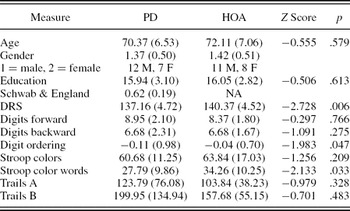
Of the original 40 participants, only 19 from each group passed screening. One of the participants with PD had a DRS score of 122, in the demented range. The excluded HOA had neuropsychological scores within the appropriate range, but was unable to complete the language tasks, and withdrew from the study. Table 1 presents demographic information for both groups; there were no significant differences in age or education. As shown, the groups only differed significantly on two neuropsychological measures: Stroop color word and digit ordering. Although the groups also differed on DRS scores, all participants scored within the nondemented range (i.e., ≥125).
Demographics and neuropsychological scores of the two groups

Note: PD, Parkinson disease; HOA, healthy older adults; DRS, Dementia Rating Scale.
Procedures
Participants were tested at their homes. Those with PD were tested 1 hr after taking PD medications in order to assess them in the “on” medication condition. Participants completed several tests of cognitive functioning and two experimental language tasks.
PD severity was quantified using the Unified Parkinson's Disease Rating Scale III motor subsection, which was administered and scored by one of the University of Florida movement disorders fellowship trained neurologists. The degree of disability due to PD was quantified using the Schwab and England Scale (Schwab & England, Reference Schwab and England1969), an examiner-administered questionnaire. The scale is scored from 0 to 100 in 10-point increments, with 0 describing a vegetative state and 100 a completely independent healthy state.
All neuropsychological tests were administered in a standard manner by a trained member of the research team. The DRS (Jurica er al., Reference Jurica, Leitten and Mattis2001), a valid screening measure for cognitive functioning in PD (Brown et al., Reference Brown, Rahill, Gorell, McDonald, Brown and Sillanpaa1999), was used to screen for dementia. Measures of memory included digit span forward and backward (Wechsler, Reference Wechsler1987) and a digit ordering task. The latter task presented participants with increasingly long lists of numbers that had to be put into numerical order receiving one point for each correct string of digits (Werheid et al., Reference Werheid, Hoppe, Thone, Muller, Mungersdorf and von Cramon2002). There were four trials at each of six levels for a maximum score of 24; testing was discontinued when individuals missed two or more trials at a level. To measure executive functioning, the Stroop colors and color-word interference tests (Rinne et al., Reference Rinne, Portin, Ruottinen, Nurmi, Bergman and Haaparanta2000) and modified versions of the Trails A and B tasks (Spreen & Strauss, Reference Spreen and Strauss1998) were administered. Modifications were made to the administration of the Trails tests to mitigate the effects of tremor and motor control problems on test performance. As the participant pointed to each target, the examiner drew the lines from circle to circle. This modified version of the task was employed with both the PD and HOA groups for the sake of consistency. The groups did not differ on any cognitive measure, as shown in Table 1.
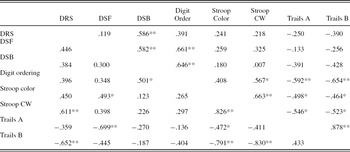
Because our intention was to test whether differences in cognitive abilities accounted for the expected group differences in sentence production, we computed composite terms for WM and EF. As shown in Table 2, many of the WM and EF measures, as well as DRS scores, were correlated with each other in both groups. Consequently, we submitted the cognitive variables, including DRS, to a principal components analysis with Varimax rotation, which yielded two significant, noncorrelated factors that together accounted for 66.67% of the variance in scores. Because Stroop and Trails B scores showed the highest loadings on Factor 1, we have referred to this as the EF factor. Similarly, digit span backward and digit ordering had the highest loadings on Factor 2; therefore, we have referred to this factor as the WM factor. As a measure of cognitive intactness, or incipient dementia, we computed a residualized DRS score (DRS-res) by statistically removing the effects of EF and WM from DRS scores. This approach yielded three, orthogonal (i.e., not correlated), cognitive factors (all r = .000). Factor scores on all three variables were lower for the PD group than the HOA group; however, nonparametric Mann–Whitney comparisons revealed that the group differences in EF and DRS-res scores only approached significance (p = .075 and .08, respectively), whereas the difference in WM scores was not significant (p > .2). These three variables (EF, WM, DRS-res) were used in the hierarchical, stepwise, multivariate regressions reported below.
Correlations among cognitive measures

Note: DRS, Dementia Rating Scale; DSF, Digit Span Forward; DSB, Digit Span Backward; Stroop CW, Stroop Color Word Interference Test. Correlations for participants with Parkinson disease are above the diagonal and healthy older adults are below the diagonal.
*p < .05. **p < .01.
Language tasks
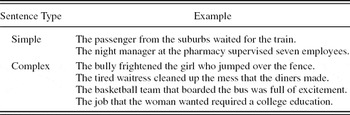
The sentence repetition task included 30 sentences designed to target different levels of grammatical complexity. The sentences, taken from Small, Kemper, and Lyons (Reference Small, Kemper and Lyons2000), were matched in number of syllables and words, word frequency, and semantic density (i.e., the number of propositions; see examples in Table 3). For the purposes of the current study, sentences were grouped into two, rather than six, categories, representing single clause (single event) sentences and dual clause (two event) sentences with embedded relative clauses. Each sentence was read aloud once by the experimenter at a moderately slow pace for the participant to repeat. Participants were instructed to listen carefully as each sentence would only be presented once.
Examples of sentence repetition stimuli

Note: The stimuli are according to Small et al. (Reference Small, Kemper and Lyons2000).
The sentence generation task employed 40 black and white line drawings depicting a variety of common events chosen from Kempler (Reference Kempler2003) and Bock, Loebell, and Morey (Reference Bock, Loebell and Morey1992) to elicit sentences of different syntactic complexities (i.e., one- and two-event sentences). Single event pictures included both transitive and intransitive actions (e.g., kick, sleep). Pictures designed to elicit two-event sentences included transitive actions (e.g., watch, chase) and three actors. These pictures have been effective stimuli for testing comprehension of complex structures and for eliciting sentences with varying grammatical structures in healthy older and young adults (Altmann & Efros, Reference Altmann and Efros2006; Altmann, Mullin, & Mann, Reference Altmann, Mullin and Mann2004; Bock et al., Reference Bock, Loebell and Morey1992; Kempler, Almor, Tyler, Andersen, & MacDonald, Reference Kempler, Almor, Tyler, Andersen and MacDonald1998). Picture stimuli were presented in one of two random orders using a notebook. Participants were told to fully describe each picture in one sentence without using pronouns. Five sample stimuli of varying complexity were provided with feedback prior to the initiation of the experimental task. Participants were not timed during either language task.
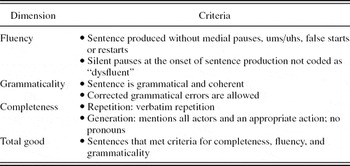
All responses on the language tasks were digitally recorded, transcribed verbatim, and scored on three language dimensions by one of two independent raters blinded to group membership. These three dimensions were adapted from previous studies with healthy and language impaired populations (Altmann, Reference Altmann2004; Altmann & Kemper, Reference Altmann and Kemper2006; Altmann, Lombardino, & Puranik, Reference Altmann, Lombardino and Puranik2007). Scoring consisted of a binary assessment of each language dimension for each sentence. Table 4 provides the scoring criteria for these language dimensions. Specifically, we scored whether a sentence was fluent, grammatical, or complete, rather than how many dysfluencies, ungrammatical elements, or missing concepts there were per sentence. We adopted this approach because it was relatively unambiguous to determine that a sentence was nonfluent, ungrammatical, or incomplete without overinterpreting the data. In contrast, in order to count errors within a sentence, we would have had to determine what the exact “target” utterance was, which was not always possible. It should be noted that completeness was defined differently in each task. Completeness in the repetition task was defined as verbatim repetition. Completeness in the sentence generation task was defined as mentioning all actors separately plus an appropriate action. Inter- and intrarater reliability for scoring was conducted on 25% of the samples. Reliability was tested using intraclass correlational analyses. Interrater reliability was good, with a Cronbach α of 0.85 (p < .001). Intrarater reliability was excellent, with a Cronbach α of 0.97 (p < .001).
Scoring criteria for language production tasks

Statistical analyses
To address our first two research questions, we computed multiple analyses of variance (MANOVAs) in which performance in the three language dimensions (fluency, grammaticality, and completeness) represented the multiple variables of interest. A separate analysis was computed for each task. Each MANOVA also included one within-subjects variable, complexity, which had two levels (simple, complex), and one between-subjects variable, group (HOA, PD).
To address our third research question, we computed a hierarchical, stepwise, multivariate regression for each variable showing significant group effects in the MANOVA. The multivariate regression allows the computation of interaction terms between group variables and covariates. If the interaction term is significant, then the slopes of the regression lines for the two groups are significantly different. If the group effect is significant, then the intercept is different for the two groups. Initial analyses demonstrated that including all possible independent variables (i.e., age, education, EF, WM, DRS-res, Group × EF, Group × WM, Group × DRS-res, group) in the solution led to models with poor fit to the data. Consequently, we employed a hierarchical, stepwise regression procedure in which age and education were presented in the first step; the main effects of EF, WM, and DRS-res were presented in the second step; the interactions (i.e., Group × EF, Group × WM, Group × DRS-res) were presented in the third step, and group was entered in the fourth step to determine if it improved the model fit.
RESULTS
Sentence repetition
To explore overall sentence repetition ability in PD, we computed a MANOVA across scores on the three language dimensions: fluency, grammaticality, and completeness. In addition, complexity (simple vs. complex sentences) was a repeated, within-subjects variable and group was a between-subjects variable. Table 5 reports means and group comparisons in all conditions for the repetition task.
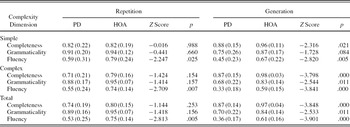
Mean (SD) proportion of responses meeting each criterion for the two groups across language production tasks and complexity levels

Note: PD, Parkinson disease; HOA, healthy older adults. The Z scores are the results of nonparametric Mann–Whitney tests used to compute the simple comparisons.
There was a significant effect of language dimension, F (2, 72) = 47.168, p < .001, η2 = 0.57, reflecting the fact that participants were significantly more grammatical (M = 0.913, SE = 0.021) than complete (M = 0.778, SE = 0.028), and significantly more complete than fluent (M = 0.652, SE = 0.036, all ps < .001). There was also a significant main effect of group, F (1, 35) = 5.271, p < .03, η2 = 0.13. This effect was modulated by a significant interaction between language dimension and group, F (2, 72) = 6.098, p < .01, η2 = 0.15. Because there were no significant effects associated with complexity, this MANOVA was recomputed without the complexity variable to explore the language dimension by group interaction. In this analysis, while the group effect remained significant, F (3, 34) = 3.870, p < .02, η2 = 0.26, the group comparison was only significant for fluency (M HOA = 0.746, SE = 0.046; M PD = 0.533, SE = 0.046), F (1, 36) = 10.561, p < .005, η2 = 0.23; whereas, grammaticality only showed a trend toward significance (M HOA = 0.945, SE = 0.028; M PD = 0.878, SE = 0.028), F (1, 36) = 2.825, p < .10, η2 = 0.07, and completeness did not differ between groups (M HOA = 0.798, SE = 0.042; M PD = 0.712, SE = 0.04), F (1, 36) = 2.084, p > .15, η2 = 0.06. Thus, with respect to our first research question, there was an overall group effect on sentence repetition performance, but this effect was only significant for fluency. Regarding the second research question, there was no effect of complexity on repetition.
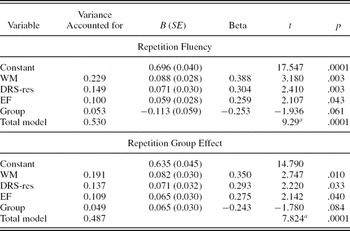
To address our third research question, whether group differences would be attributable solely to differences in cognitive ability, we analyzed repetition performance in conditions with significant group differences in the above comparisons: fluency and overall performance (i.e., those responses that were fluent, grammatical, and complete). As shown in Table 6, in respect to fluency in the repetition task, all three of the cognitive variables entered the model, accounting for 47.5% of the variance in scores. Group contributed an additional 5.3% of the variance and the model remained significant, F (4, 37) = 9.299, p < .0001; however, the effect of the group variable only showed a trend toward significance (p = .061). However, note that the β value for group was very close to that of the EF factor, which suggested that the lack of significance may have been due to low power.
Final regression models exploring the relationship between cognitive variables and error rates in fluency and overall accuracy (e.g., the group effect) in the sentence repetition task

Note: WM, working memory; DRS, Dementia Rating Scale; EF, executive function.
aThe F value of the final model.
The only other between-group difference in repetition was the main effect of group, which was explored using the same analysis as that reported above with the dependent variable being the proportion of sentences repeated that were fluent, grammatical and complete. As shown in Table 6, all three cognitive variables entered the equation, accounting for 43.8% of the variance in scores. However, the effect of the group variable was not significant once the effects of cognitive abilities were controlled (p < .09). These analyses demonstrated that cognitive variables accounted for a large portion of the variance in sentence repetition fluency and overall sentence repetition performance, whereas the presence or absence of PD played only a small role in overall performance of the task.
Sentence generation
Similar to the analysis of sentence repetition, to explore overall sentence generation ability in PD, we computed a MANOVA across scores on the three language dimensions: fluency, grammaticality, and completeness. In this analysis, complexity was a repeated, within-subjects variable and group was a between-subjects variable. Means in all conditions for the sentence generation task are shown in Table 5.
The effect of language dimension on sentence generation was highly significant, F (2, 72) = 95.846, p < .0001, η2 = 0.73, and reflected a continuum of impairment. Fluency was most impaired (M = 0.501, SE = 0.029), followed by grammaticality (M = 0.780, SE = 0.031), and completeness was most preserved (M = 0.923, SE = 0.018). The main effect of complexity was also significant, F (1, 36) = 11.985, p < .001, η2 = 0.25. However, this effect was moderated by an interaction between complexity and language dimension, F (2, 72) = 6.109, p < .005, η2 = 0.15. This interaction arose because completeness was unaffected by complexity (M = 0.923 in both two-actor and three-actor conditions), but fluency (M Simple = 0.554, SE = 0.036; M Complex = 0.448, SE = 0.027), t (37) = 3.682, p < .002, and grammaticality (M Simple = 0.807, SE = 0.036; M Complex = 0.753, SE = 0.029), t (37) = 2.429, p < .02, were significantly affected by complexity (i.e., the number of actors in the picture). There were no other significant interactions involving complexity.
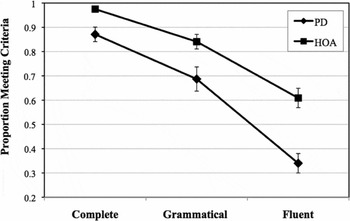
There was also a significant main effect of group, F (1, 36) = 18.659, p < .0001, η2 = 0.34, because groups were significantly different in all language dimensions (all p < .02). In addition, language dimension interacted with group, F (2, 72) = 3.447, p < .04, η2 = 0.09. As shown in Figure 1, this interaction arose, because the fluency of individuals with PD was disproportionately impaired (i.e., M Diff = 25.6%, η2 = 0.40) compared to smaller differences in grammaticality (M Diff = 14.6%, η2 = 0.16) and completeness (M Diff = 9.6%, η2 = 0.21). Thus, regarding our first research question, participants with PD were significantly impaired in all dimensions of language measured here. With regard to our second research question, complexity also contributed to performance but did not disproportionately affect the PD group.
The results of the sentence generation multiple analysis of variance across scores on the three language dimensions (fluency, grammaticality, and completeness) with group as a between-subjects variable. As shown, the Parkinson disease group performed more poorly across all language dimensions; however, this effect was exaggerated in fluency scores. The Group × Language Dimension interaction for the sentence generation task is shown. Error bars indicate standard errors.

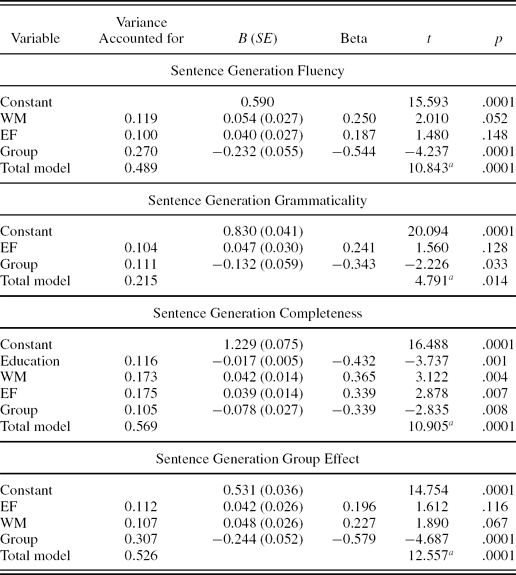
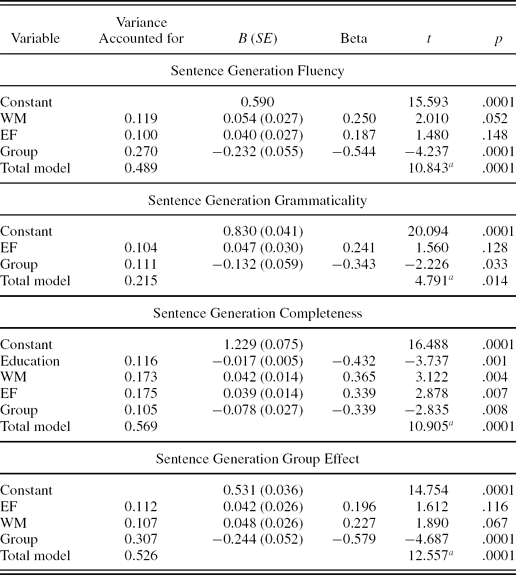
To address our third research question, whether controlling for differences in cognitive ability would eliminate effects of group on performance, we explored the significant group differences found above with hierarchical stepwise, multivariate regressions. As in the previous analyses of sentence repetition, age and education were allowed to enter in the first step, then the three cognitive factors (i.e., EF, WM, and DRS-res) were allowed to enter in the second step, the interaction factors were presented in the third step, and in the fourth step group was forced in to determine whether it improved the model. Four analyses were performed, one examining each language dimension (i.e., fluency, grammaticality, completeness) collapsing over complexity, and one for responses that were fluent, grammatical, and complete to examine the main effect of group. The results of the final models in these analyses are shown in Table 7.
Final regression models exploring the relationship between cognitive variables and error rates in the different language dimensions in the sentence generation task
Note: WM, working memory; EF, executive function.
aThe F value of the final model.
In the regression model predicting sentence generation fluency, WM entered first, followed by EF; and these two variables accounted for 21.9% of the variance in fluency scores (p = .027 and .041, respectively). Therefore, both WM and EF contributed significantly to the variance in fluency scores. However, in Step 3, group accounted for an additional 27% of the variance, even after WM and EF had been entered. As shown, the final model accounts for about 49% of the variance in fluency scores. Therefore, the groups still differed in fluency even when WM and EF were controlled.
In the analysis of grammaticality, only EF entered the model, accounting for 10.4% of the variance. Moreover, group again accounted for a significant portion of variance (11.1%) in grammaticality of sentences, and the effects of EF were no longer significant once group entered the model. This suggests that PD may impair the ability to construct grammatical sentences apart from the effects of cognitive impairments.
In the analysis of completeness, education entered the model first in the negative direction, suggesting that more educated people were more likely to use pronouns in the description of the pictures. In Step 2, WM entered the model first, followed by EF, each accounting for about 17% of the variance. Thus, education, WM and EF accounted for 46.4% of the variance in completeness scores, confirming that cognitive factors played a large role in the ability to completely describe these pictures. Subsequently, group entered the model, accounting for an additional 10.5% of variance, suggesting that the groups still differed in completeness scores even when education, EF, and WM were controlled.
The main effect of group was explored by analyzing the proportion of sentences generated that were simultaneously fluent, grammatical, and complete. In this analysis, EF entered first, accounting for 11.2% of the variance, followed by WM, which accounted for an additional 10.7% of the variance in scores (both p < .035). Subsequently, group entered the model accounting for an additional 30.7% of the variance, and, as shown, the effects of EF and WM were no longer significant once group entered. Therefore, both EF and WM contributed to successful sentence generation performance on this task. Moreover, the binary variable, group, accounted for a large amount of additional variance, suggesting that the two groups performed differently even after differences in EF and WM were controlled.
These findings demonstrate that EF and WM have a significant and pervasive effect on the ability to successfully generate sentences. However, our prediction that the inclusion of cognitive variables in the model would eliminate the group differences in performance was not supported. The effect of group remained significant in every analysis of sentence generation performance. Moreover, in no case were any of the group interactions with cognitive measures significant, indicating that WM, EF, and DRS-res had similar effects on sentence production in each group (i.e., the slope of the regression lines for the two groups were not significantly different).
DISCUSSION
This study addressed three primary research questions: How does performance on sentence repetition and sentence generation compare between HOAs and older adults with PD? Does complexity of sentence structure or of the message have an exaggerated effect on the sentence repetition or sentence generation, respectively, of older adults with PD compared to HOAs? Finally, do differences in cognitive abilities (e.g., EF, WM, and level of incipient dementia) account for group differences in performance? The findings regarding each of these questions are discussed below.
Our first research question addressed the question of overall group differences in fluency, grammaticality, and completeness in sentence repetition and sentence generation. We found that, compared to HOAs, individuals with PD were significantly impaired in both tasks with sentence generation being more strongly affected. Moreover, there were Group × Language Dimension interactions in both tasks. Fluency was the most impaired dimension of language in both groups across tasks. Further, individuals with PD were much less fluent than the HOA participants overall, and this was exacerbated in the sentence generation task. In contrast, grammaticality and completeness were significantly impaired in individuals with PD only in the sentence generation task.
These findings can be understood by taking into account the differences in task demands for repetition and generation with respect to the language dimensions examined here. Bock and Levelt (2000), expanding upon the early work of Garrett (Reference Garrett and Ellis1982, Reference Garrett and Nieuwmeyer1988), posit that there are five stages in the sentence generation process: conceptualization, functional processing (during which abstract word representations are chosen and their syntactic requirements are integrated), positional processing (at which phonological forms of words are activated and the linear structure of the sentence is generated), phonetic encoding, and articulatory planning. The sentence generation task requires processing at all levels. In contrast, sentence repetition requires the regeneration of the target sentence using words and structures held in short term memory or primed by the target sentence (Lombardi & Potter, Reference Lombardi and Potter1992; Potter & Lombardi, Reference Potter and Lombardi1990). Thus, sentence repetition primarily involves positional processing, phonetic encoding, and articulatory planning. Based on this reasoning, group differences that were significant in only sentence generation were likely due to difficulties at the conceptual level or functional processing level. Alternatively, the difficulty could be in the synchronization of information between these two levels or between functional processing and the positional processing level.
Significant group differences in grammaticality are consistent with previous reports of difficulties producing grammatical sentence in PD (e.g., Colman et al., Reference Colman, Koerts, van Beilen, Leenders, Post and Bastiaanse2009; Murray, Reference Murray2000; Small et al., Reference Small, Lyons and Kemper1997). Grammatical difficulties were only significant in sentence generation, and thus were likely due to difficulties occurring before positional level processing began. These difficulties could arise during functional processing, during which the grammatical aspects of word representations (i.e., their lemmas; Levelt, Reference Levelt1989, Vigliocco & Hartsuiker, Reference Vigliocco and Hartsuiker2002) must be integrated into a single sentence schematic or during the transfer of information from conceptual to functional level processing or functional to positional processing.
One possible explanation for the findings regarding grammatical impairments in PD is that they might have been due to the difficulties with verb access in this population (e.g., Boulenger et al., Reference Boulenger, Mechtouff, Thobois, Broussolle, Jeannerod and Nazir2008; Colman et al., Reference Colman, Koerts, van Beilen, Leenders, Post and Bastiaanse2009; Piatt et al., Reference Piatt, Fields, Paolo, Koller and Troster1999). Verb access is essential for the construction of a sentence. The choice of the verb determines assignment of the noun arguments to the various sentence positions, such as subject and object, and this assignment is based on thematic roles assigned at the conceptual level representation of the sentence (Altmann & Kemper, Reference Altmann and Kemper2006; Bock & Levelt, 2000; Vigliocco & Hartsuiker, Reference Vigliocco and Hartsuiker2002). Thus, if verb access is impaired, grammatical sentence production may also suffer. Unfortunately, we did not specifically test verb access in this study. In order to determine the proximal cause of grammatical difficulties in PD, further studies explicitly comparing sentence and verb production are required. Specifically, assessment of action naming and verbal fluency abilities should be included in order to determine whether grammatical deficits are due to specific difficulties with access to verbs or to an overall lexical access impairment. That said, verb-related errors were relatively few in this study. The overwhelming majority of grammatical errors in both groups consisted of omissions of sentence-initial determiners (e.g., “a” and “the”). This suggests that the primary locus of grammatical difficulty in sentence production for PD is at a later stage of production, such as during the transmission of information between functional and positional levels of processing. Regardless of the locus of the deficits, our findings extend the literature by demonstrating that grammatical deficits in PD are most evident in tasks in which an entire sentence must be generated to encompass specific information.
Completeness was also impaired only in individuals with PD in the sentence generation task. Impaired completeness, we speculate, could be due to difficulties at the conceptualization level. For example, insufficient activation of semantic representations of specific nouns (e.g., man, boy, woman, girl) could result in the use of pronouns (e.g., he, she, they) or inherently plural nouns (e.g. the children, the family) instead of the naming of the individual actors in the event, as required. These results are consistent with reports in the literature that individuals with PD produce lower amounts of information content during speech (e.g., Cummings et al., Reference Cummings, Darkins, Mendez, Hill and Benson1988; Murray, Reference Murray2000; Small et al., Reference Small, Lyons and Kemper1997), and suggest that some of the low information content may be due to the overuse of pronouns or less specific nouns and verbs.
In contrast, fluency was impaired in both tasks in the group with PD, although the degree of impairment in generation was much greater in generation than in repetition (see Table 5). This suggests that there were disruptions at the positional level or “below” (i.e., in phonetic and articulatory processing) as well as at the higher levels of conceptualization and functional processing. As mentioned earlier, the difficulties need not be in a particular stage of processing per se. They instead may reflect difficulties in the transfer of information between levels, especially with respect to fluency. This possibility is particularly pertinent to the PD population as there is considerable pathology in the thalamus and caudate early in the disease (Braak et al., Reference Braak, Ghebremedhin, Rub, Bratzke and Del Tredici2004). These subcortical structures are postulated to contribute to the representations of grammatical sequences for language use, integrating input from posterior language areas (e.g., the superior and middle termporal gyrus) and dlPFC, especially BA 44, 45, and 47 (Dominey & Inui, Reference Dominey and Inui2009). Disruption of these large corticostriatal networks could certainly impair the smooth flow of information between language areas, thus impairing the fluency of speech. Our findings and conclusions are consistent with those reported in Illes et al. (Reference Illes1989), who suggested that fluency difficulties arise in PD as a result of disruptions during both sentence planning and articulatory processing. However, Illes et al. (Reference Illes1989) primarily attributed the dysfluencies to adaption to the disease suggesting that the dysfluencies may have been due to an explicit strategy. In contrast, we prefer the explanation that dysfluencies are due to asynchrony in the availability of information between processing levels during sentence production and, thus are emergent effects of disease processes.
Our second research question addressed the effects of complexity on sentence production. We predicted that increased complexity would have disproportionately large effects on sentence production in individuals with PD. However, this prediction was not supported in either sentence repetition or sentence generation. Repetition performance in both groups was unaffected by increased grammatical complexity (i.e., the inclusion of relative clauses) in the sentence stimuli. In contrast, the complexity manipulation in the sentence generation task affected both groups similarly; the inclusion of three versus two actors in the picture adversely affected fluency and, to a lesser extent, grammaticality.
More complex pictures (i.e., three vs. two actors) were expected to encourage the production of complex sentences (i.e., sentences containing relative clauses), in order to test reports of decreased sentence complexity in PD language. Therefore we planned to analyze the number of complex sentences produced by each group. However, only one subject in the study, a HOA, produced complex sentences. Both groups preferred to use conjoined verb phrases or conjoined sentences to describe complex scenes, which provide increased propositional content without increasing grammatical complexity. Consequently, we were unable to analyze the complexity of sentences produced or test statements about reductions in sentence complexity. These findings suggest that difficulties in the more complex condition cannot be attributed to the demands of producing syntactically complex sentences, but may be related to having to manipulate greater amounts of propositional content.
Our third research question asked whether removing the effects of cognitive variables (i.e., EF, WM, and DRS-res) would eliminate the group differences found on the various language dimensions. Note that this question goes beyond what has previously been tested in the literature. For example, Colman et al. (Reference Colman, Koerts, van Beilen, Leenders, Post and Bastiaanse2009) report correlations between EF and WM measures and verb performance, but they do not explore whether the group differences remain significant when these cognitive variables are controlled. Similarly, sentence comprehension deficits in PD also have been reported to correlate with WM (Grossman et al., Reference Grossman, Lee, Morris, Stern and Hurtig2002) and EF (Grossman et al., Reference Grossman, Lee, Morris, Stern and Hurtig2002; Hochstadt et al., Reference Hochstadt2009), but no one has determined whether these group differences remain significant when WM and EF are controlled. Nevertheless, some researchers have taken these correlations to indicate that the language impairments in PD can be accounted for by cognitive deficits, for example, when having to switch between present and past tense (Colman et al., Reference Colman, Koerts, van Beilen, Leenders, Post and Bastiaanse2009) or between syntactically simple and complex sentences (Hochstadt et al., Reference Hochstadt2009). According to Bastiaanse and Leenders (Reference Bastiaanse and Leenders2009), it has been established that the apparent difficulties that individuals with PD have with language use, both comprehension and production, are due to cognitive deficits rather than any true linguistic deficit. This was also our initial prediction in designing this study.
It was surprising that our results only supported this assertion with respect to sentence repetition in which group differences only showed a trend toward significance when cognitive abilities were controlled. In the sentence generation task, there were pervasive group differences even when cognitive performance, age, education, and potential interactions between cognitive variables and group were taken into account. Other studies reporting grammatical deficits have also used language generation tasks (Colman et al., Reference Colman, Koerts, van Beilen, Leenders, Post and Bastiaanse2009; Murray, Reference Murray2000; Small et al., Reference Small, Lyons and Kemper1997); and both Colman et al. (Reference Colman, Koerts, van Beilen, Leenders, Post and Bastiaanse2009) and Murray (Reference Murray2000) reported correlations between grammatical performance and cognitive variables. However, neither study attempted to control for those cognitive differences. Therefore, we are left with unexpected evidence that there are fundamental differences in language production in PD that exist apart from WM, EF, or incipient dementia. Nevertheless, we must add a caveat. Although we included the cognitive tasks that have been most commonly cited in assessments of WM and EF in this population (e.g., digit span forward and backward, Trails A and B, and the Stroop task), we must leave open the possibility that other cognitive tasks might have been better able to account for the language production deficits found here.
Considering cognitive demands, WM might have been expected to contribute to errors in both tasks, but particularly to repetition. That is what we found. WM accounted for roughly double the amount of variance in the fluency scores for the repetition task than it did for the generation task. In addition, we suspect that EF contributed to fluency because of the sequencing demands of sentence production. This is consistent with Kemper, Schmalzried, Herman, Leedahl, and Mohankumar (Reference Kemper, Schmalzried, Herman, Leedahl and Mohankumar2008) who found that WM and/or EF predicted one type of dysfluency in young adults. Interestingly, level of dementia (DRS-res) also contributed to fluency but only in repetition, suggesting that incipient dementia may lead to transient interruptions of attention reflected in false starts, restarts, and temporary pauses in the flow of speech. Sentence generation, on the other hand, requires construction of the message, choice of word lemmas and access to their phonological forms, construction of a sentence structure, and populating the sentence structure with the phonological forms of words, before the sentence is ever sent to an output buffer for articulation. These additional necessary steps in the sentence generation task undoubtedly compounded the difficulty of the task likely leading to the exaggerated group differences in scores on the generation task relative to the repetition task.
Grammaticality, in contrast, was predicted only by EF, suggesting perhaps that limitations in sequencing and manipulation ability contributed to loss of necessary information (e.g., the determiners) during the production process. Other studies have reported associations between WM and grammatical production. Notably, Hartsuiker and Barkhuysen (Reference Hartsuiker and Barkhuysen2006) found that individuals with poor WM made more verb agreement errors during dual task sentence production. However, their WM task was the reading span task, a dual task that involves simultaneous storage and processing of information and that consequently also taps EF. In addition, Colman et al. (Reference Colman, Koerts, van Beilen, Leenders, Post and Bastiaanse2009) reported significant correlations between correct inflected verb production and EF in PD. The results of these two studies in conjunction with those presented here suggest that grammatical production may be vulnerable when EF abilities are compromised.
Maintaining completeness required both WM and EF. WM, we speculate, contributed to the activation of the initial concepts and the maintenance of these concepts in an activated state as the sentence production task proceeded. When WM was limited, information failed to be encoded or was lost during processing. When EF was limited, the amount of information activated for a sentence may have exceeded the amount that could be manipulated at one time, so that specifiy of information was lost from the sentence. Similarly, Coelho (Reference Coelho2002) found that in individuals with closed head injury, poorer EF as measured by scores on the Wisconsin Card Sort Test correlated with several discourse measures. Although these speculations are consistent with our findings and focus on the task demands of the sentence production process, future studies should continue to examine the contributions of WM and EF to sentence production to clarify these issues.
An intriguing corollary of our analyses is the extent to which cognitive variables predicted sentence production performance. For example, the relative contribution of EF to performance across most language dimensions was very similar. EF contributed between 10.0% and 11.2% of the variance in fluency and overall performance in both tasks, and 11% of the variance in grammaticality during sentence generation. In contrast, EF accounted for 17.3% of the variance in completeness in the sentence generation task suggesting that encoding and naming each individual actor in each picture placed considerable demands on executive resources. This difference may be due to the additional demands of the conceptualization process (e.g., Ferreira & Pashler, Reference Ferreira and Pashler2002; Marek, Habets, Jansma, Nager, & Münte, Reference Marek, Habets, Jansma, Nager and Münte2007; Power, Reference Power1985). As suggested above, we speculate that if the demands of conceptualization outstrip available capacity, the specificity of reference may be lost, leading to overuse of pronouns or failure to produce some information (e.g., saying “They are playing in the tree” rather than “The boy and girl are climbing the tree”). However, this is an empirical question that needs to be addressed by further research.
This study presents three important findings. First and most importantly, we have shown that individuals with idiopathic PD can have pervasive language difficulties in a sentence generation task that cannot be attributed to impairments on standard measures of WM and EF. Accounting for these findings are difficult, because available models of language use describing the involvement of basal ganglia dysfunction in language functioning are specific to language comprehension (Dominey & Inui, Reference Dominey and Inui2009; Hochstadt, Reference Hochstadt2009; Kotz et al., Reference Kotz, Schwartze and Schmidt-Kassow2009; Murray, Reference Murray2000; Ullman, Reference Ullmann2006) and cannot be easily extended to language production. It is possible that disruptions in basal ganglia circuitry that occur in PD have complex and broad effects on language production, affecting a range of linguistic dimensions. Research is warranted to further identify and specify the mechanisms contributing to deficits in language production secondary to basal ganglia dysfunction. Second, we have shown that in older adults, WM, and EF play a significant role in the maintenance of fluency, grammaticality, and completeness of information in language production. Few, if any, published studies have documented such pervasive cognitive effects on language production in any population. Third and finally, we have shown that the nature of the sentence production task, sentence repetition versus generation, affects the relative contribution of WM and EF to performance. Thus, previous conflicting findings regarding the relative contribution of WM and EF to language production may be due to differences in the tasks used. Each of these findings should provide fertile ground for further research.
ACKNOWLEDGMENTS
The authors are grateful to Dr. Christine M. Sapienza and Dr. John C. Rosenbek for their collaborative efforts and to Lauren Hudson and Kelsey Wallace for assistance with data acquisition and analysis. We also thank Dan Kempler and Kay Bock for sharing their picture stimuli. This work was supported in part by the VA Office of Research and Development, Rehabilitation R&D Service (Grant B3721R), Brain Rehabilitation Research Center, and the MJ Fox Foundation.