Since the Evangelical Revival triggered a new wave of British millenarian expectations and aroused religiously motivated interest in Jews, various religious bodies and individuals envisioned the necessity of Jews' conversion, stimulating countless and restless efforts to evangelize “God's chosen people.” These efforts, organized within the framework of the vast British missionary enterprise, soon became “nothing short of a national project,” to cite Michael Ragussis. This project, dubbed by its critics as “the English madness,” expressed itself in activity of various societies, and missions, in a wide flow of literature and in constantly recurring public debates.Footnote 60 The London Society for Promoting Christianity among JewsFootnote 61 (abbreviated from here to the London Society or the Society), was probably its most important outcome. Established as a separate missionary enterprise in 1809, it was the oldest and the largest society in field of nineteenth-century British “Jewish missions.” It sent missionaries not only to the Jewish communities in British colonial spaces, but also far beyond. The efforts of the Society to convert Jews are well reflected in its numerous missionary periodicals whose function, form, and language I wish to discuss here.
Missionary periodicals of the Society, as all others of such kind, were a powerful element in the missionary and fundraising scheme. For the most part, we do not have any information about their editors, but one should expect that they were recruited from the Society or were its co-workers. Editorial voices, expressed in a form of separate addresses to the readers, or commentaries added to reprinted missionary reports, were mostly anonymous. One must remember, however, that anonymity was one of the most characteristic features of the Victorian press,Footnote 62 religious and secular alike. The London Society's intelligence departed from this convention only when publishing missionary reports in which it generally tended to identify missionaries who wrote them.
The first periodical published by the London Society was entitled The Instructor. However, none of its copies has been preserved and we have no detailed information about its content. In January 1813, the Society started publishing The Jewish Repository, or monthly communications respecting the Jews, and the proceedings of the London Society. This periodical aimed at informing readers—as its long title suggests—about the progress of the missionary work and tried to encourage their interest and support.Footnote 63 After three years, the title of the journal was altered to The Jewish Expositor and Friend of Israel (also a monthly) and its content underwent a change too. In comparison with its previous incarnation, it adopted a slightly different approach focusing on “all matters connected with Jews and their evangelization,” trying to apply a more scholarly perspective, and offering a broader range of informative articles. At the same time, less attention was devoted to the proceedings of the Society. However, in order to satisfy readers interested in the proceedings, the London Society issued a separate half-year periodical, Jewish Records (1818-[84]Footnote 64), which focused specially on financial and missionary reports.Footnote 65 Its subtitle informed that the paper was intended “chiefly for the use of collectors and small subscribers to the London Society for Promoting Christianity amongst the Jews.” In the later period, the Jewish Records were printed more frequently—monthly or quarterly—which indicates growing interest in the reports on missionary work.
The Jewish Expositor, on the other hand, was continued only until June 1831. In January 1830, the Society started to publish a new periodical titled Monthly Intelligence (1830–1834) that evolved into the Jewish Intelligence (1835–1892; later continuing under other names). After The Jewish Expositor ceased publication, the Intelligence simply replaced it and took over its readership, which consisted of the Society's supporters. The general aim of this periodical was threefold: first, to promote Christian interest in evangelizing Jews all over the world; second, to encourage Christian support—both spiritual and financial—for this cause; and third, to present intelligence concerning missionary work and the financial operations of the Society. In all these aspects, save its “target group,” the Intelligence was similar to all other missionary periodicals.
The majority of texts published in periodicals of the London Society were written in prose. Occasionally religious poetry appeared, such as Jubilee Hymns,Footnote 66 which constitute a fine example of the Society's discourse, full of biblical references and lofty metaphors:

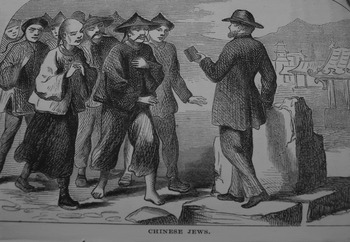
It is worth noting that the image of the Jews inscribed in the language of periodicals of the London Society, similar to its attitude toward them, is ambiguous. I would argue that it depends upon which theological tense is being used. The first one refers to the past—to the Hebrews and Israelites of the pre-Christian era who are perceived as “God's wonderful people.” They are treated with reverence and referred to with a range of biblical metaphors (for example, “Abraham's seed” or “children of Israel”). In the second stage, which began with the rejection of Jesus as their Messiah and continues till the present day, Jews are continuously described as “blind” and/or “poor.” The presentation of this contemporary Jewry varies: on one hand, we encounter polemical and stereotypical images and, on the other, reliable (and invaluable) ethnographical accounts. The third and the last stage would begin with the future conversion of the Jews, which was expected to bring about their final transformation: from the rejected and suffering nation, they would become a holy people restored to their previous glory (as in the hymn above). This idealized vision of past and future “Israelites” was being constantly challenged by missionary reports published in periodicals of the London Society, relating to contemporary, nineteenth-century Jews living in different parts of the globe. This intelligence showed that there was no single, monolithic “God's wonderful people,” but rather a number of diverse communities, each preserving its own traditions and customs.Footnote 67 Readers were puzzled to discover the existence of such “exotic” communities like Felashas (Beta Israel) in Abyssina, or a Jewish “lost tribe” in China (see figure 1). In this respect, periodicals are a remarkable source, as they reveal the tension between contradictory Jewish images and attitudes towards Jews, trapped in the constant dialectics between the ideal, the real and the imagined.
CMJ f. 25: The Children's Jewish Advocate 9 (1867), 194 (thanks to the courtesy of Church's Ministry among Jewish People).

Despite the fact that the word “Jewish” appears in the titles of this type of press, all these periodicals mentioned so far were intended for a wide Christian audience.Footnote 68 Of course, the Society encouraged Jews to take interests in its enterprise, including periodicals, but the Jewish response was close to none and the core of their readership constituted Christian supporters of the missionary project.Footnote 69 By Christian readers of these periodicals, I understand also those who defined themselves as “Hebrew-Christians,” that is converts from Judaism, although they constituted a tiny percent of the audience. It is interesting to note that in Britain, Jewish converts and Messianic Jews printed their own journal entitled Kol Israel: The Voice of Israel, conducted by Jews who believe in Jesus of Nazareth as the Messiah, which, according to my best knowledge, appeared for only a few years (1844–1847). Its aim was to offer spiritual support to members of this group, to shape their identity, and consolidate their ranks.
Over the time, the British scene of so-called “Jewish missions” diversified.Footnote 70 Audience-specific periodicals appeared, following common developments in the history of missionary periodicals. In 1845, the Society started to publish a periodical for children, The Jewish Advocate for the Young, which continued later under various titles. After the Society's sub-organization “Children's Beehive for Israel” had been created in 1892, it became its official organ (then entitled The Jewish Missionary Advocate). Another sub-organization that emerged a year later, “The Ladies' Union for Israel,” was also represented by its own periodical, Works of Faith and Labours of Love (1897–1913).Footnote 71 In comparison to other Victorian missionary (let alone religious) periodicals for women, this separate organ of the London Society for female readers appeared quite late.Footnote 72 The initial exclusion of women from active participation in the missionary field translated itself accordingly into an initial lack of dedicated periodicals for them. Such a problem was a by-product of the approach taken by founders of the modern Protestant missions who, as Jeffrey Cox describes them, “conceived of the missionary enterprise as one of male heroism.”Footnote 73 To a woman, it could offer a status of a missionary wife, but not a missionary herself,Footnote 74 which, in the case of the London Society, started to change only in the late nineteenth century. It is noteworthy that when Works of Faith finally appeared, it included texts written by both women and men. The periodical combined religious message and Bible study with missionary intelligence and charity logistics. Thus, apart from listings of “subjects for prayers,” we find requests for more worldly needs to be satisfied (like flannel, shoes, or magic lantern glass).
The above mentioned periodical for children, on the other hand, is an interesting example of propaganda dissemination and carefully crafted religious education that would help to shape the future generation of supporters of the “Jewish missions.” As other early Victorian periodicals for children—which “were envisaged as a means of instilling a moral message and . . . were certainly not design to amuse their young readers”Footnote 75 —this one also served a purely didactic and propaganda purpose. Browsing through rather dull looking and unappealing pages filled with summaries of biblical stories, short sketches on Jewish history and religion, missionary intelligence, and poetry, one may get an impression that this children's periodical did not try to appeal to its selected audience. It was only in 1854 when its editor, desiring to create a “more pleasant and more instructive” edition, troubled himself to recognize the actual needs of the young readers.Footnote 76 A year later the periodical underwent a substantial change and “put a new face on,” adapting the level and style of articles and intelligence to the children's needs. The missionary reports and edifying stories were now more carefully selected so that they would refer to the situation of Jewish children, their education, family relations, or other experiences with which Christian children could have identified. In order to make the periodical visually attractive, wood-engraving illustrations were included in each issue.
All of the missionary periodicals of the London Society discussed here were dominated by a strong religious meta-history. All were polemical and apologetic. All recycled religious and cultural stereotypes. But despite their shortcomings and limitations, these periodicals constitute a remarkable and unique source. This is especially so, if we take into consideration that we can learn as much from their polemical tones or clichés as from their ethnographical accounts concerning various Jewish communities in the nineteenth century. The restless efforts of the London Society to convert Jews, which brought so little results (if measured in the number of converts), open a vast and yet unexplored field before contemporary scholars.