INTRODUCTION: THE LAST PICTURE SHOW AS NOSTALGIA FILM
[T]he mesmerizing image of liberation haunts such visions of the frontier long after America had itself (following its Civil War) become a thoroughly capitalist environment; and this anarchist picture of people shedding their enforced tasks and dispersing into the freedom of the unexplored and the uncharted even today seems to offer relief from the oppressiveness of an omnipresent capitalism.Footnote 1
Peter Bogdanovich's masterpiece The Last Picture Show (1971) often appears in the roll call of the most important 1970s New Hollywood films.Footnote 2 It constitutes a significant example of how an unprecedented conjuncture of forces allowed rich, complex and experimental American filmmaking to find a mainstream audience during this period. It was the “decade when movies mattered,” as David Thomson once put it.Footnote 3 One of the central imperatives behind this turn in cinematic history was an interrogation of the ideological complacencies of the postwar era. It is a commonplace to note that many of the greatest filmmakers of the time used cinema to examine the hidden and compromising dimensions of the American national project. Yet the categorization of The Last Picture Show as a New Hollywood classic often involves a certain hesitation. If the New Hollywood constituted a battery of cultural shocks designed to wrench the nation out of its tranquillized complacency, this film seems to lack the aggressive provocations that can be found in many better-known films of the time. There is no charge of grand geopolitical hypocrisy abroad (Apocalypse Now, 1979, dir. Francis Ford Coppola), nor discovery of corruption at the heart of civic institutions at home (All the President's Men, 1976, dir. Alan J. Pakula). There is no bracing jolt of abject violence born in urban ennui and nihilism (Taxi Driver, 1976, dir. Martin Scorsese) nor malevolent desire circulating in a subterranean manner (Klute, 1971, dir. Alan J. Pakula). Perhaps most damning to contemporary mind-sets, there is no hint of any national reckoning with the social realities of race in American history. Without an explicit, singular, and unambiguous allegation against the national project, it is somewhat more difficult to locate The Last Picture Show within the political coordinates of the era.
Compounding this observation, The Last Picture Show displays some unsettling tendencies for a New Hollywood film, tendencies anchored in a desire to linger on memories of the past. At the level of content, Bogdanovich offers an intimate portrait of everyday life in Anarene, a small Texan town in the early 1950s, with all the attendant connotations of postwar conformism and Cold War political anxieties. At the level of form, Bogdanovich's decision to shoot in black and white serves as a masterful but anachronistic homage to the classical Hollywood style. No less than director Martin Scorsese has observed that “[t]he last person to make classical American cinema was Peter [Bogdanovich]. To really utilize the wide frame and the use of the deep focal length. He really understood it.”Footnote 4 This impulse sits uneasily with the experimental art-cinema aesthetics so famously absorbed by the New Hollywood.Footnote 5 These tendencies intersect in the narrative's denouement. The eponymous screening of Howard Hawks's Red River (1948) at the town's picture house implicates a third issue that is central to the film's interpretation – the status of the classical western in twentieth-century American popular culture. Perhaps the film's most striking feature is how it conjures a memory of the cinematic imaginary so indelibly linked with the genre from the well of some national collective unconscious.
Yet the exact relationship of the film to this generic heritage is ambiguous. It is not, of course, a western in any simple sense of the term (that is, if one adopts the narrow definition of the genre as defined by a distinctive content, i.e. narratives of colonial conflict and settlement beyond the Mississippi river in the latter half of the nineteenth century). But it undeniably speaks back to the genre in some fashion, recoding its tropes and conventions, fantasies and ideology, mise en scène and affective charges. A number of theoretical rubrics have been put forward to account for such films that from the 1960s onwards transform the codes of the western in various ways. They include the “revisionist western,” the “new western,” the “non-western,” the “anti-western” and the “post-western.” Each theoretical rubric tries to grasp the precise ways in which the genre was ideologically and formally critiqued, inverted and negated.Footnote 6 The Last Picture Show is perhaps best described as a “post-western” as its relationship to the western is fundamentally temporal and historical rather than stylistic. It does not recast the old narratives in some new light (such as by enhancing some sense of historical verisimilitude or brutality). Instead it can be placed squarely within a field of narratives strongly associated with the literature of Larry McMurtry (Hud (1963, dir. Martin Ritt) can be identified as a precursor in this sense). This field is defined by an uncomfortable enquiry into the “civilization” of the twentieth century that was secured by the very processes ostensibly figured by the western. Alternatively one might characterize it as a “meta-western,” as it investigates the nexus between the genre's spectacle and the sociological conditions that were a precondition for its very existence. These conditions were themselves deeply historical, defined by a middle-class populace invested both in a regime of mass culture and in national ideologies that sought to legitimate the modern American nation-state. It thus doubles back on itself in a self-referential fashion as both McMurtry and Bogdanovich clearly understood that by the end of the 1960s the western was a deeply contentious cultural object from which long-suppressed questions were beginning to emerge.
This orientation to the past can then be framed by a further critical question. Where it has received scholarly attention, the film's reputation has suffered as a result of its somewhat pejorative categorization as a “nostalgia film.”Footnote 7 This category is generally taken to have originated with the Marxian critic Fredric Jameson in his canonical Postmodernism book and, at first glance, implies a retreat from the sociopolitical crises of the era and an abdication of political responsibility.Footnote 8 The terminus of this line of reasoning is that The Last Picture Show (like the more commonly cited reference point, George Lucas's American Graffiti (1973)) not only subtly betrays the overarching imperatives of the New Hollywood, but might even function as an anticipatory glimmer of the Reaganite cinema of the 1980s, the hallmark of which was to rehabilitate the memory of the Eisenhower years.Footnote 9 It is undoubtedly true that the film seems to neither castigate nor disavow these recollections in any simple, outright fashion. That this apparent sense of nostalgia coalesces around the form of the western only exacerbates this problem in the contemporary climate. If we accept the proposition that the genre constituted one of the most highly charged ideological categories in the Hollywood genre system, to speak of any nostalgia for the western is no doubt deeply “problematic” for many. The Last Picture Show therefore presents significant difficulties for any scholar invested in foregrounding the essentially negative or critical vocation of the New Hollywood and, perhaps for this reason, remains something of a blind spot in the scholarly record.
However, I wish to offer a defence of the film from this charge by reference to interpretive principles drawn from Jameson's wider body of criticism and demonstrate that such a critical or pejorative designation is overly hasty and simplistic, and prematurely forecloses an enquiry into the rich inner dynamics of the film. I contend that the lessons offered by The Last Picture Show go beyond mere surface stylistics, as poetic and evocative as these are, and that this sense of nostalgia is the mechanism by which the film offers its own profoundly compromising and uncomfortable diagnosis of the American national project. But it is a diagnosis that is somewhat more subtle than those articulated in clear ethico-political terms such as “hypocrisy,” “criminality” or “corruption.” Instead, it is a diagnosis that must be grasped in terms of desire.Footnote 10 The reading that follows will argue that The Last Picture Show is structured as a constellation of character portraits united by a striking central tendency: despite their apparently unremarkable appearances, the inhabitants of Anarene are revealed to be exquisitely desiring subjects who pine away quietly but powerfully for people, places, relationships, connections, experiences, futures and indeed pasts that their empirical reality seems unable to provide. The drama of the film is then dedicated to delicately rendering the subtleties of these desires and the ways they are frustrated, misdirected, dirempted, suppressed and rerouted. I will argue that by examining the localized microcosm of Anarene as a system or network of such desires, Bogdanovich offers a powerful vision of desire that yearns for release from the constraints of historical reality itself.
However, I will argue that this diagnosis not only is present at the level of the content of the narrative, but equally is staged in the very form of the film, which may be grasped as organized around a central contradiction or antagonism.Footnote 11 Bogdanovich's translation of the literary source material into a cinematic form required him to negotiate the clash between the classical western and the new sense of social realism that was so central to the stylistics and politics of the New Hollywood. I will argue that the source of the distinctive affect of The Last Picture Show – its poignant and ineffable sense of bittersweet and melancholy pathos – can be found in the tension generated by this formal contradiction and that this tension is inscribed within the very notion of the “post-western” itself.Footnote 12 Seen from this perspective, it is possible to suggest that the apparent contradiction between the nostalgic tendencies of The Last Picture Show and the broader critical vocation of the New Hollywood is something of a false problem. Like the most satisfying films of the era, The Last Picture Show operates through complex, contrapuntal and contradictory transformations of genre and ideology, thoroughly justifying its inclusion in the pantheon of the New Hollywood.
DECOMMISSIONING THE WESTERN
From the opening shot, The Last Picture Show is amongst the most self-conscious of Hollywood's reflections on the passing of the western. As Holmes phrases it, it signals “the eclipse of the Old West.”Footnote 13 Bogdanovich invokes this cinematic heritage in the opening shot of Anarene (McMurtry modelled the setting for the novel on his hometown of Archer City, Texas and Bogdanovich renamed it “Anarene” after another Texan town to evoke memories of the town at the centre of Red River, “Abilene”). The frame opens on the shuttered shops of the Main Street, which recalls through its architecture and axial structure the ideological terrain of the frontier in which the colonial regime of “civilization” crystallized in the “wilderness” along the wagon trail or at the trading post.Footnote 14 (see Figure 1). In what might called the “psychogeography” of the western, these spatial domains were overlaid with all kinds of historical hopes, anticipations, drives and desires. It is the memory of this psychogeography that Bogdanovich so powerfully revives throughout the film.
The Last Picture Show (Columbia Pictures, 1971): Anarene's Main Street.

The great American studies scholar Richard Slotkin, one of the primary theorists of the cultural “mythology” of the West, has argued that the western constituted “the fundamental or root structure of thought and imagination that shapes American cultural mythology in all its forms.”Footnote 15 This is perhaps to state the issue at too absolute a level. Yet it is important to recall the extraordinary power of the genre in the twentieth-century popular imagination. If the western is one of the two popular cultural forms of the United States that invite comparison with the great traditions of “high” art, as some have suggested (along with jazz),Footnote 16 then the fate of the genre is surely one of the important issues in the historicity of twentieth-century cultural forms. As Jameson reminds us (following the Frankfurt school), to account for the historicity of forms is to confront the fact that even the most robust cultural phenomenon is fundamentally a historical entity, and has it within itself to “die as a genuine activity, to vanish when it has served its purpose and when that social need it once answered has ceased to exist.”Footnote 17 Indeed by 1971 this psychogeography was already a relic from an older cultural epoch. This was clear to the great theorists of the western, for whom the passing of the genre was a symptom of the seismic political, social and ideological convulsions that shook the United States in the second half of the twentieth century.
Various points of rupture have been identified when the salience and prestige of the classical western begins to decline irrevocably. It is possible that the watershed might have occurred as early as 1962 or as late as 1968, the year during which political violence, Vietnam and Watergate made the “heroic utopian mythography of the American West … impossible to sustain.”Footnote 18 The ideological structures of the western and its official doctrines (so often grasped as the “mythic” structures of the genre: the masculinist performance of physical heroism, the Promethean task of nation building, the installation of the regime of “civilization,” all culminating of course in the doctrine of Manifest Destiny) had come under very significant stress. Yet regardless of where one locates the inflection point on the timeline, the fate of the genre was not one of mere cessation. Whilst its official or overt ideological doctrines could not reproduce themselves in the new social and political climate, its codes and structures, narrative templates, mise en scène, and cinematographic conventions remained operative as elements of highly charged cultural bricolage that could be repurposed in new ways.Footnote 19 In Bogdanovich's hands, they implicitly interrogate those historical desires inscribed in the classical western.
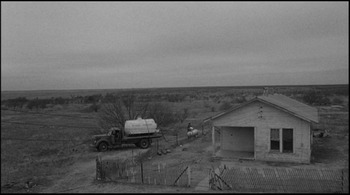
The opening shot of Anarene's Main Street envisions the “post-western” town as the product of a historical reversal – a positive that has transformed into a negative – turning old generic tropes “inside out,” as it were, to reveal a hollowness, or desiccation. For the scene populating the frame is not the bustling, optimistic, future-oriented human activity that animated the ideological dreams of the classical western. By the postwar period of the 1950s, the economic transformations of the intervening decades have left Anarene's structures of commercial and civic intercourse empty, monuments to an efflorescence of human energy that has come and gone. The iconic mise en scène of the “Old West” has inverted into a world of well-nigh complete economic stagnation, populated by structures that speak of decay, collapse, degradation and that deeply stigmatized category in so much popular American economic ideology – “failure.” Bogdanovich's camera registers variously throughout the film the ghostly movement of unmanned oil wells, the degraded agricultural land that once promised to feed a nation, the peeling paint on the facades of the town institutions and the endless expanse of the flat Texan plain covered by pestilent mesquite trees (see Figure 2). It is notable that the geographic mise en scène has been emptied of all vertical elements that might inspire any sense of awe or speak of collective aspiration (as Monument Valley did so famously), leaving frames of unyielding, oppressive horizantality. As critic Grayson Holmes observes, “What was left of the Old West in West Texas of 1951 … was, of course, a shell, a parody, an ironic form of the original cowboy landscape and practices.”Footnote 20 These images appear to us a harbinger of the trauma of economic dislocation and the fundamental, dawning realization of the historicity of economic activity itself.
The Last Picture Show: the homestead and endless expanse.

The film's dramatic investigation into these historical conditions takes the form of a contrapuntal narrative of parallel plotlines that passes behind the distressed and worn facades of Anarene to reveal its private realities. It thereby yields something of a privileged perspective into the local totality of the town, a perspective that is denied to any particular character, siloed as they are within their individual predicaments. It is a terrain that incorporates classical institutions of American small-town society, and as Holmes observes, “this narrative of small town America, small-town Texas to be specific, is used [by Bogdanovich] as a metaphor … for national-scale social and geographic change.”Footnote 21 The sociological structure of the town comprises two distinct levels that are superimposed upon one another, forming an antagonistic temporal chiasmus as the younger generation imaginatively project themselves into the future, and the older generation cannot help but project themselves into the past. There is the semi-autonomous world of the “teenagers” (that classical postwar American sociological inventionFootnote 22), governed by emergent sexual desire and its social rituals, including dating, driving around in cars, and “hanging out” after school (a historical novelty in the form of time not dedicated to economic production or social reproduction). The affect that sparks teenage life is that of naive excitement, breathless anticipation for experience and agitated impatience for the future. Then there is the world of the “adults,” whose existence turns around the world of work and marriage (now squarely defined in relation to economic production and social reproduction) and which is negatively charged by experiences of disappointment, regret, stultification, a sense of woundedness and the memory of pain. These two generational planes are bound by a web of halting and deeply compromised communication.
Bogdanovich arranges this constellation of portraits around the figure of Sonny Crawford (Timothy Bottoms). Sonny presents an interesting paradox as whilst he is a protagonist of sorts, he has little in the way of a singular overarching desire. He is a rather reactive and passive agent. He appears, on the surface, unremarkable and is certainly less socially and sexually successful than his more charismatic friend Duane (Jeff Bridges). Yet the paradox lies in the fact that this very passivity harbours an unusual sensitivity that allows him to serve as an effective barometer for detecting subtle changes of pressure in the town's social climate. As much is suggested by his deep but wordless rapport with Billy (Sam Bottoms), whose mutism renders him uniquely vulnerable. All the characters into which the film enquires are significant for Sonny in some way, offering lessons and insights that help him come to grasp the mystifying appearances that characterize his world.
THE VICISSITUDES OF EROTIC DESIRE: “WHY DON'T YOU SPARK ME LIKE YOU USED TO DO?”
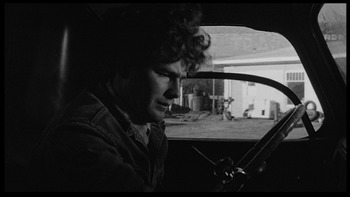
Beginning with Sonny's appearance, Bogdanovich insistently develops a central dramatic motif – the difficulty of generating and discharging sexual desire. From the moment Sonny's jalopy, with its spluttering engine, comes into view on the Main Street, the mechanics of driving as well as sexual relations are impeded (see Figure 3). Bogdanovich gives the spectator a sequence of close-ups (Sonny's foot working the accelerator, his hand manipulating the gear stick, all to no use). The lyrical content of the diegetic song playing on the radio (country star Hank William's “Why Don't You Love Me?” (1950)) makes the point clear: “Ain't had no lovin’ and a-huggin’ and a-kissin’ in a long, long while … Why don't you spark me like you used to do.” Of course, it has been argued that the classical western posed a nefarious ideological equation between masculine virility and national geopolitical or economic potency. Yet the introductory scene of Sonny is merely the prelude to a larger pattern that thoroughly unsettles and inverts this relation. Everywhere the socio-sexual dynamics of Anarene fail to cohere through poor or inappropriate erotic object choices. Giddings notes that the characters “aspire to closeness and satisfying relationships” yet they are few and far between.Footnote 23 Among the younger generation, there is Sonny and Charlene's (Sharon Ullrick) aborted date at the cinema and later in the car (Sonny reports, “it wasn't very hot”), Jacy's (Cybill Shepherd) prearranged date with Duane at the motel (she plans to lose her virginity but is foiled by his impotence, later falsely extolling, “I just can't describe it. I just can't describe it in words”), and Billy's (Sam Bottoms) degrading encounter with the town sex worker, Jimmy-Sue (Helena Humann) which ends with premature ejaculation and elicits the crushing disapproval of Sam “the Lion” (Ben Johnson). Perhaps the most extreme example is the case of Joe Bob (Barc Doyle), the preacher's son, whose abduction of a young girl most strongly indicts the claims of small-town Christian ethics to “manage” desire. It is a bracing moment of New Hollywood's willingness to inquire into deeply uncomfortable socio-sexual phenomena.
The Last Picture Show: Sonny's introduction.

The relations of the older generation seem to exhibit a slightly different pattern, although they hardly fare much better. In this realm, sexual desire has been sociologically fixed by ossified convention and does not enjoy the latitude of the teenage social world. There is the portrait of Jacy's mother, Lois (Ellen Burstyn), which stands as the most critical diagnosis of the fate of desire within bourgeois “civilized” marriage (in a basic economic topology of the town, the Farrow family home is perhaps the most conspicuously middle-class, relatively spacious and decked out in the decorating fashions of the postwar consumer society). She is the character for whom desire has been rendered banal, insisting, for example, on deflating Jacy's experience of limerence: “I thought if you slept with him a few times, you might find out there isn't nothing magic about it.” When Lois chastens Jacy about the risk of getting pregnant to Duane, she makes it clear that marriage was for her fundamentally intertwined with cynical socioeconomic considerations (“I scared your daddy into getting rich,” she tells Jacy). To break the resulting enervation, she flaunts her adultery with the working-class, seemingly more virile and handsome Abilene (Clu Gulager), an employee of her husband. Taking her cues from her mother, Jacy seduces Abilene and the encounter appears to find a certain traction in its socially tabooed quality. Yet the encounter collapses in regret and recrimination. Or equally one can point to the degraded relationship between Ruth (Cloris Leachman) and “Coach” Popper (Bill Thurman), who, it is clear, remains a closeted homosexual. When running a drill in the school gymnasium, the coach slaps the buttocks of one of the boys. Bogdanovich's camera tilts down to make the gesture unambiguous. He taunts the boys about their masculinity whilst surreptitiously noting that some of them are indeed “pretty enough to be women.” These plot lines surely contributed to the process of opening up uncomfortable speculations about clandestine forms of socio-sexual relations in the American West – a process that would culminate decades later with McMurtry's contribution as a screenwriter on Brokeback Mountain (2005, dir. Ang Lee).
However, despite this social landscape characterized by such desires derailed, blocked and misdirected, there are suggestions in the film that desire might escape this climate and find some satisfying form of expression. The first is to be found in the relationship between Sonny and Ruth. Critic Iain Crawford argues that the “men of Thalia [the town in McMurtry's novel] remain profoundly anxious about female desire and its effects.”Footnote 24 This suggests that the source material bequeaths to Bogdanovich a masculinist narrative centred around the experience of male sexual desire. Yet is has also been argued that McMurtry was a gifted writer of female characters, investigating and exploring the complex dynamics of female subjectivity. It is surely through Ruth that the argument can be made that Bogdanovich takes a deep and sensitive interest in the private desires and alienations of women, and an older woman no less. Married to Coach Popper and suffering from breast cancer, her subtle, simmering resentments as well as forbearance, tenderness and wounded pride make her perhaps the film's most affecting character. In Bogdanvoch's narrative structure, each social portrait is related to the others according to dialectical repetitions, variations and inversions. So the relationship between Ruth and Sonny combines the intergenerational choice of erotic object now with something like genuine relief from the stultification of an ill-conceived bourgeois marriage. The two first make contact at the town dance. As in John Ford's westerns, the dance in the town hall represents the persistence of old folk rituals of social and sexual permutation that figured prominently in the western and continue to structure small-town communal life into the twentieth century.Footnote 25 Whilst the yearnings of Ruth and Sonny's relations are antagonistic to the social fabric, the connection does suggest an erotic constitution that might, under different circumstances, have been felt as genuine or satisfying. Scholar Greg Giddings notes that “the tinge of hopefulness that Ruth and Sonny's rapprochement implies [that] maybe, just maybe despite the obstacles and oppressive environment, these two characters can connect, if not with each other, then at least at some point with another similar sensitive soul.”Footnote 26 There appears to be some reprieve from alienation in the pairing, some closing of the structural gap between appearance and reality. For Ruth, the relationship is the catalyst for the revivification of her very being after a long period of sexual dormancy. This revivification finds expression not only in erotic activity (brushing Sonny's hair), but also in another symptomatic change, her reemergence as a consumer (she “redecorates”). The postwar consumer economy has penetrated even the small towns of the West and Ruth's “makeover” carries a subtle libidinal charge, underlined by her choice to repaint her bedroom blue, Sonny's favourite colour. Yet on the other hand, the coupling appears unable to stabilize itself. Sonny's attentions wander to the town's most salient object of desire, Jacy, and the withdrawal of his affection becomes altogether too much for Ruth to bear.
CONTRADICTIONS OF DESIRE: REALISM AND THE WESTERN
The very fabric of the film, anchored by its sensitive attention to the microdrama of unassuming quotidian life in Anarene, is undergirded by that cinematic register or modality that is central to the American New Wave – a renewed impulse toward realism, or its more local variant of “social realism.” To invoke the term “realism” in relation to cinema is, of course, to open up a vast rubric of historical debates about the perceptual, imagistic, sociological and phenomenological nature of the cinematic image (not to mention antecedent literary or narrative forms). However, at a minimum, The Last Picture Show can be linked to certain hallmarks of classical twentieth-century cinematic realism in a number of relatively unambiguous ways. It might be characterized by a deep interest in reproducing the rich texture of an actually existing social reality, that Bazinian concern for that “base of life within which we experience everyday psychological existence.”Footnote 27 Or alternatively we might widen the frame of reference and link it to a Lukácsean conception of realism as attempting to provide “an account of the interconnection of individual and social phenomena within a particular historical conjuncture.”Footnote 28
Regardless of the precise authority invoked, the point that I wish to make about realism is a more precise and historicizing one. One of the most penetrating speculative insights about the emergence of realist textual discourse is offered by Jameson, who argued that realism is a textual mode fundamentally called into being in the mid-nineteenth century by the emergence of capitalist modernity, and whose task was to map the phenomenological experience of the new bourgeois lifeworld (to be sure this claim is made in the literary context of the history of the novel, but I would argue that the point might be transcoded into just such a novelistic film).Footnote 29 In attempting to map this new world, realist narrative fundamentally differed from earlier modes (oral, written or dramatic) of narrative in precapitalist lifeworlds in the way it organized human reality. Gone were the providential destinies of religious narrative, the superhuman deeds of myth or the epic, the comforting resolutions of social tension in comedy, and the agonizing anagnorisis of tragedy (all of which left their indelible mark on the classical western in one way or another). Instead realism seemed to develop a mode of human storytelling that tried to accommodate the psyche to the empirical weight of alienated historical existence, to acclimatize it to a new “reality principle,” to put the matter in Freudian terms. Moreover, realism aestheticized this vision of existence and valorized it as “high” art as a form of compensation for the pain to be found in its lessons. That Bogdanovich invoked the cinematic analogue of this mode is, then, not surprising: it is a thoroughly American bourgeois lifeworld that we find mapped in the realism of The Last Picture Show (it is interesting to note that the explicitly working-class worlds of industrial and agricultural work remain on the margins of the narrative). This lifeworld is, then, defined by a certain grinding intractability, in which the achievement of the apparent quietude and abundance of the postwar world masks undercurrents of stultification, alienation and nameless dissatisfaction.
What I wish to draw out now is how this cinematic language negates, in a precise way, the older language of the western such that the central antagonism or stylistic contradiction places the entire dramatic scheme of the film under a certain kind of internal (and indeed somewhat dialectical) tension. It has often been noted that whilst the classical western was a putative vision of a historical content, that vision was anything but a form of realism. Instead it was laced with deeply ideological wish-fulfillment scenarios, and functioned as an essentially allegorical landscape with all manner of magical, symbolic and providential encounters (indeed it is easy to understand how for many critics this essentially mystifying slippage makes it infinitely more ideologically suspicious). The genre forged a system of collective origin stories rather than any empirically accurate vision of past realities. Measuring this gap has been fertile ground for the critical, negative and demystifying project of bringing the genre's ideology to light. Whilst today the western is often characterized as somewhere between the bemusingly outdated and ideologically nefarious, it is easy to forget the extent to which it functioned as a series of intoxicating fantasy scenarios (in the narrow Freudian sense) in which the psyche, frustrated in its desires by empirical reality, luxuriates upon imagined gratifications.Footnote 30 To grasp this, we must to shift gears from what Paul Ricoeur would call a “negative hermeneutics” (as the broader critical project of uncovering and debunking nefarious ideology at work behind a necessarily mystifying empirical appearance) to a “positive hermeneutics,” a demonstration of how the text solicits our desires and suppressed wishes for release, gratification, plenitude and indeed Utopian salvation.Footnote 31
Almost all scholars of the western have found such subterranean pleasures at work in the fantasy system of the western. I would agree with the feminist critic Jane Tompkins, who claims, “People think of Westerns as light entertainment, adolescent and escapist, but there is nothing trivial about the needs they answer, the desires they arouse, or the visions of life they portray.”Footnote 32 A full account of such pleasures and fantasies to be found in the western is, of course, beyond the scope of the current argument.Footnote 33 But for current purposes I wish to draw out a helpful characterization of at least one such pleasure perceptively identified by Tompkins in these terms:
[The western] seems to offer escape from the conditions of life in modern industrial society: from a mechanized existence, economic dead ends, social entanglements, unhappy personal relations, political injustice … The desert light and the desert space, the creak of saddle leather and the sun beating down, the horse's energy and force – these things promise a translation of the self into something purer and more authentic, more intense, more real.Footnote 34
Or equally consider this passage:
Ordinary work – in fact, ordinary life – is too much like shopping. It never embodies what the hero's struggle to get out of the blizzard fully embodies: the fully saturated moment. But this is not because life in the twentieth century involves people in all those transactions the Western hero traditionally rejects – the acquisition of material goods, the desire for social status, the search for luxuries. What Westerns criticize in daily life is not the presence of things, technology, law, or institutions per se, but the sense that life under these conditions isn't going anywhere. If Westerns seem to long for the out-of-doors, for a simplified social existence, for blizzards and shoot-outs and fabulous exploits, it isn't because their readers want to give up TV and computers and fast foods and go back to life on the frontier. It's that life on the frontier is a way of imagining the self in a boundary situation – a place that will put you to some kind of ultimate test.Footnote 35
It is the vocabulary that Tompkins employs here when speaking of an almost existential sense of intensification and directionality that I wish to underscore, for it is this wish-fulfillment functionality that I believe is so powerfully and poignantly negated by the ennui of life in Anarene. This sense of drive and directionality can be traced even further back in the cultural record. Many theorists of the western have argued that its structures developed out of the earlier literary foundations of chivalric romance and the epic with their narrative template of the quest.Footnote 36 I would argue that these older literary materials bequeathed to the genre a certain kind of definitive affect: the electric “quickening” that comes with decision, (re)action and movement. To spur the horse into action, to light out for the territory, and of course to reach for the six-gun (in a deeply ambiguous ethical form) were the hallmark moments of such quickening in western spectatorship. Its central spatial structure was a quest governed by a deep, all-consuming desire to move forward with inexorable purpose towards some encounter, propelled by circumstances pressurized by an existential threat to survival itself. What Tompkins makes clear is that its pleasures implicitly answered the stultification that characterized so much of industrial modernity, even more so when that modernity yielded the consumer plenitude of postwar middle-class society. The historical ruse is, of course, that the inhabitants of Anarene are the putative “beneficiaries” of those future-oriented, nation-founding desires figured in the western which have now been ironized by the reversal. In fact the predicament of the inhabitants of Anarene speaks back forcefully to one of the central contradictions that inscribed nostalgia into the very essence of the genre: that the westerner was unable to accommodate himself to the climate of that “civilization” of which he was paradoxically the emissary and agent following the passage of the frontier.Footnote 37
It is now possible to suggest that this sense of desire, finding no form of adequate expression, is not abolished, but is instead driven underground. Having thus established Anarene as a post-western town, the narrative avails itself of two classical strategies for evading the enervating regime of “civilization” that thwarts it. The two strategies – to “light out” for the frontier and to turn inwards to the privileged microcosm of the cinema itself – are themselves paired or oppositional in the sense that one gestures outwards, taking a material, bodily and spatial form, whilst the other gestures inwards, taking a psychic, ideal and symbolic form. First, to “light out” beyond the supervisory powers of “civilization” was, of course, a central dramatic act in the western. But in the twentieth century, it was clear to scholars of the great American countercultural movements that this subversive act was transcoded into “hitting the road” (with the examples of the 1950s biker subcultures and the 1960s counterculture, culminating in the form of the road movieFootnote 38). For American popular culture, to take to the road in search of some libinized zone was a profound gesture. Holmes notes that “it comes as no surprise, then, that some of the happiest moments in the lives of the characters are when they are in the car, on the open road, going somewhere.”Footnote 39 These moments retain the memory of the kinetic impulses and that quickening of affect that gave the western its sense of directionality. In the first instance, Sonny and Duane take an impromptu trip to Mexico (which I would suggest functions as a symbolic cultural space in which the repressive proscriptions of an historically Protestant culture are lifted). The pair return with souvenir sombreros and a stomach complaint (Sam warns them not to get the clap). But Sonny and Jacy are not so lucky in their attempt to elope to Kansas, as they are caught by a police patrol vehicle. Whilst the iconography of Eisenhower's highways so often functions as a privileged trope for American narratives of autonomy and mobility, these structures (themselves spatial penetrations into the West following the wagon trail and the railway) now function, in a dialectical reversal, to facilitate repressive forms of social surveillance. Sonny and Jacy's capture suggests that this strategy of “lighting out” towards new realities is no longer the pressure-relieving safety valve it once was. Thus, whilst the film gestures in the direction of the buddy comedy, the road movie or the “couple-on-the-lam” trope, it never quite fully crystallizes any of these forms.
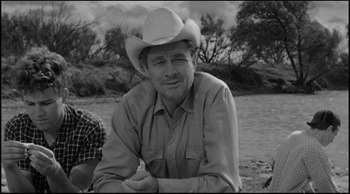
Yet, in a pivotal scene that I believe functions as something like the centre of gravity of the film's system of fantasies, memories and desires, the narrative holds out another subtly tantalizing iteration of this strategy (again the dramatic structure works through reversal and repetition). It is hinted that once, in another time prior to the solidification of the regime of civilization and its oppressive weight, lighting out did indeed offer the possibility of accessing some fleeting but authentic experience of erotic gratification or plenitude (an impulse that was itself part of the clandestine subversive pleasures of the classical western).Footnote 40 Yet it was found not at the frontier but in a sequestered, quasi-utopian natural enclave that had escaped total assimilation to the rationalizing and desacralizing powers of civilization. Sam recounts to Sonny and Billy an anecdote from his youth. It is, of course, deeply significant that this monologue is delivered by the figure in whom Bogdanovich invests the cinematic memory of the classical western. Ben Johnson was a legendary figure in the genre, having appeared in a number of its most iconic titles, and he speaks directly to the memory of that West that once “reflected promise, vigour, and unencumbered freedoms, with heroic men living in intimate connection with the land doing larger-than-life deeds.”Footnote 41 It is an extraordinary anecdote told in Peter Biskind's Easy Riders, Raging Bulls that Johnson had to be convinced by no less than John Ford himself to take the role.Footnote 42 The weight it carries is emphasized by the long take and slow dolly both in and out that Bogdanovich lavishes upon it (see Figure 4). Sam reflects wistfully to Sonny:
Sam: I just come out here to get a little scenery. Too pretty a day to spend in town. You wouldn't believe how this country's changed. First time I seen it, there wasn't a mesquite tree on it. Or a prickly pear neither. I used to own this land, you know. First time I watered a horse at this tank … was more than forty years ago. I reckon the reason I drag you out here is … I'm as sentimental as the next fellow when it comes to old times. Old times. I brought a young lady swimming out here once … more than twenty years ago. It was after my wife had lost her mind. And my boys was dead. Me and this young lady was pretty wild, I guess. In pretty deep. We used to come here on horseback and swim without no bathing suits. One day she wanted to swim the horses across this tank. Kind of a crazy thing to do, but we done it anyway. She bet me a silver dollar she could beat me across. She did. This old horse I was riding didn't want to take the water. But she was always looking for something to do like that. Something wild. I bet she's still got that silver dollar.
Sonny: Whatever happened to her?
Sam: She growed up. She was just a girl then, really. Let me help you with that.
Sonny: Why didn't you ever marry her after your wife died?
Sam: She was already married. Her and her husband was young and miserable with one another … like so many young married folks are. I thought they'd change with some age … but it didn't turn out that way.
The girl at the heart of the recollection is later revealed to be Lois. Her own recollection of Sam (voiced to Sonny upon Sam's death) reciprocates the recollection:
Lois: I guess if it wasn't for Sam … I'd just about have missed it. Whatever “it” is. I'd have been one of them amity types that thinks that playing bridge is the best thing life has to offer.
The Last Picture Show: recollections at the horse tank.

Here, in the most humble of pronouns, can be found a subtle reference to an illicit vision of life beyond the frontier as unencumbered by the erotic proscriptions of a repressive civilization (this is again part of the inheritance that McMurtry and The Last Picture Show bequeath to Brokeback Mountain). It is this memory (or dream) of the temporary return of an inner sense of lived, erotic, bodily and psychic plenitude or communion around which the film's system of nostalgia turns. Even though the sublime, vertiginous qualities of the landscape in the classical western have vanished and in their place one finds only the horizontal expanse of the plain and the pummelled surface of the horse tank, the geography gives off the dim but unmistakable signal of the Old West as an eroticized space beyond the repressive regimes of Victorian, bourgeois morality (as it so often does, this imagined solution to a social antagonism takes the form of an emancipatory ideology of “nature” as the horse tank functions as a degraded “natural and bucolic setting”Footnote 43).The film's inquiries into the diremption and circuitous routes of misplaced desire are here quelled by a relation that seems to offer some genuine encounter (Sam admits it was an adulterous relation, but that social transgression is strategically vitiated by the economic expediency that taints Lois's marriage and the symbolic disqualification of Sam's wife as having “lost her mind”). However, this memory of the body shedding its social and material constrictions in the symbolic act of bathing is itself negated and ironized through its structural double. The scene of the teenagers skinny-dipping in the fluorescent light and chlorine fumes of the pool party inverts the coding of Sam's memory: the private has become public, the nocturnal has been illuminated under artificial light, and the ineffably delicate experience has become vulgar.
This scene places a sense of nostalgia squarely at the centre of the film's affective structure and dramatizes its central ambiguity as concurrently a positive and negative, a source of pain and of comfort. On the one hand it is valuable and precious, a connection to some rare form of experience that secures both Sam and Lois's sense of the ultimate value (if any) of human life. Yet on the other hand the experience is lost, wrenchingly confiscated and sealed forever in the past, unable to be fully recuperated. Only the restorative power of memory seems able to mitigate the fundamentally brutal experience of temporality. This glimpse of a distant form of erotic plenitude (which is grasped so often by the inadequate heuristic of “romance”) is fundamentally related to the second possibility for escaping the climate of Anarene which is to be found at the town's cinema.
META-CINEMATIC REFLECTIONS AND NOSTALGIA
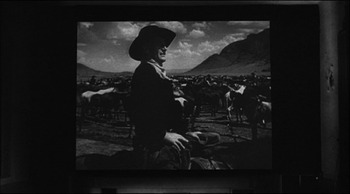
The film's denouement – the eponymous “last picture show” – is triggered by the event that serves as the structural and symbolic midway point in the narrative, the death of Sam the Lion whilst Sam and Duane are in Mexico. The system of desire and disappointment, fantasy and reality, plenitude and loss that the film has set up coalesces around this event. As mentioned above, Bogdanovich chooses Red River (Howard Hawks, 1948) as the cinematic projection against which his own mise en scène must be read. Red River stands in unambiguously for the high-water mark of the classical tradition of the western and the precise moment that Bogdanovich chooses to feature is the very epitome of that kinetic quickening described earlier. The decision to take the herd of cattle north exemplifies the call to drive forward with a profound sense of unlocking the possibility of the future (see Figure 5). It is here that the film does seem to invite the spectator to participate in some elegiac moment of nostalgia for the pleasures of the classical western (which I think is not to be equated automatically with a nostalgia for the political climate of its period of reception). Nevertheless, it is undeniable that the film is organized around a system of coordinated, interwoven nostalgias. First we have a film from the 1970s imagining a historical moment from the 1950s, the characters themselves engaged in imagining the nineteenth century. Then, as I have noted, the classical western was already characterized by a certain illicit nostalgia for the privileged mode of being that the westerner enjoyed prior to the arrival of civilization.Footnote 44 This generic affect further resonates with a biographical nostalgia for youth and adolescence with all its breathless anticipation. Finally, this is mediated by the nostalgia for the classical Hollywood image itself and its mode of spectatorship, as that profound collective cultural experience that characterized life for so many in the early and mid-twentieth century and was to be disrupted by the arrival of television. Bogdanovich's generation had experienced that technological transformation firsthand, and understood the loss that it entailed. It was this essential experience of loss that informed the American New Wave to attempt a restoration of Hollywood cinema.
The Last Picture Show: Red River and metacinematic quotation

Thus a final critical issue comes into view, one that must be approached through the various issues parsed above. Film scholar Marc Le Sueur is amongst those critics who argue that The Last Picture Show is a “‘classic’ nostalgia film” comparable to American Graffiti characterized by “‘melancholic’ nostalgia which indeed appears escapist in direction” and which “intend[s] no major criticism of society nor [does it] desire revolutionary change.”Footnote 45 From this view, the film is taken not so much to belong to the experimental Hollywood art cinema of the American New Wave, but rather to those mass cultural manifestations of the 1970s that looked back upon the 1950s with an infantile or adolescent historical imagination, recalling it as a halcyon period prior to the social and political ruptures of the 1960s with a distorted sense of historical perception.Footnote 46 This pejorative talking point partakes, then, in the conventional wisdom that nostalgia is always inherently a reactionary mystification, an illusory reconstruction of a historical past that fixates on the positive moment (“rose-coloured glasses”) and suppresses an awareness of the corresponding negative moment (coexisting forms of sociopolitical domination, alienation, etc.), yielding a manipulative and suspicious charge of affect. The result is a forthright refusal of any cultural object that is taken to “indulge” the temptation of nostalgia.
However, I believe that an important distinction can be made here to defend The Last Picture Show from such a charge. If we return to the canonical statement on the nostalgia film, Jameson's discussion in the Postmodernism book, we find that he designates those films that offer the empty revival of the past through pastiche (he describes them as “fashion-plate, historicist films” and a “depersonalized visual curiosity and a ‘return of the repressed’ … ‘without affect’”Footnote 47) as a pseudo-image of history. What Jameson seems to have in mind here is images of the past that conjure collective memories of older epochs by “stylistic connotation,” “glassy qualities,” and “attributes of fashion.”Footnote 48 He singles out the 1920s–1930s (“nostalgia-deco”) and the 1950s as particularly susceptible to such recuperations.Footnote 49 For a Marxian critic such as Jameson, the loss of the genuine ability of narrative to stimulate a heightened and lived sense of historicity in the Lukácsean–Marxian senseFootnote 50 (in which historical change is fundamentally generated by the inexorable passage of the modes of production themselves, dynamized and transformed by the structural contradictions immanent to themFootnote 51) is amongst the most deeply lamentable developments that characterized postmodernity. I believe it is significant to observe that it was American Graffiti that Jameson chose as an origin point for the nostalgia film, arguing that it was the “inaugural film of this new aesthetic discourse,”Footnote 52 as the sense of nostalgia present in Bogdanovich's film differs in certain key respects.
First, whilst a memory of adolescent desire is deeply implicated in The Last Picture Show, it can hardly be characterized as “escapist” in the sense that it does not present, in any simple or unambiguous fashion, the mere plenitude of a remembered historical era. It is not a pure “adolescent fantasy” that places the emphasis on the remembered vigour of youth. It is mirrored, tempered and indeed mediated by its negation: the biographical perspective of the adult world with its experience of defeat, loss and disappointment. It thus does something more subtle and vastly more powerful: it presents a vision of human experience as a complex, dynamic and indeed dialectical temporal patterning of positives and negatives, in which regret and nostalgia are necessarily inscribed within the experience of sociohistoric change at both individual and collective levels. In this sense it resonates with the richer and more complex sense of personal, political and aesthetic nostalgia explored by critic Svetlana Boym, who also argued that “longing and critical thinking are not opposed to one another.”Footnote 53 Nostalgia, thus conceived, may indeed have a genuine function to perform (even a political function), alerting us to the past as a repository of all manner of lost potentialities and gratifications, provided that we grasp those in a dynamic dialectical relationship with their opposite terms (the past equally as a catalogue of degradations and traumas, and the future as harbouring the potential for new forms of plenitude). In fact Jameson himself offers, in another place, a warning against the overhasty stigmatization of nostalgia. In the context of discussing the great Frankfurt school theorist Walter Benjamin, he counsels us that “there is no reason why a nostalgia conscious of itself, a lucid and remorseless dissatisfaction with the present on the grounds of some remembered plenitude, cannot furnish as adequate a revolutionary stimulus as any other.”Footnote 54
The possible source of such “lucidity” in the film is to be found in the final masterful denouement, as the film is in fact a self-conscious interrogation of the kind of mystifying ideological visions that its critics suggest it constitutes. The very essence of the film is the divergence between a cinematic representation of the past and actually lived material conditions in the present, between ideology and reality. In the cinema, as Sonny watches Montgomery Clift and John Wayne let out a “yee-hah” on the screen, Bogdanovich makes overt his intention to measure the historical gap between the two. It is a moment when the wish-fulfillment visions offered by Hollywood can no longer be mapped onto empirical conditions, preparing the way for the painful but unavoidable process of rupture and realignment.
CONCLUSION: DESIRE AND “THE REAL”
Slotkin once argued, “The historical adventure of our national [American] development will have to be reconceived to incorporate our experience of defeat and disappointment, our acquired sense of limitation, as well as the fabulous hopefulness that has perennially transformed and energized our culture.”Footnote 55 In The Last Picture Show an entire vocabulary of historical directionality and desire seems to have encountered some powerful countervailing force. This encounter is central, I believe, to the very notion of the “post-western” in the sense that it must “reconceive” a collective image of America that is characterized by an uncomfortable sense of defeat and disappointment (a notion pertinent now more than ever). This encounter finally resonates powerfully with one of the central interpretive principles of Jameson's early magnum opus The Political Unconscious, in which he offers a possible vocation for the sense of desire that I have sought to underscore. Jameson argued that in all manner of particular and historically determinate forms of narrative, the “political unconscious” of a collectivity may stage the clash between the force of desire (expressed as a “wish-fulfilling imagination”) and the set of empirical constraints which resist it at all turns, which he calls the “Real,” and which is at one with history itself:
It then sometimes happens that the objections are irrefutable, and that the wish-fulfilling imagination does its preparatory work so well that the wish, and desire itself, are confounded by the unanswerable resistance of the Real … The Real is thus – virtually by definition in the fallen world of capitalism – that which resists desire, that bedrock against which the desiring subject knows the breakup of hope and can finally measure everything that refuses its fulfillment. Yet it also follows that this Real – this absent cause, which is fundamentally unrepresentable and non-narrative, and detectable only in its effects – can be disclosed only by Desire itself, whose wish-fulfilling mechanisms are the instruments through which this resistant surface must be scanned.Footnote 56
Seen from this perspective, desire may be the mechanism in The Last Picture Show by which a certain moment in the “American adventure” is “scanned” for the trauma, the “Real” of history that is to be read only indirectly in this degraded landscape. But this sense of desire must necessarily adopt a certain orientation to the past, which critic Neil Campbell has described persuasively as a sense of the “haunting” of the post-western landscape:
The proximity of loss in the West is critical [in the post-western], being “there just yesterday” in the dreams of Manifest Destiny and frontier glory, making its loss seem “more poignant, and the wound fresher” since one is conscious always of the “utopian possibility that we just missed.” This developing and intensified sense of mourning within the West becomes part of the emergence out of the classic Western of the post-Western sensibility with its “wounded,” “haunting” past scarring the present, in which its consequences are still being played out in the changed and changing landscapes of the New West.Footnote 57
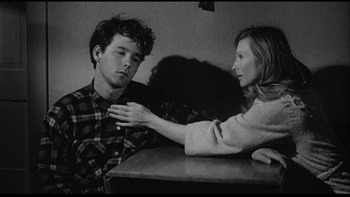
The Last Picture Show, like the greatest films of its era, constitutes a powerful case study in witnessing how the New Hollywood developed through complex reversals, recombinations and recodings. Bogdanovich's masterpiece represents an overlooked opportunity to study how these patterns transformed preexisting cinematic languages to charge them with new collective meanings in response to a rapidly changing historical situation. Bogdanovich's task in The Last Picture Show was to find a cinematic structure that could accommodate such an “experience of defeat and disappointment” and to do so organically by transforming, and indeed negating, the language of the western in a way that, paradoxically, made it possible to feel the deep gravitational pull of its pleasures once again. Its narrative is structured around a constellation of characters who seek to find a fleeting experience of gratification and plenitude within a fallen historical reality. The sting of the film's tragedy comes from the necessary brevity of any such satiation and the failure to secure any release from the larger alienating processes of history. It is an encounter perhaps most vividly dramatized in the final scene between Ruth and Sonny. After the devastating deaths of Sam and Billy, a forlorn Sonny arrives at Ruth's doorstep with ambiguous intentions (see Figure 6). Cloris Leachman delivers the scene that presumably solidified her claim upon the Academy Award for Best Supporting Actress. In a flood of rage Ruth directs her accusation at Sonny: “You've ruined it. It's lost completely … Just you needing me won't make it come back.” The “breakup of hope” has been, for Ruth, almost too much to bear. She is speaking in the immediate microcosm of an interpersonal betrayal, but the observation could equally apply to any naive investment in the “national adventure” as imagined through films such as Red River.
The Last Picture Show: Ruth, Sonny and the “breakup of hope”