1 Background
Among a wide range of verbs which allow ‘position-switching’ between direct object and prepositional object (Fillmore Reference Fillmore1968: 377), blame is known to be the only verb whose specified prepositions are for and on:
-
(1) Harry blamed Mary for his failures.
-
(2) Harry blamed his failures on Mary.
Levin (Reference Levin1993: 69) finds it worth identifying this alternation – what she calls the ‘blame alternation’ – since numerous verbs from different semantic fields appear at least in the for-construction like (1). These verbs include condemn, an apparent near-synonym of blame, while another near-synonym, accuse, selects of instead of for (Quirk et al. Reference Quirk, Greenbaum, Leech and Svartvik1985: 1159; Swan Reference Swan2005: 426). So-called spray/load verbs allow the on-variant like (2) but take with instead of for (e.g. Jack sprayed paint on the wall vs Jack sprayed the wall with paint; Levin Reference Levin1993: 50–1).
This unique alternation with blame usually receives some attention in modern grammars of English. Biber et al. (Reference Biber, Johansson, Leech, Conrad and Finegan1999: 151), for instance, observe that the two constructions are useful for ‘adjusting the form of the message according to the requirements of context’. Huddleston & Pullum (Reference Huddleston and Pullum2002: 219, 314) note that blame is a monotransitive verb with trivalent valency and point to the important distinction that the for-phrase is omissible whereas the on-phrase is not (Harry blamed Mary vs *Harry blamed his failures). The syntactic and semantic features of blame in Present-day English have also been analysed by several linguists with different approaches, such as frame semantics (Fillmore Reference Fillmore, Fillmore and Langendoen1971), generative grammar (Jackendoff Reference Jackendoff1974, Reference Jackendoff1990; Larson Reference Larson1990) and Construction Grammar (Goldberg Reference Goldberg1995). However, these studies do not take into account the fact that blame is a loanword from Old French and has been recorded since the beginning of Middle English (OED s.v. blame, v., etymology), leaving unanswered questions such as when the syntactic patterns available today emerged and how they have developed.
This article aims to fill this gap in research. With a comprehensive survey of the quotations database of the OED Online, I will investigate the diachrony of the blame alternation as well as several other constructions involving the verb and try to identify potential motivations for their rise and development. In doing so, I will examine how far historical perspectives can confirm previous discussions of the usage of blame today, which will be reviewed in the next section.
2 Previous accounts
The usage of blame in Present-day English first received some serious scholarly attention in the 1970s. Fillmore (Reference Fillmore, Fillmore and Langendoen1971) took a frame-semantic approach to discuss blame as a member of the set of verbs of judging which conceptually require three entities: situation, defendant and judge. In (1) and (2) above, his failures is the situation, which can refer to some negative action, deed or state of affairs; Mary is the defendant, who is or may be responsible for the situation; Harry is the judge, who ‘makes some kind of moral judgment about the situation or about the defendant's responsibility for the situation, or who makes a statement about such matters’ (Fillmore Reference Fillmore, Fillmore and Langendoen1971: 278; see also Fillmore Reference Fillmore1982: 115–16). Each of the three entities or roles is essential for discussing the semantic structure of blame. This is corroborated by the unacceptability of Harry blamed Mary, where the situation is not explicitly mentioned, unless the nature of the offence is contextually identifiable. Minimally, the sentence cannot be used to start a conversation (Fillmore Reference Fillmore, Fillmore and Langendoen1971: 280). Another noteworthy syntactic condition of the situation role is that in the on-construction it must be represented by a noun, while in the for-construction a gerund can realise this role (e.g. Harry blamed Mary for causing the accident).
Fillmore goes on to present detailed lexical entries for each verb of judging. Blame alone is identified with three entries, in accordance with its three different senses, which he proposes. These are conveniently summarised by McCawley (Reference McCawley, Hockey, Harper and Freed1975: 325) as ‘shift the blame onto’, ‘hold culpable’ and ‘think guilty’ and are illustrated below in (3)–(5) respectively (= McCawley's examples (34a)–(34c)):
-
(3) Phil put a bomb in the governor's office and then blamed it on me.
-
(4) Jack blamed me for writing that letter.
-
(5) Bert blamed me for what had happened.
To follow Fillmore's description, blame in (3) is a linguistic-act verb: the judge (Phil) actually says that the defendant (me) is responsible for the situation (it, i.e. putting a bomb in the governor's office), but with the presupposition that the defendant is in fact not responsible. Blame in (4) and (5), on the other hand, refers to the judge's opinions, thoughts or inner judgements,Footnote 2 and there is a presupposition that the situation is factual rather than merely conceived, which is not included in the sense of blame in (3). (4) means that the judge (Jack) thinks that the situation (writing that letter) is blameworthy, with the presupposition that the defendant (me) is responsible for the situation. In (5) the judge (Bert) thinks that the defendant (me) is responsible for the situation (what had happened), with the presupposition that the situation is blameworthy. Fillmore's subtle distinction between the second and third senses of blame is revisited in McCawley (Reference McCawley, Hockey, Harper and Freed1975: 325–9), where he observes that the situation with the sense ‘hold culpable’ ‘must be an act or a controllable state on the part of the “Defendant”’, whereas the situation for the ‘think guilty’ meaning ‘really has to be a situation (as opposed to e.g. an action)’. The consistent choice of the for-construction to illustrate these two senses and the on-construction to explain the remaining sense indicates that Fillmore and McCawley semantically distinguish the two variants of the blame alternation, although it is questionable whether a linguistic act of blaming is always meant in the on-construction but not in the for-construction.
The relative lack of syntactic discussion in Fillmore and McCawley is compensated for by Jackendoff (Reference Jackendoff1974, Reference Jackendoff1990) and Larson (Reference Larson1990). Using ‘blamer’, ‘blamee’ and ‘event’ for Fillmore's ‘judge’, ‘defendant’ and ‘situation’ respectively,Footnote 3 Jackendoff (Reference Jackendoff1974: 481–2) assumes that the two variants of the blame alternation are synonymous and derived from the deep structure as follows (see also Jackendoff & Culicover Reference Jackendoff and Culicover1971: 401–2). Note that ‘past’ in (6a) and (7a) refers to a past tense marker labelled ‘Aux’ in the projection:
-
(6)
-
(a) Harry past blame on Mary for his failures.
-
(b) Harry blamed Mary for his failures. [= (1)]
-
-
(7)
-
(a) Harry past blame for his failures on Mary.
-
(b) Harry blamed his failures on Mary. [= (2)]
-
(6a) is the deep structure, from which (7a) is optionally derived by the Prepositional Phrase Shift, which reverses the order of prepositional phrases. The Preposition Deletion rule obligatorily deletes the preposition next to the verb, yielding (6b) from (6a) and (7b) from (7a) respectively. Jackendoff also points to the close semantic and syntactic relationship between the simple verb blame and its phrasal equivalent put the blame (e.g. (6b) vs Harry put the blame on Mary for his failures; (7b) vs Harry put the blame for his failures on Mary).
Unlike Jackendoff (Reference Jackendoff1974), Larson (Reference Larson1990) argues that the two constructions of the blame alternation involve two distinct deep structures (and thus separate projections; see also Jackendoff Reference Jackendoff1990: 442–4 and Larson Reference Larson2014: 38–9), which arise from different underlying thematic relations. Specifically, the for-variant in (6b) patterns as a dative construction where the surface object is a goal and the prepositional phrase is an adjunct benefactive/malefactive phrase. This dative blame shares subcategorisation properties of the verb thank, and one of its outcomes is that the adjunct phrase can be omitted:
-
(8) Harry blamed Mary (for his failures).
-
(9) Harry thanked Mary (for the gift).
Another feature in common between dative blame and thank is that their direct object must apparently be animate unless personification is involved. This is attributed to the fact that goals in dative constructions ‘typically show an animacy restriction’ (Larson Reference Larson1990: 610):
-
(10) ?? Harry blamed the weather/temperature for his bad luck.
-
(11) ?? Harry thanked the weather/temperature for his good luck.
By contrast, the on-variant in (7b) represents a locative construction where the object is a theme and the prepositional phrase is a locative argument. The locative character is shown in its close relation with put (the blame). For instance, both locative blame and put demand a theme and a location together, thus rendering (12) and (13) unacceptable, while there is no animacy restriction on the locative prepositional phrase, as can be seen in (14):
-
(12)
-
(a) *Harry blamed his failures.
-
(b) *Harry put the blame for his failures.
-
-
(13)
-
(a) *Harry blamed on Mary.
-
(b) *Harry put on Mary.
-
-
(14)
-
(a) Harry blamed the accident on Mary/the weather.
-
(b) Harry put the blame for the accident on Mary/the weather.
-
Finally, the usage of blame was touched on very briefly in Goldberg (Reference Goldberg1995) under the framework of Construction Grammar. Like Fillmore (Reference Fillmore, Fillmore and Langendoen1971) and Jackendoff (Reference Jackendoff1974), Goldberg recognises three participant roles, i.e. roles which are associated with a particular verb's meaning. As we saw in (8) above, the role corresponding to Fillmore's situation and Jackendoff's event does not have to be overtly expressed in the for-variant of the blame alternation as long as its referent is identifiable from the context. Following Fillmore (Reference Fillmore1986), Goldberg (Reference Goldberg1995: 58–9) calls this the ‘definite null complement’. In (15) below square brackets indicate where the unexpressed role should appear:
-
(15) Chris blamed Pat [ ].
Goldberg does not discuss the blame alternation or name the three participant roles of the verb, but she introduces a parallel case. The verb load, with participant roles ‘loader’, ‘container’ and ‘loaded-theme’, is another one which occurs in the constructions with alternating NP–PP complements (e.g. She loaded the wagon with the hay vs She loaded the hay onto the wagon), and while loader and container roles must be overtly expressed, the loaded-theme role is omissible (e.g. She loaded the wagon) if it receives a definite interpretation from the context. This is indicated by square brackets in the lexical entry for load in (16); the boldface represents lexically profiled participant roles (Goldberg Reference Goldberg1995: 177–8):
-
(16) load <loader, container, [loaded-theme]>
On the basis of this entry, Goldberg (Reference Goldberg2006: 41) outlined the semantic relation between the two alternates of the load alternation, showing how the three participant roles correspond to the argument roles associated with causative + with construction and the caused-motion construction:
-
(17)

-
(18)


The argument roles ‘instrument’ and ‘path/location’ are not profiled since they are realised as oblique arguments, unlike the roles realised as subject or object, which are regularly profiled. The participant role ‘loader’ is consistently construed as a cause, whereas the container role can be construed as either a patient in (17) or a path/location in (18) and the loaded-theme role is compatible with either an instrument in (17) or a theme in (18). Different interpretations of the two constructions are attributable to the different argument roles which the two participant roles are fused with.
Considering that Goldberg's work rests on the premise that differences in syntactic forms are associated with differences in meaning, and that the blame alternation is closely analogous to the load alternation, the two variants of the blame alternation are inevitably expected to be semantically distinct from each other. On the basis of (16)–(18), we may assume that the lexical entry for blame and the structure of the blame alternation are as follows:
-
(19) blame <blamer, target, [blameable]>
-
(20)
-
(21)


Blamer is a specification of the agent role and is supposed to be animate and human.Footnote 4 Target, the recipient of the blame, may be construed as either a patient in (20) or a location in (21). An intrinsically animate label such as blamee should be avoided because, to follow Larson's (Reference Larson1990) discussion, it can be animate or inanimate at least in the on-construction.Footnote 5 In contrast, blameable, that which is to be blamed, should typically be inanimate and is compatible with either a cause in (20) or a theme in (21).Footnote 6 The on-construction can be regarded as a type of caused-motion construction in view of its supposed locative meaning (Larson Reference Larson1990). It is also analysed in Larson (Reference Larson2014: 39) in terms of caused motion (‘cause-blame-to-go’).Footnote 7
3 Questions to be addressed
Discussions of the use of Present-day English blame in the previous section point to a few areas where more work is desirable. One of them concerns the relationship between the two constructions in the blame alternation. They are often considered not synonymous, but previous studies concentrate on Present-day English and do not address how the alternation has been established since the verb was adopted from Old French at the beginning of Middle English. It is worth examining, for instance, when each of the two variants of the alternation originated, how they developed and how they were differentiated from each other. Other constructions where blame appears and the use of the verb in Old French should also be investigated to assess their influence on the growth of the alternation.
Another issue that needs to be reconsidered is Larson's (Reference Larson1990) claim that the target of blame must be animate in the for-construction but not in the on-construction, which implies that the blame alternation is possible only if the target role is represented by an animate noun. Some of the labels employed in previous studies, such as Fillmore's (Reference Fillmore, Fillmore and Langendoen1971) ‘defendant’ and Jackendoff's (Reference Jackendoff1974) ‘blamee’, presuppose that the target is animate, or specifically a human being. Examples of blame cited in Fillmore (Reference Fillmore, Fillmore and Langendoen1971), Jackendoff (Reference Jackendoff1974, Reference Jackendoff1990), Quirk et al. (Reference Quirk, Greenbaum, Leech and Svartvik1985) and Huddleston & Pullum (Reference Huddleston and Pullum2002) consistently have a human target irrespective of the type of construction, whereas Biber et al. (Reference Biber, Johansson, Leech, Conrad and Finegan1999: 151) cite an instance of an inanimate target in the on-construction, which agrees with Larson's account (Some business analysts blame the problem on tough competition in the insurance market). On the other hand, McCawley (Reference McCawley, Hockey, Harper and Freed1975: 327) shows that blame with the sense ‘think guilty’ allows a non-human target, even in the for-construction:
-
(22)
-
(a) I blame the high cost of living for Max's suicide.
-
(b) Nixon blames the lack of support from the Democrats for the failure of his fiscal policy.
-
(c) Sam blames the steel plant for the dirt on his windows.
-
Part of the target in (22b) is animate (the Democrats), and the steel plant in (22c) is an organisation, which is usually taken to be animate (Levin Reference Levin1993: 48), but the high cost of living in (22a) is unquestionably inanimate, with no personification involved. Larson assumes that animacy restriction with blame is ascribable to the fact that the verb in the for-construction is dative and its object is a goal, and that goals must typically be animate (e.g. She brought the boarder/*the border a package; cited in Goldberg Reference Goldberg1995: 142), yet this assumption is now doubtful. To extend his argument, the target of blame should also be animate in the construction where the cause of blame is not overtly expressed, since it should still be recoverable from the context. Nevertheless, counterexamples are cited in the OED (s.v. blame, v. 1 and 5):Footnote 8
-
(23) [they took occasion as oft as their Governours displeased them, by] Blaming sometimes the Policy, sometimes the Religion [to change the Government, or revolt from their Obedience at their pleasure].
(1651 T. Hobbes Leviathan III. xl. 255)
-
(24) [While he had still hoped to cajole his Parliament into submission and to become the head of an European coalition against France, he had affected] To blame the revocation of the Edict of Nantes [and to pity the unhappy men whom persecution had driven from their country].
(1849 T. B. Macaulay Hist. Eng. II. 77)
Larson's claim thus seems problematic both in Present-day English and in historical English and must be verified by more actual evidence. Granted that the target of blame is often animate, it may be a general tendency rather than any rigid constraint. With counterexamples being attested in the seventeenth and nineteenth centuries, it is critical to look into the use of blame in earlier English.
Finally, correlation between blame and put the blame as discussed in Jackendoff (Reference Jackendoff1974) and Larson (Reference Larson1990) will be strengthened if they turn out to be closely related to each other in diachronic development too. In contrast, if one has a much earlier origin than the other and their rise and development seem to be rather independent from each other, it may not be very convincing to strongly tie them together.
These three questions – diachronic relationship of the two variants of the blame alternation, animacy of the target of blame and correlation with the near-synonymous phrase put the blame – will be tackled in section 5 against empirical data from the OED, after the usage of the Old French verb blasmer is summarised in the next section based on lexicographical accounts. Of different approaches taken in previous studies, I will generally follow the ideas of Construction Grammar and thus recognise three participant roles, namely Blamer, Target and Blameable (with initial capitals), of which the last role is optionally omissible. The for-variant of the blame alternation will be regarded as an instance of the causative construction with an adjunct phrase (‘Blamer causes Target to be blamed for Blameable’) and the on-variant as an instance of the caused-motion construction (‘Blamer causes blame for Blameable to move to Target’). The animacy of the Target will be judged not only by its inherent meaning (i.e. whether the noun denotes a living thing or not) but also by its contextual meaning, since a normally inanimate entity can sometimes receive an animate interpretation due to metonymy or personification (see (10) and (11) above). As in Levin (Reference Levin1993: 48), organisations and corporate bodies such as government and army are considered animate.
4 Provenance of blame
The Anglo-Norman Dictionary labels blasmer as an active transitive verb and acknowledges three senses, ‘to blame, reproach’, ‘to accuse’ and ‘to condemn’. The illustrative quotations do not include either of the two variants of the blame alternation but instead consist of passive constructions (e.g. L. . . .fust mult blame ‘L. . . .was much blamed’) and active transitive constructions where blasmer takes a direct object, which can be either animate (e.g. Ne la blam pas s'ele m'oblie ‘I will not blame her even if she forgets me’) or inanimate (e.g. Jo ne blame poynt lur oreysuns ‘I will not condemn their entreaty’). Tobler & Lommatzsch (Reference Tobler and Lommatzsch1915–52) show that, apart from taking an accusative of person or thing like this, blasmer can be used intransitively with a dative of person (e.g. Et rois Felipes lor blasmoit ‘And King Felipe attached blame to them (dat)’) or in a double object construction with a dative of person and accusative of thing (e.g. La mortel vide li prist molt a blasmer ‘He began to much criticise the mortal life (acc) to her (dat)’).Footnote 9 The three participant roles and the optionality of Blameable in Present-day English thus have their origin in Old French. The double object construction may have facilitated the rise of either the for-construction or on-construction.Footnote 10 Tobler & Lommatzsch in fact cite an instance which corresponds to the latter, although we cannot tell how common the pattern was and the use of preposition may be due to metrical requirement:
-
(25) A Gaufroi a sa folie blasmee Li bons dux Namles
to Gaufrois has his folly blamed the good king Namles
‘To Gaufrois the good king Namles has blamed his folly.’
(Les Enfances Ogier 148)
5 Data analysis
5.1 Overview of the database
The data for this study are taken from the quotations database of the OED Online. The usability of the OED as a linguistic corpus has been increasingly acknowledged (see e.g. Fischer Reference Fischer1997; Hoffmann Reference Hoffmann2004; Rohdenburg Reference Rohdenburg, Krug and Schlüter2013). Updated on a quarterly basis, the OED Online offers access to the latest quotations database of the dictionary and is one of the best single resources for obtaining a general outline of any lexical development which spans many centuries. The verb blame is a case in point, as its history goes back over eight hundred years. Nevertheless, users must bear in mind that the OED quotations database is not designed as a linguistic corpus and is thus neither balanced nor can it be called representative. One cannot hope for any rigid statistical analysis either, so the present study is inevitably qualitative rather than quantitative. Quotations are often very short and do not always reproduce the entire sentence, making it impossible to identify the subject of the verb or the animacy of the referent of the pronoun, for instance. In the course of research for this article, whenever more context was required for clarification of this kind, I consulted a reliable edition as I did in (23) and (24) above. Despite these drawbacks, the following results will hopefully offer interesting ideas to be pursued in separate corpus-based studies.
The quotations with the verb blame were extracted in August 2013.Footnote 11 Duplicate quotations were recorded only once, and those with more than one token of blame were saved separately for each token. This data-mining process resulted in 878 instances, dating from c.1200 to 2002. Their distribution by centuries is shown in table 1.Footnote 12
Chronological distribution of the tokens of the verb blame in the OED Online

5.2 Syntactic patterns
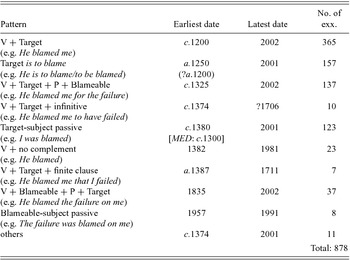
The citations extracted from the OED represent several different syntactic patterns, as summarised in table 2. The patterns are ordered according to their earliest dates of occurrence. These dates were checked against the illustrative quotations of blame in the MED entry, and the table cites the date from the MED only if it offers an earlier instance. ‘Others’ at the bottom conflate the examples where blame is just a glossed or glossing word (e.g. To Blame, accusare, culpare [1483 Cath. Angl. 34]) or where it is used adjectivally (e.g. þis compaygnie of muses i-blamed ‘this company of rebuked muses’ [c.1374 Chaucer tr. Boethius De Consol. Philos. (1868) I. prose i. 7]).
Syntactic patterns of blame as recorded in the OED quotations database

* P = preposition; V = verb
Some of the patterns reflect the Old French argument structures outlined in section 4. ‘V + Target’ and Target-subject passive are also found with blasmer, and the rise of ‘V + Target + P + Blameable’, the for-variant of the blame alternation, in the early fourteenth century may be modelled on the double object construction in Old French. However, the on-variant (V + Blameable + P + Target) emerged too late to be associated directly with any Old French influence. The blame alternation is a fairly recent development in the long history of the verb, and before then the Blameable, though lexically profiled, never seems to have been fused with a subject or object argument. The eventual emergence of the on-construction may be an analogy to existing patterns of caused-motion constructions, specifically those with on (e.g. Jack sprayed paint on the wall).
One may want to hypothesise from the accounts in Jackendoff (Reference Jackendoff1974) and Larson (Reference Larson1990) that another potential factor behind the development of the on-construction is an analogy to the idiom put blame. The OED quotations search yielded only eighteen instances, as summarised in table 3, and (26) is the earliest example found.Footnote 13
Chronological distribution of the tokens of put blame in the OED Online

-
(26) Ȝe suld haue schame On me to put swilk wrangwys blame.
‘You should be ashamed to put such unjust blame on me.’
(a.1350 in C. Horstmann Altengl. Legenden (1881) 29)
All the instances involve a prepositional phrase specifying the Target (i.e. On me in (26)) as in the on-construction, but the data are too scarce to claim any strong correlation with the rise of this construction, which would have happened much earlier if put blame had indeed been influential. The noun blame came into English from Old French (OED s.v. blame, n., etymology) in around 1230, about thirty years after the verb, and lay blame has also been attested since the fourteenth century (MED s.v. blame (n.) 1. (a) and 2. (a)). Put blame may have been critical in the choice of the preposition on in the on-construction: not only on but also in, to and upon were used during the first few centuries, but examples from the eighteenth century consistently have on. Apart from this choice, however, the direct effect of put blame on the on-construction seems limited. In fact, there is evidence that the on-construction affected the usage of put blame, rather than the other way around: examples where not just the Target but also the Blameable is overtly expressed – the very patterns quoted in Jackendoff (Reference Jackendoff1974) and Larson (Reference Larson1990) to compare with blame – are found only after the on-construction emerged, as in (27). For much of its history, put blame was used like ‘V + Target’, with the Blameable left unexpressed, even though it originated in the same period as the for-construction.
-
(27) We should not put all the blame on the prisoner, for his brazen affrontiveness.
(1909 B. A. Ronzone Marquis of Murray Hill ix. 120)
The subsequent sections will discuss the development of the three patterns in table 2 which have been the focus of previous studies, namely ‘V + Target’, ‘V + Target + P + Blameable’ (for-construction) and ‘V + Blameable + P + Target’ (on-construction), but I will also refer to other patterns to assess their effect on these three.
5.2.1 V + Target
The meaning of this pattern may be represented as ‘Blamer causes Target to be blamed’: the Blamer as agent directly causes the theme Target to get blame. The pattern has the longest history and by far the largest number of examples, whose distribution by centuries is presented in table 4.
Chronological distribution of ‘V + Target’ in the OED Online

This pattern is also recorded with Old French blasmer, and from the modern perspective, the unexpressed Blameable should receive a definite interpretation from the context. However, the Target in one of the earliest examples appears to combine the Target and Blameable. Compare (28) and (29), which are found in the same work:
-
(28) Drede letteð þe mannes shrifte. . .swiche men blameð þe prophete on þe sealm boc.
‘Dread prevents the man's shrift. . .such men blame the prophet in the psalter.’
(c.1200 Trin. Coll. Hom. 73)
-
(29) He. . .blamede here un-bileue & here unwreste liflode.
‘He. . .blamed their lack of faith and their immoral conduct.’
(c.1200 Trin. Coll. Hom. 81)
(28) with þe prophete as Target can be regarded as a clear example of the unexpressed Blameable with a definite interpretation. The act of blaming in (29) occurs right after the Blamer (Christ) shows to the Jews the sign of the prophet Jonah, and the sentence could theoretically be expanded into a for-construction as follows:
-
(30) *He. . .blamede hem for here un-bileue & unwreste liflode.
‘He. . .blamed them for their lack of faith and immoral conduct.’
The Target in (29) in effect merges the Target and Blameable in (30).Footnote 14 The alternation between (29) and (30) is called ‘Possessor Object Possessor-Attribute Factoring Alternation’ in Levin (Reference Levin1993: 72–4) and seen today with the verbs which turn up in the for-construction, such as judgement verbs like condemn and praise (e.g. They praised the volunteers’ dedication vs They praised the volunteers for their dedication).Footnote 15 The alternation comes with a slight difference in the Blamer's focus of attention in the discourse: in (30) the Target (hem) alone receives the full responsibility for the Blameable, but in (29) this Target is a possessive determiner (here) within the noun phrase which specifies the Blameable, and the amount of responsibility it receives on itself is reduced accordingly – it is defocused as the responsible participant.
The apparent merger between the Target and Blameable is facilitated by the fact that the head noun is in a part–whole relationship with the person described in the determiner. Specifically, the head noun denotes one's nature or quality, such as worthynesse (a.1425 (?a.1400)), vncourteousnesse (1531), stupidity (1628), obdurateness (1708) and bravery (1867), and sometimes something which one has done, such as kissing (a.1596), actions (1693) and inobservance (of propriety; 1837). Examples like these are found continuously from the twelfth to the twentieth century, except for the thirteenth century where the data are scarce, and they suggest that ‘V + Target’ is not necessarily the outcome of leaving the Blameable unexpressed.
The lack of animacy restriction on the Target in ‘V + Target’ may also be behind instances like (29), since the merger of an animate Target and an inanimate Blameable in the for-construction inevitably results in an inanimate noun as the direct object of the verb. More than half of the examples in table 4 have an animate Target, as (28) shows,Footnote 16 but inanimate Targets are attested not infrequently from the fourteenth to the twentieth century, such as synne (c.1380), lecherie (c.1475), claricord (1504), candle (1626), persecution (1702), principle (1830) and war (1930). Just like the Old French verb, blame can be used to blame a person or a thing, so it is reasonable that someone's something can be blamed, as in (29).
The lack of animacy constraint also applies to the patterns which arose around the same time as or shortly after ‘V + Target’ but before the for-construction, namely ‘Target is to blame’ and Target-subject passive (see table 2 above). Animate Targets are the norm in both patterns, but inanimate Targets are also found from an early period up to the present day. On the other hand, Targets in these two patterns almost never involve merger with the Blameable. The only example that I found is (31), which could be expanded into They were blamed not for the oftnes of their fasting but their hypocrisie therein. Compare it with (32), where the Target and Blameable could be merged but are not:Footnote 17
-
(31) Not the oftnes of their fasting, but their hypocrisie therein was blamed.
(1597 R. Hooker Of Lawes Eccl. Politie V. lxxii. 206)
-
(32) Whi schuld this askes be blamed or rebuked for hire vnthryftynesse?
‘Why should these lizards be blamed or detested for their wickedness?’
(a.1500 (1413) Pilgrimage of Soul (Egerton) II. xxi. f. 45 (MED))
5.2.2 V + Target + P + Blameable (for-construction)
The for-construction emerged about a century after ‘V + Target’ and may be based on the double object construction with Old French blasmer. However, even without such foreign influence, there would not have been much difficulty in its development, as it only required the addition of an adjunct prepositional phrase to the existing ‘V + Target’. The for-construction thus means that the agent Blamer directly causes the theme Target to get blame for the Blameable. The distribution of examples in the OED is summarised in table 5, and (33) is the earliest instance that I found, which requires caution, though.
Chronological distribution of ‘V + Target + P + Blameable’ in the OED Online

-
(33) Thu tones nowt the note ilke be his name, Thu bitist a-sonder bequarre, for bemol I the blame.
‘You do not sing the note in accordance with his name, you beat asunder B-natural, and I blame you for B-flat.’
(c.1325 in T. Wright & J. O. Halliwell Reliquiæ Antiquæ (1845) I. 292)
This example appears under the entry for the verb tone but has two partially overlapping duplicates under the entries for bemol and bequarre, and they are assigned different dates, a.1327 and a.1350 respectively, even though they are all cited from the same page of the same edition. The emergence of the for-construction cannot therefore be dated more precisely than to the early fourteenth century. There are also two examples of the for-construction in the works composed in the early fourteenth century, although the manuscripts are later by decades (a.1400 (c.1303) R. Mannyng Handlyng Synne (Harl.); a.1400 (a.1325) Cursor Mundi (Trin. Cambr.)).
One question worth asking here is whether ‘Target is to blame’ and Target-subject passive contributed to the emergence of the for-construction, since both of them can optionally express the Blameable in the adjunct phrase (see (32) above). Fischer (Reference Fischer and Blake1992: 337) notes that the construction ‘S is to do’ meaning possibility or obligation ‘is very frequent in Old and Middle English’, which may well explain the relatively early date of the first attestation of ‘Target is to blame’ and its productivity. However, the earliest instance where the Blameable is overtly expressed is a little later than the presumed rise of the for-construction (Thou art to blamen of that thoght ‘You are to blame for that thought’ [a.1393 Gower Confessio Amantis (Fairf.) V. l. 5208]).Footnote 18 The Blameable in ‘Target is to blame’ is in fact mostly left unexpressed. This may be because the construction ‘X is to blame’ itself is idiomatised (Fischer Reference Fischer and Blake1992: 337–9), and there is no strong motivation to supply the Blameable. It tends not to be expressed in Target-subject passive either, and the earliest instance is again later than the emergence of the for-construction (For leevyng of dedis of charite shulde he noþing be blamed ‘He should not be blamed for neglecting deeds of charity’ [c.1380 Wyclif Sel. Wks. III. 350]).Footnote 19 We can conclude that the for-construction most likely arose independently of both ‘Target is to blame’ and Target-subject passive, with the latter two patterns adopting the adjunct phrase from the for-construction.
Another question concerning the for-construction is whether Larson's (Reference Larson1990) proposed animacy restriction on it in Present-day English has any historical support. In contrast to ‘V + Target’, ‘Target is to blame’ and Target-subject passive, which are occasionally found with inanimate Targets in most periods of their record, the occurrence of Targets in the for-construction in the history of English is largely limited to animate ones, though not entirely. There is one clear instance of an inanimate Target in the fifteenth century (Thou haste thy body rechelesly gouerned and blamest hyt for thy gylt ‘You have imprudently governed your body and blamed it for your guilt’ [1483 (1413) Pilgrimage of Soul (Caxton) IV. xxvii. f. lxxiij]), and except for one example where personification may be at work (Ne blame not me, but blame the starres for this ‘Do not blame me, but blame the stars for this’ [1573 G. Gascoigne & F. Kinwelmersh Iocasta III. i, in G. Gascoigne Hundreth Sundrie Flowres sig. Q3]), all of the other scarce instances with an inanimate Target belong to the nineteenth century onwards, when more data are available.Footnote 20 Thus, Larson's claim may be considered generally valid until the beginning of the nineteenth century, but not beyond. Inanimate Targets in the for-construction in these periods include the print (1858), the ‘link’ system (1950), outer conditions (1981), nearby Interstate 95 (1996) and non-voting or tactical voting (2001), some of which reflect the culture or society at the time.
The previous section noted that the Target in ‘V + Target’ is sometimes expressed as if the Target and Blameable in the for-construction were merged and the person blamed, appearing in the possessive form, is less focused than if he/she alone is the direct object of the verb (see (29) and (30) above). It should be noted that the apparent merger of the Target and Blameable does not always occur even where it could:
-
(34) Ful fersliche Riȝt wol vs affray, And blame vs for vr mis-lyuing.
‘Right will reproach us very sternly and blame us for our sinful living.’
(c.1390 in C. Brown Relig. Lyrics 14th Cent. (1924) 126 (MED))
Examples like (34) are found in every century with record of the for-construction, while ‘V + Target’ with an apparent merger continues to appear at the same time. The for-construction may be selected when the Blamer wants to focus fully on the person in question as the responsible participant. Pragmatic factors have thus sometimes affected the selection of syntactic patterns of blame since the early history of the verb.
The development of the for-construction may also have been assisted by the realisation of the Blameable as a gerund from the early sixteenth century; (35) is the earliest instance I found. This pattern may be an extension of ‘V + Target + infinitive’ and ‘V + Target + finite clause’ as in (36) and (37) respectively, which appeared in the late fourteenth century and were still current when the gerundive Blameable arose:
-
(35) If thei should. . .blame the church for misteching the people.
(1529 T. More Dialogue Heresyes IV. xi, in Wks. 263/2)
-
(36) O Pandarus, that in dremes for to triste Me blamed hast, and wont art ofte vp breyde.
‘Oh Pandarus, who has blamed me for believing in dreams and is often wont to offer reproach.’
(c.1374 Chaucer Troilus & Criseyde v. 1710)
-
(37) His frendes blamede hym for he was so comyn to alle manere men.
‘His friends blamed him that he was so kind to all kinds of men.’
(a.1387 J. Trevisa tr. R. Higden Polychron. (St John's Cambr.) (1874) V. 5)
5.2.3 V + Blameable + P + Target (on-construction)
As an instance of the caused-motion construction, the on-construction means that the Blamer directly causes blame for the Blameable to go to the Target. While the patterns discussed so far all emerged by the end of the fourteenth century, the OED lacks evidence for the on-construction until the early nineteenth century, and all but one of its thirty-seven examples are from the subsequent two centuries. The following is the earliest instance found in the OED:
-
(38) I call this bad management, and I blame it upon you.
(1835 Fraser's Mag. 11 617)
The Blameable is expressed as a pronoun (it) and represents given information. In addition, the sentence actually ends with you, Mr. Francis Baring, although the name is not reproduced in the quotation. In such an environment the on-construction, which arranges the Blameable before the Target, works better in terms of information structure and syntactic weight than the for-construction (I blame you, Mr. Francis Baring, for it; see also Zwicky Reference Zwicky2007).
The pattern blame it on gradually spread, to the extent that Alfred Ayers in his 1881 The verbalist categorically rejected it as ‘a gross vulgarism which we sometimes hear from persons of considerable culture’ (see also Webster's dictionary of English usage s.v. blame on, blame for and Liberman Reference Liberman2007). Ayres’ criticism did not stop Kipling from adopting blame it on at the beginning of the twentieth century (two instances quoted in the OED), and it spread rapidly to a number of usage writers. In contrast, before the emergence of the on-construction, the for-construction never has it in the for-phrase except for the following:
-
(39) She has no Body to blame for it but her self.
(1711 J. Addison Spectator No. 89. ¶2)
-
(40) He spared not to blame him liberally for it.
(a.1713 T. Ellwood Hist. Life (1714) 63)
These two instances cannot be treated on a par with (38), however, as the on-construction does not result in any significant change in information structure (She has no Body to blame it on but her self; He spared not to blame it liberally on him).
The on-construction in the early twentieth century is not completely restricted to blame it on. The example below represents the intermediate stage between the for-construction (blaming women for the calamities of life) and the typical on-construction, with the on-phrase placed after the Blameable (blaming the calamities of life on women):
-
(41) I'm not one of them lobo wolves. . .who are always blaming on women the calamities of life.
(1907 ‘O. Henry’ Heart of West 220)
After the middle of the twentieth century, the Blameable is no longer exclusive to it and it is found right after the verb, followed by the on-phrase. It is also in this period that Blameable-subject passive first appeared:
-
(42) These acts of violence could not be blamed entirely on rowdies.
(1957 W. L. Lucey Catholic Church in Maine iv. 131)
Considering that Target-subject passive began to take the adjunct for-phrase only after the rise of the for-construction (see section 5.2.2), the appearance of Blameable-subject passive may imply that the on-construction was established in English then.
Nevertheless, even after the middle of the twentieth century, the on-construction is still distinct from the for-construction in a few respects; the latter two of these are illustrated in the instance of the on-construction in (43):
-
(i) The Blameable is often expressed as a gerund in the for-construction, but never in the on-construction; the gerundive Blameable in the for-construction has been a common choice since the early sixteenth century (see (35) above), but it may be avoided in the on-construction due to the principle of end-weight.
-
(ii) Blame it on is still sporadically attested, but blame X for it is rare (only one instance in 1975), and even outside this expression the Blameable in the on-construction continues to represent given information in the discourse.
-
(iii) The Target in the on-construction is much longer than the Blameable, while the Target in the for-construction is generally shorter and in any case never much longer than the Blameable; the principle of end-weight may again be relevant here.
-
(43) In analyzing these disasters the emperor blamed them on his deviation from Tao, the traditional way, which was at once the most moral and the most scientific course.
(1972 F. Fitzgerald Fire in Lake i. 11)
Finally, Larson's (Reference Larson1990) observation that there is no animacy restriction on the Target in the on-construction holds true in earlier English: compare (38) and (41) with The diskery blamed its decrease on mark-down of inventories (1942 Billboard 3 Apr. 18/1). Blameable-subject passive can also be used with an animate Target, as in (42), or with an inanimate Target (Every accident was blamed on the anti-skid brake [1979 Fortune 12 Mar. 149/2]). However, since the animacy restriction on the Target in the for-construction was found to be not rigid, especially from the nineteenth century onwards, this factor is not useful in distinguishing the two constructions.
6 Concluding remarks
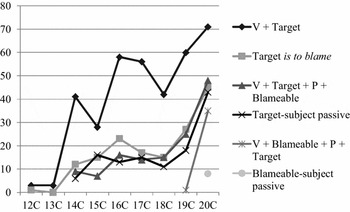
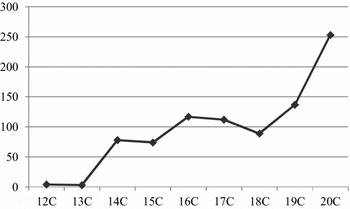
Figure 1 presents the diachronic distribution of the three main syntactic patterns discussed in this article and their related constructions. The data from the twenty-first century are excluded here. The vertical axis indicates the number of examples in the OED. With the exception of Blameable-subject passive, whose record is exclusive to a single century, the syntactic patterns in figure 1 all follow a similar path, which may be ascribed to the distribution of blame itself, as shown in figure 2.
Chronological distribution of the six syntactic patterns of blame in the OED Online

Chronological distribution of blame in the OED Online

The data from the OED resulted in a number of findings for the three questions raised after reviewing previous studies. First, put blame, which is sometimes compared with blame, is unlikely to be a critical contributing factor in the development of the on-construction, except for the choice of the preposition on. There is a gap of five centuries between their first attestations, and close equivalents of the on-construction, namely put blame for X on Y or put blame on Y for X, are found only in the twentieth century, perhaps by analogy with the on-construction which finally emerged in the previous century. Despite having coexisted with the for-construction since its first use in the fourteenth century, put blame before the twentieth century had apparently never overtly expressed the Blameable and instead continued to behave like ‘V + Target’. From a present-day perspective, the on-construction may seem to owe its meaning and structure to put blame, but historical facts suggest that the former is independent of the latter and may actually have affected its usage in expressing the Blameable.
Another reconsideration to be made regarding previous studies is Larson's (Reference Larson1990) claim that the Target in the for-construction must be animate. This apparent restriction was confirmed to be a general tendency rather than a real rule as in the double object construction in Present-day English. Inanimate Targets in the for-construction are indeed extremely rare until the nineteenth century, but examples become more available after that. Animacy is thus not a highly relevant factor for the for-construction today or in the recent history of English. Larson's claim is also weakened by the fact that the Target in ‘V + Target’ has never been limited to animate beings in the long history of this pattern. The Target in this environment should also be subject to animacy constraint if the hypothesis were valid, as the unexpressed for-phrase is assumed to be contextually recoverable. Other constructions also allow inanimate Targets, so it is safe to conclude that, irrespective of the type of construction, blame has never really had animacy restriction on the Target.
Finally, it turned out that the blame alternation was simply not possible or required until very recently, and even after it became technically available with the introduction of the on-construction, it did not immediately become fully established. The for-construction has been attested since the early fourteenth century, potentially influenced by the double object construction with Old French blasmer, but the on-construction did not arise until the early nineteenth century, possibly modelled on contemporary caused-motion constructions. The two constructions may have been able to coexist because they did not have much overlap in their uses, with the on-construction initially favoured in the expression blame it on and subsequently often selected when it is preferred in terms of information structure and the principle of end-weight.
The syntactic development of blame presented in this article raises a question as to the status of the Blameable role. Goldberg (Reference Goldberg1995) assumes that it is lexically profiled just like the Blamer and Target but can be left unexpressed if it receives a definite interpretation (‘definite null complement’). Hence, even in ‘V + Target’, the identity of the Blameable is presumed to be recoverable from the context. ‘V + Target’ has its origin in Old French, and in English it has the oldest history and is attested most richly of all the patterns. However, it is questionable whether the Blameable is indeed unexpressed in all of these instances. The Target in ‘V + Target’ sometimes seems to incorporate the Blameable when the blame concerns someone's nature or action (e.g. We blamed Mary's laziness). In such cases the person responsible for the nature or action is difficult to distinguish sharply from his/her blamed nature or action, as they are in a part–whole relationship with each other. The apparent merger between the Target and Blameable, which has been found ever since the twelfth century, conflicts with the idea in Goldberg (Reference Goldberg1995) that one profiled participant role of a verb is fused with one argument role of a construction. A closer examination of the context may disqualify some of the instances where the Target and Blameable seem to merge, but their merger in itself is known to be actually feasible under certain circumstances: Present-day English verbs of judgement, near-synonyms of blame, participate in Possessor Object Possessor-Attribute Factoring Alternation (e.g. I admired his courage vs I admired him for his courage; Levin Reference Levin1993: 72–4, 195), which precisely illustrates this merger. A more careful definition of the definite null complement is thus needed for blame as well as a large number of verbs which turn up in this alternation. Even when the Blameable does not appear where it is expected, it can sometimes combine with the Target to form a single noun phrase and share the same argument role (patient). The for-construction may have originated and continued to be employed partly as a strategy to clearly separate the Target and Blameable and focus on the Target person as the responsible participant, whereas their merger in ‘V + Target’ remained as an option to focus less on the Target person.