Introduction
Three out of four older adults living in developed countries suffer from more than one noncommunicable disease (NCD)—such as cardiovascular disease, cancer, chronic lung diseases, and diabetes—and this proportion is expected to rise dramatically in the next few years (Reference Wang, Naghavi and Allen1). Patients with chronic illness often exhibit lower than recommended adherence to medications (Reference Giardini, Martin, Cahir, Lehane, Menditto and Strano2). A review in the Annals of Internal Medicine reported that 20–30 percent of medication prescriptions are never filled and that approximately 50 percent of chronically treated patients do not adhere to their prescription medications and lack understanding of the importance of adherence and self-care (Reference Viswanathan, Golin, Jones, Ashok, Blalock and Wines3). Poor adherence to medication is significant and can lead to increased complications of disease, reduced quality of life, and increased overall healthcare costs (Reference Giardini, Martin, Cahir, Lehane, Menditto and Strano2).
The total costs in the U.S. for direct healthcare treatment for NCDs totaled $1.1 trillion in 2016 (Reference Hugh and Marlon4). In addition, NCDs lead to indirect costs; defined as lost income and reduced economic productivity (Reference Hugh and Marlon4). The increasing burden of NCDs has made the management of NCDs a global priority (Reference Hugh and Marlon4). The sixty-sixth annual World Health Assembly endorsed the World Health Organization (WHO) Action Plan for the prevention and control of NCDs 2013–20 (5).
Different strategies for improving patient outcomes, including education and motivational interview programs to allow behavioral modification, have been explored, are continuing to evolve, and have been proved to improve quality of life for patients with NCDs (Reference Georgopoulou, Prothero, Lempp, Galloway and Sturt6). More recently, the introduction of Patient Support Programs (PSPs) has been adopted to provide education and communication to improve adherence and, thus, healthcare outcomes in patients with NCDs (Reference Ganguli, Clewell and Shillington7). The Association of the British Pharmaceutical Industry (ABPI) defines a PSP as a service provided by pharmaceutical companies for direct patient or patient–caregiver engagement, designed to help patients better manage their disease and complex medication regimens, improve medication adherence, and reduce complications and related costs (8). A systematic review, assessing the outcome measures impacted by PSPs, has found that adherence measures were the most positively impacted through the use of PSPs, followed by humanistic outcomes such as patient-reported outcomes, quality of life, and functional status. On the other hand, there is less evidence supporting the positive impact of PSPs on patients’ clinical outcomes (Reference Ganguli, Clewell and Shillington7).
In terms of disease management, PSPs include support hotlines that are made available for patients or caregivers to provide them with information pertinent to their disease and medications (8). In addition, PSPs may include “Nurse Educator” initiatives where pharmaceutical companies hire nurses to engage directly with patients to assist them in administering their medications and to support them in their treatment journey (8). In terms of adherence, PSPs include programs where patients are contacted at regular intervals to check whether they are adhering to their prescribed medication regimens. Furthermore, PSP enrollment increases patient education and awareness on a disease, the course of treatment, and medication administration (Reference Koselke, Marini, Kraft, Walker, Allore and Mackler9). Thus, PSP enrollees are more likely to adopt healthy behavior and to adhere to their medications (Reference Koselke, Marini, Kraft, Walker, Allore and Mackler9;Reference Stockl, Shin, Lew, Zakharyan, Harada and Solow10). Medication adherence was defined by The WHO as “the extent to which a person's behavior corresponds with agreed recommendations from a health-care provider” (11). In terms of healthcare costs, PSPs may also include providing financial assistance for patients who cannot afford their medications, such as reimbursement or discount schemes (8).
Despite the growing awareness of PSPs worldwide, there is insufficient understanding of PSPs’ impact on patients’ lives in terms of clinical, humanistic, and economic outcomes. In Lebanon, PSPs were recently introduced into the pharmaceutical market. Only a few pharmaceutical companies have begun offering such programs and they are limited to some diseases that require highly expensive medicines. To our knowledge, in Lebanon, there are no investigations into either the level of knowledge and awareness about PSPs or on the impact of such programs on patients’ lives, done. In light of the above, the main objective of the present study is to describe the status of PSPs in Lebanon and to assess the extent of Lebanese patients’ knowledge and awareness about PSPs through a cross-sectional survey.
Methods
Source Population
This cross-sectional study was conducted between April and July 2017. A convenient sample of patients was randomly selected from outpatient clinics at four hospitals (such as the Military Hospital, Lebanese Geitaoui Hospital, Rafic Hariri University Hospital, and Ain Wazein Medical Village) within the Greater Beirut Area. These clinics include all common specialties. Permission requests to facilitate conducting the present study were submitted to all participating hospitals, along with a copy of the questionnaire and the informed consent form.
Inclusion and Exclusion Criteria
Eligible participants were Lebanese patients, 18 years old or older, suffering from one or more NCDs and undergoing treatment during the time of this study. In the present study, NCDs referred to one of the following categories: Cardiovascular Diseases, Cancer (any type), Chronic Lung Diseases, Diabetes, and others (such as Chronic Kidney Diseases, Osteoporosis, Rheumatoid Arthritis, Ulcerative Colitis, Chron's Disease, and Parkinson's). Excluded from the study were non-Lebanese patients and those who refused to sign informed consent.
Data Collection
Data were collected through a structured questionnaire that was developed by researchers and organized following an extensive literature review to meet the study's objective. The questionnaire was composed of the following six sections:
(1) Socio-demographic characteristics: Such as age, gender, employment status, and the type of NCDs.
(2) PSP status: PSP status was assessed by asking the participants the following direct questions: “Do you currently participate in a Patient Support Program?” and “Have you joined any Patient Support Program in the past?”
(3) Knowledge and awareness: Patient knowledge and awareness about PSPs in Lebanon was assessed by asking them the following direct question: “Are you familiar with Patient Support Programs or are you aware that they exist?”
(4) Healthcare follow-up: Participants were asked to specify the average duration of their visit once they consult their physicians and to indicate whether they receive any phone call from their healthcare providers (HCPs) to check on their health.
(5) Economic measures: The average number of hospital visits in the last 12 months and the average hospital stay days.
(6) Treatment adherence: Participants were asked to indicate whether they took their antihypertensive medications as prescribed by their HCPs or not.
The questionnaire was administered by trained interviewers via face-to-face interviews that lasted up to 25 minutes. Arabic, the country's official language, was used during the interviews in order to enhance the patients’ comprehension. The patients were assured of their anonymity and the confidentiality of their responses.
Sample Size Calculation
Based on previous study (12), 40–50 percent of adults had one or more chronic health conditions. Projecting these data to the Lebanese adults’ population leads to a total target population of 1.3–1.63 million. Therefore, 384 patients taken from a random sample were enrolled in the study to reflect statistically significant results of the target population with a 95 percent confidence level with a confidence interval of 5 percent.
Ethical Statement
In order to complete the requirements of the Institutional Review Boards (IRBs), the interviewers passed an examination offered by the office of the National Institute of Health (NIH) for extramural research: “Protecting Human Research Participants.” The study protocol was reviewed and approved by the IRB of the Lebanese University, the IRB of the military hospital, Lebanese Geitaoui Hospital, Rafic Hariri University Hospital, and Ain Wazein Medical Village. In accordance with the privacy rule of the Health Insurance Portability and Accountability Act and the declaration of Helsinki, all patients who participated in the study gave written informed consent.
Statistical Analysis
Data from 385 questionnaires were entered and analyzed by using Statistical Package for the Social Sciences (SPSS) program version 23. As part of quality control, the data entered into the computer were double-checked for their accuracy by making a random assessment of the survey responses and the data entered. Qualitative data were represented in frequency and percentage, whereas quantitative data, such as the number of hospital visits and hospital stay days, were represented by mean and standard deviation (SD). Bivariate analysis was performed using the Chi-square test. A value of p value < .05 was considered statistically significant.
Results
Baseline Characteristics
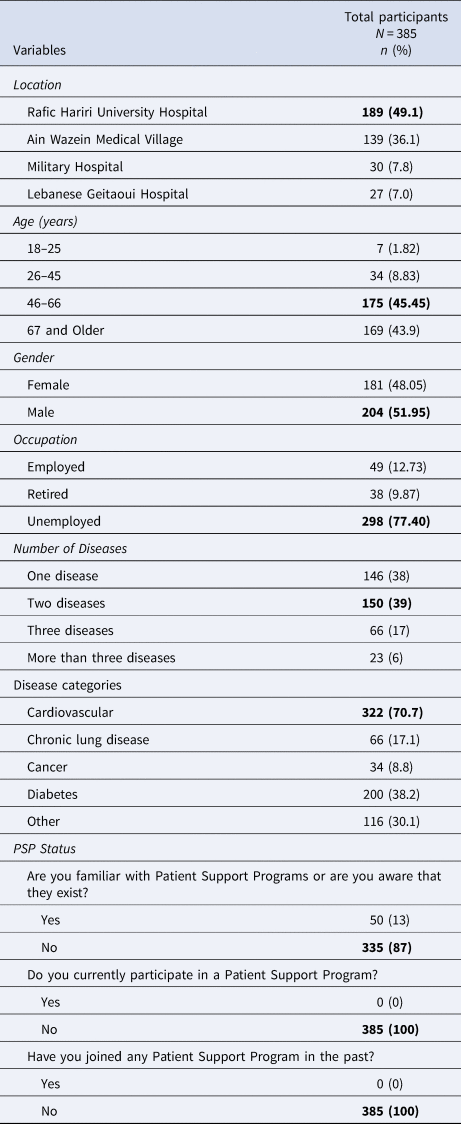
After applying inclusion and exclusion criteria, from 402 NCD patients requested, 385 participated, whereas 17 patients refused to sign the consent form and were excluded, leading to a response rate of 95.77 percent. As shown in Table 1, among the enrolled participants, 189 (49.1%) participants were recruited from Rafic Hariri University hospital, 139 (36.1%) from Ain Wazein Medical village, 30 (7.8%) patients from Military Hospital, and 27 (7.0%) patients from Lebanese Geitaoui Hospital. The study involved 204 (52.9%) males and 181 (48.1%) females with no significant age difference between males and females (p = .772). According to the age group, 175 (45.45%) participants were between 46 and 66. The survey respondents were predominantly unemployed, their number being 298 (77.40%), and only 49 (12.73%) of the sample population were employed.
Baseline characteristic, chronic diseases, and PSP status among participants

The percentages in “bold” refer to the highest percentage of each category.
Chronic Disease and PSP Status among Participants
The disease and PSP status of the study participants is presented in Table 2. The majority of the study participants, numbering 239 (62%), suffered from more than one chronic disease, out of which 150 (39%) suffered from two diseases, 66 (17%) from three diseases, and 23 (6%) from more than three diseases. In addition, the majority of the participants, 322 (70.7%), suffered from a cardiovascular disease. Due to the comorbidity factor, the percentages distributed over the different disease categories did not reach 100. Among the 385 participants, none was enrolled in a PSP program, and only 50 (13%) of them were aware of the existence of PSP service in the Lebanese healthcare sector.
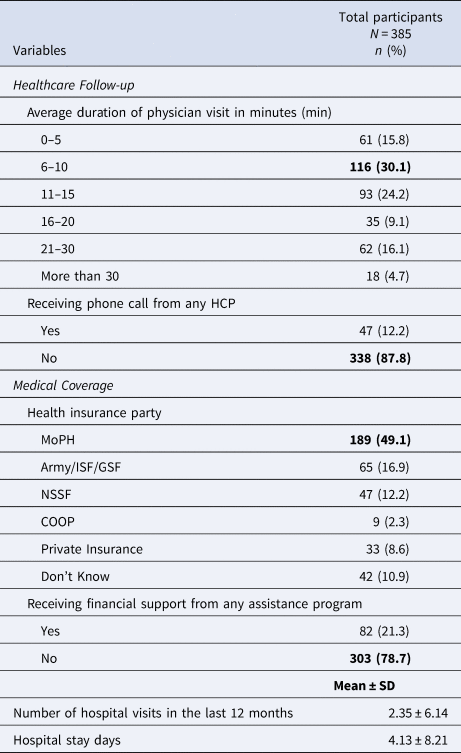
Healthcare Follow-up, Medical Coverage, and Hospitalization among participants

The percentages in “bold” refer to the highest percentage of each category.
Healthcare Follow-up, Medical Coverage, and Hospitalization
As shown in Table 2, the majority of the participants, 367 (95.3%), spend on average less than 30 minutes (min) upon consulting their physicians. However, only 18 (4.7%) spend more than 30 minutes as an average duration of the consultation visit. Moreover, 338 (87.8%) of the patients reported that they do not receive follow-up calls from their HCPs. Almost half of the respondents, 189 (49.1%), indicated that they were medically covered by the Lebanese Ministry of Public Health (MoPH). Furthermore, 82 (21.3%) of the participants received financial assistance from some programs organized by the Lebanese Ministry of Social Affairs and charities. In addition, the mean number of hospital visits in the last 12 months reported by the study participants was 2.35 ± 6.14, whereas the mean number of hospital stay days was 4.13 ± 8.21.
Medication Adherence and Reporting Adverse Events
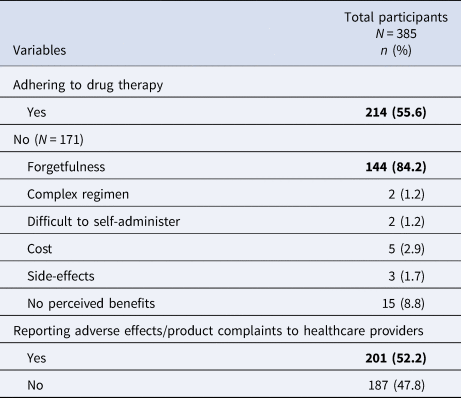
In terms of medication adherence, 214 (55.6%) patients self-reported that they do not skip any dose of their medication and consume their medication as prescribed by their HCPs. In contrast, 171 (44.4%) patients self-reported that they were nonadherent to their medication. The main reason for the nonadherence reported by the majority of nonadherent participants, 144 (84.2%), was simple forgetfulness. In addition, 201 (52.2%) of the respondents reported adverse events and/or product complaints to their HCPs. On the other hand, 187 (47.8%) of the respondents admitted that they did not report any adverse effects and/or product complaints to their HCPs (Table 3).
Medication adherence and reporting adverse events among participants

The percentages in “bold” refer to the highest percentage of each category.
Factors Associated with PSP Awareness
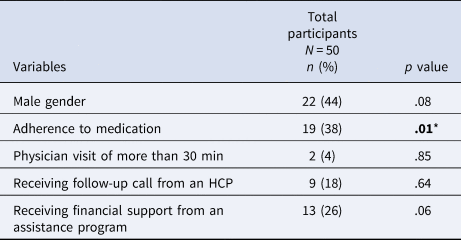
In Table 4, bivariate analysis was performed, using the Chi-square test, to evaluate factors associated with PSP awareness. The variables included gender, adherence to medication, a physician visit of more than 30 minutes, receiving a follow-up call from an HCP, and receiving financial support from an assistance program.
Factors associated with PSP awareness

The percentages in “bold” refer to the highest percentage of each category.
* p < .05 is considered significant.
As shown in Table 4, twenty-two (44%) participants who were aware about the existence of PSPs were males, with no significant difference between males and females (p = .08). In addition, nineteen (38%) participants who were aware about the existence of PSPs were adherent to their medication, which shows a significant association (p = .01) between awareness about PSPs and medication adherence. Only 4 percent of the participants who were aware about PSPs spend more than 30 minutes upon consulting their physicians (p = .85). Moreover, only 18 percent of them admitted receiving follow-up calls from their HCPs (p = .64) and 26 percent of them were receiving financial support from an assistance program (p = .06).
Discussion
The aim of the present study was to describe the status of PSPs in Lebanon and to evaluate Lebanese patients’ knowledge and awareness about PSPs. Our results showed that only 13 percent of the participants were aware of PSP offerings in Lebanon. These findings suggest that awareness about PSPs in Lebanon is still very low. Additionally, the respondents indicated that their awareness was mainly through word of mouth such as a relative or friend who was enrolled in PSPs. In agreement with our result, a survey conducted by “Accenture” in 2015 including 10,000 patients around the world reveals that less than one in five patients (19%) are aware of the services that are available to them through the companies that supply their therapeutics (Reference Romito, Pressburger and Wiedenhoft13). Our results showed that none of the 385 participants enrolled in the present study had been previously enrolled or was enrolled in a PSP during study time. Compared with other studies, the proportion of patient enrollment in PSPs was only 7.6 percent in a German study in 2020 (Reference Lenz and Harms14), whereas it was higher in the Japan Fracture Observational Study (JFOS) (39.6%) (Reference Sato, Tsujimoto, Kajimoto, Uetake, Shimoda and Fujiwara15) and a little bit higher in an U.S. study (56.7%) (Reference Brixner, Mittal, Rubin, Mease, Liu and Davis16). PASSION study included participants from fourteen different countries such as Australia, Belgium, Czech Republic, France, Germany, Greece, Israel, Mexico, the Netherlands, Portugal, Puerto Rico, Slovakia, Switzerland, and the United Kingdom; it showed that 48.7 percent of patients were PSP users (Reference Van den Bosch, Ostor, Wassenberg, Chen, Wang and Garg17). Our results could indicate that PSPs in Lebanon are relatively limited to certain diseases and patients who were not captured by this survey. Therefore, another survey should be conducted at a later stage in order to assess the evolution of PSPs in Lebanon. Although the trend of running PSPs is increasing worldwide, we can propose that PSPs around the world in general, and in Lebanon in particular, are still considered to be in their infancy.
Additionally, in our study, only 4.7 percent of patients reported that their average duration of visits to their HCPs lasts more than 30 minutes. A systematic review showed that eighteen countries covering approximately 50 percent of the world's population have a reported mean consultation length of 5 minutes or less (Reference Jin, Zhao, Chen, Wenji, Juan and Xiaoqin18). Such a short consultation length is likely to adversely affect patient care. It takes a toll on the doctor–patient relationship, which is considered a key ingredient of good care, and may represent a missed opportunity for getting patients more actively involved in their own health (Reference Jin, Zhao, Chen, Wenji, Juan and Xiaoqin18). There is less of a dialog between patient and doctor, and by increasing the odds, patients will leave the office frustrated (Reference Jin, Zhao, Chen, Wenji, Juan and Xiaoqin18). In the U.S., the average consultation length was reported to be over 20 minutes (Reference Jin, Zhao, Chen, Wenji, Juan and Xiaoqin18), whereas the consultation length in Australia was reported to be just under 15 minutes (Reference Jin, Zhao, Chen, Wenji, Juan and Xiaoqin18). Moreover, another systematic review showed that the length of consultation time was on average 6.9–12.4 minutes and the average consultation length of doctor–patient communication appears to be positively related to patient satisfaction. Increasing effective communication is generally associated with increased patient satisfaction with consultation time (Reference Fitri and Sari19). A study by Lorig et al. demonstrates that implementing support programs has improved the communication between the patient and their physician (Reference Lorig, Sobel, Ritter, Laurent and Hobbs20). This finding is in accordance with our results as none of our study participants were enrolled in PSPs. Therefore, patients need to spend sufficient time while consulting their HCPs to be adequately educated about their disease, treatment, doses, adverse effects, and other concerns related to their health condition, highlight the beneficial impact of PSPs on the patients’ journeys.
In our study, only 12.2 percent of participants reported that they receive phone calls from their HCPs checking on their health as none of them were involved in PSPs. However, other studies such as those by Kaur et al. (Reference Kaur, Kajal, Kaur and Singh21) indicated that patients participating in PSPs receive continuous calls from their HCPs due to the fact that telephonic consultation can be a useful tool to improve patients’ health status, adherence habits, and satisfaction with the treatment. In addition, a study by Houser et al. showed that 88 percent of patients favor the idea of the calls and those receiving them found them helpful. Also, they had higher patient satisfaction scores than those not called (Reference Houser, Ray, Maisiak, Panjamapirom, Willing and Schiff22). Using carefully designed follow-up calls is an innovative and supportive approach to monitor patient health problems and address urgent problems in a timely fashion (Reference Houser, Ray, Maisiak, Panjamapirom, Willing and Schiff22).
As well, a meta-analysis conducted by Ganguli et al. (Reference Ganguli, Clewell and Shillington7), which examined the results of sixty-four studies, showed a positive impact of PSPs on adherence, clinical, and humanistic outcomes, which, on the other hand, can explain the high level of nonadherents among our study participants (44.5%) as none of them was a PSP enrollee. Our results also found a significant association between patient awareness about PSPs and medication adherence (p = .01). In agreement with these findings, Stock et al. (Reference Stockl, Shin, Lew, Zakharyan, Harada and Solow10) and Rubin et al. (Reference Rubin, Mittal, Davis, Johnson, Chao and Skup23) reported that PSP enrollment leads to an improved medication adherence habit. Furthermore, a U.S. study demonstrated that the additional value of comprehensive coordinated care supported by PSPs, had shown significant changes in adherence (29 percent greater), discontinuation rate (22 percent lower), medical costs (29 percent lower), and total costs (9 percent lower), despite an increase in the prescription costs of 12 percent across a range of indications (such as rheumatoid arthritis, Crohn's disease, ulcerative colitis, psoriasis, psoriatic arthritis, ankylosing spondylitis, uveitis, and hidradenitis suppurativa). Therefore, although there may be an increase in drug costs associated with PSPs, the total cost associated with treating these indications is likely to be lower (Reference Brixner, Mittal, Rubin, Mease, Liu and Davis16). Besides, forgetfulness was reported by 84 percent of nonadherent respondents to be the major contributing factor to nonadherence, which is in concordance with the results of the Adis et al. study (Reference Adis, Martins and Fakeye24). The provided services by PSPs such as automated reminders, text messages, and electronic pill boxes can be very useful tools in improving adherence habits and overcoming one of the main barriers which is forgetfulness.
Moreover, our results showed that the majority of the participants (89.1%) had healthcare coverage. However, some of the reimbursement bodies in Lebanon, such as the National Social Security Fund (NSSF), Cooperative of Government Employees (COOP), and private insurances might not provide full coverage. Besides, 21.3 percent of our participants received financial assistance from some programs organized by the Lebanese Ministry of Social Affairs and charities. Superficially, copay assistance programs present a path to access and affordability for patients (Reference Zafar and Peppercorn25). However, by reducing cost sharing without addressing the problem of high healthcare costs, these programs not only fail to solve the problem of access to quality care, but also perpetuate it (Reference Zafar and Peppercorn25). Shielding patients from drug costs could minimize political pressure to address costs and facilitate greater use of drugs, which raise the total healthcare expenditures while increasing company profits (Reference Zafar and Peppercorn25). On the other hand, Koselke et al. (Reference Koselke, Marini, Kraft, Walker, Allore and Mackler9) showed in their study that PSPs such as “The Outpatient Oral Anticancer Therapy” helped 59 percent of patients receive financial assistance to obtain their medication, thus improving their access to high-cost medications. Financial assistance proposed by PSPs could help compensate the charges that are not fulfilled by the reimbursement bodies that help patients overcome the financial obstacles in order to access their treatments.
As our results showed that none of the participants was enrolled in PSPs, the impact of PSPs on hospitalization was assessed based on the literature that had previously examined this issue. A study aiming to evaluate the total medical costs for patients taking Humira [Adalimumab], a treatment indicated for the treatment of several chronic immune-mediated diseases, showed that the total medical costs were 10 percent lower for PSP enrollees than for non-PSP patients (US$35,741 vs. US $39,713), with the main driver of lower spending being the significant reductions in hospitalization costs (US$5,960 vs. US$10,297) (Reference Rubin, Mittal, Davis, Johnson, Chao and Skup23). Therefore, enrollment in PSPs was associated with reductions in medical costs (all-cause and disease-related) and total healthcare costs (particularly inpatient costs) (Reference Rubin, Mittal, Davis, Johnson, Chao and Skup23). These data are of interest to physicians, who may wish to consider selecting therapies with robust PSPs for their patients in order to achieve optimal clinical outcomes, as well as to payers, who may note the reduced costs associated with patient enrollment in PSPs (Reference Rubin, Mittal, Davis, Johnson, Chao and Skup23). Moreover, Lorig et al. (Reference Lorig, Sobel, Ritter, Laurent and Hobbs20) showed that over a one-year period, PSP participants had a mean of 0.97-day reduction in hospitalization, showing an annual cost saving of US $400,000 for 489 PSP-enrolled patients. One year after exposure to PSPs, most patients experienced statistically significant improvements in a variety of health outcomes (such as fatigue, shortness of breath, pain, role function, depression, and health distress) and had fewer emergency department visits (Reference Lorig, Sobel, Ritter, Laurent and Hobbs20).
An analysis of the mentioned results could suggest that there should be a consideration of not only the prevalence of PSPs, but also the quality of these programs and the information communicated to patients. Drawing key learnings from previous or existing PSPs could lead to drafting recommendations for good practice of PSPs that would help patients in the information seeking/education process and finally contribute to better patient-reported outcomes and healthcare cost savings.
Clinical Implications
Given the significant value that PSPs create for patients, there should be a more substantial effort by pharmaceutical companies to expand and promote their PSPs in the Lebanese market. On the other hand, payers, regulators, and reimbursement bodies in Lebanon should consider including PSPs in the value assessments of new/existing therapies. To bridge the current awareness gap, regulators and pharmaceutical companies should work together to increase the awareness about the importance of PSPs. Such promotional efforts should introduce the PSP concept, the aim of the program, the benefits to patients, as well as enrollment information so that patients become aware how to sign up and enroll in a particular program. Needless to say, PSP promotional efforts should be carried out in an ethical manner within the confines of the laws governing the marketing of medicinal products. Therefore, there is an urgent need for local authorities to generate local recommendations and guidelines on the good practices of PSPs to ensure that all efforts put are indeed for the best interest of patients. The present study is a starting point for conducting future research and analysis in the area of pharmaceutical companies’ efforts for patient support.
Study Limitations
The total number of visited hospitals was four, which is considered a small number compared with the overall number of hospitals in Lebanon, predisposing us to a possible selection bias. Thus, increasing the number of hospitals included in the study would have given more accurate and diverse results. Moreover, in an observational study, a response bias usually occurs because the study participants may respond to questions in a socially desirable manner rather than accurately, which will consequently influence our reported results.
Conclusion
In conclusion, the present study suggests that the growing trend of running PSPs by pharmaceutical companies is still at its infancy in Lebanon. Additionally, the study has shed light on the importance of implementing such programs as they demonstrably improve clinical, humanistic, and economic outcomes for patients. Future research endeavors should focus on improving the effectiveness and efficiency of PSPs so that pharmaceutical companies can serve their patients in more impactful and beneficial ways.
Funding
This project has been funded with support from the Lebanese University.
Conflict of Interest
The authors report no conflicts of interest in this work.