Introduction
Technological practices are key to understanding modern society. From energy production to telecommunications and medicine, human well-being depends on the availability of technical solutions to the problems that individuals and groups face. Given this, a large amount of literature has analysed the determinants of technology innovation and adoption (Grübler et al. Reference Grübler, Nakićenović and Victor1999; Beise Reference Beise2004). While much of this literature focuses on economic factors, an important subset of the literature emphasises the role of politics and policy (Cashore Reference Cashore2002; Laird and Stefes Reference Laird and Stefes2009; Lyon and Yin Reference Lyon and Yin2010).
In political analysis of technology diffusion, the role of (social) advocacy groups – organised groups of people with a common societal goal – has recently drawn a lot of attention (Falkner Reference Falkner2003; O'Rourke Reference O'Rourke2003; Binder and Neumayer Reference Binder and Neumayer2005; Michaelowa Reference Michaelowa2005; Gullberg Reference Gullberg2008; Vasi Reference Vasi2011). According to this research, advocacy groups have played a pivotal role in promoting the diffusion of technologies that help them achieve their own aims. For example, environmentalists could promote wind and solar power to reduce greenhouse gas emissions. This line of inquiry emphasises two channels of influence. First, advocacy groups can lobby policymakers (Michaelowa Reference Michaelowa2005; Gullberg Reference Gullberg2008). For instance, environmentalists could demand a feed-in tariff. Second, advocacy groups campaign to induce end users to adopt new technologies (Cashore Reference Cashore2002; Vasi Reference Vasi2011). To illustrate, environmentalists could name and shame companies that do not purchase green electricity.
While these accounts recognise the possibility that advocacy groups lobby both policymakers and end users, they do not offer a theoretical model of how these strategies interact. Does political lobbying support campaigning vis-à-vis end users, or does political lobbying replace campaigns targeted at end users? Scholars of “private authority” (Cashore Reference Cashore2002; Falkner Reference Falkner2003; Pattberg Reference Pattberg2005) and lobbying (Baron Reference Baron2001; Feddersen and Gilligan Reference Feddersen and Gilligan2001) have argued that advocacy groups can influence the decisions of end users, even if the state fails to regulate. However, it seems equally plausible that public policy can support a social movement's efforts to influence end users. This question has important implications for explaining why some advocacy group movements succeed and others fail, for explaining why some technologies become widely adopted while others die a silent death, and for different advocacy group movements’ choice of strategies and tactics.
Motivated by these concerns, we present a game-theoretic analysis of the strategic relationship between political lobbying and campaigns targeted at end users. We examine games in which an advocacy group is trying to induce people to adopt a new technology. In one variant of the game, the advocacy group can only campaign vis-à-vis end users because the government is not receptive to political lobbying. In another variant, the advocacy group can also engage in political lobbying for technology adoption subsidies because the government is responsive to lobbying.
By comparing technology adoption outcomes and the advocacy group's equilibrium payoffs across the two variants, we can shed light on the importance of opportunity structures that allow political lobbying for the advocacy group's success. For example, consider two advocacy groups that face otherwise similar circumstances except that one of them has the resources to engage in political lobbying within the system. We examine the consequences of this difference for technology adoption.
We show that if an advocacy group is unable to lobby policymakers, its campaigning efforts vis-à-vis end users weakens the government's policy response. As the advocacy group's incentive to promote the new technology grows, the government's subsidy decreases. The government anticipates that campaigning will promote technology diffusion, and thus the government's incentive to subsidise the new technology decreases. The government can free ride on the advocacy group's efforts.Footnote 1 For example, if environmentalists do not have access and connections to a country's ministry of trade and industry, then environmental campaigns targeted at major electricity consumers result in lower subsidies for renewable energy. Advocacy groups can be much more effective if they combine political lobbying and campaigns aimed at end users.
This finding emphasises the complementarity of political lobbying and public campaigns aimed at end users. End users play a key role because their decisions ultimately determine the diffusion of new technology. But if an advocacy group cannot lobby policymakers, then effective public campaigns will undermine the government's incentive to implement public policies. While this incentive to free ride cannot be eradicated in full, an advocacy group that is able to adopt a dual strategy of lobbying policymakers while campaigning in the public can mitigate the negative consequences of such free riding by providing the government with incentives to offer subsidies. This results in a significant payoff increase to the advocacy group. Thus, advocacy groups have strong incentives to engage in political lobbying if they are able to do so. A government's willingness to respond to advocacy groups’ demands is key to understanding the overall effectiveness of advocacy for technology adoption.
The most important implication of this analysis is that the relationship between the intensity of the advocacy group's preference regarding the new technology and the government's subsidy depends on the possibility of political lobbying. If political lobbying is not possible, the advocacy group's preference intensity is negatively associated with the government's subsidy. While intuition states that strong advocacy groups should increase the government's willingness to subsidise new technologies, exactly the opposite is true when political lobbying is difficult. Only when political lobbying is possible is the advocacy group's preference intensity positively associated with the government's subsidy. This finding is important for empirical scholarship because it suggests that, contrary to some earlier accounts, such as the story of wind energy advocacy in Vasi (Reference Vasi2011), that political institutions modify the effect of advocacy group preferences on public policy.
The article is organised as follows. First, we briefly review the literature on advocacy group movements and technology diffusion. Next, we present and solve our game-theoretic model. Third, we illustrate our findings with a concise survey of the environmental movement's influence on wind energy deployment. Before the concluding remarks, we examine a model extension that allows competing advocacy groups, such as coal companies expecting to lose from increased use of wind electricity, to lobby the government against technology diffusion.
Advocacy groups and technology diffusion
Our aim is to examine the conditions under which advocacy groups can increase the rate of technology diffusion. We define advocacy groups broadly as organised groups of individuals with a common social goal, such as promoting gay rights or protecting environmental quality (Wapner Reference Wapner1995; Keck and Sikkink Reference Keck and Sikkink1998; Price Reference Price1998; Vasi Reference Vasi2011). By technology diffusion, we refer to the adoption of a new technological innovation by end users (Lanjouw and Mody Reference Lanjouw and Mody1996; Grübler et al. Reference Grübler, Nakićenović and Victor1999; Huber Reference Huber2008). We are particularly interested in technologies that advocacy groups could promote. For environmentalists, these may include wind power or energy conservation equipment; for opponents of stringent intellectual property rights, freeware software would qualify.
Advocacy groups can promote technology diffusion in several ways. Much of the extant literature focuses on lobbying political authorities (Binder and Neumayer Reference Binder and Neumayer2005; Michaelowa Reference Michaelowa2005; Lyon and Yin Reference Lyon and Yin2010; Vasi Reference Vasi2011). These scholars argue that engaging in political lobbying for legislation is essential because governments enact and administer policy (Dalton and Rohrschneider Reference Dalton and Rohrschneider2003). According to this literature, advocacy group members can demand that the government enact policies that increase the diffusion of a new technology. For example, the environmental movement played an integral role in promoting the adoption of feed-in tariffs in Germany (Laird and Stefes Reference Laird and Stefes2009). Similarly, activists combating the spread of HIV have lobbied governments for policies that allow citizens to obtain medicine and adopt preventive measures at a lower cost. Dalton (Reference Dalton1994) and Shaiko (Reference Shaiko1999) present examples of non-governmental organisations collaborating with parliamentarians and testifying before government commissions in Europe and the United States.
An alternative approach that has drawn considerable attention in recent years focuses on advocacy groups’ efforts to directly promote technology diffusion by enticing end users to adopt new technologies and practices (Cashore Reference Cashore2002; O'Rourke Reference O'Rourke2003; Gulbrandsen Reference Gulbrandsen2004, Reference Gulbrandsen2008; Dingwerth Reference Dingwerth2008; Vasi Reference Vasi2011). This literature highlights the fact that if governments fail to enact policies that allow technology diffusion, then advocacy groups can create schemes of “private authority” that increase end users’ incentives to adopt new technologies in the absence of governmental regulation (Falkner Reference Falkner2003; Prakash and Potoski Reference Prakash and Potoski2006; Vogel Reference Vogel2008; Abbott and Snidal Reference Abbott and Snidal2010). One prominent example is the private forest certification scheme of the Forest Stewardship Council which certifies a company's forest practices, and thus allows this company to acquire a greener image (Cashore Reference Cashore2002; Pattberg Reference Pattberg2005). The scheme promotes the diffusion of sustainable forestry technology without relying on public regulations. Similarly, Vasi (Reference Vasi2011) notes that environmental movements have organised campaigns to induce large companies to purchase wind electricity.
While previous research has recognised both channels of influence, their interactions have not been theorised. A common premise in the literature on private authority is that it can substitute for lackluster governmental regulation (Cashore Reference Cashore2002; Falkner Reference Falkner2003; Gulbrandsen Reference Gulbrandsen2004; Pattberg Reference Pattberg2005). However, this research does not offer analytical characterisation of the conditions under which public and private governance are substitutes. It is equally plausible that in some circumstances they support each other. For example, advocacy groups may play a useful role in facilitating the enforcement and implementation of public policies that mandate the adoption of a certain technology. Indeed, public-private partnerships are increasingly common in national and global governance (Dingwerth Reference Dingwerth2005; Zarco-Jasso Reference Zarco-Jasso2005).
One study that offers a detailed analysis of lobbying political authorities and end users is Vasi's (Reference Vasi2011) account of the effect of the environmental movement on the use of wind power in Europe and the United States. He provides empirical evidence that environmental movements have often successfully lobbied for public policies while also campaigning to increase the number of end users that use wind energy. He recognises the importance of both channels of influence, and shows that the environmental movement has relied on both, but he does not offer a theoretical analysis of the interactions between these two forms of lobbying. Thus, it remains unclear whether these two forms of influence should be regarded as substitutes, complements, or independent forces that do not produce interactive effects.
In the game-theoretic literature on advocacy groups and lobbying, at least three contributions are worth highlighting. Baron (Reference Baron2001, Reference Baron2009) presents models of “private politics”, whereby activists can target firms to influence their business practices. The activist's campaigning influences the firm's strategy and competitive position. Our model builds on these insights and examines how end user lobbying interacts with conventional political advocacy.
In an earlier contribution, Ainsworth and Sened (Reference Ainsworth and Sened1993) argue that advocacy groups are “entrepreneurs with two audiences”: they must simultaneously influence the government and maintain the support of their constituencies. According to this model, one key function that advocacy groups can perform is to provide information about people's policy preferences to the government. In our model, the advocacy group also has two audiences. However, our focus is on the role of political and end user lobbying, as opposed to the informational logic of advocacy.
Feddersen and Gilligan (Reference Feddersen and Gilligan2001) analyse the role of activism in the provision of “credence goods”, defined as goods whose quality consumers cannot directly observe. In the model, activists can both provide consumers with information about this unobserved quality and induce firms to produce goods of high quality. While our model is not based on incomplete information, we also highlight the possibility that interest groups provide consumers with incentive to purchase new technologies.
We contribute to the literature by developing a theory of lobbying political authorities and end users as complementary strategies. Building on the literature, we assume that both causal channels are potentially effective. We then show that in the absence of political lobbying, campaigns to mobilise end users may have perverse effects: while they increase end users’ incentives to adopt new technologies, they also reduce the government's incentive to subsidise the adoption of these technologies. Thus, campaigns to mobilise end users have a negative effect on governmental policy. In contrast, we find, campaigns to mobilise end users in conjunction with political lobbying avoid this negative effect. The following sections detail this argument.
Theory
Our game-theoretic analysis sheds light on the strategic relationship between political lobbying and influencing potential end users of new technology. We thus compare two variants of a simple mathematical model. In one variant, an advocacy group can only lobby the end user. In another variant, the advocacy group can also lobby the government. The first variant focuses on an advocacy groups that is unable to engage in political lobbying, perhaps because all advocates are local grassroots activists. The second variant captures a situation in which the advocacy group has the resources and access needed to influence governmental decision making from within. While these two scenarios are stylised, as most advocacy groups engage both in political lobbying and end user campaigning, a comparative analysis is useful because it isolates the effect of enhanced political access on strategies and outcomes. Based on this model, we examine how the possibility of political lobbying shapes the government's policy incentives and influences the advocacy group's effectiveness.
The model is designed to emphasise the possibility of dual strategy: advocacy groups can both lobby the government for technology adoption subsidies and implement campaigns that directly encourage end users to adopt the new technology. One variant of the model allows the advocacy group to select an optimal “mix” of political lobbying and end user campaigning. As such, the model differs from conventional accounts of lobbying that omit end users (Grossman and Helpman Reference Grossman and Helpman1994; Keohane et al. Reference Keohane, Revesz and Stavins1998). While our approach to political lobbying is perhaps not as sophisticated as extant theories, we are able to incorporate campaigns vis-à-vis end users. The analysis of such dual strategies is our key contribution to the literature.
The case of technology adoption warrants a specific model because it differs from some conventional lobbying situations in several respects. Specifically, our model highlights three key differences to conventional lobbying models (Ainsworth and Sened Reference Ainsworth and Sened1993; Austen-Smith Reference Austen-Smith1993; Grossman and Helpman Reference Grossman and Helpman1994, Reference Grossman and Helpman2001; Hall and Deardorff Reference Hall and Deardorff2006). First, many policies, such as tax or health care reform, do not require end user campaigning for adoption. Second, while subsidies play a major role in technology adoption, they are not applicable to many other issue area. Finally, the nature of technology adoption is important for understanding the sequence of moves. In many issue areas, advocates create public support among the public for policy before it is implemented. In the case of technology adoption, end users move after the policy is already enacted.
Model
The game analysed here is played by an advocacy group, a government, and an end user. The advocacy group can lobby a government to increase the governmental subsidies for technology consumption. A government then decides the subsidy level, and the advocacy group can directly lobby end users to increase the technology consumption. The end user considers the adoption of a concrete new technology, such as a solar panel or a hybrid car.Footnote 2 The end user's decision is influenced by the government's subsidy and the advocacy group's campaigning.
We first present a full model incorporating both political lobbying and campaigns targeted at the end users. Then, we consider the model without political lobbying and compare it with the full model to examine the interactive effects of political lobbying and consumer lobbying.
To maximise tractability, we introduce several simplifications. First, we do not consider a firm's decision to develop technology. An advocacy group's lobbying might be significant in promoting the firm's technology development but the firm's decision has a minimal impact on the end user's technology consumption. To maintain a sharp focus on technology consumption, our model leaves this complication for future research. Second, we assume complete information. While assuming uncertainty could provide interesting insights, we prefer a simple exposition that is accessible to a broad audience. One issue that we are unable to analyse under complete information is “greenwashing”, defined as the possibility that the end users adopt technologies under the false belief that these technologies are environmentally sustainable. Given our focus on concrete technology adoption, this simplification seems warranted. Moreover, while our model omits this issue, one imagine that one part of end user campaigning is information provision (Feddersen and Gilligan Reference Feddersen and Gilligan2001).
In the baseline model, we assume only one advocacy group exists. However, below we examine an extension that features competition between groups. For example, an environmental advocacy group could compete with industry lobbyists. The extension shows that our main results continue to hold under competitive lobbying.
We also do not emphasise dynamics in the analysis. Our static model does not examine learning. In reality, it seems plausible that the advocacy group's strategy converges to our equilibrium over time. The advocacy group might begin by relying on one strategy, such as end user campaigning, and then learn the need for a dual strategy over time. This expectation is consistent with the general thrust of our argument. Moreover, the advocacy group's ability to promote the new technology could change over time. As the number of end users increases, the government's political support to promote the technology may also increase due to network externalities. Accordingly, it seems plausible that the advocacy group's initial activities can create a positive feedback loop that causes more lobbying, subsidies and technology adoption over time.
Sequence of moves
Formally, we consider the following sequence of moves:
1. The advocacy group decides on political lobbying
 $$)(--><$> p\, \in \,[0,\infty ) <$><!--$$
.
2. The government selects subsidy
$$)(--><$> s\, \in \,[0,\infty ) <$><!--$$
.3. The advocacy group decides on mobilisation
$$)(--><$> m\, \in \,[0,\infty ) <$><!--$$
to lobby the end users.4. The end user decides on consumption
$$)(--><$> U\, \in \,[0,\infty ) <$><!--$$
.


This sequence of moves is based on the idea that the advocacy group first engages in political lobbying, and then lobbies the end user after observing the government's subsidy choice. The end user selects the consumption based on the governmental subsidy and the advocacy group's campaign.Footnote 3
End user payoffs
The model assumes a single end user who decides on the technology consumption. While individual decisions can be made in various ways, we make a general assumption that the end user's decision on technology consumption is determined by the level of advocacy group mobilisation, subsidy from the government, and costs and benefits of using the new technology. For a given level of technology consumption U, the payoff to the end user is
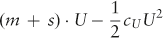 $$(m\, + \,s) \cdot U\,{\rm{ - }}\,\frac{1}{2}{{c}_U}{{U}^2} $$
For every unit of technology consumption U, the end user gains a marginal benefit of m + s. This benefit increases with mobilisation m and subsidy s. The second term,  $$)(--><$> \frac{1}{2}{{c}_U}{{U}^2} <$><!--$$
, reflects the cost of the technology. We assume a linear payoff structure to reduce notation and obtain explicit analytical solutions, but the main insights from the analysis would hold given more general payoffs, specifically concave benefit and convex cost functions.
The gains from the mobilisation level m have a natural interpretation: if the advocacy group campaigns for a new technology, the end user obtains a larger reputational benefit from adopting it. For example, if environmentalists campaign for recycling, then companies can adopt recycling technologies to green their image. In addition, the advocacy group can also provide potential end users with useful information and even offer to help them adopt new technologies. The key scope condition is that the advocacy group's campaigning increases the end user's incentive to adopt the new technology. In practice, this usually requires the existence of reputational or informational benefits.
The value of the subsidy s also has a natural interpretation: for each unit of new technology adopted, the end user receives some compensation from the government. This increases the end user's willingness to adopt. For example, the government could subsidise renewable energy or a new flu vaccine.
A key assumption in our model is that the use of technology is costly for the end user, and the marginal cost increases with additional technology consumption. In the case of renewable energy technology, the end user finds it costly to purchase expensive renewable energy rather than relying on inexpensive coal. In this case, the coefficient cU captures the opportunity cost of replacing coal with renewable energy sources.
Therefore, the end user prefers not purchasing technology without the benefits from the advocacy group and the governmental subsidy. Moreover, relying on renewable energy technology becomes increasingly expensive on the margin.Footnote 4 For every unit of technology that the end user does not purchase, one could imagine the end user purchasing another technology that the advocacy group detests. Alternatively, the end user could purchase nothing at all.
Advocacy group payoffs from mobilisation
We assume that the advocacy group is mainly concerned with the societal benefits from new technology adoption, such as pollution abatement, and the mobilisation costs. At the mobilisation stage, the advocacy group takes the government's subsidy s as a given. Thus, it maximises the following payoff with respect to m:
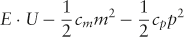 $$E \cdot U\,{\rm{ - }}\,\frac{1}{2}{{c}_m}{{m}^2} \,{\rm{ - }}\,\frac{1}{2}{{c}_p}{{p}^2} $$
where political lobbying p has been chosen at a prior stage of the game.
First, the advocacy group obtains a marginal benefit E from each unit of new technology adopted. Since this paper focuses the promotion of new technology, we suppose that the advocacy group acquires higher marginal benefits E if the group has a keen interest in the new technology.
The advocacy group must pay the mobilisation cost  $$)(--><$> \frac{1}{2}{{c}_m}{{m}^2} <$><!--$$
in order to promote the use of technology. The coefficient cm measures the average cost of lobbying. As the coefficient increases, the advocacy group's effectiveness declines. As usual, this cost increases on the margin. The cost includes financial and human resources. Given the limited resources of the advocacy group, aggressive mobilisation carries a high cost. Suppose an advocacy group implements a campaign to encourage the use of renewable energy. A modest campaign is relatively easy to implement, but a more aggressive campaign taxes the group's limited resources to a much greater extent.
Government payoffs
We assume that the government's payoff comprises three elements: the benefits from a new technology, previous political lobbying, and the subsidy costs. We denote the payoff for the government by
 $$(B\, + \,p) \cdot U\,{\rm{ - }}\,s \cdot U$$
The marginal value from the end user's technology consumption is B + p. The government's intrinsic policy preference, which indicates the government's interest in new technology, is B. In the environmental case, for instance, B may reflect the green party's vote share or voters’ intrinsic preferences.
The government also obtains a marginal benefit p for each unit of technology consumption by the end user, because political lobbying by the advocacy group exerts influence. Aggressive political lobbying increases the government's incentives to enact policies in support of the new technology (Keohane et al. Reference Keohane, Revesz and Stavins1998). This lobbying may capture information provision, public campaigning, or even political contributions.
Finally, we assume the government pays a cost for subsidising technology consumption. For every unit of technology consumption, the marginal cost the government pays is s. While governmental subsidies to new technologies can in principle take various forms, such as production subsidies, we focus here the subsidisation of the end user, such as tax incentives or direct subsidy for the technology consumption. This is not to discount other policy instruments, but to simplify the analysis and maintain parsimony.
Advocacy group payoffs from political lobbying
Similar to the advocacy group's payoff at the mobilisation stage, we assume that the group is concerned with the eradication of a negative externality through new technology and the costs of political lobbying in the beginning stage. Recall that the payoff to be maximised with respect to p is
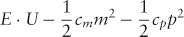 $$ E \cdot U\,{\rm{ - }}\,\frac{1}{2}{{c}_m}{{m}^2} \,{\rm{ - }}\,\frac{1}{2}{{c}_p}{{p}^2} $$
Note that the mobilisation effort m is only chosen later, after the government has chosen the subsidy.
As noted above, we assume that the advocacy group obtains benefits U from the end user's technology consumption. To lobby the government, the advocacy group must pay a cost  $$)(--><$> \frac{1}{2}{{c}_p}{{p}^2} <$><!--$$
because the political lobbying requires financial and human resources. Also, it should be noted that the cost of political lobbying increases on the margin. This assumption can be justified because the cost of political lobbying varies depending on the orientation of politicians or the policy issues. The advocacy group can first lobby politicians interested in environmental protection (low marginal cost) and then move to politicians with business interests, which would require more resources. Also, the cost of political lobbying differs across policy instruments. For instance, the government might be more inclined to adopt tax rebates than to provide direct subsidies. Therefore, the advocacy group should pay increasingly higher costs to expand the scope of political lobbying.
Equilibrium
Since this is a game of complete information, the appropriate solution concept is the subgame-perfect Nash equilibrium. An equilibrium of the game comprises a political lobbying strategy p* for the advocacy group in the beginning stage, a government strategy s* for the government, and a social mobilisation strategy m* for the advocacy group at the mobilisation strategy and a strategy on the use of technology U* for the end user. Each equilibrium strategy, s*, m* and U* should be a best response to prior decisions and equilibrium strategies down the game tree.
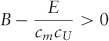
We solve the game through backward induction. The full mathematical solution can be found in the appendix; we summarise the key features of the equilibrium here. Throughout, we focus on interior equilibria, where the government offers a non-zero subsidy s* > 0 and the advocacy group mobilises, m* > 0. For this condition to be met in the game with and without political lobbying, we need
 $$B\,{\rm{ - }}\,\frac{E}{{{{c}_m}{{c}_U}}}\, \gt \,0$$
This condition is met when the group's mobilisation cost and the end user's adoption cost are relatively high. The conditions appear plausible whenever a new technology is in focus and the advocacy group has limited resources.
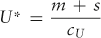
The end user selects the level of technology consumption to maximise its payoffs:
 $${{U}\ast} \, = \,\frac{{m\, + \,s}}{{{{c}_U}}}$$
This expression shows that the the end user's consumption increases as the mobilisation m and subsidy s increase, and as the cost of using technology decreases. However, the effect of an increase in mobilisation or the subsidy decreases as the marginal cost of adoption, cU, increases.
Given the consumption level, we can now examine the prior mobilisation stage. The advocacy group anticipates the effect of mobilisation on consumption, and thus selects the mobilisation level such that
 $${{m}\ast} \, = \,\frac{E}{{{{c}_m}{{c}_U}}}$$
This expression shows that mobilisation increases with the benefits that the group ascribes to technology adoption. This marginal effect decreases with the product of the mobilisation cost cm and the adoption cost cU.
Given that consumption depends on mobilisation and the subsidy, we now examine how the government should select the subsidy. In the appendix, we show that the marginal cost of the subsidy increases with greater use. We insert the expected use of new technology,  $$)(--><$> {{U}\ast} \, = \,\frac{{m\, + \,s}}{{{{c}_U}}} <$><!--$$
, and the mobilisation level,
 $$)(--><$> {{m}\ast} \, = \,\frac{E}{{{{c}_m}{{c}_U}}} <$><!--$$
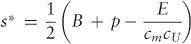
, to the government's payoff equation. The government's payoff is maximised by the following subsidy:
 $${{s}\ast} \, = \,\frac{1}{2}\left( {B\, + \,p\,{\rm{ - }}\,\frac{E}{{{{c}_m}{{c}_U}}}} \right)$$
This expression shows, unsurprisingly, that the subsidy increases with the government's intrinsic preference B and the degree of political lobbying p. Interestingly, though, holding political lobbying constant it decreases with the advocacy group's valuation of the new technology, E.
This observation is key to understanding our model. Suppose the government understands that the advocacy group has a strong interest in the new technology. It thus understands that mobilisation will be aggressive, and thus the end user will consume a lot. If it nonetheless offers a large subsidy, the total cost is high because the end user obtains the subsidy for every unit that it consumes – even if it consumed them because of mobilisation. Consequently, the government reduces the subsidy if the advocacy group is expected to mobilise in an aggressive fashion.
The advocacy group selects its political lobbying such that
 $${{p}\ast} \, = \,\frac{{\frac{1}{2}E}}{{{{c}_p}{{c}_U}}}$$
This shows that political lobbying increases with the group's valuation of the new technology E, and decreases with the cost of lobbying cp. Interestingly, it also shows that political lobbying decreases with the end user's adoption cost, cU. This is because the effectiveness of political lobbying is lower under high adoption costs. Each unit of lobbying produces a lesser increase in total use.
We now have a full solution to the model. How can one compare it to the model variant without political lobbying? This is achieved simply by setting p* = 0 and using the solution to the resulting subgame beginning with the subsidy choice. In the absence of political lobbying, the remainder of the equilibrium analysis continues to hold, except that the government's incentive to subsidise the new technology is not shaped by political lobbying. Similarly, we can compare it to the model variant without end user campaign by setting m* = 0. The equilibrium technology consumption with dual strategy is  $$)(--><$>{{U}\ast} \, = \,\frac{1}{{{{c}_U}}} \cdot \frac{1}{2}( {B\, + \,{{p}\ast} \, + \,\frac{E}{{{{c}_U}{{c}_m}}}} \right)<$><!--$$
. This reduces to
 $$)(--><$>{{U}\ast} \, = \,\frac{1}{{{{c}_U}}} \cdot \frac{1}{2}( {B\, + \,\frac{E}{{{{c}_U}{{c}_m}}}} \right)<$><!--$$
without political lobbying and to
 $$)(--><$>{{U}\ast} \, = \,\frac{1}{{{{c}_U}}} \cdot \frac{1}{2}(B\, + \,{{p}\ast} )<$><!--$$
without end user campaign.
Results
In this section, we characterise the main results of our game-theoretic analysis. We begin with a description of the government's policy, or equilibrium subsidies s*. We then examine the end user's equilibrium technology use U*. In each case, we analytically and graphically compare the effects of different variables on the dependent variable. We separately analyse cases with and without political lobbying. Proofs can be found in the mathematical appendix.
Subsidies
Consider first the choice of equilibrium subsidies s*. Here, the advocacy group's preferences turn out to have highly contingent effects.
Proposition 1 (equilibrium subsidies): Equilibrium subsidies increase by  $$)(--><$> \frac{{\frac{1}{2}E}}{{{{c}_p}{{c}_U}}} <$><!--$$
under political lobbying. The marginal effect of an advocacy group's preference intensity E on subsidies increases from
 $$)(--><$> {\rm{ - }}\frac{1}{{{{c}_m}{{c}_U}}} <$><!--$$
to
 $$)(--><$> \frac{1}{2}\frac{1}{{{{c}_p}{{c}_U}}}\,{\rm{ - }}\,\frac{1}{{{{c}_m}{{c}_U}}} <$><!--$$
.
This result is illustrated in Figure 1. The figure shows the equilibrium subsidy as a function of  $$)(--><$> E,{{c}_m},{{c}_p},{{c}_U} <$><!--$$
. A particularly notable feature of the figure is the effect of the advocacy group's technology valuation E on the equilibrium subsidy. Without political lobbying, this marginal effect must be negative,
 $$)(--><$> {\rm{ - }}\frac{1}{{{{c}_m}{{c}_U}}} <$><!--$$
, as illustrated on the right side of the figure. The government anticipates mobilisation, and thus reduces the subsidy to avoid a high cost.
The government's equilibrium subsidy s*.

With political lobbying, the effect maybe negative or positive,  $$)(--><$> \frac{1}{2}\frac{1}{{{{c}_p}{{c}_U}}}\,{\rm{ - }}\,\frac{1}{{{{c}_m}{{c}_U}}} <$><!--$$
. In particular, if political lobbying is not very costly (upper left corner), then the effect of increased valuation E on the subsidy is positive. Despite the government's concern about the subsidy cost, the advocacy group is capable of mounting such an effective political lobbying campaign that the total effect is positive.
While the strategic logic behind this result is clear enough, the empirical implication runs counter to intuition. One might expect the effectiveness of advocacy to depend on whether political institutions and the government's preferences enable effective lobbying, but the hypothesis that stronger advocacy groups reduce the government's incentive to subsidise new technology is not obvious. Our model shows that this possibility is plausible because the government expects the advocacy group to promote the new technology. The government can thus gain the benefits from the new technology without incurring the cost of a generous subsidy.
This result shows the importance of political lobbying for understanding advocacy groups’ ability to increase the adoption of new technologies. Without political lobbying, the government reduces subsidies in anticipation of mobilisation. But under political lobbying, this effect is outweighed by the lobbying effort as long as the advocacy group has a sufficiently large interest in the new technology.
Technology use
Consider now equilibrium technology use U*. Now the relationship between the advocacy group's preferences E and the outcome U* is less complex than in the case of subsidies s*. Nonetheless, we see that political lobbying exerts considerable influence on equilibrium technology use U*.
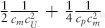
Proposition 2 (equilibrium technology use): Equilibrium technology use increases by  $$)(--><$> \frac{1}{4} \cdot \frac{E}{{{{c}_p} \cdot c_{U}^{2} }} <$><!--$$
under political lobbying. The marginal effect of an advocacy group's preference intensity E on technology use increases from
 $$)(--><$> \frac{1}{2}\frac{1}{{{{c}_m}c_{U}^{2} }} <$><!--$$
to
 $$)(--><$> \frac{1}{2}\frac{1}{{{{c}_m}c_{U}^{2} }}\, + \,\frac{1}{4}\frac{1}{{{{c}_p}c_{m}^{2} }} <$><!--$$
.
This proposition shows that the group's interest in new technology has larger effects on technology use if political lobbying is allowed. As illustrated in Figure 2, the effect of an increase in E is always higher with than without political lobbying. This is intuitive: how could the opportunity to lobby reduce technology adoption? Note, however, that the importance of the technology adoption cost cU, is also considerable. When this cost is low, say cU = 1, the effect of an increase in E is large, and particularly so given political lobbying.
The end user's technology use U*.
In sum, the game-theoretic analysis offers two important insights. The advocacy group's ability to engage in political lobbying is key to ensuring that the government subsidises new technologies, for without political lobbying the advocacy group's willingness to lobby, as measured by the valuation E, has a negative effect on the subsidy. For this reason, political lobbying is an important complement to mobilisation vis-à-vis end users. In the absence of political lobbying, willingness to campaign vis-à-vis end users has a negative effect on the government's support. But if political lobbying is possible, this need not be so.
Empirical illustrations
In this section, we present empirical illustrations for our theory. These illustrations have a twofold purpose. First, they provide concrete empirical examples of some key variables and parameters of our model, and thus facilitate future empirical analysis. Second, they show that the model is consistent with empirical patterns. While a systematic empirical analysis is beyond the scope of this theoretical article, real examples are nonetheless useful.
This section aims to show that a combination of effective political lobbying and end user campaigning is present in successful cases and relatively absent in less successful cases. In examining effectiveness of political lobbying, we pay particular attention to whether a favourable political context provided advocacy groups the opportunity to engage in political lobbying. Our theory expects that advocacy groups can effectively engage in political lobbying only under a sympathetic government. For end user campaigning, we look at whether advocacy groups could reach out to the end user through a grassroots network or coordination among non-governmental organisations (NGOs). We show that advocacy has been the most successful when a dual strategy has been possible.
Much of our empirical illustration is based on Vasi (Reference Vasi2011). He analyses the environmental movement's ability to promote wind energy. His book is ideal for our purposes because it is the most comprehensive analysis of environmental movements and technology diffusion. It examines behaviour and outcomes in multiple countries and over time. It also examines both political lobbying and campaigns targeted at end users. Thus, it offers an ideal collection of empirical material for our illustrative purposes.
We look at three cases of successful advocacy and one case of less successful advocacy. We consider advocacy effective if the advocacy group's mobilisation ultimately succeeds in increasing the end users’ adoption of a new technology innovation. While governments generally offer some subsidies to new technologies, both in our model and in the empirical record, the government's adoption of a generous subsidy, such as a costly feed-in tariff, also indicates successful advocacy because it ultimately leads to increased technology consumption by the end users.
For successful cases, we focus here on Denmark, Germany and Spain. Vasi (Reference Vasi2011) deems them examples of successful advocacy, so they are ideal for illustrating the logic of our theory. In all three cases, we show that political lobbying and campaigns aimed at end users played an important role in effective advocacy. This is consistent with our theoretical argument.
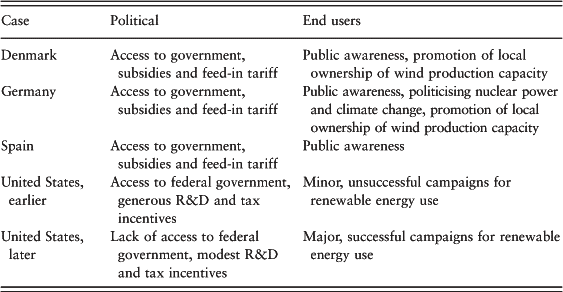
We also examine one less successful case, namely the United States. In this case, we find that while the environmentalists had access to the Carter administration around the 1973 and 1979 oil crises, lobbying of end users was missing. Later, environmentalists have had some success in inducing end users to adopt wind energy. However, they have failed to induce effective policies at the federal level. An overview of the material that we survey is provided in Table 1.
An overview of empirical examples
Notes: The first column gives the case. The “political” column summarises the mechanism and effects of political lobbying. The “end user” column summarises the mechanism and effects of campaigns aimed at end users. An empty cell indicates largely unsuccessful efforts.
Denmark
Denmark was the first country to develop a commercially successful manufacturing industry for wind power (Heymann Reference Heymann1998). Between 1991 and 2007, the share of renewables in energy generation increased from 3.0 per cent to 28.4 per cent. Both political lobbying and campaigns targeted at end users played an important role. Given that Denmark had little domestic energy production, the 1973 oil crisis hit it particularly hard. The government's initial response was to invest in nuclear energy, but Danish environmentalists formed two highly successful groups, named the Organization for Information about Nuclear Power (OOA) and the Organization for Renewable Energy (Vasi Reference Vasi2011, 69–70). During the next three decades, these organisations have successfully pushed for policies and regulations that promote the wind energy industry. Between 1979 and 1989, the government offered direct capital subsidies for wind turbine construction. Already in 1984, renewable energy was exempted from the national electricity tax. In 1991, the government offered a special subsidy for wind energy producers (Lipp Reference Lipp2007; Vasi Reference Vasi2011).
Yet campaigns aimed at end users also played an important role. In 1977, environmental organisations participated in the construction of a large wind turbine in Tvind. The construction of a large wind turbine by local enthusiasts was a major symbolic victory for wind power in Denmark, and already in 1977 the Organization for Renewable Energy (OVE) “established the Cooperative Energy Offices, a national network where ordinary people could get free information and advice about renewable energy systems” (Vasi Reference Vasi2011, 73). Ever since, public awareness and local ownership of wind energy have played a central role in Danish renewable energy policy. Of all wind energy capacity built in Denmark, “about 25 percent … has been developed by wind turbine guilds or cooperatives” (Vasi Reference Vasi2011, 167).
The Danish environment movement's successful implementation of a dual strategy of political lobbying and end user campaigning is attributable to a favourable political context and a grassroots network. Advocacy groups could effectively engage in political lobbying because the government was willing to respond to advocacy groups’ demands. From the early 1970s, the government proactively increased its environmental protection activities and institutionalized its efforts by establishing a Ministry for Environmental Protection. Also, advocacy groups had many sympathisers in the Social Democratic Party and the Socialist Folkparty as well as in the Green Party. Under this favourable political condition, the OVE lobbied legislators to pass legislation to adopt pro-renewable energy policies and endeavoured to be involved in policy-making process through participating in hearings and committees (Vasi Reference Vasi2011, 70–73). A grassroots network also contributed to effective advocacy. For instance, the OOA led a grassroots movement based on a network of 130 local groups and “organized a major campaign in which it distributed the informational brocher Denmark without Nuclear Power to all households in the country” (Vasi Reference Vasi2011, 70).
Germany
In Germany, the share of renewables in energy generation increased from 1.1 per cent in 1991 to 11.8 per cent in 2007. Much of this success can be attributed to the environmental movement's effectiveness in political lobbying and public campaigns. Beginning with political lobbying against nuclear power, the German environmental movement has consistently promoted policies that support renewable energy (Lipp Reference Lipp2007; Laird and Stefes Reference Laird and Stefes2009). In 1983, German environmentalists formed die Grnen, or what was to become the world's most successful green party, and thus greatly enhanced their ability to operate within the political system. They also formed an alliance with the influential trade unions. Hermann Scheer's organisation, Eurosolar, moved a feed-in tariff on the political agenda already in 1988. Only two years later, in 1990, Germany adopted the pioneering Electricity Feed Act, “partly because of environmental groups’ campaigns against climate change” (Vasi Reference Vasi2011, 63–64).
Political lobbying was accompanied by public campaigns aimed at educating the public about the benefits of renewable energy. In 1995, for instance, “environmental groups collected over 650,000 signatures to show support for … renewable energy” (Vasi Reference Vasi2011, 62). Such activities have been so successful that “[a]bout 33 per cent of all wind capacity in Germany has been built by associations of local landowners and nearby residents” (Vasi Reference Vasi2011, 167). Given that Germany is the home to many major energy utilities, this is an amazing accomplishment.
As in the Danish case, a favourable political context created the opportunity for effective political lobbying and advocacy groups successfully reached out to potential end users through a network of numerous NGOs. Some in the governing party such as the Green Party and the Social Democratic Party shared the environmental movement's concerns and environmental groups also had political allies in the Christian Democratic Union (CDU). The German government established several environmental agencies such as the German Federal Environment in 1990, and the German Advisory Council on Global Climate Change in 1992 (Vasi Reference Vasi2011, 67). Also, coordinating efforts by numerous NGOs contributed to the successful end user campaigning. For instance, the German League for Nature Conservation and Environmental Protection, an umbrella organisation of over 100 environmental NGOs, was involved in the issue of global climate change from 1988 and had provided information about climate change to raise public awareness. By the late 1980s, the German environment movement had the largest number of organisational membership in Europe (Vasi Reference Vasi2011, 61).
Spain
While Spain is a latecomer to renewable energy, between 1991 and 2007 the share of renewables in energy generation increased from 0.4 per cent to 10.7 per cent. Again, success was associated by the environmental movement's dual strategy of political lobbying and end user campaigning. In Spain, Greenpeace has played a dominant role. Together with other environmental organisations, “Greenpeace has run a climate change campaign that affected the Spanish government's decision to adopt and implement pro-renewable energy policies … Greenpeace was not only the first NGO in Spain to lobby for the adoption of [feed-in] tariffs, it was also the first to participate as an external consultant in subsequent revisions, defending the tariffs when they were under threat” (Vasi Reference Vasi2011, 80).
In Spain, campaigns aimed at end users played a particularly important role. As Vasi (Reference Vasi2011, 80) notes, “realizing that any significant reduction in greenhouse gases depends on the public's acceptance of new technologies such as wind power, environmental activists engaged in significant public-education efforts”. Given that Spain initially had few wind cooperatives and local opposition to wind farms was growing, environmental organisations such as Greenpeace played a key role in allowing the public support for wind energy to grow while new wind farms were being built.
The evidence for dual access to policymakers and end users is weaker in Spain than in Germany and Denmark, perhaps because the Spanish case has not been studied as extensively. However, there is some evidence that both political institutions and public opinion have been conducive to wind energy deployment. As to political institutions, a key factor in Spain has been the autonomy of regional governments in renewable energy policy: “Several of Spain's Autonomous Regions have been acutely aware of the opportunities presented by wind power in terms of regional industry policy and employment” (Perez and Ramos-Real Reference Perez and Ramos-Real2009, 1063), and this has allowed environmental NGOs to influence local renewable energy policy. Similarly, end users have been sympathetic to the efforts of wind advocates: “The larger social context has been supportive of wind energy and is generally regarded by local actors as highly beneficial for its associated employment and development opportunities” (del Río and Unruh Reference del Río and Unruh2007, 1504). This generally sympathetic view of wind energy has presumably facilitated the aforementioned efforts of Greenpeace and other wind energy advocates.
United States
Although the United States has in recent years seen rapid growth in renewable energy, it clearly lags behind the European pioneers in the use of wind energy. Our model offers some insights why this is so. While our model suggests a dual strategy as key for effective advocacy, advocacy groups in the United States were not given an opportunity to engage in political lobbying and end user campaigning at the same time. In early years, advocacy groups could successfully lobby politicians and policy makers under favourable political conditions during the Carter administration, but political lobbying without an extensive grassroots movement only brought a modicum level of success. From the late 1990s, advocacy groups increased their campaigning efforts targeting end users but could not effectively undertake political lobbying because a government was not willing to respond to advocacy groups.
Despite excellent wind potential, it was not until the year 2000 or so that large increases in capacity were achieved. During the Carter administration, newly powerful environmental organizations such as the Union of Concerned Scientists and the National Resources Defense Council were able to induce the federal government to support renewable energy (Vasi Reference Vasi2011, 99). During those years, federal investment in research and development on renewables was approximately equal to that provided for fossil fuels. Federal tax incentives provided in the Energy Tax Act of 1978 and the Crude Oil Windfall Profits Act of 1980 contributed to California's becoming the first state to build wind power in the early 1980s.
Yet renewables did not begin their rapid expansion until two decades later. While it is impossible to say exactly why, one reason may be that environmental organisations never made renewables a genuinely popular social issue. They were very successful in combating nuclear power, but they did not succeed in convincing the public that wind and solar energy were important political issues. Our model expects that such mobilisation efforts only focused on political lobbying would be less effective in technology diffusion because the end user's consumption is influenced by both advocacy group's mobilisation and governmental subsidy, which complement each other. While the federal government did offer relatively generous subsidies to wind energy during Carter's tenure, renewable energy never became a genuine cause clbre with strong public support. With President Reagan's entry into office, federal support for renewable energy dried out and the period of stagnation began.
More recently, end user campaigns have proven at least moderately successful. Vasi (Reference Vasi2011, 117) estimates that between 1997 and 2007, approximately 2,000 MW of wind energy capacity were constructed in the United States as a result of environmental campaigns. These include campaigns to induce major companies to purchase wind energy, decarbonisation efforts on university campuses, and cities aiming at carbon neutrality. At the same time, though, an unfavourable political context provided little opportunity for effective political lobbying. The federal government has resisted calls for aggressive policies, such as a federal portfolio standard or feed-in tariff. Investment in research and development has plummeted (Nemet and Kammen Reference Nemet and Kammen2007), and the federal government does not have a consistent, reliable policy for renewable energy tax credits.
Indeed, our model suggests that such end user campaigns without effective political lobbying should be less effective. If such end user campaigns had been accompanied with effective political lobbying, advocacy movements would have increased governmental subsidy, which would have ultimately led to increased technology consumption by end users. Given the large size of the electricity market in the United States, even a modest federal feed-in tariff would have almost certainly resulted in a much larger increase in capacity construction. Additionally, much of the actual increase in wind energy capacity in the United States can be attributed to portfolio standards in the states, such as Texas (Rabe Reference Rabe2004; Lyon and Yin Reference Lyon and Yin2010).
California's exceptional rise as a wind power leader from the early 1980s warrants an additional explanation. While advocacy groups have not been successful in other states, “the combination of a strong environmental community and a favorable political context (due to the election of a pro-environment governor, Jerry Brown) made California a wind power leader both nationally and internationally in the eary 1980s” (Vasi Reference Vasi2011, 100). California's hospitable atmosphere to environmental movement attracted a country's environmentalists and renewable energy enthusiasts. Their lobbying and campaigning resulted in the introduction of a wind energy investment tax credit, which allowed investors in wind power plants a 25 per cent deduction from federal tax income Vasi (Reference Vasi2011, 48). The growth of the wind energy industry slowed down after the mid-1980s with the changes in political opportunity, but the industry revived again from the mid-1990s when environmental groups introduced the concept of a renewable portfolio standard (RPS) in California. With advocacy groups’ intensive political lobbying, the California RPS was adopted in 2002 and accelerated in 2006. It requires California electricity utilities to expand their renewable portfolio by 1 per cent every year until they reach 20 per cent in 2010. Environmental groups further pushed legislators to establish a 33 per cent target by 2020, which Governor Arnold Schwarzenegger responded by signing an executive order, mandating an RPS of 33 per cent by 2020 Vasi (Reference Vasi2011, 105). Importantly for our model, environmental groups also faced a conducive end user community: due to their investments dating back to the 1980s Californian energy utilities were sympathetic to renewable energy and even supported the wind energy advocates’ campaign for an RPS in California and at the federal level Vasi (Reference Vasi2011, 104).
Extensions
In this section, we consider three important extensions of the model: competing advocacy groups, substitutability between subsidies and end user campaigning, and the existence of tipping points in technology adoption. These extensions show that while the key insights from our analysis remain intact in model variants, substitutability and tipping points have important implications for the role of the government. In particular, substitutability and easily reachable tipping points mean that the government need not offer generous subsidies to achieve high levels of technology adoption.
Competing advocacy groups
In our main model, there is only one advocacy group. In many contexts, however, competing interest groups exist. For example, environmental advocacy groups may face counteractive lobbying from the coal and oil industry in environmental policy. Given the importance of this possibility, we now examine the effects of such interest groups in an extended model.
To extend the model, we rely on our main model with two modifications. First, we assume an opposing interest group exists. This opposing interest group can lobby the government to reduce subsidies.Footnote 5 Let  $$)(--><$> o\, \in \,[0,\infty ) <$><!--$$
denote the opposing group's activity. The opposing interest group selects o at the same time as the original advocacy group selects p. Suppose the opposing interest group's payoff is
 $${\rm{ - }}U\,{\rm{ - }}\,\frac{1}{2}{{c}_o}{{o}^2} $$
Thus, it prefers to minimise the use of the new technology. For example, a coal company loses profits if the use of wind electricity increases.
The government reacts to each group's lobbying. Thus, it maximises the following payoff:
 $$(B\, + \,p\,{\rm{ - }}\,o) \cdot U\,{\rm{ - }}\,s \cdot U$$
This expression states that each unit of lobbying reduces the government's incentive to subsidise the new technology.
In this model, our basic logic remains unchanged but both the equilibrium subsidy and equilibrium technology use are naturally reduced.
Proposition 3 (competing interest groups): If a competing interest group exists, the lobby's equilibrium behaviour remains unchanged. The equilibrium subsidy decreases by  $$)(--><$> \frac{1}{2}\frac{1}{{{{c}_U}{{c}_o}}} <$><!--$$
and equilibrium technology use decreases by
 $$)(--><$> \frac{1}{4}\frac{1}{{c_{U}^{2} {{c}_o}}} <$><!--$$
.
This proposition states that our main result concerning the original advocacy group's behaviour is unchanged by competition. However, the equilibrium subsidy decreases due to the opposing group's lobbying. This, in turn, reduces equilibrium technology use. Competing interest groups can slow the diffusion of new technologies that they oppose, but their existence does not modify any of our key conclusions.
Subsidies and campaigning as substitutes
While our main model treats the effect of government subsidies as independent from end user campaigning, we extend our model to account for possible substitutability between subsidies and campaigning for the end user. The end user's payoff is now as follows:
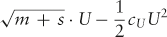 $$\root\of {m\, + \,s} \cdot U\,{\rm{ - }}\,\frac{1}{2}{{c}_U}{{U}^2} $$
For every unit of technology consumption U, the end user receives a marginal benefit of  $$)(--><$> \root\of {m\, + \,s} <$><!--$$
. Mobilisation m and subsidy s increase the payoff for the user with decreasing returns on the margin. We assume a specific functional form
 $$)(--><$> \root\of {m\, + \,s} <$><!--$$
instead of a generic concave function, V (·), to convey the intuition more explicitly and to simplify the problem. With this modification, the end user's optimal consumption becomes
 $$)(--><$> {{U}\ast} \, = \,\frac{{ \root\of{m\, + \,s} }}{{{{c}_U}}} <$><!--$$
. Given the end user's consumption, we assume the advocacy group maximises its payoff
 $$)(--><$> E \cdot U\,{\rm{ - }}\,{{c}_m}m <$><!--$$
. For simplification, we assume that the advocacy group's mobilisation costs are linear. The unique optimal strategy is
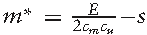 $$)(--><$> {{m}\ast} \, = \,\frac{E}{{2{{c}_m}{{c}_u}}}{\rm{ - }}s <$><!--$$
: the optimal level of mobilisation decreases linearly as the subsidy increases.
How does this influence the government's subsidy and political lobbying decision? The government maximises its payoff  $$)(--><$> B \cdot U\,{\rm{ - }}\,s \cdot U <$><!--$$
under no political lobbying and
 $$)(--><$> (B\, + \,p) \cdot U\,{\rm{ - }}\,s \cdot U <$><!--$$
under political lobbying. Given the end user's consumption and the advocacy group's mobilisation level, the government provides no governmental subsidy, s* = 0, regardless of the existence of political lobbying. The government, anticipating that the advocacy group will linearly increase the mobilisation effort to supplement a low government subsidy, decides to free ride on the advocacy group's effort. Then, the advocacy group does not engage in political lobbying at the lobbying stage and divert its efforts to mobilise the end user.
Proposition 4 (substitutability): If government subsidies and end user campaigns are substitutes, as defined above, the government provides no subsidy and the advocacy group only engages in mobilisation targeting the end user.
This proposition shows that if government subsidies and end user lobbying are too substitutable, the government's free riding becomes extreme: it refuses to provide any subsidies whatsoever. In this case, the advocacy group's initial lobbying is also irrelevant because the government's position cannot be changed.
Tipping points
The end user's technology consumption could drastically increase once it reaches a certain tipping point (Arthur Reference Arthur1989; Cowan and Gunby Reference Cowan and Gunby1996).Footnote 6 To capture the impact of tipping points on advocacy group's strategy, we modify our model so that the payoff to the end user is
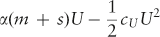 $$\alpha (m\, + \,s)U\,{\rm{ - }}\,\frac{1}{2}{{c}_U}{{U}^2} $$
and assume that  $$)(--><$> \alpha \, \rightarrow \,\infty <$><!--$$
when
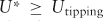 $$)(--><$> {{U}\ast} \,\geq \,{{U}_{{\rm{tipping}}}} <$><!--$$
. The end user decides to consume U max if the optimal technology consumption U* reaches the level of tipping point U tipping, and
 $$)(--><$> {{U}\ast} \, = \,\frac{{\alpha (m\, + \,s)}}{{{{c}_U}}} <$><!--$$
otherwise. Given the end user's decision, the advocacy group decides on mobilisation level to maximise its payoff
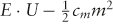 $$)(--><$> E \cdot U\,{\rm{ - }}\,\frac{1}{2}{{c}_m}{{m}^2} <$><!--$$
. We assume that m tipping() is a minimum level of mobilisation that could induce the end user's technology consumption to reach a tipping level for a given s. The advocacy group decides on the mobilisation level m tipping if m tipping is lower than the optimal level of mobilisation m* or if m tipping is higher than the optimal level m* but the cost of mobilisation is low enough such that
 $$)(--><$> E \cdot ({{U}_{{\rm{max}}}}\,{\rm{ - }}\,{{U}\ast} )\, \gt <$> <$>\,\frac{1}{2}{{c}_m}(m_{{{\rm{tipping}}}}^{2} \,{\rm{ - }}\,{{({{m}\ast} )}^2} ) <$><!--$$
. Otherwise, the advocacy group's optimal mobilisation level is
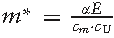 $$)(--><$> {{m}\ast} \, = \,\frac{{\alpha E}}{{{{c}_m} \cdot {{c}_U}}} <$><!--$$
.
To examine how the existence of tipping points influences the government's subsidy and the advocacy group's political lobbying strategy, we explore three scenarios: (i) when m tipping is lower than the optimal level of mobilisation m*, (ii) when m tipping is higher than m* and the benefit of mobilisation at the tipping level is just below its costs, and (iii) when m tipping is far above the optimal mobilisation level m*.
Proposition 5 (tipping points): If a tipping point exists, the following hold:
1. If the tipping point is reached without subsidies, so that
$$)(--><$> {{m}_{{\rm{tipping}}}}(0)\, \lt \,{{m}\ast} <$><!--$$
, the advocacy group reduces its mobilisation efforts and the government provides no subsidy.2. If the tipping point is difficult to reach, with
$$)(--><$> {{m}_{{\rm{tipping}}}}\,{\rm{ - }}\,{{m}\ast} (0)\, \rightarrow \,\infty <$><!--$$
, the equilibrium strategies remain unchanged from the original game.3. If the tipping point is close to being reached without subsidies, so that
$$)(--><$> {{m}_{{\rm{tipping}}}}\,{\rm{ - }}\,{{m}\ast} (0) <$><!--$$
is positive but small enough, the government provides the minimum level of subsidy that induces widespread technology diffusion to the tipping point, and there is no political lobbying.



We discuss these three cases in turn. First, consider the subcase where m tipping(0) is lower than m*, the optimal level of mobilisation without a tipping point. Since the advocacy group can maximise the benefit from technology consumption with lower level of mobilisation m tipping(0), the optimal level of mobilisation becomes m tipping(0). This mobilisation level is sufficient to induce the end user to consume U max and the government does not find any additional incentive to provide subsidy for technology consumption. The advocacy group in turn does not adopt political lobbying strategies.
Second, consider the case where  $$)(--><$> {{m}_{{\rm{tipping}}}}(0)\,{\rm{ - }}\,{{m}\ast} \, \rightarrow \,\infty <$><!--$$
. In this case, m tipping(0) is much higher than m* the advocacy group decides on the mobilisation level
 $$)(--><$> {{m}\ast} \, = \,\frac{{\alpha E}}{{{{c}_m} \cdot {{c}_U}}} <$><!--$$
due to high costs of reaching m tipping without subsidy. The equilibrium remains unchanged, as the government selects the subsidy level
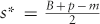 $$)(--><$> {{s}\ast} \, = \,\frac{{B\, + \,p\,{\rm{ - }}\,m}}{2} <$><!--$$
due to high costs and the advocacy group similarly selects the political lobbying level
 $$)(--><$> {{p}\ast} \, = \,\frac{{\frac{1}{2}\alpha E}}{{{{c}_p}{{c}_U}}} <$><!--$$
.
Finally, suppose  $$)(--><$> {{m}_{{\rm{tipping}}}}(0)\, \gt \,{{m}\ast} <$><!--$$
and
 $$)(--><$> E \cdot ({{U}_{{\rm{max}}}}\,{\rm{ - }}\,{{U}\ast} )\, = \,\frac{1}{2}{{c}_m}(m_{{{\rm{tipping}}}}^{{\rm{2}}} (0)\,{\rm{ - }}<$> <$>\,{{({{m}\ast} )}^2} )\,{\rm{ - }}\,{\epsilon} <$><!--$$
where
 $$)(--><$> {\epsilon}\, \rightarrow \,0 <$><!--$$
. Under this condition, m tipping(0) is only slightly higher than the optimal mobilisation level m*, and the cost of mobilisation to reach the tipping level is slightly higher than the benefit from maximum level of technology diffusion. Since it is costly for the advocacy group to increase its mobilisation to m tipping(0), the advocacy group decides on the mobilisation level m* without subsidy. The minimum level of governmental subsidy necessary for reaching a tipping level of mobilisation is thus almost negligible, ε. Given the subsidy level ε, the advocacy group would select on m tipping(ε) because
 $$)(--><$> E \cdot ({{U}_{{\rm{max}}}}\,{\rm{ - }}\,{{U}\ast} )\, =<$> <$> \,\frac{1}{2}{{c}_m}(m_{{{\rm{tipping}}}}^{{\rm{2}}} ({\epsilon})\,{\rm{ - }}\,{{({{m}\ast} )}^2} ) <$><!--$$
. Thus, the government offers a tiny subsidy, barely sufficient to induce tipping, and thus the advocacy group need not engage in strategically prior political lobbying.
Changing the order of moves
In the original game, the government moves first. We now consider the game so that the advocacy group selects the mobilisation level before the government's choice of subsidy. This extension shows that the main results continue to hold.
Proposition 6 (changing the order of moves): If the advocacy group selects the mobilisation level m before the government selects the subsidy level s, the following hold:
1. Without political lobbying, an increase in the advocacy group's valuation of the new technology, E, has a negative effect on the government's subsidy s*.
2. With political lobbying, an increase in the advocacy group's valuation of the new technology, E, has a less negative, or even positive, effect on the government's equilibrium subsidy s*.
This proposition shows that our results are not driven by the order of moves. Even if the advocacy group is the first mover, the government's incentive to free ride on mobilisation efforts remains intact.
Conclusion
Available technology is a central determinant of human well-being. In this article, we have examined the role that advocacy group movements play in the promotion of technology adoption. Advocacy groups can promote their own goals by inducing end users to adopt new technologies that advance these goals, and previous research indicates that many advocacy groups have played an important role in the diffusion of new technologies (Cashore Reference Cashore2002; Gulbrandsen Reference Gulbrandsen2004; Vasi Reference Vasi2011).
An advocacy group's ability to promote technology adoption depends on a dual strategy of political lobbying and end user campaigning. Failure to engage in political lobbying reduces the effectiveness of end user campaigning. In particular, end user campaigns without political lobbying give the government a counterproductive incentive to reduce subsidies to a new technology. We have also illustrated these central findings with a concise survey of the environmental movement's role in promoting wind energy.
These findings have some notable broader implications for the study of advocacy group movements. Theoretically, they emphasise the importance of nuanced strategic models. Researchers are often tempted to simplify their analytical models by focusing on a single strategy or domain. We have found that such simplifications can be dangerous if one strategy's effectiveness depends on another strategy's success. It seems plausible that such complementarity applies more broadly to activism. However, we do not argue that two strategies are always complementary. They may also serve as substitutes in some cases. Further theoretical research can shed light on this.
Perhaps the most important question that our model raises concerns the determinants of governments’ preferences. If an advocacy group's political lobbying is often complementary to campaigns aimed at end users, advocacy groups can be expected to prefer political lobbying. Therefore, the government's responsiveness to political lobbying should influence technology adoption to a great extent. Future theoretical research could examine the role of political institutions, electoral incentives, partisanship, and fiscal constraints in determining a government's responsiveness to lobbying by different advocacy groups.
Ours is a theoretical analysis, so we have refrained from a comprehensive empirical test. It is our hope, though, that the present model can inform and guide detailed empirical accounts of how exactly environmental movements combine political lobbying and end user campaigning. We would expect them to play a complementary role in the context of technology diffusion. For examining this and related hypotheses, our model provides an analytically sound platform for sophisticated strategic analyses of a social movement's ability to influence policy and behavior.
Acknowledgements
The authors thank Ion Bogdan Vasi, the anonymous reviewers, and the editor of The Journal of Public Policy for helpful comments on this article.
Mathematical appendix
Equilibrium
This is a game of complete information, so we use the subgame-perfect equilibrium as our solution concept. We solve the game through backward induction. We then prove the propositions given in the main text.
First, the end user decides on consumption  $$)(--><$> U\, \in \,[0,\infty ) <$><!--$$
to maximise
 $$)(--><$> (m\, + \,s) \cdot U\,{\rm{ - }}\,\frac{1}{2}{{c}_U}{{U}^2} . <$><!--$$
The marginal benefit of increasing U is given by
 $$)(--><$> m\, + \,s\,{\rm{ - }}\,{{c}_U}U <$><!--$$
. This must equal zero in equilibrium, so the unique optimum is
 $$)(--><$> {{U}\ast} \, = \,\frac{{m\, + \,s}}{{{{c}_U}}} <$><!--$$
.
Second, the advocacy group decides on mobilisation  $$)(--><$> m\, \in \,[0,\infty ) <$><!--$$
to maximise
 $$)(--><$> E \cdot U\,{\rm{ - }}\,\frac{1}{2}{{c}_m}{{m}^2} \,{\rm{ - }}\,\frac{1}{2}{{c}_u}{{p}^2} \, = \,E(\frac{{m\, + \,s}}{{{{c}_U}}})\,{\rm{ - }}\,\frac{1}{2}{{c}_m}{{m}^2} <$><!--$$
. The marginal benefit,
 $$)(--><$> \frac{E}{{{{c}_U}}}\,{\rm{ - }}\,{{c}_m}m <$><!--$$
, equals zero at
 $$)(--><$> {{m}\ast} \, = \,\frac{E}{{{{c}_m}{{c}_U}}} <$><!--$$
. This is the unique optimal strategy.
Third, the government selects subsidy  $$)(--><$> s\, \in \,[0,\infty ) <$><!--$$
to maximise
 $$)(--><$>{ &#x0026; (B\, + \,p) \cdot U\,{\rm{ - }}\,sU\, = \,(B\, + \,p)\big( {\frac{{m\, + \,s}}{{{{c}_U}}}} \big)\,{\rm{ - }}\,s\big( {\frac{{m\, + \,s}}{{{{c}_U}}}} \big)\, = \,\frac{{B\, + \,p}}{{{{c}_U}}}\big( {\frac{E}{{{{c}_m}{{c}_U}}}} \big)\, + \, \cr &#x0026; \frac{{(B\, + \,p)}}{{{{c}_U}}}s\,{\rm{ - }}\,\frac{s}{{{{c}_U}}}\big( {\frac{E}{{{{c}_m}{{c}_U}}}} \big)\,<$> <$>{\rm{ - }}\,\frac{{{{s}^2} }}{{{{c}_U}}} \cr} <$><!--$$
. Differentiating with respect to s and equating to zero, this payoff is maximised when
 $$)(--><$>{ {{s}\ast} \, = \,\frac{1}{2}\big( {B\, + \,p\,{\rm{ - }}\,\frac{E}{{{{c}_U}{{c}_m}}}} \big) <$><!--$$
.
Finally, the group's payoff at the original lobbying stage is  $$)(--><$> E \cdot U\,{\rm{ - }}\,\frac{1}{2}{{c}_m}{{m}^2} \,{\rm{ - }}\,\frac{1}{2}{{c}_p}{{p}^2} <$><!--$$
. Given that m is chosen subsequently and does not depend on p or s, the group maximises
 $$)(--><$> E \cdot \frac{s}{{{{c}_U}}}\,{\rm{ - }}\,\frac{1}{2}{{c}_p}{{p}^2} \, = \,E \cdot \frac{1}{{{{c}_U}}} \cdot \frac{1}{2}\big( {B\, + \,p\,{\rm{ - }}\,\frac{E}{{{{c}_m}{{c}_U}}}} \big)\,{\rm{ - }}\,\frac{1}{2}{{c}_p}{{p}^2} . <$><!--$$
Differentiating with respect to p, this payoff is maximised when
 $$)(--><$> {{p}\ast} \, = \,\frac{{\frac{1}{2}E}}{{{{c}_p}{{c}_U}}}. <$><!--$$
Inserting
 $$)(--><$>{ p\, \in \big\{ {0,\frac{{\frac{1}{2}E}}{{{{c}_p}{{c}_U}}}} \big\} <$><!--$$
in
 $$)(--><$> {{s}\ast} \, = \,\frac{1}{2}\big( {B\, + \,p\,{\rm{ - }}\,\frac{E}{{{{c}_U}{{c}_m}}}} \big) <$><!--$$
, we see that the equilibrium subsidy is strictly positive for all
 $$)(--><$> {{p}\ast} \,\geq \,0 <$><!--$$
, so a unique interior equilibrium exists. This completes the equilibrium analysis.
Proofs
To prove the propositions 1–2, simply compare the values of s* and U* setting p* = 0 versus  $$)(--><$>{ {{p}\ast} \, = \,\frac{{\frac{1}{2}E}}{{{{c}_p}{{c}_U}}} <$><!--$$
and using the solution of the subgame that solves. The subsidy is given by
 $$)(--><$>{ {{s}\ast} \, = \,\frac{1}{2}\big( {B\, + \,{{p}\ast} \,{\rm{ - }}\,\frac{E}{{{{c}_U}{{c}_m}}}} \big) <$><!--$$
and total consumption by
 $$)(--><$>{ {{U}\ast} \, = \,\frac{1}{{{{c}_U}}} \cdot \frac{1}{2}\big( {B\, + \,{{p}\ast} \, + \,\frac{E}{{{{c}_U}{{c}_m}}}} \big) <$><!--$$
. Both propositions follow.
Extension: competing advocacy groups
The end user's strategy remains unchanged at  $$)(--><$> {{U}\ast} \, = \,\frac{{m\, + \,s}}{{{{c}_U}}} <$><!--$$
. Similarly, the groups mobilisation decision remains unchanged at
 $$)(--><$>{ {{m}\ast} \, = \,\frac{E}{{{{c}_m}{{c}_U}}} <$><!--$$
. The government's subsidy, however, is now
 $$)(--><$>{ {{s}\ast} \, = \,\frac{1}{2}( {B\, + \,p\,{\rm{ - }}\,o\,{\rm{ - }}\,\frac{E}{{{{c}_U}{{c}_m}}}} ) <$><!--$$
. Given this, the original group maximises
 $$)(--><$>{ E \cdot \frac{1}{{{{c}_U}}} \cdot \frac{1}{2}\big( {B\, + \,p\,{\rm{ - }}\,o\,{\rm{ - }}\,\frac{E}{{{{c}_m}{{c}_U}}}} \big)\,{\rm{ - }}\,\frac{1}{2}{{c}_p}{{p}^2} <$><!--$$
. This leaves us with the unchanged optimum, or
 $$)(--><$>{ {{p}\ast} \, = \,\frac{{\frac{1}{2}E}}{{{{c}_p}{{c}_U}}} <$><!--$$
. The opposing group maximises
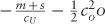 $$)(--><$> {\rm{ - }}\frac{{m\, + \,s}}{{{{c}_U}}}\,{\rm{ - }}\,\frac{1}{2}c_{o}^{2} o <$><!--$$
. Substituting
 $$)(--><$>{ {{s}\ast} \, = \,\frac{1}{2}\big( {B\, + \,p\,{\rm{ - }}\,o\,{\rm{ - }}\,\frac{E}{{{{c}_U}{{c}_m}}}} \big) <$><!--$$
and differentiating with respect to o to obtain the first-order condition, we are left with
 $${{o}\ast} \, = \,\frac{1}{{{{c}_U}{{c}_o}}} $$
Thus, all comparative statics remain unchanged. This proves proposition 3.
Extension: subsidies and policy as substitutes
The end user's optimal consumption is  $$)(--><$> {{U}\ast} \, = \,\frac{{\root\of {m\, + \,s} }}{{{{c}_U}}} <$><!--$$
. The advocacy group maximises its payoff
 $$)(--><$> E \cdot U\,{\rm{ - }}\,{{c}_m}m <$><!--$$
, which can be rewritten as
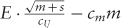 $$)(--><$>{ E \cdot \frac{{\root\of {m\, + \,s} }}{{{{c}_U}}}\,{\rm{ - }}\,{{c}_m}m <$><!--$$
. This payoff is maximised at
 $$)(--><$> {{m}\ast} \, = \,\frac{{{{E}^2} \,{\rm{ - }}\,4c{{m}^2} c{{u}^2} s}}{{4c{{m}^2} c{{u}^2} }}\, <$> <$>= \,\frac{{{{E}^2} }}{{4c{{m}^2} c{{u}^2} }}\,{\rm{ - }}\,s <$><!--$$
. Given the end user's consumption and the advocacy group's mobilisation decision, the government maximises its payoff
 $$)(--><$> (B\, + \,p) \cdot U\,{\rm{ - }}\,s \cdot U <$><!--$$
with political lobbying and
 $$)(--><$> B \cdot U\,{\rm{ - }}\,s \cdot U <$><!--$$
without political lobbying. Substituting
 $$)(--><$>{ {{U}\ast} \, = \,\frac{{\root\of {m\, + \,s} }}{{{{c}_U}}} <$><!--$$
and
 $$)(--><$>{ m\ast\, = \,\frac{{{{E}^2} }}{{4c{{m}^2} c{{u}^2} }}\,{\rm{ - }}\,s <$><!--$$
gives
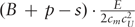 $$)(--><$>{ (B\, + \,p\,{\rm{ - }}\,s) \cdot \frac{E}{{2{{c}_m}c_{U}^{2} }} <$><!--$$
and
 $$)(--><$>{ (B\,{\rm{ - }}\,s) \cdot \frac{E}{{2{{c}_m}c_{U}^{2} }} <$><!--$$
, respectively. Regardless of the existence of political lobbying, the optimal subsidy is s* = 0. The advocacy group maximises its payoff
 $$)(--><$>{ E \cdot U\,{\rm{ - }}\,\frac{1}{2}{{c}_m}{{m}^2} \,{\rm{ - }}\,\frac{1}{2}{{c}_p}{{p}^2} <$><!--$$
. Substituting
 $$)(--><$>{ {{U}\ast} \, = \,\frac{{\root\of {m\, + \,s} }}{{{{c}_U}}} <$><!--$$
and
 $$)(--><$>{ {{m}\ast} \, = \,\frac{{{{E}^2} }}{{4c{{m}^2} c{{u}^2} }}\,{\rm{ - }}\,s <$><!--$$
gives
 $$)(--><$>{ E \cdot \frac{{\root\of {m\, + \,s} }}{{{{c}_U}}}\,{\rm{ - }}\,\frac{1}{2}{{c}_m}{{\big ( {\frac{{{{E}^2} }}{{4c{{m}^2} c{{u}^2} }}\,{\rm{ - }}\,s} \big )}^2} \,<$> <$>{\rm{ - }}\,\frac{1}{2}{{c}_p}{{p}^2} <$><!--$$
. The optimal political lobbying is thus also p* = 0.
Extension: tipping points
From the assumption, the end user decides to consume U max if  $$)(--><$>{ {{U}\ast} \, = \,\frac{{\alpha \,(m\, + \,s)}}{{{{c}_U}}}\,\geq \,{{U}_{{\rm{tipping}}}} <$><!--$$
and U* otherwise. The advocacy group receives a payoff of
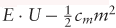 $$)(--><$>{ E \cdot U\,{\rm{ - }}\,\frac{1}{2}{{c}_m}{{m}^2} <$><!--$$
. If the advocacy group mobilises at the tipping level, its payoff becomes
 $$)(--><$>{ E \cdot {{U}_{{\rm{max}}}}\,{\rm{ - }}\,\frac{1}{2}{{c}_m}m_{{{\rm{tipping}}}}^{2} <$><!--$$
. Thus, the end user mobilises at m tipping if m tipping < m* or if m tipping > m* and
 $$)(--><$>{ E \cdot ({{U}_{{\rm{max}}}}\,{\rm{ - }}\,{{U}\ast} )\, \gt \,\frac{1}{2}{{c}_m}(m_{{{\rm{tipping}}}}^{{\rm{2}}} \,{\rm{ - }}\,{{({{m}\ast} )}^2} ) <$><!--$$
. Otherwise, the end user's optimal mobilisation remains at
 $$)(--><$>{ {{m}\ast} \, = \,\frac{{\alpha E}}{{{{c}_m}{{c}_U}}} <$><!--$$
.
First, consider  $$)(--><$>{ {{m}_{{\rm{tipping}}}}\, \lt \,{{m}\ast} . <$><!--$$
The advocacy group receives a payoff of
 $$)(--><$>{ E \cdot {{U}_{{\rm{max}}}}\,{\rm{ - }}\,\frac{1}{2}{{c}_m}m_{{{\rm{tipping}}}}^{{\rm{2}}} <$><!--$$
for the mobilisation at m* and that of
 $$)(--><$>{ E \cdot {{U}_{{\rm{max}}}}\,{\rm{ - }}\,\frac{1}{2}{{c}_m}{{m}\ast} <$><!--$$
. Since m tipping < m*, the government maximises its payoff when selecting on m tipping. The government selects on s* = 0 since its benefit is maximised from U max regardless of its subsidy level. Likewise, the advocacy group engages no political lobbying (p* = 0).
Second, consider the case where  $$)(--><$>{ {{m}_{{\rm{tipping}}}}\,{\rm{ - }}\,{{m}\ast} \, \rightarrow \,\infty <$><!--$$
. In this case, m tipping is too high to induce the advocacy group to increase its mobilisation level. Without a subsidy, the advocacy group decides on
 $$)(--><$>{ {{m}\ast} \, = \,\frac{{\alpha E}}{{{{c}_m} \cdot {{c}_U}}} <$><!--$$
. The government maximises its payoff payoff
 $$)(--><$>{ (B\, + \,p) \cdot U\,{\rm{ - }}\,s \cdot U <$><!--$$
with political lobbying and
 $$)(--><$>{ B \cdot U\,{\rm{ - }}\,s \cdot U <$><!--$$
without political lobbying. With
 $$)(--><$>{ {{m}_{{\rm{tipping}}}}\,{\rm{ - }}\,{{m}\ast} \rightarrow \,\infty <$><!--$$
, it is clear that the government cannot offer a subsidy high enough that would reach m tipping. Substituting U* and m* and differentiating with respect to s gives the optimal subsidy level
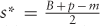 $$)(--><$>{ {{s}\ast} \, = \,\frac{{B\, + \,p\,{\rm{ - }}\,m}}{2} <$><!--$$
with political lobbying and
 $$)(--><$>{ {{s}\ast} \, = \,\frac{{B\,{\rm{ - }}\,m}}{2} <$><!--$$
without political lobbying. The advocacy group's payoff
 $$)(--><$>{ E \cdot U\,{\rm{ - }}\,\frac{1}{2}{{c}_m}{{m}^2} \,{\rm{ - }}\,\frac{1}{2}{{c}_p}{{p}^2} <$><!--$$
is maximised at
 $$)(--><$>{ {{p}\ast} \, = \,\frac{{\frac{1}{2}\alpha E}}{{{{c}_p}{{c}_U}}} <$><!--$$
. Thus, the equilibrium strategies are unchanged.
Finally, suppose  $$)(--><$>{ {{m}_{{\rm{tipping}}}}\, \gt \,{{m}\ast} <$><!--$$
and
 $$)(--><$>{ E \cdot ({{U}_{{\rm{max}}}}\,{\rm{ - }}\,{{U}\ast} )\, = \,\frac{1}{2}{{c}_m}(m_{{{\rm{tipping}}}}^{2} (0)\,<$> <$>{\rm{ - }}\,{{({{m}\ast} )}^2} )\,{\rm{ - }}\,{\epsilon} <$><!--$$
. Without subsidy, the advocacy group mobilises at m* because
 $$)(--><$>{ E \cdot ({{U}_{{\rm{max}}}}\,{\rm{ - }}\,{{U}\ast} )\, \lt \,\frac{1}{2}{{c}_m}(m_{{{\rm{tipping}}}}^{2} (0){\rm{ - }}{{({{m}\ast} )}^2} ) <$><!--$$
but decides on
 $$)(--><$>{ {{m}_{{\rm{tipping}}}}({\epsilon}) <$><!--$$
if given the governmental subsidy ε because
 $$)(--><$>{ E \cdot ({{U}_{{\rm{max}}}}\, - \,{{U}\ast} )\, = \,\frac{1}{2}{{c}_m}(m_{{{\rm{tipping}}}}^{2} (0)\,{\rm{ - }}\,{{({{m}\ast} )}^2} ) <$><!--$$
. The government maximises its payoff by selecting on
 $$)(--><$>{ s\, = \,{\epsilon} <$><!--$$
and receives payoffs of
 $$)(--><$>{ (B\, + \,p) \cdot {{U}_{{\rm{max}}}}\,{\rm{ - }}\,{\epsilon} \cdot {{U}_{{\rm{max}}}} <$><!--$$
, or
 $$)(--><$>{ B \cdot {{U}_{{\rm{max}}}}\,{\rm{ - }}\,{\epsilon} \cdot {{U}_{{\rm{max}}}} <$><!--$$
where there is no political lobbying, p = 0. If the government deviates by increasing the subsidy, the payoff decreases due to increasing costs and fixed benefit at
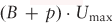 $$)(--><$>{ (B\, + \,p) \cdot {{U}_{{\rm{max}}}} <$><!--$$
. The government does not have an incentive to decrease its subsidy because lowering the subsidy level gives the payoff of
 $$)(--><$>{ (B\, + \,p) \cdot {{U}\ast} \, \lt \,(B\, + \,p) \cdot {{U}_{{\rm{max}}}}\,{\rm{ - }}\,{\epsilon} \cdot {{U}_{{\rm{max}}}} <$><!--$$
since the tipping point cannot be reached. The advocacy group's payoff
 $$)(--><$>{ E \cdot U\,{\rm{ - }}\,\frac{1}{2}{{c}_m}{{m}^2} \,{\rm{ - }}\,\frac{1}{2}{{c}_p}{{p}^2} <$><!--$$
is maximised at p = 0 because U max is reached without costly political lobbying.
Extension: changing the order of moves
We change the order of the play such that the advocacy group decides on the mobilisation level m before the government selects its subsidy level s.
Without political lobbying
1. The advocacy group decides on mobilisation
$$)(--><$>{ m\, \in \,[0,\infty ] <$><!--$$
to lobby the end user.2. The government selects subsidy
$$)(--><$>{ s\, \in \,[0,\infty ] <$><!--$$
.3. The end user decides on consumption
$$)(--><$>{ U\, \in \,[0,\infty ] <$><!--$$
.


Equilibrium
1. The end user maximises its payoff
$$)(--><$>{ (m\, + \,s) \cdot U\,{\rm{ - }}\,\frac{1}{2} \cdot {{c}_U} \cdot {{U}^2} <$><!--$$
by setting its consumption level at
$$)(--><$>{ {{U}\ast} \, = \,\frac{{m\, + \,s}}{{{{c}_U}}} <$><!--$$
.2. The government maximises its payoff
$$)(--><$>{ B \cdot U\,{\rm{ - }}\,s \cdot U\, = \,B \cdot \frac{{m\, + \,s}}{{{{c}_U}}}\,{\rm{ - }}\,s \cdot \frac{{m\, + \,s}}{{{{c}_U}}} <$><!--$$
by setting its subsidy level at
$$)(--><$>{ {{s}\ast} \, = \,\frac{{B\,{\rm{ - }}\,m}}{2} <$><!--$$
.3. The group maximises its payoff
$$)(--><$>{ E \cdot U\,{\rm{ - }} \frac {1}{2}\,\cdot c_m\, m^2 -\frac {1}{2}\cdot c_p \cdot p^2<$><!--$$
by setting its mobilisation level at
$$)(--><$>{ {{m}\ast} \, = \,\frac{E}{{2{{c}_m}{{c}_U}}}} <$><!--$$
.






The advocacy group's mobilisation level is smaller than the mobilisation level in the original game, where the group moves after observing the government's subsidy level,  $$)(--><$>{ \frac{E}{{{{c}_m}{{c}_U}}} <$><!--$$
. The government's subsidy level becomes
 $$)(--><$>{ {{s}\ast} \, = \,\frac{1}{2}\big ( {B\,{\rm{ - }}\,\frac{E}{{2{{c}_m}{{c}_U}}}} \big ) <$><!--$$
, which is larger than the subsidy level in the original game, where the group moves after the government,
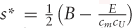 $$)(--><$>{ {{s}\ast} \, = \,\frac{1}{2}\big ( {B\,{\rm{ - }}\,\frac{E}{{{{c}_m}{{c}_U}}}} \big ) <$><!--$$
. However, our main intuition that the advocacy group's valuation E has a negative marginal impact,
 $$)(--><$>{ {\rm{ - }}\frac{1}{{4{{c}_m}{{c}_U}}} <$><!--$$
, on the government's subsidy level does not change.
With political lobbying
1. The advocacy group decides on mobilisation
$$)(--><$>{ m\, \in \,[0,\infty ] <$><!--$$
to lobby the end user, and political lobbying
$$)(--><$>{ p\, \in \,[0,\infty ] <$><!--$$
.2. The government selects subsidy
$$)(--><$>{ s\, \in \,[0,\infty ] <$><!--$$
.3. The end user decides on consumption
$$)(--><$>{ U\, \in \,[0,\infty ] <$><!--$$
.


Equilibrium
1. The end user maximises its payoff
$$)(--><$>{ (m\, + \,s) \cdot U\,{\rm{ - }}\,\frac{1}{2} \cdot {{c}_U} \cdot {{U}^2} <$><!--$$
by setting its consumption level at
$$)(--><$>{ {{U}\ast} \, = \,\frac{{m\, + \,s}}{{{{c}_U}}} <$><!--$$
.2. The government maximises its payoff
$$)(--><$>{ (B\, + \,p) \cdot U\,{\rm{ - }}\,s \cdot U\, = \,(B\, + \,p) \cdot \frac{{m\, + \,s}}{{{{c}_U}}}\,<$> <$>{\rm{ - }}\,s \cdot \frac{{m\, + \,s}}{{{{c}_U}}} <$><!--$$
by setting its subsidy level at
$$)(--><$>{ {{s}\ast} \, = \,\frac{{B\, + \,p\,{\rm{ - }}\,m}}{2} <$><!--$$
.3. The group maximises its payoff
$$)(--><$>{ E \cdot U\,{\rm{ - }}\,\frac{1}{2} \cdot {{c}_m}{{m}^2} \,{\rm{ - }}\,\frac{1}{2} \cdot {{c}_p} \cdot {{p}^2} <$><!--$$
by setting its mobilisation level at
$$)(--><$>{ m\ast\, = \,\frac{E}{{2{{c}_m}{{c}_U}}} <$><!--$$
and political lobbying level at
$$)(--><$>{ {{p}\ast} \, = \,\frac{E}{{2{{c}_U}{{c}_p}}} <$><!--$$
.







Now, the government's subsidy level becomes  $$)(--><$>{ {{s}\ast} \, = \,\frac{1}{2}\big ( {B\, + \,\frac{E}{{2{{c}_U}{{c}_p}}}\,<$> <$>{\rm{ - }}\,\frac{E}{{2{{c}_m}{{c}_U}}}} \big ) <$><!--$$
. The marginal effect of the advocacy group's valuation E becomes
 $$)(--><$>{ \frac{1}{{4{{c}_U}{{c}_p}}}\,{\rm{ - }}\,\frac{1}{{4{{c}_m}{{c}_U}}} <$><!--$$
, which is larger than
 $$)(--><$>{ {\rm{ - }}\frac{1}{{4{{c}_m}{{c}_U}}} <$><!--$$
, and positive if cp > cm. Thus, our main result from the model still holds: political lobbying is key in determining the impact of advocacy group's activity on the level of government's subsidy.