


Introduction
Theoretical and research basis for the chosen therapy
Post-traumatic stress disorder (PTSD) is a chronic, often debilitating mental health disorder that may develop from exposure to or witnessing a traumatic event including natural disasters, military trauma, interpersonal trauma and intensive care unit (ICU) admission (White et al., Reference White, Pearce, Morrison, Dunstan, Bisson and Fone2015). Acute stress disorder can follow immediately after the trauma and can last up to 4 weeks. PTSD can be diagnosed when symptoms persist beyond this period. In line with the Diagnostic and Statistical Manual of Mental Disorders (fifth edition: DSM-5), those symptoms occur in clusters including: intrusions (e.g. memories, images, nightmares or flashbacks); avoidance of feelings and external reminders; negative alterations on cognitions and mood (e.g. negative assumptions about self or the world); reactivity (e.g. hypervigilance) and functional impairment (e.g. work and social) (American Psychiatric Association, 2013).
How does PTSD present following ICU critical illness?
Patients who emerge from the ICU are at heightened risk of PTSD. The available data suggest that roughly a quarter of patients who survive admission to the ICU meet the diagnostic criteria for PTSD (Burki, Reference Burki2019). Pre-existing anxiety has been shown to be a risk factor for developing PTSD. Furthermore, PTSD often co-occurs with post-ICU anxiety, depression and post-critical illness symptoms (Hatch et al., Reference Hatch, Young, Barber, Griffiths, Harrison and Watkinson2018).
Delirium is a condition commonly associated with ICU admission where patients experience delusions/confusion around the reality of ongoing events with or without hallucinations (Arumi et al., Reference Arumi, Bulbena-Cabre and Bulbena2021). The DSM-5 (American Psychiatric Association, 2013) lists four domains of delirium: disturbance of consciousness, change in cognition, rapid onset of symptoms, and fluctuations in severity of these symptoms. These critical-illness hallucinations can be differentiated from drug-induced or psychotic hallucinations in that they are primarily visual (King and Gratrix, Reference King and Gratrix2009).
COVID-19 ICU critical illness and PTSD
During COVID-19 infection, patients experience hypoxia, a depletion of oxygen to the cells of the body (Mason, Reference Mason2020). Depending on acute symptom severity, hospitalised COVID-19 patients are treated in five steps. During step 1, oxygen therapy is provided via a nasal cannula. Step 2 requires an oxygenation mask. Step 3 uses continuous positive airway pressure (CPAP) where oxygen is delivered from a machine. During step 4, there is a 30% survival rate and invasive mechanical ventilation (IMV) is used. Step 5 has a 20% survival rate and may require extracorporeal membrane oxygenation (ECMO) where the patient is oxygenated under full sedation (UK Research and Innovation, 2020). Treatment in any of these steps, (particularly steps 4 and 5) can occur in ICU. Emerging data show that a significant proportion of patients emerging from ICU following COVID-19 critical illness show the aforementioned patterns of ICU-PTSD (Janiri et al., Reference Janiri, Carfi, Kotzalidis, Bernabei, Landi and Sani2021). However, following COVID-19 disease, some patients experience persistent physical health symptoms that can last for weeks or months after the infection has gone. These symptoms include fatigue, breathlessness, poor concentration, body aches, chest pain and cough, amongst many (Carfi et al., Reference Carfi, Bernabei and Landi2020; National Institute for Health and Care Excellence, 2020a). According to the World Health Organization (2021), this is referred to as post COVID-19 condition or long COVID, which may overlap with the PTSD symptoms.
What are the recommended treatments for ICU-PTSD?
In the UK, the National Institute for Health and Care Excellence (2018) guidelines recommend trauma-focused cognitive behavioural therapy (CBT) or eye movement desensitisation and reprocessing (EMDR) as first-line treatments for PTSD. These guidelines also stipulate that treating PTSD first is most helpful where depression co-occurs but is not severe enough to interfere. The National Institute for Health and Care Excellence (2009) guidelines for rehabilitation after critical care illness in adults recommend a review two to three months following discharge and psychological intervention if PTSD is present. There are currently no clear guidelines on interventions for ICU- PTSD. However, the National Institute for Health and Care Excellence (2018) guidelines recommend careful planning and adaption of existing interventions. Murray et al. (Reference Murray, Grey, Wild, Warnock-Parkes, Kerr, Clark and Ehlers2020) outlined how the cognitive therapy for PTSD (CT-PTSD) model (a form of trauma-focused CBT) could be applied to ICU-PTSD.
The CT-PTSD model as described by Ehlers and Clark (Reference Ehlers and Clark2000) identifies the cognitive, emotional and behavioural processes that occur in trauma and targets these in treatment. This model suggests that information processing during a traumatic event is mediated by predominantly sensory data-driven perception. This information is encoded as distorted fragments of sensory information. The nature of this trauma memory causes a re-experiencing of the trauma memory as if it were happening again in the here-and-now (nowness), e.g. flashbacks or prolonged physiological distress to reminders of the trauma. Both the nature of the trauma memory and distorted appraisals about the trauma and its consequences contribute to a sense of current threat. This is characterised by feelings of a perceived imminent danger and is the core experience in PTSD. This can be in the form of directly threatening intrusive, emotional (e.g. fear, anger, shame) and physiological symptoms related to the present experiences or state during the trauma. Earlier trauma and pre-existing anxiety can affect cognitive processing. For example, it can cause stronger threat activation or re-experiencing (Schweizer et al., Reference Schweizer, Schmitz, Plempe, Sun, Becker-Asano, Leonhart and Tuschen-Caffier2017).
Ehlers and Clark (Reference Ehlers and Clark2000) propose that trauma victims engage in unhelpful behavioural (e.g. avoidance) and cognitive strategies (e.g. thought suppression) that prevent them from elaborating their trauma memory and modifying their distorted appraisals. The treatment model aims to elaborate the trauma memory and modify the distorted appraisals. This can be achieved by imaginal reliving and/or written narratives. Research recommends conducting memory-based work as early on in therapy as possible (Ehlers et al., Reference Ehlers, Clark, Hackmann, McManus and Fennell2005).
Treatment for PTSD is routinely conducted face-to-face. However, with the current pandemic climate, there has been a need to adapt remote service provision (e.g. OXCADAT, 2020; Wild et al., Reference Wild, Warnock-Parkes, Murray, Kerr, Thew, Grey, Clark and Ehlers2020). Furthermore, a study by Pearson et al. (Reference Pearson, Kaysen, Huh and Bedard-Gilligan2019) highlighted the importance of psychoeducation and family involvement as key interventions in the treatment of PTSD. This is also emphasised for ICU-PTSD (Murray et al., Reference Murray, Grey, Wild, Warnock-Parkes, Kerr, Clark and Ehlers2020). There is also research evidence to support the importance of multidisciplinary management of co-morbid physical health problems during PTSD treatment (Sharp et al., Reference Sharp, Busuttil and Murphy2019).
Purpose of this study
This study aimed to apply the CT-PTSD model in the current case of ICU-PTSD as outlined by Murray et al. (Reference Murray, Grey, Wild, Warnock-Parkes, Kerr, Clark and Ehlers2020).
Data have shown that some survivors of COVID-19 go on to develop PTSD (Einvik et al., Reference Einvik, Dammen, Ghanima, Heir and Stavem2021; Janiri et al., Reference Janiri, Carfi, Kotzalidis, Bernabei, Landi and Sani2021). Using lessons from past pandemics, Skilbeck et al. (Reference Skilbeck, Spanton and Roylance2020) had mapped out a trajectory of a surge of COVID-19 ICU-PTSD. This Improving Access to Psychological Therapies (IAPT) service has seen an increase in the number of such cases. The IAPT provision has evolved in the UK since 2008. It aims to offer improved access to psychological therapies for depression and anxiety disorders (Department of Health, 2008). This provision is commissioned by the National Health Service (NHS) as part of primary care. The IAPT initiative is to offer talking therapy via a stepped-care model between low intensity (e.g. guided self-help) and high-intensity interventions (e.g. CBT). These interventions are evidence-based and recommended by the National Institute for Health and Care Excellence guidelines.
This study was completed as part of the 6-month NHS and Health Education England (HEE) implemented IAPT-PTSD top-up training. This training aimed to enhance CBT practice for qualified, accredited practitioners with a focus on developing skills in working with complexity and improving outcomes. The study was conducted by an accredited CBT therapist supervised by an accredited senior CBT therapist and registered nurse, who also had ICU experience. Prior to the study, informed consent was sought from the client in line with the service governance and ethics committee guidelines. The client was given full information on the purpose of the study and extent of confidentiality, and he gave informed written consent for publication.
Case introduction
The case
The client was a 46-year-old Asian British male. The client was raised in the UK. His marriage of 18 years had dissolved six years prior, and he was living alone away from his ex-wife and two grown-up children. He worked long hours in the catering industry. The client had no pre-existing anxiety or any underlying health conditions, and he had viewed himself as generally healthy, strong and safe. The client contracted COVID-19 at the beginning of the pandemic, ten months prior. He had experienced a persistent headache and tiredness which he put down to a normal cold. His symptoms worsened over five days, culminating into severe breathlessness. He was hospitalised for six weeks, a month of which was spent under sedation in an induced coma. He was treated at step 5 with ECMO. During hospitalisation, the client’s family were not allowed to visit, with communication being made via video-link. The client reported that he was unable to move, felt alone and had thoughts around dying. He also reported having flashbacks of the hallucinations he experienced in ICU. Upon discharge, the client was experiencing mental and functional impairment which was impacting his ability to engage in daily activity or return to work. The client lived alone but had temporarily moved in with his sister. He had been diagnosed with long COVID and was being managed under the care of cardiopulmonary and physiotherapy specialists. He was referred to IAPT for psychological intervention by his general practitioner (GP).
Presenting problem
At assessment, the client’s description of his main problem was consistent with ICU-PTSD. He reported daily experiences of nightmares and flashbacks associated with his ICU critical illness. The client’s memory of the trauma was disjointed, and he was unable to recall most of the events. The client also presented with symptoms of depression and panic. Since the PTSD presented as the most impactful, the depression and panic symptoms were considered as secondary. His coping strategies at the time included avoidance, e.g. not going outside, avoiding physical exertion and use of safety behaviours (e.g. delaying going to bed, checking bodily sensations). The client reported that his family (sister, brother, daughter and nephew) were supportive. The client presented with hopelessness but denied any suicidal ideation.
Measures
Criteria for PTSD diagnosis were assessed using the PTSD Checklist for DSM-5 (PCL-5; Blevins et al., Reference Blevins, Weathers, Davis, Witte and Domino2015), a 20-item measure of symptoms. Prior to treatment, the client’s symptoms were assessed using a series of standard measures routinely used in IAPT, and interview. These measures were also used throughout treatment as follows: depression symptoms were assessed using the Patient Health Questionnaire-9 (PHQ-9) scale, a reliable and valid diagnostic measure of depression (Kroenke et al., Reference Kroenke, Spitzer and Williams2001). Generalised anxiety disorder (GAD) was assessed using the Generalised Anxiety Disorder Assessment-7 (GAD-7) scale (Spitzer et al., Reference Spitzer, Kroenke, Williams and Löwe2006). Symptoms of panic disorder were measured using the Panic Disorder Severity Scale (PDSS; Shear et al., Reference Shear, Brown, Barlow, Money, Sholomskas, Woods, Gorman and Papp1997). Functional impairment was assessed using the Work and Social Adjustment Scale (WSAS), a reliable and valid tool (Mundt et al., Reference Mundt, Marks, Shear and Greist2002). Dissociation was screened using the Dissociative Experiences Scale (DES), a self-assessment questionnaire for dissociative symptoms (Bernstein and Putnam, Reference Bernstein and Putnam1986). Improvement was measured in line with the IAPT (2014) manual. The PHQ9 scores range from 0 to 27, with a clinical cut-off of 10, and a reliable change index of 6 points. The GAD-7 scores range from 0 to 21 with a clinical cut-off of 8, and a reliable change index of 4 points.
Problem maintenance factors and patterns of change were also assessed using PTSD-specific process measures. The short Post-Traumatic Cognitions Inventory (PTCI-S; Foa et al., Reference Foa, Ehlers, Clark, Tolin and Orsillo1999; Kleim et al., Reference Kleim, Grey, Hackmann, Nussbeck, Wild, Stott and Ehlers2013), analysed altered trauma-related beliefs about self, the world and the future. The response to intrusions questionnaire (RIQ-S; Clohessy and Ehlers Reference Clohessy and Ehlers1999) analysed cognitive efforts to avoid the memory or the tendency to ruminate and dwell on its post-traumatic appraisals. The Short Safety Behaviours Questionnaire (SBQ-S; Dunmore et al., Reference Dunmore, Clark and Ehlers1999) was used to monitor behavioural strategies to avoid the trauma memory, its appraisals and matching triggers. Belief ratings were measured on an arbitrary scale of 0 to 10, where 0 indicated no belief and 10 indicated complete belief. Qualitative information about the therapy process was gathered by interview and a patient experience questionnaire (PEQ), where the client reported what aspects of therapy were most helpful.
Assessment
A CBT assessment was conducted with the client in order to develop a shared understanding of his main problem. The assessment also included screening for PTSD and co-morbid disorders, suitability for CBT, recognition of unhelpful cognitive and behavioural precipitating factors, level of optimism and ability to engage in therapy. Any previous psychiatric history was also explored, especially in light of the presence of the re-experiencing symptoms of his ICU hallucinations. At assessment, the client reported a sense of hopelessness but denied any suicidal ideation, citing his family and religion as protective factors. He also denied any previous trauma or adversity. The client appeared visibly hyperaroused and fearful. The client presented with symptoms consistent with PTSD indicated by his interview. He also showed clinically important symptoms of PTSD as measured on the PCL-5. The client also showed clinically important symptoms of co-morbid depression, generalised anxiety disorder and panic disorder as indicated by his interview and scores on the PHQ-9, GAD-7 and PDSS. He also presented with functional impairment as measured on the WSAS and interview. His goals were to: (1) overcome his nightmares, flashbacks and sense of current threat, (2) re-engage with avoided activities, and (3) return to work.
Case formulation
The client’s problem was formulated using the Ehlers and Clark (Reference Ehlers and Clark2000) CT-PTSD model. This was adapted for ICU-PTSD as outlined by Murray et al. (Reference Murray, Grey, Wild, Warnock-Parkes, Kerr, Clark and Ehlers2020). The client’s assessment revealed factors that contributed to his sense of current threat.
Appraisals
The client’s appraisals made at the time of the trauma and afterwards were included: a shattered sense of safety (e.g. ‘I am going to die’, ‘it is going to happen again’, ‘I am in danger’); a shattered sense of trust in health professionals (e.g. ‘they are trying to kill me’); a sense of self blame (e.g. ‘I am weak’); and shattered optimism (e.g. ‘my body is permanently damaged’, ‘I will never be able to work again’).
Trauma memory
The client’s trauma memory was fragmented without dissociation as screened on the DES and interview. His main symptoms were vivid nightmares, flashbacks and intrusive memories of the ICU experience including being unable to move. The client was also experiencing flashbacks of the hallucinations and delusions he experienced in ICU. These re-experiencing symptoms were visual images of ‘people standing by his bed trying to kill him’. These memories were trauma-related rather than psychotic, in line with his history and DSM-5 criteria. Therefore, they were conceptualised as flashbacks in line with the CT-PTSD model. The client reported no earlier trauma or pre-existing anxiety which might affect cognitive processing.
Maintaining behaviours and cognitive strategies
The client engaged in suppression of the trauma memories by trying to push them to the back of his mind. He also avoided reminders of the trauma including talking about it and matching triggers. These included external stimuli including hospitals, ambulances, doctors and nurses, films, photographs, news and certain smells (e.g. hospital-related smells such as disinfectant). They also included internal cues such as bodily sensations including breathlessness and racing heart. Behavioural strategies to manage these triggers included delaying going to bed, telephoning the emergency services, avoiding going outside, and constant checking of breathing rates, oxygen levels and heart rate. The client also ruminated about being weak and other people perceiving him as ‘crazy’, leading to shame and guilt.
Considerations for secondary symptoms of depression, panic disorder and long COVID
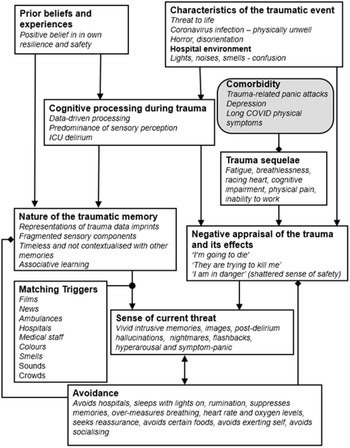
The client’s main problem was ICU-PTSD, which was the focus of treatment. The client was also experiencing symptoms of secondary depression including low mood, lack of motivation, negative cognitions and poor sleep. These symptoms of depression were moderately severe as determined from the PHQ-9 and his interview. However, in line with the National Institute for Health and Care Excellence (2018) guidelines, they did not warrant additional targeted intervention as they were not severe enough to interfere with the PTSD treatment plan. The client was also experiencing symptoms of secondary panic disorder including sudden panic attacks with focus on shortness of breath and catastrophic misinterpretations of these symptoms. This was associated with constant anticipatory anxiety around the next panic attack. This fear of symptoms led to avoidance and safety-seeking behaviours such as avoiding physical exertion and frequently calling the emergency services. These panic symptoms were acute and likely to interfere with the PTSD treatment plan. Therefore, the initial treatment phase incorporated targeted panic management CBT interventions. In line with his diagnosis for long COVID, the client was experiencing shortness of breath, tachycardia, fatigue and brain fog. These long COVID symptoms were being managed under the physical health team and were evaluated as stable enough to not interfere with the PTSD treatment plan. The treatment plan and is shown in Fig. 1.
Case conceptualisation of the client’s ICU-PTSD. The client’s main problem (PTSD) was formulated with the Ehlers and Clark (Reference Ehlers and Clark2000) CT-PTSD model which took account of the co-occurring depression, panic and long COVID symptoms.

Course of treatment and outcomes
The main treatment goals in line with the Ehlers and Clark (Reference Ehlers and Clark2000) CT-PTSD model were to modify his trauma-related appraisals, reduce his re-experiencing and maintaining behaviours and cognitive strategies. The treatment plan involved the client’s GP, physiotherapists, cardiopulmonary specialists and his family. The client was offered 16 sessions of CBT. These were 60- to 90-minute weekly video sessions conducted via Microsoft Teams. This was followed by a 30-minute 3-month follow-up telephone session.
Session 1: Engagement and socialisation to treatment
The client presented with visibly high-level distress and hyperarousal. He also exhibited a shattered sense of his own safety, as indicated on his PTCI-S and RIQ-S. The initial sessions involved getting an account/timeline of the trauma, operationalising his treatment goals into realistic plans, normalising the symptoms causing a sense of current threat (e.g. nightmares, flashbacks/hallucinations as part of the trauma memory), psychoeducation about the nature of the trauma memory (e.g. re-experiencing and nowness) and providing a treatment rationale (e.g. imaginal reliving to help process the memory, contextualise it in the past and reduce the accompanying symptoms).
Sessions 2 to 3: Cognitive therapy for panic attacks and reclaiming
As the client presented with symptoms of panic disorder which were a barrier to memory work, they were treated first. These initial sessions involved identification of the panic symptoms, associated catastrophic misinterpretations and unhelpful strategies. This was followed by psychoeducation and experiential in-session and out-of-session behavioural experiments. The experiments involved the client tolerating his physical symptoms without engaging in his safety behaviours or avoidance. This further enabled the client to engage with reclaiming activities. Due to the client’s long COVID symptoms, the reclaiming activities followed the National Institute for Health and Care Excellence (2020b) guidelines on graded exercise in the context of COVID-19. It also involved guidance from the client’s GP, physiotherapist and cardiopulmonary specialists. The initial reclaiming activities involved the client going outside for short 5-minute walks which were initially completed with a family member. This was gradually followed by completing these tasks alone and for longer periods.
Sessions 4 to 9: Elaboration of trauma memory and updating
Elaboration presented an initial challenge as the client’s trauma memory was fragmented. This was managed by the initial use of a timeline to help clarify the temporal order of events. This also validated the use of a written narrative rather than imaginal reliving in the first instance. The timeline involved the client mapping out the sequence of events in the session. His family were involved in the homework task where the client had discussions with them on the events. The client’s family provided factual information which helped the client fill in the missing gaps. The written narrative was completed in-session with the client over a 30-minute period. This time allocation was important as a gauge for pacing the narrative and ensuring that the client did not skip over parts of the memory. Prior to commencing, safety anchor points when the client felt safe just before and after the trauma were identified. He was guided throughout by the therapist to write the narrative in the first person and present tense. The client then read the narrative aloud to the therapist. He repeated this process for homework. Following this, four main hotspots which comprised both ‘real’ and ‘hallucinated’ trauma memories were identified. The first hotspot was of being taken to the hospital in an ambulance where he realised something was wrong and felt a shattered sense of safety. He reported appraisals around not being safe. The second moment of hotspot was lying in a coma unable to move. He reported cognitions around feeling alone with the appraisal ‘I am going to die’. He also reported delirium experience hotspots where he saw doctors and nurses by his bedside with the appraisal ‘they are trying to kill me’. He also saw them looking at him through an alien object, slicing his head and torso with the appraisal ‘I am dead’. The third hotspot was having doctors and nurses telling him what had happened and where he was and feeling fear and confusion with the appraisal ‘they are trying to kill me’. The client rated the second hotspot as the most distressing. These hotspots were further elaborated through chunked imaginal reliving. They were then modified through memory updating including cognitive restructuring. The restructured hotspots were inserted into the narrative as ‘what I now know’ memory updates. The client made the following updates: ‘I now know that I did not die’ and ‘I now know that they did not kill me and that they were trying to help me’. He showed himself this by physically standing up and reminding himself of where he was in the present moment, the date and time. He also showed himself his medical progress reports and confirmed that the doctors and nurses helped him recover from his critical illness. Using this information, the client also challenged the distorted beliefs that his body was permanently damaged and that he was weak. This was reinforced using cognitive restructuring and self-compassion. The imaginal reliving also updated the client’s ‘hallucinated’ trauma memories. For example, he reappraised that: (1) the perceived alien object was the bedside clinic notes computer; (2) the perceived slicing of his neck and torso was the ECMO intervention which used his neck and groin area; (3) the professionals only stood by his bedside because they were performing various treatments such as monitoring his progress and administering his medication. The trauma-memory updates are summarised in Table 1.
Example trauma-memory updates

The updates included both ‘real’ and ‘hallucinated’ trauma memories.
Sessions 10 to 13: Stimulus discrimination and site visit
The client had an array of matching triggers which he was managing through avoidance and use of safety behaviours, as indicated on his SBQ-S. The rationale behind stimulus discrimination helped the client differentiate between ‘Then vs Now’ using a list of matching triggers and their context in order to process the trauma memory into the past. The initial discrimination involved a Then vs Now discussion whilst comparing the similarities and differences between the trauma memory and its matching triggers. The next stage involved in-session Then vs Now experiential learning. As prioritised by the client, this started with watching a five-minute film clip of an emergency ambulance. The client differentiated the now ambulance vs then. Following this, the client approached a real ambulance for homework. The client approached his other matching triggers over three weeks.
In line with Murray et al. (Reference Murray, Grey, Wild, Warnock-Parkes, Kerr, Clark and Ehlers2020). the client’s site visit involved careful preparation. It was completed in three stages: preparatory discussion and imaginal rehearsal, a virtual site tour of an ICU, and attendance to a real-life follow-up medical appointment at the unit. This appointment served as a timely naturalistic site visit. Due to COVID restrictions at the time, the client attended the appointment alone. After the follow-up appointment, the client further discriminated his hospital attendance using ‘Then vs Now’ contextualisation: (1) he attended voluntarily; (2) it was a different day and he attended by taxi rather than ambulance. He also discriminated that: (3) the ward had been rearranged and was less crowded; and (4) he was able to speak to the professionals, was sat down and was able to stand up and voluntarily leave when the procedure was complete. These differences helped the client to experience that the trauma was in the past.
Sessions 14 to 15: Consolidating the modification of maintaining strategies
Towards the end of therapy, the client still reported periodic thought suppression, symptom checking and rumination. In order to reinforce the learning from earlier on in therapy, these sessions focused on discussing the problematic consequences of these unhelpful behavioural and cognitive strategies. The pros and cons of using these strategies were reviewed, and the client was able to consolidate his learning on the undesirable consequences of these strategies.
Session 16: Therapy blueprint
The learning from above was reviewed in a therapy blueprint on what aspects of treatment were most useful. In the blueprint the client outlined the differences between his current updated memory compared with the original trauma memory. He also listed his cognitive and behavioural changes including the unhelpfulness of his safety behaviours, avoidance and rumination. The client also planned how he would maintain these changes and overcome any arising problems.
Quantitative outcomes
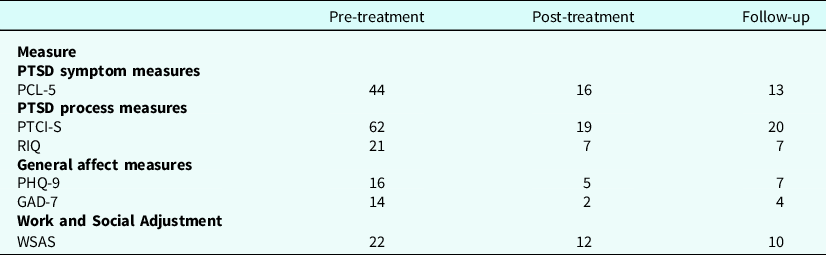
By the end of therapy, the client the client no longer showed clinically important symptoms of PTSD as assessed on the PCL-5 and interview. This change correlated with a reduction in his post-traumatic cognitions about himself and the world, negative responses to intrusions and use of safety behaviours as indicated on his PTCI-S, RIQ-S and SBQ-S. The client also no longer showed clinically important symptoms of depression as indicated on his PHQ-9. This change was maintained at 3-month follow-up. Table 2 shows client scores on the outcome and process measures.
Symptom and process scores across treatment

Measures used were: PCL-5, PTSD for DSM-5; PTCI-S, short version of Posttraumatic Cognitions Inventory; RIQ-S, short version of the Response to Intrusions Questionnaire; SBQ-S, short version of the safety behaviours questionnaire; PHQ-9, Patient Health Questionnaire; GAD-7, Generalised Anxiety Disorder questionnaire; WSAS, Work and Social Adjustment Scale.
Qualitative outcomes
As indicated on his PEQ, the client reported that being able to confront his trauma memory and update it was most helpful in overcoming his trauma-related symptoms and appraisals which helped him reconnect with avoided activities (e.g. he resumed exercising and visiting his family). The client reflected on how he overcame his nightmares, flashbacks/hallucinations and unhelpful strategies. He reported a marked decrease in the belief ratings of the appraisals that he was weak (9 to 0) and that other people would perceive him as crazy (7 to 0). He also reflected on the inaccuracy of his trauma-related appraisal that he would never work again and had in fact resumed employment. The client also discriminated that the remainder of his symptoms were long COVD related.
Discussion
This study illustrates the effective use of the CT-PTSD model in the treatment of COVID-19 ICU-PTSD. In a similar fashion to standard CT-PTSD, this study used an individualised case formulation. An important consideration was the normalisation of both ‘real’ and ‘hallucinated’ trauma memories. In this case, the client had a sense that his ‘hallucinated’ trauma memories were bizarre and worried about being perceived as crazy. Given the disjointed nature of his trauma memory, the client’s family were involved in the treatment to provide key information. The site visit was also particularly important in helping fill in the gaps in the client’s trauma memory to make it easier to process. For this client, the opportunity for a site visit came naturally due to a follow-up appointment at the unit. This may not be the case for other clients. This approach was also culturally acceptable to this client as his recovery already involved his family as a whole. However, family involvement may not be appropriate or possible for other clients.
Several studies (e.g. Hatch et al., Reference Hatch, Young, Barber, Griffiths, Harrison and Watkinson2018) have shown that PTSD rarely occurs in isolation. The current case portrayed PTSD with co-occurring depression, panic disorder and long COVID. In line with the National Institute for Health and Care Excellence (2018) guidelines for managing PTSD, the depression was taken into consideration but was not treated separately as it was not severe enough to interfere with the PTSD treatment plan. In this case, the depression symptoms alleviated after treating the PTSD. The panic symptoms presented a barrier to therapy and were addressed through brief panic management before focusing on treating the PTSD. In view of the client’s overlapping long COVID symptoms, therapy took a graded approach and offered psychoeducation on the overlapping symptoms. Therapy also involved consultation with the client’s physical health professionals who offered guidance on his suitability for CT-PTSD and the appropriate behavioural experiments. All the above factors were considered in this CT-PTSD conceptualisation of COVID ICU-PTSD. This approach has been described by Barton et al. (Reference Barton, Armstrong, Wicks, Freeman and Meyer2017) where they consider the case of complex depression with other co-morbid disorders. They define complexity as cases having ‘multiple moving parts’ which could have a bearing on the disorder specific treatment plans. Some co-occurring moving parts will respond to the treatment of the main moving part, whereas others may need additional interventions. Adopting this principle, the current case had the PTSD symptomology as its main moving part with co-occurring depression, panic disorder and long COVID. This approach worked in this case but may not necessarily apply to other similar presentations.
Limitations
As with all case studies, this intervention was helpful for this client but may not generalise to all ICU-PTSD cases. As this study was not controlled, it did not rule out effects of natural recovery in parallel to his physical health improvement. However, natural recovery seems unlikely as this condition had persisted for several months prior to treatment. Nevertheless, despite these limitations, this case study illustrates the effective use of CT-PTSD in the treatment of COVID-19 ICU-PTSD.
Key practice points
-
(1) This study would benefit clinicians working with clients presenting with ICU-PTSD. Cases like this will present to IAPT, especially with the current pandemic. The key learning is that clinicians need not be deterred by the array of experiences presented by such cases in terms of the nature of the trauma memory and co-occurring symptoms.
-
(2) Clinicians need to take account of the interacting parts of these presentations. This means that individualised formulations may need to be enhanced by additional interventions to address the co-occurring symptoms. What worked best in this case was the use of an individualised CT-PTSD formulation. This formulation conceptualised the disjointed nature of the trauma memory and the co-occurrence of ‘real’ and ‘hallucinated’ trauma memories. It took account of the client’s co-occurring symptoms of depression, panic and long COVID.
-
(3) Multiple working relationships are a key contributor to treatment planning and outcomes. This case study involved the client, his family and physical health professionals.
Data availability statement
The authors can confirm that the data supporting the findings are available in the article.
Acknowledgements
The authors would like to acknowledge the support and encouragement of Daniela Antonie (clinical lead), Chris Spanton (deputy clinical lead) and Monton Jienpetivate (associate clinical director for IAPT) at East London NHS Foundation Trust. They would also like to thank Anke Ehlers and the OXCADAT team for their guidance on the NHS HEE training. Thanks also goes to the client for his consent.
Author contributions
Lilian Skilbeck: Conceptualization (equal), Data curation (equal), Formal analysis (equal), Methodology (equal), Writing – original draft (lead), Writing – review & editing (equal); Suzanne Byrne: Conceptualization (equal), Data curation (equal), Formal analysis (equal), Methodology (equal), Writing – original draft (supporting), Writing – review & editing (equal).
Financial support
None.
Conflicts of interest
There are no known conflicts of interest.
Ethical standards
The authors have abided by the Ethical Principles of Psychologists and Code of Conduct as set out by the BABCP and BPS. In line with this, ethical approval was sought from the East London Foundation Trust board of Ethics Committee (GECSE, G2104). Client consent and data management were conducted in line with their recommendations.




Comments
No Comments have been published for this article.