Introduction
In Cambodia, in the lower Mekong River basin, around one-third of the population lives below the poverty line (Nesbitt, Reference Nesbitt1997). Agriculture provides livelihoods for 60 % of the total population. The climate in this region is tropical monsoonal, with a wet season from June to November followed by a prolonged dry season. The main agricultural activity is smallholder production of wet-season rice (Oryza sativa L.), which is grown mostly in rain-fed lowlands. Rice ecosystems are classified into rain-fed lowlands (for wet-season rice; 81 %), uplands (1 %), deepwater (1 %), and irrigated lowlands (for dry-season rice; 17 %) (MAFF, 2018). Concomitant with the development of irrigation infrastructure, the area of dry-season rice in Cambodia has rapidly increased from 0.16 × 10⁶ ha in 1993 (Nesbitt, Reference Nesbitt1997) to 0.55 × 10⁶ ha in 2017 (MAFF, 2018). Where irrigation water is available, introducing double-cropping practice – that is, irrigated rice in the dry season followed by rain-fed rice in the wet season – increases annual income by >25 % (Fukai and Ouk, Reference Fukai and Ouk2012).
Coarse-textured infertile soils lacking sufficient N, P, and K limit rice yields in Cambodia (Kong et al., Reference Kong, Hin, Seng, Ismail, Vergara, Choi, Ehara and Kato2019). Following a large national soil survey, the soils were classified into 11 groups according to their nutrient management requirements: Bakan, Kampong Siem, Kbar Po, Kein Svay, Koktrap, Krakor, Labansiek, Orung, Prateah Lang, Prey Khmer, and Toul Samroung (White et al., Reference White, Dobermann, Oberthur and Ros2000). The low soil fertility results from weathering of soils with a low organic carbon content, as is typically seen in the Prateah Lang soil, which covers 25–30 % of the country’s rice-growing area. On the other hand, loamy or clayey soils such as Toul Samroung (7–10 % of the rice-growing area), Bakan (10–15 %), and Krakor (15 %) have the potential for high rice productivity.
A number of field studies have focused on the improvement of nutrient management of wet-season rice in Cambodia to close the nationwide yield gap, that is, increasing mean farm yield (3.3 t ha−1; MAFF, 2018) towards potential yield (Blair and Blair, Reference Blair and Blair2014; Seng et al., Reference Seng, Ros, Bell, White, Hin, Fukai and Basnayake2001; Wade et al., Reference Wade, Amarante, Olea, Harnpichitvitaya, Naklang, Wihardjaka, Sengar, Mazid, Singh and McLaren1999; White et al., Reference White, Dobermann, Oberthur and Ros2000). Potential yield is the yield of a cultivar grown in environments to which it is adapted with non-limiting water and nutrient conditions (Evans and Fischer, Reference Evans and Fischer1999). Our previous field experiment showed that the best nutrient management gave yields of a popular photoperiod-sensitive cultivar (‘Phka Rumduol’) as high as 5.2 t ha−1 in the wet season (Kong et al., Reference Kong, Hin, Seng, Ismail, Vergara, Choi, Ehara and Kato2019). However, little is known of the experimental potential yield (i.e., best yield from experiments; Stuart et al., Reference Stuart, Pame, Silva, Dikitanan, Rutsaert, Malabayabas, Lampayan, Radanielson and Singleton2016) or the economically attainable yield (i.e., best farmers’ yield) of dry-season rice in the region. In the Philippines, Indonesia, Thailand, and Vietnam, the difference between dry-season and wet-season rice in the climatic potential yield simulated by the ORYZA model is theoretically <10 % (Laborte et al., Reference Laborte, de Bie, Smaling, Moya, Boling and Van Ittersum2012). But an experiment conducted in Cambodia reported significantly lower potential yield of a non-photoperiod-sensitive short-duration cultivar (‘IR66’) in the dry season (2.1–2.4 t ha−1) than in the wet season (3.0 t ha−1) (Pheav et al., Reference Pheav, Bell, White and Kirk2003). In contrast, another study growing ‘IR66’ on a different soil group in Cambodia reported an experimental potential yield of 7.0 t ha−1 (Poulton et al., Reference Poulton, Vesna, Dalgliesh and Seng2014), indicating that the nutrient requirements of non-photoperiod-sensitive cultivars in the dry season may depend on the soil group. Since the soil-specific nutrient management guideline for dry-season rice in Cambodia was prepared with limited experimental data (White et al., Reference White, Dobermann, Oberthur and Ros2000), there is a need to adapt it to the different soil groups. Such improvement in nutrient management should further close the yield gap and enhance the economic benefit from fertilizer investments.
Where canal water is available for irrigation, Cambodian rice farmers are beginning to invest more in their fields in the dry season to maximize productivity and profitability. The objectives of this study were to evaluate the experimental potential yield of dry-season rice, its response to nutrient inputs on different soils, and the economic feasibility of various nutrient management treatments, as the basis for soil-specific fertilizer recommendations in Cambodia.
Materials and Methods
Field experiments
Experiments were conducted at government research stations or in farmer fields on four soil groups in four Cambodian provinces (Battambang, Kampong Thom, Pursat, and Siem Reap) during the dry seasons of 2016 and 2017 (Supplementary Table S1 available online at https://doi.org/10.1017/S0014479719000346). The monthly mean temperature in Cambodia ranges from 26 to 31 °C throughout the year. In the USDA classification (White et al., Reference White, Dobermann, Oberthur and Ros2000), the Toul Samroung (high-fertility clay) soil is classified as Endoaqualfs; Prateah Lang (moderate-fertility clay) as Plinthustalfs; Krakor (loam) as Inceptisol; and Bakan (loam) as Alfisol. Soil characteristics differ among soil groups and soil layers (Supplementary Table S1). Clay content, plant-available K, and cation-exchange capacity (CEC) are highest in the Toul Samroung soil and lowest in the Prateah Lang soil. There was a significant positive relationship (P < 0.01) between total C and total N, and there were significant negative relationships between the sand and clay contents, between the sand content and CEC, and between the sand content and available K (Supplementary Fig. S1).
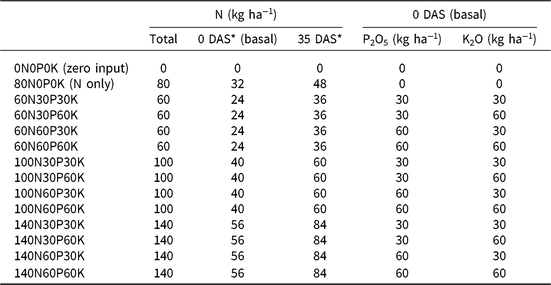
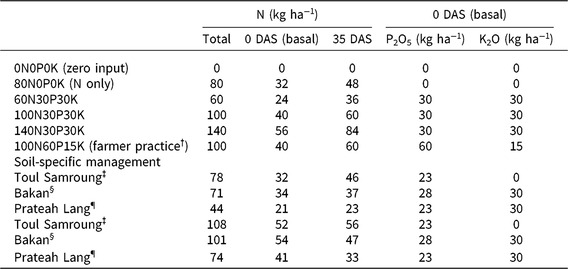
We examined 14 (2016) and 8 (2017) nutrient management regimes at each site (Tables 1 and 2), growing a popular non-photoperiod-sensitive cultivar (‘Chul’sa’). The fertilizer application rates in the farmer practice were based on a survey of 1200 rice farmers in 2013 (Mr. Sophoan Sourn, Cambodia Agricultural Value Chain Program, unpublished data). Fertilizer application in the soil-specific management regime followed the recommendations of the Cambodian Agricultural Research and Development Institute (CARDI). In 2017, we also tested the addition of 30 kg ha−1 of N to the fertilizer rate under soil-specific management (Table 2). Amounts of urea, diammonium phosphate, and potassium chloride were determined to provide these fertilizer rates in each treatment. Treatments were arranged in a randomized complete block design with three (2016) or four (2017) replicates. Each plot covered 15.0 m2 (3.0 × 5.0 m). Bunds (15 cm height, 50 cm width) were built around each plot to prevent the flow of fertilizer between adjacent plots. Seeds were soaked in tap water for 3 days and then broadcast on puddled soil at 80 kg (dry) per hectare. The sowing date ranged from 9 December 2015 to 12 March 2016 (dry season of 2016) and from 26 November 2016 to 16 February 2017 (dry season of 2017), depending on the timing of the recession of floodwaters at the end of the wet season and the availability of irrigation at each site. After seeding, the soil was kept saturated for 2 weeks by applying daily flush irrigation, then shallow water (3–5 cm) was maintained in the field until harvest.
Nutrient management treatments in dry-season rice in Cambodia in 2016

DAS, days after sowing.
Soil-specific nutrient management treatments in dry-season rice in Cambodia in 2017

DAS, days after sowing.
† Application regime based on farmer practice in dry seasons (S. Sourn, unpublished data).
‡ Soil in Battambang and Kampong Thom.
§ Soil in Pursat.
¶ Soil in Siem Reap.
Measurements
The date of 50 % heading in each plot was recorded. At maturity, plant height and panicle number were measured from an area of 0.25 m2. In addition, five representative medium-sized panicles were collected, and the numbers of ripened and empty grains were counted to determine the number of spikelets per panicle and the filled grain percentage. The paddies were manually harvested from a 5-m2 area in each plot, threshed, and winnowed, and grain yields were converted to values at a 14 % moisture content.
The economic returns (the ‘gross return above fertilizer cost’) were determined by subtracting the total cost of the fertilizer inputs from the income received from the harvested paddy rice. The treatment-specific costs of fertilizers were calculated by multiplying the amount of each fertilizer by the fertilizer price. The income for each treatment in each plot was calculated by multiplying the plot’s yield by the grain price. We used the farm-gate price of dry paddy rice in this calculation, which was 0.21 USD kg−1. The price of fertilizers was 0.44 USD kg−1 for urea, 0.57 USD kg−1 for diammonium phosphate, and 0.58 USD kg−1 for potassium chloride. These prices represented the mean local market prices from 2015 to 2017.
Statistical analysis
We performed analysis of variance (ANOVA) using the generalized linear model in STAR v. 2.0.1 software, an open-access program implemented in the R package (https://bbi.irri.org). Nutrient management and location were regarded as fixed effects, replicate was treated as a random effect, and the effects of nutrient management, location, and their interaction were assessed. When the ANOVA result was significant at P < 0.05, we compared pairs of values using Fisher’s least significant difference (LSD) test.
Results
Grain yield and economic profit
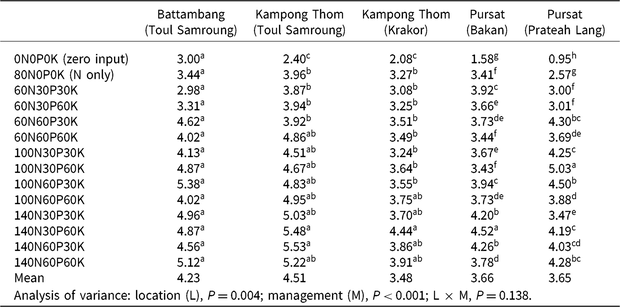
Grain yield ranged from 1.0 to 5.5 t ha−1 in 2016 and from 1.3 to 6.7 t ha−1 in 2017, depending on location and nutrient management (Tables 3 and 4). The experimental potential yield differed among locations, ranging from 4.4 to 5.5 t ha−1 in 2016 and from 3.0 to 6.7 t ha−1 in 2017. Except in Battambang in 2017, it was highest on Toul Samroung soil. Compared with zero input, the yield response to 80 kg ha−1 of N input was significant in seven of the nine combinations of province × soil × year (except Battambang in 2016 and Siem Reap in 2017). The additional P and K inputs further improved rice yield in those seven combinations.
Grain yield (t ha−1) of dry-season rice in different nutrient management treatments in Cambodia in 2016

Different letters indicate significant difference at 5 % probability.
Grain yield (t ha−1) of dry-season rice in different nutrient management treatments in Cambodia in 2017

* Application regime based on farmer practice in dry seasons (S. Sourn, unpublished data).Different letters indicate significant difference at 5 % probability.
In 2016, the nutrient management regime that maximized grain yield differed among provinces (Table 3). In Battambang, treatment differences were not significant. In Kampong Thom, the lowest rates required to maximize yields were 60-60-60 or 100-30-30 kg ha−1 of N-P2O5-K2O on Toul Samroung soil, and 100-60-60 or 140-30-30 kg ha−1 on Krakor soil. In Pursat, yield was maximized by 140-30-60 on Bakan soil and by 100-30-60 kg ha−1 on Prateah Lang soil.
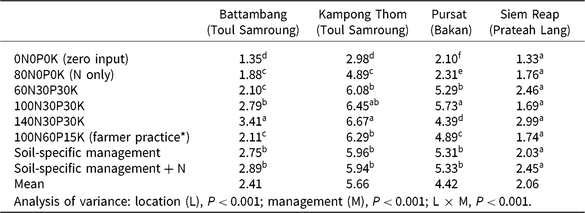
In 2017, yields were maximized at 140-30-30 kg ha−1 of N-P2O5-K2O on Toul Samroung soil in both provinces and at 100-30-30 kg ha−1 on Bakan soil in Pursat, but treatment differences were not significant on Prateah Lang soil in Siem Reap (Table 4). Yields of farmer practice were improved by additional inputs of N or K on Toul Samroung in Kampong Thom and Bakan soils. Yields in soil-specific management were not improved by additional N input on any soil group. The combined results show that yields on Toul Samroung soil were consistently maximized by adding at least 140-30-30 kg ha−1, but fertilizer rates that maximized yields on the other soil groups were inconsistent among locations and years.
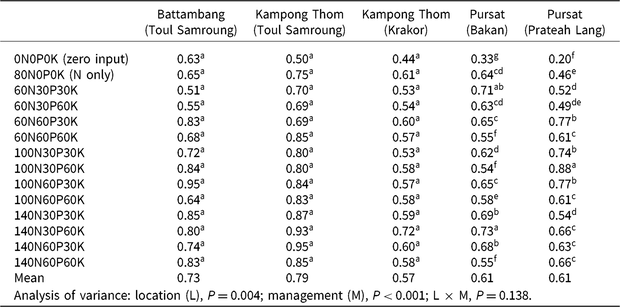
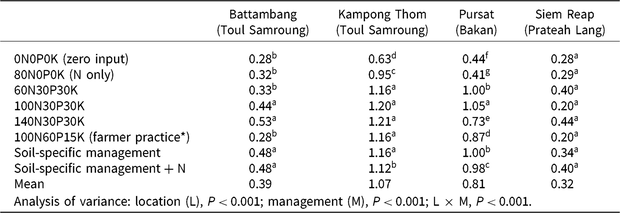
In 2016, gross returns above fertilizer cost did not differ among nutrient management regimes on Toul Samroung and Krakor soils, but were maximized by 60-30-30 or 140-30-60 kg ha−1 on Bakan soil in Pursat and by 100-30-60 kg ha−1 on Prateah Lang soil in Pursat (Table 5). In 2017, soil-specific management of 78-23-0 kg ha−1 on Toul Samroung soil was as profitable as 100-30-30 and 140-30-30 kg ha−1 (Table 6). On Bakan soil, profit was highest at 100-30-30 kg ha−1, followed by soil-specific management at 71-28-30 and 60-30-30 kg ha−1. On Prateah Lang soil, it did not differ among nutrient management regimes. Note that soil-specific management consistently provided >75 % of the highest economic profit obtained in high-input plots.
Gross return above fertilizer cost (× 103 USD ha−1) of dry-season rice in different nutrient management treatments in Cambodia in 2016

Different letters indicate significant difference at 5 % probability.
Gross return above fertilizer cost (× 103 USD ha−1) of dry-season rice in different nutrient management treatments in Cambodia in 2017

* Application regime based on farmer practice in dry seasons (S. Sourn, unpublished data).Different letters indicate significant difference at 5 % probability.
Agronomic traits associated with grain yield
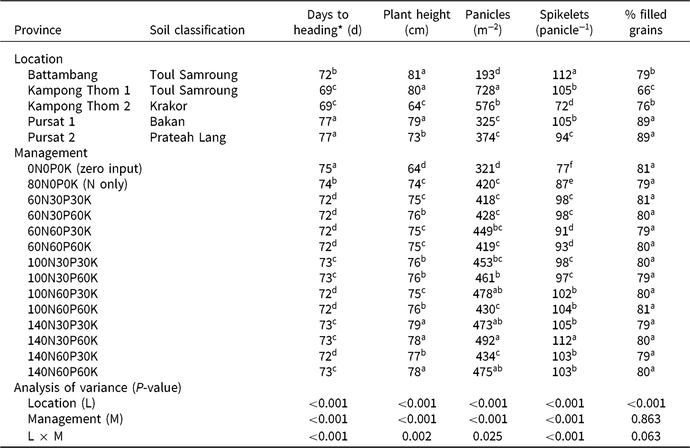
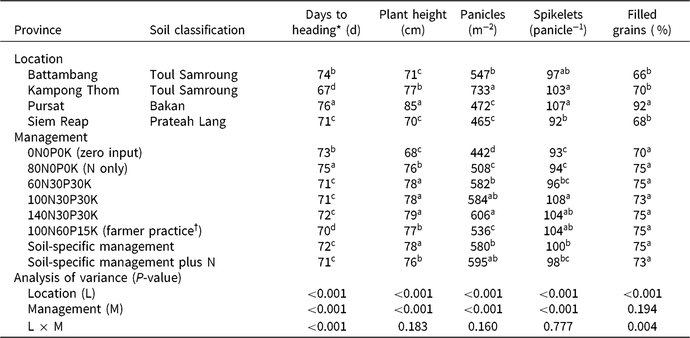
We found statistically significant effects of location and nutrient management on all agronomic traits (except for management on the percentage of filled grains) in both years (Tables 7 and 8). In general, days-to-heading decreased with increasing fertilizer input. Plant height was greater on Toul Samroung and Bakan soils than on Prateah Lang soil, and increased with increasing fertilizer inputs. Both panicle number and, more clearly, spikelets per panicle significantly and positively responded to the additional inputs.
Yield components of dry-season rice in different nutrient management treatments in Cambodia in 2016

* From sowing.Different letters indicate significant difference at 5 % probability.
Yield components of dry-season rice in different nutrient management treatments in Cambodia in 2017

* From sowing.
† Application regime based on farmer practice in dry seasons (S. Sourn, unpublished data).Different letters indicate significant difference at 5 % probability.
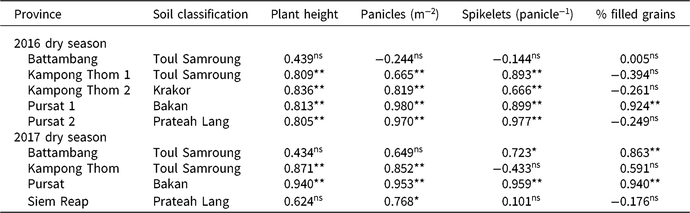
Panicle number was significantly and positively correlated with yield in seven out of the nine combinations, as were plant height and spikelets per panicle in six combinations (Table 9). On the other hand, filled grain percentage was significantly correlated with yield in only three combinations.
Correlation coefficients (Pearson’s r) for the relationship between grain yield and agronomic characters in different nutrient management treatments in Cambodia

*P < 0.05; **P < 0.01; ns, not significant.
Discussion
Crop yield gap is the difference between mean farm yield and potential yield (Evans and Fischer, Reference Evans and Fischer1999). This is a key indicator in estimating potential benefits from technology innovation in crop management (Foley et al., Reference Foley, Ramankutty, Brauman, Cassidy, Gerber, Johnston, Mueller, O’Cornell, Ray, West, Balzer, Bennett, Carpenter, Hill, Monfreda, Polasky, Rockstrom, Sheehan, Siebert, Tilman and Zaks2011). Among the benchmarks for potential yield, the experimental potential yield would be more suitable for less intensive cropping systems than the climatic (theoretical) potential yield, in that one can more reasonably attribute the yield gap to differences in management practices (Stuart et al., Reference Stuart, Pame, Silva, Dikitanan, Rutsaert, Malabayabas, Lampayan, Radanielson and Singleton2016). To the best of our knowledge, this is the first study to report the experimental potential yield of dry-season rice on different soils in Cambodia: 6–7 t ha−1 on Toul Samroung soil, 5–6 t ha−1 on Bakan soil, and 3–5 t ha−1 on Prateah Lang and Krakor soils (Tables 3 and 4). These yields are comparable to those of wet-season rice: Poulton et al. (Reference Poulton, Vesna, Dalgliesh and Seng2014) reported an experimental potential yield of 5.4 t ha−1 on Prateah Lang soil, growing the same cultivar as here in the wet season. Note that the cultivar we used (‘Chul’sa’) is a locally adapted modern cultivar in Cambodia (Poulton et al., Reference Poulton, Vesna, Dalgliesh and Seng2014). Fertilizer inputs were achievable and not far beyond farmer practice (Tables 1 and 2), so the experimental potential yield here is likely similar to the economically attainable yield. If we were to apply fertilizers impractically frequently, maximum yields on the other soil groups would probably reach that on Toul Samroung soil (with the highest clay content and high CEC).
The estimated experimental potential yield of dry-season rice in Cambodia compares with those in reports from neighboring countries. On-farm surveys found economically attainable yields of 5–7 t ha−1 and comparable yields between seasons: 4.8 t ha−1 for both dry-season and wet-season rice (Stuart et al., Reference Stuart, Pame, Vithoonjit, Viriyangkura, Pithuncharurnlap, Meesang, Suksiri, Singleton and Lampayan2018) and 6.4 versus 6.2 t ha−1 in central Thailand (Laborte et al., Reference Laborte, de Bie, Smaling, Moya, Boling and Van Ittersum2012), and 7.3 versus 5.5 t ha−1 in the Mekong delta of Vietnam. The same authors also found that farmers who obtained the best yields applied more fertilizers per unit area in the dry season (Laborte et al., Reference Laborte, de Bie, Smaling, Moya, Boling and Van Ittersum2012). Our results, the previous reports, and the simulation model approach (Laborte et al., Reference Laborte, de Bie, Smaling, Moya, Boling and Van Ittersum2012) strongly suggest that, at least for non-photoperiod-sensitive cultivars, the experimental potential yield in the lower Mekong River basin would be similar between dry-season and wet-season rice, viz., 5–7 t ha−1.
Nutrient requirements for the experimental potential yield differed among locations and years (Tables 3 and 4). Nevertheless, there was no occasion when grain yield was maximized at the highest rate (140-60-60 kg ha−1). Thus, we can at least conclude that nutrient requirements for the experimental potential yield of dry-season rice are less than this rate on any soil in Cambodia. Unless 60-60 kg ha−1 of P2O5-K2O is applied, the required N rate should be >100 kg ha−1 (see Results). This rate is comparable to a previous claim of 97–162 kg ha−1 for dry-season rice in Southeast Asia (Laborte et al., Reference Laborte, de Bie, Smaling, Moya, Boling and Van Ittersum2012). Our results also show that N-only input is not enough to maximize productivity, but further research is needed to determine the best P and K rates for dry-season rice in Cambodia.
While greater rates of fertilizer often increased grain yield further (5 and 6), modest fertilizer application rates in the soil-specific recommendation by CARDI (Table 2) would still allow resource-poor farmers to achieve a stable economic profit from their fertilizer investment. For those farmers willing to invest more in dry-season rice cultivation on Toul Samroung soil, adding N and K to the soil-specific recommendation would slightly increase productivity without reducing profits. For wet-season rice, in contrast, we previously showed that additional fertilizer inputs into soil-specific management significantly and consistently improved profits (Kong et al., Reference Kong, Hin, Seng, Ismail, Vergara, Choi, Ehara and Kato2019). There could be three reasons for the different implications of the nutrient requirements between dry- and wet-season rice. One is that the growth duration is much shorter in non-photoperiod-sensitive cultivars in the dry season than in photoperiod-sensitive cultivars in the wet season. The other is that the recommended rates for dry-season rice (Table 3) are much higher than those for wet-season rice (57–63 kg ha−1 of N, 23–38 kg ha−1 of P2O5, and 0–35 kg ha−1 of K2O on Toul Samroung and Prateah Lang soils; Kong et al., Reference Kong, Hin, Seng, Ismail, Vergara, Choi, Ehara and Kato2019), reflecting the fact that farmers apply more fertilizer in the dry season than in the wet season, particularly N and P (Fukai and Ouk, Reference Fukai and Ouk2012). In addition, the frequent loss of standing water in wet-season rice, usually grown under rain-fed lowland conditions, might accelerate the N loss through denitrification or leaching (Buresh et al., Reference Buresh, Castillo, Dela Torre, Laureles, Samson, Sinohin and Guerra2019).
Among agronomic traits, panicle number, spikelets per panicle, and plant height were correlated with yield more frequently than was filled grain percentage (Table 9). Both panicle number and spikelets per panicle responded to fertilizer inputs, but the percentage of filled grains did not (Table 8). In direct-seeded rice, higher seedling densities than in transplanted rice often cause vigorous vegetative growth and consequently earlier leaf senescence and poor grain filling due to nutrient deficiency after anthesis, particularly in medium-duration cultivars (Liu et al., Reference Liu, Won, Banayo, Nie, Peng and Kato2019). However, limited canopy cover and biomass production due to the short vegetative growth phase of a short-duration cultivar grown in coarse-textured infertile soil is likely to reduce the sink size more than growth during grain filling (Xu et al., Reference Xu, Zhan, Yu, Nie, Huang, Cui, Wang, Li and Peng2018). Thus, the importance of early fertilizer application to ensure vigorous vegetative growth should be emphasized. We suggest that sink size (number of spikelets per m2) should be the major target in nutrient management of dry-season rice in Cambodia.
Conclusion
From field experiments on four soil groups in 2 years, this study reports potential yields of dry-season rice in Cambodia: 6–7 t ha−1 on Toul Samroung soil, 5–6 t ha−1 on Bakan soil, and 3–5 t ha−1 on Prateah Lang and Krakor soils. These values could form the baseline for the potential impact of the introduction of innovative crop management in future agricultural programs. Lower rates than 140-60-60 kg ha−1 of N-P2O5-K2O are likely to achieve the best yield on any soil group. While grain yield of dry-season rice was increased by adding more fertilizer, we suggest that modest fertilizer application rates in the current recommendation by CARDI would be reasonable for risk-averse smallholder farmers in Cambodia.
Supplementary materials
For supplementary material for this article, please visit https://doi.org/10.1017/S0014479719000346
Acknowledgments
We thank Messrs. Sokheng Keo, Leng Layhuot, Akhara Ouk, and Seyla Sem (International Rice Research Institute) for technical assistance. The study was conducted under the Transnational PhD Program of Nagoya University’s Asian Satellite Campuses Institute and the Southeast Asian Regional Center for Graduate Study and Research in Agriculture (for K.K.). We are grateful for the financial support of the U.S. Agency for International Development, the International Fund for Agricultural Development for the Consortium for Unfavorable Rice Environments (CURE), the Consultative Group on International Agricultural Research (CGIAR) for the Research Program on Rice Agri-Food Systems, and a Grant-in-Aid for Scientific Research from the Japan Society for the Promotion of Science (no. 18KK0169).
Financial support
None.