Introduction
Alzheimer's disease (AD) is the commonest cause of dementia affecting over half a million people in the UK, and accounting for approximately 60% of all dementias (Rodda et al., Reference Rodda, Boyce and Walker2008). It is a progressive disorder, however the rate of cognitive decline in patients with AD varies considerably. A meta-analysis of 37 published studies involving 3,492 patients with AD estimated the annual rate of change scores on the Mini-Mental State Examination (MMSE) to be 3.3 points (Han et al., Reference Han, Cole, Bellavance, McCusker and Primeau2000). Yet some individuals with AD show rapid cognitive decline, defined as a loss of 4 points or more on the MMSE in six months (Dumont et al., Reference Dunmont, Voisin, Nourhashemi, Andrieu, Koning and Vellas2005), whilst others show little or no change over several years. Clinical and social demographic heterogeneity associated with cognitive decline has been suggested as the reason however, age of disease onset may be one of the factors related to the pattern of progression in AD.
Individuals who develop dementia before the age of 65 years are diagnosed with young onset AD (YOAD), sometimes also called early onset AD. Those who develop dementia in later life, aged 65 years or older, are called AD with late onset (LOAD; World Health Organisation, 1992). The reason for this dividing line of 65 years appears to be based on social factors such as the traditional retirement age rather than any biological differences or statistical foundations (Eriksson et al., Reference Eriksson, Fereshtehnejad, Falahati, Farahmand, Religa and Eriksdotter2014). Despite this somewhat arbitrary conceptualization there are important imaging, neuropathological and neurochemical differences between the two groups of patients. Those with YOAD have been noted by some to have greater gray matter atrophy (Frisoni et al., Reference Frisoni, Testa, Sabattoli, Beltramello, Soininen and Laakso2005), and pathologically have more severe senile plaques, neurofibrillary tangles, and synapse loss (Sakai et al., Reference Sakai2013). There are also widespread and greater deficits in the neurochemical acetylcholine and other neurotransmitters such as adrenaline (Nochlin et al., Reference Nochlin, Van Belle, Bird and Sumi1992). Furthermore, clinical differences have been reported. Patients with YOAD are more likely to present with impairment in language, attention, and visuospatial dysfunction, whereas those with LOAD more commonly experience difficulties with their memory (Koss et al., Reference Koss1996). These findings suggest YOAD may be a separate entity to those with LOAD, and raises interesting questions about the manner in which AD progresses in individuals with YOAD compared to those with LOAD.
It is generally agreed that people with autosomal dominant familial AD have an earlier onset and more rapid deterioration than patients with sporadic AD. Yet there appears to be a lack of consensus regarding young onset sporadic AD and rate of decline. Reviewing the literature, younger individuals with AD are thought to have a more rapid course and increased rate of progression. This assumption appears to be based on studies that have shown younger individuals to convert to AD faster than older adults (Holland et al., Reference Holland, Desikan, Dale and McEvoy2012). Also from studies that have found older individuals with LOAD to have a slower rate of decline in cognitive function (Wilson et al., Reference Wilson, Beckett, Bennett, Albert and Evans1999; Mungas et al., Reference Mungas, Reed, Ellis and Jagust2001; Wilson et al., Reference Wilson2002; Wilson et al., Reference Wilson2004; Bernick et al., Reference Bernick, Cummings, Raman, Sun and Aisen2012; Holland et al., Reference Holland, McEvoy, Desikan and Dale2012). Furthermore, a comprehensive review of 82 studies predicting factors associated with rapid cognitive decline in patients with AD found that younger participants had a more rapid decline in cognitive function than older participants (Sona et al., Reference Sona, Ellis and Ames2013). In these aforementioned studies age of disease onset is considered as a continuum, as opposed to categorizing age and comparing patients with YOAD to those with LOAD.
To date there are no previous reviews identified that have synthesized the available evidence to conclude if there is a difference in the rate of decline between patients with sporadic YOAD and patients with LOAD. Understanding if such a disparity exists has several important clinical implications. In patients diagnosed with YOAD the impact of the condition appears to be even greater than in older patients. Often patients with YOAD are still employed and may provide the main family income, have an active social life, and in many cases have parental responsibility. Thereby increasing our understanding of the prognosis, or the course of the disease process is likely to inform the patient and their family what to expect and when, and enable them to plan and prepare for the future. Furthermore, it may assist clinicians to delineate these groups of patients as distinct entities, and manage the different courses of illness more efficiently, such as identifying patients who need specific considerations and psychosocial interventions (Spalletta et al., Reference Spalletta2013).
Method
Search strategy
A systematic search was initially undertaken by one of the authors (KS) using the Medline database. Search terms for early onset AD were combined with search terms for rate of cognitive decline. Terms were searched in the title and abstract except where otherwise stated. The Medline search was conducted on PubMed as follows:
-
(a) “Alzheimer's disease”
AND
-
(b) Age
AND
-
(c) “rate of decline” OR “rate of progression” OR “cognitive decline” OR “cognitive function” OR “cognitive differences”
This was followed up by a more sensitive search strategy on five databases, modifying search terms as necessary, including PsycINFO, Web of Science, CINAHL, EMBASE, and the Cochrane Library (Database of Abstracts of Reviews of Effects and Central Controlled Trials Register) – covering the period from January 1980 to January 2014. No language restrictions were applied. This was coupled with citation tracking of key primary papers. Reference lists of all included papers were also hand searched.
Inclusion criteria
Studies meeting the following criteria were included in the review.
-
(a) Study design could have been any primary research design including randomized controlled trials (RCTs), randomized crossover studies, controlled trials (cohort, before/after), observational, and cross-sectional.
-
(b) Participants: young onset defined as less than 65 years old and late onset being 65 years or older that fulfill the criteria of probable AD (McKhann et al., Reference McKhann, Brachman, Folstein, Katzman, Price and Stadlan1984).
-
(c) Topic: papers comparing the rate of cognitive decline between YOAD and LOAD.
-
(d) Outcomes: standardized instruments measuring the rate of cognitive decline over a period of time ranging from neuropsychological battery tests to shorter tests of cognition such as the MMSE.
Study selection
Titles of studies and abstracts where relevant and available were independently screened. All potentially relevant studies that met the inclusion criteria were then retrieved in full text and read by authors ZW and KS. Inter-reviewer agreement on application of inclusion/exclusion criteria was satisfactory (κ = 0.85). In all cases disagreement among authors was resolved through discussion so that a consensus was obtained.
Data extraction and quality assessment
One author (KS) used a standardized form to extract the following information from the included studies: (i) study setting and population including number of participants, age, and gender; (ii) study design including length and frequency of follow up; (iii) study results including measure of cognitive assessment used and change in scores from baseline and during the follow-up period. Extracted data were checked for accuracy by author ZW and any discrepancies were resolved through further discussion.
Included studies were then assessed by authors ZW and KS using the Newcastle–Ottawa Quality Assessment Scale for cohort and case-control studies (Wells et al., Reference Wells2011). This scale is a nine-item instrument that judges aspects of methodology in observational studies related to study quality based on three broad areas: the selection of the study groups; the comparability of the groups; and the ascertainment of either the exposure or outcome of interest for case-control or cohort studies respectively (Wells et al., Reference Wells2011). Interpretation of the scale is performed by awarding “stars” for high-quality components. Stars are then added up and used to compare the quality between studies.
Results
Search results
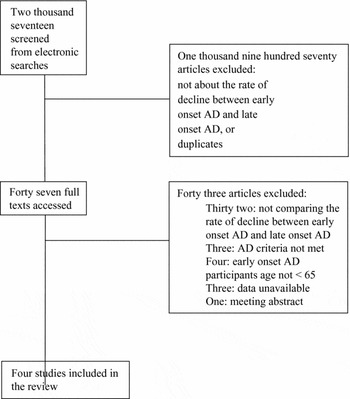
The search of the electronic databases yielded 2,017 publications. Based on title and abstract, 47 studies were selected for further reading, of which four were included in the final selection of publications. Figure 1 summarizes the study flow through the review. Of the included studies three were related to a faster decline in YOAD (Jacobs et al., Reference Jacobs1994; Van der Vlies et al., Reference Van der Vlies, Koedam, Pijnenburg, Twisk, Scheltens and Van der Flier2009; Panegyres et al., Reference Panegyres and Chen2013), and one found no difference between the two groups (Gronning et al., Reference Gronning, Rahmani, Gyllenborg, Dessau and Hogh2012).
Study flow through the review.

Overall description of included studies
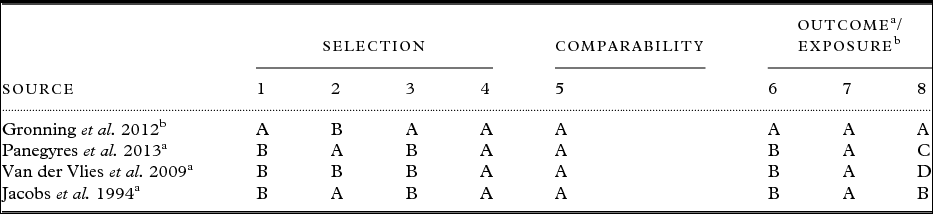
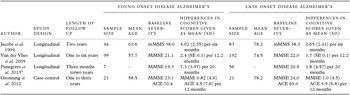
All of the studies scored highly on the Newcastle–Ottawa assessment scale with a score of 6 or greater (see Table 1 for ratings of study quality for each of the Newcastle–Ottawa criteria). The review comprised of three longitudinal studies and one case-control study published between 1994 and 2013. The included studies provided data from an aggregate sample of 523 persons from North America and Europe, the majority of white race. Persons with YOAD totaled a sample size of 171 (range: 7 to 99), mean age 59.9 (range: 46 to 64.9), with the overall sample comprising of approximately 66% females and 34% males. Those with LOAD comprised a larger sample size of 352 (range: 21 to 192), mean age 76.9 (range: 65 to 85), with the sample accounting for a similar gender ratio of 67% females and 33% males. The length of follow up ranged from three months to six years, and the frequency of outcome measures on cognitive decline varied from 2, 6, 12, to 20 months. Three studies measured the rate of cognitive decline using the MMSE (with one of these studies using both the MMSE and the Addenbrookes Cognitive Examination (ACE) as outcome measures), and one study used the Modified Mini Mental State (mMMS). The baseline severity of dementia was comparable between groups with patients having mild-to-moderate AD. For example, those studies that used the MMSE persons with YOAD had an average score of 21.1 (range: 19.3 to 23.1), and LOAD 22.3 (range: 20.9 to 24.0). Table 2 provides an overview of the four studies included.
Modified Newcastle–Ottawa Quality Assessment Scale for cohort and case-control studies included in the review

aFor cohort studies, (1) indicates representativeness of the exposed cohort: A, truly representative of the average patient with Alzheimer’s disease (AD); B, somewhat representative of the average patient with AD; C, selected group; and D, no description of the derivation of the cohort. (2) Selection of the non-exposed cohort: A, drawn from the same community as the exposed cohort; B, drawn from a different source; and C, no description of the derivation of the non-exposed cohort. (3) Ascertainment of exposure: A, secure record; B, structured interview; C, written self-report; and D, no description. (4) Demonstration that outcome of interest was not present at start of study: A, yes; B, no. (5) comparability of cohorts on the basis of the design or analysis: A, study participants for age; B, study participants for additional risk factors (such as education and severity of illness); and C, not done. (6) Assessment of outcome: A, independent blind assessment; B, record linkage; C, self-report; and D, no description. (7) Was follow-up long enough for outcomes to occur: A, yes; B, no. (8) Adequacy of follow-up of cohorts: A, complete follow-up -- all participants accounted for; B, small number of participants lost to follow-up unlikely to introduce bias or description provided of those lost; C, low follow-up rate and no description of those lost; and D, no statement.
bFor case-control studies, (1) indicates adequacy of definition of patients with Early Onset AD (EOAD): A, yes, independently validated; B, yes, based on self reports; C, no description. (2) Representative of patients with EOAD: A, participants representative of the population; B, potential for selection bias or not stated. (3) Selection of patients with Late Onset AD (LOAD): A, community patients with LOAD; B, hospital patients with LOAD; C, no description. (4) Definition of participants with LOAD: A, no history of disease; B, no description. (5) Comparability of patients with EOAD and LOAD on the basis of the design: A, study controls for age; B, study controls for additional factor(s). (6) Ascertainment of exposure: A, by blinded record; B, by blinded interview; C, un-blinded interview; D, written self report only; E, no description. (7) Same method of ascertainment used for patients with EOAD and LOAD: A, yes; B, no. (8) Non-response rate: A, the same for patients with EOAD and LOAD; B, non-respondents described; C, different rate and no designation.
Summary of included studies

amMMS = Modified Mini Mental State; MMSE = Mini-Mental State Examination; ACE = Addenbrookes Cognitive Examination; SD = standard deviation; SE = standard error.
bAn estimation of the standard deviation is given based on the assumption the two time points are uncorrelated (as correlation between time points was not given).
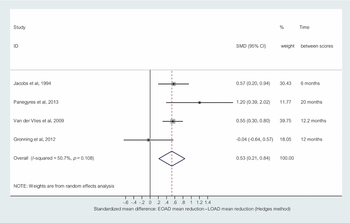
Of the four papers included in the review there was a large amount of heterogeneity between the studies (I 2 statistics: 50.7%, p = 0.108). See Figure 2 for a graphical representation of the study data. Using the random effects model by DerSimonian and Laird (Reference DerSimonian and Laird1986) there is a statistically significant difference in the rate of cognitive decline between those with YOAD and LOAD. This is illustrated by the overall standardized mean difference which shows a greater reduction in the YOAD group by 0.53 units (95% CI = 0.21–0.84). Yet this relatively large pooled effect size needs to be viewed in relation to the variability of the included studies.
Forest plot that examines the rate of cognitive decline between patients with YOAD and LOAD.

Faster decline in young onset AD
There were three studies included in the review that found a faster rate of decline in persons with YOAD. One of the earlier studies comparing the rate of cognitive decline between people with YOAD and LOAD is a prospective longitudinal study by Jacobs and colleagues (Reference Jacobs1994). Jacobs et al. (Reference Jacobs1994; n = 127) found on average participants with AD prior to 65 years of age declined 1.4 points faster on the mMMS per six-month period compared to participants with LOAD. Jacobs and colleagues (Reference Jacobs1994) also found that those with YOAD had distinct clinical profiles in comparison to those with LOAD, thereby supporting the possible notion that YOAD is a separate entity to LOAD. They found patients with YOAD had more pronounced deficits in attention and working memory, whilst participants with LOAD predominantly had deficits in memory measures including recall and naming. These findings have been reported elsewhere (Koss et al., Reference Koss1996; Davidson et al., Reference Davidson2010; Sa et al., Reference Sa2012), and it has been postulated that patients with YOAD may have a primary involvement of the parietal lobe, whereas patients with LOAD may reflect involvement of the temporal lobe (Hogh et al., Reference Hogh, Sjo, Gade and Waldemar2004; Baumann et al., Reference Baumann2010).
Papers by Van der Vlies et al. (Reference Van der Vlies, Koedam, Pijnenburg, Twisk, Scheltens and Van der Flier2009) and Panegyres et al. (Reference Panegyres and Chen2013) further replicate these findings that those with YOAD had a faster rate of cognitive decline. Van der Vlies et al. (Reference Van der Vlies, Koedam, Pijnenburg, Twisk, Scheltens and Van der Flier2009; n = 291) found patients with YOAD lost on average 2.4 points per year on the MMSE compared to patients with LOAD who lost 1.7 points per year on the MMSE. Panegyres et al. (Reference Panegyres and Chen2013) report differences over a 20-month period with those with YOAD losing 7.3 points on the MMSE compared to those with LOAD who lost 1.8 points. Yet of significance is the small sample size used in the YOAD group (n = 7) which is further highlighted by the wide confidence interval in Figure 2. Interestingly, over a 12-month period patients with YOAD lost 1.3 points on the MMSE compared to those with LOAD who lost 0.7 points. This suggests a more rapid decline in the YOAD group over a longer follow-up period. Yet unlike in other studies Panegyres et al. Reference Panegyres and Chen2013 found those with YOAD to have a significantly lower MMSE score at baseline (YOAD: 19.3, LOAD: 20.9, p < 0.05), and this difference gradually increased over the follow-up period (p < 0.0001). However, it may be the more advanced disease severity at the time of inclusion which explains these findings.
Both papers consider the influence of the apolipoprotein E (APOE) gene on the rate of cognitive decline. The APOE genotype is considered a risk factor for the development of AD, however, previous findings have been variable as to the relationship between APOE є4 allele and rate of cognitive decline in AD (Davidson et al., Reference Davidson2007). Van der Vlies et al. (Reference Van der Vlies, Koedam, Pijnenburg, Twisk, Scheltens and Van der Flier2009) compounded this debate by finding that patients with YOAD who did not carry the genetic APOE є4 had a more rapid cognitive decline than non-carriers with LOAD; whereas young and late onset carriers for APOE є4 showed similar rates of cognitive decline. Interestingly they concluded that whilst APOE є4 is a risk factor for developing AD, in patients with YOAD the APOE є4 protects patients once they have the disease. Panegyres et al. (Reference Panegyres and Chen2013) partially agrees with this and their findings suggest that APOE є4 allele is a more important risk factor for LOAD.
No difference in rate of decline between young and late onset AD
Gronning et al. (Reference Gronning, Rahmani, Gyllenborg, Dessau and Hogh2012) undertook a case-control study and compared the change in MMSE and ACE score per year based on the period of follow up (taken at the time of diagnosis and repeated at the project visit). They found no difference in the rate of cognitive decline and the age of onset of AD. However, these findings may also be attributable to limited statistical power due to the small number of patients recruited to the study (n = 42). Gronning and colleagues (Reference Gronning, Rahmani, Gyllenborg, Dessau and Hogh2012) also compared clinical progression and biomarkers in the cerebrospinal fluid (CSF) between participants with YOAD and LOAD. They obtained measures of a-beta (AB), phosphorylated, and total tau (PT and TT) values. Gronning and colleagues (Reference Gronning, Rahmani, Gyllenborg, Dessau and Hogh2012) concluded there was a tendency towards lower values of AB in the YOAD group, but there was no significant correlation between CSF biomarkers and disease progression in either group. Previous studies have suggested that patients with YOAD may have raised levels of PT and TT values in the CSF, which predicts a more rapid decline (Snider et al., Reference Snider2009; Koric et al., Reference Koric2010).
Discussion
The aim of the present review was to systematically identify and examine appropriate studies to investigate whether there is a difference in the rate of cognitive decline depending on the age of diagnosis of AD. The findings of the review are mixed and conflicting. While three of the included studies showed patients with YOAD to progress faster than patients with LOAD, which is in keeping with contemporary beliefs, one study did not find a relationship entirely between age at onset and progression.
These findings are consistent with previous studies that have reported the effect of age on cognitive deterioration in patients with AD. Some studies have shown a faster rate of cognitive decline in younger patients (Seltzer et al., Reference Seltzer and Sherwin1983; Lucca et al., Reference Lucca, Comelli, Tettamanti and Tiraboschi1993; Koss et al., Reference Koss1996; Wilson et al., Reference Wilson, Gilley, Bennett, Beckett and Evans2000; Sakai et al., Reference Sakai2013), others found no association between age of onset and rate of decline (Katzman et al., Reference Katzman1988; Ortof et al., Reference Ortof and Crystal1989; Haupt et al., Reference Haupt, Pollmann and Kurz1993; Bracco et al., Reference Bracco1994; Bowler et al., Reference Bowler, Munoz, Merskey and Hachinski1998), and another suggested cognitive decline is slow during the early and very late stages of AD and more rapid during the middle stages (Stern et al., Reference Stern1994). Few studies appear to have reported a faster rate of decline in patients with LOAD (Huff et al., Reference Huff, Growdon, Corkin and Rosen1987). This was also the case during the review which only identified an abstract presented at a recent meeting by Altinkaya et al. (Reference Altinkaya, Behrem, Karagoz Sakalli, Sutlas, Kirbas and Topcular2013; full publication not available) who found patients with YOAD had a slower rate of decline in MMSE compared to LOAD over an average follow-up period of 2.84 years.
Similar to the studies included in this review previous studies have also commented on the heterogeneity between patients and inter-individual differences in rate of decline (Wilson et al., Reference Wilson, Gilley, Bennett, Beckett and Evans2000). This limits the conclusiveness of findings between age at onset of AD and rate of progression. It was originally thought the diverging findings of previous studies was a result of the variable classification of YOAD and LOAD. Yet age distribution may also be a confounder in the studies included in this review. Two of the included studies (Van der Vlies et al., Reference Van der Vlies, Koedam, Pijnenburg, Twisk, Scheltens and Van der Flier2009; Gronning et al., Reference Gronning, Rahmani, Gyllenborg, Dessau and Hogh2012) calculated the mean baseline age from the registered age at time of diagnosis. One of the studies (Jacobs et al., Reference Jacobs1994) based the age of participants on onset of the disease using information provided by a family member of caregiver. The study by Panegyres et al. (Reference Panegyres and Chen2013) does not report the mean age of participants.
The uncertainty surrounding the age people develop AD may also in part extend to the diagnosis of AD itself. The relatively low prevalence of YOAD, the diagnostic uncertainty, and the separation from other forms of dementia more frequent at this age, i.e. Frontal Temporal Dementia, and misidentification of atypical AD all may affect the precise diagnosis of AD and inclusion of people with YOAD (Sa et al., Reference Sa2012). These difficulties may partly account for the relatively small sample sizes of people with YOAD. Furthermore, none of the included studies had post-mortem validation of the diagnosis of AD. Also a third of patients with AD have at autopsy a degree of vascular pathology yet only one study (Panegyres et al., Reference Panegyres and Chen2013) controlled for vascular risk factors.
Differences in patient characteristics such as gender and level of education and their possible effects on disease progression are accounted for by Jacobs et al. (Reference Jacobs1994) and Gronning et al. (Reference Gronning, Rahmani, Gyllenborg, Dessau and Hogh2012). After controlling for gender they found no effect of an uneven gender distribution on rate of cognitive decline in AD. This is in comparison with a previous study that found women to progress at a faster rate than men (Lucca et al., Reference Lucca, Comelli, Tettamanti and Tiraboschi1993). Regarding level of education Jacobs et al. (Reference Jacobs1994) found patients with YOAD had completed more years of education than late onset patients, while Gronning and colleagues (Reference Gronning, Rahmani, Gyllenborg, Dessau and Hogh2012) found no difference in the level of education between the two groups. Both of these studies found no significant association between education level and rate of cognitive decline. Again, this is in contrast to previous studies that found higher education seems to delay the onset of AD, but when patients with higher education develop AD they then experience faster cognitive decline (Scarmens et al., Reference Scarmens, Albert, Manly and Stern2006; Sona et al., Reference Sona, Ellis and Ames2013).
The frequency and collection of data using various cognitive measures may also have affected the findings of the included studies. Three of the studies used the MMSE (with one of these studies also using the ACE), and one study used the mMMS to measure cognitive decline. The ceiling and floor effects of such cognitive scales may make patterns difficult to detect at various stages of the disease (Davidson et al., Reference Davidson2007). Also, one of the included studies (Panegyres et al., Reference Panegyres and Chen2013) repeated the MMSE testing at approximately two monthly intervals over 2 years. This may have introduced learning effects and thereby compromised the data collected. A further consideration is that influence of age may be too small to have a measurable effect on certain cognitive measures during limited follow-up periods (Bernick et al., Reference Bernick, Cummings, Raman, Sun and Aisen2012). To enable accurate comparisons of cognitive test scores and decline among studies a suitable length of follow up and frequency of cognitive testing is required. Currently the National Institute of Clinical Excellence (NICE) guidelines suggest that patients with a diagnosis of dementia on treatment should be followed up every six months and disease progression measured in part by the MMSE (NICE, 2011). Therefore, a follow-up period of at least one year with two separate cognitive measurements seems a suitable suggestion for studies measuring the rate of cognitive decline.
There are some limitations to our review. First, due to the large degree of heterogeneity between studies it was not possible to undertake a meta-analysis and the results were largely analyzed and discussed qualitatively. Where a forest plot was used to illustrate the differences in rate of cognitive decline between those with YOAD and LOAD these findings are limited with there being only four papers included in the review; the time gap between the before and after scores varies between the studies; and the highly unlikely assumption that the scores were uncorrelated in the study by Panegyres et al., Reference Panegyres and Chen2013. Second, the review set fairly stringent inclusion criteria and there may have been potential studies excluded as a result. For example, the review specified people with AD met the diagnostic criteria as set by McKhann et al. (Reference McKhann, Brachman, Folstein, Katzman, Price and Stadlan1984). This resulted in two potential studies being excluded as one used the International Classification of Diseases (ICD) criteria to diagnose patients with AD (Haupt et al., Reference Haupt, Pollmann and Kurz1993), and another used the DSM-III criteria (Ortof et al., Reference Ortof and Crystal1989). Lastly, there were several limitations of the studies included in the review which may have affected the overall findings and comments. In summary the limitations of the included studies are as follows: (1) difficulties in determining the precise age at onset of disease partly because of the insidious onset of dementia; (2) relatively small sample sizes in the majority of the included studies, and noticeable imbalance of participants between the YOAD and LOAD groups; (3) the presence of uncontrolled variables such as gender, level of education, baseline dementia severity, and vascular risk factors; (4) lack of uniformity in the evaluation of cognitive impairment; and (5) variable lengths of follow up and frequency of cognitive testing. These limitations may have affected the overall conclusions drawn from the review.
Conclusion
There were four studies identified that compared the rate of cognitive decline between patients with YOAD and those with LOAD. Three of these studies reported a faster rate of disease progression in those with YOAD, and one found no difference in the rate of cognitive decline between the two groups. The overall findings of the review are limited by the heterogeneity and various limitations of the included studies. There is a need for future research to address the methodological limitations described such as including sufficient sample sizes and follow-up periods, controlling for possible confounding factors such as vascular risk factors, and performing biomarkers to improve diagnostic accuracy. This will help to validate the findings so far and improve our understanding of the rate of cognitive decline in people with young and late onset AD.
Conflict of interest
None.
Description of authors’ roles
KS carried out the review and wrote the paper. ZW oversaw the review. Both authors designed the review, critically appraised the included studies, and reviewed drafts of this paper.
Acknowledgments
Our thanks to Matthew Burnell, statistician at University College London, for his help with calculating the effect sizes and design of the forest plot included in the paper.