Introduction
Soil contaminated by parasitic protozoans and helminths from animals can constitute a potential risk of human infection (Santarém et al., Reference Santarém, Giuffrida and Arantes2004). Several parasites of dogs, cats and rats can cause serious pathologies in humans, such as visceral larva migrans, cutaneous larva migrans and toxoplasmosis (Doligalska & Donskow, Reference Doligalska and Donskow2003).
Contamination of soil by parasites in leisure and recreational areas has been studied in several parts of the world (Fonrouge et al., Reference Fonrouge, Guardis, Radman and Archelli2000; Mustafa et al., Reference Mustafa, Seyrek, Aslan, Ozbilge and Atay2001; Pawlowski & Mizgajska, Reference Pawlowski and Mizgajska2002; Carden et al., Reference Carden, Meusemann, Walker, Stawell, Mackinnon, Smith, Stawell and Hall2003; Habluetzel et al., Reference Habluetzel, Traldi, Ruggeri, Attili, Scuppa, Marchetti, Menghini and Esposito2003; Wiwanitkit & Waenlor, Reference Wiwanitkit and Waenlor2004; Chorazy & Richardison, Reference Chorazy and Richardison2005; Matsuo & Nakashio, Reference Matsuo and Nakashio2005). In countries such as Japan (Shimizu, Reference Shimizu1993) and the United Kingdom (Gillespie et al., Reference Gillespie, Pereira and Ramsay1991), contamination in parks shows rates of 63% and 6.3%, respectively. In Latin America, soil samples from Argentina and Peru have shown a prevalence index of contamination of 28.9% and 70.6% respectively (Castilho et al., Reference Castilho, Bazan, Alvarado and Saez2001; Pierangeli et al., Reference Pierangeli, Giayetto, Manacorda, Barbieri, Soriano, Veronesi, Pezzani and Minvielle2003). In Brazil, where zoonoses such as giardiasis, cryptosporidiosis, toxoplasmosis, visceral larva migrans and cutaneous larva migrans are a serious public-health problem (Soares et al., Reference Soares, Bernardes and Cordeiro-Neto2002), soil contamination in recreational areas of schools and squares can be significant, ranging from 18% to 100% (Chieffi & Müller, Reference Chieffi and Müller1978; Nunes et al., Reference Nunes, Pena, Negrelli, Anjo, Nakano and Stobbe2000; Guimarães et al., Reference Guimarães, Alves, Rezende and Rodrigues2005).
The presence of protozoans and helminths potentially infective for humans in soil is associated with the structural characteristics of the soil, presence of plant cover and climatic conditions (Pierangeli et al., Reference Pierangeli, Giayetto, Manacorda, Barbieri, Soriano, Veronesi, Pezzani and Minvielle2003). Seasonal variations including temperature and humidity can influence the distribution and survival of eggs, larvae, cysts and oocysts (Nzeako, Reference Nzeako1992; Schulz & Kroeger, Reference Schulz and Kroeger1992; Smith, Reference Smith1998; Mercado et al., Reference Mercado, Ueta, Castilho, Munoz and Schenone2004).
The objective of this study was to assess the presence of helminths and protozoans in public squares and lawns of the city of Maringá in southern Brazil, during winter and summer, and to evaluate seasonal fluctuations in relation to edaphic and climatic factors.
Materials and methods
Study area
The study was conducted in Maringá (52°20′W, 23°20′S) in southern Brazil (Herman & Rosa, Reference Herman and Rosa1963). The 2004 census indicated a population of 313,465 inhabitants, with 283,978 people resident in the urban area, and a Human Development Index of 0.841 (IBGE). The city contains extensive green areas consisting of forest remnants, children's parks, squares and pedestrian paths, which are used for recreation by a large proportion of the population. In these locations it is common to find domestic and stray animals, especially dogs, which frequently pollute the environment with faeces.
Sampling
The samples were collected from January 2003 through June 2004, in the months of summer and winter, the two most extreme seasons for tropical climate, from 90% (13) of all public squares covered by sand, and from 30% (4) of all lawns. The areas selected for sampling were those most frequented by the local residents.
In each square, five samples of sand, weighing 130 g each, from each corner and from the centre of the square (650 g total weight) were collected. Sand from a depth of approximately 5 cm of the sandpit was placed in polythene sacks and taken to the laboratory for analysis. A total of 6500 g of sand was quantitatively analysed in each season.
For the lawns, their total lengths were divided into five equidistant points. At each point, a 20 cm × 10 cm surface area was removed with a garden spade. The total amount of turf collected and quantitatively analysed in each season was 0.4 m2.
Each sample was placed in an unused plastic sack and taken to the Laboratory of Environmental Parasitology and Food of the State University of Maringá (UEM). Each sample was processed on the day of collection.
Soil analyses
The laboratory analyses were carried out separately for each of the five individual collection points in squares. The material was processed by techniques of centrifugal-flotation, sedimentation in water, and a method based on positive larval thermo-hydrotropism (Neves, Reference Neves2003). For centrifugal-flotation, 60 g of the 130 g sample collected from each point was divided into three aliquots of 20 g each. One aliquot was processed with zinc sulphate at density 1180, another with zinc sulphate at density 1420, and the third aliquot using a saturated sugar solution of density 1240. Four slides were examined from each density.
For water-sedimentation, 40 g of each 130 g sample collected from each point was diluted in water, filtered through gauze and consolidated for 24 h. The supernatant was discarded, and the sediment was suspended in 5% formalin, filtered through doubled gauze and stored. All the sediments were analysed by means of an optical microscope; approximately 200 slides per sample were inspected.
In addition, 30 g of sand was used for the method based on positive larval thermo-hydrotropism. The sample was placed in gauze wetted with distilled water over a sieve and transferred to a refrigerator for 5 min. It was then set over a funnel containing distilled water at 45°C and left to rest for 4 h. Next, the water was collected and transferred to a watch glass, and inspected first by means of a stereoscopic microscope and then with an optical microscope, with a drop of Lugol's solution (iodine/potassium iodide) added for identification of the larvae.
Grass samples were washed manually with 200 ml of distilled water. The wash water was divided into 50 ml aliquots and treated by the same methods as described above, except for the method based on positive larval thermo-hydrotropism.
Protozoan cysts or oocysts and helminth eggs or larvae were identified based on morphological and morphometric characteristics, measured with an ocular micrometer. For oocysts, the numbers of sporocysts/sporozoites were used for identification; those that had not undergone sporulation were considered to be protozoan oocysts.
The results of the laboratory analyses of samples from all the squares were expressed quantitatively as number of eggs, larvae, cysts or oocysts per 6500 g of sand, including the techniques of centrifugal-flotation at different densities and sedimentation in water. This quantity was obtained by calculating 100 g per sample point × 5 points in each square × 13 squares investigated. The results of the analysis of lawns, in winter and summer, were expressed as number of parasites per 0.4 m2 (20 cm × 10 cm from each sample point × 5 points × 4 lawns).
The method based on positive larval thermo-hydrotropism, used for samples from squares, provided a qualitative estimate of presence or absence of larvae.
Climatic and soil characteristics
Seasonal climatic data were obtained from the UEM Climate Station. Temperature, wind speed, relative humidity and rainfall were recorded. Soil type was determined by the UEM Laboratory of Agrarian Sciences.
Data analysis
A non-parametric Kruskal–Wallis variance analysis test was applied to the data, to compare total frequency of each helminth egg/larva and protozoan cyst/oocyst found in squares and lawns, in winter and summer (software Statistic version 8.0 – StatSoft, Inc., Tulsa, Oklahoma, USA). Statistical significance was defined as P < 0.05.
Results
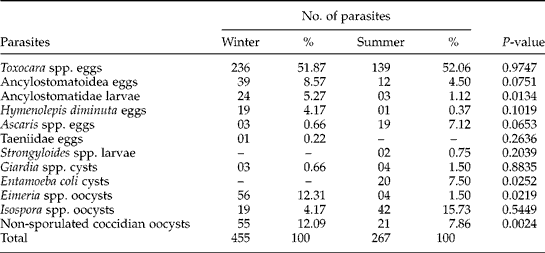
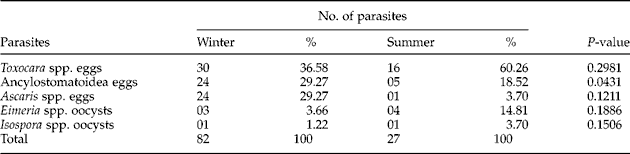
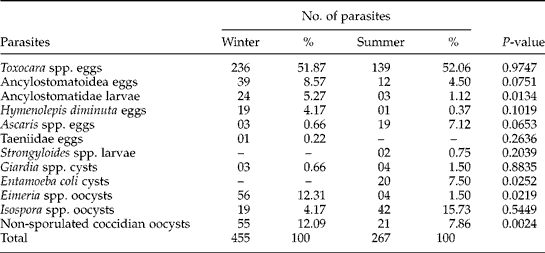
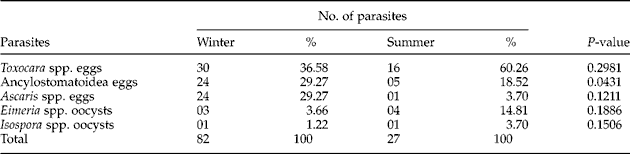
One hundred and thirty sand samples were collected from 13 public squares, 65 in summer and 65 in winter; and 40 samples of grass from four lawns, 20 in each season. Both sand and lawn samples contained helminths and/or protozoans. In both seasons, helminths were the most frequent parasites observed in the squares and lawns, with increased prevalence in winter (tables 1 and 2). Diversity of both helminths and protozoans was higher in the squares.
The prevalence (%) of parasites in 13 public squares in the city of Maringá, Paraná, Brazil, in winter and summer, January 2003 to June 2004.
The prevalence (%) of parasites in four public lawns in the city of Maringá, Paraná, Brazil, in winter and summer, January 2003 to June 2004.
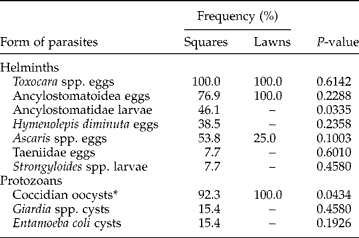
Eggs of Toxocara spp. were the most frequently found (P < 0.0001) in both winter and summer, and were equally distributed in the sets of sand and grass samples (P = 0.6142) (table 3) and at the different collection locales (P = 0.2038). Eighty-three and 60% of eggs of Toxocara spp. were embryonated, in winter and in summer, respectively. Moving larvae were present in 11% of eggs.
Frequency of contamination by parasites in 13 public squares and four lawns in the city of Maringá, Paraná, Brazil, January 2003 to June 2004.
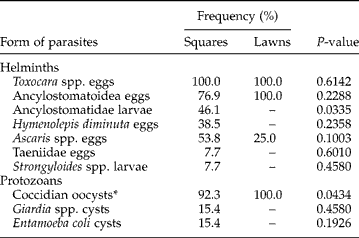
* Coccidia of the genera Eimeria or Isospora, and non-sporulated coccidian.
In addition to Toxocara spp. eggs, a significant number of eggs of Ancylostomatidae were observed in squares (P = 0.0040), and eggs of Ascaris spp. (P = 0.0007) in lawns during winter. Of the protozoans, oocysts of Isospora spp. were prevalent in squares (P = 0.0200) during summer.
Ancylostomatid larvae were more frequent in squares (P = 0.0335), and coccidian oocysts in lawn samples (P = 0.0434) (table 3). Ancylostomatid larvae (P = 0.0204) and ancylostomatoid eggs (P = 0.0083) were predominant in winter. Ancylostomatid larvae were found only in squares (table 3).
With regard to protozoans found in squares during winter, 43% were Eimeria spp. and 12.6% were Isospora spp. In summer, 62.7% were Isospora spp. and 7.5% were Eimeria spp. Entamoeba coli cysts were found only in summer (table 1).
In the qualitative analysis, by the method based on positive larval thermo-hydrotropism, ancylostomatid larvae were observed in 31% of squares in winter and summer. Larvae of Strongyloides spp. were found in 15.4% of squares in summer.
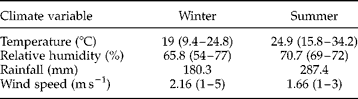
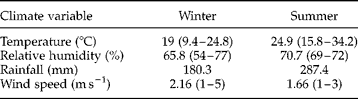
The climate is classified as Subtropical Superhumid, with mean annual rainfall of 1700 mm year− 1 (Silveira, Reference Silveira2003). Climatic data are presented in table 4. In the winter dry season, mean temperatures are normally below 18°C (Silveira, Reference Silveira2003). Rainfall was lower in winter than in summer (table 4).
Climate data for Maringá, Paraná, Brazil, January 2003 to June 2004.
The soil is sandy, well drained, and contains little organic matter (0.52%). The relationship between dry weight and soil in natura was 0.897, with 0.22% organic carbon. The sampling locations in squares lacked plant cover. The lawns were completely covered by grass.
Discussion
This investigation revealed significant environmental contamination by helminths and protozoans with zoonotic potential. In Brazil, nearly all studies on soil contamination in public squares and in animal faeces have assessed the prevalence of Toxocara spp. and hookworms, because of the importance of visceral and cutaneous larva migrans to humans (Coelho et al., Reference Coelho, Dini, Milman and Oliveira2001; Scaini et al., Reference Scaini, Toledo, Lovatel, Dionello, Gatti, Susin and Signorini2003; Santarém et al., Reference Santarém, Giuffrida and Arantes2004). This study differs from previous studies in Brazil in detecting a wide range of protozoans and helminths, and in the quantitative parasitological and seasonal analysis of the soil.
Contrary to expectations, there was a high frequency of parasites, especially of helminths, in winter. Seasonal and climatic conditions are important in the occurrence of environmental contamination (Spratt & Singleton, Reference Spratt and Singleton1987; Özkayhan, Reference Özkayhan2006). However, the study area has a tropical climate and, although the winter is relatively dry, temperatures are not low enough to reduce the number of forms of protozoans and helminths encountered. In summer, solar radiation is stronger and public spaces are more used, resulting in constant circulation of the sand and consequently reducing survival of protozoans and helminths. The vulnerability of Ascaris eggs to direct sunlight, and several factors including temperature (optimal development at 20–30°C), and adequate shade and moisture can affect egg development in soil (Hotez et al., Reference Hotez, Remme, Buss, Alleyne, Morel and Breman2004). In countries with colder climates, such as Poland and Japan, environmental investigations were carried out in spring, the season with the most favourable climatic conditions for finding helminths (Mizgajska, Reference Mizgajska2001; Matsuo & Nakashio, Reference Matsuo and Nakashio2005). Although local climatic factors may affect survival of eggs and larvae (Oge & Oge, Reference Oge and Oge2000), Toxocara spp. eggs are extremely resistant to adverse environmental conditions (Matsuo & Nakashio, Reference Matsuo and Nakashio2005).
According to this study, of all the forms diagnosed in the different locations analysed, eggs of Toxocara spp. were the most frequently encountered parasites, both in winter and in summer, demonstrating high environmental contamination by animal faeces. This finding indicates the potential risk of transmission of toxocariasis to the human population, mainly for children who frequent these places. Contamination by eggs of Toxocara spp. of public spaces used for leisure and recreation has been reported by several investigators in many countries (Fonrouge et al., Reference Fonrouge, Guardis, Radman and Archelli2000; Castilho et al., Reference Castilho, Bazan, Alvarado and Saez2001; Mizgajska, Reference Mizgajska2001; Ruiz de Ibáñez et al., Reference Ruiz de Ibáñez, Garijo and Alonso2001; Mercado et al., Reference Mercado, Ueta, Castilho, Munoz and Schenone2004; Wiwanitkit & Waenlor, Reference Wiwanitkit and Waenlor2004; Matsuo & Nakashio, Reference Matsuo and Nakashio2005), especially in public parks (Matsuo & Nakashio, Reference Matsuo and Nakashio2005).
The greater presence of ancylostomatoid eggs and ancylostomatid larvae in winter demonstrates the perfect conditions of tropical climates for development and sustainability of these helminths throughout the year. However, even though high temperatures and humidity favour the development of ancylostomatid larvae from eggs present in the soil (Diba et al., Reference Diba, Whitty and Green2004), the reduction of contamination during the summer may be due to higher temperatures and sunny days, which, despite the frequent rains, may have contributed to the destruction of these parasites present in the sand or lawns. Nunes et al. (Reference Nunes, Pena, Negrelli, Anjo, Nakano and Stobbe2000), investigating sand from municipal elementary schools in Araçatuba in southeastern Brazil, also observed a predominance of Ancylostoma spp. larvae during winter. In addition, the presence of larvae in squares can be attributed to faecal contamination by pets that typically live in nearby apartments and defecate in the squares.
The significant presence of Eimeria spp. oocysts in squares during winter, and Isospora spp. oocysts in squares and lawns during summer, confirm the presence of animals such as dogs, cats and birds in these public spaces and the possibility of zoonotic foci. Although the squares have wire mesh and fences to prevent animals entering, we noted that the gates were frequently left open. Like other cities of the world, Maringá has an excessive number of urban pigeons. To prevent faecal contamination of the environment by animals it is important to identify these (Matsuo & Nakashio, Reference Matsuo and Nakashio2005) and to promote sanitary education among people who live around them. It is essential that owners of dogs and cats be made aware that their animals can spread zoonoses through depositing faeces on ground also frequented by children, and that personal hygiene measures are fundamental to the control of zoonoses (Castilho et al., Reference Castilho, Bazan, Alvarado and Saez2001).
The presence of eggs of Ascaris spp. in the squares and lawns may be important if these were A. lumbricoides. Although these locations are intensively used for leisure and sports activities, there were no public toilets. Furthermore, homeless people make the lawns their temporary homes. Eggs of Toxocara spp. and Ascaris spp. have thick shells and are very resistant to adverse environmental conditions, being able to survive for several years (Neves, Reference Neves2003).
This study has shown that the urban spaces investigated provide appropriate conditions for the development of infectious forms of helminths and protozoans that are capable of infecting human populations, mainly Toxocara spp. eggs, both in winter and summer. The presence of animals, principally dogs and cats, in high numbers, and the lack of sanitary control may be contributing to the contamination of the public spaces studied. In addition, the finding of infectious forms of parasites with zoonotic potential indicates environmental contamination, demonstrating the need for preventive measures such as adequate periodic sanitary monitoring based on control of animal entry, and health education of the population that frequents public recreation areas.