1. Introduction
Large areas containing occurrences of volcanic, endogenic and hydrothermal breccia structures are associated with terranes, provinces and belts related to geological settings (i.e. subduction, collisional plates, etc.). These are produced either by volcanic chains or intrusive granitoid bodies.
Volcanic breccias form large parts of composite volcanoes and are commonly viewed as containing pyroclastic fragments emplaced by pyroclastic processes (Wright et al. Reference Wright, Smith and Self1980). Most volcanic breccias are interpreted as debris-flow or sheetwash deposits with a dominant pyroclastic matrix and containing mixed material of autoclastic or alloclastic and pyroclastic origin. Usually, autoclastic breccias include the products of fragmentation of semi-solid lava by its own movement (friction-breccia, flow-breccia) and the products of the explosion of gases within lavas, whereas alloclastic breccias result from the fragmentation of pre-existing rocks by volcanic-related processes beneath the surface (Wright & Bowes, Reference Wright and Bowes1963).
Endogenic and hydrothermal breccia structures were recorded in the Cordilleran–Andean belt, Circum-Pacific belt, European Variscan orogenic belt (i.e. Cornubian Hercynic granitoids, French Massif Central, Iberian Massif, etc.), and Neogene volcanism of the Carpathian arc, among others, where most of the breccia structures are mineralized. Associations of breccias with ores in a variety of mineralization types and settings have been reported in relation to porphyry copper systems (Sinclair, Reference Sinclair and Goodfellow2007; Sillitoe, Reference Sillitoe2010 among others), W-mineralization (Harlaux et al. Reference Harlaux, Mercadier, Marignac, Villeneuve, Mouthier and Cuney2019) and Au–Ag precious metals (Sillitoe, Reference Sillitoe1985; Goldfarb et al. Reference Goldfarb, Baker, Dubé, Groves, Hart, Gosselin, Hedenquist, Thompson, Goldfarb and Richards2005; Zhang et al. Reference Zhang, Yang, Weinberg, Groves, Wang, Li, Liu, Zhang and Wang2019).
A complex study dedicated to breccia formation and its evolution related to a variety of base and precious metals and lithophile elements in a volcano-plutonic arc was carried out by Sillitoe (Reference Sillitoe1985), from which several possible mechanisms for subsurface brecciation were drawn. The most abundant and widespread breccias are associated within porphyry copper systems, gold, molybdenum, tin or tungsten deposits. The Lowell & Guilbert (Reference Lowell and Guilbert1970) and dioritic models (Hollister, Reference Hollister1978), related to porphyry copper systems, have associated breccia pipe structures with a halo alteration–mineralization described in several deposits from the United States (Bingham, Utah; Bagdad, Arizona), Chile (El Teniente) and Peru (Toquepala), among others. Also, tourmaline breccia structures associated with Sn–W metallogenesis (Goode & Taylor, Reference Goode and Taylor1980; Allman-Ward et al. Reference Allman-Ward, Halls, Rankin, Bristow and Evans1982; Harlaux et al. Reference Harlaux, Mercadier, Marignac, Villeneuve, Mouthier and Cuney2019) were described across the European Variscan belt within the Cornubian Hercynic granitoids (Cornwall, England) and French Massif Central (Le Puy, France), exhibiting certain similarities with those from the Bolivian tin belt (Sillitoe et al. Reference Sillitoe, Halls and Grant1975).
Deep sedimentary basins affected by the circulation of magmatic fluids or by the intrusion of igneous rocks may result in the migration of a combination of fluids, hot water and gases, with hybrid geological systems, hosting both volcano-hydrothermal and sedimentary components, being first recognized by Svensen et al. (Reference Svensen, Planke, Jamtveit and Pedersen2003). Piercement structures (i.e. hydrothermal vent complexes) associated with the escape of over-pressured fluids may represent important secondary migration pathways for basinal fluids, including petroleum (Svensen et al. Reference Svensen, Planke, Jamtveit and Pedersen2003, Reference Svensen, Jamtveit, Planke and Chevallier2006, Reference Svensen, Planke, Chevallier, Malthe-Sorenssen, Corfu and Jamtveit2007, Reference Svensen, Bebout, Kronz, Li, Planke, Chevallier and Jamtveit2008; Jamtveit et al. Reference Jamtveit, Svensen, Podladchikov, Planke, Breitkreuz and Petford2004). There are many cases around the world where magmatic intrusions and volcanic plumbing systems occur within sedimentary basins resulting in hybrid systems with both CO2-rich geothermal fluids and CH4-rich biogenic gas (microbial or thermogenic) sourced from organic-rich sediments (Procesi et al. Reference Procesi, Ciotoli, Mazzini and Etiope2019). Thus, unexplained exotic hydrocarbon reservoirs have been found in volcanic rocks distributed along the Pacific Rim, Africa and Central Asia (Schutter, Reference Schutter, Petford and McCaffrey2003 b) in the last 20 years. According to Schutter (Reference Schutter, Petford and McCaffrey2003a), more than 100 volcanic gas fields with proven reserves have been found in various countries such as the United States (Gries et al. Reference Gries, Clayton and Leonard1997), Venezuela (Rohrman, Reference Rohrman2007), Argentina (Sruoga & Rubinstein, Reference Sruoga and Rubinstein2007), Japan (Sakata et al. Reference Sakata, Sano, Maekawa and Igari1997; Tomarua et al. Reference Tomarua, Lu, Fehn and Muramatsu2009) and China, where favourable targets for natural gas exploration were delimited in volcanic rocks from China (Feng, Reference Feng2008; Wang et al. Reference Wang, Feng, Liu and Chen2008).
An unmineralized hydrothermal breccia structure with organic carbon and nitrogen fixed in clay minerals (argillic alteration) was identified in the fossil hydrothermal system of Harghita Bãi from the Neogene volcanism of the East Carpathians (Romania) (Bobos, Reference Bobos2012). This breccia structure type is unusual owing to the presence of organic-N fixed in illitic clays within the argillic alteration developed along the breccia structure. This study combined field and descriptive observations carried out on the breccia architecture, complemented by mineralogical and geochemical data (high-field-strength elements (HFSEs), rare earth elements (REEs) and 13C, 15N, 18O isotopes) for whole argillic rocks, ammonium-illite (NH4-I) clay fractions and quartz crystals collected from the breccia structure, in order to identify the source of the palaeofluid circulation. In particular, the 13C and 15N isotopes measured on NH4-I clays represent tracers of fluid flow circulation in the fossil hydrothermal system of Harghita Bãi, which contributed to a late NH4-I alteration, with higher amounts of NH4 fixed in the illite lattice structure at temperatures up to 300 °C.
2. Geological background
2.a. Regional geology
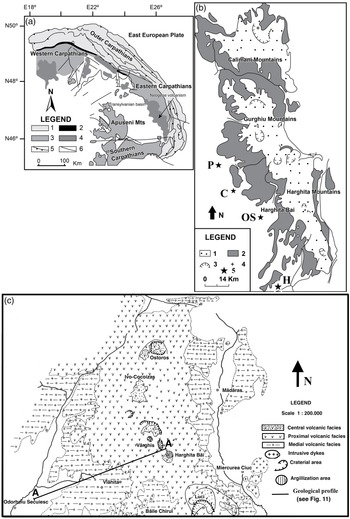
The Neogene volcanic activity from the East Carpathians represents a subsequent stage of magmatism associated with the Carpathian orogen, with the calc-alkaline volcanism (Miocene and Pliocene) considered to be related to subduction of the East European Plate and Inner-Carpathian area beneath the Alpaca and Tisza–Dacia microplate (Fig. 1a) (Seghedi et al. Reference Seghedi, Balintoni and Szakács1998). The Călimani–Gurghiu–Harghita (CGH) volcanic chain, known for its diminishing volume and age southwards from 10 to 3.9 Ma, consists of calc-alkaline products displayed along the easternmost margin of the rigid Tisza–Dacia block (Szakács & Seghedi, Reference Szakács and Seghedi1995). This marks the end of the post-collisional subduction-related magmatism along the front of the European convergent plate margin (Seghedi et al. Reference Seghedi, Balintoni and Szakács1998). A post-collisional setting was suggested, where a large volume of calc-alkaline magma was formed along the trans-tensional faults (e.g. at the margins of the Transylvanian basin) at destructive boundaries (Mason et al. Reference Mason, Seghedi, Szakács and Downes1998; Seghedi & Downes, Reference Seghedi and Downes2011). The locations of the eruption centres in the CGH chain are concentrated at intersections with the crustal fault system propagated from N to S along the arc at the eastern boundary of Tisza–Dacia block, suggesting a NNW–SSE-striking sinistral trans-tensional faulting (Fielitz & Seghedi, Reference Fielitz and Seghedi2005).
(a) Geotectonic sketch of the Carpatho-Pannonian area (Royden, Reference Royden, Royden and Horváth1988; Seghedi et al. Reference Seghedi, Balintoni and Szakács1998, Reference Seghedi, Downes, Szakács, Mason, Thirlwall, Rosu, Pécskay, Márton and Panaiotu2004) showing major tectonic units and boundaries, and the main areas of the Neogene calc-alkaline volcanic rocks. Legend: 1 – Outer Carpathians (Moldavide); Neogene–Quaternary sediments and flysch nappes; 2 – Pieniny klippe belt; 3 – pre-Neogene rocks of the inner Alpine – Carpathian Mountains; 4 – Neogene calc-alkaline volcanic areas; 5 – major thrusts; 6 – strike-slip faults. Reproduced from Bobos & Eberl (Reference Bobos and Eberl2013) with permission of Springer Nature. (b) Geological sketch of the Călimani–Gurghiu–Harghita volcanic arc, Eastern Carpathians (Szakacs & Seghedi, Reference Szakács and Seghedi1995). Legend: 1 – upper structural compartment (central or ‘core’ and proximal or ‘flank’ facies model). The central facies is constituted by eroded central volcanic depressions, the crater and/or caldera remnants and eruptive vents, whereas the proximal facies corresponds to lava flows and subordinate pyroclastic interbeds, which accompany the modified outer slopes of the volcanic edifices (Szakacs & Seghedi, Reference Szakács and Seghedi1995); 2 – lower structural compartment (peripheral distal or volcaniclastic facies, which surround the base of volcanoes); 3 – crater area; 4 – centres of eruptions; 5 – seeps and volcanic muds. The Harghita Bãi hydrothermal area is indicated by an arrow. Also, the seeps and volcanic muds (P – Praid; C – Corund; OS – Odorheiu Secuiesc; H – Homorod) located on the eastern margin of the Transylvanian basin. Reproduced from Bobos & Eberl (Reference Bobos and Eberl2013) with permission of Springer Nature. (c) Geological map of the northern Harghita Mountains and location of the Vârghis–Harghita Bãi stratovolcano.

The interaction between the volcanic edifices and pre-volcanic basement of the eastern Transylvanian basin was deduced from the topographic and tectonic features and inferred from geological and geophysical data (Szakács & Krézsek, Reference Szakács and Krézsek2006; Krézsek & Bally, Reference Krézsek and Bally2006). The Transylvanian basin, consisting of the Dacia block and NE Tisza block, displayed a minor Miocene upper crustal extension, which was replaced during Late Miocene time by small-scale contraction features and shallow salt diapirs (Krézsek & Bally, Reference Krézsek and Bally2006; Maţenco et al. Reference Maţenco, Krézsek, Merten, Schmid, Cloetingh and Andriessen2010). The pre-volcanic basement of the western part of the CGH chain boundary with the Tisza–Dacia block consists of a thick sedimentary pile, including ductile rocks such as clay and salt that are prone to plastic deformation (Krézsek & Bally, Reference Krézsek and Bally2006).
2.b. The Călimani–Gurghiu–Harghita volcanic arc
The CGH volcanic chain (Fig. 1b) is the youngest unit of the Carpathian arc, being formed within a regional context of igneous activity migration in time and space from northwest to southeast (Central Slovakia to Eastern Carpathians), with a volcanic evolutionary trend from acid to basic being assigned. The Călimani Mountains (north) are the larger and older stratovolcano, whereas the Harghita Mountains (south) are the younger volcanic centre. The volcanic activity developed from the north to the south of the volcanic chain along several stratovolcano centres from Late Miocene (12 Ma) to Quaternary (0.2 Ma) times (Pecskay et al. Reference Pécskay, Edelstein, Seghedi, Szakács, Kovacs, Crihan and Bernad1995), with 18 major volcanic centres being recognized along the CGH volcanic chain.
Magmatic activity was developed after the thrust emplacement of the flysch and molasse zones from the East Carpathians. The thickness of the flysch and molasse sediments is ∼6–7 km (Roure et al. Reference Roure, Roca and Sassi1993), and they crop out to the east of the CGH volcanic chain, suggesting that only a small proportion of the sediments was subducted overlying the downing plate (Seghedi et al. Reference Seghedi, Balintoni and Szakács1998). Also, the continental metamorphic basement (Precambrian metamorphic rocks and Mesozoic sedimentary cover) cropping out east of the volcanic arc was tectonically active during the Variscan and Alpine orogenesis (Pana & Erdmer, Reference Pana and Erdmer1994).
The parental magma assimilated metamorphic rocks in the northern Harghita and Gurghiu mountains, whereas flysch sediments contaminated the parental magmas in the southern Harghita and Călimani (Mason et al. Reference Mason, Downes, Thirlwall, Seghedi, Szakács, Lowry and Mattey1996). Therefore, andesite magmas erupted through the crustal basement, assimilating a variety of rocks during their ascent to the surface.
2.c. The volcanic structure of Vârghis–Harghita Bãi
The CGH volcanic chain is viewed as an ideal volcanic structure, consisting of a central volcanic zone having an infrastructure of subvolcanic bodies, with an intermediate zone corresponding to a volcanic cone and a peripheral volcaniclastic zone (Szakacs & Seghedi, Reference Szakács and Seghedi1995). The volcanic structure of Vârghis–Harghita Bãi (VHB) is situated in the northern sector of the Harghita Mountains (Fig. 1c), where the volcanic edifice had a multi-stage evolution including a stratovolcanic and intrusive stage. The volcaniclastic compartment represents a distal peri-volcanic facies as volcanic fans or aprons, whereas the stratovolcanic compartment represents a central facies with complex craters and calderas modified by erosion (Szakacs & Seghedi, Reference Szakács and Seghedi1995).
The Harghita Bãi eruptive structure situated in a craterial area joins the stratovolcanic compartment consisting of a deep microdiorite to andesite formation preceding a great variety of andesitic rocks developed to the surface. The post-failure activity developed along the CGH volcanic chain generated several lava centres in the region, including several late-stage andesitic lava extrusions (i.e. Harghita Ciceu, Borhegy, etc.), which partly obtrude the older Harghita Bãi intracraterial area (Szakacs & Seghedi, Reference Szakács and Seghedi1995). The absolute ages of the andesitic rocks corresponding to the intermediate zone of the VHB stratovolcanic structure range from 6.3 to 3.9 Ma (Late Pliocene; Peltz et al. Reference Peltz, Vâjdea, Balogh and Pécskay1987; Pecskay et al. Reference Pécskay, Edelstein, Seghedi, Szakács, Kovacs, Crihan and Bernad1995).
2.d. The fossil hydrothermal system of Harghita Bãi
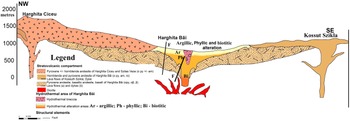
The ‘fossil’ hydrothermal system of Harghita Bãi resulted from complex hydrothermal activity, well-established in a given geotectonic setting as being the result of a volcano-plutonic hydrothermal system evolution. The magmatic-hydrothermal fluids related to the evolution of the subvolcanic body (i.e. microdiorite) generated this hydrothermal system. A wide variety of calc-alkaline andesites (e.g. basaltic andesite, amphibole ± pyroxene ± biotite andesite) occur above the subvolcanic body. The alteration halo (biotite → amphibole → phyllic → argillic) centred on the intrusive dioritic body and subvolcanic body (Fig. 2) was probably associated with the evolution of a porphyry copper system (Stanciu, Reference Stanciu1984).
Schematic cross-section through the fossil hydrothermal system of Harghita Bãi illustrating salient features of the hydrothermal alteration zones and the hydrothermal breccia location.

The hydrothermal area of Harghita Bãi was investigated from the surface to a depth of −110 m, where a hydrothermal injection breccia structure containing NH4-illite–smectite (I–S) mixed-layers (40–5 %S) was identified for the first time (Bobos & Ghergari, Reference Bobos and Ghergari1999; Bobos, Reference Bobos2012). The NH4-I–S clays occur in the barren part of the breccia structure, where a conversion series of smectite to NH4-I–S ordered mixed-layered (40–5 %S) and K-I/NH4,K-I mixed phases (outside of the breccia structure at −110 m in mine drifts) were identified (Bobos, Reference Bobos2012, Reference Bobos2019; Bobos & Eberl, Reference Bobos and Eberl2013). K–Ar dating of the K-I/NH4,K-I mixed phases yielded an age of 9.5 ± 0.5 Ma, whereas the NH4-I collected from the bottom of the breccia structure (−110 m) yielded a younger age of 6.2 ± 0.6 Ma (Clauer et al. Reference Clauer, Liewig and Bobos2010).
A large number of CO2-rich cold springs, CO2-rich gas vents (‘mofettes’), dry fumaroles and CO2 gas discharged to the surface are well known within the volcanic edifices of the Harghita Mountains and across the CGH volcanic chain as well (Rãdulescu et al. Reference Rãdulescu, Peter, Stanciu, Stefanescu and Veliciu1981; Crãciun & Bandrabur, Reference Craciun and Bandrabur1993). The large circulation of fluids (+ gases) in the Harghita volcanic area was triggered by the presence of mantle-derived magmas, where the total 3He came from the mantle or from degassing of magmas stored in the crust, and the CO2 from either volcanic degassing or metamorphism of recently subducted limestones (Vaselli et al. Reference Vaselli, Minissale, Tassi, Magro, Seghedi, Ioane and Szakács2002).
3. Materials, sample preparation and methods
3.a. Materials
The NH4-I-bearing argillized andesite rocks were collected from the mine drifts and shafts located at depths of −30, −50, −80 and −110 m, where a broad argillization zone occurs exceeding more than 100 m in depth (studied area). Whole NH4-I argillized rocks were submitted for mineralogical and chemical analysis. Clay fractions of <2 μm were extracted from whole rocks for mineralogical and stable isotope geochemistry. A complete series of NH4-I–S mixed-layers (here after NH4-I clays) were identified at different levels within the breccia structure (Bobos, Reference Bobos2012; Bobos & Eberl, Reference Bobos and Eberl2013), including a mechanical mixture of potassium-illite (K-I) and (NH4,K)-I mixed-layers (hereafter K-I/NH4,K-I clays) identified at −110 m outside of the breccia structure (Bobos, Reference Bobos2019).
3.b. Clay sample preparation
The chemical treatments of the clay samples followed M. L. Jackson’s (Reference Jackson1975) method. In brief, the samples were treated with Na-acetate (NaOAc) to remove carbonate (pH = 5.5; T = 100 °C). Fe oxyhydroxides were reduced using Na-dithionite and Na-citrate (pH = 7; T ∼80 °C). The salt excess was removed from the <2.0 µm clay fractions by washing in distilled-deionized water followed by dialysis.
The samples were washed several times after saturation with each inorganic complex in a 1:1 deionized water – ethanol mixture until chloride-free, based on the AgNO3 test, which confirmed the complete removal of Cl– ions. The oriented clay mounts were ethylene glycol solvated for 8 hours at 60 °C, prior to X-ray diffraction (XRD), and compared to air-dried patterns. The <2.0 µm size fraction was separated by successive dispersion and sedimentation cycles in distilled water according to Stoke’s Law; the clay fractions were concentrated by centrifugation and re-dispersed with an ultrasonic probe.
3.c. Analytical techniques
3.c.1. X-ray diffraction
XRD patterns of oriented specimens were obtained using a Rigaku Geigerflex D/max.–C series automated diffraction system equipped with a graphite monochromator and using CuKα radiation. Samples were analysed in the range 2–50° 2θ, using a 1° divergence slit, a step size of 0.05° 2θ and a counting time of 5 s/step.
3.c.2. Infrared spectroscopy
Pellet discs of 15 mm were prepared by mixing 1 mg of sample (<2 µm fraction) with 200 mg KBr and then pressing at 14 kg cm−2. Prior to analysis, the pellets were heated overnight at 150 °C to remove any adsorbed water. The samples were studied in the absorption mode using a Bruker Tensor 27 spectrometer equipped with a deuterated triglycine sulfate (DTGS) single detector plate. The infrared (IR) spectra were recorded in the 4000–400 cm−1 frequency region. The measurements of the integrated intensity of the molecular vibration bands were made using the OPUS 4.2® software supplied by Bruker.
3.c.3. Scanning electron microscopy
Small pieces (5–8 mm in diameter) of argillized rocks were mounted on a carbon holder and sputter-coated with a thin carbon film for conductivity. The scanning electron microscopy (SEM) study was performed with a Hitachi S-4100 electron microscope operated at an accelerating voltage of 25 kV and 5 nA beam current, equipped with an X-ray energy-dispersive spectral (EDS) spectrometer (Oxford Instruments INCA energy). A 200 nm spot size and 100 s of live time were used.
3.c.4. Inductively coupled plasma mass spectrometry
Major-, trace- and REE chemistry were measured on whole altered and fresh rocks by inductively coupled plasma mass spectrometry (ICP-MS) at Actlabs (Ancaster, Ontario, Canada). Prior to analysis by ICP-MS, the whole rocks underwent a lithium metaborate/tetraborate fusion, which rapidly dissolved in nitric acid. Actlabs uses a fusion process that guarantees precise total metal analyses, particularly for REEs and trace elements in resistant phases (Hoffman, Reference Hoffman1992; https://www.actlabs.com). Calibration was carried out using the international standards used by Actlabs (GXR-1, NIST 694, DNC-1, GBW 07113, GXR-4, SDC-1, GXR-6, LKSD-3, LKSD-4, BaSO4, W-2a, SY-4, CTA-AC1, BIR-1a, NCS DC70014, NCS DC70009, OREAS 100a, OREAS 101a, OREAS 98, JR-1, DNC-1a, OREAS 13B). The analytical precision calculated between the measured and certified values of the standards is ±3 % for all elements. The reproducibility of the results was confirmed by the duplicate samples sent with the package. The measurement precision for major elements is within the 1–2 % interval, whereas it is better than 5–10 % for trace elements. For REEs, the measurement precision was 5 % or better. Accuracy was verified with laboratory standards run simultaneously. The REE data were plotted against the Upper Continental Crust (UCC) normalization reference (Rudnick & Gao, Reference Rudnick, Gao, Holland and Turekian2003) in order to visualize the fractionation processes of either light REEs (LREEs) relative to medium REEs (MREEs) or heavy REEs (HREEs).
3.c.5. Organic elemental analyser
Carbon–nitrogen–hydrogen–sulfur (C–N–H–S) were measured with a Thermo Finnigan, Flash 2000 in the Department of Chemistry of the University of Aveiro (Portugal). Standard and replicated samples were used for quality control with a relative analytical error of <2 %. About 30 mg of ground sample were weighed and filled into tin cups for the C–N–H–S measurements.
3.c.6. Conventional isotope ratio mass spectrometry
The carbon content and δ13C isotopic compositions were measured with an elemental analyser coupled to a DELTAplusXL (ThermoFischer) isotopic ratio mass spectrometer in the Keck Laboratories of Arizona State University (Tempe, AZ, USA). Carbon contents were measured on bulk argillic andesite rocks and clay fractions, whereas the δ13C isotope analysis was carried out only on the <2 µm NH4-I samples extracted from the bulk altered argillized andesite. The carbon isotopic compositions were expressed in the standard δ-notation in parts per mil (‰), as the relative difference between isotopic ratios in the sample and in conventional standards (Vienna Pee Dee Belemnite; V-PDB) for carbon (δ13C = 0.0 ‰; Craig, Reference Craig1953). The δ13C/12C isotopic ratio in the clay fractions was analysed after dissolving samples in H3PO4, and the results are presented as per mil (‰) deviations with respect to V-PDB. The δ13C values were calculated using the following equation:
 $${\delta ^{13}}{\rm{C(\unicode{0x2030}}}) = (({^{13}}\textrm{C}/{}^{12}\textrm{C})\textrm{sample}/{{(^{13}}\textrm{C}/{}^{12}\textrm{C})_\textrm{std}}) - 1)*1000$$
The international graphite standard USGS 24 (δ13C = −16.0 ± 0.1 ‰) was used for 13C measurements. The reproducibility of isotopic compositions based on replicate measurements was ± 0.1 ‰ for δ13C values, and the precision of analysis was ± 0.2–0.3 ‰ for δ13C.
3.c.7. Oxygen isotopes
Oxygen isotope analysis was carried out on quartz crystals collected from the breccia structure at −110 m and −80 m. Oxygen was extracted by reaction with BrF5 at 550 °C in Ni reaction vessels (Clayton & Mayeda, Reference Clayton and Mayeda1963), converted to CO2 and analysed in a double-collecting mass spectrometer. The results are given in the usual δ-notation in per mil relative to the SMOW standard as averages of duplicate determinations, with a precision of +0.2 ‰. The δ18O value of the NBS-28 quartz standard was +9.6 ‰ during the course of the study.
4. Results
4.a. Geometry, shape and texture of breccia
Magmatic-hydrothermal breccia structures are described in the literature in terms of morphology, composition or ore-related mineralization event (Sillitoe, Reference Sillitoe1985; Laznicka, Reference Laznicka1988; Reimold, Reference Reimold1998; Taylor & Pollard, Reference Taylor and Pollard1993; Corbett & Leach, Reference Corbett and Leach1998; Davies et al. Reference Davies, Cooke, Gemmell, Bucci and Mair2000 among others). The breccia structure from the Harghita Bãi area is confined to a single space with a close genetic connection to a porphyry intrusive dyke and a crustal fracture (NE–SW), devoid of ores and with organic C and N elements fixed in illite argillic alteration. The exotic elements found in the hydrothermal alteration envelope increase the scientific interest.
Several mine drifts at –30 m, –50 m, –80 m and –110 m including shaft mining works were prospected underground in the former ‘kaolin’ mine of Harghita Bãi for detailed information concerning the geometry, shape and texture of the breccia. Extending breccia was verified laterally and vertically where a movement of the andesitic flow was observed from the bottom to upper part of the breccia structure.
The horizontal extension of the breccia structure was estimated at ∼50 to 70 m and vertically ∼150 m. The contact between the breccia and wall rock is net-like or marked by fractures observed in several places underground. Tuffaceous matrix or exotic rocks from a possible pre-volcanic fundament were not identified within the breccia matrices.
Apparently, gas explosions played a main role in the architecture of the breccia formation. The explosion character of the breccia could be related to reduced pressure above the magma column (Sillitoe & Sawkins, Reference Sillitoe and Sawkins1971), where the finest material deposited after the gas explosion (Perry, Reference Perry1961) cemented the brecciated andesitic blocks or fragments. Movement of andesite blocks or fragments in rising gas show either irregular or rounded clasts at the top.
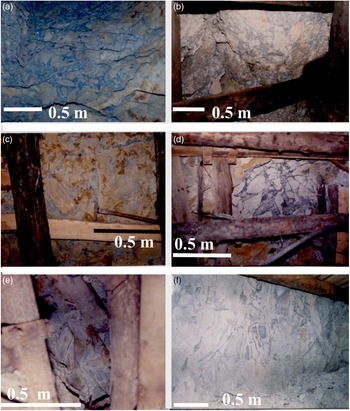
The top and bottom terminations of the breccia structure were identified underground at −30 m and −110 m. Andesitic blocks and fragments moved and collapsed after the gas explosion occurred at the top of the breccia structure. Angular to sub-rounded rock fragments ranging in size occur underground from −30 to −50 m. Rounded, spheroidal, elliptical or subangular clasts were observed (Fig. 3a), where fragments of andesite rocks of various sizes (15 to 50 cm) were argillized and caught in a flour groundmass. The rotation of clasts and the transition of the shapes of small andesite fragments (2–3 cm) from irregular polygons to elliptical (Fig. 3a) that are caught in a milled matrix occur only at the top of the breccia. Characteristically, both rounded clasts and elliptical fragments are aligned, keeping the same flow direction as significant hydrothermal fluid feeders.
Textural anatomy of the breccia structure: (a) Angular, sub-rounded and elliptical fragments of NH4-I argillized andesite (15 to 50 cm) caught in a milled matrix (−30 m). (b) A chaotic texture with angular blocks and fragments (at the top) and smaller angular fragments in a flour-milled rock groundmass, where the breccia structure was cut by a fracture (−50 m). (c) The ‘crample’ breccia texture with a ‘shingle’ breccia texture (−80 m). (d) The ‘jigsaw’ breccia texture (−90 m). (e) The ‘crackle’ breccia texture (−110 m). (f) In situ hydraulic fracturing of andesite porphyry dyke (−110 m) and NH4-I (5 %S) alteration where a tension and shearing fracture system is well highlighted. Reproduced (Fig. 3f) from Bobos & Eberl (Reference Bobos and Eberl2013) with permission of Springer Nature.

A variety of similarly shaped clasts, in a chaotic texture and high amount of flour-milled rock groundmass, were also observed at the top of the breccia (Fig. 3b). The contact was controlled by a fracture or an external brittle fracture to the west of the breccia structure, where a sheared andesite material, strongly milled, could be observed. Parts of the breccia structure show multiple events of brecciation, cementation and re-brecciation (near a tectonic fault).
A ‘crample’ breccia occurs in several places caught in a flour-milled rock mass, where irregular andesitic blocks (∼50 × 20 cm) with rounded edges or ‘shingle’ blocks with a parallelepiped shape (Fig. 3c) were found at –80 or –90 m underground. The argillized andesite rocks are progressively displaced and tumbled into the small (20 to 40 cm) or larger disordered fragments of andesite to the outer limits at –80 m. Also, andesite blocks of 60 × 110 cm joined to small andesite blocks with a parallelepiped shape were identified (Fig. 3c). Part of the breccia structure with a ‘shingle’ texture was formed by collapsed material after the gas explosion. This part of the breccia structure could be associated with a ‘shingle breccia’ texture as a result of regular breakage and detachment of zones of sheeting like those around pipe walls and large fragments (Sillitoe, Reference Sillitoe1985).
A jigsaw or mosaic texture is observed in Figure 3d, where big and small clasts of andesite were fragmented or disrupted. Rotational ‘blocks’ are defined as breccias in which the blocks were disrupted by rotation of breccia clasts as a result of the introduction of additional matrix (Corbett & Leach, Reference Corbett and Leach1998). Small clasts observed (Fig. 3d) were weakly or strongly milled during rotation, where the fluidized matrix formed the cement between big or small angular argillized clasts.
A ‘crackle’ breccia texture characterized by andesite fragments fitted back into their apparently initial position was observed at –80 m. In this region, the open-space-fillings are cemented by flour-rock, and an incipient argillic alteration was observed on the edges of andesite blocks (Fig. 3e).
A transitional stage to the main intrusive body (dyke) was observed towards the bottom at −110 m (Fig. 3f). Tension and shearing fissure system types were identified in the brecciated NH4-I altered andesite dyke (Fig. 3f). The hydraulic fracturing of the andesite dyke occurred owing to a high-pressure gas explosion event (∼100 MPa, after Guedes et al. Reference Guedes, Bobos, Liewig, Noronha, Noronha, Doria and Guedes2000), generating ‘crackle’ blocks. Cement and hydrothermal quartz crystals from the open-filling space of the breccia were collected from this location for mineralogy and geochemistry (see Table 1). The fractured andesitic spaces were filled by quartz, pyrite and tourmaline crystallized after a high-pressure gas explosion.
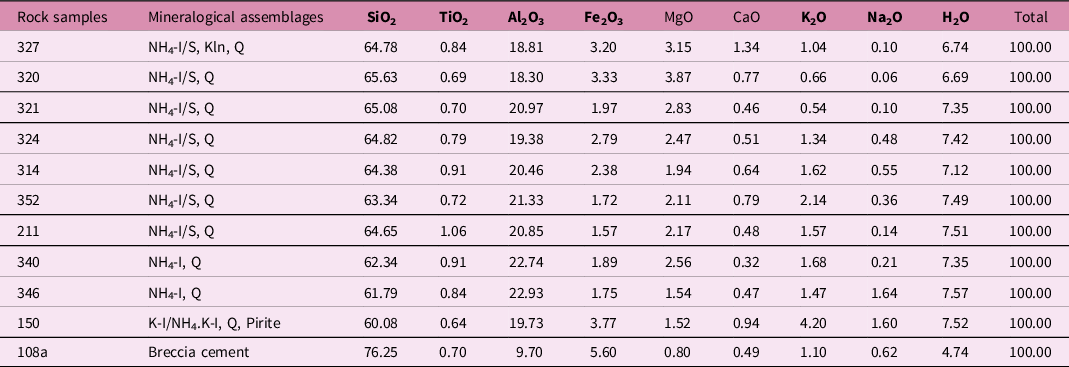
Oxide chemical elements composition of NH4-I and K-I/NH4,K-I argillic alteration of andesite rocks

4.b. Alteration stages
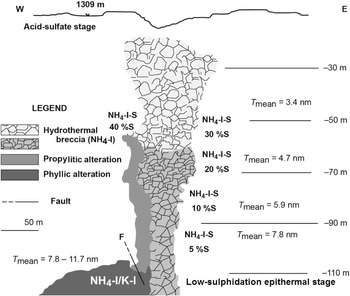
During the protracted period related to a high-pressure gas explosion event, the fractured blocks and fragments of andesite rocks supported argillization across the breccia structure from −110 m to −30 m. The K-I alteration (at −110 m), older than the NH4-I alteration, and a propylitic alteration (smectite) at −80 m occurs outside of the breccia structure. The NH4-I with 5 % smectite (%S) content occurs at −110 m (Fig. 3f), interpreted as being the central zone of the breccia structure. NH4-I–S ordered mixed-layers (the %S content ranging from 10 to 40 %) were identified at the top of the breccia structure at −80 m, −55 m and −30 m.
K–Ar data of K-I alteration yielded an age of 9.5 ± 0.5 Ma, whereas NH4-I alteration yielded an age of 6 to 2 (± 0.5) Ma (Clauer et al. Reference Clauer, Liewig and Bobos2010). The spatial relationship between the NH4-I alteration zone found within the breccia structure and the K-I and propylitic alteration stages is shown in Figure 4.
The distribution of NH4-I samples (taking into account the %S and T mean) within the breccia structure (from −50 m to −110 m), and the relationship with K-I (phyllic) and propylitic alteration (after Bobos & Eberl, Reference Bobos and Eberl2013). The breccia structure corresponds to fragments and blocks of andesitic flow that rose up by gas explosion (upper part) and fractured andesitic blocks in situ (bottom part). Reproduced from Bobos & Eberl (Reference Bobos and Eberl2013) with permission of Springer Nature.

In general, the zonation of hydrothermal alteration often occurs from an illite zone (phyllic) at the centre, to a smectite zone (propylitic) at the margin, where such central zonation represents the effects of hydrothermal fluid circulation at a higher temperature where metals may have been deposited (Inoue et al. Reference Inoue, Utada and Wakita1992).
4.c. Mineralogy
Bulk NH4-I altered andesite rock shows a monotonous mineralogy composed of quartz, NH4-I, Ca–Na feldspar (andesine), pyroxene, amphibole and small amounts of pyrite. The open-space filled by flour groundmass is predominantly composed of quartz (>75 %) and small amounts of pyrite (± marcasite), tourmaline, amphibole and pyroxene.
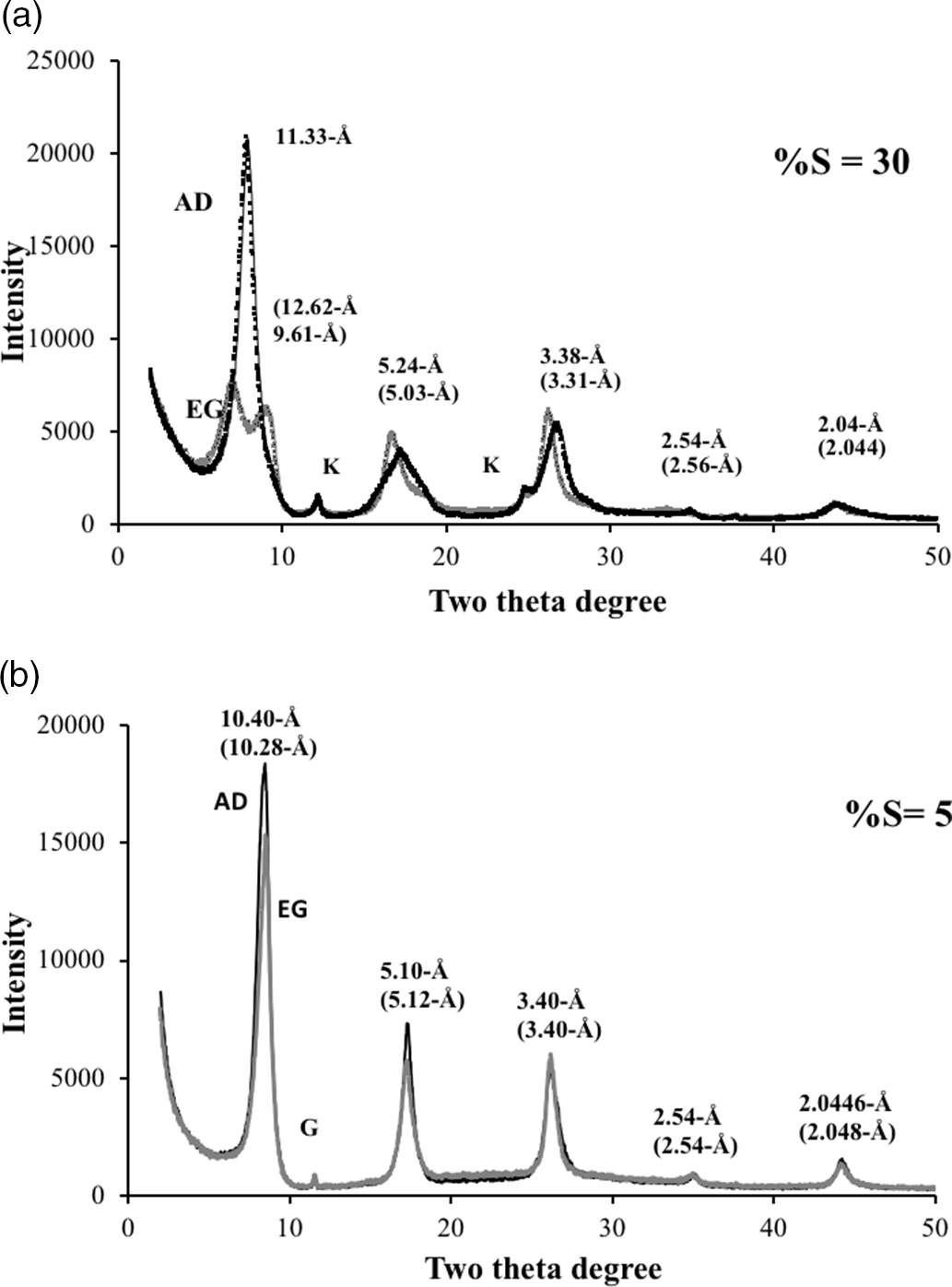
The mineralogy of the breccia structure is composed of NH4-I–S clays where the evolution of NH4-I crystal growth was simulated using the crystal growth theory of Eberl et al. (Reference Eberl, Drits and Środoń1998). The <2 µm clay fractions extracted from altered andesite rocks collected from −110 m (sample HB-18) contain NH4-I and small amounts of quartz (<10 %). Changes in the mean crystallite thickness (T mean) of NH4-I–S (30 to 5 %S) from 2.8 nm to 7.1 nm for the <2 µm fractions were measured from –55 to −94 m by Bobos & Eberl (Reference Bobos and Eberl2013) (Fig. 4). NH4-I found at c. −94 m (Fig. 3f) displays a log-normal crystallite thickness distribution (CTD) shape. The T mean of NH4-I clays (<2 µm) increased with depth where a better correlation of NH4-I–S with %S layers was found (Fig. 4). Two representative XRD patterns of NH4-I–S mixed-layers with 5 and 30 %S, samples HB-18 (−90 m) and HB-4 (−55 m), are shown in Figure 5a, b.
Selected XRD patterns of NH4-I–S ((a) 30 %S and (b) 5 %S) interstratified structure (<2 µm clay fraction) oriented specimens run in air-dried (AD) and ethylene glycol (EG) conditions using CuKα radiation. K – kaolinite; G – gypsum.

The crystal growth of K-I and NH4,K-I mixed clays collected from −110 m (outside the breccia structure) was also simulated, where two log-normal CTDs were identified corresponding to two different illite populations. Also, the T mean of K-I ranges from 12.1 to 24.7 nm, higher than NH4-I (e.g. <7.1 nm).
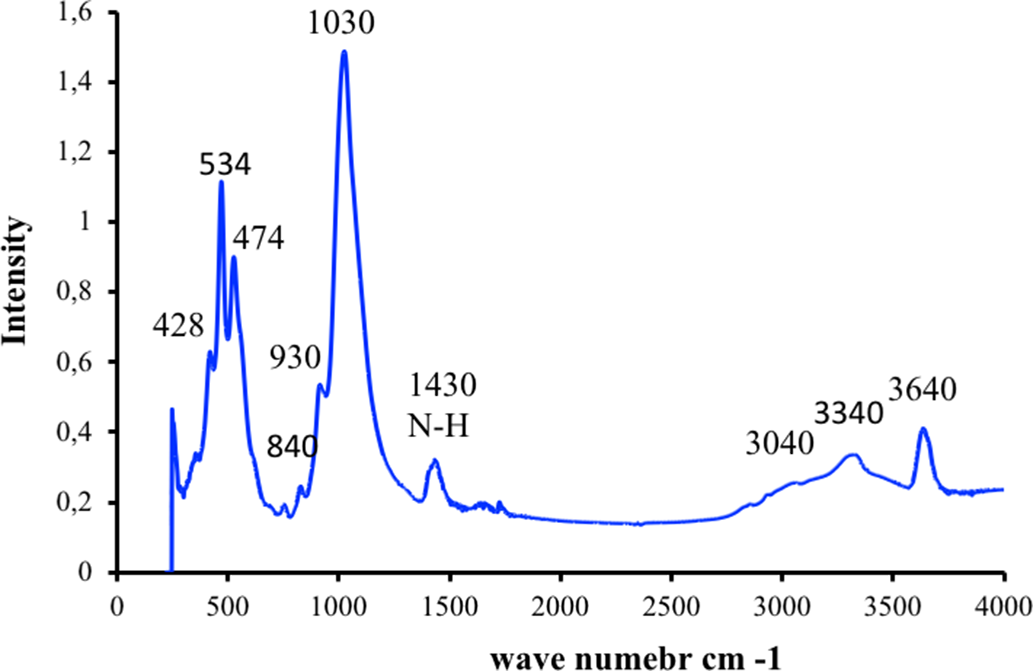
The NH4 fixed in illite interlayers confirmed by Fourier transform infrared spectroscopy (FTIR) shows values of absorption bands characteristic of illite minerals (Fig. 6). Four absorption bands attributed to N–H stretching and bending are observed at 3340 cm−1, 3040 cm−1, 2840 cm−1 and 1430 cm−1, with the absorption bands at 1430 cm−1 indicating the presence of NH4 + fixed in illite interlayers, corresponding to the fundamental vibration (ν 4) model for NH4 + (Petit et al. Reference Petit, Righi and Madejová2006).
Infrared spectrum of NH4-I, indicating the NH4 bending at 1430 cm−1

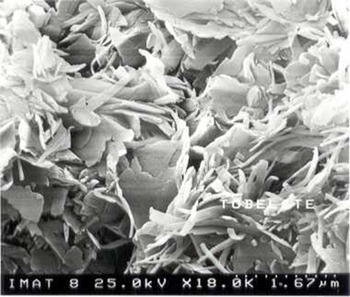
The NH4-I crystals show a variable morphology (Fig. 7) exhibiting randomly oriented lath-like aggregates with variable widths or platy aggregates.
Scanning electron microscopy of NH4-I crystals exhibiting a platy- and lath-shape morphology.

4.d. Major-, trace- and rare earth element geochemistry
Major, trace and REEs were measured in K-I and NH4-I altered andesite rocks collected from the breccia structure. The SiO2 and Al2O3 contents measured in the NH4-I altered rocks are ∼60 % and 20 %, respectively (Table 1). High silica and low alumina contents were measured (Table 1) in the breccia cement, which are well correlated with the mineralogical data. A variable content of FeO was found in the whole rocks owing to the pyrite oxidation stage. Low amounts of MgO and CaO were found in the NH4-I rich altered rocks. The content of H2O increased as the smectite content increased in the illitic altered rocks.
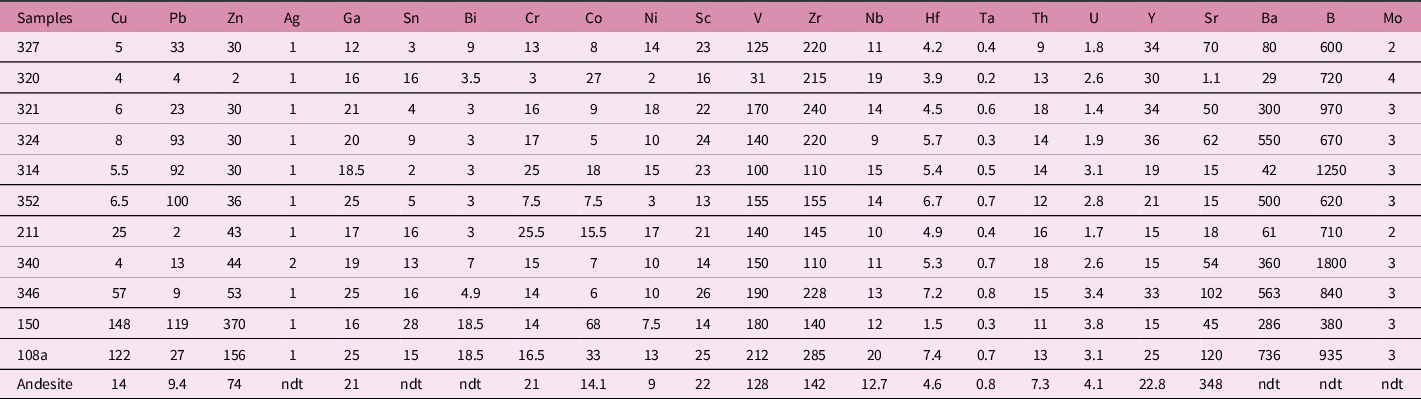
The content of chalcophile elements (Cu, Pb, Zn, Bi, As, Ga, Sn) is generally lower in NH4-I altered andesite (Table 2). The Cu, Pb, Zn and Bi amounts with high sulfur affinity show values below the geochemical clarke number of Cu (100 ppm), Pb (16 ppm) and Zn (50 ppm) as a limit of mineralization indicators. Ga ranges from 12.2 to 25.2 ppm and As from 6.2 to 13.4 ppm. Sn shows values from ∼15 to 25 ppm in NH4-I altered andesite. The siderophile elements (Co, Ni, W, Mo) show low values, where Mo is undetected in most of the samples or is close to the detection limit (2 ppm).
Traces and HFSE chemical elements of NH4-I and K-I/NH4,K-I argillic alteration of andesite rocks

The light elements show high B and low Li concentrations (Table 2) in NH4-I altered rocks. Also, a high amount of B was measured in illitic altered andesite samples close to fractured areas. Trace amounts of tourmaline in the assemblage with pyrite and quartz explain the presence of higher B amounts.
HFSEs (Nb, Ta, Zr, Hf, Y) show low concentrations close to those measured in fresh andesite rocks (Table 2). Low amounts of Nb (9 to 20 ppm) and Ta (0.2 to 0.8 ppm) were identified in NH4-I altered rocks, where the Nb/Ta ratio ranges from 15.7 to 28.57 (fresh andesite rocks is ∼53.33). In addition, the continental crust has a lower Nb/Ta ratio (= 12 to 13) than the bulk silicate Earth (Nb/Ta = 1479.3) (Münker et al. Reference Münker, Pfänder, Weyer, Buchl, Kleine and Mezger2003). Zr ranges from 110 to 285 ppm and Hf from 3.9 to 7.4 ppm in the NH4-I altered rocks. Lower values of Zr (55 ppm) and Hf (1.5 ppm) were measured in K-I/NH4,K-I. The Zr/Hf ratio ranges from 20.37 to 55.12. The data plotted in the Nb versus Ta and Zr versus Hf diagrams do not show any fractionation between HFSEs.
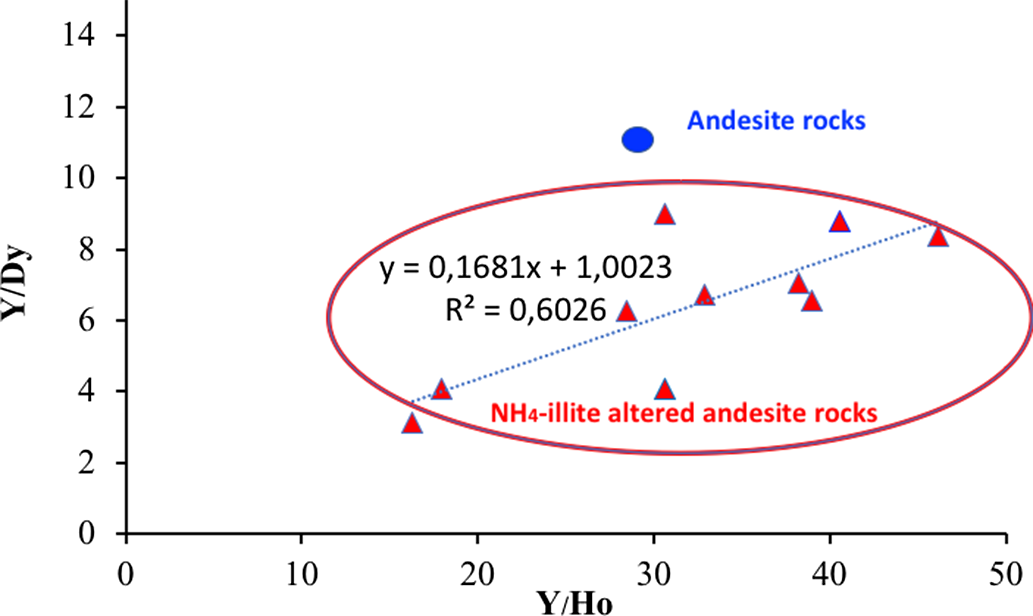
Yttrium and Ho or Dy with a similar charge and size remained tightly coupled (Shannon, Reference Shannon1976) during the illitization process. Y ranges from 15 to 36 ppm, Ho from 0.62 to 1.16 ppm and Dy from 3.73 to 5.26 ppm. A very low correlation coefficient (not shown) was observed in the Y versus Ho and Y versus Dy diagrams. The Y/Ho ratio ranges from 16.30 to 46.15 and Y/Dy ratio from 3.10 to 8.99. The data plotted in the Y/Dy versus Y/Ho diagram show a moderate correlation coefficient (Fig. 8). By contrast, lower amounts of Y, Ho and Dy were measured in the K-I/NH4,K-I altered andesite rocks than in the NH4-I altered rocks.
Diagram of Y/Dy versus Y/Ho.

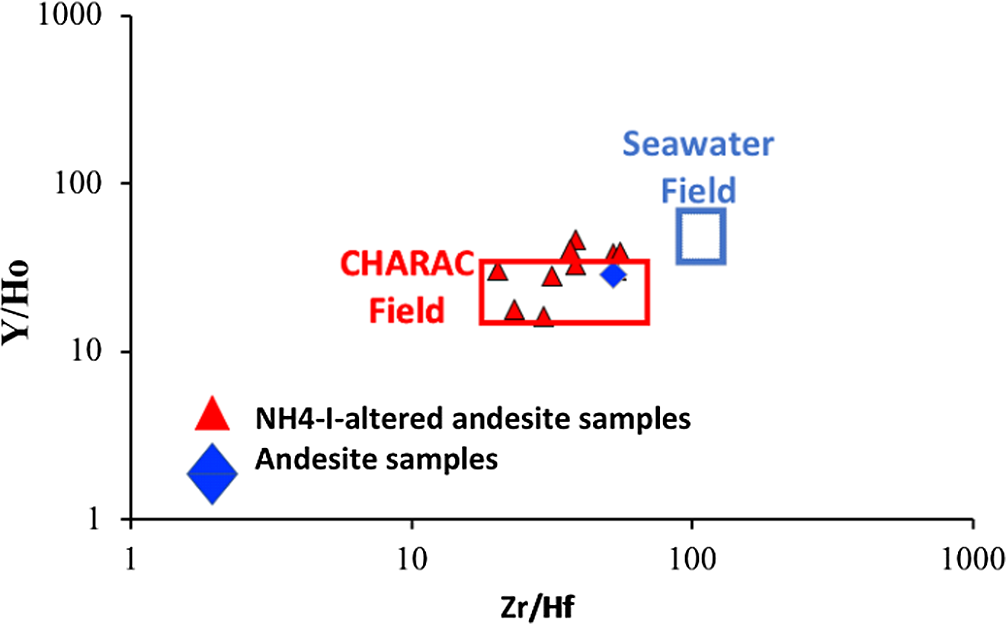
The CHArge-and-RAdius-Controlled (CHARAC) behaviour (Bau, Reference Bau1996) of the element pairs Y–Ho and Zr–Hf was tested on fresh andesite, K-I/NH4,K-I and NH4-I altered andesitic rocks. In natural environments, Y and the REEs (with the exceptions of Ce and Eu) occur exclusively in the trivalent oxidation state, whereas Zr and Hf are tetravalent. In octahedral coordination, Y(III), Ho(III), Zr(IV) and Hf(IV) show close effective ionic radii of 1.019, 1.015, 0.84 and 0.83 Å, respectively (Shannon, Reference Shannon1976). The Y/Ho and Zr/Hf ratios of fresh andesite rocks, K-I/NH4,K-I and NH4-I altered rocks are close to the normalization ratios, indicating a CHARAC behaviour of these elements in silicate melts (Fig. 9).
Diagram of Y/Ho versus Zr/Hf (Bau, Reference Bau1996) corresponding to altered and fresh andesite rocks.

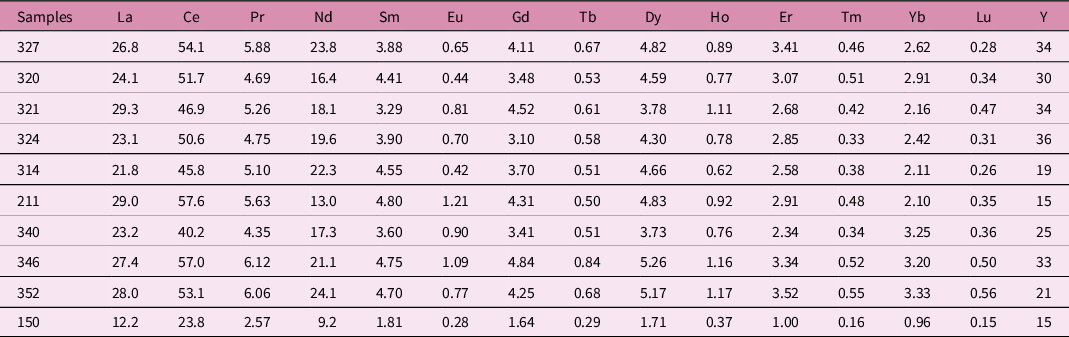
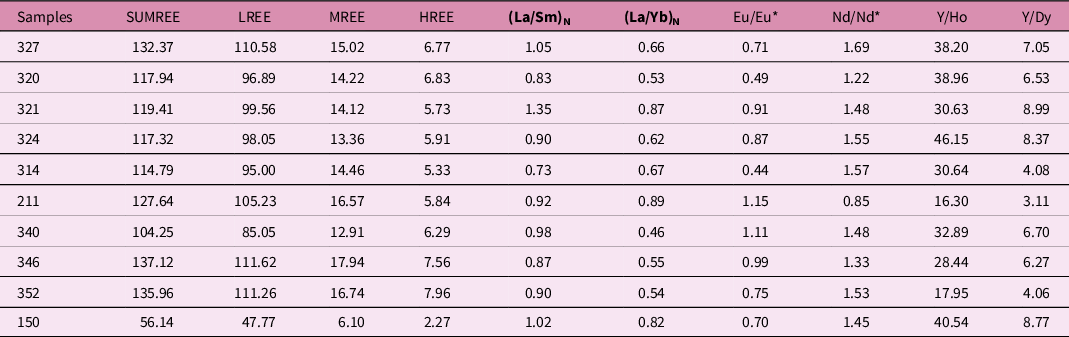
The REE concentrations of whole argillic altered andesite rocks from the breccia structure are shown in Table 3. The ΣREE concentrations of NH4-I and K-I/NH4,K-I altered andesite rocks ranges from 104.25 to 135.96 ppm, where a higher amount of LREEs (85.05 to 111.62 ppm) than HREEs (5.33 to 7.96 ppm) characterize the NH4-I altered rocks (Table 4). The La/Sm ratio is below unity (0.73–0.98), and the La/Yb ratio ranges from 0.46 to 0.89 (Table 4), where no correlation between La/Sm and La/Yb ratios was found.
REEs of NH4-I and K-I/NH4,K-I argillic alteration of andesite rocks

Sum of the REE, LREE, MREE and HREE concentrations, the La/Sm and La/Yb UCC normalization ratios, the Eu* and Nd* anomalies and the ratios of Y/Ho and Y/Dy

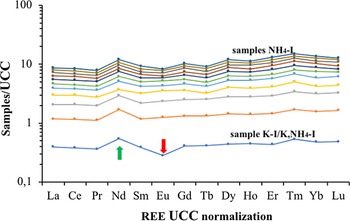
The REE UCC normalization patterns of NH4-I altered andesite rocks display a flat shape (Fig. 10), with a positive Nd* anomaly from 1.22 to 1.69 and a slowly positive Tm* anomaly (Tm/Tm* = (Tmn)/(Ern × Ybn)1/2) occurring. The ΣREE (56.14 ppm) of the K-I/NH4,K-I sample is half of that in the NH4-I samples, and a negative Eu* anomaly (0.70) was identified (Table 4) by contrast with the UCC normalization pattern of the NH4-I altered rocks.
The REE UCC normalization patterns of NH4-I and K-I/NH4,K-I argillic andesite rocks.

4.e. Elemental analysis of volatile (C–N–H–S) and stable isotopes (δ13C and δ18O)
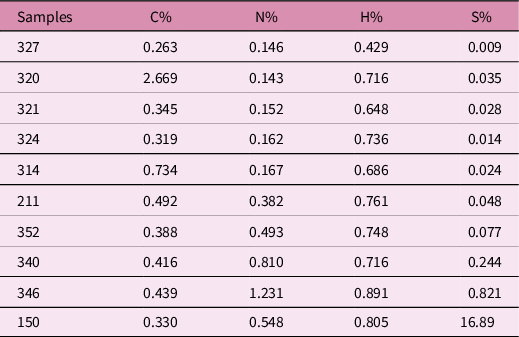
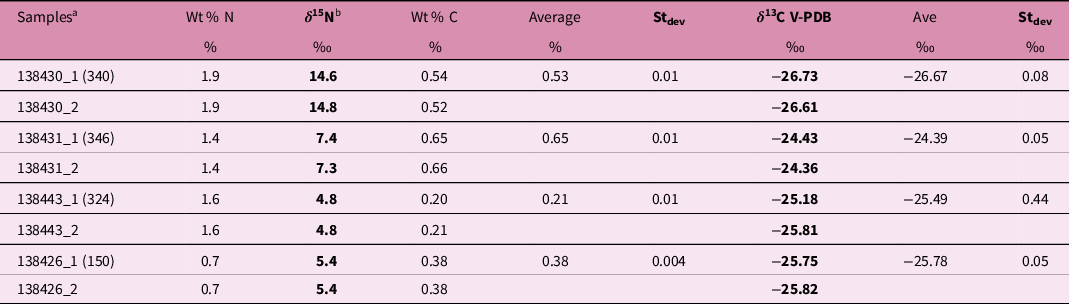
The volatile (C–N–H–S) analysis was carried out either on the cement of breccia from open-space-filling, flour-rocks or argillic altered rocks (Table 5). Nitrogen is associated with carbon and other volatiles (i.e. H and S), where N (wt %) ranges from 0.143 to 1.231 and C wt % from 0.263 to 2.669 (Table 5). Both C and N were also measured for the <2 μm NH4-I and K-I/NH4,K-I fractions extracted from the argillized rocks. C (wt %) ranges from 0.20 to 0.66 and N (wt %) from 0.7 to 1.9 (Table 6). δ13C (‰) ranges from −24.39 to −26.67 and δ15N (‰) from 4.8 to 14.8 in the clay fractions (Table 6).
The C–N–H–S volatile elements measured for NH4-I and K-I/NH4,K-I altered andesite rocks

The δ13C and δ15N isotope geochemistry of the <2 µm clay fractions of NH4-I and K-I/NH4,K-I samples extracted from the bulk altered argillized andesite

a The sample number corresponds to the <2 µm clay fractions and the number in parentheses corresponds to the whole altered rock discussed in this work.
b Data are from Bobos & Williams (Reference Bobos and Williams2017).
The δ18OQ isotope (V-SMOW) for quartz crystals collected from argillic andesite blocks at −110 m yielded a value at c. +15.12 ‰ (1τ), which represents a mean value of five samples. The δ18OF isotopic fractionation calculated for the quartz–H2O pair (Clayton et al. Reference Clayton, O’Neil and Mayeda1972) is 7.73 ‰ (1τ) for the quartz precipitation at a temperature of 270–300 °C estimated from the fluid inclusion data (Guedes et al. Reference Guedes, Bobos, Liewig, Noronha, Noronha, Doria and Guedes2000). Calculating Δ = δ18OQ − δ18OF, a value of 7.39 ‰ (1τ) was obtained.
5. Discussion
5.a. Breccia architecture
The calc-alkaline plutons are multiphase in time and space, generating alteration–mineralization patterns centred on the intrusions, extending into a large volume of wall rocks from the top of the pluton (Sillitoe, Reference Sillitoe2010). Most plutons are characterized by multiple intrusive events with numerous porphyritic cupolas assumed to be connected at depth to a larger pluton.
The breccia structures described in the literature are associated with successive intrusive-tectonic stages, where a wide variety of positions in time and space may be represented within the porphyry systems (Sillitoe, Reference Sillitoe1985). Furthermore, the breccia structures are derived from an interaction of magmatic-hydrothermal–structural–volcanic processes developed in an epithermal porphyry environment (Davies et al. Reference Davies, Cooke, Gemmell, Bucci and Mair2000).
Subvolcanic intrusions located inside of the stratovolcano’s edifices from the Neogene volcanic chain of the Eastern Carpathians (Gurghiu and Harghita) have generated a zonal hydrothermal alteration–mineralization pattern from potassic to phyllic, argillic and propylitic (Stanciu, Reference Stanciu1984). Subvolcanic intrusive bodies of microdiorite to andesite composition generated the fossil hydrothermal system of Harghita Bãi, where the successive hydrothermal alteration stages (i.e. biotite, phyllic and argillic types) were probably associated with a porphyry copper system. The hydrothermal alteration stages previously described were identified in several volcanic structures (i.e. Seaca-Tãtarca, Ostoros, Mãdãras) aligned along the NE–SW fracture system from the Gurghiu and Harghita mountains, being considered by Stanciu (Reference Stanciu1984) as similar to those alteration zones described for the Andean-type copper mineralization.
Furthermore, several types of breccia were described in the Neogene volcanic chain of the East Carpathians, such as: (i) the ‘endogene’ breccia structures cemented by tuffaceous material in the eruptive structure of Zebrac-Mermezeu (South Călimani Mts) (Peltz et al. Reference Peltz, Tanasescu and Vâjdea1982 b) or in the Seaca-Tãtarca caldera (Gurghiu Mts) resulting from an ‘unsuccessful’ volcanism (Peltz et al. Reference Peltz, Peltz and Botar1982 a); (ii) the hydrothermal breccia from the Ostoros caldera (Gurghiu Mts) interpreted as a ‘metasomatic pseudobreccia’ (Stanciu, Reference Stanciu1976); and (iii) the ‘intrusive’ breccia from the Mãdãras volcanic structure (north of the Harghita Mts) constituted by a ‘chaotic’ distribution of sedimentary (i.e. pelitic rocks), well-rounded quartz grains and volcanic rocks (Stanciu et al. Reference Stanciu, Udrescu and Medesan1984). In most cases, the hydrothermal breccias from the Neogene volcanism of the Carpathians are blind mineralized structures.
In fact, larger meteoric–hydrothermal breccia structures in porphyry-Cu systems resulting from flashing of relatively cool ground waters on approach to magma are usually related to late-mineral porphyry dykes, which may display a downward transition to porphyry intrusions (Sillitoe, Reference Sillitoe2010). The intrusion size controls the longevity of intrusion-induced hydrothermal circulation and heat transfer, which may or may not make long-lasting hydrothermal systems.
In the VHB volcanic structure, a conductive magmatic-hydrothermal circulation generated a suite of hydrothermal alterations from potassic (biotite) to phyllic (K-I) and to argillic and advanced argillic alteration. The breccia structure described in the Harghita Bãi hydrothermal area resulted from hydro-fracturing of the installed porphyry intrusive dyke owing to a high-pressure hydrothermal fluid circulation within the evolution of a magmatic-hydrothermal system. Also, crustal fracturing played a main role regarding the porphyry intrusive dyke installation, where the breccia structure displays a net-like contact at different underground levels with the NE–SW crustal fracture. The rocks interacted with water-rich hydrothermal solutions at a high fluid pressure within the fissures and fractures and then, the effective pressure decreased subsequently leading to fracture propagation along the breccia structure (Sibson, Reference Sibson1977, Reference Sibson1986; Laznicka, Reference Laznicka1988; Scholz, Reference Scholz1990; Jebrak, Reference Jebrak1997; Taylor & Pollard, Reference Taylor and Pollard1993).
The fragment geometry (e.g. morphology and distribution) may be a key mechanism for the brecciation process, with the initially in situ ‘crackle’ propagation event being observed from −110 m to −80 m. After this, the effect of high gas pressure facilitated the splaying of wall rock into angular rock fragments cemented by a fine quartz-rich andesite material. The following sequences were recognized, e.g. initial fracturing of andesite, degassing of volatiles, collapse and diffusion of hydrothermal fluids across open spaces. The breccia structure architecture and mineralogical composition are characterized by the following elements: (i) in situ fracturing of andesitic rocks (‘crackle’); (ii) fragmentation (‘shingle’) and explosion of andesitic rocks at the top of the breccia structure; (iii) transported fragments (e.g. clasts) which favoured the permeability increases; (iv) open spaces filled with fine materials resulting from fracturing; and (v) K-I alteration outside the breccia structure and NH4-I alteration within the breccia structure. No contact between the intrusion breccias and the altered porphyry intrusive dyke was identified.
In addition, a tension and shearing fissure system observed in the brecciated altered andesite dyke (Fig. 3f) follows the breccia structure formation, probably related to the last volcanic eruption.
5.b. Mineralogy and geochemistry
Impregnation of the andesite (formation of impregnated texture) and hydrothermal alteration stages (illitization in the presence of NH4) from the brecciated structure were related to a complex of hydrothermal events, with various geological and physical factors being responsible for their formation. Among these factors are the andesite dyke emplacements, brecciation-types, permeability and the origin of the hydrothermal fluid. In addition, the fluid chemistry may be varied or not provide trace elements that represent an important fingerprint of the fluid origin.
The breccia structure devoid of ore is a peripheral injection breccia formed during the VHB stratovolcano evolution, where the andesite blocks supported a low-sulfidation-type alteration (Hedenquist & Lowenstern, Reference Hedenquist and Lowenstern1994) or a phyllic and argillic alteration (Meyer & Hemley, Reference Meyer, Hemley and Barnes1967). Another aspect previously discussed (Bobos & Williams, Reference Bobos and Williams2017 and references therein) emphasized the mineralogy, geochemistry and fluid chemistry. Mineralogical data obtained on clay fractions extracted from argillic altered andesite identified a series of NH4-I–S mixed-layered clays (see Fig. 4) within the breccia structure, and K-I + NH4,K-I mixed phases outside of the breccia structure (−110 m).
The illite reaction history in the Harghita Bãi hydrothermal system was obtained by studying the evolution of the shapes of their CTDs where different isotope ratios were preserved during the illite crystal growth mechanisms (Williams & Hervig, Reference Williams and Hervig2006). The NH4–I–S mixed layer distribution within the breccia structure reflects variations of %S and T mean as fracturing degree and temperature decreased in the breccia structure from −110 m to −30 m (see Figs 3, 4; Bobos & Eberl, Reference Bobos and Eberl2013). Therefore, NH4–I crystals grew up to 7.8 nm (5 %S), whereas K–I crystals grew larger, up to 24.7 nm. Also, light isotopes (δ11B and δ7Li) previously measured on the K-I and NH4-I–S series confirmed different fluid sources in the crystallization of illite crystals (Bobos & Williams, Reference Bobos and Williams2017).
Furthermore, HFSE and REE geochemistry provide important insights into the water–rock interaction where the relative abundances of these elements depend upon the temperature, fluid chemistry, pH and type of altered rock. The concentrations of HFSEs measured on NH4-I altered rocks show low concentrations below reported values in fresh andesite rocks (Nb = 15–20 ppm; Ta <0.6 ppm; Zr = 160–240 ppm). The geochemical behaviour of Nb and Ta is intimately linked to abundant Ti in oxide minerals, where Fe–Ti oxides (i.e. rutile and ilmenite) are the dominant host minerals of Ti, Nb and Ta in crustal rocks. The Nb/Ta ratio (15.71 to 28.57) in the NH4-I argillic altered rocks is lower than in fresh andesite rocks (>53.3). Given that amphibole favours Nb over Ta, the fluids in equilibrium with amphibole should have low Nb/Ta. A slight increase in Zr is observed in the NH4-I altered rocks, where the Zr/Hf ratio shows a large fractionation from 39.74 to 102.38. This is explained by the breakdown of pyroxene and amphibole, which released Zr into the hydrothermal fluids, resulting in Zr gains by the hydrothermally altered rocks (Rubin et al. Reference Rubin, Henry and Price1993).
Lower concentrations of Y, Ho and Dy were found in the NH4-I altered andesite samples than the fresh andesite rocks. The Y/Ho ratios represent a geochemical proxy indicative of the water–rock interaction and adsorption processes by clays. The Y/Ho ratio (16.30 to 46.15) is below the chondritic molar ratio (continental crust) of 52 (McDonough & Sun, Reference McDonough and Sun1995). The Y/Ho ratio variations are well explained through the formation of alteration minerals, which in turn may induce different scavenging effects on these elements (Bau, Reference Bau1999). By contrast, an elevated Y/Ho ratio (∼101) in hydrothermal fluids corresponds to mixing with seawater (Bau & Dulski, Reference Bau and Dulski1995; Bau et al. Reference Bau, Moller and Dulski1997). The lower Y/Ho ratio measured and lack of a Ce* anomaly in our samples suggests that the hydrothermal fluid was not mixed with seawater. The Y/Dy ratio (3.10 to 8.99) also shows low values close to those values corresponding to andesite rocks.
The Y/Ho and Zr/Hf ratios were used to verify whether Y, REEs, Zr and Hf in the argillic altered rocks were inherited from the andesite rocks or aqueous fluids. Fresh andesite igneous rocks and NH4-I altered andesitic rocks show Y/Ho and Zr/Hf ratios close to the chondritic ratios (Fig. 9), indicating a CHARAC behaviour of these elements in silicate melts. The Y/Ho and Zr/Hf ratios reflect their source rocks, confirming no contribution of aqueous solutions to the NH4-I andesite alteration.
Seawater (e.g. natural low-temperature aqueous solution) is characterized by Y/Ho ratios between 44 and 74 and by Zr/Hf ratios between 85 and 130 (Zhang et al. Reference Zhang, Amakawa and Nozaki1994; Bau et al. Reference Bau, Dulski and Muller1995). The Zr/Hf ratio is considerably higher than those values suggested by Boswell & Elderfield (Reference Boswell and Elderfield1988).
The REE normalized patterns of the K-I/NH4,K-I and NH4-I altered andesite reflect two different fluids during illite mineral crystallization in two distinct K–Ar dated events (Clauer et al. Reference Clauer, Liewig and Bobos2010). The REE data obtained on the NH4-I altered andesite rocks series (Tables 3, 4) show a fractionation trend with a positive Nd* anomaly and no Eu* anomaly relative to UCC normalization by contrast with the K-I/NH4,K-I altered andesite rocks which show a negative Eu* anomaly (Fig. 11). The positive Nd* anomaly relative to UCC identified in the NH4-I altered andesite was not inherited from the andesite rocks, indicating a boundary exchange process derived from another fluid composition generated by an external source (i.e. organic influences, basinal fluid). Also, the slight increase of the Tm* anomaly could reflect the influence of tourmaline (reflecting Tm-bearing minerals) in the NH4-I altered andesitic rocks.
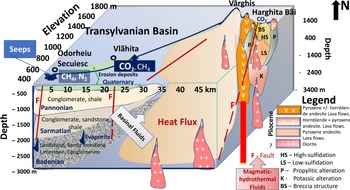
Suggested sketch of volcano–basement interaction and the geological transect profile (see Fig. 1c) from Odorheiu Secuiesc to the Vârghis–Harghita Bãi stratovolcano with expelled seeps, mud, CO2-free spring discharge and basinal fluids (C and N) along the permeable zones from the boundary between the Transylvanian basin basement and the Harghita volcanic arc.

Preliminary fluid inclusion data identified four primary coeval types (aqueous one-phase (L), aqueous two-phase (L–V), rare aqueous multiphase (L–V–S) with a halite cube and carbonic one-phase (V) at room temperature in the NaCl–CaCl2–MgCl2–H2O–(CH4–CO2) system) in small quartz crystals grown in the argillic mass of the NH4-I altered andesite (−110 m), where the coexistence of H2O–CaCl2(MgCl2)–NaCl brines and CH4-vapours in fluid inclusions resulted from an immiscibility process at a temperature of 270 °C and pressure of 100 MPa, respectively (Guedes et al. Reference Guedes, Bobos, Liewig, Noronha, Noronha, Doria and Guedes2000). The CH4 identified as vapours in fluid inclusions derived from a variety of carbon host-rock sources from the Transylvanian basin. Probably, the CH4 was associated with other major gases (e.g. CO2, N2, H2O, etc.) in the initial stage, where individual gases were fractionated later into vapour phases (Giggenbach, Reference Giggenbach1980).
Furthermore, high amounts of organic carbon and nitrogen were measured either in whole rocks or the <2 µm clay fractions (Tables 5, 6). The δ13C measured is strongly depleted (−24.39 to −26.67 ‰) in the NH4-I–S clay fractions (<2 µm), reflecting values close to oxidation of thermogenic CH4, which typically indicates a moderate level of δ13C-depletion (−20 to −50 ‰) (Whiticar, Reference Whiticar1999). The δ13C values obtained are different to those measured in the CO2-free springs discharged from the Harghita Bãi area, which round to −4.21 ‰ (Vaselli et al. Reference Vaselli, Minissale, Tassi, Magro, Seghedi, Ioane and Szakács2002), but are very close to those values for gas seeps from the small Homorod mud volcano (δ13C = −25.68 ‰, Homorod 3, eastern Transylvania basin border with the Neogene volcanic arc; see Fig. 1b), where extremely high concentrations of nitrogen (>92 vol. %) and helium (up to 1.4 vol. %) were measured (Etiope et al. Reference Etiope, Baciu and Schoell2011).
δ15N (‰) ranges from +4.8 to +7.4 (± 0.6) for the NH4-I–S and NH4,K-I clays, with one outlier for NH4-I–S of +14.6 (± 0.6) (Bobos & Williams, Reference Bobos and Williams2017), which supports the interpretation of an influx of waters from organic sediment (δ15N ≥ +5 ‰). Also, such high positive δ15N values acquired by the NH4-I–S (5 %) clays have been observed in the presence of meteoric waters mixed with hydrothermal fluids (Haendal et al. Reference Haendel, Muhle, Nitzsche, Stiehl and Wand1986). Nitrogen in both types of NH4-I–S and NH4,K-I mixed-layered clays from the Harghita Bãi area is attributable to shales of Miocene age from the Transylvania basin, since the major fraction of coexisting carbon is derived from the same source (Sano & Williams, Reference Sano and Williams1996).
5.c. Boundary fluid exchange: isotopic records
Fluid–rock interaction is an exchange of elements taking place at increasing temperatures, where the interaction involves dissolution–precipitation, chemical exchange reactions, redox reactions, diffusion and their combinations.
Oxygen isotopes measured on neoformed bipyramidal quartz crystals collected from argillic ‘crackle’ andesite rocks at −110 m yielded a value of 15.12 ‰ (1τ) in equilibrium with a calculated δ18OF value of 7.73 ‰ (1τ), corresponding to waters with a magmatic isotopic composition. Light isotopes (δ11B and δ7Li) measured previously for the K-I/NH4,K-I mixed clays correspond to a magmatic fluid enriched in heavy-B and Li (Bobos & Williams, Reference Bobos and Williams2017). This is well supported by δ18O isotope data obtained on neoformed quartz crystals, which confirmed the presence of a magmatic-hydrothermal fluid circulation which generated the hydrothermal system probably earlier than 9.5 Ma, the absolute age of K-I alteration identified at −110 m outside of the breccia structure. By contrast, the NH4-I–S series is consistent with an influx of isotopically light-B and Li waters (δ11B = –12 to –22.4 ± 0.8 ‰; δ7Li = −8.6 to −12.3 ± 0.8 ‰) derived from hydrothermal leaching of continental evaporite and/or organic-rich sediments (Bobos & Williams, Reference Bobos and Williams2017). This is also supported by δ13C isotope data (−26 ‰) obtained on clay fractions which show values close to those values from macro- or microseepage gas observed in the eastern margin of the Transylvanian basin (i.e. Praid, Odorheiu Secuiesc, Homorod) related to thermogenic reservoirs in tectonically active areas (Etiope et al. Reference Etiope, Baciu and Schoell2011), where the δ13C of released gas ranges from −25 to −45 ‰ (Klusman et al. Reference Klusman, Leopold and LeRoy2000).
The HFSEs measured on both the K-I/NH4,K-I and NH4-I altered rocks were inherited from the source rocks, indicated also by the CHARAC behaviour of these elements (Fig. 9). Otherwise, the REE patterns show differences between the K-I/NH4,K-I and NH4-I samples with respect to Eu* and Nd* anomalies, indicating fluid changes with respect to NH4-I alteration. The negative Eu* anomaly of K-I/NH4,K-I suggests a partial breakdown of plagioclase from andesite rocks. Different fluid sources with no Eu* anomaly and Nd* anomaly correspond to the NH4-I altered rocks.
5.d. A proposed model of non-magmatic fluid circulation, origin and trap
The argillic alteration areas in a continental volcanic arc are an important key in understanding the origin of the fluids involved in hydrothermal systems, with the K-I and NH4-I clays from the Harghita Bãi hydrothermal system retaining magmatic and non-magmatic signatures. The geochemical signatures serve as a tracer of the mobility of magmatic and organic–sedimentary components in the upper continental crust. Physical and chemical interactions between the host rock and migrating fluids profoundly affect elemental geochemical cycling among seawater, sediments, crust and mantle reservoirs (Moore & Vrolijk, Reference Moore and Vrolijk1992).
The presence of mud volcanoes and seepage across the back-arc continental ‘sag’ basin of Transylvania (Tiliţă et al. Reference Tiliţă, Maţenco, Dinu, Ionescu and Cloetingh2013, Reference Tiliţă, Scheck-Wenderoth, Maţenco and Cloetingh2015) resulted from active compressional tectonics perturbing deep natural gas and petroleum reservoirs, where the Neogene volcanism (from Late Miocene to Quaternary times) caused a heat flow increase and simultaneous basin uplift, reaching temperatures of 200 °C at depths shallower than 3000 m, where most gas reservoirs are located in the eastern Transylvania basin margin (Krézsek et al. Reference Krézsek, Filipescu, Silye, Maţenco and Doust2010). The gas structures close to the Neogene volcanic chain contain higher concentrations of CO2 (up to 90 %), N2 (up to 60 %) and He (up to 5 %) (Filipescu & Huma, Reference Filipescu and Huma1979).
Peripheral deformation of the pre-volcanic shallow sedimentary basement of the eastern part of the Transylvanian basin induced sagging and spreading of the nearby large volcanic edifices as well as enhanced the salt diapirism owing to the effect of increased heat-flux (Tiliţă et al. Reference Tiliţă, Maţenco, Dinu, Ionescu and Cloetingh2013). The post-salt succession tilting is related to salt withdrawal processes and rotation of the whole post-salt sedimentary succession along the salt-layer acting as a detachment surface (Szakács & Krézsek, Reference Szakács and Krézsek2006).
The igneous calc-alkaline intrusions increased the temperature, sufficient for catagenesis of the rocks from the eastern margin of the Transylvanian basin, which was accompanied by abrupt overpressure and host-rock fracturing, which favour organic fluid expulsion (Schutter, Reference Schutter, Petford and McCaffrey2003 b; Iyer et al. Reference Iyer, Schmid, Planke and Millett2017). The Praid, Corund, Morareni, Odorheiu Secuiesc and Homorod seeps and volcanic muds (Fig. 11) expelled both biogenic and thermogenic methane along the anticlinal structures, faults related to salt diapirism or fractures on the eastern margin of the Transylvanian basin (Etiope et al. Reference Etiope, Baciu and Schoell2011; Italiano et al. Reference Italiano, Kis, Baciu, Ionescu, Harangi and Palcsu2017), where most seeps are linked to gas reservoirs (Baciu et al. Reference Baciu, Ionescu and Etiope2018). Such transitional sedimentary versus magmatic systems (Fig. 11) implied the temperature increases around the reservoir, abrupt overpressure, host-rock fracturing and the expulsion of organic fluid with a chemical composition that reflected the host rocks: CH4, N2, B, Li, salts and water (based on fluid inclusion data on quartz and the light isotope composition of NH4-I clays).
Migration along faults or fractures of dissolved gases in thermal springs or groundwater is well highlighted across the transect profile from Odorheiu Secuiesc and Vlãhita to the Harghita Bãi area (Fig. 11). Here, CO2 rises during subsurface gas–water interactions between the pristine air-equilibrated water (normally infiltrating as air saturated water; ASW) and deep-seated endogenic gases of variable origin (organic, crustal and/or mantle-derived) (Vaselli et al. Reference Vaselli, Minissale, Tassi, Magro, Seghedi, Ioane and Szakács2002; Italiano et al. Reference Italiano, Kis, Baciu, Ionescu, Harangi and Palcsu2017).
The post-intrusive fracture system (NE–SW) recognized in the CGH volcanic chain (Szakacs & Seghedi, Reference Szakács and Seghedi1995) opened the circulation routes for volatile escape during the consolidation of the intrusive bodies. Late volcanic activity dated from 6.5 to 3.9 Ma (Pecskay et al. Reference Pécskay, Edelstein, Seghedi, Szakács, Kovacs, Crihan and Bernad1995) in the northern part of Harghita opened or reactivated new pathways and provided new circulation routes for basinal fluids from the petroleum system of the eastern Transylvanian basin to new and old permeable zones (faults, breccia structures, etc.) and expelled seeps from the biogenic petroleum system of the Transylvanian basin.
The presence of gas accumulations with high concentrations of CO2 (up to 90 wt %) and N2 (up to 40 wt %) typify gas fields in the close proximity of the Pliocene volcanic rocks at the southeastern borders of the basin that provided additional heat and gases to the hydrocarbon system (Paraschiv, Reference Paraschiv1980; Krézsek et al. Reference Krézsek, Filipescu, Silye, Maţenco and Doust2010). Both carbon and nitrogen from various organic sediments from the Transylvanian basin were transferred in the volcanic continental arc and then, N was fixed as NH4 + into illite clays, reflecting a complete palaeo-biogeochemical cycle. Pyrolysis experiments suggest that N2-rich gas is released during the final stage of gas generation, after CH4 formation has ceased (Krooss et al. Reference Krooss, Littke, Muller, Frielingsdorf, Schwochau and Idiz1995). Values of +4 ‰ > δ15N < +18 ‰ imply that the N2 may have originated from post-mature sedimentary organic matter (Zhu et al. Reference Zhu, Shi and Fang2000).
The K–Ar age of 9.5 ± 0.5 Ma obtained for K-I confirmed an early post-magmatic stage related to an early magmatism with implications probably at deep depths for thermogenic gas generation. The time of dry-gas generation from the post-salt sediments or biogenic petroleum system (Mid- to Late Miocene), estimated to be 7–9 Ma (Ciulavu et al. Reference Ciulavu, Dinu, Szakács and Dordea2000), is older than the last volcanism event dated from 6.3 to 3.9 Ma (Peltz et al. Reference Peltz, Vâjdea, Balogh and Pécskay1987; Pecskay et al. Reference Pécskay, Edelstein, Seghedi, Szakács, Kovacs, Crihan and Bernad1995) corresponding to the intermediate zone of the VHB stratovolcanic structure. This agrees also with the K–Ar data (<6.2 ± 0.6 Ma) previously obtained on the NH4-I alteration event (Clauer et al. Reference Clauer, Liewig and Bobos2010), where basinal fluids transported the organic elements from the biogenic petroleum system. The absolute ages obtained on the NH4-I alteration correlated with the absolute ages of the last volcanism, suggesting that the dry-gas generation from the post-salt sediments began before 6.3 Ma.
6. Conclusion
The thermal influence of the shallowest-level diorite intrusions resulted in abrupt expulsion of magmatic-hydrothermal fluids, which generated potassic (biotite), phyllic (K-I, 9.5 Ma) and argillic alteration. The hydrothermal injection breccia may be indicative of abrupt overpressure build-up and magmatic-hydrothermal fluid expulsion during this first hydrothermal event. Several evolution stages of brecciation were recognized by textural aspects identified from top to bottom, such as: ‘shingle’, ‘jigsaw’, ‘crackle’ and hydraulic in situ fracturing.
The second hydrothermal event related to basinal fluid (organic) circulation in the Harghita Bãi hydrothermal system occurred after the last volcanic activity, where several younger late-stage andesitic lava extrusions (e.g. Harghita Ciceu, Borhegy, etc.) appeared and obtruded the older cratered areas of the VHB stratovolcano. The last volcanism (6.3 to 3.9 Ma) and simultaneous volcano-induced tectonic activity in the proximity of the eastern Transylvanian basin basement increased the heat flow, generating lateral salt extrusion, basin uplift, enhanced diapirism and pressure increase in the gas reservoir. The basinal fluid with a chemical composition reflecting the host – post-salt petroleum system – (CO2, CH4, N2, salts, B, Li and water) expelled seeps, mud pools and organic fluids in the vicinity of the volcanic continental arc (e.g. Praid, Odorheiu Secuiesc, etc.), where basinal fluids circulated along permeable zones (i.e. fractures, faults) and interacted within the stratovolcanic structures of the Harghita Mts.
The HFSE behaviours of the K-I and NH4-I argillic altered andesite are close to chondritic ratios, indicating no contribution of hydrothermal fluid, especially on NH4-I andesite alteration and the CHARAC behaviour within silicate melts. Nevertheless, REE normalized patterns show two distinct trends, one with a Eu* anomaly (K-I) and the other with a Nd* anomaly (NH4-I), indicating a boundary exchange with the organic-enriched waters. The strongly depleted δ13C (V-PDB) measured in the NH4–I clays shows values (−24.39 to −26.67 ‰) close to CH4 thermogenic oxidation, whereas the δ15N confirmed that the N2 originated from post-mature sedimentary organic matter. The phyllic alteration (K-I) related to an early magmatic-hydrothermal event identified in the fossil hydrothermal system of Harghita Bãi was later replaced by NH4-I alteration owing to circulation of the organic-rich fluid along permeable zones after the breccia pipe formation.
Acknowledgements
I thank Prof. Ioan Mârza from the ‘Babes-Bolyai’ University of Cluj-Napoca (Romania) who kindly accompanied me on the field trip in the Harghita Bãi area. I acknowledge use of the Keck Environmental Lab assisted by Natalya Zolotova from the Arizona State University (USA). I thank Dr Henrik H. Svensen (Univ. Oslo) for review that greatly improved the earlier version of the manuscript. Also, I am very grateful to Prof. Lynda B. Williams (ASU-Tempe, USA) for through reading and comments and to Dr Tim Johnson (editor) for excellent editorial handling. In addition, I acknowledge Paolo Fulignati (Pisa University, Italy) for the reading and suggestions.