Introduction
A significant consequence of increasing atmospheric CO2 is the acidification of the world’s oceans (Pearson & Palmer Reference Pearson and Palmer2000). To date studies have focused exclusively on the negative effects of ocean acidification on calcification and other biological processes in temperate and tropical benthic marine invertebrates and algae (Kurihara & Shirayama Reference Kurihara and Shirayama2004, Kurihara et al. Reference Kurihara, Shimode and Shirayama2004, Kuffner et al. Reference Kuffner, Andersson, Jokeil, Rodgers and Mackenzie2008, Hoegh-Guldberg et al. Reference Hoegh-Guldberg, Mumby, Hooton, Steneck, Greenfield, Gomez, Harvell, Sale, Edwards, Caldeira, Knowlton, Eakin, Iglesias-Prieto, Muthiga, Bradbury, Dubi and Hatziollos2007, Fabry et al. Reference Fabry, Seibel, Feely and Orr2008, Kurihara 2008, Dupont et al. Reference Dupont, Havenhand, Thorndyke, Peck and Thorndyke2008, McDonald et al. 2009). In contrast, while studies are currently under way on the impacts of ocean acidification on pelagic Antarctic shelled pteropods (V.J. Fabry and colleagues), we know of no studies on the effects of increased acidification on calcified marine invertebrates and algae that comprise the rich benthic communities of Antarctica (Arntz et al. Reference Arntz, Brey and Gallardo1994). This is a serious knowledge gap.
High latitude seas surrounding Antarctica are arguably among the most vulnerable regions of our planet with respect to prospective biotic impacts of ocean acidification (Fabry et al. Reference Fabry, Seibel, Feely and Orr2008). This is because there is a preponderance of species with thin, weak, shells (Nicol Reference Nicol1967, Vermeij Reference Vermeij1978), a result of either calcium ions being difficult to extract from seawater at low temperature (Graus Reference Graus1974, Harper Reference Harper2000, but see Aronson et al. Reference Aronson, Thatje, Clarke, Peck, Blake, Wilga and Seibel2007) or a protracted evolutionary history that has selected against robust shell calcification due to an absence of shell-crushing invertebrates, such as crabs and heavily jawed fish (Vermeij Reference Vermeij1978, Thatje et al. Reference Thatje, Anger, Calcagno, Lovrich, Portner and Arntz2005, Aronson et al. Reference Aronson, Thatje, Clarke, Peck, Blake, Wilga and Seibel2007, McClintock et al. Reference Mcclintock, Ducklow and Fraser2008). Furthermore, there is an inverse relationship between the solubility of calcium carbonate and temperature (Revelle & Fairbridge Reference Revelle and Fairbridge1957), a high probability the Southern Ocean will begin to become undersaturated with respect to aragonite (a polymorph of calcium carbonate) in the next few decades (Caldeira & Wickett Reference Caldeira and Wickett2005, Fabry et al. Reference Fabry, Seibel, Feely and Orr2008, Guinotte & Fabry Reference Guinotte and Fabry2008, McNeil & Matear Reference Mcneil and Matear2008), and a high incidence of benthic species with slow growth, delayed reproduction, and a long life span (Pearse et al. Reference Pearse, Mcclintock and Bosch1991).
The purpose of the present study was to examine the effects of seawater acidification on the dissolution rates of representatives of both aragonitic and calcitic shells of a range of common Antarctic benthic macroorganisms including the bivalves Laternula elliptica (King & Broderip) and Yoldia eightsi (Courthouy), the gastropod limpet Nacella concinna (Strebel), and the brachiopod Liothyrella uva Broderip. Moreover, the calcified thallus of a coralline alga that frequently coats the shells of the limpet N. concinna was also examined. As in the majority of studies that have examined the impacts of ocean acidification on calcified temperate and tropical marine invertebrates, we chose to employ an experimental pH of 7.4 (similar to 23 of 30 studies cited in table 1 of Kurihara 2008). More importantly, this level of ocean acidity is predicted to occur in shallow coastal waters by the year 2300 (Caldeira & Wickett Reference Caldeira and Wickett2003), a time period unlikely to be sufficient for evolutionary processes to select for more robust shells or physiological mechanisms to adequately protect calcified body parts or enhance calcification. Moreover, pH 7.4 is conservative if atmospheric emissions are modelled on the high end of their predicated range (cumulative atmospheric emission of 20 000 Pg C), where global surface seawater pH reductions could be as high as 1.4 units (pH 6.7) by the year 2300 (Caldeira & Wickett Reference Caldeira and Wickett2005).
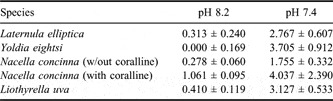
Mean ± 1 s.e. percent weight loss in paired half shells of benthic Antarctic macroinvertebrates over a nine week exposure to seawater at either 7.4 or 8.2 pH.

Materials and methods
Fresh, intact, empty shells of the bivalves Laternula elliptica (70–110 mm long diameter) and Yoldia eightsi (30–36 mm long diameter), and living individuals of the gastropod limpet Nacella concinna (30–40 mm long diameter) with and without the outer shell encrusted with a coralline alga, and the brachiopod Liothyrella uva (30–36 mm long diameter) were collected in April–June 2008 by hand using SCUBA from depths of 5–30 m in the near vicinity of Palmer Station, Anvers Island, off the western Antarctic Peninsula (64°46.5′S; 64°03.3′W). Shells of these species vary in their composition of isomorphs of calcium carbonate. The shells of the bivalves Laternula elliptica and Yoldia eightsi are aragonitic (Barrera et al. Reference Barrera, Tevesv, Carter and McCall1994, Marshall et al. Reference Marshall, Pirrie, Clarke, Nolar and Sharman1996), while the shells of the gastropod limpet N. concinna and the brachiopod L. uva are both calcitic (Carter Reference Carter1990, Marshall et al. Reference Marshall, Pirrie, Clarke, Nolar and Sharman1996). Nacella concinna is often encrusted with a coralline alga comprised of magnesium-calcite (Guinotte & Fabry Reference Guinotte and Fabry2008). It was not possible to completely protect the outer organic periostracal shell layers in the fresh field-collected post-mortem shells of the bivalves L. elliptica and Y. eightsi (although shells of recently dead marine invertebrates still contain a large amount of organic matter associated with the periostracum or other organic coating, Marshall et al. Reference Marshall, Pirrie, Clarke, Nolar and Sharman1996). The shells of the limpet N. concinna and the brachiopod L. uva were gently cleaned of living tissue to minimize damage to the outer periostracum of limpet shells and the thin, outer, protective nanocrystalline layer of the brachiopod shells. Shells were air dried slowly at room temperature, individually wrapped, and shipped to the University of Alabama at Birmingham, USA. For all shells, there was no contact with preservation agents that might alter the nature of an organic matrix.
Intact shells were cut lengthwise into two approximately equal-sized halves using a variable speed rotary tool (Foredom Electric Company, Bethel, CT) equipped with a 0.4 mm thick abrasive cut-off disk (25 mm diameter). Five shells and their respective paired half were placed into each of five one-litre beakers containing artificial seawater (Instant Ocean™, Aquarium Systems, Inc. Mentor, OH) made up at 35 ppt salinity and held in a constant cold temperature room at 4°C. This temperature is within 2°C of the upper range of seawater temperatures that occur at Palmer Station (Barnes et al. Reference Barnes, Fuentes, Clarke, Schloss and Wallace2006). Control beakers were aerated with atmospheric air driven by an aquarium pump. Experimental beakers received a mixture of air from the pump and USP medical grade 100% by volume CO2 from a cylinder (Airgas, Inc., Radnor, PA). The gases were mixed using a gas proportioning rotameter (Omega Engineering, Inc., Stamford, CT). The gas mixture in the experimental treatment was adjusted to achieve a pH of 7.4, while the ambient seawater control treatment was pH 8.2. The pH levels of seawater in beakers in both treatments were measured every two days using a Fisher Model AB15 pH/mV/°C/F Meter to ensure stability. The meter displayed pH to two decimal places. In order to ensure that, with dissolution, calcium ion levels did not rise and buffer the pH, calcium ion levels in the seawater of both experimental and control treatments were measured weekly using a calcium ion-specific ion electrode (Thermo Scientific, Beverly, MA). In addition, 25% of the seawater was replaced each week in both treatments to ensure seawater quality stability. It was not necessary to equilibrate the replacement seawater prior to its addition, as it equilibrated within 1–2 hr when added to the experimental beakers.
The chemical characteristics of the artificial seawater were as follows: total alkalinity (determined by titration): 2558 μmol kg-1 (experimental), 2678 μmol kg-1 (control), ΩAr 0.47 (experimental), ΩAr 2.66 (control), ΩCa 0.74 (experimental), ΩCa 4.22 (control). The Ω values were calculated using the Microsoft Excel spreadsheet “co2sys.xls” v.14 by G. Pelletier, E. Lewis and D. Wallace (http://www.ecy.wa.gov/programs/eap/models.html).
Shells were removed from their respective beakers weekly, dried at room temperature under circulating air in an exhaust hood for c. 4 hr and then weighed to the nearest 0.1 mg on a top-loading Mettler AJ100 balance (Mettler-Toledo Inc., Columbus, OH). To ensure that shells were completely dry prior to each weighing, several shells were spot checked by further drying them under a hair dryer and re-weighing them to confirm that weights did not decline with further drying.
After a period of 35 days, a stereo microscope (Leica model MZ6 stereo microscope) equipped with a Polaroid Model DMC 1E digital camera was employed to take digital photographs of the outer surfaces of bivalve, limpet and brachiopod shells, as well as the outer surfaces of the coralline alga encrusting the shells of limpets.
Shell and thallus outer surface morphologies were also imaged after 56 days using a Topometrix “Explorer” Atomic Force Microscope (AFM) in contact imaging mode. The cantilevers used were non-conductive triangular silicon nitride with nominal spring stiffness of 0.05 N/m. The nominal tip radius was 20 nm. The images obtained were processed by Topometrix SPM Lab NT Version 5.0 software, and consisted of a first-order levelling of the surface and a left shading of the image.
A modified paired t-test was used to compare the mean weights of the shell halves from the two treatments at each seven days during the 56 day exposure period. For each pair of shell halves, the starting weight difference was not 0. So, an “adjusted” difference for each shell was calculated as:

where C is “control” (pH 8.2) and E is “experimental” (pH 7.4). Since the pH 7.4 shells were hypothesized to dissolve at a greater rate than at pH 8.2, the mean adjusted difference was expected to be negative and the t-test test was done one-tailed. For all statistical comparisons, the cut-off for significance was P ≤ 0.05.
The mean percentage of the original weight that was lost by the shells after 63 days was also calculated for both the pH 7.4 and pH 8.2 treatments for each species.
Results
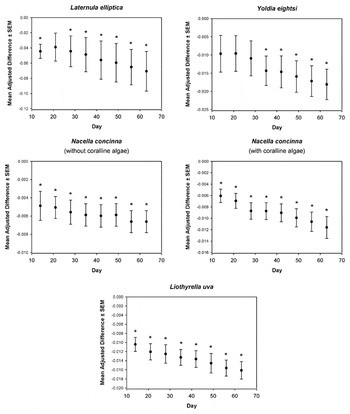
Within 14 days, the outer surfaces of shells held in acidified pH 7.4 seawater were visibly less lustrous than outer surfaces of shells held in ambient 8.2 pH seawater. At 14 days, the rate of shell dissolution (shell mass) was significantly greater in the experimental treatment (pH = 7.4), compared to the control treatment (pH = 8.2) for the brachiopod L. uva and for the shells of the limpet N. concinna, both with and without coralline algae (Fig. 1). The difference became significant for the bivalves L. elliptica after 28 days, and for Y. eightsi after 35 days (Fig. 1). In one instance, a shell of L. elliptica in the pH 7.4 treatment became so fragile that it fragmented into multiple pieces while the paired shell half held in ambient pH 8.2 seawater remained intact. Shells of the limpet N. concinna encrusted with the thalli of a coralline alga exposed to pH 7.4 lost a higher percentage of initial weight than those limpet shells lacking coralline algae (Fig. 1). By day 63, coralline-encrusted limpets had lost 2.3 times the weight of non-encrusted limpets (Table I). Thus, thalli of the coralline algae also experienced dissolution in seawater at pH 7.4. Mean percent weigh losses over 63 days for all shells in both pH treatments are presented in Table I.
Mean differences in weight between shell halves exposed to seawater at pH 8.2 and pH 7.4 for various amounts of time. Adjusted differences were calculated as (C - E at day 0) – (C - E at day ), where C is “control” (pH 8.2) and E is “experimental” (pH 7.4). When the E shells lose more weight than the C shells, the adjusted difference is negative. Means shown with an asterisk are significantly less than 0 (paired t-test, one-tailed).

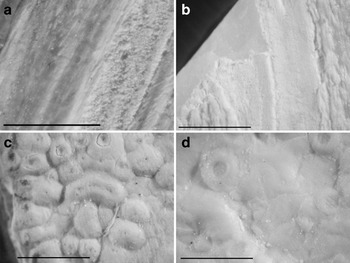
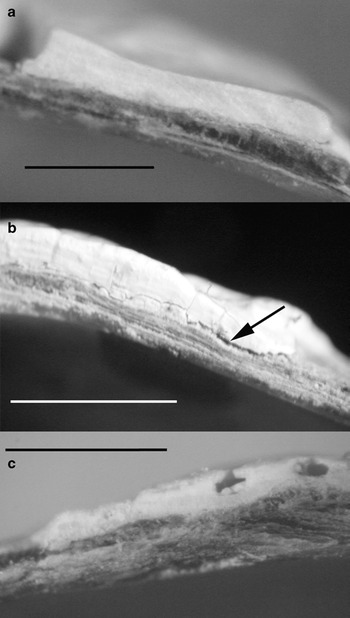
Digital light microphotographs of the upper surfaces of the shells of both species of bivalve and the brachiopod following a period of 35 days revealed a greater irregularity as the more soluble surface regions dissolved on outer surfaces of shells held in the pH 7.4 when compared to the pH 8.2 treatment (see Fig. 2a & b showing the shell of the bivalve Yoldia eightsi as a representative example). Moreover, after a similar period the thalli of the coralline algae encrusting shells of limpets exposed to pH 7.4 seawater displayed evidence of dissolution when compared to the pH 8.2 treatment, as seen by an increase in definition of the conceptacle pores (Fig. 2c & d). Three weeks later, after a period of 56 days, the coralline alga in the 7.4 pH treatment, but not in the control pH 8.2 treatment, had begun to fracture and crack along its zone of interface with limpet shells (Fig. 3).
External shell surfaces of the bivalve Yoldia eightsi after 56 days of exposure to seawater at a. pH 7.4, and b. pH 8.2, and a coralline alga encrusted on the shells of the limpet Nacella concinna after 56 days of exposure to seawater at c. pH 7.4, and d. pH 8.2. In each image, the scale bar is 1 mm.

View of the cut edge of Nacella concinna with its surface encrusted with a coralline alga. a. is at the beginning of the experiment, b. is the same shell after 56 days of exposure to pH 7.4 seawater. The arrow depicts the region of decomposition and probable initial separation from the limpet shell upon which it is encrusted. c. is the control half of the same shell after 56 days of exposure to pH 8.2 seawater. In each image, the scale bar is 1 mm.

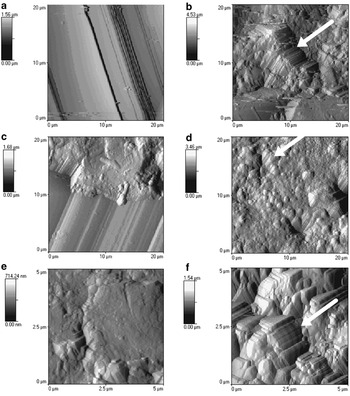
Atomic force microscopy of the shells and coralline alga confirmed light microscopic observations and provided additional information on the ontogeny of the impacts on calcium carbonate microarchitecture under reduced pH. After a period of 56 days, the outer surface of shells of both bivalves, the limpet, and the outer shell surface of the brachiopod held in the pH 7.4 treatment displayed extensive degradation (see Fig. 4 for representative examples). Evident was the appearance of prisms emerging from the eroded outer shell in both species of bivalves, especially the aragonitic prisms of Yoldia eightsi (Fig. 4a & b). Calcitic prisms were less pronounced in the outer shell surface of the gastropod limpet Nacella concinna (Fig. 4c & d), while complex calcific prisms were conspicuously visible in the degraded outer shell surface of the brachiopod Liothyrella uva (Fig. 4e & f).
Atomic force microscopy images of the surfaces of shells exposed for 56 days to control (pH 8.2) or acidified (pH 7.4) seawater. a.Yoldia eightsi control, b.Y. eightsi acidified, c.Nacella concinna control, d.N. concinna acidified, e.Liothyrella uva control, and f.L. uva acidified. Arrows in b, d & f indicate prisms emerging from dissolved shells.

Discussion
Our findings indicate that weakly calcified marine macroinvertebrates occurring in Antarctic benthic communities are highly vulnerable to dissolution under predicted conditions of ocean acidification. While shells of the two bivalves, limpet and brachiopod exposed to ambient pH 8.2 seawater remained intact, the outer surfaces of shells exposed to pH 7.4 seawater exhibited evidence of deterioration after a period of only 35 days, and by 56 days it was possible to detect the exposure of aragonitic or calcitic prisms in the outer shell surfaces of the brachiopod Liothyrella uva and the bivalve Yoldia eightsi. As exposure of prisms occurred in both shells of bivalves and brachiopods, they are similarly vulnerable to the effects of acidification despite differences in their shell architecture. Bivalve shells generally have an inner nacreous layer, a central prismatic layer, and a thin outer organic periostracal layer. In contrast, brachiopod shells, while also structured into layers, have a thin, outer hard protective layer (primary layer) comprised of randomly oriented nanocrystalline calcite, which is underlain by a softer secondary layer built of long calcite fibres stacked into parallel blocks. Exposure of shell prisms in both bivalves and brachiopods is indicative of structural disintegration that compromises both shell integrity and strength via a suite of unique microarchitectural properties (Scurr & Eichhorn Reference Scurr and Eichhorn2005). Degradation of calcium carbonate was also evident in the thalli of the coralline red algae. By day 35 there was visual evidence of enhanced irregularity on the surface and enhanced definition of the conceptacle pores. We also detected separation (cracking) of the thallus along the zone of interface with the outer limpet shell. This cracking was not due to mechanical damage and cannot be explained by repeated drying as shells with coralline algae were dried similarly in both treatments and cracking only occurred in the pH 7.4 treatment. This observation suggests that encrusting coralline red algae lacking an adequate compensatory response to ocean acidification could become prone to dislodgement from hard surfaces upon which they encrust. The potential dissolution susceptibility of coralline red algae is exacerbated by the fact that magnesium calcite is an important component of coralline red algae, and is known to be even more soluble than aragonite at high latitudes (Andersson et al. Reference Andersson, Mackenzie and Bates2008).
The order of weight loss we observed showed no clear pattern of calcitic shells being less resistant to dissolution than those comprised of aragonite, despite calcite being 35% less soluble in seawater than aragonite (Morse et al. Reference Morse, Mucci and Millero1980, Mucci Reference Mucci1983). In the present study the pattern of the most to the least percent shell weight loss over a 63 day period was aragonitic Yoldia > calcitic Liothyrella > aragonitic > Laternula > calcitic Nacella. Thus, shell dissolution was greater in the calcitic shells of the brachiopod Liothyrella uva than for the aragonitic shells of the bivalve Laternula elliptica, despite the lower solubility of calcite. This observation supports the conclusion of Harper (Reference Harper2000) who indicated that the common premise that calcitic shells evolved to retard shell dissolution (e.g. Taylor & Reid Reference Taylor and Reid1990, Vermeij Reference Vermeij1993) should be treated with caution. Factors outside the scope of the present study including crystal size and morphology, differences in shell chemistry, and differences in the type or structure of organic material surrounding the inorganic matrix of shells, must be considered as potential controlling factors in shell weight loss regardless of whether the shells are comprised of aragonite or calcite (Harper Reference Harper2000). It has been predicted that shells comprised of aragonite would be especially susceptible to ocean acidification (Caldeira & Wickett Reference Caldeira and Wickett2005, Fabry et al. Reference Fabry, Seibel, Feely and Orr2008, Guinotte & Fabry Reference Guinotte and Fabry2008) because aragonite is expected to become undersaturated by 2030 (McNeil & Matear Reference Mcneil and Matear2008). The results of the present study imply that calcitic shells may be as susceptible even though the saturation of calcite may not decrease as rapidly. Our observations also indicate that future studies may need to be cautious about using saturation state as an indicator of when shell dissolution will commence on a large scale.
Glover & Kidwell (Reference Glover and Kidwell1993) and Lockwood & Work (Reference Lockwood and Work2006) indicate that taphonomic studies show degradation in post-mortem shells is comprised of predictable damage processes that include disarticulation, fine-scale surface alteration, periostracum loss, edge modification, and fragmentation. Degradation in post-mortem shells is similar in some respects to what happens in shell loss in living animals, and Harper (Reference Harper2000) points out that dissolution is not restricted to dead shells and that long-lived shelled macroinvertebrates may be at serious risk of shell-weakening.
Based on current models of atmospheric CO2 production, the pH level examined in the present study (7.4) is estimated to occur in shallow seas by the year 2300 (Sundquist Reference Sundquist1993, Caldeira & Wickett Reference Caldeira and Wickett2003, Reference Caldeira and Wickett2005). As our present study did not examine living individuals, future studies are needed to evaluate the potential ability of calcified Antarctic benthic macroorganisms to compensate for the dissolution effects of acidification on calcification processes and shell dissolution across the range of pH values anticipated to occur under models of ocean acidification. While there have been shown to be varied responses in calcification upon exposure to conditions of ocean acidification in temperate and tropical shelled marine organisms (Fabry Reference Fabry2008), compensation is likely to be challenging for many Antarctic marine macroorganisms. This is because aragonite is expected to become undersaturated in high latitude seas by 2030 (McNeil & Matear Reference Mcneil and Matear2008) and the difficulties of calcification may be greater in cold Antarctic seas where CaCO3 has a greater solubility at low temperature (Revelle & Fairbridge Reference Revelle and Fairbridge1957, but see Aronson et al. Reference Aronson, Thatje, Clarke, Peck, Blake, Wilga and Seibel2007). Many temperate and tropical benthic marine invertebrates show little or no enhanced calcification in response to seawater acidification (e.g. Kurihara & Shirayama Reference Kurihara and Shirayama2004, Kurihara et al. Reference Kurihara, Shimode and Shirayama2004, Fine & Tchernov Reference Fine and Tchernov2007). Furthermore, Antarctic marine benthic macroorganisms, in general, and those examined specifically in the present study, are known to have extremely slow growth and long life span (multiple decades) (Ralph & Maxwell Reference Ralph and Maxwell1977, Peck & Bullough Reference Peck and Bullough1993, Arntz et al. Reference Arntz, Brey and Gallardo1994, Peck et al. Reference Peck, Brockington and Brey1997, Clarke et al. Reference Clarke, Prothero-Thomas, Beaumont, Chapman and Brey2004). We detected significant shell dissolution within only a few weeks time which constitutes a very small fraction of life expectancy. The differences we detected in dissolution rates, although small, would add up over the years to large differences in shell and thallus strength and integrity.
Calcified marine invertebrates and coralline algae make up a significant component of the rich benthic communities of Antarctica (Clarke & Johnston Reference Clarke and Johnston2003, Amsler et al. Reference Amsler, Rowley, Laur, Quetin and Ross1995). Many of these species play important roles in bioturbation, the provision of hard substrata for epiphytic and epifaunal communities, and community trophodynamics (Arntz et al. Reference Arntz, Brey and Gallardo1994). Barring a significant reduction in anticipated levels of anthropogenic atmospheric CO2-induced ocean acidification (Wigley et al. Reference Wigley, Richels and Edmonds1996), we caution that the benthic marine communities of the Southern Ocean are likely to be the “canaries in the coal mine” when it comes to global impacts of ocean acidification on calcified benthic organisms (Hall-Spencer et al. Reference Hall-Spencer, Rodolfo-Metalpa, Martin, Ransome and Fine2008). Moreover, if the recent discovery of crushing predators (deep water king crabs) moving up the Antarctic continental slope (Thatje et al. Reference Thatje, Anger, Calcagno, Lovrich, Portner and Arntz2005) portends their invasion into shallow Antarctic seas, then weakly calcified benthic marine organisms suffering the consequences of ocean acidification may become even more vulnerable.
Acknowledgements
We thank Margaret Amsler, Philip Bucolo, and Craig Aumack for assistance in field collections. Liz Harper made valuable recommendations on an earlier draft of this manuscript. We also thank those individuals employed by Raytheon Polar Services for providing valuable logistical support in Antarctica. This research was facilitated by the generous support of the Office of Polar Programs of the National Science Foundation to J.B.M. and C.D.A. (OPP-0442769). JBM also thanks the Friends of Conservation (FOC) and an endowment from the University of Alabama at Birmingham for financial support.