Introductory sections of the target article by Juslin & Västfjäll (J&V) contain important information but are based on three erroneous premises. In the first premise, stated in the opening sentence of the Abstract (“Research indicates that people value music primarily because of the emotions it evokes”) and in the lead paragraph, “people” refers exclusively to youths listening to pop music (Behne Reference Behne, Deliége and Sloboda1997; Sloboda & O'Neill Reference Sloboda, O'Neill, Juslin and Sloboda2001; Zillmann & Gan Reference Zillman, Gan, Hargreaves and North1997).Footnote 1 Such evidence from adolescent self-reports – generally permeated by lay music-emotion (M-E) theories – is treated as relevant to the genuinely important theoretical question: Can instrumental (especially non-referential, “absolute”) music directly induce emotion? Meanwhile, the methodologically sound empirical evidence about this relationship is miniscule, weak, and limited to classical music (Konečni Reference Konečni2008; Konečni et al. Reference Konečni, Brown and Wanic2008).
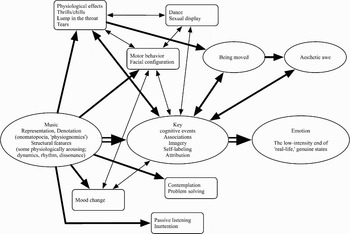
The second erroneous premise is that there is inexplicable disagreement among M-E researchers although the explanation is straightforward: The neuroscientists cited (Kölsch, Peretz, and Panksepp & Bernatzky) generally define emotion exclusively as brain events (in a reductionist manner) – with no or little reference to subjective experience and verbal report, whereas others (Gabrielsson, Kivy, Konečni, Scherer) consider subjective experience indispensable – usually without ignoring the physiological response. An additional aspect of the rather misleading way of setting the stage is the neglect of the terms “directly” and “mediation” in the rendering of some researchers' views (for a review, see Konečni Reference Konečni, Juslin and Sloboda2003) – which is that music does not directly induce emotions and that the M → E effect is typically mediated by memories, associations, and various social emotion-inducing behaviors, such as dance (Fig. 1).
Relationships relevant to the induction of emotion by music. The thickest arrows show the central route. From Konečni et al. (Reference Konečni, Brown and Wanic2008). (©2008 Sage, with permission.)

The authors suspect, disapprovingly, that the skeptical position on M→E stems from its over-reliance on cognitive appraisal; this is odd because major, perhaps dominant, emotion theories emphasize appraisal and it is unclear why they should accommodate “musical emotions” – a term Zangwill (Reference Zangwill2004, p. 35) calls “obscurantist.” Furthermore, J&V themselves assign a key role to cognitive mediators (see examples in the central ellipse in Fig. 1) in at least four of the six “psychological mechanisms” that they believe underlie M→E.
Figure 1 diagrams the third of the article's inaccurate premises. J&V state that providing evidence that music affects all of the components in their Table 2 would “demonstrate that music can evoke ‘real’ emotions” (sect. 2, para. 4). But most of the studies in Table 2 are limited to a single component, and my Figure 1 shows how certain measures taken singly (e.g., psychophysiological thrills/chills) may be dead ends that do not escalate to emotion unless mediated (Konečni et al. Reference Konečni, Wanic and Brown2007).
Turning to the article's core, nonmusical mediation of the possible M→E effect is involved in the following proposed psychological mechanisms: visual imagery (the visual image, not the music that gives rise to it, is the proximal cause in the induction of emotion); episodic memory (memories of real-world emotional situations, not music, are the proximal causal factor); emotional contagion – whereby emotion might be induced by the music's expressiveness being mimicked internally – “admittedly … remains speculative” (sect. 3.1.3, para. 6) and seems unlikely to be effective without some episodic-memory involvement; evaluative conditioning (a nonmusical emotional event with which music has been temporally paired is the true cause of emotion); finally, there are no rational grounds to hypothesize dissonant chords (re: brain stem reflex; see the left ellipse in Fig. 1) and violations of musical expectancy to induce emotions without nonmusical enhancement.
In summary, in causal-modeling terms, if these nonmusical mediators (images, memories, associations) were to be kept constant, there would be no effect of music on emotion. This being so, and given that all of the proposed concepts are well known in psychology and aesthetics, one must conclude that the target article's proposals are neither innovative nor conducive to a deeper understanding of the direct M→E effect.
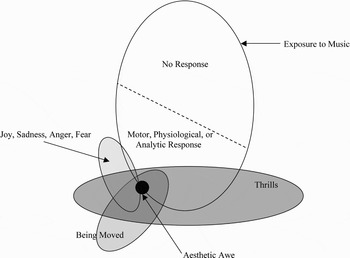
However, having acknowledged the key role of nonmusical mediators, and rejected the term “musical emotions”Footnote 2 (Konečni, Reference Konečni2008), what about the subjectively real and sometimes profound quasi-emotional state that (even) absolute music can produce, one that is different from “real-life” emotions (right-hand ellipse, Fig. 1)? It might be advantageous to use the term being-moved or being-touched. This concept (quasi-emotional state) is one of the three hierarchically arranged, dynamically related, components (along with thrills/chills and aesthetic awe) of the recently developed aesthetic trinity theory (ATT; Konečni Reference Konečni2005; Reference Konečni2008) shown in Figures 1 and 2.
Quasi-emotional, emotional, and nonemotional responses to music and a hypothetical comparative estimate of their prevalence. From Konečni (Reference Konečni2008). (©2008 American Psychological Association, with permission.)

Being-moved (authentic substantives exist in many languages) is proposed as a distinct and reportable (measurable) state inducible by non-aesthetic (e.g., witnessing selfless sacrifice; Konečni et al. Reference Konečni, Wanic and Brown2007) and aesthetic events; among the latter, music is perhaps foremost – because of its temporal nature and rich network of mediators outlined in the target article (cf. Konečni Reference Konečni2005; Reference Konečni2008). The nuances in being-moved may be due to two sources: (a) contemplation simultaneous with listening (e.g., on infinity or on exquisite musical skill) and (b) subtle expressive attributes of music, such as nobility, grace, or serenity. Colorations of being-moved may thus effectively capture the meanings desired by terms like “less terrible,” “less coarse,” and “refined” emotions (Darwin Reference Darwin1871/1902, p. 735; James Reference James1884; Frijda & Sundararajan Reference Frijda and Sundararajan2007), whereas the overlap, in Figure 2, of being-moved and the fundamental emotions suggests that the cognitive mediators listed in the central ellipse of Figure 1 may convert the state of being-moved into (low-intensity) sadness or joy.