In June 2014, control of Mosul, Iraq’s second city, was seized by fighters belonging to the Islamic State of Iraq and Syria (ISIS). Health care during the 36 mo of ISIS control was difficult for both patients and health providers. Reference Michlig, Lafta and Al-Nuaimib1,Reference Lafta, Cetorelli and Burnham2 The military liberation began in East Mosul in October 2016, and was concluded in west Mosul, in July 2017. Fighting and aerial bombardments became much more intense as the conflict move from east Mosul across the Tigris river to west Mosul, where the ISIS forces made their last stand. West Mosul was the older and poorer part of the city, tightly packed with narrow and twisting streets. There was considerable loss of life in west Mosul where many of the buildings were destroyed. Reference Lafta, Al-Nuaimib and Burnham3 We conducted a first household care-seeking survey immediately after the liberation of Mosul, which found care-seeking patterns with a relatively good access to services, but a shortage of medicines and a limited ability to pay for medicines. Reference Lafta, Cetorelli and Burnham2 Persons who reported chronic diseases were taking treatment only intermittently.
During the 10 mo of military action to liberate Mosul from ISIS, the primary health-care centers (PHCCs) sustained some damage, but it was the hospitals that suffered the greatest damage. Mosul General Hospital served as a command post for ISIS and was heavily bombed. 4 Other hospitals were extensively damaged in the fighting, particularly in the Medical City area of west Mosul. While considerable damage to hospitals was structural, there was widespread more superficial damage, and much of the diagnostic equipment was nonfunctional. Before ISIS and the military actions, it was estimated that there were 6000 hospital beds serving Mosul which, at that time, had an estimated population of up to 3 million. 5,Reference Lynch6 In September 2018, there were only 1000 hospital beds available for the estimated current population of up to 1.8 million. 7
Immediately following the defeat of ISIS, Unicef made vaccines and vitamin A available sporadically during ISIS control, and in large amounts after ISIS fell. Salaries for health workers were started again by the Iraq central government. Medicines began returning to private pharmacies, but more slowly to the public-sector facilities. Hospital services were consolidated among less damaged hospitals. In west Mosul, services were concentrated in the former Medical City area. Functional equipment was salvaged from destroyed hospitals. Prefabricated buildings supplemented the still-usable structures. Equipment from the field hospitals that functioned behind the front lines during the liberation was moved to east Mosul. Health workers joined together with community members to clean up and repair health facilities, especially PHCCs. Some of the medical equipment for these clinics had been hidden from ISIS by health workers so was now available. Repairs were aided by private philanthropy and some assistance from UN agencies. Reference Coker8,9 A temporary Medecins Sans Frontieres (MSF; Doctors Without Borders) hospital in west Mosul was set up to provide inpatient and outpatient services at the site of a former PHCC, and this unit handled an extensive surgical load. 10 Ambulance services were partially restored. Private medical practices were reestablished to some extent in east Mosul. A common message exchanged among Mosul residents was to look after yourselves, avoid injuries so you will not need care, which may not be available.
Health workers who left during ISIS years had begun to return. Some continued to live in Dohuk or Erbil in Kurdistan while working in Mosul. For some medical specialists, there is little opportunity to practice their specialties with the rudimentary diagnostic services available. Local health staff reported to the survey team that nurses and paraprofessional staff were less likely to have left Mosul than doctors.
The city’s 2 medical schools combined resources to operate from shared facilities. Mosul University medical school had been severely damaged, but there was less damage to the newer Nineveh medical school. Many medical faculty members live in Kurdistan, coming to Mosul daily for teaching. Medical students largely remained in Mosul during ISIS occupation, but among them extensive psychological effects have been reported. Reference Zubair and Mohammad11
There is little in the health literature that documents evolving health-seeking practices post conflict, which could help guide restoration of health services to meet a population’s changing needs. To understand how the access and use of health services by Mosul residents had changed in the year following the official declaration of liberation from ISIS control, we conducted this 600-household care-seeking survey in September 2018.
Methods
This study is a follow-up to our 2016/2017 survey in which 40 clusters were randomly selected from a listing of the residential administrative units or neighborhoods of Mosul. Reference Lafta, Cetorelli and Burnham12 For this 1-y follow-up survey, 20 clusters were randomly chosen from the original 40 residential clusters were deemed adequate to measure changes in care-seeking practices. Of these 20 clusters, 12 clusters (360 households) were randomly chosen from the original 25 east Mosul clusters, and 8 clusters (240 households) from the original 15 west Mosul clusters. As with the 2016/2017 survey, the start house was randomly selected using a random grid overlying a satellite map of the respective Mosul clusters. After interviewing the head of household or senior female in the start house, interviewers moved to the next house to the right. At intersections, the interview team turned to the right. Where a house had been destroyed, was unoccupied, or the householder refused to participate, the interviewers continued in the same direction to the next occupied house. Even though 20 of the same clusters from the 2016/2017 survey were used, none of the individual households included in the earlier survey were again sampled in the 2018 study, which was conducted in September 2018.
The questionnaire, adapted from the 2017 survey, began with a household listing of persons in the household on or after July 2017. Demographic characteristics were collected including births, deaths, injuries, and marriages. Patterns of illness, care-seeking behavior, and use of maternal health services were recorded. For this survey, a household was defined as a group of people living together, eating from a common kitchen, and living in a structure with a separate entrance from the street. The questionnaire is included as Supplementary Table 1.
The interview team was composed of 4 persons with a doctoral degree in community medicine and who had extensive experience with previous community surveys. All interviewers were originally from Mosul. Some interviewers had participated in the 2017 survey, but all received 2 d of training for this survey.
Verbal informed consent to participate was obtained from the head of household or the senior woman in the household. This person was then asked about reported illnesses in the households, and further information gathered from senior household member and from the persons affected, particularly in the reported cases of chronic conditions. Interviewers used paper forms, and these were inspected for completeness before leaving a household. Data from completed forms were computer entered in SPSS in Baghdad and preliminary analysis conducted there. Further analysis using Stata (Stata Corp., College Station, Texas) was conducted in Baltimore.
This study received ethical approval from the Scientific and Technical Committee of Al Mustansiriya University. The Institutional Review Board at Johns Hopkins Bloomberg School of Public Health declared that analysis of these data without personal identifiers as exempt.
Results
Demographic Characteristics
This survey visited 600 households: 360 in east Mosul and 240 in west Mosul. All households had been continuously present in Mosul since July 2017. Only 24 households (4%) were not present in Mosul before July 2017. In the 600 households, there were 3375 persons, with a mean household size of 5.6 persons. Households were larger in in west Mosul than east (6.2 vs 5.2). Children under age 15 y constituted 29.6% of household members, 26.0% in east Mosul and 34.1% in west Mosul. There were 49 more male children than females, largely reflecting sex differences found in east Mosul. Only 3 households declined to participate in the survey. The household demographic characteristics are shown in Table 1.
Demographic characteristics of surveyed households

Illness Among Children
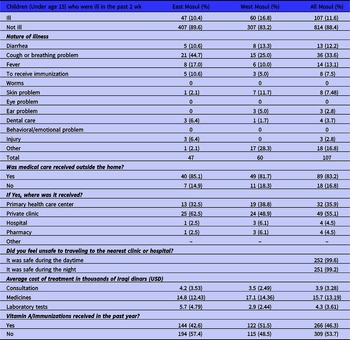
In Table 2 are set out the illnesses reported in the previous 2 wk by 107 (11.6%) of the 921 children under age 15 y in the sample.
Illness among 921 children under age 15 y in the past 2 wk

Among the 107 children ill in the past 2 wk, the most common complaint in children was cough or difficulty breathing, experienced by 36 (33.6% or 3.9% of all children) followed by fever in 14 (13.1% or 1.5% of all children) and diarrhea in 13 (12.2% or 1.4% of all children). Of the 107 children reportedly ill, 89 (83.2%) were taken for treatment outside the household. Private clinics were the choice for 49 (55.1%) with public sector PHCCs for all but 8 (9%) of the remaining children. The mean costs were 15,700 IQD (US$13.19) for medicines, 3900 IQD ($US3.28) for consultation, and 4300 IQD (US$3.61) for laboratory tests. During the past year, 266 (46.3%) of 575 children under age 15 had received some vaccines and vitamin A (commonly given together). There were no children who had reported psychological or behavioral problems.
Illness Among Adults
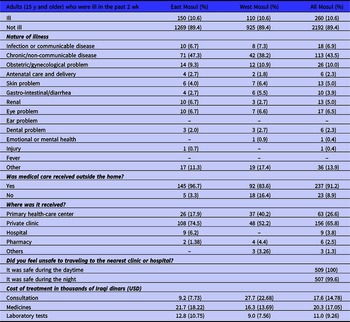
In Table 3 are noted the predominant reasons among the 260 (of 2452) adults reporting illness in the past 2 wk. The most frequently reported illnesses were chronic or noncommunicable diseases (NCDs): 113 persons (43.5% or 4.6% of all adults). Reported obstetrical or gynecological conditions present in 26 (21.0%) of those seeking care or 1.6% of all adult women), and a communicable disease in 18 (6.9% or 0.7% of all adults). There was only 1 person who reported an emotional, psychological, or mental health problem for which care was sought. Care outside the home was sought by 237 (91.2%) of the 260 persons reporting illness. The majority of adults who sought care outside the home used private clinics (156, 65.8%). A PHCC was used by 63 (26.6%) persons with the balance receiving care at hospitals, pharmacies, or other sources. The mean cost of treatments was IQD 20,300 (US$17.05) for medicines, IQD 17,600 (US$14.78) for consultation, and IQD 11,000 (US$9.26) for laboratory tests.
Illness among 2452 adults in the past 2 weeks

Between July 2017 and September 2018, there were 28 injuries reported and 18 deaths among the 600 households. Reference Lafta, Cetorelli and Burnham12 There were 3 infant deaths. Among the nonfatal injuries, only 6 of the 28 were admitted to hospital. One death from nonintentional injury was reported, and 15 deaths were the outcome of disease. There were 2 intentional violence-related deaths. One person stepped on an explosive in the backyard of a house and a second returned to his vacant house, and later was found dead from an explosive injury.
Clinic Visits
For children seeking care, 198 (78.4%) of 253 children were treated within 15 min of their home during their last illness. Average travel time for care was 8.9 min. Of families with children receiving immunizations, 220 (93.3%) said the immunization was received within 15 min of their house. For adults receiving care during their last illness, average travel time for treatment was 11.8 min, and 466 (86.8%) reached the health facility within 15 min. For both adults and children needing treatment household reported that it was safe to travel to the nearest clinic or hospital by day or night (Tables 2 and 3).
Pregnancy and Delivery
Among the households surveyed, there had been 76 deliveries reported in the past year, all but 2 of which had occurred in a health facility (Supplementary Table 1). Pregnant women in east Mosul reported, on average, almost 4 antenatal clinic visits a year, while those in east Mosul made an average of slightly more than 2 antenatal clinic visits. There were 20 (21%) women who reported no antenatal clinic visits. Almost all women reported that their children were delivered by a doctor.
Complications reported were rare, with hypertension among four women being the most common condition. There were no maternal deaths. Since birth, there had been 2 deaths in children, 1 a neonate.
NCDs
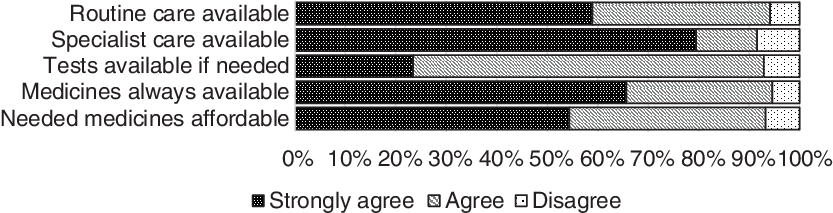
The 600 households reported 239 persons with hypertension, type 2 diabetes, or chronic obstructive pulmonary disease (COPD), representing 7.1 of households. Persons with these NCDs were asked about the treatment of their disease, and their responses are shown in Figure 1. There were 141 (59.0%) who strongly agreed that routine primary care was easily available, increasing to 190 (79.5%) who strongly agreed that specialist care was readily available, and 141 (59%) agreed to routine primary care was easily available. While two-thirds of patients with NCDs strongly agreed that access to medicines for their conditions was stated as good for, there were only 130 (54%) who strongly agreed that NCD medicines were affordable.
Access to NCD services and medicines.

Satisfaction With Health Services
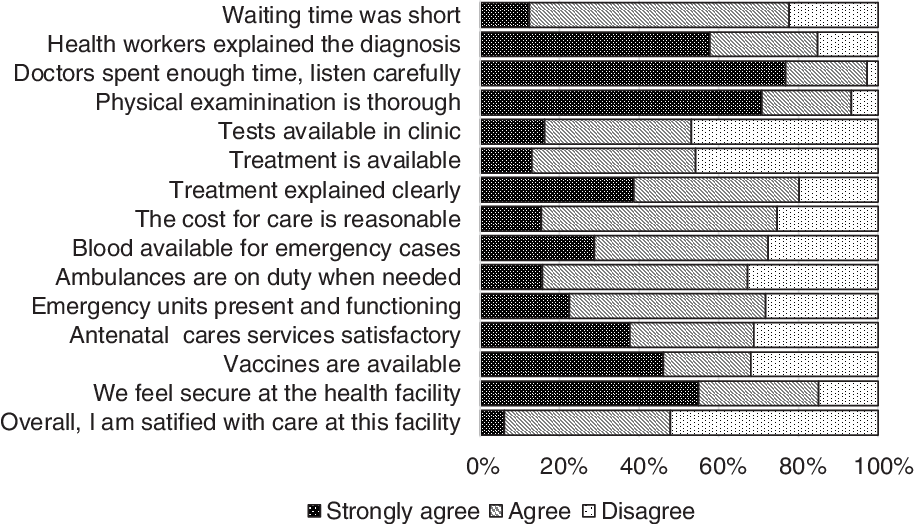
Households were asked about their assessment of the general health services they used regularly, and their responses are shown in Figure 2. There were 595 households that provided an opinion. Respondent assessments were most positive for the work of the health worker in the examination of the ill person and the explanation of the disease condition, as well as the feelings of security at the health facility. There were small numbers who strongly agreed that medicines and tests were available and 231 (38.8%) and 279 (46.9%), respectively, disagreeing. Opinion on other areas, such as waiting time, costs, and presence of ambulances, was variable. Only 36 (6%) patients strongly agreed that, overall, they were satisfied with care from their usual source of health services, with 310 (52.1%) disagreeing.
Respondents’ assessments of the health care services they regularly used.

Comparisons Between 2016/17 Survey and 2018 Survey
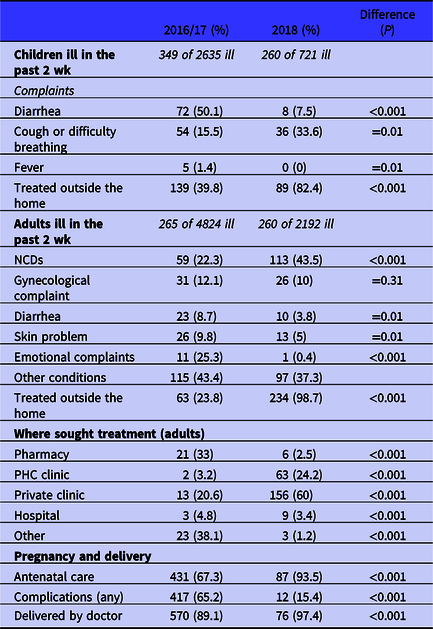
The intent of this study was to assess how care-seeking and perceptions of care had changed after the military liberation of Mosul from ISIS (Table 4), using the same questionnaire in the same neighborhoods. The frequency of various illnesses reported from the past 2 wk changed substantially for almost all variables 1 y after liberation from ISIS. Diarrhea, especially in children was much less as were skin problems and emotional and behavioral problems. At the same time, cough or difficulty breathing was increased among children. Among adults there were larger numbers of people seeking care for NCDs. Treatment outside of the household was sought for 82.4% of sick children and for 98.7% of adults, more than twice the level a year earlier. A year after ISIS, almost all pregnant women attended antenatal clinics. For pregnancies delivering after the ISIS period, there were fewer pregnancies with complications reported (15.4% vs 65.2%).
Comparisons of findings immediately after ISIS control with 1 y later among a sub-set of the same populations

Compared with the ISIS years, the preferred point of treatment was the private clinic or the public sector PHC clinic, especially for children. One year after ISIS was defeated, few people sought initial care from pharmacies or informal sources.
Discussion
This study was carried out to determine the extent of change in care-seeking practices and perceptions of health care for the population of Mosul 1 y following the liberation of Mosul. The study is important as often the time is not taken to understand how care-seeking behavior changes after conflict, and what are the needs for services from a population perspective. This is informative as the population’s needs may differ from those before a conflict, and health services may need to be restructured for different needs than before the conflict. There is commonly an assumption that health services should be restored to their preconflict structure without an attempt to determine a population’s experiences and preferences. In Mosul, the previous health system was a centralized hospital-based structure, whereas post-ISIS, the population had a clear preference for private primary care services, perhaps promoted by the heavy damage to hospitals during the liberation of Mosul. The epidemiological and demographic changes Iraq is experiencing will require a different health service than that inherited from the Saddam Hussein era.
The findings of the survey reported here can be compared with data drawn from samples from the same areas at the end of ISIS control. In both surveys, household members spoke freely to the interviewers and often were eager to share their experiences. Since Iraqi government control returned, household size changed from 6.3 to 5.6 persons per household, although now west Mosul households were somewhat larger than those of east Mosul. It may be that, in the previous survey, household size had been increased by persons joining from housing that had been destroyed in the intense fighting. The notable shifts were in the increase in adults, with a lower proportion of children than at the time of liberation from ISIS. The proportion of older adults (50+) was little changed from ISIS years.
Illness among children under age 15 reported for the past 2 wk was slightly lower (11.6%) than noted at the end of ISIS occupation (13.2%). The nature of childhood illnesses reported had shifted dramatically, however, with much less diarrhea, but with an increase in cough or difficulty breathing.
The decrease in diarrhea prevalence may coincide with the restoration of pumped water to Mosul; pumping had largely stopped during ISIS times, with reliance on hastily dug shallow wells. 13,Reference Aboulenein14 Throughout the ISIS period, water from wells in east Mosul was tested as unfit for drinking. Reference Al-Ozeer and Ahmed15 Hand hygiene may well have improved also. The complaints of coughing or breathing problems among children may be related to the extensive dust from clearing destroyed buildings in Mosul and the dust blown in from agricultural lands which now lacked irrigation. 16
The pattern of illnesses reported among adults past 2 wk had also shifted, with NCDs replacing emotional problems as the most common cause. It may be that, with little intentional violence occurring 1 y after ISIS and fewer acute conditions dominating everyday concerns, NCDs had received greater attention. Diarrhea reported among adults was also less common 1 y later as compared with the end of ISIS control. Seasonality of complaints may have played some role as the 2017 data were collected from east Mosul were collected in March, west Mosul in September 2017, and this 1-y follow-up survey was completed in September 2018.
Access to Services
A dramatic change was seen in access to services. During ISIS control, only 23% of adult illnesses and 39.8% of childhood illnesses were treated outside the household. At the 1-y mark, the numbers had increased to 82.4% and 98.7%, respectively. In these years, the principal source of care for both adults and children were an informal source, usually after-hours visits to health workers living in the neighborhood, a choice made for security reasons. Reference Lafta, Cetorelli and Burnham2 One year after ISIS, patients chose private clinics over other sources of care for both adults and children, with pharmacies playing an insignificant role, and informal sources none. In Iraq, private clinics generally function in the evenings, staffed by government medical offices working out of hours, something that was not allowed during ISIS years. The use of private clinics for adults, and to a somewhat lesser extent children, is a long-standing use pattern in Iraq; however, public sector PHC clinics play an important role for childhood immunizations and as a safety net for poor populations. Reference Burnham, Hoe and Hung17 During years of ISIS control, costs were the major barrier to treatment, and 1 y later care was thought to be more affordable by many. On average, adults paid the equivalent of US$17.05 for medicines, US$14.78 for the clinic consultation (commonly a private clinic), and US$9.26 for any laboratory tests. The costs for children were substantially less as they were more likely to be treated in public sector facilities. For reference, the mean household monthly income was US$461 in west Mosul and US$336 in east Mosul at this time. Reference Lafta, Al-Nuaimi and Sultan18
Although health workers reported that UNICEF had made vaccines and vitamin A (commonly given together) available for health systems distribution, the percentage of children reported to have received immunizations and vitamin A was 42.6%, compared with 46.5% during ISIS control and 64.4% DT3 coverage for Nineveh in the 2011 MICS survey in children 12-23 mo. This suggests that immunization efforts may not have been sufficient to have an impact on low immunization coverage. 19
Maternity Services
Institutional deliveries have been an established practice in Iraq for many years, which did not change significantly during ISIS years. However, antenatal clinic visits did increase substantially after ISIS, and the number of reported complications in pregnancies diminished dramatically. Improved nutrition and better access to services may have contributed to these changes.
NCDs
In this follow-up survey, there were 239 (7.1%) persons of the 3,375 household members who reported a diagnosed NCD. This compares with 10.4% of persons in households during ISIS years. This may represent the impact of displaced younger household members returning and other demographic shifts. During the ISIS years only 22.3% of persons with NCDs had seen a health provider in the previous 2 wk. This loss of continuity of services was perhaps even more pronounced among persons displaced from their homes. Reference Baxter, Eldin and Al Mohammed20 One year after ISIS, NCDs had become the most common reason for adult care-seeking. Health services were perceived to be generally available to meet the needs of NCD patients. Considering the patchwork of partially functioning health facilities available in Mosul at the follow-up study, this would seem to indicate that persons with an NCD had been able to work around many of the structural barriers to health care to get the care they need. Information from the last facility visited indicates that people do not have to travel far for services.
Patient Assessment of Health Services
In the follow-up study, a goal was to assess perceptions of health care being received in a heavily damaged city with limited health resources. Given the worry about an ISIS return and the large amount of unexploded ordinance in the city, the perceptions of security in clinic visits were surprisingly good. The ability of professional staff to interact with patients, explaining the diagnosis in a manner that could be understood and being thorough in their work received the highest scores from clinic users. This is a real testament to the dedication of health workers, many of whom had suffered greatly themselves. Reference Michlig, Lafta and Al-Nuaimib1 It was not a surprise to find that there was a lack of satisfaction with the availability of many clinical services and commodities. The euphoria that came with the destruction of ISIS may have created expectations of a rapid return of services that was unrealistic, given the limited assistance with reconstruction provided by central government.
Limitations
This study has multiple limitations. The smaller sample size allows less precision in the results in comparison than the larger 2016/17 study. The cluster selections were initially made using satellite maps of residential neighborhoods. The population size of Mosul is not accurately known so sampling proportional to size could not be carried out. Considerable population movement has occurred within Mosul due to the widespread destruction from military actions, thus these findings may not be representative of other areas of the city. Although all households were present during the year following liberation, many household members may have come back from displacement sites at some point during the past year. Recall bias is probable with details of clinic visits, payments, and availability and satisfaction of services. Illnesses reported by households are likely to underestimate the true prevalence of disease in the study area.
Conclusions
One year after the recapture of Mosul from ISIS, health services were becoming more available to the people of Mosul, particulalry private clinics. Compared with the findings immediately after the end of ISIS control, diarrhea among children has dramatically reduced. The emotional or psychological complaints are much less at 1 y. Large changes have occurred in access to services. Compared with health-seeking practices during ISIS control, the large majority of both children and adults are treated outside the home at private clinics and public sector facilities and, not at pharmacies or with clandistine visits to the homes of heath workers. Costs of care are still a barrier to some. Satisfaction with services is mixed. While the attention of health providers is rated highly, the availability of medicines, laboratory tests, costs of care, and waiting times were rated less so. The general picture of personal security while seeking care is good. Much more must be done to restore full health services to populaton of Mosul, and this will require considerable time.
Supplementary material
To view supplementary material for this article, 344 please visit https://doi.org/10.1017/dmp.2021.112.
Acknowledgments
We gratefully acknowledge the cooperation of the household residents of Mosul who generously gave of their time to help us complete this survey. We express our appreciation to the interviewers who faced hardship and some personal danger in completing this field work.
Author Contributions
The study was conceived by R.L. and G.B., the principal authors. R.L. and M.A. oversaw the field work and reviewed the data before computer entry. L.S. and H.R. assisted with the data analysis. G.B. prepared the manuscript. All authors had full access to the data and reviewed the final manuscript.
Funding
This study was completed using funds internal to the 2 universities, with no external funding sources.