1. Information: Shannonian and Dretskean
In what follows I will use a random variable, S, to encode the state the world is in, and another random variable, M, for signals. How should we characterize the information that values of M (i.e., individual signals) carry about values of S (i.e., individual world states)? The most basic quantity with which information theory records dependence between two random variables is the mutual information between them.Footnote 1 This quantity being an expected value, Dretske (Reference Dretske1981, 52–53) claims, renders it unsuitable for an analysis of representational status, and it should be substituted by notions that record relations between individual states, Si, and individual signals, Mj. The basic relation that substitutes mutual information in contemporary Dretskean accounts is that of making a probabilistic difference (Scarantino Reference Scarantino2015): a signal Mj makes a probabilistic difference to the instantiation of a state Si if and only if the following basic inequality holds:
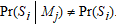
Nearly all the accounts of information developed in the recent, and not so recent, philosophical literature on this topic are variations on, and attempts to quantify, this inequality. For illustration, in Skyrms (Reference Skyrms2010, 36) the “information in [Mj] in favor of [Si]” is defined as the pointwise mutual information (PMI) between state and signal.Footnote 2 There is a direct relation between PMIs and the basic inequality: the former are nonzero if and only if the latter is true.
The running thread connecting most prominent contemporary accounts of information is that all there is to Shannon’s information theory, at least for the purposes of investigating the nature of representation, is two quantities: the unconditional probability of states and the probability of states conditional on signals, perhaps rearranged as the logarithm of their ratio, or in some other way. Unsurprisingly, from this it is routinely concluded that there is much more to representation than information. This conclusion is premature: informational content in the Dretskean tradition is not all there is to information theory by a long shot. This claim is different from the claim that information is all there is to representation, which I do not endorse—for one thing, I believe, with teleosemanticists (Millikan Reference Millikan1984; Neander Reference Neander2017), that teleofunctions have a role to play in a complete theory of representation—but, I will argue here, it does mean that no Dretske-style “semanticized information” needs to be recognized, over and above the quantities studied in information theory proper. I will argue that it also means that some prominent proposals offered as ways to bridge the information-representation gap are, in fact, unwittingly appealing to informational structure.
In the following section I review two such proposals. My aim is not to argue against them. They are built on largely correct insights. I will instead aim at showing that a better informed understanding of information provides a way of incorporating these insights in a unified, purely information-theoretic picture.
2. Bridging Information and Representation
2.1. Many-to-One-to-Many Architectures
The first proposal is that, for a certain vehicle to qualify as a representation, on top of carrying information it must sit in the right place in a certain cognitive architecture. Sterelny (Reference Sterelny2003), for example, has argued that the emergence of representations is enabled by two prior evolutionary transitions: from “detection” to “robust tracking,” on the one hand, and from “narrow-banded” to “broad-banded” behavioral responses, on the other. Robust tracking is in essence a many-to-one relation between world state and signal: many sensory inputs give rise to one and the same representation. Other theorists have advocated similar architectural constraints on representational vehicles. Famously, Burge (Reference Burge2010, 413) places a great deal of weight on perceptual constancies in his characterization of perceptual representation. This is a variation on Sterelny’s idea and, as such, a many-to-one architectural constraint on representational status.
As for broad-banded responses, in these systems a single representation will be flexibly dealt with, resulting in different courses of action, depending on the context where the representation is tokened. Response breadth is in essence a one-to-many relation between representational vehicle and output: one representation, many agential outputs.
2.2. Reference Magnetism
A second proposal has been to focus on the entities that should figure in the content of simple representations. The suggestion, typically, is that represented entities should be appropriately natural, or real. For example, Ryder (Reference Ryder2004, Reference Ryder, Macdonald and Papineau2006) has argued that neurons become attuned to sources of correlation. These entities are closely related to Richard Boyd’s homeostatic property clusters (HPC; Boyd Reference Boyd1989): HPC theory identifies natural kinds with clusters of properties that tend to be instantiated together. What Ryder calls sources of correlation are the grounds for these HPC-related frequent coinstantiations—whatever it is that makes them not mere statistical flukes. Ryder claims that many of the representations the brain trades in target sources of correlation. Martínez (Reference Martínez2013) and Artiga (Reference Artigaforthcoming) have made more general cases that simple representations preferably target HPCs (Martínez) or properties that best explain the co-occurrence of other properties (Artiga).
A similar idea has been explored in an entirely independent line of inquiry starting with Lewis (Reference Lewis1983, Reference Lewis1984): “Among the countless things and classes there are … only an elite minority are carved at the joints, so that their boundaries are established by objective sameness and difference in nature. Only these elite things and classes are eligible to serve as referents” (Reference Lewis1984, 227). This is what Sider (Reference Sider2013, 33) calls reference magnetism.
As I show in section 4, many-to-one-to-many cognitive architectures and reference magnetism, although apparently disparate ideas, are in fact closely related, and the explanatory payback they bring to representation-involving talk depends on their informational underpinnings.
3. Information Theory Is a Source-Channel Theory
Philosophy has understood information theory as a mostly definitional effort: for all philosophers have typically cared, the theory begins and ends with a presentation of what it takes for one random variable (or the worldly feature it models) to carry information about another. But information theory goes well beyond that. It is, well, a theory, and as such it is chiefly composed of claims that are advanced in the hope that they be true about the world.
In a nutshell, the most celebrated results in information theory have to do with specifying how faithful the transmission of information from a source can be, when it happens over a (noisy, narrow) channel. These results have typically played no role in informational accounts of representation.Footnote 3 Take, for starters, the idealized depiction of an information-processing pipeline in figure 1 (cf. Cover and Thomas Reference Cover and Thomas2006, fig. 7.1).
Information-processing pipeline.

Here an encoder produces a signal as a response to a message incoming from a source. This signal goes through a channel and is subsequently decoded, producing a message that is then utilized for whatever purposes downstream. The first thing to note is that the broadly Dretskean ideas about the content of a signal introduced in section 1 only have use for the first two links in this information-processing chain: how signals carry information about a certain original message produced by a source, as depicted in figure 2. In fact, in information theory the main action happens immediately after that: a source is producing stuff, and we want information about that stuff to go through a channel.
Information-processing pipeline in the Dretskean tradition.

Information theory is mainly about providing theoretical guarantees of faithfulness in transmission, given the rate of the channel. We can think of this rate as the number of bits it provides for the encoder to use in the signal. If, say, the rate is 2 bits per use of the channel, this means the encoder can use up to 2 bits to construct the signal and be sure that it can pass unscathed through the channel and on to the decoder. In typical cases of representation, channel rate is consistently smaller than ideal. Consider animal alarm calls. Vervet monkeys, for example, are typically described as being able to produce three different, discrete kinds of calls (Seyfarth, Cheney, and Marler Reference Seyfarth, Cheney and Marler1980a, Reference Seyfarth, Cheney and Marler1980b) that are usually taken to be associated with the presence of leopards, eagles, and snakes, respectively. Obviously, the entropy of the relevant aspects of the environment that prompt the production of a call (e.g., think of all the possible patterns of approach of these predators) vastly outstrips the rate of a channel, which consists in the production of just one out of three possible signals. This means that loss in communication is inevitable. Alarm calls, and for analogous reasons representations in general, are all about lossy transmission.
The way in which information theory deals with lossy transmission is by defining a distortion measure (Cover and Thomas Reference Cover and Thomas2006, 304) that gives a score to a pair composed of a certain original message M, and the decoded version thereof,  . In what follows, I will be using the Hamming distortion that simply adds one to the distortion when the bits in the original and decoded signals (which we can assume to be binary strings) do not coincide, and zero otherwise, then normalizes. So, for example, the Hamming distortion between an original message
 and a decoded message
 is
 , because the second and last (a total of 2) bits have been decoded incorrectly, and there are 6 bits in total.
The central result in this so-called rate-distortion theory approach to lossy transmission is that there is a rate-distortion function, R(D), which gives the minimum rate at which any given distortion is achievable. The actual mathematical expression of the rate-distortion function need not detain us here (see Cover and Thomas Reference Cover and Thomas2006, 307, theorem 10.2.1), but it is such that the Blahut-Arimoto algorithm (Arimoto Reference Arimoto1972; Blahut Reference Blahut1972) allows us to calculate it easily.
The main thesis of this article is that representations belong in information-processing pipelines whose rate-distortion function has sweet spots: by this I mean points in the rate-distortion curve such that the usefulness of increasing the rate of the channel past those points is much smaller than before reaching them. Moreover, the encoding-decoding strategies that make use of these representations tend to live in the vicinity of those sweet spots. I submit that it is these information-theoretic properties that the conditions on representation discussed in section 2 try to get at.
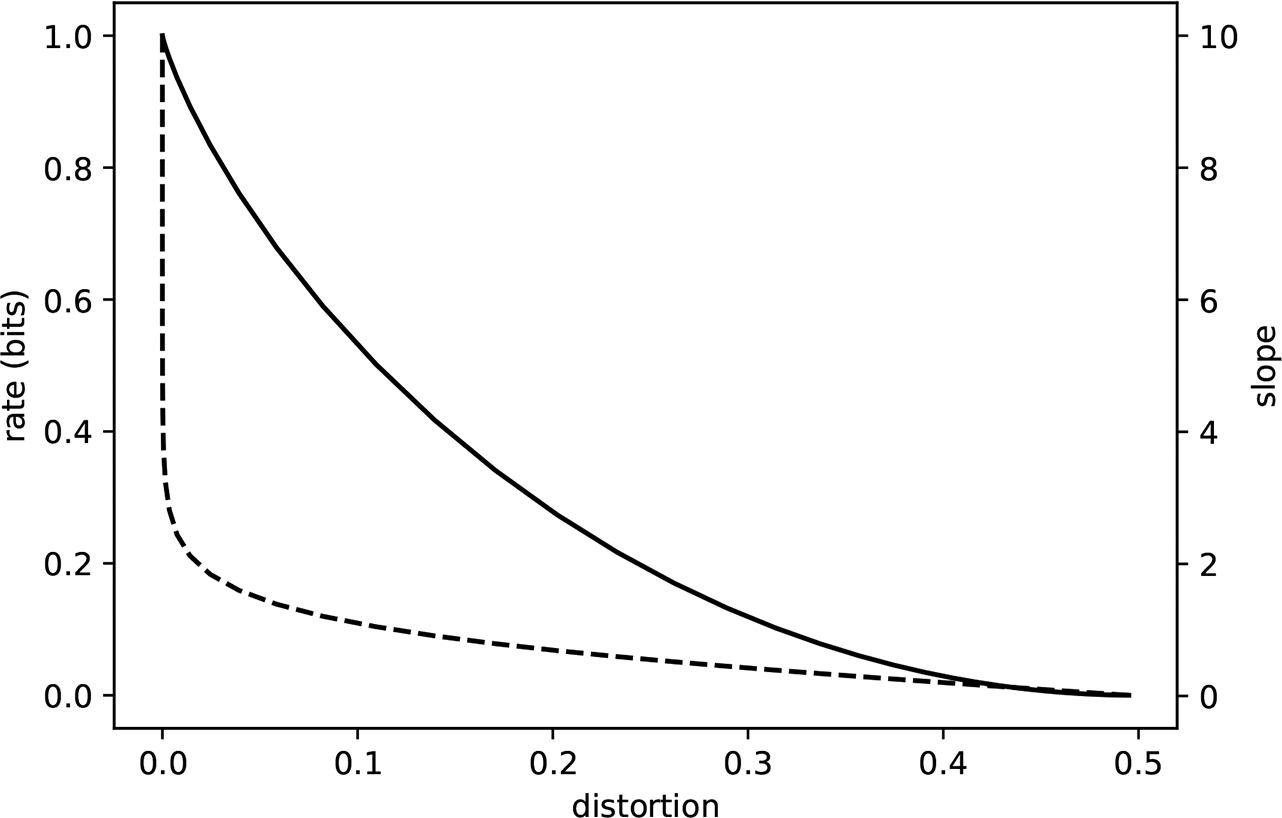
To see how rate-distortion analyses work, let us start by looking into a source that models a series of fair-coin tosses: this random variable would have two values, Heads and Tails, with associated probabilities ( ). Using the Hamming distortion as our target distortion measure, if the coin lands heads (tails) and the decoded message is tails (heads) the distortion is one, otherwise zero. The Blahut-Arimoto algorithm allows us to draw the rate-disortion curve, in figure 3.Footnote 4 Here the continuous line is the rate-distortion curve. It intersects the x-axis at 1.0 bits (the entropy of the source) and it intersects the y-axis at 0.5 (the lowest average distortion one can achieve when the channel is closed). The dashed line gives a measure of how steep the continuous line is at any given point—the absolute value of the slope of the continuous line. The higher the dashed line, the steeper the continuous line.
Rate-distortion function for a coin toss.

The situation this setup is modeling is one in which a single cue is present or not, and a signal tries to keep track of whether it is. This is precisely the kind of situation where many theorists (e.g., Sterelny and Burge; see sec. 2.1) would see the postulation of representations as entirely idle (see, e.g., Schulte’s [Reference Schulte2015] vasopressin example). In agreement with the idea that postulating representations here is idle, there is not much structure to the rate-distortion curve corresponding to this setup: reading the chart from right to left, increasing the rate makes the achievable expected distortion go smoothly down, until the rate hits the entropy of the source, at which point the achievable distortion is zero. That is about it.
Let us now model one kind of situation in which there is a reasonably wide consensus that representations make an explanatory contribution: vervet monkey alarm calls, as reviewed above. In the model, the source—the situation the information-processing pipeline is dealing with—randomly makes members of two natural kinds (we can think of them as two different predators) be present or not present at any given time, independent of each other. This intends to mimic the situation vervet monkeys face, where snakes, leopards, and eagles show up or not, more or less at random.
These natural kinds are modeled as homeostatic property clusters (see sec. 2.2 above). In order to derive an explicit probability distribution for the source out of this qualitative description, the two HPCs are in their turn represented by two Bayesian networks, each with a parent node and four children (see fig. 4). Each of the nodes stands for a property, such as having spots or moving in a slithery way; if the node is on it means the corresponding property is instantiated; if it is off it means it is not. In the model, children nodes replicate noisily the state of their parent. Thus, for example, if the parent is on (if the corresponding property is instantiated) each child property will have a .95 chance of being instantiated, too; if the parent is off the probability for each child being instantiated is .05. The unconditional probability of instantiation for the two parent nodes is .5.
Two natural kinds.

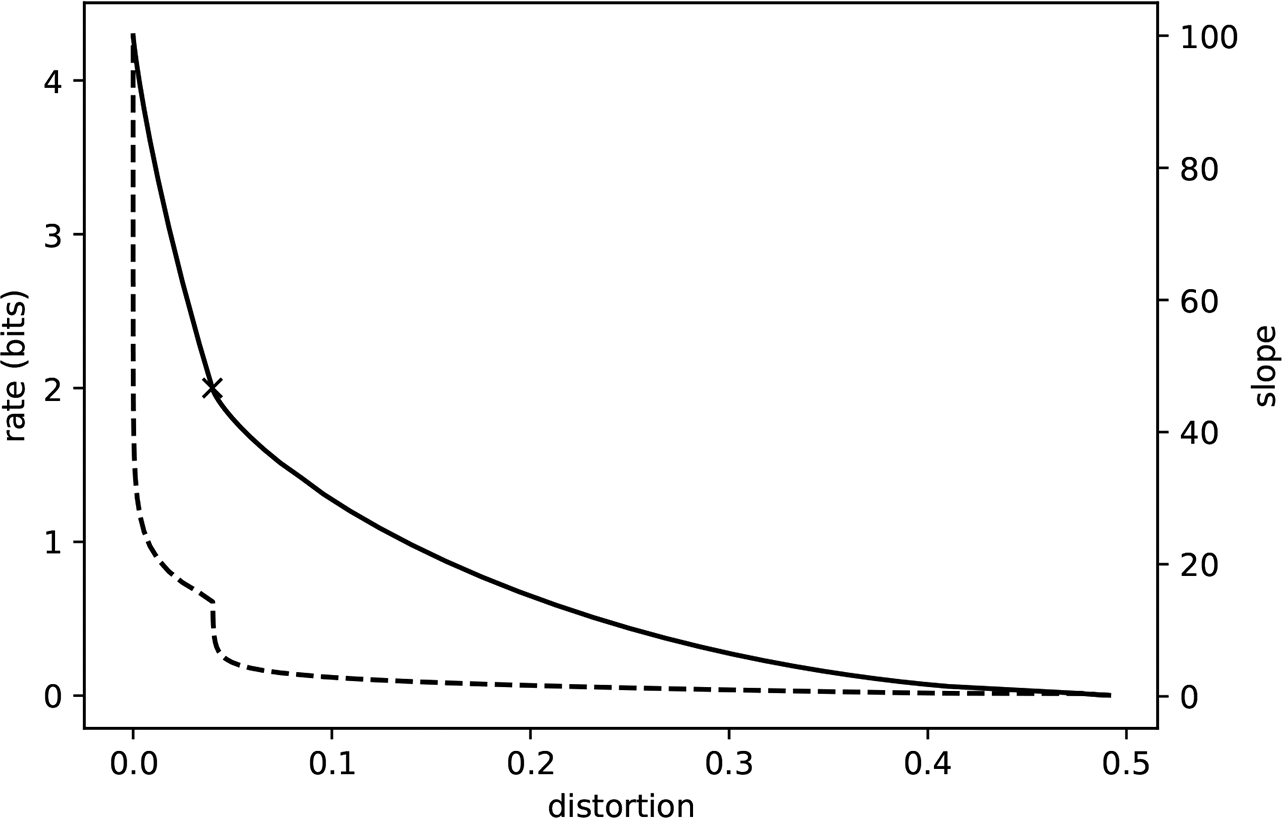
In the model, the source produces a 10-place binary string, with each character of the string being one if the corresponding node is on, and zero if it is off. This signal is encoded, goes through a channel, and is then decoded on the other side. The target distortion measure is the Hamming distortion. Figure 5 plots the rate-distortion curve for this model. It is very different from the curve in figure 3: here, there is a clear “sweet spot”—a sudden drop in the usefulness of extra rate (see the dashed curve)—when the system hits a rate of 2 bits/use. That is, there is, in a certain principled sense, an optimal level of lossy compression; a way to set up an encoding-decoding strategy that recovers most of what is going on in the world of relevance to the information-processing system, even through a very severe, 2-bit bottleneck. I claim that this is no coincidence. Our representation-attributing practices gravitate toward this kind of situation.
Sweet spot in the rate-distortion function.

To see how sweet spots in rate-distortion curves and representations are related, consider now what an optimal encoding-decoding strategy would look like. That is, how should the encoder encode the message coming from the source, and how should the decoder decode the signal coming from the encoder, so that the resulting expected distortion between original and decoded messages is the minimum achievable, at the sweet spot?
Optimal Encoding Strategy. First divide the incoming signal into two halves, one corresponding to properties P 1 through P 5; the other corresponding to properties P 6 through P 10.
If there is a majority of ones in the first half of the original message, set the first bit of the signal to one. Otherwise set it to zero. Ditto for the second half of the original message and the second bit of the signal.
Optimal Decoding Strategy. If the first bit in the incoming signal is one, set the first half of the decoded message to 11111. Otherwise, set it to 00000. Ditto for the second bit and the second half of the decoded message.
How should we interpret what encoder and decoder are doing here? A natural way is this: they are using the presence or absence of properties in an HPC cluster as diagnostic of the presence or absence of the underlying natural kind (this would be the encoding part) and then taking the resulting signals as representing the presence of a paradigmatic instance of the kind, one that has all the properties in the cluster (this would be the decoding part). With HPC kinds being what they are, frequently the first half of the incoming message will resemble the paradigmatic presence of the first kind (11111) or its paradigmatic absence (00000), and the same will happen with the second half and the second kind. That is why this encoding-decoding strategy works so well.
In describing this optimal strategy I have helped myself to representational vocabulary; it has been useful in order to explain how the strategy works and why behaving in this particular way achieves low distortion at low rates: it is because each of the two bits in the signal is caused by, and causes, behavior that is optimally attuned to the probabilistic structure of each of the two natural kinds in the model world, respectively. Nothing going on in this system falls outside the purview of Shannonian information theory—of information theory tout court, so at least in this kind of case representational talk depends on no noninformational fact.
We can now understand better what is lacking in the philosopher of mind’s information-theoretic toolkit: it is entirely possible, and computationally trivial, to calculate, for example, Skyrms’s PMI between each of the possible signals (00, 01, 10, and 11) and each of the possible world states (all 1,024 of them, from 0000000000 to 1111111111). Doing so would leave us with four vectors (one for each signal) with 1,024 entries each (one for each world state). First, this is an unwieldy collection of numbers, which does not bring out the relevant structure. For example, if the probability of children nodes being on conditional on their parent being on was .96 instead of .95, the rate-distortion curve would be qualitatively identical, with a sweet spot in exactly the same place, yet most numbers in the Skyrmsian informational content vectors would change. Second, and most important, nothing in those 4,096 numbers allows us to infer the presence of a sweet spot. The relevant information is simply not there, depending as it does on a distortion measure that is not used in computing Skyrmsian informational contents.
If the discussion so far is on the right track, the question about what makes representational talk explanatory can be readily answered: saying that a certain vehicle is a representation conveys something quite specific about its informational context. It says that the vehicle is part of an encoding-decoding strategy that exploits a sweet spot in a rate-distortion curve—where the curve is in turn fixed by the probabilistic structure of the world and the target distortion measure. This, in less technical terms, translates to saying that the vehicle is summarizing relevant (this is where the distortion measure comes in) aspects of the current situation in an optimal, if lossy, manner, made possible by how the world is (this is where the probabilistic structure of the world comes in). This explication of the explanatory contribution of representations can be turned into an explicit answer to what makes something a representation—an answer, that is, to what Artiga (Reference Artiga2016) calls the metasemantic question:
The Rate-Distortion Approach. A signal, M, in a certain information-processing pipeline, I, is a representation if the following two conditions are met:
Existence. There are sweet spots in the rate-distortion curve associated with I.
Optimality. M is produced as part of an encoder-decoder strategy that occupies the vicinity of one of these sweet spots.
So, pace Dretske, the core information-theoretic notions of entropy, rate, distortion, and so on can provide invaluable insight into the representational status of individual signals. If the rate-distortion approach is on the right track, those information-theoretic notions, through the existence condition, specify the kind of setup where representations live, which then the optimality condition can use to provide a criterion for the representational status of individual signals.
I offer the foregoing discussion as a preliminary case for the rate-distortion approach to representation: it shows how postulating representations is explanatory, even if these representations depend just on (Shannon) information. It illuminates the difference in representational status between cue-driven examples, such as Schulte’s vasopressin, and vervet alarm calls and other similar examples. To complete this preliminary case I now show how the ways to bridge the gap between natural and nonnatural information discussed in section 2 can be seen as implicit attempts to get at rate-distortion sweet spots.
4. There Is No Gap to Bridge
What does it take for the existence condition to be met? That is to say, what circumstances result in sudden drops in the slope of the rate-distortion curve? We have seen one such family of circumstances: if the pattern in which properties are instantiated in the source is noisily replicated in a cluster, then sudden drops are to be expected; distortion will decrease with rate up to the point where all the main sources of variation in property instantiations are accounted for, and all that remains is the residual noise in instantiations within each cluster. Take a look again at figures 4 and 5: to describe this source we basically need enough rate to account for the two main sources of variation, P 1 and P 6. This is not all there is to the world, because it is possible for the other properties to (fail to) token independently of their parent, but the unlikeliness of these departures makes the extra rate comparatively less useful.
Noisy replication of property instantiations is at the core of the HPC theory of natural kinds, as we saw above. This means that, in general, the presence of HPC natural kinds in a source will create sweet spots. This opens a line of argument in favor of reference magnetism from information-theoretic premises: reference magnetism should be seen as making a point about the kind of probabilistic structure that an information-processing pipeline must be attuned to, if signals are to effect the kind of optimal lossy compression that underlies our representation-attributing practices. Reference magnetism is just a way of meeting part of the existence condition.
Regarding the suggestion, by Sterelny, Burge, and others, that representations inhere preferably on signals sitting in a one-to-many-to-one pipeline, I submit that the many-to-one aspect of this suggestion aims at meeting the optimality condition; the one-to-many aspect, together with reference magnetism, aims at meeting the existence condition.
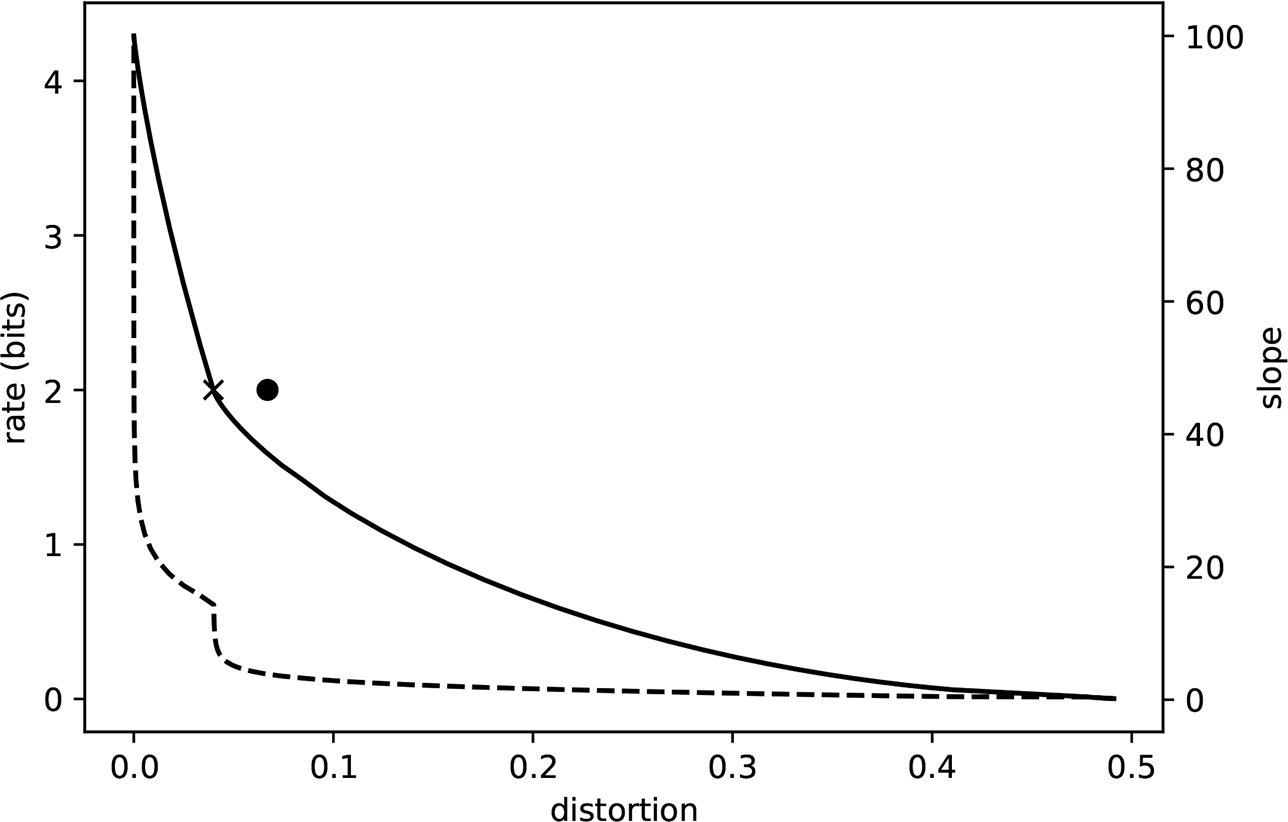
The first thing to note here is that the optimal encoding strategy presented above enforces what Sterelny calls robust tracking and Burge calls constancy: the strategy consists in considering all properties coming from each of the two clusters and setting the relevant bit to one only if a majority of those properties are instantiated. That is, the encoder is taking a multiplicity of configurations (the first half of the incoming signal being 00111, 01011, 10111, etc.) to a single output: the first bit of the signal being one. Furthermore, that part of the signal will be decoded as 11111; from there on, the system downstream will treat whatever is out there in the world as a paradigmatic member of the first kind. The system is recovering the presence of a natural kind out of many different, noisy instantiation patterns. This is a clear instance of constancy. Suppose that the encoder, instead of being many-to-one, depended on a single cue; say, suppose it set the first bit to one if one of the children properties (say, P 2) was instantiated, and to zero otherwise. In such a cue-driven setup, the best encoder-decoder arrangement possible is marked by the circle in figure 6. This has almost double the distortion than the optimal encoding (marked by the cross) that sits right on top of the optimal rate-distortion curve. This cue-driven system would not meet the optimality condition, which means that a many-to-one architecture is instrumental to meeting it.
Cue-driven encoding.

Finally, the target distortion measure in the information-processing pipeline can be seen as that which Sterelny’s one-to-many condition on representation is actually tracking. Using, for example, the Hamming distance as a distortion measure is tantamount to assuming that all of the properties of the natural kinds are relevant for downstream processing. One natural way in which this may happen is when the agent is to respond flexibly to the presence of the natural kind: in different contexts or states different properties of the kind might be relevant and, for example, the presence of a tree might be sometimes relevant to behavior because it bears fruit (if the agent is hungry) and some other times because it has a dense cover (if the agent is looking for shelter).
Caring about all (or many) properties of the kind is what makes the rate-distortion curve display a sweet spot. If, instead, the agent has a rigid, stereotyped response to the presence of members of the kinds—that is, if it only cares about the presence of one property, which is the property that makes that rigid behavioral response fitness-conducive, then the curve is again as presented in figure 3. Rigid behavioral responses make the probabilistic structure of the kinds largely irrelevant. As a result, the system behaves as if a coin were tossed, where heads would mean that the target property is tokened, and tails that it is not. This arrangement does not meet the existence condition. Sterelny’s broad-banded responses are, again, a way of getting at rate-distortion sweet spots.