




No CrossRef data available.
THE UNEVEN RESULTS OF INSTITUTIONAL CHANGES IN CENTRAL AND EASTERN EUROPE: THE ROLE OF CULTURE
Published online by Cambridge University Press: 07 January 2006
Abstract
The main objective of this essay is to show that the process of transition from socialism to capitalism in Central and Eastern Europe is a cultural problem rather than a technical one. In pursuing that objective I analyze two interrelated issues. First, analysis shows why and how cultural differences in Central and Eastern Europe have, via transaction costs specific to the process of transition, specific and predictable effects on the results of institutional restructuring, and, consequently, on economic performance. Second, I argue that spontaneous changes in the prevailing culture could, under a set of credible and stable formal rules of the game, help to close a gap between the culture supportive of capitalism and the prevailing culture in Central and Eastern Europe.My colleague and friend Fred Fransen made two major contributions to this essay: he helped me identify numerous inconsistencies in the essay, and he changed a number of my perceptions on the relationship between culture and economic performance. James Buchanan, Ljubo Madzar, Henry Manne, Milic Milovanovic, and Katarina Ott gave me useful suggestions and comments on earlier drafts. I am grateful to Victor Vanberg and Ulrich Witt for the opportunity to discuss this essay with their colleagues and students at the University of Freiburg and Max Planck Institute in Jena, Germany.
Information
- Type
- Research Article
- Information
- Copyright
- © 2006 Social Philosophy and Policy Foundation
I. Introduction
Social activity involves human interactions on two levels. The first level concerns the development, modification, and specifications of institutions. Institutions define the basic framework within which people interact with one another; we can refer to them as the rules of the game. The second level of social activity concerns human interactions within the prevailing institutional arrangements; we can refer to this level of activity as the game itself. The two levels of social activity are interrelated. By constraining the scope and contents of human interactions, the rules help interacting individuals to predict each other's behavior, or, to put it another way, the rules lower the transaction costs of playing the game. Of course, lower transaction costs mean a higher level of economic activity. By implication, a change in the rules changes both the way the game is played and the level of economic activity.
The institutional framework consists of formal and informal rules, all of which create their own behavioral incentives. Formal rules are constitutions, statutes, common law, and other governmental regulations. They are enacted, enforced, and changed by governmental authorities. Informal rules include traditions, customs, religious beliefs, and all other norms of behavior that have passed the test of time and that bind the generations. The enforcement of informal rules takes place by means of sanctions such as ostracism by friends and neighbors, loss of reputation, or alienation (expulsion) from the community.
After the collapse of their Communist governments in 1989, Central and Eastern European countries (hereafter C&EE) started the process of institutional restructuring. The intention of the new leaders was to transform C&EE countries into free-market, private-property economies.1
The end of socialism in Central and Eastern Europe in the late 1980s opened the region to an influx of new ideas and opportunities. Indeed, everybody wanted a piece of the action. Overnight, former dissidents became political leaders and social innovators. The old ruling elite quickly forgot “the laws of history” and has been trying to find ways to retain power and influence. Western politicians saw an opportunity to extend the political and economic influence of their countries. Western businesses eyed new markets. Western scholars realized that social changes in C&EE were likely to create enormous opportunities for research grants, promotions, and publications in academic journals. In an about-face, many academics from the West who used to preach socialism, economic planning, and all sorts of industrial democracy schemes joined their free-market colleagues in supporting the process of transition to capitalism. In order to “strengthen” their grant proposals and submissions to academic journals, Western scholars needed cooperation from their colleagues in C&EE, and they had no problem getting that support. In exchange for funding, travel, and possible visiting appointments in the West, many scholars from C&EE were eager to join their Western colleagues on projects they privately considered irrelevant.
The twentieth century experienced two major applications of socialism: National Socialism, and Marxism-Leninism or communism. Those two brands of socialism were equally unrelenting in their oppression of inferior races and the bourgeoisie, respectively. It is perfectly legitimate to refer to C&EE countries as either former socialist or former communist countries.
Numerous academic studies have shown that the relationship between capitalism and economic prosperity arises from the fact that the institutions of capitalism create economic freedoms and protect individual rights.3
See, for example, Jacob de Haan and Jan Sturm, “On the Relationship between Economic Freedom and Economic Growth,” European Journal of Political Economy 16 (2000): 215–41; Johan Torstensson, “Property Rights and Economic Growth,” Kyklos 47, (1994): 231–47; Douglass North, and Barry Weingast, “Constitution and Commitment: The Evolution of Institutions Governing Public Choice in Seventeenth-Century England,” Journal of Economic History 49 (1989): 803–32; and Svetozar Pejovich, ed., The Economics of Property Rights (Cheltenham: Edward Elgar, 2001), vol. 2, part IV.
James Gwartney, “What Have We Learned from the Measurement of Economic Freedom?” paper presented at a conference titled “The Legacy of Milton and Rose Friedman's Free to Choose: Economic Liberalism at the Turn of Twenty-First Century,” Federal Reserve Bank of Dallas, 2003, p. 3.
Ana Isabel Eiras, Ethics, Corruption, and Economic Freedom, The Heritage Foundation Lecture no. 813 (Washington, DC: The Heritage Foundation, 2003), 1.
It is predictable, then, that to measure economic freedom, both indexes use the factors that also define capitalism. The Fraser Index uses the following categories: size of government, economic structure and use of markets, monetary policy and inflation, freedom to use alternative currencies, credibility and stability of property rights, free trade, and freedom of exchange in capital markets. The Heritage Index covers the following categories: trade policy, fiscal burden of government, government intervention in the economy, monetary policy, capital flows and foreign investments, banking and finance, wages and prices, property rights, regulation, and the extent of the black market. A differentiating feature of the Heritage Index is the classification of each country as either free, mostly free, mostly unfree, or repressed. I will use the same classifications in my analysis.
Neoclassical economics provided the general framework for the debate in the early 1990s over how best to conduct the transition to capitalism. According to the tenets of neoclassical economics, the transition to capitalism required macro-stabilization (i.e., stable rates of interest, low inflation, low unemployment, etc.), privatization, and market prices. Given the neoclassical assumption of zero transaction costs, Central and Eastern Europeans were expected to quickly perceive new opportunities, evaluate their consequences, and make the utility-maximizing choices. Privatized assets, regardless of their initial ownership, would quickly end up in the hands of the highest-valued users. In this scenario, it seemed appropriate to encourage new leaders in C&EE to use the strong hand of the state to build capitalism. The road to capitalism was seen as merely a technical problem.
Many property-rights and public-choice scholars regarded neoclassical economics as ill suited for carrying out the process of transition in C&EE. Major reasons for their doubts were the failure of neoclassical economics to appreciate that structural change from above must be consistent with people's mental models and its failure to acknowledge the importance of transaction costs.6
Of course, neoclassical economics was mainstream economics in the 1990s (and still is); it is supported by the majority of economists as well as major organizations such as the World Bank. Perhaps the most prominent figure was Jeffrey Sachs.
Ronald Coase, The Firm, the Market, and the Law (Chicago: University of Chicago Press, 1988), 175 and 179.
Indeed, economic policies based on neoclassical economics have produced a host of unintended political and social consequences, culminating in the rising strength of pro-socialist parties in the region.8
Svetozar Pejovich, “After Socialism: Where Hope for Individual Liberty Lies,” Journal des Economistes et des Etudes Humaines 11 (2001): 23–27.
The Federation of Serbia and Montenegro was ranked as repressive in the 2003 Heritage Index of Economic Freedom and was dropped from the index in 2004 for lack of information.
The main purpose of this essay is to show that culture plays an important role in the process of institutional restructuring. To accomplish this objective, I seek to demonstrate, in Section II, that cultural differences in C&EE create transaction costs specific to the process of transition, and that those transaction costs, in turn, explain the uneven results of institutional restructuring from the early 1990s until 2004. In Section III, I address an important issue: Are changes in informal rules or culture possible, and if so, could those changes in entrenched cultural values reenergize the process of institutional restructuring in C&EE, and at what cost?
The following pairs of terms are used interchangeably throughout the essay: “informal rules” and “culture”; “rules” and “norms of behavior”; “capitalism” and “the free-market, private-property economy”; and “formal institutions” and “law.”
II. The Costs of Transition: It's the Culture, Stupid!
A. Culture and economic performance
As early as 1976, James Buchanan wrote that mathematical techniques and econometrics were taking the discipline of economics in the wrong direction. “The principle that exposure to economics should convey,” he wrote, “is that of spontaneous coordination, which the market achieves. The central principle of economics is not the maximization of objective functions subject to constraints. Once we become methodologically trapped in the maximization paradigm, economics becomes applied mathematics or engineering.”10
James Buchanan, “General Implications of Subjectivism in Economics,” paper presented at a conference titled “Subjectivism in Economics,” University of Dallas, 1976, p. 2.
Twenty-five years later, Enrico Colombatto argued that the process of institutional restructuring in C&EE is a cultural problem rather than merely a technical one.11
Enrico Colombatto, “The Concept of Transition,” Journal of Markets and Morality 4 (2001): 269–88.
There is no generally accepted definition of culture.12
For different definitions of culture, see Vernon Ruttan, “Cultural Endowments and Economic Development: What Can We Learn from Anthropology?” Economic Development and Cultural Change 36 (1988): 247–71.
Douglass North, Institutions, Institutional Change, and Economic Performance (Cambridge: Cambridge University Press, 1990), 37. Ernest Gellner defined culture as “a distinct way of doing things which characterizes a given community.” See Gellner, Plough, Book, and Sword (London: Collins Harvill, 1988), 14.
Thus, the process of institutional restructuring is about the enactment of new formal rules. A new formal rule creates new choices for human interactions or modifies old ones. In either case, it changes the opportunity set within which the game is played. The effect of this new rule on economic performance must then depend on how individuals perceive and subjectively evaluate new trade-offs. And how individuals perceive new opportunities depends on the prevailing culture in the community. The prevailing culture thus plays a major role in determining the costs of integrating the new rule into the prevailing institutional structure. The relationship between new formal rules and the prevailing informal rules can be summarized in terms of what I will call the interaction thesis:
When members of the community perceive the consequences of new formal rules to be in conflict with their prevailing culture, the transaction costs of integrating those rules into the institutional framework will be high, will consume more resources, and will reduce the production of wealth. And when members of the community perceive the consequences of new formal rules to be in harmony with their prevailing culture, the transaction costs of integrating those rules into the institutional framework will be low, will consume fewer resources, and will increase the production of wealth.
Of course, rules do not interact, people do. However, rules create incentives, which in conjunction with individuals' subjective perceptions of reality produce economic results.
B. Culture and transition in Central and Eastern Europe
Once we recognize that culture matters, the analysis of its effects on the transition to capitalism has to address two issues: (1) What are the most important formal institutions of capitalism, and what incentives do they generate? And (2) what kind of culture supports those incentives?
1. Basic formal institutions of capitalism.
The institutions of capitalism are many. However, following the works of Bruno Leoni, Friedrich von Hayek, James Buchanan, and many other scholars, I take it that the basic formal institutions setting capitalism apart from other systems are private property rights, the law of contract, an independent judiciary, and a constitution that de facto protects individual rights.14
I refer to a constitution that is credible (i.e., protects individual rights de facto) and stable (i.e., difficult to change). Many constitutions (e.g., Soviet constitutions) are not worth the paper on which they are written.
Two major requirements for an independent judiciary are that judges expect their decisions to be carried out and that their jobs do not depend on legislators and/or bureaucrats. An independent judiciary should not be confused with a good judiciary. It all depends on the people who become judges.
Robert Barro, “Rule of Law, Democracy, and Economic Performance,” in 2000 Index of Economic Freedom (Washington, DC: The Heritage Foundation and the Wall Street Journal, 2000), 47. In the West, the rule of law and democracy go together. However, Fareed Zakaria argues that a number of countries that have multiparty elections are, in effect, illiberal democracies; they do better on political liberties than on civil and economic ones. See Fareed Zakaria, “The Rise of Illiberal Democracy,” Foreign Affairs 76 (1997): 22–43.
Private property rights provide strong incentives for those who own resources to seek the highest-value uses for their assets. The law of contract reduces the transaction costs of identifying the value of resources in alternative uses; hence, it promotes trade. Buchanan alludes to the fact that private property rights and the law of contact create incentives for interacting individuals to equalize private and social costs of using scarce goods: “Economic performance can only be conceived in values, but how are those values determined? By prices, and prices emerge only in competitive markets. They have no meaning in a non-market context, where the choice-influenced opportunity costs are ignored.”17
Buchanan, “General Implications of Subjectivism in Economics,” 8.
2. A culture supportive of capitalism.
The incentive effects of the basic institutions of capitalism require a culture that encourages individuals to pursue their private ends—that is, the culture of individualism. Cambridge University anthropologist Alan Macfarlane has traced the origin of the culture of individualism to thirteenth-century England. He defines it as “the view that society is constituted of autonomous, equal units, namely separate individuals, and that such individuals are more important, ultimately, than any larger constituent group. It is reflected in the concept of individual property, in the political and legal liberty of the individual, in the idea of the individual's direct communication with God.”18
Alan Macfarlane, The Origins of English Individualism (London: Blackwell, 1979), 196.
By holding that the individual is superior to any group, the culture of individualism encourages behavior based on the principles of self-interest, self-responsibility, and self-determination. These principles of behavior, in turn, encourage the community to reward competitive performance, to promote risk-taking, and to view income inequalities as desirable results of entrepreneurship and free trade. We can say that the culture of individualism sees the community as a voluntary association of individuals who, in the pursuit of their private ends, join and leave the community by free choice.
The free-market, private-property economy and the culture of individualism are Western phenomena. They developed spontaneously in response to events in the West over a period of several centuries. In the sixth century, Pope Gregory I initiated the process that eventually replaced the extended family with the nuclear family. He did it by overturning four traditional and legal practices: marriage to close kin, marriage to the widows of close kin, the transfer of children by adoption, and concubinage.19
See Deepak Lal, Unintended Consequences (Cambridge, MA: MIT Press, 1998), 83.
C. The prevailing culture in Central and Eastern Europe and the costs of transition
The prevailing culture in Central and Eastern Europe has a bias toward collectivism, egalitarianism, and shared values that predates communism. The community in C&EE tends to be seen as an organic whole in which individuals are expected to subordinate their private ends to the pursuit of common values (however defined). Predictably, the extended family has always played an important role in most C&EE countries.20
I thank James Buchanan for his comments on the extended family.
The behavioral consequences of the nuclear family and the extended family illustrate major differences between the culture of individualism in the West and the culture of collectivism in C&EE. By encouraging the concept of a polity consisting of natural equals, the nuclear family in the West creates incentives for bonding among individuals across family lines. By emphasizing egalitarianism and collectivism, the extended family in C&EE raises the transaction costs of interactions between individuals belonging to different groups.
Professor Avner Greif of Stanford University provides an excellent comparison of the collectivist culture of the Maghribi community (a community of Arab traders) and the individualistic culture in Genoa from the eleventh to the thirteenth centuries.21
In a letter to the author of this essay, Professor Avner Greif wrote: “‘Maghrib’ means ‘West’ in Arabic. During the medieval period and long after, the term was used to refer to the Muslim World's west: North Africa, Spain, and Sicily. The Maghribi traders migrated from Iraq in the tenth century to the Maghrib and hence they were called ‘the Maghribi traders.’ The documents that I have used reflect the correspondence of the Maghribi community in Fustat (known today as Old Cairo).”
Avner Greif, “Cultural Beliefs and the Organization of Society: A Historical and Theoretical Reflection on Collectivist and Individualist Societies,” Journal of Political Economy 102 (1994): 942.
While egalitarianism and collectivism are important common traits in C&EE, the prevailing culture in the region is not homogeneous. The culture of collectivism and egalitarianism gets stronger the farther east and southeast one travels. For example, this is how a Bulgarian scholar, Antonina Zhelyazkova, describes the structure of contemporary families in Albania: “Family community [is] composed of three or four generations, with a high level of internal solidarity. Within the [family] there is a strict, clear-cut age hierarchy, where the father's … word is law…. [T]his is due to the age-old internal ethno-cultural mechanism, which … contributes to the preservation of their tradition.”23
Antonina Zhelyazkova, Albanian Prospects (Sofia: International Center for Minority Studies, 2003), 140–41. Young Albanians who go abroad work hard and save their money. Most of them continue to live in their own cultural ghettos. Those who return to their homeland bring along the money they have saved but not necessarily Western values.
We can attribute the heterogeneity of informal rules in C&EE to the influence of three empires (Austro-Hungarian, Russian, and Ottoman), three religions (Roman Catholic, Orthodox, and Islam), and to the internal strength of ethnicity and/or nationalism. I turn now to a few examples that capture the essence of those influences.
The following quote from historian Perry Anderson suggests why the transaction costs of accepting the right of ownership have been relatively lower in C&EE countries that belonged to the Austro-Hungarian empire or had strong relations with the West: “The age in which ‘absolutist’ public authority was imposed was also simultaneously the age in which ‘absolute’ private property was progressively consolidated. It was this momentous social difference which separated the Bourbon, Habsburg, Tudor or Vasa monarchies from any Sultanate, or [the Russian Empire].”24
Perry Anderson, Lineages of the Absolutist State (London: Verso, 1974), 429.
Writing about informal rules in Russia and their implications, Silke Stahl, at the time a researcher at Max Planck Institute in Jena, argued that such rules are not supportive of the principles of behavior based on self-interest, self-responsibility, and self-determination. Especially important are Stahl's references to the sources of egalitarianism and collectivism in Russia: “In Russia [informal] institutions found their expression in egalitarianism and collectivism. Egalitarianism is the psychological disposition of a group of people who consider material equality as the essential base of social interaction. Collectivism … refers to a societal organizational pattern, which centers on the group and not the individual as the basic unit in society…. The reasons for egalitarianism and collectivism [in Russia] can be found in religious beliefs.”25
Silke Stahl, “Transition Problems in the Russian Agriculture Sector: A Historical-Institutional Perspective,” in Pejovich, ed., The Economics of Property Rights, 157.
The idea of the immorality of charging interest on loans and the absence of the concept of legal personality—still prevalent in many Islamic countries—have influenced the development of both formal and informal rules in the areas of C&EE that used to be controlled by the Ottoman empire.26
Timur Kuran, “Why the Middle East Is Economically Underdeveloped: Historical Mechanism of Institutional Stagnation,” unpublished manuscript.
The law of limited liability was known in Europe as early as the eleventh century. See Lal, Unintended Consequences, 81–82.
Historically, communities in C&EE have responded to outside influences by creating strong informal rules developed along ethnic lines and/or around national myths (for example, the Kosovo myth in Serbia and the thousand-year dream of national independence in Croatia). As repositories of old unsettled scores, as well as of various national myths, informal rules strengthen mutual understanding within each ethnic group while simultaneously (and predictably) treating other groups as alien. The result is relatively higher transaction costs for social contacts across ethnic lines. In addition, religious differences among C&EE countries reinforce the alienation of one ethnic group from another. The Serbs in Croatia, the Albanians in Macedonia, the Turks in Bulgaria, the Hungarians in Slovakia (like the Basques in Spain and the Arabs in France) are just a few examples of alienated ethnic groups.
Analysis suggests that in the early 1990s, the prevailing culture in C&EE was not in tune with the behavioral incentives required for the successful functioning of the basic formal institutions of capitalism. This means that the conflict between the behavioral incentives of the institutions of capitalism and the prevailing culture in C&EE creates transaction costs specific to the process of transition. Transaction costs specific to transition can be categorized as subjective or objective. Giving up the predictability of other people's behavior, accepting the risks of nonroutine behaviors, and estrangement from friends and neighbors who are slower in abandoning old rules are examples of subjective costs arising from the conflict between the formal institutions of capitalism and the prevailing informal rules. Objective costs include sunk investments in the development of the prevailing informal rules, and the strength of the groups and coalitions that stand to gain from preserving the status quo (such as officials of the former Communist governments in C&EE).
A common response by most countries in C&EE to the conflict between their prevailing cultures and the institutions of capitalism was to enact “clarifying” laws and regulations. These included the reintroduction of price controls over some goods, restrictions on the flow of capital, and rules concerning laying off workers. The stated intent of these laws and regulations was to reduce the conflict arising between new formal institutions and the prevailing culture; however, the consequences of these laws, whether those consequences were intended or unintended, have been a slow return to the old system of dirigisme from above. Eventually, people ended up with a government-engineered compromise between capitalism and the old system, with the costs of transition being borne by all citizens regardless of whether they wanted institutional reforms, opposed them, or didn't care one way or the other. The legal theorist Cass Sunstein has noted the costs of these laws and regulations in C&EE. “Without strong constitutional provisions on behalf of property rights, civil society, and markets, there will probably be a substantial temptation to intrude on all these institutions, and, by so doing, recreate the very problems that such institutions are supposed to solve.”28
Cass Sunstein, “On Property and Constitutionalism,” Cardozo Law Review 14 (1993): 935.
D. Culture and the results of transition
Given that the prevailing culture in C&EE is not homogeneous, the transaction costs of transition differ from one country to another, and these differences in transaction costs translate into different transition results. Since the culture of individualism is a Western phenomenon, this analysis suggests that the results of institutional restructuring should correlate with the extent of Western influence in the various countries of C&EE. To test this hypothesis, we can divide C&EE countries into two groups: those that have had more cultural and political interactions with the West, and those that have had less or none.
The Czech Republic, Croatia, Hungary, Slovakia, and Slovenia used to be part of the Austro-Hungarian empire. The empire, which lasted several centuries and came to an end in 1918, was short on democracy but strong on the rule of law and the enforcement of property rights. It is reasonable to expect that the prevailing informal rules in those countries have retained memories of the rule of law and individual rights. Western culture entered Poland via the Catholic Church. In addition to playing a major role in the development of informal rules in that country, the Church also helped the Poles to preserve their customs and traditions during several periods of Russian aggression (including the post–World War II years). For centuries, the Baltic states maintained strong contacts with merchants from Germany, Sweden, and Finland. Christianity arrived in the Baltic states from the West. Estonia and Latvia have become predominantly Lutheran, while Lithuania is Roman Catholic. Through religious contacts and trade, Western culture contributed to customs and traditions in the Baltic states.
In the process of transition, the Baltic states, and especially Estonia and Latvia (which have Russian minorities amounting to about 30 percent of total population), had an important starting advantage over other C&EE countries. Since de-Communization did not happen in C&EE, Communists and fellow travelers, with their well-established “old boy” network, joined the new ruling elite and provided strong support to the forces that preferred to maintain collectivist values. However, most important political positions in the Baltic states under Communist rule were held or controlled by Russians. In the early 1990s, leading Russian Communists either fled back to Russia or lost jobs and influence because of their ethnic origin. Hence, the culture of collectivism in the Baltic states lost a major source of support.29
I thank Professor Andreas Freytag from Friedrich-Schiller University in Jena, Germany, for this point.
After a brief rule (1682–1725) by Peter the Great, who appreciated the importance of Western culture, the Romanovs chose to isolate the middle and lower classes in Russia from the West. The Russian Orthodox Church played a major role in helping the ruling elite to preserve this cultural isolation of Russia (and the countries dominated by Russia, such as Belarus, Moldavia, and Ukraine) from the West. To say that Eastern Orthodox churches, including the Russian church, have historically shunned the culture of individualism is merely a factual observation, which does not imply a judgment about the worthiness of their religious beliefs and dogmas. As recently as the late 1990s, the Russian church lobbied the state to prohibit or at least restrict the spread of Western influence via Protestant and Catholic churches.
The Ottoman empire influenced the development of informal rules in the parts of the Balkans it controlled during most of the period from the fourteenth through the nineteenth centuries (Greece, Serbia, Bulgaria, Romania, Albania, Bosnia, and Montenegro). However, two factors limited Turkish influence on local cultures. First, the Turks did not interfere in civil disputes between Christians, which helped to preserve local customs. Second, Christians were obliged to wear distinctive clothing, which, while marking them as second-class citizens, reinforced their ethnic loyalties.
Contrary to many local myths, the Ottomans did not repress Christian religious services. In fact, until the second half of eighteenth century, Ottoman rule was quite tolerant. Professor Andre Gerolymatos, director of Hellenic Studies at Simon Fraser University, offers this description of Ottoman rule in the Balkans: “The Ottoman era in Southeastern Europe was marked by periods of not only great upheaval and hardship, but also benevolent administration and prosperity that enhanced the living standards of all Ottoman subjects…. [The fact that] the Ottomans did not embark on wholesale forcible conversions enabled the Balkan people to maintain their identities into the nineteenth century.”30
Andre Gerolymatos, The Balkan Wars (New York: Basic Books, 2002), 73–77.
While maritime trading helped the Greeks (and the small percentage of Montenegrins living along the Adriatic coast) to become aware of other cultures, Serbia, Macedonia, Romania, Bulgaria, Bosnia, and Montenegro had no permanent access to Western culture until the early nineteenth century. The Renaissance and the Reformation, new scientific discoveries, classical liberalism, and Adam Smith all had their effects long before those countries opened their borders to the West. Interactions with Serbs living in the Austro-Hungarian empire helped the people of Serbia, for example, to open their first important window to the West only in the late eighteenth century.
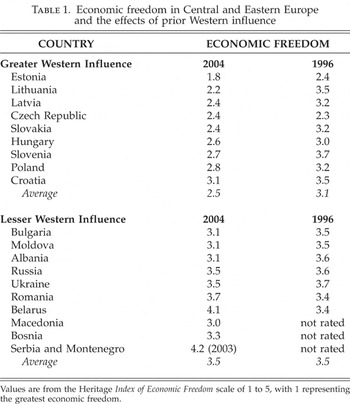
Table 1 divides C&EE countries into those that experienced greater and lesser influence from the West. The table then provides data from the Heritage Index of Economic Freedom in order to measure the results of institutional restructuring. Since institutional restructuring is a process rather than an event, the table shows the results of transition in two different years, 1996 and 2004.31
See 1996 and 2004 Index of Economic Freedom published jointly by the Heritage Foundation and the Wall Street Journal.
Economic freedom in Central and Eastern Europe and the effects of prior Western influence

Table 1 provides striking evidence in support of the interaction thesis, which states that the conflict between the incentive effects of the formal rules of capitalism and the prevailing culture of a given country creates transaction costs specific to the process of transition in that country. In 1996, the Heritage Index ranked only Estonia and Czech Republic as mostly free countries. All other countries were ranked as mostly unfree. The mean rating of the countries influenced by the West was 3.1, already close to the mostly free ranking. The mean rating of the countries not influenced by the West was 3.5.
In 2004, the Heritage Index ranked all countries influenced by the West, except Croatia, as free or mostly free, and all those not influenced by Western culture as mostly unfree or repressed.32
It is important to repeat that the ranking of countries in the Heritage Index is in terms of economic freedoms only.
The evidence in support of the interaction thesis has an important implication. By assuming that the road to capitalism is a technical problem, economic reforms based on neoclassical economics ignored the fact that capitalism is much more than an alternative method for the allocation of resources. It is a way of life. The effort to impose the transition to capitalism via the strong hand of the state had the effect of forcing upon ordinary people institutional changes that were alien to the fabric of community life in C&EE. This became more true the farther east and southeast one traveled. All that ordinary people got was the switch of one set of institutions for another set, neither of which they chose for themselves.
This failure of neoclassical economics to recognize the importance of cultural values has been observed by the economist Douglass North: “Many Latin American countries adopted the U.S. Constitution (with some modifications) in the nineteenth century, and many of the property rights laws of successful Western countries have been adopted by Third World countries. The results, however, are not similar to those in either the United States or other successful Western countries. Although the rules are the same, the enforcement mechanism, the way enforcement occurs, the norms of behavior, and the subjective models of the actors are not [the same].”33
North, Institutions, Institutional Change, and Economic Performance, 101.
III. Capitalism by Choice: The Road to Liberty
A. Framework for analysis
An alternative method of transition is to identify and enact formal rules that would encourage voluntary changes of informal institutions in Central and Eastern Europe. The three critical factors that would encourage the process of spontaneous changes in informal rules and reenergize the process of transition from within the system are the market for institutions, the carriers of institutional restructuring, and the margin of acceptable behavior. I will discuss each of these in turn.
1. The market for institutions.
A well-functioning market has two major functions: to create incentives for institutional innovation and to reduce the costs of adaptive behavior. The former provides individuals with freedom to seek changes in the rules of the game. The latter gives the community as a whole freedom to accept or reject those changes voluntarily. Not infrequently, new informal rules eventually become formal rules. Gary Libecap, professor of economics at the University of Arizona, has demonstrated the development of informal property-rights arrangements in the American West and their eventual enactment into formal rules. As “the mining industry boomed, spurred by huge ore discoveries,” he writes, “… pressure on existing legal institutions forced new ownership structures to emerge. This resulted in the observed progression in mineral rights law from general, unwritten rules in the 1850s to highly specified statutes and court verdicts by the end of the century.”34
Gary Libecap, “Economic Variables and the Development of the Law: The Case of Western Mineral Rights,” in L. Alston, T. Eggertsson, and D. North, eds., Empirical Studies in Institutional Change (Cambridge: Cambridge University Press, 1996), 57 (emphasis added).
To develop the market for institutions, C&EE countries would have to enact, admittedly from above, the basic institutions of capitalism, namely: private property rights (the enactment of private property rights is not to be confused with the abolition of other types of existing property rights; the important requirement is that the legal system treat all types of property rights equally), the law of contract, the constitution, and an independent judiciary. As I have noted (in Section IIB), these rules create incentives for individuals to accept the risk and uncertainty associated with innovation, and they lower the transaction costs of the integration (or rejection) of a novelty into the prevailing institutional framework.
The basic institutions of capitalism enforce individuals' claims of noninterference against the rest of the world, provide protection against all levels of government, and make these claims enforceable in the courts. Hence, the basic institutions of capitalism in effect protect negative rights.35
In contrast, positive rights, such as a right to free public education, call for interference by the state.
Referring to the importance of negative rights for the process of institutional restructuring in C&EE, Cass Sunstein has written: “The case for a firm negative constitution, and for creation and protection of [stable and credible] property rights and free markets, is very strong in Eastern Europe.”36
Sunstein, “On Property and Constitutionalism,” 918 and 935.
Bernhard Heitger, “Property Rights and the Wealth of Nations: A Cross-Country Study,” Cato Journal 23 (2004): 400.
While many new leaders in C&EE countries may have sincerely rejected socialism, they have matured professionally in collectivist cultures under socialist political traditions. At the same time, they are faced with the task of establishing institutions that would protect individual rights. Thus, the development of the market for institutions in C&EE is a difficult public choice problem.
2. The carriers of institutional restructuring.
Decisions that are said to be made by governments, parliaments, corporations, and other organizations are actually decisions made by individuals. That is, the individual is the carrier of economic activities, including institutional innovations. As economists Armen Alchian and William Allen have written: “Groups, organizations, communities, nations, and societies are institutions whose operations can best be understood when we focus attention on the action and choices of constituent members. When we speak of the goals and actions of the United States, we are really referring to the goals and actions of the individuals in the United States.”38
Armen Alchian and William Allen, University Economics (Belmont, CA: Wadsworth Publishing, 1964), 12.
The community's voluntary acceptance of innovation means that the carrier of change (hereafter the “pathfinder”) has made the community better off; otherwise, the innovation would have been rejected. Thus, successful institutional innovation enhances economic development. Since it is the consequence of a pathfinder's vision and of incentives to accept risk, innovation can be neither planned for nor predicted in advance. To maximize the flow of potential innovations, then, all members of the community must be free to innovate and must have incentives to do so. That is, the freedom to innovate requires the absence of arbitrary power on the part of the ruling group, and the subjection of all citizens to the same laws.
3. The margin of acceptable behavior.
The essence of a culture lies in the values it embraces. Being entrenched in the social fabric of society, those values determine the margin of acceptable behavior. The term “margin of acceptable behavior” separates informal rules that fall within the margin from unacceptable norms of behavior that fall outside it. Every culture (and subculture) has its own margin of acceptable behavior. However, these margins of acceptable behavior are not written in stone. A lowering of the margin of acceptable behavior means the addition of a previously submarginal norm to the set of acceptable rules.39
In this essay, I use the terms “lowering” and “changing” the margin of acceptable behavior interchangeably.
B. Changes in informal rules and transition
A spontaneous change in the prevailing culture means a change in the margin of acceptable behavior. And to change the margin of acceptable behavior requires an individual willing and able to take the risk of overcoming the objective and subjective costs of carrying out a submarginal activity. Human history is full of successful and unsuccessful attempts by pathfinders to change the margin of acceptable behavior. Successful cultural changes at the margin range from the social acceptance of interracial marriages, single motherhood, and cohabitation arrangements in the West, to allowing young people to choose their own partners in marriage in many developing countries, to truly major changes like the birth of Christianity. However, the basic mechanism of change is pretty much the same.40
As far as I know, an article by Goetz Briefs is the earliest attempt to interpret the consequences of the relationship between formal and informal rules via changes at the margin. See Goetz Briefs, “The Ethos Problem in the Present Pluralistic Society,” Review of Social Economy 15 (1957): 47–75.
Suppose that a new idea or opportunity for human interactions were to become available to a community from without or be discovered from within. In either case, the agent of change would be the pathfinder who perceives prospects for personal gain from exploiting such new opportunities. If the new opportunities for human interactions were not in tune with the prevailing culture in the community, a conflict would arise between the pathfinder trying to exploit those opportunities and the community at large. That is, the behavior of the pathfinder would be below the margin of acceptable behavior. In practice, such conflicts have surfaced in many different forms in Central and Eastern Europe. People have said that individuals seeking new contractual arrangements are foreigners “who want to take our money abroad,” or women “who should be staying at home,” or enterprising men “who want to profit at other people's expense,” or Baptist missionaries “who want to destroy our Orthodox faith.”
While the costs of changes in formal rules imposed from above are borne by taxpayers, including those who either oppose or do not care about reforms, the pathfinder bears the costs of innovation.41
In addition to financial losses, those costs could range from losing friends to losing jobs and alienation from the community.
If my analysis is correct, then spontaneous changes in informal rules have four important social consequences:
(1) The cost of pursuing a submarginal activity is borne by those who expect that their benefits will exceed their costs of violating the margin of acceptable behavior.
(2) The market for institutions and the freedom to innovate lower the transaction costs of carrying out a submarginal activity.
(3) A spontaneous change in informal rules means that changes in the margin of acceptable behavior are sustainable at low transaction costs.
(4) The pathfinder's freedom to engage in a submarginal activity does not prejudice the direction of institutional changes. For example, the Amish people in the United States have, at a cost borne by themselves, maintained their prevailing culture.
James Buchanan has contrasted this method of institutional restructuring with alternatives that rely on the strong hand of the state:
An activist state [is] ever ready to intervene when existing rights to property are challenged, ever willing to grasp the nettle and define rights anew, which once defined, immediately become vulnerable to still further challenges. [In a passive state,] there is an explicit prejudice in favor of previously existing rights, not because this structure possesses some intrinsic ethical attributes, and not because change itself is undesirable, but for the much more elementary reason that only such a prejudice offers incentives for the emergence of voluntary negotiated settlements among the [individual members of the community].42
James Buchanan, “Politics, Property, and the Law,” Journal of Law and Economics 15 (1972): 451–52.
Detailed analysis of the factors through which the free market for institutions affects the prevailing informal rules in C&EE, and the circumstances upon which those factors depend, is beyond the scope of this essay. However, it might be useful to point out briefly the effects of two important factors, entrepreneurship and the corporate firm, on cultural change.
1. Entrepreneurship.
Privatization of state-owned firms has not done much to change the prevailing culture in C&EE. Those firms have out-of-date assets. Their employees are accustomed to a paternalistic environment.43
For an example of this, see the appendix.
Milic Milovanovic, “Endogenous Corruption in Privatized Companies,” unpublished manuscript.
An alternative for the new leaders in C&EE is to invest time and effort in encouraging the development of never-privatized, owner-managed firms. The laws of contract and property create incentives for entrepreneurs to form new business enterprises. The efficiency of owner-managed firms arises from the marriage between the owners' right to capture the benefits of their decisions and the fact that they bear the costs of those decisions.
However, improving economic performance is not the most critical role that entrepreneurs play in the transition process. The essential contribution they make to the transition process lies in bringing closer the culture of capitalism and the prevailing culture in C&EE. That is because the owner-managed enterprise is the breeding ground for a work ethic, a capitalist exchange culture, and a way of life that rewards performance, promotes individual liberties, and places high value on self-responsibility and self-determination. To maximize incentives for entrepreneurship, new leaders must keep the costs of entry into business low, avoid piling up business regulations, and eliminate the disincentive effects of taxation.45
See Simeon Djankov et al., The Regulation of Entry (New York: National Bureau of Economic Research, Working Paper 7892, 2000).
The argument that subsidies or low-interest loans are viable alternative methods of enhancing entrepreneurship is invalid. Whatever the facade of words, the allocation of subsidies is a political decision. This means that subsidies raise the transaction costs of allocating resources to the highest-valued users. The assumptions that the government is capable of identifying the most productive users at a lower cost (compared to resource allocation in competitive markets) and that the government would use this information if it had it, require a staggeringly large leap of faith. Most important, entrepreneurs who fail are not going to repay loans; therefore, the costs of their failures will be borne by foreigners, international financial institutions, local taxpayers, or all of these. Subsidies and low-interest loans do not deliver a lesson in the culture of individualism.
2. The corporate firm.
The corporate firm is the most effective method of voluntarily gathering large amounts of capital for long-lived ventures. This advantage of the corporate firm over other types of business enterprises derives from the anonymous alienability of shares, which the law of limited liability made possible. The anonymous alienability of shares enables individual owners (shareholders) to buy and sell shares without requiring the approval of other owners of the firm or even caring who they are.
The ability of the corporate firm to attract a large number of investors to buy its shares is not a free good. It depends on the strong protection of investors. Protection of investors refers to ways of ensuring that the firm pursues the objectives established by the initial investors in the charter of incorporation and that shareholders' wealth is protected from redistribution in political markets.46
Subsequent investors (shareholders) are buying into those initial contracts made by original investors. In transparent financial markets, share prices incorporate the expected effects of initial contractual terms.
Leaving aside its economic benefits, the dispersion of shareholding could be a major channel for the transmission of the culture of individualism in Central and Eastern Europe.47
Research and evidence have totally undermined Adolf Berle and Gardiner Means's analysis of the costs of the dispersion of shareholding (Berle and Means, The Modern Corporation and Private Property [New York: Macmillan, 1935]). To paraphrase Armen Alchian, the “separation of ownership from control” hypothesis is an empty piece of poetry. Of course, if corporate managers could and did transfer shareholders' wealth to themselves, how do we explain that literally millions of large and small savers are purchasing shares? There is no law that says that they have to do so. And in the United States, people have many other alternatives for investing their funds.
(1) The dispersion of shareholding means that investors can diversify their portfolios and avoid firm-specific risk. An implication of this is that potential pathfinders have incentives to invest in risky ventures due to the ability to mitigate those risks through diversification.48
See Jonathan Macey, Gli Stati Uniti: Un Paese Senze Legge (Turin: International Centre for Economic Research, Working Paper no. 2, 1998).
(2) The dispersion of ownership contributes to the development of a middle class whose members have significant and diversifiable stakes in the free-market economy.
(3) A corporation is not a democracy. Leaving aside the tiny fraction of corporate activists, all that shareholders want is the highest possible value for their shares. By selling or threatening to sell their shares, shareholders lower the transaction costs of replacing management. Hence, corporate managers have strong incentives to pursue shareholders' interests.
The dispersion of shareholding is not a worldwide phenomenon. Numerous studies have shown that common law gives shareholders better protection compared to the protection provided by statutory laws. Not surprisingly, the dispersion of shareholding is much greater in the United States than in Western Europe, where large families, a few large shareholders, and financial institutions like banks own shares.49
See, for example, Katharina Pistor, Patterns of Legal Change: Shareholder and Creditor Rights in Transition Economies (Basel, Switzerland: European Bank for Reconstruction and Development, Working Paper no. 49, 2000); and Rafael La Porta et al., “Corporate Ownership Around the World,” Journal of Finance 54 (1999): 471–513.
Alberto Alesina and George-Marios Angeletos, Fairness and Redistribution: U.S. vs. Europe (New York: National Bureau for Economic Research, Working Paper 9502, 2002).
New leaders in C&EE have failed to appreciate the importance of the dispersion of shareholding. Otherwise they would have paid more attention to the freedom of contract and the protection of shareholders' property rights. Under the combined influence of their prevailing informal rules, the socialist heritage, and the impact of European Union bureaucracy, C&EE countries (with a few exceptions, such as Estonia) consider the corporate firm a vehicle for promoting the subjective preferences of the ruling elite, rent-seeking coalitions, and the so-called stakeholders. Those preferences include the protection of jobs, the promotion of public interests (as defined by the ruling elite), provision of welfare benefits, and support for various industrial democracy schemes—everything but the protection of shareholders' wealth.
IV. Conclusion
The analysis in this essay suggests three conclusions regarding the effects of culture on institutional restructuring in Central and Eastern Europe. First, the incentive effects of the formal institutions of capitalism and the prevailing culture in C&EE create transaction costs specific to the process of institutional reforms. Differences between those transaction costs, on a country-by-country basis, explain both the uneven results of using the strong hand of the state to impose capitalism from the early 1990s through 2004 as well as the rising strength of pro-collectivist political parties.
Second, the promotion of economic liberty could reenergize the transition to capitalism in C&EE. The enactment of credible and stable property rights and free trade would provide incentives for risk-takers in the community to engage in activities that, while fully legal, are not in tune with the prevailing culture. And the success of capitalism in protecting individual rights and producing sustainable economic growth would create incentives for pathfinders to move the prevailing cultural values in C&EE closer to a culture supportive of capitalism. In a nutshell, liberty supports capitalism.
Third, common law would have been more effective than statutory laws in promoting and protecting entrepreneurship and corporate firms in C&EE. This is true because common law is more flexible in adjusting the entrenched cultural values to the changing requirements of real life. The legal scholar Henry Manne said it well: “A common law system does seem peculiarly well suited to the need in any legal system to respond appropriately to new circumstances. In its origin … common law was primarily local, tribal, or customary law, and, probably for this reason, common law judges have always had a predilection to subsume local customs into decision rules.”51
Henry Manne, “The Judiciary and Free Markets,” Harvard Journal of Law and Public Policy 21 (1997): 21.
Appendix
As I noted in Section II, the expected economic effects of negative rights depend on both their credibility and their stability. The following account illustrates this point.
Niksicka Pivara (Niksich Brewery) in Montenegro was known all over Europe for its excellent beer.52
The material in this appendix is adapted from Svetozar Pejovich, “Understanding the Transaction Costs of Transition: It's the Culture, Stupid,” Review of Austrian Economics 16 (2003): 355–56.
The end of socialism in the early 1990s led to the privatization of many enterprises, including the Niksich Brewery. A foreign investor bought a 70 percent interest in the brewery. The buyer paid 16 million German marks (this happened before the advent of the euro) in cash and promised to invest another 25 million marks in the firm. The employees and local citizens kept a 30 percent interest in the brewery. In addition, the foreign investor promised that the average real salary paid to the employees would not fall below the average real salary in the brewery at the time it was purchased. The average salary in real terms was 200 marks (about $100) per month. In those uncertain political and economic times in the Balkans, the German mark served as the currency of choice.
The owners kept their contractual promise and invested more than 25 million marks in the brewery. Yet, after decades of socialism, private ownership was out of tune with the prevailing culture in Montenegro. The employees discovered that shirking, tardiness, and long coffee breaks were out, while disciplined work was in. Former managers and some employees lost a number of pecuniary and nonpecuniary benefits characteristic of property rights in socialism, such as using company trucks for private business, frequent trips abroad, cheap credit, and subsidized housing. Local officials lost gifts and patronage.
The first strike occurred over the salary issue. The local union asked the firm to raise the average salary to 600 German marks. Management said no. From then until 2002, strikes, threats of strikes, and labor disputes continued to plague the brewery. In May 2002, just as the tourist season was to begin, the employees demanded, through their local union, a salary increase of 35 percent. At that time, the average wage in the brewery was 100 percent above the average monthly pay in Montenegro.
In addition to higher pay, the employees also wanted the firm to buy a car for the union office, to give a share of its profit to the union, to put a representative of the employees on the board of directors, to provide opportunities for the employees to travel abroad at company expense, and to earmark a large amount of the firm's revenue to build subsidized apartments for workers. By the fall of 2002, the owners had had enough. They decided to move the brewery out of Montenegro. The response from the striking employees and local politicians was quick and reflected their “understanding” of the right of ownership. They said the new owners had not built the factory and, therefore, had no right to close it down.
The message of the story is that the enactment of private property rights in many Central and Eastern European countries means little. To have the desired effects on economic life, private property rights have to be both stable and credible.
Economic freedom in Central and Eastern Europe and the effects of prior Western influence
 You have
Access
- 8
- Cited by