





Introduction
The classical understanding of voting revolves around the positive act of expressing support for a candidate, political party, or set of policies. Yet, in recent decades, politics has become increasingly negative: In many countries, citizens feel more negatively toward those who support a different party or candidate (Garzia et al., Reference Garzia, Ferreira da Silva and Maye2023; Iyengar et al., Reference Iyengar, Sood and Lelkes2012), and they express stronger dislikes than likes toward parties (Abramowitz & Webster, Reference Abramowitz and Webster2016). Meanwhile, political parties engage in negative campaigns (Jamieson, Reference Jamieson1993; Nai, Reference Nai2020), amplified by the media (Haselmayer et al., Reference Haselmayer, Meyer and Wagner2019; Soroka, Reference Soroka2014; Soroka & McAdams, Reference Soroka and McAdams2015). Such negativity may cause voting against candidates (Garzia & Ferreira da Silva, Reference Garzia and Ferreira da Silva2022a, Reference Garzia and Ferreira da Silva2022b, Reference Garzia and Ferreira da Silva2024), and increased turnout or rather abstention in some cases (Donovan et al., Reference Donovan, Tolbert and Gracey2016; Nai, Reference Nai2013). Therefore, researchers have called for a systematic investigation of negativity in politics (Iyengar & Westwood, Reference Iyengar and Westwood2015; Nai et al., Reference Nai, Garzia, Aaldering, da Silva and Gattermann2022; Reiljan, Reference Reiljan2020).
Political negativity is usually defined as an expression or attitude that is negative toward one or more political actors, rather than positive toward another. Therefore, much existing literature contrasts it with positivity, assuming that voters are motivated either by support or opposition. For example, negative campaigning entails communicating an opponent’s flaws rather than one’s own virtues (Lau et al., Reference Lau, Sigelman and Rovner2007), negative partisanship is identifying oneself in opposition to a political party (Abramowitz & Webster, Reference Abramowitz and Webster2016), and negative voting entails voting primarily against, rather than in support of, a candidate or party (Garzia & Ferreira da Silva, Reference Garzia and Ferreira da Silva2022a). This relative understanding of negativity overlooks the complexity of citizens’ attitudes, who hold positive and negative evaluations simultaneously (e.g., Lavine, Reference Lavine2001; Zaller & Feldman, Reference Zaller and Feldman1992). In reality, both positive and negative voting are part of a pro-voting orientation, and combinations of positive support for and negative feelings toward candidates may be obscured by their relative construction.
In contrast to this pro-voting orientation, the existing literature fails to recognize a second type of negativity, namely, negativity directed against voting itself. Citizens can perceive voting as meaningless or inconsequential, as cumbersome or boring, or even as unethical. Though likely related, this is different from abstention: one can dislike voting without considering that a reason to abstain or find voting is unethical but feel pressured to do so. Regardless, this anti-voting orientation is arguably more dangerous than negative voting, as it can nourish antidemocratic sentiments.
In this paper, we embrace the multifaceted nature of political negativity and present an argument that (1) allows negativity and positivity in voting to vary independently and (2) distinguishes negative voting from anti-voting orientation. To do so, we rely on a set of attitudes called ‘meanings of voting’. These are the definitions, associations, and motivations that citizens connect to ‘voting’. By investigating how citizens understand ‘voting’, we can (1) study negativity as a multifaceted construct and (2) include nonvoters in our analysis. This allows us to study the prevalence of negativity among all citizens, the correlations between the different meanings, and their relations to voting intentions and democratic attitudes – offering a nuanced investigation of political negativity and democracy (Nai et al., Reference Nai, Garzia, Aaldering, da Silva and Gattermann2022).
Empirically, we propose a measure of positive and negative meanings of voting, and anti-voting orientation, which we implement in original surveys in twelve countries with differing geography, political systems, and levels of democracy. First, we show that positive and negative meanings of voting are correlated. Although positive meanings of voting are most prevalent, negative meanings and anti-voting orientations are pervasive in each country under study. Second, we demonstrate that negative meanings and anti-voting orientations are distinct constructs. Negative meanings of voting signal dissatisfaction with democracy, while anti-voting orientations correspond to a surprising combination of skepticism about democracy, apathy, and relative satisfaction with how democracy works.
Negativity in politics and voting
Much work has conceptualized what voting means to citizens. Voting can be an instrumental choice through calculus (Downs, Reference Downs1957; Riker & Ordeshook, Reference Riker and Ordeshook1968), an expression of will or identification (Brennan & Hamlin, Reference Brennan and Hamlin1998; Schuessler, Reference Schuessler2000), a symbolic act (Campbell, Reference Campbell2008), or a civic duty (Dalton et al., Reference Dalton, Sin and Jou2007). These classical accounts usually assume that citizens understand voting as supporting a party, candidate or policy – in other words, citizens hold positive meanings of voting (Table 1).
Definitions of voting orientations and meanings

Table 1 Long description
A table categorizing orientations and meanings of voting. The table has two columns and four rows. The first column lists orientations, and the second column describes the meanings. Row 1: Pro-voting orientation, To understand voting as something valuable, as meaningful, useful, ethical, or fun. Row 2: Positive meanings of voting, To understand voting as an act in favor of a candidate, a party or a set of policies. Row 3: Negative meanings of voting, To understand voting as an act against a candidate, a party or a set of policies. Row 4: Anti-voting orientation, To understand voting as something negative in itself, as meaningless, useless, unethical, or cumbersome.
However, citizens may also understand voting as an act against a candidate, party, or policy – hold negative meanings of voting (Table 1). Stemming from political psychology (Gant et al., Reference Gant, Berelson, Lazarsfeld and Mcphee1985; Gant & Davis, Reference Gant and Davis1984), and protest voting (Alvarez et al., Reference Alvarez, Kiewiet and Núñez2018; Kselman & Niou, Reference Kselman and Niou2011), previous work considers a vote positive or negative from the perspective of the voter who casts it (Garzia & Ferreira da Silva, Reference Garzia and Ferreira da Silva2022a). Such negative voting occurs when citizens dislike one party while not liking another (Garzia & Ferreira da Silva, Reference Garzia and Ferreira da Silva2022b). This is also the case when using blank ballots – a form of political expression that allows citizens to participate in the electoral process while simultaneously signaling their dissatisfaction with the available choices (Cohen, Reference Cohen2024). Both positive and negative meanings are part of an overarching pro-voting orientation that considers voting valuable, meaningful, useful, ethical, or fun.
We argue that this conceptualization of negativity in voting is useful but incomplete. In addition to voting against a political actor or policy – which considers voting a valuable act – citizens may have negative views about voting itself. As research on political efficacy and participation barriers suggests, many citizens view the electoral process with skepticism regarding its utility or accessibility (Abramson & Aldrich, Reference Abramson and Aldrich1982; Brady & McNulty, Reference Brady and McNulty2011). These negative orientations toward voting represent an important dimension that extends beyond opposition to candidates or policies. This anti-voting orientation is an umbrella concept for negativity toward voting (Table 1).
Negative meanings of voting and anti-voting orientation differ in the object which their negativity refers to, with important consequences for democracy. Negative meanings of voting reflect dissatisfaction with a particular (set of) options, while anti-voting orientation reflects dissatisfaction with the voting process or the political system. This distinction can be construed through the lens of Voice, Exit, and Loyalty theory (Hirschman, Reference Hirschman1970). While positive meanings of voting can be subsided within the ‘loyalty’ category – continuously supporting a political party, both positive and negative meanings of voting represent a form of ‘voice’ – expressing (dis)content or preferences through voting. In contrast, anti-voting orientation represents a form of ‘exit’. Negative meanings of voting reflect dissatisfaction, but consider voting a valuable means to express this. In contrast, citizens with an anti-voting orientation consider participation in elections itself as futile or cumbersome – even though other considerations may still lead them to vote.
Importantly, voting occurs in both liberal democracies and electoral autocracies (e.g., Grumbach, Reference Grumbach2023). Under such conditions, the meanings of voting may represent different ideas. Although support for democracy remains high in electoral autocracies (Claassen & Magalhães, Reference Claassen and Magalhães2023; Ferrín & Kriesi, Reference Ferrín and Kriesi2025), incumbent supporters hold less liberal interpretations of democracy (van der Brug et al., Reference van der Brug, Popa, Hobolt and Schmitt2021). Negative voting can represent rejection of both candidates and regimes, while anti-voting orientation may reflect legitimate concerns about election fairness. Despite these differences in content, the magnitude and effects of voting meanings may be similar across regime types.
The structure of negativity in voting
Now that we have conceptualized positive and negative meanings of voting and anti-voting orientation, we consider how they relate to each other. Previous work has investigated positive and negative voting relative to each other (Garzia & Ferreira da Silva, Reference Garzia and Ferreira da Silva2022b, Reference Garzia and Ferreira da Silva2022a). However, this general tendency in public opinion research to view political attitudes as unidimensional and bipolar has been challenged by demonstrating that citizens’ tendencies are often simultaneously positive and negative (Lavine, Reference Lavine2001; Zaller & Feldman, Reference Zaller and Feldman1992). Citizens often feel torn between competing feelings, such as enthusiasm for a candidate’s policies and concerns about their character (Lavine et al., Reference Lavine, Johnston and Steenbergen2012).
Similarly, citizens likely perceive voting as supporting one party and opposing another. In fact, the existing literature theorizes that both provide reasons to vote (Garzia & Ferreira da Silva, Reference Garzia and Ferreira da Silva2022b, Reference Garzia and Ferreira da Silva2022a) – indeed, they are part of a pro-voting orientation. Returning to Voice, Exit, and Loyalty theory (Hirschman, Reference Hirschman1970), positive and negative meanings of voting reflect different flavors of ‘loyalty’ and ‘voice’, representing individuals who want to vote. Because a relative measure may obscure absolute levels of each meaning, our conceptualization allows for positive and negative meanings of voting to vary independently, and we expect them to correlate.
H1a: Positive and negative meanings of voting are correlated.
From this perspective, anti-voting orientation contrasts both positive and negative meanings of voting. Indeed, positive and negative meanings of voting consider voting useful or fulfilling as part of a pro-voting orientation. Both represent ‘voice’ and positive meanings, and additionally reflect ‘loyalty’. In contrast, an anti-voting orientation is pessimistic about voting, representing a form of ‘exit’ (Hirschman, Reference Hirschman1970). As such, we expect that:
H1b: Anti-voting orientation is inversely related to positive meanings of voting.
H1c: Anti-voting orientation is inversely related to negative meanings of voting.
Negativity in voting and democracy
Scholarly interest in negativity primarily lies in its relationship with electoral participation and democratic attitudes. Attitudes about voting and voting intention should be related (Ajzen, Reference Ajzen1991). However, while these three understandings of voting can be held simultaneously, one cannot intend to vote and abstain at the same time. As such, there is no perfect relationship between the meanings of voting and voting intention, and studying the meanings of voting may help explain seemingly contradictory or inconsistent behaviors.
Starting with voting intention, positive and negative meanings are both associated with voting goals. These may be instrumental (to get a candidate into office or weaken another party’s position in parliament), or expressive (to express one’s preference for (aversion to) a candidate, without explicit concern for the election outcome; Schuessler, Reference Schuessler2000). Indeed, both expressive voting and the desire to hold governors accountable are associated with a higher inclination to vote (Smets & van Ham, Reference Smets and van Ham2013). We thus expect that positive and negative meanings of voting are related to vote intention.
H2a: Positive meanings of voting are correlated with vote intention.
H2b: Negative meanings of voting are correlated with vote intention.
In contrast, anti-voting orientation – by definition – consists of views that question the usefulness, pleasantness, meaningfulness, or morality of voting. Voting intentions likely depend on the combination of positive and negative meanings of voting and anti-voting orientation, as well as feelings of duty (Dalton et al., Reference Dalton, Sin and Jou2007) or electoral calculus (Riker & Ordeshook, Reference Riker and Ordeshook1968). As such, an anti-voting orientation can be held by citizens who intend to vote (e.g., if they experience a sense of duty) and by citizens who do not. Moreover, anti-voting orientation is related to non-electoral participation such as protesting (Brunetti et al., Reference Brunetti, Boyer and Plescia2025), emphasizing its relevance for nonvoters. Regardless, our rationale is straightforward: when citizens experience few benefits (Gerber et al., Reference Gerber, Hoffman, Morgan, Raymond, Abaluck, Dellavigna, Finan, Gailmard, Green, Green, Leon, Masatlioglu, Miguel, Mourifie, Myatt, Rabin, Rao, Shapiro, Thaler and Titova2020), few effects (e.g., Karp & Banducci, Reference Karp and Banducci2008; Verba et al., Reference Verba, Schlozman and Brady1995), high costs (Nemčok et al., Reference Nemčok, Wass and Peltoniemi2024), or simply dislike (Ajzen, Reference Ajzen1991) voting, they should have less intention to vote. As such, in line with previous work (Brunetti et al., Reference Brunetti, Boyer and Plescia2025), we expect:
H2c: Anti-voting orientation is inversely related to vote intention (H2c).
How do the meanings of voting relate to democratic attitudes? Democratic attitudes are multidimensional (Easton, Reference Easton1975; Norris, Reference Norris2011), as they encompass beliefs and evaluations regarding democracy as an ideal and a practical system. Satisfaction with democracy refers to contentment with the current regime’s performance (Norris, Reference Norris and Norris1999) – that is, democracy in practice. In contrast, the importance of democracy refers to the belief in democracy as a fundamental principle or ideal, regardless of its current performance (Linde & Ekman, Reference Linde and Ekman2003). Positive and negative meanings of voting do not reflect a rejection of democracy as an ideal. However, negative voting reflects frustration with specific issues or actors and could relate to dissatisfaction with democracy in practice. Similarly, negative partisanship leads to less satisfaction with democracy (Ridge, Reference Ridge2020). We thus expect these relations:
H3a: Positive meanings of voting are correlated with satisfaction with democracy and support for democracy.
H3b: Negative meanings of voting are correlated with support for democracy but inversely related to satisfaction with democracy.
Finally, anti-voting orientation is explicitly critical of voting, the central act of contemporary democratic participation. Because anti-voting orientation forms a broad umbrella concept, it is likely related to both evaluations of the system and a lack of support for democracy (Plescia, Abdala, Kritzinger, et al., Reference Plescia, Abdala, Kritzinger and Zechmeister2025). Perceiving voting as ‘useless’ likely reflects dissatisfaction with democratic performance without necessarily rejecting democratic principles (Norris, Reference Norris2011), whereas viewing voting as ‘unethical’ suggests a fundamental challenge to democracy’s legitimacy (Rosanvallon & Goldhammer, Reference Rosanvallon and Goldhammer2010). Therefore, we expect an inverse relation between anti-voting orientation and both democratic attitudes.
H3c: Anti-voting orientation is inversely related to satisfaction with democracy and support for democracy.
Data and method
We test our hypotheses in a novel cross-sectional survey in 12 countries with differing geography, political systems, and levels of democracy – in order to ensure a broad application of our approach across cultures and political systems (Plescia, Abdala, Boyer, et al., Reference Plescia, Abdala, Boyer, Brunetti and Le Gall2025). These countries are Australia, Brazil, Colombia, Estonia, Hungary, Italy, Nigeria, Serbia, Sweden, Tunisia, Türkiye, and the United States. This cross-sectional approach aims to investigate the measurement and explore the prevalence, structure, and correlates of our categories, before future work can focus on the causal direction of these findings. To reduce the effects of specific election campaigns but ensure voting is salient in participants’ minds, the survey was fielded in each country about two months before their legislative elections of 2022 or 2023. Quotas were imposed on age, gender, legislative district, and education, although highly educated individuals are somewhat overrepresented. Sample sizes range from N = 1375 in Colombia to N = 4000 in the US and include citizens of voting age. Survey companies were selected according to their abilities in each specific country. In most countries, the survey was administered online, but where internet penetration is low (Nigeria and Tunisia), we used face-to-face interviews. Please see online Appendix A for details and descriptive statistics about each sample.
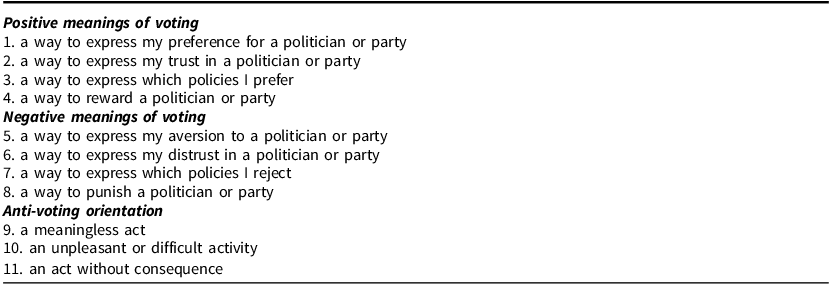
Meanings of voting were measured via a battery of items, which participants rated on a scale from 0 (completely disagree) through 10 (completely agree). The questions started with the opening sentence ‘To me, voting means…’, followed by 11 items (randomized order) that the respondents rated (Table 2). The items for positive and negative meanings of voting both contained three expressive statements (statements 1-3, and 5-7) and one instrumental statement (statements 4 and 8). The measure of anti-voting orientation consisted of three items expressing a general sense of meaninglessness (‘a meaningless act’), lack of efficacy (‘an inconsequential act’), and dislike of voting (‘a difficult or unpleasant activity’). The final measures are the mean score of the items on each scale. Where data were collected in-person, in Nigeria and Tunisia, a random subset of items was used to avoid participant fatigue. Descriptives and reliability scores are provided after the measurement validation in the results section.
Items measuring positive and negative meanings of voting, anti-voting orientation

Table 2 Long description
A table listing items measuring positive and negative meanings of voting and anti-voting orientation. The table has 11 rows and 2 columns. The columns are labeled 'Positive meanings of voting' and 'Negative meanings of voting'. Row 1: a way to express my preference for a politician or party. Row 2: a way to express my trust in a politician or party. Row 3: a way to express which policies I prefer. Row 4: a way to reward a politician or party. Row 5: a way to express my aversion to a politician or party. Row 6: a way to express my distrust in a politician or party. Row 7: a way to express which policies I reject. Row 8: a way to punish a politician or party. Row 9: a meaningless act. Row 10: an unpleasant or difficult activity. Row 11: an act without consequence.
We measure participants’ intention to vote on a scale from 0 ‘definitely not’ through 1 ‘definitely’ (M = .80, SD = .31), importance of democracy on a scale from 0 ‘not at all important’ to 1 ‘absolutely important’ (M = .85, SD = .23), and satisfaction with democracy on a scale from 0 ‘not at all satisfied’ through 1 ‘completely satisfied’ (M = .51, SD = .33). Importance of democracy is not measured in Italy. See all wordings in online Appendix B. Although intention to vote and importance of democracy are both skewed toward the high end of the scale, they are only mildly correlated (r = .42). Satisfaction with democracy is weakly correlated with intention to vote (r = .19) and importance of democracy (r = .19). As they are related to voting and democratic attitudes (Gallego, Reference Gallego2010; Geys et al., Reference Geys, Heggedal and Sørensen2022; Iversen & Rosenbluth, Reference Iversen and Rosenbluth2006; Mishler & Rose, Reference Mishler and Rose2007; Voicu & Bartolome Peral, Reference Voicu and Bartolome Peral2014), as well as to understandings of voting (Boyer et al., Reference Boyer, Belén Abdala and Plescia2025), we include age (M = 44, SD = 17), gender (51% women), education (low/medium/high, Median = medium) and political interest (on a scale from 1 to 4, Median = 3) as control variables.
As an analytical strategy, we describe each meaning using means and standard deviations, factor and reliability analyses. To test Hypothesis 1, we use bivariate partial correlations, controlling for age, gender, education, and political interest. To test Hypotheses 2 and 3, we regress voting intention and democratic attitudes on the three meanings of voting and the control variables. In both analyses, we use country-fixed-effects models to test the overall effect, and we test the same effects within each country to explore between-country differences. We choose country-fixed effects models over multi-level models because we have no specific hypotheses regarding country-level variables, and the small number of countries may bias the results (Möhring, Reference Möhring2012). We report the statistics of the country-fixed-effects models in the text and present the country-level analyses in the figures. All scales are converted to a 0-1 range for comparability.
Results
Measurement validation
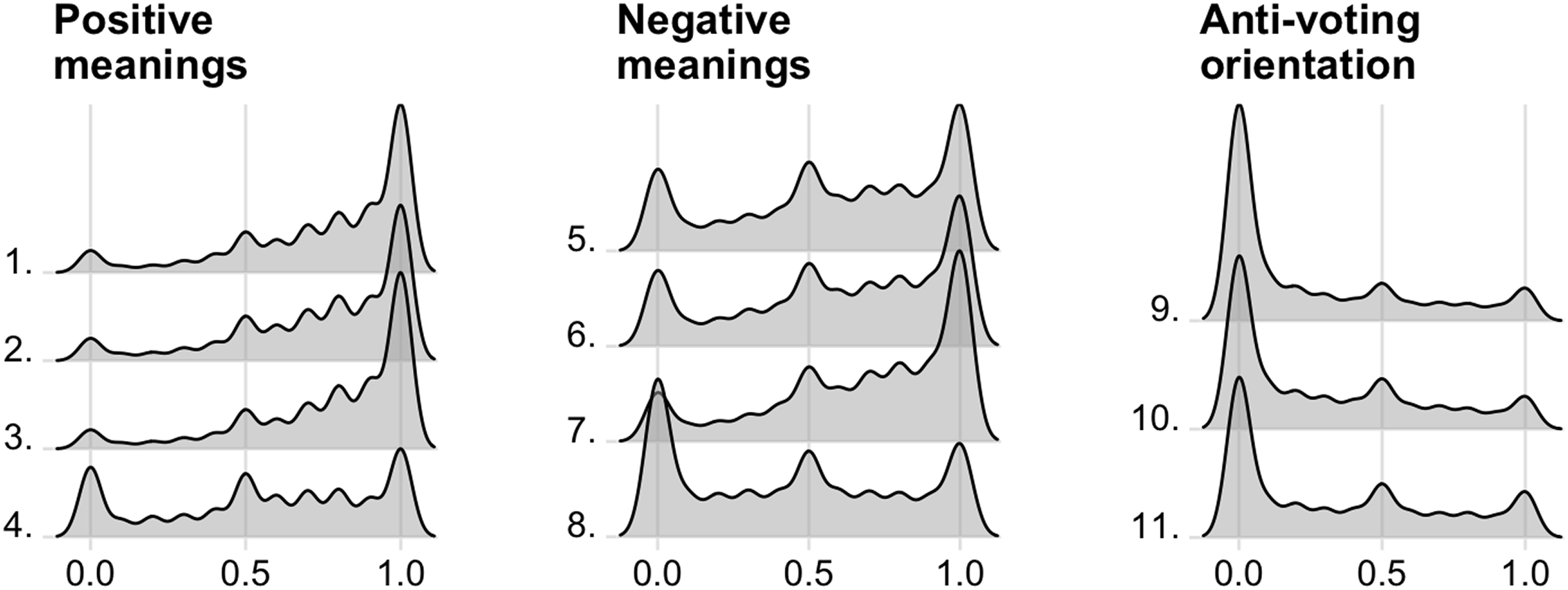
The distribution of each item is presented in Figure 1. The pooled sample shows a reasonable to high internal consistency for positive (Cronbach’s α = .81), and negative (α = .82) meanings, and anti-voting orientation (α = .73). The scores for positive meanings of voting range from α = .71 in Nigeria to α = .88 in Italy and Tunisia, for negative meanings from α = .74 in the United States to α = .86 in Serbia, and for anti-voting orientation from α = .62 in Hungary through α = .85 in Türkiye. However, for anti-voting orientation, there are lower scores in Serbia (α = .48), and Tunisia (α = .50). Our measure seems robustly reliable for negative and positive meanings of voting, but is less reliable for anti-voting orientation in Serbia and Tunisia.
Density plots of items 1–11 of the new measures (see Table 2).

Even though positive and negative meanings and anti-voting orientation are by definition multidimensional constructs, we conduct confirmatory factor analysis (CFA) for the proposed measurement. In this model, each type of meaning is modeled as one unidimensional scale. The model shows a reasonable fit with the data (CFI = .91, TLI = .89, RMSEA = .099). In the CFA per country, fit could not be calculated for Nigeria and Tunisia due to the lack of complete cases (where we collected a subset of items). Model fit was lowest in the US (CFI = .80, TLI = .73, RMSEA = .162) and highest in Serbia (CFI = .96, TLI = .95, RMSEA = .067; see Table C1 in online Appendix C).
While these models fit reasonably, an investigation of each item with respect to their factor loadings suggests that the instrumental items (‘a way to [reward/punish] a certain party or candidate’) load less well on the positive and negative scales than the rest. It is not unexpected that subcategories of a multidimensional scale reduce the model fit when coerced into one factor, and modeling these two items as independent scales significantly improves the CFA model (CFI = .97, TLI = .95, RMSEA = .066; see Table C2 in online Appendix C for country analyses). However, considering the theoretical nature of these constructs and the strong internal reliability, we use the predetermined 4-item scores in the analyses. Descriptive statistics and reliability scores for each country are in online Appendix D.
The structure of negativity in voting
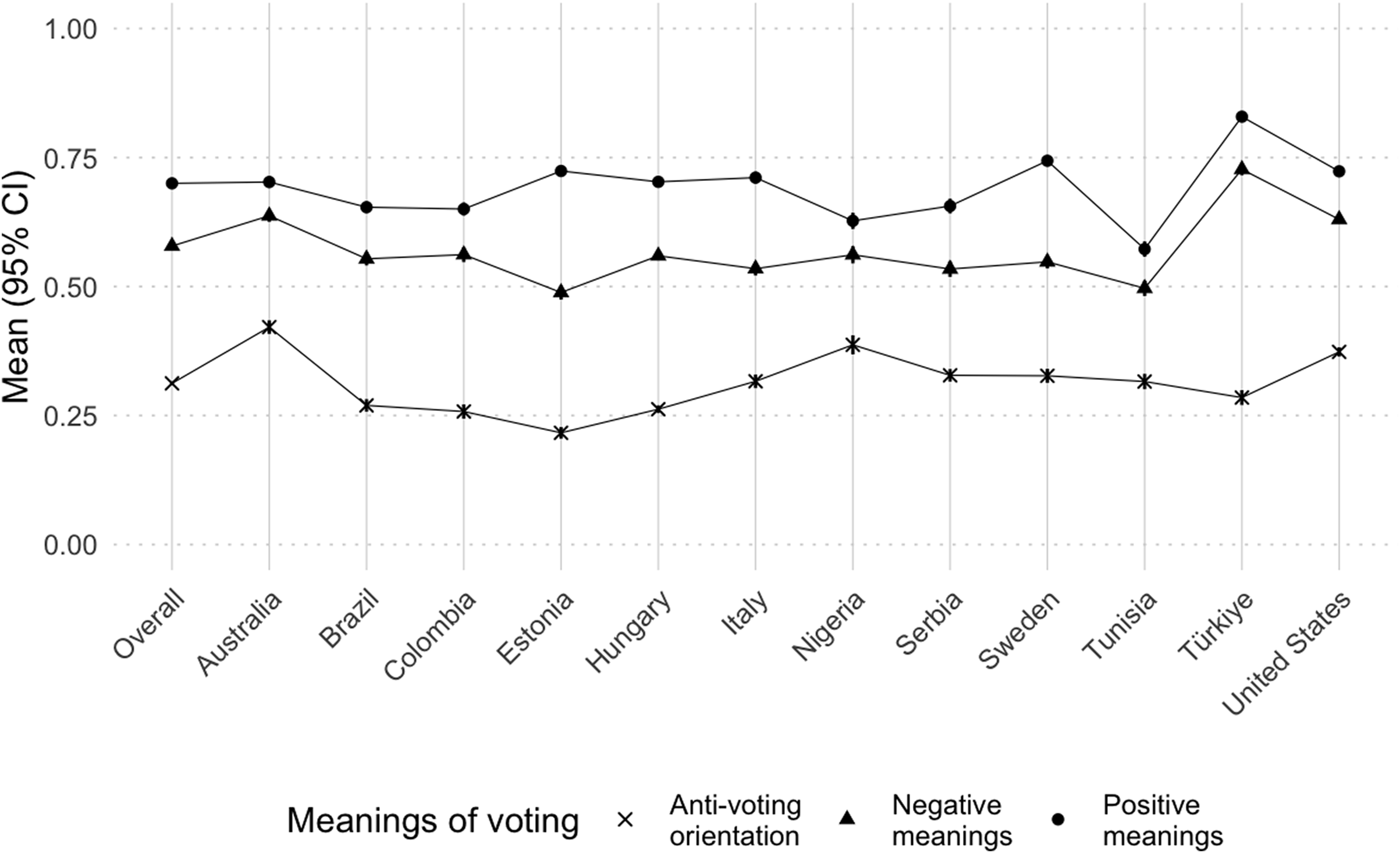
The structure of negativity is consistent across the countries in our sample (Figure 2). Positive meanings are most prevalent (overall: M = .70, SD = .24), followed by negative meanings (overall: M = .58, SD = .27). Anti-voting orientation is least frequent, though not uncommon (overall: M = .31, SD = .28). Positive meanings are most prevalent in Türkiye (M = .83, SD = .20) and least in Tunisia (M = .57, SD = .28) – as are negative meanings (Türkiye: M = .73, SD = .26; Tunisia: M = .50, SD = .28), but Estonians hold a similarly low number of negative meanings as Tunisians (M = .49, SD = .27). Anti-voting orientation is most prevalent in Australia (M = .42, SD = .26) and least in Estonia (M = .22, SD = .22). While countries show a remarkably similar distribution, there are considerable differences too.
Mean scores and 95% confidence intervals of meanings of voting.

Similarly, there are small but important differences between individuals: older and higher-educated people hold more positive and negative meanings of voting and fewer anti-voting orientations than younger and lower-educated people, respectively. Men hold somewhat more negative meanings than women (online Appendix E).
How do these attitudes relate to each other? We test Hypotheses 1a-c through bivariate partial correlations between the three meanings of voting, controlling for the third attitude about voting, age, gender, education, political interest, and, for the overall effect, the country under study (see online Appendix F for the partial correlations per country). We expected positive and negative meanings to be correlated (H1a), and both to be inversely correlated with anti-voting orientation (H1b and H1c). H1a is robustly confirmed across all countries in the sample (overall: r = .52, p < .001; Figure 3). Indeed, positive and negative meanings of voting are correlated, ranging from r = .32 (p < .001) in Nigeria to r = .68 (p < .001) in the United States. H1b is also confirmed, considering the overall inverse correlation between positive meanings and anti-voting orientation (r = −.17, p <.001). However, there is a nonsignificant correlation in Tunisia and a positive correlation in Nigeria. Finally, H1c is rejected. There is a robust correlation between negative meanings and anti-voting orientation (r = .27, p < .001). In sum, there is strong evidence of correlations between positive and negative meanings of voting and between negative meanings and anti-voting orientation, as well as an inverse relation between positive meanings and anti-voting orientation.
Partial bivariate correlations between positive and negative meanings of voting, and anti-voting orientation.

Negativity in voting and democracy
Next, we examine how each attitude relates to vote intention and democratic attitudes (country-specific regression analyses in Figure 4 and online Appendix G; country-fixed-effects models in the text and Table G1). We run three robustness checks. To ensure the analyses’ independence of participants’ eligibility to vote, we replicate each, excluding participants who were ineligible to vote in the previous election (online Appendix H). Second, for comparison to previous work, we use a relative measure of negative voting intention (online Appendix I). Third, we replicate the analysis without the item concerning voting costs in the anti-voting orientation scale (online Appendix J). These checks reach the same conclusions as the main analysis.
Meanings of voting, vote intention, and democratic attitudes. Note. Black: p < .05.

Figure 4 Long description
The image contains three sets of scatter plots, each set representing different aspects of voting behavior and democratic attitudes across several countries. Each set is divided into three columns: Positive meanings, Negative meanings, and Anti-voting orientation. The rows represent different variables: Vote intention, Satisfaction with democracy, and Importance of democracy. Each scatter plot shows the unstandardized coefficient with a 95 percent confidence interval for countries including Australia, Brazil, Colombia, Estonia, Hungary, Italy, Nigeria, Serbia, Sweden, Tunisia, Turkey, and the United States. Panel A: Vote intention. The first row of scatter plots shows the relationship between vote intention and the three different meanings. Positive meanings generally show higher coefficients, indicating a stronger positive relationship with vote intention. Negative meanings show varied coefficients, and anti-voting orientation shows a mix of positive and negative coefficients. Panel B: Satisfaction with democracy. The second row of scatter plots illustrates the relationship between satisfaction with democracy and the three meanings. Positive meanings tend to have higher coefficients, suggesting a stronger positive relationship. Negative meanings show a mix of coefficients, and anti-voting orientation shows varied results. Panel C: Importance of democracy. The third row of scatter plots depicts the relationship between the importance of democracy and the three meanings. Positive meanings generally have higher coefficients, indicating a stronger positive relationship. Negative meanings show a mix of coefficients, and anti-voting orientation shows varied results. The black dots represent statistically significant coefficients (p < .05), while grey dots represent non-significant coefficients.
We expected positive and negative meanings to correlate with vote intention (H2a and H2b). H2a is firmly supported as Figure 4 shows significant correlations between positive meanings of voting and vote intention in all countries except Nigeria (overall: b = .36, SE = .01, p < .001). While negative meanings are also related to vote intention (overall: b = .03, SE = .01, p < .001), the effect is weaker and often nonsignificant in the country subsamples (Figure 4). H2b is thus rejected. H2c is robustly supported: anti-voting orientation is negatively associated with vote intention (overall: b = −.16, SE = .01, p < .001). In short, positive meanings of voting are strongly related to vote intention and anti-voting orientations to intended abstention. However, the relationship between negative meanings of voting and vote intention is weak and varies across countries.
Turning to democratic attitudes, we see a stark difference between the importance of democracy and satisfaction with democracy (Figure 4). Positive meanings of voting are correlated with the importance of democracy (overall: b = .29, SE = .01, p < .001), and so are negative meanings of voting – albeit weakly (overall: b = .03, SE = .01, p < .001) and driven solely by Brazil, Colombia, and Serbia. Anti-voting orientation is inversely related to the importance of democracy (overall: b = -.12, SE = .01, p < .001), in all countries except Nigeria and Tunisia.
The correlations between the meanings of voting and satisfaction with democracy are different (Figure 4). As expected, satisfaction with democracy is robustly correlated with positive (overall: b = .37, SE = .01, p < .001) and negative meanings of voting (overall: b = -.15, SE = .01, p < .001). Only in Brazil, Estonia, Italy, and Nigeria are the correlations with negative meanings nonsignificant. However, unexpectedly, anti-voting orientation is positively related to satisfaction with democracy (b = .11, SE = .01, p < .001), significantly in 7 out of 12 countries. Only in Estonia, anti-voting orientations are inversely related to satisfaction with democracy. This might signal that citizens with anti-voting orientations don’t find democracy important enough to be dissatisfied with it.
In sum, positive meanings of voting are strongly related to both variables of democratic support. H3a is robustly supported. Negative meanings of voting are indeed inversely related to satisfaction with democracy, but not related to the importance of democracy. H3b is thus only weakly confirmed. Anti-voting orientation is inversely related to the importance of democracy, but positively related to satisfaction with democracy. H3c is, therefore, not supported.
Discussion
We started with the premise that there are two types of negativity in voting (voting against and against voting) and that positivity and negativity can coexist in citizens’ minds. Although positive meanings of voting are the most prevalent of the three meanings, our findings call for the need to rethink negativity in elections.
First, positive and negative meanings of voting are complementary and compatible attitudes. When measured separately, the effects of negative voting seem more nuanced than the previous work suggests. In fact, in comparison with the relative measure in online Appendix I, it seems that high levels of negative meanings of voting can be obscured by even higher positive meanings. Moreover, the relationships of negative meanings with intention to vote and democratic attitudes are more nuanced using our measure.
Citizens with negative meanings of voting are disillusioned. They find it important to live in democracies, but they are unsatisfied with the democracy they live in. In other words, they are disillusioned by the practical state of democracy, rather than the system of democracy. Just like democratic dissatisfaction does not predict turnout (Kostelka & Blais, Reference Kostelka and Blais2018), there was no clear relationship between negative meanings and vote intention.
Second, while anti-voting orientation is less prevalent, it takes up substantial space in citizens’ meanings of voting – even for those who intend to vote. Many citizens feel negatively about voting in some way. Anti-voting orientation is inversely related to vote intention and the importance of democracy. Surprisingly, however, it is correlated with satisfaction with democracy. Anti-voting orientation seems to stem from a sense of disillusionment toward the political system, rather than the specific political situation. Consistent with theories of political alienation (Finifter, Reference Finifter1970; Norris, Reference Norris2011), this attitude may reflect general skepticism about any kind of collective action rather than dissatisfaction with democracy. More fine-grained analysis is necessary to detect how to combat anti-voting orientation.
Moreover, the relationships between the different meanings of voting may uncover another measurement error at work. Citizens with positive meanings hold fewer anti-voting orientations, while citizens with negative meanings hold more anti-voting orientations. When one compares positive to negative meanings of voting without controlling for anti-voting orientation, the results may thus very well reflect their differences in anti-voting orientation rather than the difference between positive and negative voting. Such confounding may hinder our understanding of negativity in voting and complicate the investigation of the mechanisms underlying its relationship to democratic behaviors and attitudes.
Despite Nigeria being an outlier, we are confident that our measure functions well across countries. The positive performance across diverse settings suggests a degree of robustness in our approach. Indeed, even between liberal democracies and electoral autocracies, the results are remarkably similar. However, our analysis has limitations in assuming meaning equivalence across different political and cultural contexts (Heath et al., Reference Heath, Fisher and Smith2005). Future research should explore how voting meanings vary by context.
While these are robust and important contributions, this study can tell us little about causality. Whether meanings of voting precede or follow participation and democratic attitudes, or both, remains to be discovered in future research. Moreover, there is some instability in the measurement and results in Nigeria and Tunisia, due to their relatively undemocratic regimes (Boese et al., Reference Boese, Lundstedt, Morrison, Sato and Lindberg2022), or the use of in-person interviews. Moreover, the category anti-voting orientation requires additional sub-categorization. While our analysis in online Appendix J shows that removing criticism of practical issues regarding voting does not change the effects, more work is required to explore subcategories of anti-voting orientation. Finally, future work should refine the models for positive and negative meanings and anti-voting orientation. In sum, this study indicates the necessity and offers the tools for a systematic investigation of negativity in voting that considers the intricate reality of citizens’ perspectives.
Supplementary material
The supplementary material for this article can be found at https://doi.org/10.1017/S1475676525100364.
Data availability statement
The dataset is published through the AUSSDA repository, as cited in the paper (Plescia, Abdala, Boyer, et al., Reference Plescia, Abdala, Boyer, Brunetti and Le Gall2025).
Funding statement
This project is part of the ERC Starting Grant Project DeVOTE (https://www.votemeanings.eu) and has received funding from the European Research Council Starting Grant No 949247. Open access funding provided by Vrije Universiteit Amsterdam
Competing interests
The authors declare no potential conflicts of interest with respect to the research, authorship, and/or publication of this article.
Ethics approval statement
The project was approved by the Ethics Committee of the University of Vienna (application number: 00642, decision date: 19.04.2021).
Permission to reproduce material from other sources
Not applicable.



 Open access

