Introduction
When a parent is diagnosed with a life-threatening illness, the family dynamics are challenged and the parent needs to balance his or her own health and worries with those of the children. Similarly, the co-parent must balance the care of a partner with parental responsibilities. Life-threatening illness has shown to be associated with high risks of psychological distress for both the ill parent and family members (Thastum et al., Reference Thastum, Watson and Kienbacher2009; Caruso et al., Reference Caruso, Nanni and Riba2017). Even though the entire family is affected when a parent is severely ill, systematic reviews (Niemelä et al., Reference Niemelä, Repo and Wahlberg2010; Kuhne et al., Reference Kuhne, Krattenmacher and Beierlein2012; Ellis et al., Reference Ellis, Wakefield and Antill2017) show that there are few evaluated psychosocial interventions for families with dependent children. Even fewer interventions involve a family-centered perspective since many of the available interventions divide children and parents into groups where they interact with members from other families.
One family-centered intervention (Beardslee et al., Reference Beardslee, Versage and Wright1997a, Reference Beardslee, Wright and Salt1997b) is the Family Talk Intervention (FTI), also called Beardslee's Family Intervention. FTI has been used clinically in Sweden in palliative care, but no scientific evaluations are made in that context. FTI, which main goal is to improve family communication about illness-related subjects in the family, consists of six key concepts: (1) sharing a history together, (2) bringing knowledge about illness, (3) addressing the needs of the children, (4) planning how to talk to the children, (5) breaking the silence together as a family, and (6) continuing the family dialog, moving on, and facing the future (Beardslee, Reference Beardslee2002). FTI has mainly been evaluated in psychiatric care, using both quasi-experimental and qualitative design, showing positive effects for both children and parents concerning family communication about illness-related subjects (Pihkala et al., Reference Pihkala, Cederström and Sandlund2010, Reference Pihkala, Sandlund and Cederström2011; Christiansen et al., Reference Christiansen, Anding and Schrott2015). In studies with a qualitative approach but also in a randomized controlled design, positive results have been shown among families where a parent has cancer or other severe illnesses (Bugge et al., Reference Bugge, Helseth and Darbyshire2008, Reference Bugge, Helseth and Darbyshire2009; Niemelä et al., Reference Niemelä, Repo and Wahlberg2012). However, to date, FTI has not been evaluated in palliative care from the parents’ perspective.
Aim
The aim of this study was to evaluate the feasibility of FTI in terms of acceptability from the perspective of parents in families where one parent suffers from a life-threatening illness and receives specialized palliative home care.
Methods
Design
Data for this study were derived from a pilot intervention study (Eklund et al., Reference Eklund, Kreicbergs and Alvariza2018) aimed at evaluating FTI from the perspective of all family members, using mixed methods (Creswell and Clark Plano, Reference Creswell and Planoclark2018). The present study has a descriptive design and is based on interview and questionnaire data gathered from parents after their participation in FTI. The study followed the principles of the Declaration of Helsinki (World Medical Association, 2018), and ethical approval was obtained from the Regional Ethical Review Board in Stockholm (2016/664-31/5 and 2017/7-31/1).
The Family Talk Intervention
FTI was originally developed for families with a parent with an affective disorder who had children aged 6–18 years (Focht and Beardslee, Reference Focht and Beardslee1996; Beardslee et al., Reference Beardslee, Swatling and Hoke1998, Reference Beardslee, Gladstone and Wright2003; Beardslee, Reference Beardslee2002). FTI is not a psychotherapeutic intervention. The overarching aims of FTI are to support an open, honest family communication and to improve family members’ understanding of the disease. The core elements of FTI are to support the families in talking about illness-related subjects, support the parents in understanding the needs of their children and how to support them, and support the families in identifying their strengths and how best to use them. By promoting protective factors, a process that builds up resilience is initiated. FTI focuses mainly on the children and has an eclectic approach, including psycho-educative, narrative, and dialogical ways of working. The psycho-educative element focuses on increased illness-related knowledge, and the narrative element involves the family's own stories and is central in FTI. The dialogical way of working focuses on making problematic situations visible by making the children's voices heard, sharing experiences within the family, and seeing all the family members’ different perspectives (Focht and Beardslee, Reference Focht and Beardslee1996; Beardslee et al., Reference Beardslee, Swatling and Hoke1998, Reference Beardslee, Gladstone and Wright2003; Beardslee, Reference Beardslee2002). FTI is manual-based, follows a structured protocol, and is led by one or two interventionists educated in the FTI method.
FTI entails six meetings, which in this study, were led by two interventionists educated in the FTI method, one deacon and one medical social worker (none of the authors were involved in intervention delivery). The meetings are held one or two weeks apart with each family in a place chosen by that family, often their home. Meetings 1–2 include the parent(s) and focus on their experiences of the situation, as well as the consequences of the diagnosis for each family member. During the meeting, each child's situation is discussed, including strengths, problems, worries, the situation in school and with friends, social network, and knowledge of the disease. The parent(s) will formulate the goal of the intervention. Meeting 3: the interventionists will meet with each child, preferably without the parent(s), talking about the child's life situation, feelings, understanding of the disease, questions, and hobbies. The relationship with their parent(s) is discussed, as is the child's social network. The interventionists identify protective factors from the child's narrative (e.g., well-functioning school life and relationships with friends), as well as risk factors (e.g., poor social network). The child can also formulate questions for the parent(s) and what he/she wants to discuss during the family meeting. Meeting 4 includes the parent(s) and focuses on planning the family meeting. The children's thoughts and questions serve as a guide for the upcoming family meeting. Meeting 5 is preferably led by the parent(s), to facilitate continuous communication within the family, and consists of questions and issues raised earlier by the family members. This family meeting can be seen as a starting point for communication within the family. Meeting 6 is a follow-up with all family members, preferably held within a month of Meeting 5. The meeting is guided by the family members’ needs, e.g., regarding communication and parenting.
Procedure and participants
Families were recruited during March 2017 and February 2018, via medical social workers at two specialized palliative home care units, in Stockholm, Sweden. Inclusion criteria for families were (1) at least one parent with a life-threatening illness, (2) at least one child aged 6–19 years, and (3) able to speak and write Swedish. The ill parent described who was included in his or her family. All family members were invited to participate and were given written and verbal information about the study. Age-adapted information was given to children under the age of 15 years.
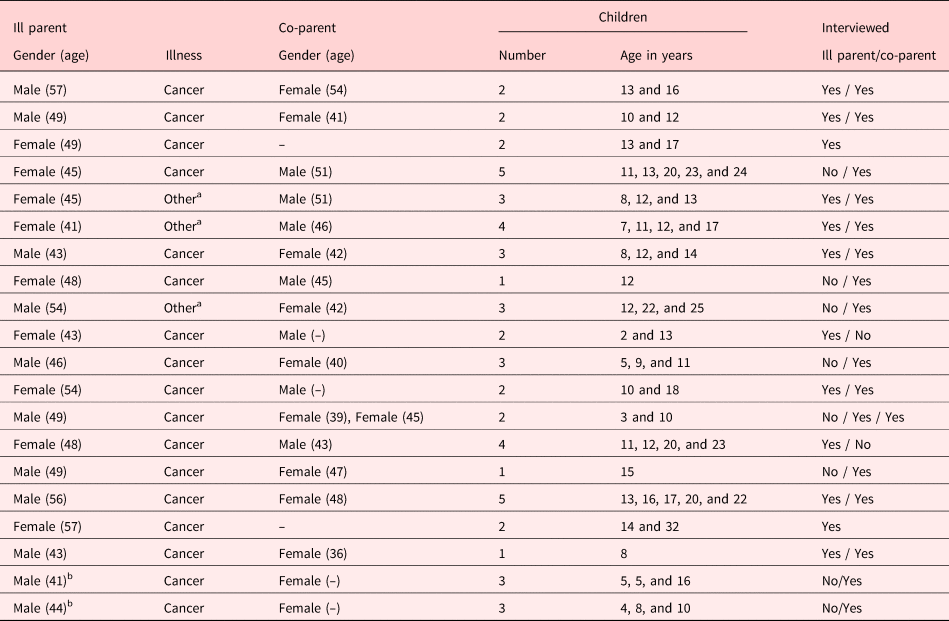
In total, 20 families (out of an eligible 30, participation rate 67%) consented to participate in FTI; however, two families were not able to follow through with the regular form of FTI due to the parent's death. In one of those families, the ill parent died after meeting 3, and in the other family, after meeting 2. In all, 39 parents participated; 9 mothers and 11 fathers with life-threatening illnesses (mostly cancer) with a mean age of 48 years (41–57 years). Nineteen co-parents, either living together or separate from the ill parents, participated. The number of children per family varied from 1 to 5 (Table 1).
Participant characteristics

a Advanced pulmonary disease, gastric bleedings due to Dieulafoy's lesion, and chronic liver disease.
b Died during ongoing FTI.
Data collection
Data were collected between March 2017 and May 2019 at three time points: baseline (questionnaire), upon intervention completion (questionnaire and interviews), and 1 year after baseline (questionnaire). The questionnaires were sent by post to the families. The present study includes data from questionnaires and interviews at the time of the intervention's completion.
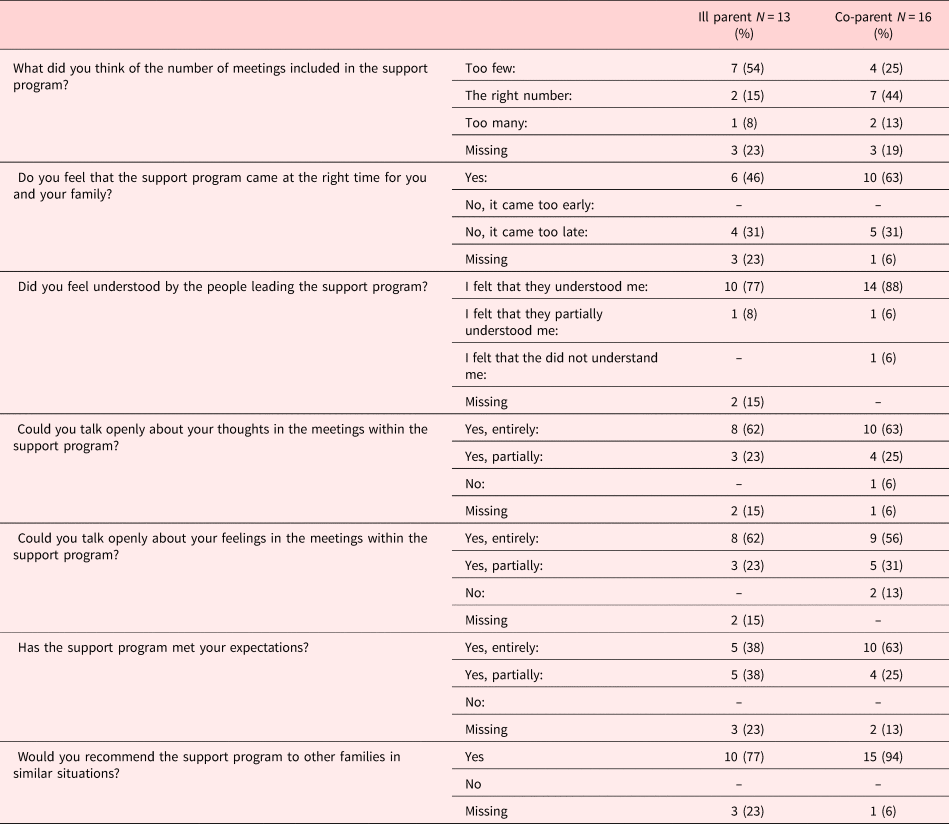
Study-specific questionnaires were developed (Charlton, Reference Charlton2000; Eklund et al., Reference Eklund, Kreicbergs and Alvariza2018), with separate versions for the ill parent, the co-parent, and the children. The questionnaires consisted of five parts: socio-demographics, illness-related information, family communication, psychosocial well-being, and experiences of participation in FTI. For this study, data from the last part were used (Table 2). These questions were inspired by Pihkala et al. (Reference Pihkala, Cederström and Sandlund2010) who evaluated FTI in Swedish psychiatric care. In total, 29 parents (13 ill parents and 16 co-parents) answered the questionnaire.
Parents’ experiences of the FTI

Upon completion of FTI, 29 parents (12 ill parents and 17 co-parents) were interviewed. The reasons provided for not responding to the questionnaire or not participating in the interview were related to the detoriating illness or death of the patient. The interviews were conducted by one or two of the authors. Families were to choose place for the interviews and all but one was held at the family home. The interviews lasted between 17 and 81 min and were audio-recorded.
Data analysis
Descriptive statistics (frequencies and percentage) were used to analyze the answers from the closed-ended questions in the questionnaires, using IBM SPSS Statistics v.22.
Interviews were transcribed verbatim and analyzed using conventional content analysis with no preconceived categories (Hsieh and Shannon, Reference Hsieh and Shannon2005). All transcripts were read several times by the first and the last author to obtain an overall impression of their content. Bearing in mind the aim of the study, meaning units were identified and assigned a code. All of the authors then participated in comparing codes independently, based on similarities and differences, gathered into three categories and three subcategories. Discussions were held between all the authors, and when needed, the codes and categories were compared with texts in the transcripts to be true to the words of the parents. Quotations from the interviews are presented in the article to illustrate the different categories.
Results
Results from questionnaires
Most of the parents (83%) reported that FTI had met their expectations and 77% of the ill parents and 94% of the co-parents would recommend FTI to other families in similar situations. The parents (90%) reported feeling understood by the interventionists, and a majority (86%) felt at ease with sharing their thoughts and feelings freely during the meetings, although a few co-parents (19%) reported not being able to do this. More than half of the parents (55%) reported that the intervention was offered at the right time for them, while others (31%) would have preferred it earlier. A little less than half of the parents (38%) reported a wish for additional meetings, while others (31%) considered that the intervention included a sufficient number of meetings and a few (10%) believed it was too many meetings (Table 2).
Results from interviews
The content analysis resulted in three categories and three subcategories. The first category is: A well-structured and flexible design, with the subcategories; Earlier start and the need for preparedness, and Adjusting FTI meetings to suit the individual families. The second category is: The interventionists’ personal qualities and experiences are of great importance. The third category is: Sharing views and feelings during the FTI meetings.
A well-structured and flexible design
Earlier start and a need for preparedness
Parents expressed that they would have appreciated FTI to have started earlier during the ill parent's disease trajectory. One ill father expressed, “For me, it should have been earlier, before I was admitted to the palliative home care team. The kids knew even then about my illness but they might have needed an eye-opener as to what was to come.”
Parents would have appreciated a more thorough briefing with the interventionists before starting FTI. One co-parent expressed a wish for separate meetings to be accommodated between himself and his child, as the ill mother never acknowledged her forthcoming death. He, as a co-parent, felt the need to meet with the interventionists and the child without the ill mother present, thus allowing them to talk more freely.
Some parents would have preferred a more detailed guide for the separate meetings beforehand, giving them time to reflect on the aspects that would be covered. The spouse of one ill woman, and father of three children, expressed, “If one would have had assigned some material prior to each meeting, the next time we would focus on this and that, then maybe one would have been able to prepare oneself a bit more.”
Adjusting meetings to suit the individual families
According to the parents, the location, time, and duration of the meetings were important aspects. Parents appreciated that the time and place for meetings were arranged in a way that did not disturb their children's everyday life. They also thought it was beneficial that the length of the meetings was adapted accordingly to who was attending, for example, to the ill parent's wellbeing and the children's age. The mother in a family with one child where the ill father could not take part in the follow-up interview expressed, “It depends on the one who is ill. How that person is feeling. I felt that NN (the ill father) was way too tired on some occasions. That it became too hard for him and that the meetings were too long.” Overall, however, the parents expressed that they were allowed to take the time they needed for each meeting.
While most parents expressed having had the possibility to schedule the meetings at times and places that suited the families, their satisfaction decreased when the families’ preferences could not be met. Two families had a longer period of time between meetings 5 and 6, due to the summer vacation. In both of these families, the ill parents’ well-being changed during this time and the last meeting was described as being awkward, bringing up aspects that were no longer relevant. Some parents also expressed that they would have preferred additional meetings provided over a longer period of time.
The interventionists are of great importance
Parents stressed the importance of the interventionists and that their professional and personal qualities and experiences were crucial in building trust. The interventionists were described as being easy to talk to, being professional yet personal, and quick to grasp what the parents wanted to say. Parents also expressed feeling safe in letting their children talk with the interventionists alone, due to the warm and caring personality and professional competence of the interventionists. An ill single-mother of two daughters expressed, “I don't know, it might be their way. When they come, they fit right in. It's so easy. My youngest daughter thinks it's easy to talk to them, so easy.” In addition, parents experienced that the interventionists were deeply committed to their family. One father expressed, “I think it's just how they are, as persons. They get truly engaged and it feels just like a close friend that you can call.”
Parents clearly expressed a need to talk about their situation but said that it could be emotionally hard to prepare for a meeting. However, that feeling was usually exchanged for a sense of relief afterwards. One ill father expressed, “It was striking that we all found it very challenging at the beginning of each meeting, but were calmed at the end of them.” Similarly, another ill father expressed the child-meeting (meeting 3) to have benefited his children, “Well, I don't know much of what they talked about, but it was obvious that they were relieved afterwards.” One parent explained how she felt pressured by the interventionists to talk about things she did not yet feel ready to talk about. She expressed this as being difficult and only possible due to the trust that had been established between her and the interventionists:
“I felt pushed to talk about things we normally don't talk about within the family. I wasn't comfortable with the thoughts that we might receive bad news from the health care team and wanted to take things at my own pace. Being pressured to put these thoughts into words made me anxious and irritated, even angry. They (the interventionists) confronted me about it and helped me realise what I was frightened about. I didn't want to think about worse times right then, we aren't there yet … Now I'm glad that we talked about it, and that I felt I could trust them (the interventionists).”
Parents expressed that a close bond with the interventionists had been developed during FTI and that it was difficult to part from them.
Sharing views and feelings during the FTI meetings
Some parents expressed that they had had a rather open dialog within the family prior to the intervention, while others expressed that these meetings helped them talk about difficult questions. They said that the positive experience of participating in the intervention had made them aware of how difficult these conversations were without support. A mother of three, whose husband was admitted to the hospital at the time of the interview, expressed “It's wonderful to get help because before this we had to do it all by ourselves. To get outside support, it's like night and day. Although, it's also what's sad. That we just were walking in darkness, so to speak.” Many parents expressed that they would never have shared their thoughts and feelings in a similar way without the meetings and they appreciated having had this possibility. They described that they, during the meetings, had been able to express their views and feelings freely. They also believed that all family members had told their individual story. They considered having a third part present during the meetings had been important, as this had facilitated the conversation. Parents described how the conversation was carried through the interventionist and that it was sometimes perceived as being less stressful addressing the interventionists than the other family members directly, even though they were all in the same room. One ill mother of two expressed, “I think that even though NN (the child) talked to NN (the interventionist), his words were directed towards me. The words just took a small detour, and it might be easier to say what he wants to say to her. Then the words are carried through her to me.”
Parents experienced that having separate meetings for parents and children was helpful in supporting the children to share their views and needs with the parents. Some parents had experienced that the interventionists supported their child/children in talking of different aspects during a shared meeting. Others had experienced that the interventionists shared information with them, as agreed by the individual child. Parents also appreciated that children had the possibility to ask the interventionists to keep some information for themselves.
Discussion
The results indicate that FTI is feasible in terms of acceptability in palliative care, and this is one of the first studies to evaluate FTI in this context. Parents found the design of FTI to be well-structured and flexible according to their families’ needs regarding the time and place of the meetings and in determining which members of the family should participate. The importance of the interventionists was clearly acknowledged, as their professional competence, engagement, and support were vital for building trust in sharing narratives and communicate openly within the family. In addition, parents expressed that FTI provided them with a setting within which they could share thoughts and views that they would not have shared otherwise.
These results are in line with parents’ experiences of FTI in families where one parent suffers from mental illness or substance abuse (Pihkala et al., Reference Pihkala, Sandlund and Cederstrom2012, Reference Pihkala, Dimova-Branstrom and Sandlund2017). However, it is worth stressing that FTI in a palliative care setting might need to pay special attention regarding flexibility. Due to the symptom burden related to severe illness, the ill parent's possibilities for participation may be affected (Verkissen et al., Reference Verkissen, Hjermstad and Van Belle2019). Co-parents might be overwhelmed and burdened by caregiving and parenting responsibilities (Grande et al., Reference Grande, Rowland and Van Den Berg2018), and children can prefer distraction and retreat from illness (Melcher et al., Reference Melcher, Sandell and Henriksson2015; Sheehan et al., Reference Sheehan, Mayo and Christ2015). It is known that intervention delivery and research in palliative care is especially challenging; still, it is important to acknowledge that patients, even when close to death, and their family members have been shown to be consistently willing to engage in research and report participation as a positive experience. Their willingness and possibilities for participation can, however, be limited by physical and/or psychological symptoms. Regardless, it has been stressed that patients in palliative care should be invited to participate and that it can be unethical not to offer them opportunities to participate because of their severe illness (Higginson et al., Reference Higginson, Evans and Grande2013). Instead, it is suggested that flexibility is allowed in research and in the delivery of family-based interventions. Consequently, interventions in palliative care might need to use adaptive designs, allow changes in intensity and duration, and to focus on the needs of patients and family members at given times (Ratcliff et al., Reference Ratcliff, Vinson and Milbury2019). These suggestions are supported further by the results in the present study, as some parents wished an earlier start — some even wanted FTI to be initiated at the time of diagnosis — and many wished for additional meetings.
During the FTI meetings in this study, parents felt free to express feelings and believed that all family members shared their individual story, but still, separate meetings for parents and children were appreciated. Living in a family with life-threatening illness can be understood as described by Carlander et al. (Reference Carlander, Ternestedt and Sahlberg-Blom2011), who found that families dealt with illness and impending death by both “being me in a family close to death” and “being us in a family close to death.” Each of the family members, thus, dealt with the threat of death as an individual experience with consequences for one's own life, but the family also dealt with illness and the threat of death as a group. The results in the present study revealed a need for meetings in "constellations" other than those outlined in the FTI manual, as one family member could hinder communication between others. This could be compared with findings obtained by Carlander et al. (Reference Carlander, Ternestedt and Sahlberg-Blom2011), who found that family members did not always want to share feelings with each other. Instead, the ill person became more introverted when the body signaled progressing illness, as that was not easy to share with the rest of the family. Some topics were consciously avoided by both the ill family member and the rest of family members, to protect the ill person (Carlander et al., Reference Carlander, Ternestedt and Sahlberg-Blom2011). This must be taken into consideration when working with an FTI which strives to open communication within families. According to the present study, the interventionists played a crucial role in contributing to communication in the families about difficult subjects that would not have been addressed otherwise. Similar results were found in Pihkala et al. (Reference Pihkala, Sandlund and Cederstrom2012, Reference Pihkala, Dimova-Branstrom and Sandlund2017).
In palliative care, there is a clear consensus that the unit of care is the patient and the family, yet developing adequate models of family-centered care has proved to be challenging. Families with an ill parent who has dependent children, often have extra needs of support. FTI is not a therapeutic intervention, it is instead psycho-educational, family-centered and targets families with dependent children, providing opportunities to systematically contribute with extra support to meet the special and individual needs of families.
Methodological considerations
In the present study, 67% of eligible families chose to participate in the FTI. This can be compared with a recent study that failed to recruit parents with cancer and their co-parents to a psycho-educational intervention aiming to support parenting. The authors reported that the families’ reasons for declining were medical, parenting, and work commitments (Stafford et al., Reference Stafford, Sinclair and Newman2019). The FTI in the present study was delivered to the whole family, as well as children, in the family home at times that suited each of the families, which might have increased the participation rate.
Our results are strengthened by the fact that the data were collected using a mixed-method approach including both questionnaires and interviews, which is preferred when evaluating a complex intervention (Farquhar et al., Reference Farquhar, Ewing and Booth2011). However, the sample was small and included only Swedish-speaking families from a larger city, limiting the transferability of the results to other settings. Nevertheless, it is reasonable to assume that our results would be applicable to other parents in similar situations, even though more research is needed.
Conclusion
The results indicate that FTI is feasible in terms of acceptability from the perspective of parents in a specialized palliative home care context. Overall, the parents appreciated the design of the intervention and experienced an opportunity to share thoughts and views within the whole family. FTI could, thus, add valuable support to families with a parent suffering from a life-threatening illness. FTI should not replace support from the regular health care system but instead should act as a complement existing services to help the families strengthen communication.
Clinical implications
A recent study concludes that few family-based interventions reach clinical practice, even though they are positively evaluated in studies (Ratcliff et al., Reference Ratcliff, Vinson and Milbury2019). Based on the positive experiences of the participants in FTI in this study, we believe it would be of value to implement FTI within palliative care. According to our results, it is important to stress that the individual interventionists need both professional and personal competence, engagement and interest to adapt to the families’ needs, allowing more flexibility. Implementing FTI within palliative home care could also provide the families with continued support after the designated meetings included in the intervention.
Acknowledgments
The authors acknowledge the interventionist in this study, Anna Pautzauer Persone and Åsa Högman. They also acknowledge the Erling-Person Family Foundation for funding the study. They are grateful to all families who participated in the study, for generously sharing their lives and experiences.