Introduction
The Amazonian freshwater stingrayPotamotrygon wallacei (Carvalho et al., Reference Carvalho, Rosa and Araújo2016) is the smallest known species among the Potamotrygonidae family and it is endemic to the Rio Negro basin in the Brazilian Amazon. This species and all others from the genus Potamotrygon are included in CITES Appendix III (Resolution 17.247; CoP17, 2016) to combat illegal international trade (Ramos, Reference Ramos2017).
Potamotrygon wallacei (cururu stingray) presents high habitat specificity, preferentially occupying flooded forests (igapó). Such areas are strongly modified by the annual flood pulses (Junk et al., Reference Junk, Bayley and Sparks1989) that occur in the region. In regular flooding cycles, reproductive events such as gonadal maturation, copulation, pregnancy, rest and regeneration occur sequentially in this species, during the transition phases: drought, rising water and flooding (Araújo, Reference Araújo1998; Charvet-Almeida et al., Reference Charvet-Almeida, Araújo and Almeida2005; Morales-Gamba, Reference Morales-Gamba2018). Males of P. wallacei have limited periods of reproductive activity and depend on the flood pulse as a trigger for the production of steroid hormones, which are responsible for controlling the processes of spermatogenesis and spermiogenesis (Morales-Gamba, Reference Morales-Gamba2018).
Environmental climatic phenomena, such as the ‘El Niño’, drastically modify the hydrological level of the rivers, not only affecting the habitat of this species but also modifying their reproductive cycle. This leads to an extension or reduction of the periods for reproductive rest (Araújo, Reference Araújo1998; Morales-Gamba, Reference Morales-Gamba2018). In addition to environmental phenomena, ornamental fishing and habitat reduction (igapó areas), have placed the species in a highly vulnerable situation (Araújo et al., Reference Araújo, Charvet-Almeida, Almeida and Pereira2004). Drastic changes in environmental variables such as temperature, water quality and food resources affect nutritional and health conditions in fish, having direct impacts on the development of sperm cells, with resulting changes in sperm morphology and quality that can contribute negatively towards their reproductive success (Pitnick et al., Reference Pitnick, Hosken, Birkhead, Birkhead, Hosken and Pitnick2009). All of these pressures in local populations draw our attention to the need for captive breeding programmes to preserve vulnerable species.
One of the limiting factors for the success of a captive breeding programme is the quality of gametes, as they are affected by several environmental variables (Bobe and Labbé, Reference Bobe and Labbé2009). Getting to know both sperm morphology and the main parameters that determine sperm quality is fundamental for the creation of a germplasm bank to store this genetic material for conservation purposes (Dietrich et al., Reference Dietrich, Pecio, Sikorska, Wolnicki, Slowińska, Hliwa, Kamiński, Andronowska and Ciereszko2014).
Dzyuba et al. (Reference Dzyuba, Ninhaus-Silveira, Kahanec, Veríssimo-Silveira, Rodina, Holt and Dzyuba2019) verified for the ocellate river stingray Potamotrygon motoro the presence of motility in the sperm found in the attachment ducts (epididymis and seminal vesicle), however no information about the morphology or qualitative parameters of these cells has been reported.
Considering the lack of information in the published literature about spermatic characterization in the Potamotrygonidae family, this study aimed to describe, for the first time, the sperm morphology and spermatic quality of free-living adult actively breeding males of cururu stingray, P. wallacei.
Material and Methods
Adult males of P. wallacei (n = 3; disc width = 200 ± 21 mm, mean ± standard deviation (SD); clasper length > 50 mm) were captured in April 2017 with the assistance of professional fishermen, in nocturnal fishing held at Igarapé Zamula, located in the municipality of Barcelos, Amazonas, Brazil (0o50’28’’S, 62o46’5’’W). Each individual was measured, sexed, classified according to the maturational stages recommended for marine elasmobranchs (ICES, 2013) and adapted for freshwater stingrays (Morales-Gamba, Reference Morales-Gamba2018).
The specimens were anesthetized through immersion in eugenol solution (0.2 mg/l), immediately euthanized by having their spinal cord cut, and then dissected for collection of both the sperm and the reproductive apparatus, which were analyzed in a parallel investigation (Morales-Gamba, Reference Morales-Gamba2018) designed to correlate the morphology of the reproductive tract with plasma steroid hormone profiles in adults of this species during different phases of reproductive cycle.
All males analyzed here were classified as adult, actively breeding males (ICES, 2013; Morales-Gamba, Reference Morales-Gamba2018), as they possessed rigid and fully calcified claspers, their testes were developed and lobulated, and ducts were full of sperm, which was released through the clasper when squeezed.
The sperm was collected in loco from the seminal vesicle region using a disposable syringe, and fixed in buffered saline formaldehyde solution (Hancock, Reference Hancock1957) in the ratio 1:1000 (sperm:fixative) for further evaluation of sperm concentration using an haematimetric Neubauer chamber. For evaluation of the percentage of morphologically normal spermatozoa, a 15-μl aliquot of fixed semen solution was mixed with 5 μl Rose Bengal dye (Maria et al., Reference Maria, Azevedo, Santos and Carneiro2012) and a cell smear was performed on a glass slide. Anomalies in the head, midpiece or flagellum were evaluated and characterized when present. The evaluation was performed under an optical microscope (×400 magnification), with quantification of 100 cells per slide (Soares et al., Reference Soares, Streit, Ebert, Coldebella and Oberst2010).
Sperm plasma membrane integrity was analyzed by preparing a cell smear using 2 μl of fresh semen, 2 μl of 5% eosin and 2 μl of 10% nigrosine (Viveiros et al., Reference Viveiros, Orfão, Nascimento, Corrêa and Caneppele2012). In total, 100 cells were evaluated using a cell smear and an optical microscope (×1000 magnification). Cells that were heavily stained pink were considered to have an injured plasma membrane, while lightly stained cells were considered to have intact membranes.
In the morphometric analysis, 50 spermatozoa images from each male were generated using a Leica DM500 optical microscope with a built-in Leica ICC50 W digital camera at ×400 or ×1000 magnification and later evaluated using ImageJ® software v.1.51p. The lengths of the head, midpiece, cytoplasmic sheath and flagellum and total sperm length were measured, following the descriptions made for spermatozoa of several elasmobranchs by Tanaka et al. (Reference Tanaka, Kurokawa, Hara, Jamieson, Ausio and Justine1995). All data are expressed as mean ± standard deviation.
Results and Discussion
The cell concentration in the semen of P.wallacei was 0.34 ± 0.05 × 10¹⁰ spermatozoa/ml of semen. The sperm evaluations showed a high percentage of cells with intact membrane (98 ± 2%). Similarly the percentage of morphologically normal spermatozoa reached 92 ± 1%. From the percentage of spermatozoa that presented anomalies, only damage related to the structure of the flagellum was found: 37.5% with folded flagella, 37.5% with rolled-up flagella, and 25% with broken flagella.
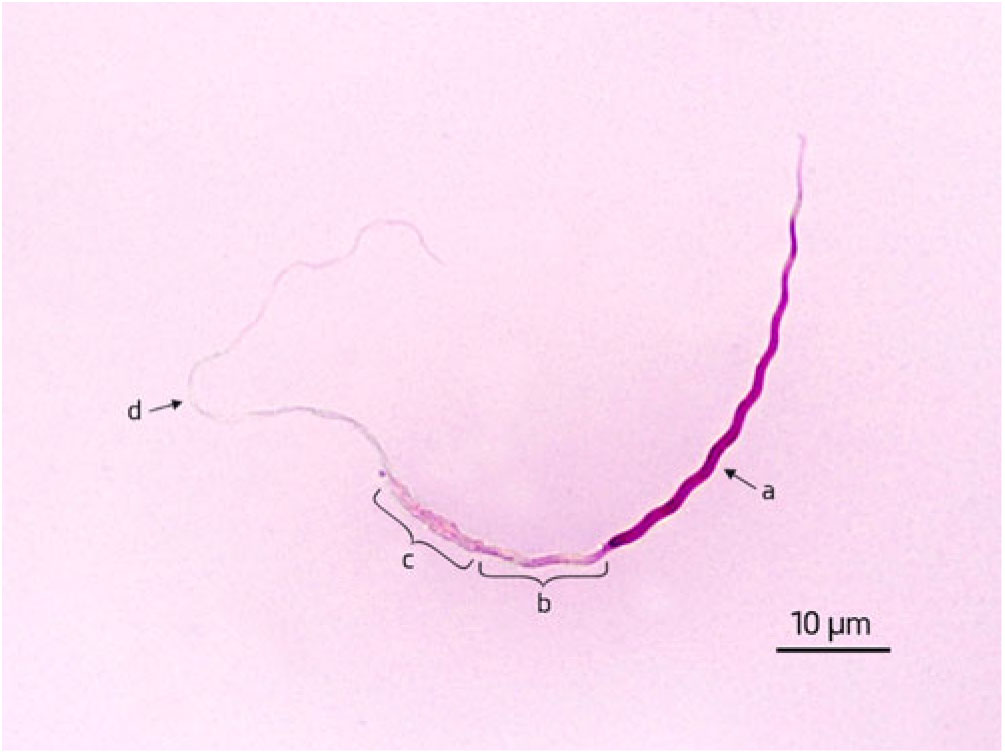
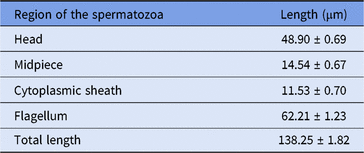
The P.wallacei spermatozoa were helical in shape with a total length of 138.25 ± 1.82 μm and a long head, representing 35% of the total length. The midpiece (14.54 ± 0.67 μm) was shorter than the head, which was attached to the flagellum by a cytoplasmic sheath. This cytoplasmic sheath (11.53 ± 0.70 μm) was reflected as a sleeve around the proximal portion of the flagellum and was a little wider than the other cell components (Fig. 1 and Table 1). Adult males of P. wallacei store cohesive sperm masses in the seminal vesicle, without specific aggregates such as spermatozeugmata and spermatophores (Araújo, Reference Araújo1998; Morales-Gamba, Reference Morales-Gamba2018), commonly found in other elasmobranchs. However, they had similar morphology when it came to helical format (Jamieson, Reference Jamieson and Hamlett2005). In P. wallacei this format was evident during the final phase of stretching of the spermatids and progressed until final formation of the spermatozoon (Zaiden et al., Reference Zaiden, Brinn, Marcon and Urbinati2010), which was the result of condensation of nucleoprotein fibres in the nucleus during spermiogenesis (Chatchavalvanich et al., Reference Chatchavalvanich, Thogpan and Nakai2004). This format allows the spermatozoa to progress in a way that is similar to a propeller (Stanley, Reference Stanley1971).
Photomicrograph of a spermatozoon from an active adult male of Potamotrygon wallacei. (a): head; (b): midpiece; (c): cytoplasmic sheath; and (d): flagellum. Eosin–nigrosin staining.

Sperm morphometric data (mean ± standard deviation (SD)) from the freshwater Amazonian stingray, Potamotrygon wallacei

The dimensions observed in the morphometric analysis of P.wallacei spermatozoa resembled the dimensions of spermatozoa in sharks and rays such as Squalus suckleyi (Stanley, Reference Stanley1971), Myliobatis tobijei and Raja eglanteria (Tanaka et al., Reference Tanaka, Kurokawa, Hara, Jamieson, Ausio and Justine1995) which had been analyzed with electron microscopy. In shark species such as Galeus eastmani, Etmopterus brachyurus and Squatina japonica, substantial differences in the size of spermatozoa were also observed, with total length above 180 μm (Tanaka et al., Reference Tanaka, Kurokawa, Hara, Jamieson, Ausio and Justine1995). These differences may be related to the wide variety of female reproductive tracts and their reproductive modes (matotrophy and lecitotrophy) (Hamlett and Koob, Reference Hamlett, Koob and Hamlett1999), as differences in sperm morphology are result of adaptations to the fertilization environment (Pitnick et al., Reference Pitnick, Hosken, Birkhead, Birkhead, Hosken and Pitnick2009).
Despite the fact that there are no reports in the published literature on sperm plasma membrane integrity in elasmobranchs, the low percentage of abnormal cells observed in this study (~8%) indicated that the in natura semen of P.wallacei males was of high quality in terms of morphology, stimulating new studies on in vitro manipulation for reproduction purposes. These observations are unprecedented for potamotrygonids and they show the morphological similarities of spermatozoa in this group compared with other elasmobranchs.
In addition, this information on sperm plasma membrane integrity and sperm concentration will serve as a basis for future studies involving in vitro manipulation of gametes aimed at the development of protocols for establishment of a germplasm bank. These banks are necessary to provide adequate management strategies for conservation of a species with endemic status and high habitat specificity.
Financial support
This work was financed by a grant from the National Council for Scientific and Technological Development (CNPq) to JLM (process # 484566/2013-0). RDMG is grateful for the Master degree scholarship granted by Fundação de Amparo à Pesquisa do Estado do Amazonas (FAPEAM, process 003/2016-POSGREP).
Conflicts of interests
The authors declare that there is no conflict of interest.
Ethical standards
This work received prior authorization from the Chico Mendes Institute for Biodiversity Conservation (ICMBio) – Brazilian Ministry of Environment (SISBIO # 18285-1), and approval from the Ethics Committee on Animal Use for Research of the Federal University of Amazonas (Protocol CEUA/UFAM # 002/2017).