Introduction
Despite the fact that women's rights have been increasingly defined as equal to men's in both law and social policy, in post-war Japan women continue to be at a disadvantage in many aspects of social and economic life. Many of such gender differentiations stem from cultural and institutional ‘familism’ based on the male-breadwinner family model. Women's housing asset portfolio is a case in point. Outside the conventional family structure, and also that of traditional married women, their housing asset portfolio has remained at a low level. This article explores women's access to housing assets in the institutional context of a home-owning democracy in Japan.
While strong gender-based practices continue, more recent socio-economic changes have inevitably started to redefine women's position in housing, including changes in household formation such as a decline in conventional households; women's increased education and labour market participation, which coincides with destabilised male employment and income; and housing market volatility. An increasing number of women with higher employment and income status now own a share of their residential properties. Although they are still a small minority, the ways in which women participate in the home-owning democracy are now beginning to change.
Home ownership and housing asset accumulation have long been central themes in housing studies internationally (see, for example, Forrest and Murie, Reference Forrest and Murie1995; Kurz and Blossfeld, Reference Kurz and Blossfeld2004), and there has been a growing body of literature regarding the position of women in various welfare states (Lewis, Reference Lewis1992; Orloff, Reference Orloff1993; Sainsbury, Reference Sainsbury1994). Existing studies on women and housing, however, have tended to highlight their disadvantaged positions (Gilroy and Woods, Reference Gilroy and Woods1994), and research into women's individual asset accumulation has been underdeveloped. This article, drawing from survey data in Japan, seeks to fill this gap, stressing the importance of women's home ownership in our understanding of contemporary social processes.
After explaining the research methodology that informs the empirical part of this article, we begin with the conceptual and policy frameworks. First, gender issues in the concept of a property-owning democracy will be explored, followed by an examination of the various institutional arrangements to shape women's positions and experiences. The article then moves on to present the empirical research findings, discussing the current housing situations of women, together with demographic shifts taking place over the past few decades. This section highlights significant differences between women in conventional and non-conventional households in their housing asset portfolios. Finally, the article discusses continuity and change in women's access to home ownership. The overall aim of this article is to demonstrate a structural lag between the institutional ‘familism’ model and salient forces of socio-economic change surrounding women's position in Japan.
Research
Empirical evidence was drawn from a survey conducted in 2004 among women aged between 25 and 54 in Japan. The survey questionnaire covered a wide range of issues relating to women's housing and assets, including savings and pensions. Out of a sample of 3,676 women, who were randomly selected across the country based on the Basic Resident Register to avoid bias in terms of age and residential areas, 2,205 responses were received (a 60 per cent response rate) (for full reports, see the Institute for Research on Household Economics, 2006a, 2006b).
For analysis, we used different categorisations to address the issues relating to individuals’ assets. In general housing statistics, there has often been a tacit assumption that housing is an issue at the household level, and thus the majority of housing research has been conducted among households as a unit. We therefore conducted a two-layered analysis: one at the household level (in order to compare and contrast our results with the national data), and another at the individual level (to highlight women's own asset status). The analysis focuses in particular on the asset profile of individual women in overcoming conventional limitations.
Despite efforts to reflect national characteristics, there was a certain bias attached to our samples. Compared with census data, our sample included: a smaller percentage of those in their twenties; more married women (82 per cent compared to 73 per cent in the census) and fewer never-married ones (12 per cent compared to 19 per cent); and a smaller percentage in smaller households (the average household size was 3.9 people in our sample compared with 2.7 in the census). The bias resulted in more conservative outcomes, and also the research was not able to capture well the experiences of single women and single households. For this article, the limitation of the survey results are supplemented by other research to highlight changes in this area.
Women and the home-owning democracy
How distinctive the Japanese welfare state is in comparison with other industrial nations or in the East Asian context is a matter of debate (see, for example, Esping-Andersen, Reference Esping-Andersen1997; Peng, Reference Peng2000; Holliday and Wilding, Reference Holliday and Wilding2003; Takegawa, Reference Takegawa2005), but certainly a characteristic of Japan's welfare mix has been its ‘familism’ (Takegawa, Reference Takegawa1999; Yokoyama, Reference Yokoyama2002; Uzuhashi, Reference Uzuhashi2003; Watanabe, Reference Watanabe2004; Osawa, Reference Osawa2006). The close link between home ownership and the male-breadwinner family model, which underpinned the foundation of the welfare state, has been at the heart of Japan's property-owning democracy. The gender divisions of labour have been clearly defined in the Japanese welfare state, and thus the development of the home ownership sector has been explicitly connected with the ‘standard family’ model (Yazawa, Reference Yazawa, Kishimoto and Suzuki1996; Izuhara, Reference Izuhara2000; Hirayama and Ronald, Reference Hirayama and Ronald2007). Since the scale of state welfare provision has remained marginal, the accumulation of assets in the form of residential property has been pivotal in household security (Hirayama and Hayakawa, Reference Hirayama, Hayakawa, Forrest and Murie1995; Hirayama, Reference Hirayama and Izuhara2003). The government has encouraged middle-class nuclear households to obtain ‘husband-earned’ housing as ‘family places’. Public resources have almost exclusively been directed towards helping such ‘standard families’ through state-assisted housing loans and a unique occupational welfare system. In this context, unlike other societies where joint ownership has become increasingly popular (Finch et al., Reference Finch, Hayes, Mason, Masson and Wallis1996), in Japan gendered accumulation of housing assets has been distinctive and persistent.
Peter Saunders (Reference Saunders1990) first introduced the concept of a property-owning democracy by examining the relationship between housing tenure and political alignment in Britain. He discussed in general how the whole nation had become middle class with the expansion of home ownership towards the lower sections of society, and in particular how promotion of home ownership had led to a shift in people's voting behaviour. The expansion of home ownership brought increased opportunities for participation in society. Despite such expansion of home ownership boosting the middle-class population, however, Forrest et al. (Reference Forrest, Murie and Williams1990) argue that not everybody is granted the same privilege and opportunity. For Forrest et al., ‘home ownership is a diverse and fragmented tenure deriving from and generating a diversity of experiences amongst owners. This differentiation within home ownership has increased as the tenure has extended to different groups of people and types of properties’ (Reference Forrest, Murie and Williams1990: 2).
Social class was at the heart of the debate regarding diversity and democracy, while debates around aspects of gender differences were few and far between. When women were discussed in the context of housing, it tended to be the experiences of female-headed households as a new type of household. Gender-sensitive research on housing wealth has certainly been underdeveloped to date. However, social change in more recent years has brought women (as individuals) greater opportunity to participate in housing wealth accumulation, and their experiences are likely to be different from those of men and also vary according to marital status and social class.
The significance of home ownership has recently been revisited in the context of property-owning or asset-based welfare states (Groves et al., Reference Groves, Murie and Watson2007). With the diffusion of neoliberal ideology and the intensified competitiveness of the globalised economy, there has been growing pressure to cut back on social spending and public subsidies. This has corresponded with the tendency of an increasing number of welfare states to promote the individual ownership of residential properties. The idea is that the expansion of home ownership can be a deterrent to a high level of social spending, substituting for a decline in state welfare provision. Again, however, the argument around asset-based policy focuses on social class, paying little or no attention to gender differences. In Japan, where housing policy has been directed almost exclusively towards the promotion of property ownership since immediately after the Second World War, the trade-off between state welfare and home ownership has long been regarded as an important element accounting for the growth of owner occupation (Hirayama and Hayakawa, Reference Hirayama, Hayakawa, Forrest and Murie1995). This characteristic of Japan's welfare state is strongly implicated with institutional ‘familism’ and the gendering of housing asset ownership.
Women in the institutional context
Housing policy occupied a ‘wobbly pillar’ in social policy in Japan as in many other advanced economies because – compared with education, healthcare and social security – housing is more likely to be provided in the market domain (Torgersen, Reference Torgersen, Turner, Kemeny and Lundqvist1987). Moreover, in Japan, since 1950 issues relating to housing have been officially excluded from social policy (and put under the jurisdiction of the Construction Ministry), when the Social Security Committee concluded that housing was not a part of ‘social security’. Consequently, housing policy in Japan has not been effectively targeted to achieve equality and redistribution between the social classes or between the sexes.
Housing policy alone, however, is not responsible for the current asset status of Japanese women. To take a broad view, various laws and policies – and also the absence of them – have combined to produce the current position and status of women in the family and in society as a whole. This section largely focuses on various areas of policy and institutional arrangements, which have some implicit and explicit concept of ‘women’ as individuals or as dependents. It does not provide an exhaustive list of such policies but rather highlights significant areas of institutions shaping and constraining women's access to housing wealth.
While some specific policies have much more direct interaction with causes relating to women's asset building, others are more implicit. For example, although contemporary Japan has moved away from the male-breadwinner family model and has moved towards the dual-worker model in line with international trends (Osawa, Reference Osawa2006), wives’ increased contribution to the household economy has not yet been translated into asset accumulation, largely due to the low status of women in the labour market, conventional cultural practice and also the financial and property ownership mechanisms found in Japan (Izuhara, Reference Izuhara2002, Reference Izuhara2005).
The first most obvious and direct intervention is the mortgage lending policy. Among various housing measures, since 1951 the low-interest loans by the Government Housing Loan Corporation (GHLC) have been particularly crucial for the expansion of the home ownership sector. The GHLC provided middle-income households with long-term, low-interest mortgages to achieve and improve their home ownership. Their lending policies were not explicitly discriminating towards women or single people; however, certain eligibility criteria were set to screen potential borrowers. It was as late as 1981 that the GHLC began to provide single-person households with mortgages, and until 1993 an age restriction existed for single households. Among single households, public loans were available only to those over the age of 40 until 1988, and to those aged over 35 before the age restriction was removed in 1993. The family-oriented loan was also evident in other criteria: only those who purchased, extended or rebuilt a house larger than 50 m2 in size were subject to receive tax incentives, not to mention access to public loans. This implicitly excluded smaller (single) households. Also, until 1997, lower ceilings had been used for borrowing limits applicable to single people. The lending policy of the GHLC was gradually transformed towards including single people. However, the intention of such policy changes was to stimulate the economy in general rather than to encourage a particular group to become home owners (Hirayama, Reference Hirayama and Izuhara2003). Japan's housing policy has moved sharply towards accentuating the role of the market in providing and financing housing since the mid-1990s (Hirayama and Ronald, Reference Hirayama and Ronald2007). This policy shift led to the dissolution of the CHLC in March 2007, and its successor, the Housing Finance Agency, withdrew from the primary mortgage market and deals only with the secondary market of mortgage securities. Although private financial institutions do not necessarily discriminate against women, their access to mortgages continues to be restricted due to their employment status and related financial status.
Second, the individualised (property) ownership system tends to squeeze women out of housing wealth accumulation. It was introduced in the New Civil Code in 1947 to reform the patriarchal authority over family wealth and management under the previous regime, and instead to promote equal rights and greater democracy among the population regardless of their gender and birth order. In reality, however, the system has produced a pervasive pattern of home ownership. Under the system, the proportion of an individual's investment is directly translated to a share of his/her ownership of the property. Thus, male breadwinners tend to be ‘sole owners’ due to their dominance in income-earning activity, while their wives have little or absolutely no share of the family wealth. Moreover, in Japan, savings and borrowings are largely based on individuals, and closely tied to individuals’ own income and credit status, which contributes to the exclusion of women from joint ownership of their marital home and other family wealth. In this scenario, a dual-earner household each needs to arrange a separate mortgage to have their contribution recognised. Only those who borrow mortgages and invest in a house purchase are entitled to have their name on the ownership deed, unless they obtain property by other means such as inheritance. Over the years, the necessity to translate women's unpaid work into financial terms and thus improve their asset situation has been stressed, but the conventional ownership pattern has been maintained.
Third, in contrast, social security has been developed based on the ‘family as a unit’, which also reinforces women's positions as dependents (Osawa, Reference Osawa1993; Yokoyama, Reference Yokoyama2002) and undermines their wealth accumulation potential. The notion of the ‘family as a unit’ has encouraged society to achieve high marriage rates in the post-war period since the conventional family structure has always given significant advantages to its members. The system often made women financially dependent on their husbands, thus restricting their choices, and reinforced gender roles among married couples in order to maximise available resources within the family and to benefit fully from the system. Japanese women thus had typically gained welfare entitlement not by their own right and qualification, but by virtue of their dependent status within the family as wives and mothers. This mechanism generated an economic ‘bond’ between the couple and contributed to women's low asset portfolio (Izuhara, Reference Izuhara2000).
The discriminatory tax treatment of dual-earner households and housewives’ pension categories are good examples. Many married women try not to exceed the maximum earning limit (¥1,300,000 = £6,500) for basic benefits without contributions (and ¥1,030,000 for husband's income tax deduction) and to stay in a dependent status in order to benefit fully from the taxation and welfare system. The Class 3 public pension category was introduced in 1985 to reinforce the protection of housewives. The intention of the Class 3 pension was to reduce the large proportion of women without a pension in old age. However, the fact that housewives benefit without any additional contributions by their employed husbands continues to provoke public debate, especially in the context of an ageing society and the foreseeable ‘pension crisis’ (Yokoyama, Reference Yokoyama2002). On the other hand, the pension system has now started to recognise and protect women who fall out of the security of marriage given the current demographic shift. Under the 2004 reforms, couples who divorce after April 2007 are able to split the entitlement to the earnings-related portion of the husband's pension that accrued during their marriage. The intention of the reforms is to provide financial security to divorced women in later life, although the full promotion of equal opportunity and status in employment for women remains a contentious issue.
Since the ‘family as a unit’ system is employed in taxation and benefit calculations, a married woman who is unemployed can be better off on average than her counterpart who has a moderate career. Japan's housing system has been characterised by the fact that major corporations have provided their employees with housing-related benefits such as housing allowances, company housing and company housing loans (Sato, Reference Sato, Hirayama and Ronald2007). However, such in-house housing assistance targeted mostly male employees and their family members. Limited access to housing-related occupational benefits can be a drawback for single ‘career’ women to secure adequate accommodation on their own. The housing asset status therefore can be highly polarised between married women and their single career counterparts in their old age: the asset status of married women tends to become more favourable in their old age when they outlive their partner (through horizontal inheritance), although the succession of housing wealth seems too late for many women to utilise for themselves.
Finally, the labour market provides another means of gender stratification on housing wealth. The Equal Opportunity Act enacted in 1986 and its major amendments in 1997 and 2006 have provided the institutional framework for enhancing women's entry into and status in the labour market. The female labour participation rate has increased from 58 per cent in 1980 to 68 per cent in 2005. Even the participation rate of those aged between 25 and 34 who used to leave the workforce due to marriage and child rearing has been rising. However, hiring practices, employment stability, promotion opportunities and the remuneration of women are still far from equal to those of men. While corporations have abandoned explicit gender discrimination in employment practices (responding to requirements by the reformed Equal Opportunity Act), they have developed new employment categories in which, for example, employees who accept company's orders such as work-related moves and long working hours receive higher salaries and better promotion opportunities. Indeed, male employees are more likely to fit into such categories. This system effectively maintains de facto gender discrimination in employment practices. More recently, a combination of the post-bubble recession and increased competitiveness in the global economy has brought a ‘casualisation’ and thus ‘feminisation’ of the labour force. Partly due to the reformed Dispatched Labour Law in 1999, the ratio of part-time, temporary and dispatched employment rose from 7 per cent in 1992 to 13 per cent in 2002 for men, but from 36 per cent to 49 per cent for women. In the same period, the rate of regular or managerial employment dropped from 91 per cent to 85 per cent for men, and for women more sharply from 63 per cent to 48 per cent. Since occupational welfare has played an important role in substituting for public welfare provision, employment discrimination has combined with the allocation of family-based social security benefits to produce a large disparity of economic situations between women inside the conventional family form and those outside.
Demographic change and women's housing condition
The housing asset status of Japanese women – in particular, those housewives who still form the majority in Japanese society – are best described as having ‘the ideological ownership of housing without any actual legal substance’. The majority of Japanese women typically live in a house owned by their breadwinner husband without their name on the ownership deed. Drawing from the survey data, this section highlights the differentiated housing situations of women with particular reference to demographic shifts. It demonstrates a strong continuity of traditional housing practices found in Japanese society.
Marital status and housing tenure
Marital status is a key indicator for differentiating women's housing situations in Japan. Many married women live in ‘husband-earned housing’ as a ‘family place’, while their unmarried counterparts are not able to participate fully in the home-owning democracy. Recent demographic transformations, however, mainly caused by rising marital age, falling fertility and increasing longevity, have led to a decline in conventional households. This also means that an increasing number of women are now outside the ‘standard family’ model and thus are at a disadvantage in their housing choice.
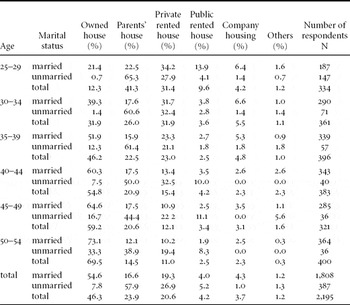
The survey data clearly indicate that housing tenure correlates with the age of the respondents: the older they are the more likely they are to own a house (see Table 1). This reflects the fact that over time many households climb up the housing ladder towards home ownership. The level of home ownership is 32 per cent for those aged 30–34, 55 per cent for those aged 40–44, and as high as 70 per cent for those aged 50–54. Younger women tend to live in their parents’ home (41 per cent for the 25–29 cohort) or private rental housing (32 per cent for those aged 30–34). Many women appear to move from the parental home to private rental, and eventually to an owner-occupied dwelling.
Women's housing tenure by age and marital status

Marital status determines the women's housing tenure (see Table 1). The average level of home ownership is 55 per cent for married women across all age cohorts, but as low as 8 per cent for unmarried women. This stark contrast is observed for all the age groups. The levels of home ownership for married women and unmarried women are 52 per cent and 12 per cent for those aged 35–39, and 65 per cent and 17 per cent for those aged 45–49, respectively. The data suggest that the majority of women who are owner-occupiers tend to climb up the housing ladder not as individuals but via marriage.
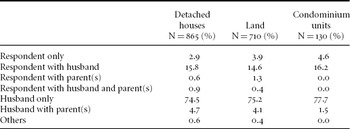
Many married women live in owner-occupied housing, although these dwellings are mostly ‘husband-earned/owned dwellings’. Our survey was designed to identify the legal ownership of both land and dwellings (for example, detached houses, condominiums). The ownership of a condominium usually means the ownership of a certain share of the building and its land. As shown in Table 2, 75 per cent of detached houses, 75 per cent of its land and 78 per cent of condominiums are owned by the respondents’ husbands as ‘sole owners’. The cases in which women have some share are as low as 20 per cent on average. This means that many women who reside in their owner-occupied home are not the legal owner of their property. Moreover, among women who own a share of their property, the rates of those who own more than 50 per cent are low: 16 per cent for houses and 23 per cent for condominiums.
The ownership of detached houses, land, and condominiums

The majority of owner-occupiers purchased or had their house built rather than inherited it. According to the survey data, the male heads of households played a significant role in financing the acquisition of their home. Of households who purchased or had their house built, 96 per cent used mortgages, and housing loan repayment is almost exclusively the responsibility of husbands (90 per cent). This demonstrates that the financial status of male workers in the mortgage market has been the basis for the expansion of Japan's home ownership. There are many cases where wives as the secondary earner of households contribute to mortgage repayments, but they tend not to be formally responsible for mortgages mainly due to their low financial status. The rate of women who own inherited properties was equally low due to the gendered inheritance practice (Izuhara, Reference Izuhara2004).
Single women and limited housing choice
Over the past decades, the number of unmarried women has consistently been on the increase, and thus the concept of the ‘standard family’ has been challenged. According to the Population Census, between 1980 and 2005 the proportion of unmarried women rose from 26 per cent to 62 per cent in the 25–29 age group, and from 22 per cent to 37 per cent in the 30–34 age group. The ratio of unmarried women at the age of 50, who are defined as ‘lifelong never-married’ in the Japanese statistical term, increased to 7 per cent from 1980 to 2005. While the divorce rate is still lower in Japan than in most western countries, the ratio of divorces to marriages rose from 18 per cent in 1980 to 37 per cent in 2005. The rate of conventional nuclear households, consisting of a married couple and their children, decreased from 40 per cent in 1985 to 34 per cent in 1995 and to 30 per cent in 2005. Such changes are particularly noticeable in urban areas. For example, in Tokyo in 2005 the rate of unmarried women was 43 per cent in the 30–34 age group; the rate of ‘lifelong never-married women’ was 13 per cent; and the percentage of nuclear households was as low as 26 per cent. As a result, the combination of the family-orientated housing system and the increasing number of unmarried women has led to an inevitable increase in female individuals with limited housing choice. It is difficult for many women to access the home ownership market without marriage due to their often disadvantaged employment status and income.
Since the late 1990s, an increase in ‘parasite singles’ – adult children living in their parents’ home – has drawn not only academic but also popular debate (Yamada, Reference Yamada1999). According to the survey data, the average rate of unmarried women living in their parents’ houses is 58 per cent (see Table 1). The figure decreases as the women get older. However, even in the 45–49 age band, the rate is significantly high, at 44 per cent. It has been pointed out that ‘parasite singles’ may benefit from advantages such as not having to pay housing costs and, fearing a decline in their quality of life should they become independent or get married, they prefer to live for long periods in their parents’ house. The sustained promotion of home ownership has encouraged the current parents’ generation to acquire their own spacious home, enabling the younger generation to become ‘parasites’.
Some commentators criticise ‘parasite singles’ for their dependent attitudes, attributing the phenomenon to a cultural tendency peculiar to Japan: parents’ overprotection of their children and the delay of young adults in becoming independent (Miura, Reference Miura2005). However, taking the recent prolonged recession and the reorganisation of the labour market into consideration, it is reasonable to regard the ‘parasite’ phenomenon as not culturally but economically rational. Many unmarried women, whose employment is mostly insecure, tend to have very limited housing choice other than living in their parents’ house. A recent survey on ‘parasite singles’, conducted by the National Institute of Population and Social Security Research (2001), found that many ‘parasite singles’ were not ‘lazy’ but, despite working, did not earn enough to be able to establish an independent household.
In Japan, the private rental sector has accounted for about a quarter of the housing stock. Public housing policy, focusing on the promotion of home ownership, has not supported the development of the private rented sector. There has been little assistance in the construction of private rental housing and absolutely no provision of rent subsidy. This has resulted in low-quality private rental housing in terms of floor space and facilities. Many unmarried women have sought to secure their housing in the private rental market, but found it difficult to access adequate, affordable accommodation. Furthermore, rental property owners tend to reject female-headed households, because unmarried women, unless they are employees of major companies, are often seen as not having stable income for rent payments and, moreover, are viewed as ‘strange people’ in popular discourse (Sakai, Reference Sakai2003). Major corporations provide their employees living in private rental housing with rental allowance, but such provision is de facto only for male regular employees. Corporations tend to employ women as lower-rank or non-regular employees who are able to commute from their home or parental home, enabling them to avoid providing a rental allowance.
Divorced women tend to suffer employment instability and a very low level of income. The poverty rate of lone-mother households has notably been higher than that of other types of household (Hamamoto, Reference Hamamoto, Higuchi and Ota2004; Yui, Reference Yui2006). In addition, the individual property system has produced a disadvantageous position of divorced women in (housing) property division with their former husbands. Divorced women, who lived in an owner-occupied home before divorce, tend to move out of the home since they possessed little or no legal share of the property. For many women, obtaining a reasonable share of the property in the court appears not to outweigh its likely financial and social cost. According to a questionnaire survey on divorced individuals with parental custody conducted by the Ministry of Health and Welfare in 1997, housing tenure change before and after divorce was significantly different between men and women. While the level of home ownership dropped a little from 43 per cent to 41 per cent for men, the figure more than halved from 29 per cent to 11 per cent for women. The rate of those who moved immediately after divorce was 28 per cent for men but 71 per cent for women.
New trends in women's home ownership
Alongside the strong persistence of gender-based practices highlighted in the previous section, some changes are also taking place in the current socio-economic climate. First and foremost, with the weakening foundation of the Japanese welfare state, a decline in ‘standard families’ is the most influential factor leading the change. In contemporary society, the male-breadwinner family model is no longer sustainable or the most desirable option for many people. This section investigates some subtle but emerging changes in relation to women and housing wealth. There are three significant dimensions which erode the ‘standard family’ model and potentially promote women's greater access to home ownership. First is demographic change. There has been a steady increase in non-conventional households, and thus an increasing number of women are now living outside the traditional family model. Rapid social change has meant that the sustainability of the traditional model is now increasingly being challenged. This has pushed the government to reconsider the ways in which social policies and institutions are formed and operated. One example is the reform in 2007 of the pension system to protect divorced women. The government is not beginning to dissolve the tradition of family-centred institutional approaches, but public policies now require suitable adjustments to accommodate real demographic changes. A research committee within the Council for Gender Equality (2002) recommended that the systems of social security and taxation be transformed from ‘household as a unit’ to an individual base. According to the committee, current institutions do not support women's free choice in terms of lifestyle but lead or even force women to choose particular patterns of family and work life.
Second, labour market restructuring has destabilised the employment and income of male breadwinners. Japan's corporate sector, particularly the major corporations, traditionally adopted a system of lifelong employment and seniority-based pay systems. However, an increasing number of corporations have had to abandon such practices and replace them with a more neoliberal approach of performance-based system for both salary and promotion. According to a survey conducted by the Japan Institute for Labour Policy and Training (2004), the percentage of companies that placed more importance on performance than the traditional seniority system to determine salaries was 19 per cent. However, 42 per cent of the companies who responded were planning to adopt such performance-based pay within the next three years. It is thus becoming increasingly difficult for male householders to obtain a ‘family wage’ in the post-industrial labour market. The decline of male income has inevitably pushed wives into the formal labour market.
Gender equality and the improvement of women's working conditions have become policy issues which the government needs to address, not only due to increasing claims from women for equality but also due to the decline in the labour force. The government now recognises the necessity to mainstream gender equality in the labour market and various aspects of social life in order to mitigate falling fertility rates. The Basic Law for a Gender-Equal Society in 1999 meant that gender equality has become a public policy priority. Also, successive reforms of the Equal Opportunity Act have signified a shift in government policy towards encouraging women into the workforce by means of achieving gender equality in employment practices, although de facto discrimination still persists.
The third dimension is related to housing market volatility. Housing and land prices rose continuously and rapidly until the economic bubble burst, and the lack of affordable housing has continued to be a problem in Japan. While the burst of the bubble led to a drop in housing prices, housing has not yet become affordable for many, and housing prices have risen again in large cities since the early 2000s. In the Tokyo metropolitan area, the average price-to-income ratio for a condominium, which rose from 4.2 times salary in 1985 to eight times in 1990, dropped to 4.7 times in 1998, and then rose again to 5.2 times in 2005 (Ministry of Land, Infrastructure and Transport, 2006). Moreover, public policy to accelerate urban redevelopment in major cities in the context of the post-bubble recession has generated a new boom in the housing market in the city centre, and has encouraged rising housing prices (Hirayama, Reference Hirayama2005). Such a volatile housing market, combined with the reorganisation of the labour market, has made it difficult for households on only a male breadwinner's income to purchase a home. Moreover, as Japan's economy has undergone a period of deflation or minimal inflation since the bubble burst, the burden of mortgage repayment has become heavier. In other words, wives are increasingly expected to earn considerable income in order to access home ownership. In addition, first-time marriage age has consistently been rising. Since most Japanese people acquire their own housing after marriage, later marriage means a shorter period for housing loan repayment. This also encourages wives to participate in the paid workforce to help repay such loans more easily.
Dual-earner households
There are considerable debates in contemporary Japanese society around social class becoming more fixed over the generations (Shirahase, Reference Shirahase2006; Tachibanaki, Reference Tachibanaki2006). This is also evident in partnering practices: for example, high-income females tend to marry high-income males and low-income females tend to marry low-income males, which accentuates the class division. This is a more positive side of the change that shows the emergence of double-income households in which women play a crucial role in the household economy and thus access to a share of their residential property.
There are often two types of double-income households. The more common type is a household with an employed husband and a spouse in part-time or casual employment, while the other type is where the husband and wife are both in full-time regular employment. Recent social changes have increased the former type of households in particular, in which wives who have contributed to the household economy have a small share of the residential property. While the latter type has still remained a minority, an increasing number of women are now willing to maintain their full-time employment status, and thus their share of the residential property is proportionally larger.
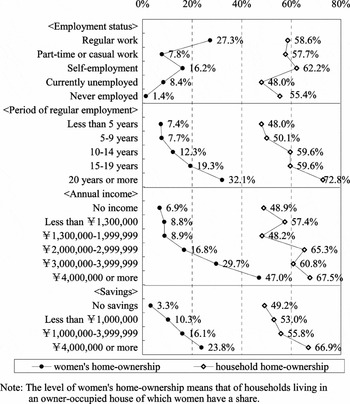
Our survey revealed that the economic status of women correlated to the level of their home ownership and whether or not they had a share of the property. Figure 1 illustrates, among married women, the relationship between various indices relating to economic status, the level of household home ownership and the level of women's home ownership (the rate of owner-occupier households in which the wives have a share of the property). The level of women's home ownership clearly correlates with their employment status: higher for those in full-time regular employment (27 per cent) than for those in part-time or casual employment (7.8 per cent), in self-employment (8.4 per cent) and not in employment (1.4 per cent). The duration of their full-time regular employment again correlates both to the level of their own ownership and that of household home ownership. For women who worked for more than 20 years, the level of their own ownership is high, at 32 per cent, and that of household ownership is significantly high, at 73 per cent. Women's full-time employment plays a key role not only in accessing their own ownership but also in increasing the household access to owner-occupation.
Married women's home-ownership by employment status, period of regular employment, annual income and savings

Not surprisingly, income has a strong correlation with home ownership. In cases where women earn more than ¥4,000,000 (about £20,000) annually, the rate of women's home ownership and that of a household's are high: 47 per cent and 67 per cent, respectively. It is noteworthy that the level of home ownership by household is the lowest, at 48 per cent, for the group where women earn ¥1,300,000–¥1,999,999 (£6,500–£10,000) annually. The reason could be that women in this group do not seek to earn income much above ¥1,300,000 (£6,500) – the upper limit for benefiting fully from the taxation and social security systems – presumably because their husbands’ incomes are low. But their earnings not exceeding ¥2,000,000 (£10,000) is reflected in the low level of home ownership. The survey data also show that women who own substantial savings tend to own their own housing assets, and support their households in becoming owner-occupiers. For women with savings of more than ¥4,000,000 (£20,000), their individual level of home ownership is relatively high, at 24 per cent, and that of household home ownership at 67 per cent.
Single career women
Changes are also apparent among unmarried women with a career trajectory. Many unmarried women, who exist outside the protection of the family-based system, have been excluded from the home-owning democracy. However, a new trend is that a small but increasing number of single women in full-time employment are purchasing condominiums in the central areas of large cities. Matsumoto (Reference Matsumoto1998), analysing the geographic distribution of single people who own a house in the Tokyo metropolitan area, found that the ratio of female home owners was high in central city areas, while that of male home owners was more concentrated in the periphery, implying an expansion of the home ownership market for single women in the city centre. Also, a survey of 3,743 households who purchased a condominium in the Tokyo metropolitan area in 2004 revealed that 7.7 per cent of all the purchasers were single women and that more single people and fewer nuclear households acquired a condominium in the ward districts than in other areas. The ratio of single people (including men) and nuclear households was 22 per cent and 34 per cent in the ward districts, and 9 per cent and 51 per cent in other less central areas, respectively (Recruit, 2005).
According to Yui (Reference Yui, Yui, Kamiya, Wakabayashi and Nakazawa2004), who investigated the urban condominium market, a structure that supported the growing market for single women was developed for various reasons: an increase in income of women in full-time employment; the tendency of single women to place importance on convenient commuting, leading to the growth of a market for condominiums aimed at women in city centres; and, finally, single women, being concerned with providing for their old age, increasingly wishing to stabilise their residential situation by acquiring assets in the form of housing. In large cities, Tokyo in particular, developers have sought to expand the condominium market by targeting single women as a new group of purchasers, and have increased the construction of so-called ‘compact condominiums’ for the single and couple markets. While a compact condominium unit is small, with a floor space of just 30–50 m2, it is equipped to a high specification, is fashionably designed and located in attractive or trendy neighbourhoods, appealing to urban career women. Some private banks have also begun to provide mortgages specifically for single women in full-time employment. These new trends have reflected the fact that single career women have formed a small but visible new group accessing urban home ownership.
Conclusion
A particular form of property ownership has been embedded in the development of post-war Japan's home-owning democracy, where the majority of women have lived in ‘husband-earned housing’ as ‘family places’ without owning their own housing assets. This article has explored the impact of various institutions and policies on gendering the ownership of residential property. A wide range of institutional and policy practices – mortgage provision, property ownership, social security, taxation and labour market operation – have effectively combined to define the position and status of women in the property-owning society. Within the ‘family as a unit’ system, many women have sought to secure their housing and life not as individuals but via marriage. Due to such a system, unmarried women have suffered from economic insecurity and limited housing options.
Over the past few decades, Japan has experienced demographic transformations, labour market reorganisation and housing market volatility. These rapid socio-economic changes are likely to erode the ‘standard family’ model, promoting social restratification with women's situations as a key variable. It is becoming less affordable for single-earner households to purchase a house, and thus dual-earner households have been on the increase. Households with two earners both in full-time employment are in the most advantageous position to buy their own home, where working wives tend to own their share of the property. Many wives have entered the newly evolving casual labour market to reinforce the household economy and to access home ownership, although their share of the property has remained marginal. In the central areas of major cities, some single career women buying a condominium have generated a new trend in the housing market. Many unmarried women have lived in their parents’ home, or had no choice but to live in low-quality private rental accommodation. At the lowest end of society, divorced women with children have been disadvantaged by unemployment and a very low level of income, and have mostly been excluded from the home-owning democracy.
There has been an increased contradiction between the persistency of institutional ‘familism’ and real socio-economic changes in Japan. Despite the decline in conventional households and the instability of labour and housing markets, the policy framework of favouring traditional families and thus the gendered ownership of housing assets remain largely static. It is likely that, while more women with higher employment status will own their own housing assets on the one hand, an increasing number of unmarried women with unstable employment, on the other hand, will be out of the protection of social policy. A critical question, drawn from Japan's experiences, is whether or not a home-owning democracy associated with the institutional gendering of housing asset accumulation will change.
Acknowledgement
This article draws on research on ‘women and assets in Britain and Japan’ funded by the Institute for Research on Household Economics, Japan. The authors were members of the project team.