

%20--%3e%3c!DOCTYPE%20svg%20PUBLIC%20'-//W3C//DTD%20SVG%201.0//EN'%20'http://www.w3.org/TR/2001/REC-SVG-20010904/DTD/svg10.dtd'%3e%3csvg%20version='1.0'%20id='Layer_1'%20xmlns='http://www.w3.org/2000/svg'%20xmlns:xlink='http://www.w3.org/1999/xlink'%20x='0px'%20y='0px'%20width='64px'%20height='64px'%20viewBox='5.5%20-3.5%2064%2064'%20enable-background='new%205.5%20-3.5%2064%2064'%20xml:space='preserve'%3e%3cg%3e%3ccircle%20fill='%23FFFFFF'%20fill-opacity='0'%20cx='37.785'%20cy='28.501'%20r='28.836'/%3e%3cpath%20fill='%23595959'%20d='M37.441-3.5c8.951,0,16.572,3.125,22.857,9.372c3.008,3.009,5.295,6.448,6.857,10.314%20c1.561,3.867,2.344,7.971,2.344,12.314c0,4.381-0.773,8.486-2.314,12.313c-1.543,3.828-3.82,7.21-6.828,10.143%20c-3.123,3.085-6.666,5.448-10.629,7.086c-3.961,1.638-8.057,2.457-12.285,2.457s-8.276-0.808-12.143-2.429%20c-3.866-1.618-7.333-3.961-10.4-7.027c-3.067-3.066-5.4-6.524-7-10.372S5.5,32.767,5.5,28.5c0-4.229,0.809-8.295,2.428-12.2%20c1.619-3.905,3.972-7.4,7.057-10.486C21.08-0.394,28.565-3.5,37.441-3.5z%20M37.557,2.272c-7.314,0-13.467,2.553-18.458,7.657%20c-2.515,2.553-4.448,5.419-5.8,8.6c-1.354,3.181-2.029,6.505-2.029,9.972c0,3.429,0.675,6.734,2.029,9.913%20c1.353,3.183,3.285,6.021,5.8,8.516c2.514,2.496,5.351,4.399,8.515,5.715c3.161,1.314,6.476,1.971,9.943,1.971%20c3.428,0,6.75-0.665,9.973-1.999c3.219-1.335,6.121-3.257,8.713-5.771c4.99-4.876,7.484-10.99,7.484-18.344%20c0-3.543-0.648-6.895-1.943-10.057c-1.293-3.162-3.18-5.98-5.654-8.458C50.984,4.844,44.795,2.272,37.557,2.272z%20M37.156,23.187%20l-4.287,2.229c-0.458-0.951-1.019-1.619-1.685-2c-0.667-0.38-1.286-0.571-1.858-0.571c-2.856,0-4.286,1.885-4.286,5.657%20c0,1.714,0.362,3.084,1.085,4.113c0.724,1.029,1.791,1.544,3.201,1.544c1.867,0,3.181-0.915,3.944-2.743l3.942,2%20c-0.838,1.563-2,2.791-3.486,3.686c-1.484,0.896-3.123,1.343-4.914,1.343c-2.857,0-5.163-0.875-6.915-2.629%20c-1.752-1.752-2.628-4.19-2.628-7.313c0-3.048,0.886-5.466,2.657-7.257c1.771-1.79,4.009-2.686,6.715-2.686%20C32.604,18.558,35.441,20.101,37.156,23.187z%20M55.613,23.187l-4.229,2.229c-0.457-0.951-1.02-1.619-1.686-2%20c-0.668-0.38-1.307-0.571-1.914-0.571c-2.857,0-4.287,1.885-4.287,5.657c0,1.714,0.363,3.084,1.086,4.113%20c0.723,1.029,1.789,1.544,3.201,1.544c1.865,0,3.18-0.915,3.941-2.743l4,2c-0.875,1.563-2.057,2.791-3.541,3.686%20c-1.486,0.896-3.105,1.343-4.857,1.343c-2.896,0-5.209-0.875-6.941-2.629c-1.736-1.752-2.602-4.19-2.602-7.313%20c0-3.048,0.885-5.466,2.658-7.257c1.77-1.79,4.008-2.686,6.713-2.686C51.117,18.558,53.938,20.101,55.613,23.187z'/%3e%3c/g%3e%3c/svg%3e)
%20--%3e%3c!DOCTYPE%20svg%20PUBLIC%20'-//W3C//DTD%20SVG%201.0//EN'%20'http://www.w3.org/TR/2001/REC-SVG-20010904/DTD/svg10.dtd'%3e%3csvg%20version='1.0'%20id='Layer_1'%20xmlns='http://www.w3.org/2000/svg'%20xmlns:xlink='http://www.w3.org/1999/xlink'%20x='0px'%20y='0px'%20width='64px'%20height='64px'%20viewBox='5.5%20-3.5%2064%2064'%20enable-background='new%205.5%20-3.5%2064%2064'%20xml:space='preserve'%3e%3cg%3e%3ccircle%20fill='%23FFFFFF'%20fill-opacity='0'%20cx='37.637'%20cy='28.806'%20r='28.276'/%3e%3cg%3e%3cpath%20fill='%23595959'%20d='M37.443-3.5c8.988,0,16.57,3.085,22.742,9.257C66.393,11.967,69.5,19.548,69.5,28.5c0,8.991-3.049,16.476-9.145,22.456%20C53.879,57.319,46.242,60.5,37.443,60.5c-8.649,0-16.153-3.144-22.514-9.43C8.644,44.784,5.5,37.262,5.5,28.5%20c0-8.761,3.144-16.342,9.429-22.742C21.101-0.415,28.604-3.5,37.443-3.5z%20M37.557,2.272c-7.276,0-13.428,2.553-18.457,7.657%20c-5.22,5.334-7.829,11.525-7.829,18.572c0,7.086,2.59,13.22,7.77,18.398c5.181,5.182,11.352,7.771,18.514,7.771%20c7.123,0,13.334-2.607,18.629-7.828c5.029-4.838,7.543-10.952,7.543-18.343c0-7.276-2.553-13.465-7.656-18.571%20C50.967,4.824,44.795,2.272,37.557,2.272z%20M46.129,20.557v13.085h-3.656v15.542h-9.944V33.643h-3.656V20.557%20c0-0.572,0.2-1.057,0.599-1.457c0.401-0.399,0.887-0.6,1.457-0.6h13.144c0.533,0,1.01,0.2,1.428,0.6%20C45.918,19.5,46.129,19.986,46.129,20.557z%20M33.042,12.329c0-3.008,1.485-4.514,4.458-4.514s4.457,1.504,4.457,4.514%20c0,2.971-1.486,4.457-4.457,4.457S33.042,15.3,33.042,12.329z'/%3e%3c/g%3e%3c/g%3e%3c/svg%3e)
%20--%3e%3c!DOCTYPE%20svg%20PUBLIC%20'-//W3C//DTD%20SVG%201.0//EN'%20'http://www.w3.org/TR/2001/REC-SVG-20010904/DTD/svg10.dtd'%3e%3csvg%20version='1.0'%20id='Layer_1'%20xmlns='http://www.w3.org/2000/svg'%20xmlns:xlink='http://www.w3.org/1999/xlink'%20x='0px'%20y='0px'%20width='64px'%20height='64px'%20viewBox='5.5%20-3.5%2064%2064'%20enable-background='new%205.5%20-3.5%2064%2064'%20xml:space='preserve'%3e%3cg%3e%3ccircle%20fill='%23FFFFFF'%20fill-opacity='0'%20cx='36.924'%20cy='28.403'%20r='28.895'/%3e%3cpath%20fill='%23595959'%20d='M37.442-3.5c8.99,0,16.571,3.085,22.743,9.256C66.393,11.928,69.5,19.509,69.5,28.5c0,8.992-3.048,16.476-9.145,22.458%20C53.88,57.32,46.241,60.5,37.442,60.5c-8.686,0-16.19-3.162-22.513-9.485C8.644,44.728,5.5,37.225,5.5,28.5%20c0-8.762,3.144-16.343,9.429-22.743C21.1-0.414,28.604-3.5,37.442-3.5z%20M12.7,19.872c-0.952,2.628-1.429,5.505-1.429,8.629%20c0,7.086,2.59,13.22,7.77,18.4c5.219,5.144,11.391,7.715,18.514,7.715c7.201,0,13.409-2.608,18.63-7.829%20c1.867-1.79,3.332-3.657,4.398-5.602l-12.056-5.371c-0.421,2.02-1.439,3.667-3.057,4.942c-1.622,1.276-3.535,2.011-5.744,2.2%20v4.915h-3.714v-4.915c-3.543-0.036-6.782-1.312-9.714-3.827l4.4-4.457c2.094,1.942,4.476,2.913,7.143,2.913%20c1.104,0,2.048-0.246,2.83-0.743c0.78-0.494,1.172-1.312,1.172-2.457c0-0.801-0.287-1.448-0.858-1.943l-3.085-1.315l-3.771-1.715%20l-5.086-2.229L12.7,19.872z%20M37.557,2.214c-7.276,0-13.428,2.571-18.457,7.714c-1.258,1.258-2.439,2.686-3.543,4.287L27.786,19.7%20c0.533-1.676,1.542-3.019,3.029-4.028c1.484-1.009,3.218-1.571,5.2-1.686V9.071h3.715v4.915c2.934,0.153,5.6,1.143,8,2.971%20l-4.172,4.286c-1.793-1.257-3.619-1.885-5.486-1.885c-0.991,0-1.876,0.191-2.656,0.571c-0.781,0.381-1.172,1.029-1.172,1.943%20c0,0.267,0.095,0.533,0.285,0.8l4.057,1.83l2.8,1.257l5.144,2.285l16.397,7.314c0.535-2.248,0.801-4.533,0.801-6.857%20c0-7.353-2.552-13.543-7.656-18.573C51.005,4.785,44.831,2.214,37.557,2.214z'/%3e%3c/g%3e%3c/svg%3e)
3.1 The Humanitarian Appeal
Research into contemporary philanthropy corroborates the importance of direct solicitations for raising charitable contributions.Footnote 1 How successful relief organisations are in generating capital and gathering resources depends largely on their appeals and fundraising activities. Other beneficial factors for fundraising, such as trust in the organisation or commitment to particular aid schemes, are often also the result of direct appeals or pleas for assistance in documents such as organisation flyers or annual reports.Footnote 2
During the representation of needs and agency on behalf of others, humanitarian paradoxes may arise.Footnote 3 Calls for aid try to maximise philanthropic success by narratives and visuals that typically express the moral views of those making the appeal and what they presume may motivate potential donors. On the one hand, humanitarian agents point to need, worthiness, and entitlement, and on the other, they cite compassion, obligation, and interest, thus tailoring their message to different audiences and media formats. Scholars have proposed a variety of classifications for these aid schemes, based on ideal types, general patterns, or genres of appeals.Footnote 4 Analyses tend to overlap with regard to the content and underlying strategy.Footnote 5 Key features of appeals during the last 200 years have been ‘reductivist messages’ and visually based emotional representations.Footnote 6 They use ‘incitement’ (or diagnostic frames), employing facts, definitions, and legitimation of the cause; and ‘enticement’ (or motivational frames), stirring up emotions, marshalling reasons to take action, and evoking images of deserving recipients.Footnote 7
Jeffrey Flynn has proposed two ideal types that may be useful in analysing the moral economy of food aid. The first, which he calls the ‘suffering stranger appeal’, imposes a causal relation on distant suffering by telling donors that they have the means to alleviate misery. The responsibility to help derives here in a Singerian sense from the ability to help. By contrast, the less frequently deployed ‘causal contribution appeal’ confronts donors with their complicity and creates a moral obligation for reparation (rather than aid) by disclosing a causal responsibility for distant suffering. Thus, the former approach motivates ‘those who are capable’, while the latter addresses ‘those who are culpable’.Footnote 8
Irrational Donors and Rational Fundraisers
Economic theories have not been good at explaining why people would make voluntary contributions for the well-being of strangers. The presumption that rational individuals make purposeful choices does not seem to apply to the humanitarian sector. It is an area where individual donors may not actively seek out charitable causes, but do tend to respond to appeals for aid.
Extensive research on donor behaviour shows that the decision to contribute, the amount, the cause, and the organisation chosen are seldom based on rational economic considerations, such as ‘How can one save as many lives as possible with as little money as possible?’. Rather than pondering ideas of effective altruism, donors tend to be influenced by psychological numbing, such as the proportion dominance effect. When asked, people usually say they prefer to save 90 per cent of 1,000 endangered people, rather than 0.1 per cent of 1,000,000 – although 100 more would survive in the latter case.Footnote 9 They also favour actions helping a single individual rather than intervening on behalf of a group, and they prefer a known beneficiary over an anonymous one – the so-called identifiable victim effect.Footnote 10 This effect occurs following minor de-anonymisation and is especially important if the person in need belongs to a potentially adversarial group.Footnote 11
Some patterns are especially evident from an analysis of famine relief. First, it is easier to raise money for sudden emergencies.Footnote 12 The initial days and weeks after the news of a disaster reaches the general public are usually the most successful. However, donations decrease as a relief situation becomes chronic. The amount of publicity given to crises and the donor expectations aroused also shape aid choices of emergency agencies.Footnote 13 Second, the identification of alleged perpetrators and the suspicion that a catastrophe is man-made reduces the willingness of donors to contribute, compared to disasters conceived of as ‘natural’.Footnote 14 It is, therefore, in the interest of humanitarian organisations and their beneficiaries to conceal possible human causes of famine.Footnote 15 Third, research shows that perceived distance correlates negatively with donations. The slogan ‘charity begins at home’ not only expresses parochial or national sentiments regarding who has a greater claim to assistance, but also reflects the widespread expectation that charitable donations will have a greater impact on nearby recipients.Footnote 16 However, humanitarian organisations can counter the latter view by mounting customised appeals.Footnote 17 This is especially important as the willingness to rely on a charitable organisation’s discretion increases with the distance from the population in need; that is, the further away a sufferer is, the greater the acceptance of a humanitarian broker, who otherwise might be deemed unnecessary, to supply aid.Footnote 18 Fourth, there is an in-group effect that prioritises helping members of one’s own social, ethnic, religious, or national group.Footnote 19 Nevertheless, the primacy of the in-group depends on perceptions. Thus, humanitarian organisations may try to create or enlarge in-groups (e.g., children, coreligionists, or people with regional ties), aligning them with the respective cause. In this way, those who formerly were outsiders are admitted to the donor’s in-group through the back door.Footnote 20 By making the self-interest of donors or their in-groups central to a campaign, an organisation can exploit the in-group effect indirectly, even where direct beneficiaries are perceived as outsiders.
As a consequence of these factors, not all disasters result in calls for aid, while other emergencies may result in donations that exceed the basic needs on the ground. Aid supplies depend on funding raised by the effective communication of a humanitarian cause to the public. Ideally, this is done in ways that not only evoke personal emotions, but also result in social concern and a sense of financial obligation.Footnote 21 In order to accomplish such a goal, relief organisations and fundraisers must incorporate strategies identified by research and experience.Footnote 22 Thus, fundraising is an activity that aligns moral and economic rationales: human suffering and the ‘intentions and actions of the donor are commodified’, and the altruistic act of giving is ‘imbued with innovative business models’.Footnote 23 The discrete logic of ‘the good project’, by which aid organisations link donor publics with selected groups of recipients, gains ascendancy, and determines the formatting and merchandising of particular humanitarian causes.Footnote 24 This leads to conflicts within the moral economy. It also entails criticism, as the resulting fundraising practices may collide with changing humanitarian principles, especially idealistic notions of how and where humanitarian work should be done.
Moral Economy Dilemmas
It is a troublesome dilemma that successful fundraising strategies may be ethically problematic and imperil the moral integrity of the organisation and its beneficiaries. The imaginary presented in some humanitarian campaigns, however effective it might be, has been accused of being founded on a ‘pornography of pain’.Footnote 25 The trade-off between emotional appeals with a high financial return and adhering to high moral standards has also been described as a conflict of aesthetics and ethics.Footnote 26 It mirrors the general humanitarian schism between the stereotyped figure of the cold-blooded calculating professional and the compassionate but inefficient grass-roots activist.
Reductionist and paternalistic practices, such as the use of heart-rending images of a woeful child to stimulate compassion, raise the issue of the dignity of would-be beneficiaries upon the conscience of humanitarians who seek to link distressed populations with donors in a manner that is both ethical and efficacious.Footnote 27 While the use of certain essentialising images that contrast with Western plenty may serve the immediate goal of generating donations, it can inhibit the formation of deeper commitments and sustained patterns of collective action.Footnote 28 When celebrities speak on behalf of humanitarian causes, there is a similar risk that they may ‘steal the show’ from those who need help. In this way, some strategies that raise large sums for the most dire situations may hamper long-term change and increase the likelihood that aid will be needed again in the future.
A paradox of the moral economy is that often the most pressing calls for donations are those proclaiming a beneficiary’s entitlement and the obligation of the benefactor to provide aid, factors that appear inconsistent with the voluntarist character of humanitarianism.Footnote 29 Such moral commitment appeals seek to create correlates with the request for government intervention, and therefore entail a measure of charitable self-abrogation. However, the dividing line for the individual donor and public agencies remains that between de facto choice and legal obligation. As long as moral judgement precedes compulsory legislation, the concept of humanitarianism continues to make sense. Michael Walzer has argued that humanitarianism is a ‘two-in-one enterprise’, based on both charity and justice – on the supererogatory kindness that acknowledges a moral duty to strangers.Footnote 30 From the point of view of social psychology, charitable giving resembles the medieval purchase of indulgences, ‘paying taxes to God’.Footnote 31 Today many humanitarian organisations have adopted a vocabulary of justice and entitlements that symbolically empowers beneficiaries.Footnote 32 However, rather than seeking to establish global justice by the redistribution of the necessities of life among the world’s citizens, this practice shows that from their non-governmental perspective, such organisations find utility in drawing on a strong aid narrative.Footnote 33
3.2 Empire, Faith, and Kinship: Ireland
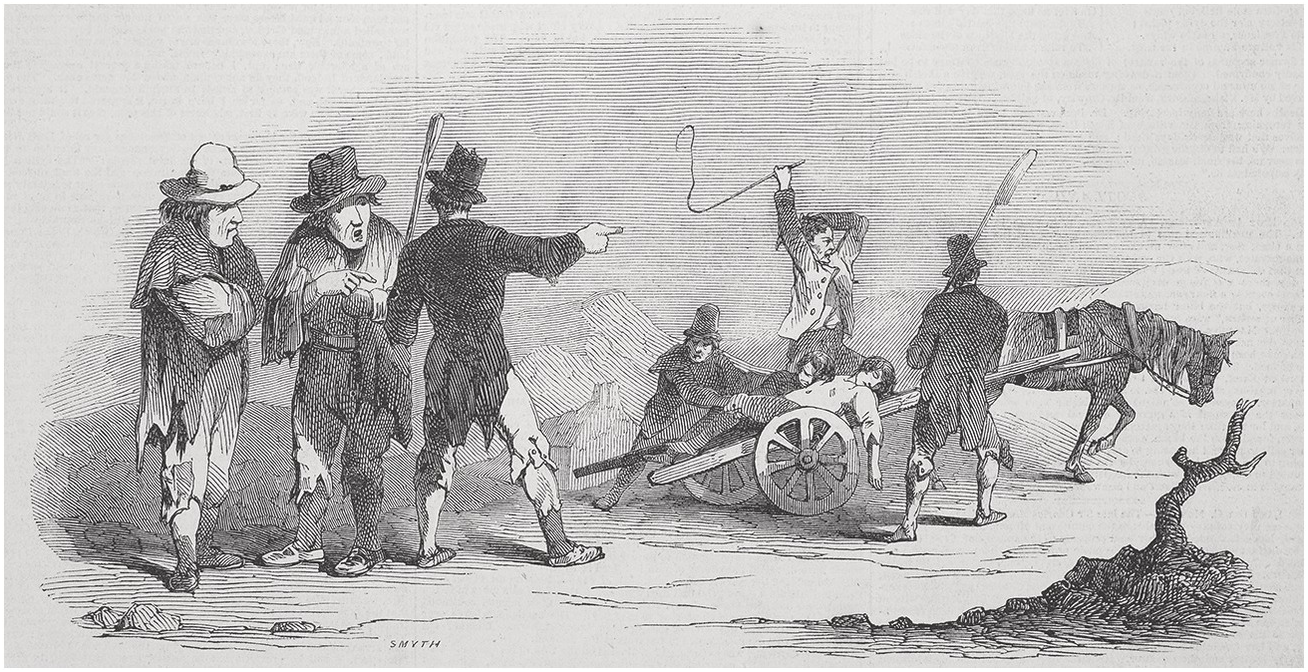
In the closing days of 1846, newspapers across England published a Cork magistrate’s eyewitness account of famine in Ireland that was a revelation for the public. The open letter was addressed to the duke of Wellington and described the horror of hundreds of living skeletons in Skibbereen, a small town west of Cork that became notorious for its plight (see Figure 3.1). Even the Times, an organ with little sympathy for Irish suffering and critical towards voluntary contributions, printed the piece in its Christmas Eve edition. The letter included an indirect aid appeal to those who could send relief by urging that ignoring the desperate situation of the Irish would see them fail before ‘the Judge of all the earth’. Moreover, calling upon Wellington to help rescue the land of his birth and not abandon his compatriots who had lost their lives for the empire, the magistrate urged him to bring Ireland’s plight before Queen Victoria and thus secure for himself the inscription ‘Servata Hibernia’ upon his tomb. Wellington was to invoke the queen’s female sense of decency, and let the published letter’s account of destitution and nakedness encourage her to command that aid no longer be withheld.Footnote 34 The letter illustrates that the gendered perception of emergencies and the addressees of calls for aid has not changed over time. Other direct appeals to the queen petitioned her ‘as a woman’ and ‘a mother’.Footnote 35 They all mirrored the widespread notion in Ireland of being entitled to aid from Britain, and minor sums were immediately sent to the Cork magistrate for distribution.Footnote 36 However, according to one Irish calculation, their country was entitled to thirty million pounds, a sum greater than that spent for ending slavery, as Irish distress was said to exceed that of the blacks.Footnote 37
Funeral at Skibbereen, London Illustrated News, 30 Jan. 1847.
Imperial Relief
The comparatively broad acknowledgement of Irish suffering in the press at the time of the open letter coincided with the preparation of the major extra-governmental aid effort, the creation of the British Relief Association (BRA).Footnote 38 The BRA was a voluntary effort closely related to the government, but its origin and the deliberate exclusion of its beneficiaries from the aid narrative have not been examined. A deputation of the interdenominational Relief Committee of Skibbereen, sent to London in December 1846, took the first initiative, rather than English residents.Footnote 39 The Irish representatives consisted of protestant ministers Richard B. Townsend and Charles Caulfield, who were granted a meeting with the home secretary and with Charles Trevelyan, the permanent secretary of the treasury and the principal figure in government relief to Ireland. At their first meeting, the Irish deputies felt that they were treated as ‘insignificant individuals’; they were then granted a second meeting. Nevertheless, the letter they received a few days later declared that their request for a queen’s letter was premature and suggested the alternative of private Irish, as well as English, charity.Footnote 40
Such a response was not simply an abdication of responsibility: Trevelyan’s evangelical morals, while hostile to state intervention, were more receptive to voluntary efforts. Three days after the first meeting with the deputies, he recommended a general English subscription supervised by officials to supplement what he believed were ‘the necessary deficiencies of our Government Relief’.Footnote 41 Another motivation was the desire to pass the verdict of God and history, despite alleged Irish misbehaviour.Footnote 42 This dutiful attitude is indicative of the widespread contempt for what was perceived as ‘Irish apathy and abuse’. Trevelyan’s belief that ‘further horrifying accounts’ were needed to promote the subscription indicates the dismissive attitude towards reports from Ireland of which there was no lack.Footnote 43 At another meeting, the deputies were made to feel ‘as if they were the first men in the land’ and were advised how to go about raising private charity.Footnote 44
Townsend and Caulfield favoured a public fundraising event that would also rebut English misconceptions about Ireland. Although they were now treated respectfully, they could not obtain the backing of individuals needed for such an undertaking. This outcome was influenced by the deputies’ contact officer, who thwarted their call for support behind their backs.Footnote 45 In their report they state ‘it was by little and little the real nature of our position as a deputation opened upon us’. The contact officer ultimately made it clear that a public meeting was ‘utterly impracticable’, as it was likely to engender political controversy and damage the Irish cause. He promised that the addressees of the deputation ‘would work the matter themselves’ and would raise a subscription far exceeding the expectations of the two representatives. Thus, committing their ‘begging-box into hands most influential at present in the Kingdom’, Townsend and Caulfield returned to Ireland.Footnote 46 The Times explained the deputation’s failure by maintaining that, rather than robbing their own deserving poor and supporting conspiracy, agitation, and possibly arms and secession, the English people preferred ‘to bestow their charity where they can direct its application’ and ‘secure both benefit to the recipient, and something like gratitude to the giver’.Footnote 47
Thus, the London establishment designed its own fundraising campaign. The queen’s offer of £1,000 (an amount equal to that already pledged by several financial magnates) was refused as ‘it wasn’t enough’.Footnote 48 Scotland, where people in some areas were also suffering, was added to the cause in a last-minute manoeuvre to provide a rationale for the queen to double her contribution.Footnote 49 This boosted the legitimacy of the humanitarian enterprise, although, according to a later allotment formula, it implied that one-sixth of the funds collected were diverted from Ireland.Footnote 50 A prominent committee ran the relief effort as an all-British campaign, primarily by means of repeated advertisements in major newspapers and two queen’s letters issued in January and October 1847.
The campaign’s first appeal to the public included a statement on objectives and a list of donors, headed by the queen, and also noted a contribution by the ‘Children and Servants of a Family in the Country’. As customary in nineteenth-century fundraising, accounting elements were prominent through the documentation of subscriptions, but the appeal also indicated restrictions in the appropriation of aid. It was to consist only of provisions, not cash, targeted at individuals with no employable male relative, and was to entail some work by the recipient in return, wherever practicable. The appeal was based on ‘the strong conviction that there are a large number of benevolent persons fully acquainted with the distress, and ready to bestow their bounty whenever a channel is presented to them through which it may be applied, and secured as far as possible from the danger of being abused’. In addition to the BRA’s passive self-image as a strictly controlled channel, it was announced that donors were able to contribute in kind and that earmarking for any particular district would be strictly observed.Footnote 51
Subsequent advertisements were commonly accounting summaries, with indirect appeals in the form of a list of subscribing social peers. The BRA prominently cited the chairman of the East India Company and the governor of the Bank of England as auditors; itemised provisions shipped to various Irish ports; explained the principles of distribution and monitoring procedures; and listed exceptional instances in which small sums of money were granted for further distribution.Footnote 52 Later advertisements included mention of the extreme distress witnessed by agents of the BRA, or limited themselves to printing lists of subscribers and the names of committee members and auditors.Footnote 53 More explicit appeals also continued. In a typical one, the committee expressed its hope that the liberality of the British people would enable them ‘in some degree’ to continue mitigating ‘the horrors of a calamity, the extent and severity of which … it is hardly possible to over-picture’.Footnote 54
Another framework for appeals was provided by a queen’s letter authorising church collections in support of the BRA’s fundraising. It was directed to Anglican bishops in their provinces, thereby prompting them to ‘effectually excite their parishioners to a liberal contribution’.Footnote 55 The letter was read from the pulpit in the first months of 1847, accompanied by sermons promoting the cause of relief. The government also declared 24 March a national day of fasting and ‘humiliation’. A number of sermons were published and raised additional funds by offering arguments to encourage giving. Following the royal proclamation of a national fast day, many ‘famine’ sermons were delivered urging the nation to atone for its collective sins. However, the sense that Ireland, although part of the UK, was a peculiar country suppressed British contributions. The paltry, somewhat hostile response to the queen’s second letter, issued in connection with an improvised national day of thanksgiving, made this especially obvious.Footnote 56
The Irish and English affiliation could be clearly seen in the armed forces. The Irish Relief Fund in Calcutta had been the first attempt of its kind in the British Empire, outside of Ireland itself. At a time of heavy losses in the conquest of India, the fund’s secretary declared that the Irish were those ‘who “clear the road” in the battle’ – that is, comrades-in-arms whose hearts should be comforted by care for their families and friends at home.Footnote 57 A newspaper article cautioned that recent battlefield casualties would mean that fewer remittances would be flowing to Ireland, something that a community effort could mitigate.Footnote 58
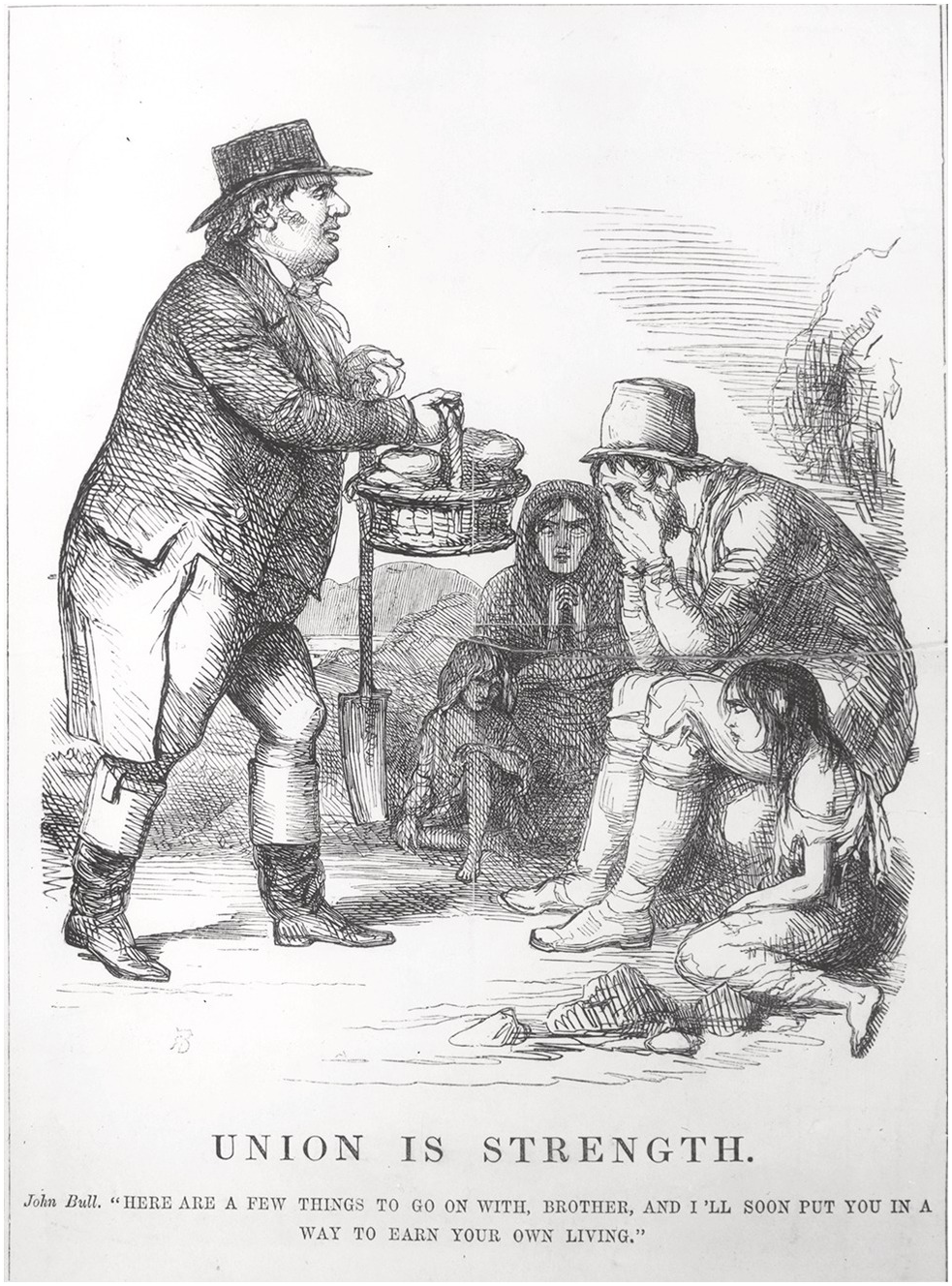
At the first public meeting of the fund on 2 January 1846, the Catholic archbishop of Calcutta, despite propaganda for cohesion, took it upon himself to refute the condescending remarks of other committee members by pointing to centuries of English injustice and maladministration that had reduced Ireland ‘habitually to the condition of a pauper’ (see Figure 3.2). He reminded those present that the gospel said donors should make recipients feel that they were receiving charity from ‘equals before God’, and that gratitude was a pre-eminent trait of the Irish character. Apart from addressing bilateral relations, the meeting represented the subscription as an opportunity – in response to the British administration of relief in India – ‘for the wealthy natives of this country to show that they were not behind Europeans in this exercise of beneficence’.Footnote 59 The Calcutta Relief fund continued its work in the following years by sending substantial sums to the BRA and other relief organisations.
The activism in their homeland at the time prompted UK citizens in a number of cities abroad to organise collections among themselves and within the society that they lived in, with varying success. In Hamburg, six individuals called for the support of Europe-at-large for their campaign, suggesting a particular duty was owed to their compatriots, and expressing confidence that the local public would join their effort. The collection raised £450, but a German newspaper derided the call from a different moral economy perspective: ‘Do the wealthy Brits also want to burden us with their country’s destitution? They have instigated it; let them remedy it.’Footnote 60 A charity concert organised in the English church in Hamburg did not attract many people and received a very poor review.Footnote 61 Meanwhile, at a public concert in London, Jenny Lind’s fee for an opera season was said to be £12,000 plus travel and lodging, something that made another German newspaper exclaim with moral economic indignation, ‘And all this, while Ireland starves!’Footnote 62
Catholic Relief
In Catholic circles, Ireland was referred to as the Islands of Saints. It was seen as having provided invaluable historical services to religion, literature, and the advancement of England.Footnote 63 The priest of a Liverpool church, whose background included ties to Ireland, proposed a more aggressive request for relief. He declared that England owed Ireland a great deal for the misery brought about by centuries of tyranny and oppression, and that the Irish had a claim on the gratitude of English Catholics for their successful battle for religious emancipation – something that lifted their coreligionists in the UK up from being ‘a proscribed and degraded class’.Footnote 64 Moreover, Catholic charity was aroused in opposition to what they saw as the ‘black charity’ of the proselytising Special Fund for the Spiritual Exigencies of Ireland. This fund provided relief for those willing to undergo religious conversion, appealing for donations by suggesting that ‘the Gospel is, more readily than heretofore, now received from hands which have willingly administered relief to … temporal necessities’.Footnote 65 In view of its timing in mid-October 1846, the first explicitly Protestant relief activity seems to have come about in reaction to Catholic efforts.Footnote 66
Catholic fundraising in England was generally conciliatory, ecumenical, and careful not to alienate the Protestant majority. At the beginning of October 1846, Irish expatriates in London created a network of district committees for Irish relief that also lobbied the government to compel Irish landlords to be more loyal to their homeland. While the network’s central committee passed all proceeds on to the four archbishops of Ireland, a Catholic magazine emphasised that Protestants, Jews, and Englishmen were among the donors and activists.Footnote 67 Catholic clergymen from Ireland became speakers at fundraising events, such as one held at the City Lecture Theatre in London.Footnote 68 Another preacher from Ireland delivered charity sermons in churches at Leamington Priors and London. Speaking in Christian rather than Catholic terms, he warned that the ‘distressed fellow-creatures in the Sister Country’ might be the ‘future selves’ of his audience, depending on the extent of others’ goodwill. He claimed that charity was ‘blessed in proportion as it blesses’ and that the duty of giving was advocated by nature, reason, and God, the neglect of which would be ‘the forerunner of eternal damnation’. On the Day of Judgement, he declared, benevolent works would insure generous donors ‘a portion of that same mercy which they were that day called upon to exercise towards their famishing fellow-creatures’.Footnote 69 A later newspaper advertisement asked all to ‘remember that Salvation is denied to those who do not feed the Starving according to their ability’.Footnote 70
Around the time that the BRA was set up, Fredric Lucas, editor of the Tablet, in an article entitled ‘The National Christmas Famine’, asked what he and his readers could do about the starvation in Ireland. Being a Quaker convert, Lucas suggested that the Society of Friends had ‘borrowed from the Catholics of other days an example which we ought to be ashamed not to follow’. As he put it, Christ was perishing for want in Irish cabins, and the Catholic code of morality entailed an obligation of charity at the same time that the ‘penalty of hell’ awaited those who failed to perform their appointed task.Footnote 71 From then on, the Tablet became ‘the repository of Irish grievances and of Irish sufferings’ in England – that is, the primary outlet for aid appeals from the Irish clergy.Footnote 72
By the end of 1846, the vicar apostolic (bishop) of London issued a pastoral epistle with instructions for celebrating the jubilee of the commencing papacy of Pius IX. He ordered that an appeal be made in London chapels for the purpose of relieving distress in Ireland as well as in the respective congregation – the collection to be divided into equal portions.Footnote 73 Criticism of the bishop’s coupling of charity abroad and at home made him revise his instructions so that the sum raised was solely devoted to Irish relief.Footnote 74
Episcopal collections were held throughout England and Wales, often on a weekly basis until Easter to enable poor parishioners to contribute greater aggregate sums. One pastoral made it clear that the present Irish suffering ‘has never been equalled in the memory of any one of our generation’, and called for ‘generous sacrifices for its alleviation’.Footnote 75 The bishop of Yorkshire had personally witnessed the distress in Ireland and urged the claims of ‘our famishing Brethren’ upon the charity of his flock, asking rhetorically where those not sufficiently attentive to the cries of the hungry expected to stand ‘on the great accounting day’.Footnote 76 In a subsequent call, he pleaded for additional alms, warning that God was fully capable of afflicting England in the same manner as Ireland.Footnote 77 In a like manner, another bishop’s pastoral cautioned that the time had come ‘for each one to measure out with that measure wherewith he desires that it be meted to him again’. It emphasised that those affected by the famine deserved aid not merely as fellow creatures and subjects of the same empire, but also as parishioners ‘closely knit together with us in religious communion’.Footnote 78
Descriptions of the distress in Skibbereen, and the British home secretary’s letter endorsing private charity in England to the deputies of that town, were reprinted in France and Italy.Footnote 79 As a result, philosopher Antonio Rosmini, an early advocate of ‘social justice’ and founder of the Institute of Charity, was spurred into action. Even before the general British campaign started, he requested one of his missionaries in England to initiate a collection for Irish relief, citing God’s recompensing moral economy. He himself issued an appeal in Northern Italy that raised £556 by the end of 1847.Footnote 80
The first transnational call from a Catholic institution was issued by the Society of St Vincent de Paul (SVP) through its president, Jules Gossin (see Figure 3.3). Upon receipt of various letters and documents from Ireland, the SVP council general had ordered its local branches (conferences) to raise funds for the clients of the ten Irish conferences. The appeal declared that the principle of self-subsistence for local chapters was untenable in view of the extraordinary calamity, and urged the society’s members to give generously and quickly as ‘death does not wait’.Footnote 81 The Dutch national council began its ensuing appeal by reminding members of the Irish saints who had evangelised the Netherlands, suggesting there was a ‘religious debt to pay’.Footnote 82
Jules Gossin (1789–1855). Daguerreotype, 1844.

The most authoritative call for Irish relief came from the newly inaugurated Pope Pius IX in his second encyclical, issued on 25 March 1847. Addressing prelates all over the world, he invoked the Catholic tradition of alms-giving for Christians in need, quoting the moral economy of church father St Ambrose: ‘Christians should learn to use money in looking not for their own goods but for Christ’s, so that Christ in turn may look after them.’ Pius IX mentioned his own Irish relief efforts, warned of the worsening calamity, and suggested that Ireland particularly deserved aid for its loyalty to Rome and its missionary engagement around the world. He proclaimed a triduum (three days) of public prayer for suffering Ireland, with an indulgence of seven years granted as a reward for attendees, and exhorted all Catholics to give alms for relief.Footnote 83
A total of 30,000 copies of the encyclical were printed and within a month distributed all over the world by the Sacred Congregation for the Propagation of the Faith.Footnote 84 It was further reproduced by the Catholic press and hierarchy. For example, the Central district (the future Diocese of Birmingham) made 150 copies of the encyclical, which was to be read at all churches together with a pastoral epistle from the bishop.Footnote 85 When it was sent to the Irish bishops, the encyclical was accompanied by a letter that in general terms complied with the wish of Prime Minister Russell that the pope praise the Irish clergy for their conduct during the famine and ask them to trust the government and its relief efforts.Footnote 86
While the encyclical was heeded in many places, it was ignored or depreciated in others. The Austrian emperor, for example, decreed that only the sections on prayer and indulgences be communicated to the faithful, not allowing systematic collections that benefitted foreigners. When the issue was discussed in autumn 1847, the time for relief was considered past, and the extent of American contributions served as a further argument against the need to solicit funds.Footnote 87 In the diocese of Brixen, church collections were made nevertheless, but they were announced incidentally and were only conducted on a voluntary basis.Footnote 88
In St Gallen, a Swiss town named after an Irish monk, where distress in the local bishop’s own parish caused him to leave it to the discretion of the wealthy to contribute to Irish relief, the sum of 4,325 francs (£170) was collected.Footnote 89 The prevailing opinion among Catholics abroad was expressed by a Swiss newspaper, which stated that ‘England has a very heavy – and the primary – duty of Irish relief.’ However, the paper, continued, ‘we may not now ask what duties England has to Ireland, but rather the duties we Catholic Christians from Switzerland must fulfil to aid that unfortunate country’. As in the case of the Dutch, obligations to Ireland were acknowledged for its role in Christianising Germany and Switzerland.Footnote 90
An Irish bishop thanked the pope for his initiative as ‘well calculated to inspire the people with hope and to fill the Clergy with confidence’.Footnote 91 Pius IX had been drawn to the issue of Irish relief when Paul Cullen, rector of the Pontifical Irish College, urged Catholics not to fall behind the generosity of Protestants in Rome.Footnote 92 UK residents of the Holy City held a fundraising meeting on 13 January 1847, at which the rector was represented by a deputy who suggested that ‘the collection [be made] general through the city’; Cullen was also elected to the committee.Footnote 93 It was announced that the pope would contribute 1,000 Scudi (£213), and that he ordered a solemn triduum in one of the local churches from 24 to 26 January, with sermons in Italian, English, and French, to elicit donations for relief. Pius IX expressed ‘the deep pain which it had given him to hear of the suffering state of Ireland’ and ‘regretted that his power of contributing to her relief was not more in proportion to his good wishes’.Footnote 94 Cullen, who was eager that Rome distinguish herself and show the world ‘that she is not only the centre of faith, but also the soul of charity’, explained that the papal donation was ‘a very large sum for one who has so many calls to respond to’ and suggested that a thousand dollars from the pope was ‘more than a hundred thousand from the queen of England’.Footnote 95 In a fundraising pamphlet in the Italian language that appears to have been published on behalf of the Rome committee of UK citizens, Cullen claimed it was general knowledge that the English government had failed to provide sufficient relief.Footnote 96 He later described the underlying significance of the pope’s encyclical as ‘a standing testimony against the misrule of England’.Footnote 97 A contemporary witness commended Cullen’s sermon during the triduum as impressive.Footnote 98
Acclaimed pulpit orator Gioacchino Ventura held the triduum’s main sermon in Italian. He suggested that the spirit of charity was the bond uniting all Catholics, but that the Irish people also had particular merits, had suffered extraordinarily, and had conducted themselves admirably, making them deserving of his audience’s best sympathies. Hence, he
conjured all his hearers in the name of humanity, virtue, love of country, and above all of religion, to aid by their contributions, and by their most fervent prayers to rescue from starvation a people, which was a model to all the countries in the world, for their social virtues, their patriotism, their fidelity to constituted authority, and above all for their attachment to the Catholic Faith, their practice of its holy duties, and their zeal in propagating it.Footnote 99
Ventura framed the welcome contributions by English and Irish Protestants in Rome as ‘an emanation of Catholic charity’, inherited from the spirit of their forefathers or inspired by the surrounding Catholic atmosphere. He hoped that what appeared to be Irish acquiesce in starving to death in union with the disposition of Christ would ‘ascend as a holocaust of reconciliation to the throne of the Most High, to draw down on England not the justice and indignation which liar crimes deserve, but conversion to the true faith, grace, mercy, and salvation’. The colourful report on the effects of the sermon, with its surrounding choreography of church rituals for a time of famine and an appeal by alumni of the Pontefical Irish College, included the observation that ‘the very beggars with tears in their eyes emptied the contents of their poor purses into the hands of the collectors’.Footnote 100
Rome’s example was followed in some Italian bishoprics even before the pope’s encyclical was issued. Thus, a pastoral letter from the town of Jesi argued that Christian charity being universal, the obligation towards brothers of faith was all the more stringent; that the modern principle of association was a force for good; and that the rational and enlightened spirit embodied in public opinion contributed to the denouncement of selfish behaviour. The Jesi pastoral underscored the possibility that the local populace might some day find themselves in need of such aid, and so charity shown to Ireland might be insurance against such a calamity befalling their own selves. It also claimed that God rewarded ‘good works with great interest, giving eternal glory as the recompense of the most trifling acts of beneficence’.Footnote 101
Apart from church collections, committees in Rome and Florence launched fundraising events such as society balls and an aid concert. One socially conscious woman even organised a lottery for a valuable painting.Footnote 102 The pope himself provided an autograph letter and a rosary of agates that were exhibited at a bank in London and raffled off for the relief of Irish famine hungry. However, the £61 realised fell short of the £100 that the organisers had hoped for, and critics accused the event of ‘dispensing the spiritual graces, of which the Pope claims to be the depositary’.Footnote 103
The idea of famine relief as an undertaking for the entire Catholic world originated with Gossin at a point in time before the SVP’s general appeal, and the Holy See acknowledged the SVP’s role in bringing the encyclical about.Footnote 104 Gossin was the driving force behind a petition signed by 197 prominent Frenchmen, including mathematician Augustin-Louis Cauchy, publisher and politician Count Charles de Montalembert, and political analyst Alexis de Tocqueville. Dated 6 January 1847, it called on the pope to launch a ‘new crusade, although a completely peaceful crusade, a crusade of charity, of prayer, and of good deeds’ for suffering Ireland and for persecuted Christians of the Lebanon as well. By May, when the archbishop of Paris implemented the famine encyclical, a subscription was opened under his auspices.Footnote 105 The committee’s public appeal described it as ‘a truly national and French enterprise’ that would attract everyone, without distinction of party or creed. The appeal stated that high food prices were responsible for the campaign’s slow start, but insisted that French economic hardship could not compare with the suffering of the Irish.Footnote 106 However, the minister of justice protested against unauthorised publication of the encyclical and reminded the French clergy of the requirement of obtaining permission to do so.Footnote 107
The bishop of Marseilles had already issued a pastoral epistle on 24 February that drew an analogy between the Irish and the early Christians, who, during the Roman Empire, adhered to their faith even under torture. He also argued that Catholic beneficence was particularly called for in light of the active proselytism in Ireland; and, as in the pastoral from Jesi, he suggested that a universal plea for charity was even more incumbent on his coreligionists when those who were suffering belonged to ‘the great Catholic family’.Footnote 108 Following the encyclical, at least twenty-one French bishops published pastoral letters. Despite differences in form and content, their message was one: ‘The Irish are starving and need your help.’ An analysis sees a deliberate choice of shocking examples, but also notes the ‘almost throwaway fashion’ in which the famine is presented. The arguments put forward were similar to those of English and Italian clerics, but some French pastorals also suggested that famine relief offered a high moral ground vis-à-vis the English, or that it otherwise served the self-image of France as le grande nation.Footnote 109
Despite the fact that French collections for Ireland were generally church organised, they were ultimately coordinated by the voluntary Comité de secours pour l’Irlande. Laymen took a prominent role in the effort because of the contemporary distress prevailing in France. It was regarded as ‘a matter of Prudence not to expose the clergy to be reproached by the people of neglecting their fellow Country men, and of manifesting their solicitude for strangers’.Footnote 110 However, the Irish were no strangers to the French Catholic elite – they were their idealised model of Catholic spirituality.Footnote 111
US Relief
Catholic appeals in the New World resembled those of the Old, but at times had clearer political references and more compelling language. For example, John Bernard Fitzpatrick, bishop of Boston, stated in a pastoral that Ireland no longer lamented her lost liberties nor the union with Great Britain, bewailing instead the dying of her children. According to him, ‘our own home; or at least … the home of our loved fathers and friends’ required extraordinary charity, something that made any discussion of responsibilities of the UK parliament or Irish landlords immaterial. This engendered the bishop’s conviction that ‘not one will fail to act nobly and generously his part, or to fulfil to the extent of his means what we do not hesitate to call a sacred duty’.Footnote 112
Irish communities were the driving force for famine relief in North America. In addition to Catholics, those communities included Protestants and had much to gain by reaching out to a wider public. The resulting fundraising rhetoric outlined an impartial, national campaign that resembled the one in France. North American society, however, was more diverse. It was made up of large groups of Irish immigrants with a vested interest in their country of origin, alongside a Protestant majority with no particular religious affinity to Ireland. The situation in Canada was akin to that of the USA, but contained a stronger Catholic element and had the British Empire as an additional bond. Nonetheless, a satirical journal in Montreal derided the Irish predominance in relief committees by publishing a fictional list of miniscule contributions, all coming from members of one family clan.Footnote 113
It has hitherto been accepted that Irish relief was a national US effort, without scrutinising who was involved. It has not been considered that downplaying social disparities between donors is a common humanitarian propaganda strategy, although the emphasis on particularly deserving beneficiaries frequently surfaces amid an overall universalist rhetoric. For example, a speech that Henry Clay delivered at a New Orleans town meeting in 1847 invoked a humanitarian imperative irrespective of colour, religion, and civilisation. After a tribute to universalism, Clay explained at length that the meeting did not concern any distant country, but a nation ‘which is so identified with our own, as to be almost part and parcel of ours, bone of our bone and flesh of our flesh’.Footnote 114
President Polk’s threat to veto US government aid to Ireland for constitutional reasons thwarted a plan that had been developed with reference to Americans being an ‘offspring’ of the Irish.Footnote 115 However, civil society responded positively to a convention in Washington on 9 February 1847, chaired by Polk’s vice-president. A member of Congress from each of the twenty-nine states was appointed an honorary vice-president of the meeting, which recommended that fundraising committees be set up throughout the USA. A lengthy appeal was issued to the public, cautiously mentioning that there were hundreds of famine victims, explaining the hardships in Europe, and the efforts made by the British. The Cork magistrate’s letter to Wellington was cited, as well as correspondence from the West Cork region addressed to the ‘Ladies of America’.
Although the Washington appeal spoke of ‘a sister nation’ to which one of the speakers suggested the USA owed ‘a deep debt of gratitude’, and which according to another was well blended into the American ‘blood’, the overall approach and message were universal. Robert Dale Owen, congressman and son of the British social reformer, exemplifies this with an appeal that anticipated Singer’s argument on the insignificance of distance whenever there is knowledge of need. Other voices suggested that the financial boom in the USA at the time (which was in stark contrast to bad harvests and economic depression across Europe), and the demand for labour and settlers, facilitated the framing of Irish relief as a broader cause. The meeting concluded with the adoption of a resolution moved by an Irishman, thanking those involved in the gathering and, by extension, the American nation, and indicating an elaborate humanitarian choreography.Footnote 116
Despite the advancement of famine relief as a national cause, the case of the Philadelphia Irish Relief Committee, which, according to a recent study, typified ‘“universal America” where class, ethnicity, and religious denomination did not matter’,Footnote 117 indicates the need for critical review. The first relief committee in November 1846 was practically an organ of the Hibernian Society for the Relief of Emigrants from Ireland, although it figured as a group of ‘gentlemen’ who addressed ‘fellow citizens’ in Philadelphia and the south-western region of the USA. By February 1847, in order to extend its reach beyond the ethnic ghetto in more than words, the committee broadened its membership. However, the majority of members of the executive committee for the city of Philadelphia still belonged to the Hibernian Society. Others bore Irish names. Yet another called attention to ‘the claim of the Irish people upon us, from blood association, and the influence of the many domestic ties’. The committee resolved that its papers be placed in charge of the Hibernian Society and, in its final report, noted that its relief efforts had not been confined to people of Irish descent – a truism that downplayed the centrality of the ethnic community in the campaign.Footnote 118
The Philadelphia Committee, with its published report and the extensive documentation of its networking within the city’s Irish community’s elite, is easily verifiable with regard to its social basis. It suggests that the case of the similarly named Irish Relief Committee, which was organised by the Hibernian Society of Charleston, was not the exception researchers have claimed, but may rather have been typical of relief initiatives for Ireland.Footnote 119
The first foreign effort mounted in the USA to assist Ireland was initiated by John W. James, the president of the Boston Repeal Association, on 25 November 1845. He proposed a subscription among members of the organisation ‘for their suffering brethren, which would, when sent forward, not only do much to relieve their distress, but also redound to their own credit’.Footnote 120 The resulting Irish ‘community effort’ was based on collections in churches, at a public meeting, and private subscriptions. However, since it was linked to the movement for the repeal of the Act of Union between Great Britain and Ireland, this aid effort and its association with the demand for Irish autonomy came into conflict with political priorities.Footnote 121 In the years that followed, the Boston Repeal Association continued to collect funds for Ireland, but it combined providing food aid and the shipment of arms for the insurgency of ‘Young Ireland’.Footnote 122 The repeal movement had branches throughout the USA that it also mobilised for famine relief in other areas.Footnote 123
By 7 February 1847, after the Catholic clergy of Boston had established a committee that became the Relief Association for Ireland, a broad circle of sponsors from that city disseminated an address on Irish relief by means of the newly introduced electric telegraph. It reportedly made a strong impression on the country.Footnote 124 Various calls led to the formation of the broader New England Relief Committee one week later. The appeals urged the public to provide relief regardless of the causes of famine. They emphasised suspicions that the reports from Ireland may have been exaggerated were untrue.Footnote 125 During a time of US aggression against Mexico, a Protestant minister declared that the sight of relief ships ‘under the white flag of peace and mercy’ would be a ‘nobler spectacle’ than that of battleships, and said that aiding Ireland would make war with the UK psychologically unlikely.Footnote 126 An examination of contemporary speech acts shows that they highlighted notions of Christian duty, idealistic humanitarianism (sometimes from an internationalist perspective), and a belief in the obligation of sharing America’s abundance. Some voiced uneasiness over profitting from the European food shortage or the Mexican War, seeing an opportunity to improve British–American relations. An instance of Irish aid for New England in the seventeenth century was recalled. As in the case of other US relief efforts, it appears that the sense of common purpose that was evoked had a value of its own for a much divided community.Footnote 127 At the same time, the strong Irish presence in Boston, despite being poorly integrated, was a significant factor. A major facilitator of the Boston civic effort was of the opinion that the Great Irish Famine represented a unique charitable cause because its stories came ‘so directly from the Irish around us, who themselves contributed all they could to relieve their relations in the old country’.Footnote 128
In New York, where people of Irish descent made up a quarter of the population, the first Irish relief committee was formed in December 1846, mostly by members of the ethnic community with affinities to the Democratic party. A broader General Relief Committee coalesced by February 1847. It included, among others of Irish background, the Quaker Jacob Harvey, who conducted public relations that raised famine awareness throughout the USA and resulted in funds that were generally forwarded to the Society of Friends in Dublin. The Irish-born Catholic bishop of New York joined forces with the general committee, serving as a speaker and, in an ecumenical gesture, transferring the collections from his diocese to the Society of Friends as well. Despite a considerable Irish presence among the committee members, its founder and chairman, Myndert van Schaick, did not have a family connection to Ireland. Ultimately, the committee represented a broad group of businessmen and prominent individuals with links to shipping interests and to the Commissioners of Emigration (i.e., immigration) of the State of New York.Footnote 129
During the 1840s, a period of rising food prices and mounting freight rates, the transportation of emigrants was a business that lowered the overall cost of conveying American goods to European markets. One of the most active members of the New York committee was the treasurer of the Irish Emigrant Society of that city. Harvey, who was among the commissioners of emigration, envisioned a solution to the Irish subsistence crisis through populating the American West: ‘The more people we can bring over, the better for all parties.’Footnote 130 Van Schaick concluded a public speech somewhat obscurely with the hope that ‘the Irish people would adopt the American system of Common School education, or something similar to it, which would enable them to take care of themselves in future’.Footnote 131 The committee’s appeal to the public distilled the economic fundamentals down to a single line ‘What is death to Ireland is but augmented fortune to America; and we are actually fattening on the starvation of another people.’ The appeal raised the cry that four million people were on the verge of starvation resulting from a famine that was not caused by improvidence or vice. A triad of charity, civilisation, and Christianity was invoked, along with the plea that ‘Every dollar that you give, may save a human being from starvation!’Footnote 132
US celebrity peace crusader Elihu Burritt made a similar appeal in one of his ‘Olive Leaf’ broadsheets to the American people. Reprinted by US newspapers, it claimed that ‘A penny a day will save a human life.’ (For his audience at home, he translated the phrase as ‘two cents’ worth of Indian meal’.)Footnote 133 Burritt also travelled to the scenes of misery, reporting on what he found in another ‘Olive Leaf’ that circulated across the USA and England.Footnote 134 He described people in the terminal stages of starvation, and added political observations comparing the dire labour situation in Ireland with ‘the curse of slavery’.Footnote 135 For his British audience, he published a pamphlet detailing three days of horror he experienced in Skibbereen in February 1847. A prominent Quaker wrote the pamphlet’s foreword and called for a moral economy for Ireland equivalent to that of England. He based his appeal on the Irish people’s entitlement to ‘support from the land and other fixed property’ which entitlement, in times of distress, superseded any landlord’s or creditor’s demand for rent or interest.Footnote 136 However, he did not go so far as to suggest that there was a moral economy that included Ireland as an equal among the other members of the UK.
3.3 Altruism, Self-interest, and Solidarity: Soviet Russia
Although it was known for months that a famine threatened parts of Soviet Russia in 1921, it was Maxim Gorky’s appeal in July of that year that first brought the famine to the world’s attention. In contrast to many other famines, relief was triggered by a representative of the afflicted country requesting help for himself and his compatriots. It was a ‘deputy appeal’ in the sense that Gorky lent his voice to the Bolshevik government, which after long reluctance had decided to accept foreign aid. To make the call more acceptable to the West (and perhaps also to avoid humiliation), the Russian leadership signalled their ‘surrender’ through a non-communist international celebrity. Lenin and the People’s Commissar for Foreign Affairs, Chicherin, only launched their own, somewhat different, appeals weeks later. Accordingly, Gorky did not speak in the name of the government, but rather for the Russian people. Stressing their cultural significance, he wrote ‘Gloomy days have come for the country of Tolstoy, Dostoyevsky, Meneleyev, Pavlov, Mussergsky, Glinka and other world-prized men and I venture to trust that the cultured European and American people, understanding the tragedy of the Russian people, will immediately succor with bread and medicines.’Footnote 137
While initially stating that the famine was caused by nature, thereby relieving the government of responsibility, Gorky also blamed ‘the damnable war and its victors’ vengeance’ for the conditions, thus suggesting an unsettled debt on the side of the West. Gorky developed this thought further by demanding aid especially from ‘those who, during the ignominious war, so passionately preached fratricidal hatred’, although he did not point to a specific country or group. Finally, when he characterised the famine to Western philanthropists as a ‘splendid opportunity to demonstrate the vitality of humanitarianism’, it was with a tinge of sarcasm, although he apologised immediately for his ‘involuntary bitterness’. He concluded by asking ‘all honest European and American people for prompt aid to the Russian people’.
During the following months, Gorky’s appeal was reprinted in newspapers abroad and used in the campaigns of various relief organisations. It was the starting point of an international relief campaign. For example, while the Save the Children Fund (SCF) magazine The Record had barely mentioned conditions in Russia until then, the famine dominated its headlines and those of other relief organisations’ publications, such as the Bulletin of the American Relief Administration (ARA), for the next one and a half years. Dozens of smaller aid agencies, committees, and individuals, along with journalists, did their best to keep the Russian famine in the public eye.
Funding Approaches
After the ARA and Nansen’s International Committee for Russian Relief (ICRR) had signed treaties with the Soviet government, their affiliated organisations promulgated appeals in a multitude of leaflets, letters, and newspaper advertisements. There was some cooperation among them, such as the All-British Appeal, but often they competed for donations. The SCF addressed people from all walks of life through advertisements placed in mass media, whereas other organisations focused on specific groups. Thus, the Joint Distribution Committee (JDC) called upon American Jews, the Volga Relief Society (VRS) solicited Americans of Russian-German origin, the Berlin-based Workers’ Relief International (WIR) and their US auxiliary, the Friends of Soviet Russia (FSR), appealed to the working class, and religious groups solicited their own members. In addition, a great number of individuals founded voluntary committees that collected donations from acquaintances or colleagues.
The ARA, as a US umbrella organisation, never made any public appeals. Before the Riga treaties were signed, Hoover was already determined to oppose appealing to the public, as had been done in relief work for Central Europe in 1920.Footnote 138 He was convinced that US citizens should not be asked for help again, as their charitable generosity was exhausted. The slogan ‘charity begins at home’ gained momentum, especially as relief for ‘Red Russia’ was the object.Footnote 139 As an ARA staff member put it, Hoover ‘has dreaded seeking, or encouraging others to seek, financial support for people outside our own country during a period when so many of our own people are unemployed’.Footnote 140 Another reason for the ARA not launching a public appeal was to avoid discussions and counter claims that they feared might endanger the whole operation.Footnote 141
These considerations were paralleled by doubts concerning the profitability and practicality of public appeals.Footnote 142 In contrast to other organisations, the ARA aimed to fight the famine in its entirety. From the start, Hoover was certain that the Russian operation was ‘entirely beyond the resources of all the available private charity’ and needed substantial governmental support.Footnote 143 He considered it a better strategy to ask Congress for a larger sum than to hope for thousands of small donations. However, while rejecting a public appeal, the ARA turned to long-standing supporters and primarily solicited their major donors.Footnote 144 The ARA also established its own press department, which supplied journalists in the USA and correspondents in Russia with press material, instead of paying for advertisments.Footnote 145
The fundraising campaigns of organisations affiliated with the ARA felt the impact of this strategy.Footnote 146 After Congress had granted US$20 million to the ARA, other relief organisations were asked why the public was still being appealed to for donations, and whether the government contribution would not be ‘sufficient for the necessary work’.Footnote 147 For smaller organisations that did not receive governmental funding, the crowding out tendency of public funding and Hoover’s reservations posed a serious problem.Footnote 148 Hoover had not only refused to back an appeal, but at the turn of 1921/2, publicly announced that there was hardly any need for additional grain donations, as the Russian infrastructure could not cope with more than the ARA was already supplying. Some Quakers regarded this as conscious sabotage, and the American Friends Service Committee (AFSC) sought to make Hoover retract his statement.Footnote 149
Morally Worthy Recipients
Advocating and justifying relief for the population of a foreign country was far from uncontroversial after the Great War, but in the case of Russia, nearly all organisations (apart from some pro-communist groups) faced an even greater challenge: raising money for a foreign power with a hostile ideology. After all, during the Russian civil war, most Western states had openly supported the Whites in their fight against the Reds.Footnote 150 Many saw communism not merely as an alternative political system, but as a disease spreading chaos and threatening civilisation, especially as Western media had provided their readers with sensationalistic stories about Bolshevik horrors.Footnote 151
Many politicians, some members of the press, and Russian emigrant organisations criticised relief efforts as aiding the Soviet government.Footnote 152 In order to create ‘morally worthy victims’, aid organisations tried to draw a distinction between Russian citizens and the Bolshevik government.Footnote 153 They had to ‘make people realise that these Russian children, starving and dying, are essentially the same as our own’, as The Record put it.Footnote 154 Accordingly, ordinary Russians were portrayed as ‘brave, simple, splendid folk’ who carried out relief work as best they could and were no Bolsheviks.Footnote 155 Hoover himself stated on several occasions that the Russian people could not be blamed, nor should they suffer, for the mistakes of their government.Footnote 156
However, even if those starving were Bolsheviks, many humanitarians were convinced that political considerations must not play a role in alleviating a famine. Nansen rhetorically asked his critics whether it would be worth letting twenty million people starve to death in order to avoid strengthening the Soviet regime.Footnote 157 SCF co-founder Jebb even admitted that relief tended to benefit the Soviet government because the ‘indirect result of relief is to … stabilise the existing order’, but like Nansen she asked whether this would be reason enough to let millions of Russian children die.Footnote 158 An article in The Record at the time argued that ‘it is a detestable and frigid charity that refuses to stretch out a hand to save those who differ in politics or religion from itself’. Nevertheless, the criticism had an effect, and many appeals concentrated initially on the least controversial group, Russian children. As the article stated, those children are ‘no more Bolshevik than you and I are’.Footnote 159 Both the SCF and the ARA kept emphasising that all food would reach the children, that no Red Army soldier would profit thereby, and that those on the ground providing relief would immediately leave the country if the smallest part of the aid was diverted from the children.Footnote 160
In addition, relief organisations, except for communist ones, largely avoided speculation about the causes of the famine. If reasons for the famine were discussed at all, it was described as a natural catastrophe that came to the Russian people ‘not through their fault or the fault of others’.Footnote 161 Possible human factors, such as Soviet policies or the blockade imposed by the Western Powers, were brushed aside to avoid controversy.Footnote 162 In one of the few cases where the question of guilt was mentioned in The Record, the author tried to create a balanced picture in which both sides were to blame:
While it may be true that misgovernment has aggravated the effects of the famine, it must be remembered that it is primarily due to the war, the blockade and the drought of last year, for which the Russian people are in no way responsible, and in any case this furnishes no ground for allowing the population to die while we carefully apportion the blame for their death.Footnote 163
This narrative absolving the Russian government of blame was necessary as co-operation with Russian authorities was essential for relief work to succeed. In order to describe the Russians – even communists – as deserving beneficiaries, Russian institutions were praised for their willingness to co-operate and conflicts were downplayed. In addition, it was underlined that the Russians had not passively submitted to their fate, but that the government and the population heroically fought the famine. ARA, SCF, the Quakers, and especially the WIR emphasised Russian relief efforts and their co-operative spirit in articles and appeals. Well-organised children’s hospitals, the exemplary work of Russian volunteers and employees, domestic fundraising efforts, the distribution of crop seeds by the government, and similar Russian initiatives were highlighted to Western audiences.Footnote 164 Internally, however, criticisms about the lack of Russian assistance, their inadequate work ethic, and a cumbersome bureaucracy were widespread, especially within the ARA.Footnote 165
Mixed Emotions: Children, Horrors, and Holidays
By 1920, children had become the ‘quintessential humanitarian subject’ and ‘descriptions and depictions of children’s bodies were closely linked to humanitarian appeals’ (see Figures 3.4, and 3.5).Footnote 166 The innocent child as a victim had become a humanitarian means to an end, as it exemplified both the horrors of wars and catastrophes as well as the hope for a better future.Footnote 167 Consequently, not only the SCF, but the ARA and affiliated organisations, as well as several Red Cross societies, spoke exclusively about children in their first public commitments and appeals. A European campaign by artists and writers, supported by the WIR and Nansen, ran under the slogan ‘For Our Little Russian Brothers’, and even the FSR asked its audience to answer ‘the cry of children whose fathers died by bullets supplied to the counter-revolutionary … by American, British and French imperialists’.Footnote 168
Russia Restituenda (Russia Must Recover), 1922.
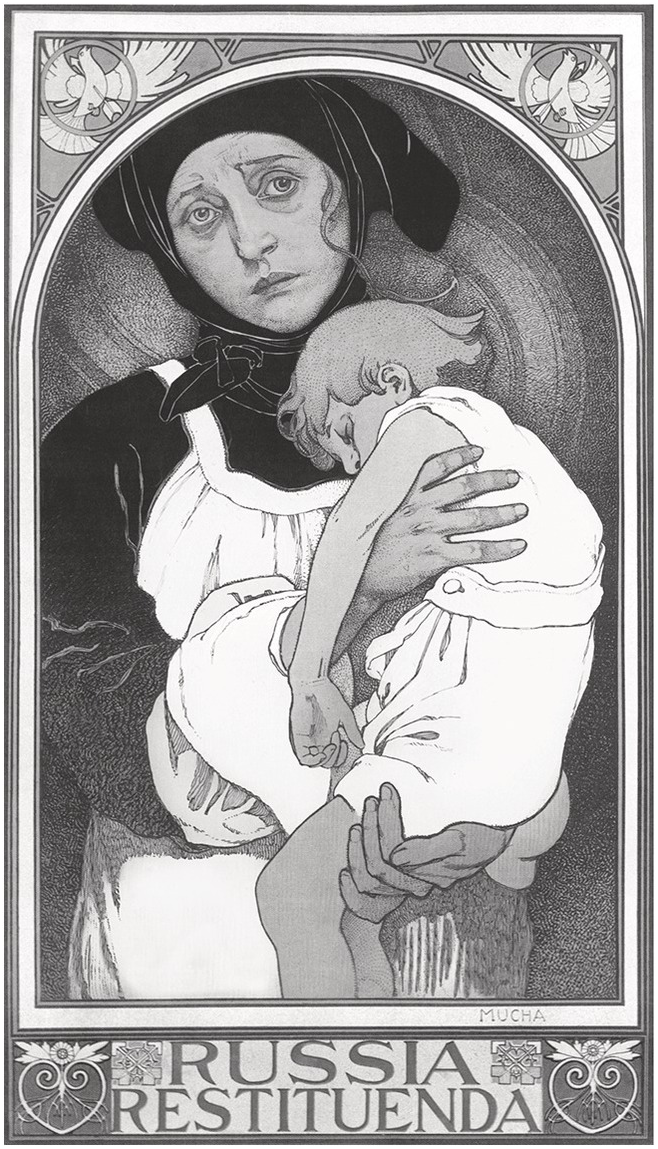
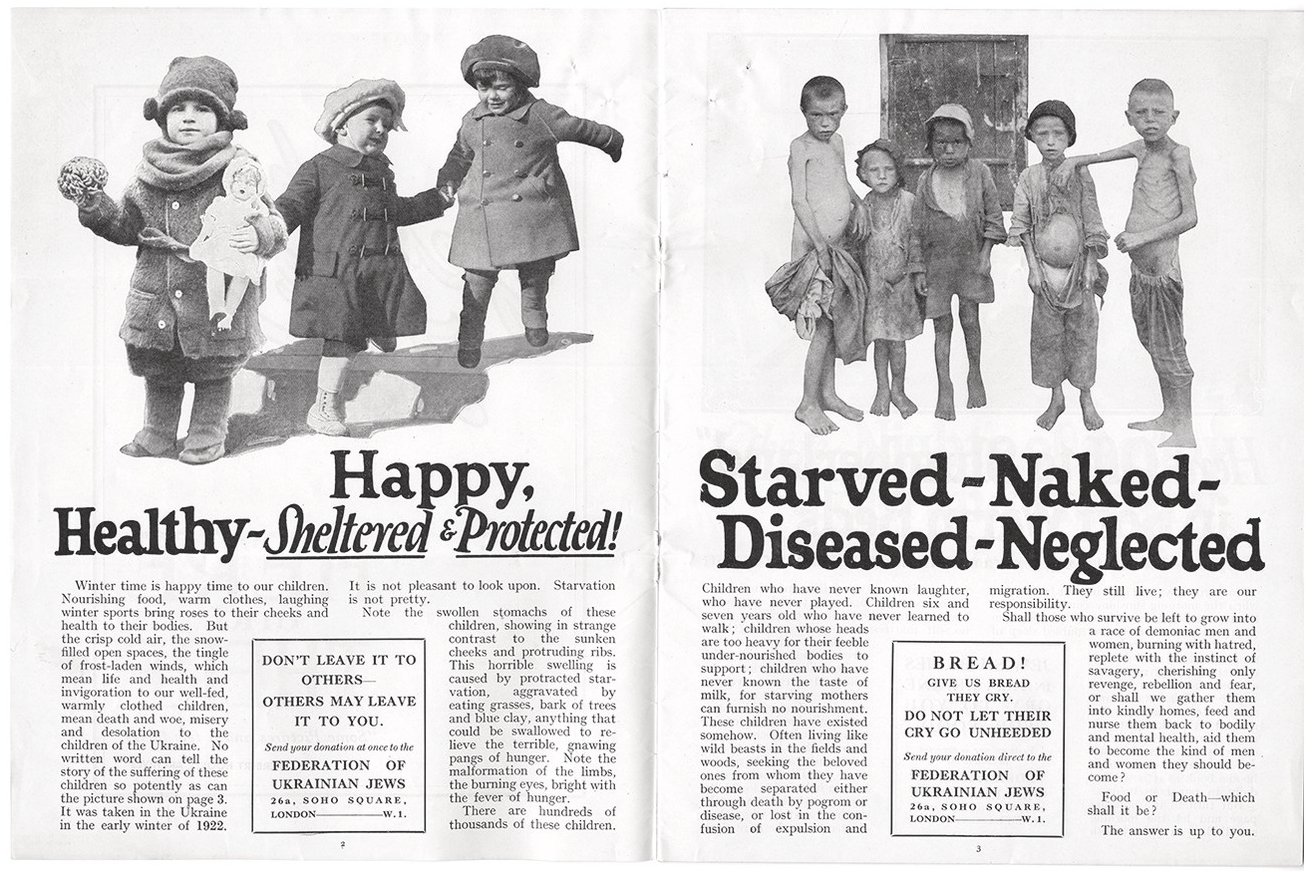
To evoke maximum feelings of pity, descriptions of needy children were often embellished with hyperbole. For example, children were said to have ‘hands like claws’ and ‘only their big dark, wondering eyes give any indication of the childish beauty gone forever’.Footnote 169 An early SCF report depicted the situation in a children’s home as follows: ‘Little cots each containing a little shrivelled form, its eyes staring out of a head which seemed nothing more than skin stretched tightly over a skull, with a little mouth that gasped out a mute appeal for help, as a fish gasps for breath when taken out of water.’Footnote 170
Texts like these led to criticism that the SCF was making ‘capital out of popular emotions’. However, an article in The Record readily conceded that this was the intention. Helping others, the author claimed, was a primitive instinct and charities in general, and the SCF especially, capitalised on this instinct.Footnote 171 Individuals and groups from Russia used this strategy as well, and thrust themselves upon their Western addressees with descriptions of cannibalism, suicide, and murder, hoping this would open their hearts and purses.Footnote 172
Photos and postcards, often depicting children in dire need, were widely circulated, mostly with a calculated shock effect.Footnote 173 In articles and pamphlets, pictures of children were also used to illustrate a before–after development, a humanitarian strategy that was already some decades old, showing the effects of the feeding programme, as well as providing a here–there contrast between children in the West and in Russia (see Figure 3.5).Footnote 174 For the SCF, campaigning and propaganda were embedded in public relations programmes and often designed by mass media experts. The cornerstones of effective communication were ‘originality in announcements, designs, speeches’, ‘simplicity and clearness’, and constant repetition. As in the advertising industry, it was considered ‘necessary to strike the same nail and to strike for a long time in order to drive it in deeply into the consciousness of the unknowing crowd’.Footnote 175
However, it was realised at the time that the adoptation of business methods could raise ethical problems. An article by the noted author and playwright Israel Zangwill ridiculed this development by presenting charity slogans like ‘Try our cheap charity – Certified pyre’, ‘Ten thousand war orphans – guaranteed genuine’, and ‘Good deeds at a unique discount’.Footnote 176 Ruth Fry, head of the Friends’ Emergency and War Victims Relief Committee (FEWVRC), viewed the increasing influence of public relations techniques on the humanitarian sector sceptically. For Quakers, she suggested, ‘relief is propaganda’. However, as this propaganda was a reflection of fieldwork rather than a public relations effort, it remained ‘free from the sting and stigma it would have had, had it been undertaken of set purpose’.Footnote 177 Fry’s moral concerns seem to have had little practical impact: like the SCF, the FEWVRC hired publicity staff and acknowledged the correlation between advertising expenditures and income.Footnote 178
Like the SCF, the ARA knew that providing businesslike relief was not enough to win public goodwill, and that propaganda had to deal with ‘human suffering … as emotional arguments have greater carrying power … than scientific or statistical analysis’.Footnote 179 The ARA press department was, therefore, eager to receive usable information from the famine front.Footnote 180
The medium of film became part of the campaign, and the SCF, ARA, ICRR, Quakers, and FSR produced films or documentary clips that were shown to a broader public and during fundraising events.Footnote 181 However, it seems that the SCF alone was wholeheartedly convinced by the medium. They adopted the motto ‘Seeing Is Believing’ and put great efforts into promoting their famine movie. An article in The Record suggested that the film aroused ‘emotions akin to those engendered by an autopsy’ among members of the audience. Moreover, the camera provided ‘incontrovertible evidence of the ravages of the famine’ and proved all those who had denied its death toll and criticised the work of the SCF wrong. Those who nevertheless still doubted were said to be ‘deliberately condemning them [the children] to death’.Footnote 182 However, the direct financial return of the famine film was disappointing, and the SCF admitted that at many screenings only a handful of viewers were present.Footnote 183 The ARA, on the other hand, remained sceptical regarding the effectiveness of films as a fundraising tool. Its director general, Edgar Rickard, pointed out that ‘the history of our film ventures, starting with Belgium relief, have as far as I know produced nothing but anxiety’.Footnote 184
The coverage of the famine was especially evident during Christmas and Easter, when headlines full of pathos dominated the newspapers.Footnote 185 Holiday drives often included here-and-there comparisons, contrasting Western abundance with Russian deprivation (see also Figure 3.5): ‘As I look into the crowded shops [in London] I think of thousands of villages, very silent in a snow-covered land, where there will be no Christmas feast but only the moaning of the peasant families sitting at empty boards or lying down to die. Some of these I saw a week or two ago must now be dead.’Footnote 186 Even the ARA, otherwise reluctant to issue any kind of appeal, took the opportunity to encourage US citizens to buy food remittances as Christmas gifts. The organisers hoped doing so would widen the donor community, as ‘the actual saving of lives at Christmas will appeal to many charitable Americans having no relatives or friends in Russia’.Footnote 187
In the end, not even the communist FSR could afford to refrain from mounting an appeal. Among other things, it organised a ‘Nation-Wide Holiday Drive’,Footnote 188 sold Christmas stamps, and organised a campaign called ‘A Million Meals for a Million Russian Orphans This Christmas’ to collect one million dimes, representing an equal number of meals, for which every donor received a ‘handsome certificate’.Footnote 189 Despite many similarities, the slogans used by communist organisations sometimes differed from those of other agencies. Even during holiday campaigns, they did not fail to refer to the international class struggle: ‘At Christmas, profiteers buy pearl necklaces for their mistresses, but the class conscious worker makes a gift of food for his starving Russian comrades.’Footnote 190 In addition, socialist holidays, like the anniversary of the October Revolution, were used to advantage for fundraising purposes.Footnote 191
Self-interest as a Fundraising Strategy
Another way of coping with the ‘helping the enemy’ dilemma was to minimise the altruistic dimension of relief and stress that national and individual self-interest was served by helping Soviet Russia. Nansen justified Norway’s governmental aid in a statement to the Assembly of the League of Nations in Geneva by suggesting Russian relief would contribute to the economic stabilisation of war-ridden Europe. In the end, he alleged, it was not ‘humanitarian sentiment’ but ‘cold economic importance’ that determined the Norwegian government’s actions in this question.Footnote 192 A conference organised by the International Committee of the Red Cross in Berlin in December 1921 passed a resolution embodying a similar notion, namely, that the world economy depended on the restoration of Russian markets and production.Footnote 193
Hoover was an outspoken anti-Bolshevik, but since the ARA relied on public funding, he emphasised US self-interest as being served by famine relief, which he described as an ‘act of economic soundness’.Footnote 194 When lobbying for congressional funding, he argued that buying grain would stabilise the market and thereby help US farmers. ‘Helping ourselves helps others’ was President Warren Harding’s summary of this idea in a speech on Russian relief in December 1921.Footnote 195 However, this strategy allowed Russian leaders to understate the altruistic dimension of Western help and their own debt of gratitude, depicting food aid as a capitalist endeavour.Footnote 196 When the humanitarian enterprise in Soviet Russia reached its peak in 1922, Leon Trotsky stated that ‘philanthropy is tied to business, to enterprises, to interests – if not today, then tomorrow’.Footnote 197 Trotsky’s depiction of humanitarian aid as donor driven is shared by many modern commentators.Footnote 198
Even relief organisations with a more cosmopolitan and altruistic profile, like the SCF, used economic reasoning in their campaign, arguing that if Russia were to enter world markets again, unemployment at home would be reduced.Footnote 199 Relief for Russia therefore appeared as ‘an investment rather than an expenditure’, and it was further claimed that ‘no [other] investment would bring so great a return’.Footnote 200 Although pursuing spiritual aims, the Papal Relief Mission was in a way also investment-oriented. Current research confirms the claims of contemporary critics that its efforts were guided by the hope of reclaiming ground it had lost to the Orthodox Church, rather than simply by benevolence as such.Footnote 201
To critics wary of stabilising an enemy regime, Hoover replied that the ARA campaign was not about helping a Bolshevik country, but about helping a country that anticipated a regime change in the near future. The relief campaign would contribute to this by securing the good will of the Russian people. Hoover believed that relief for Soviet Russia was the most effective way to halt the ‘Bolshevik disease’ from spreading into Europe, and perhaps even heal Russia herself of it. US relief would enhance democracy and give the USA an advantage over Europe in future competition for untouched Russian markets.Footnote 202 For Hoover, in the long run, gratitude and the resulting moral credit was a political means to an end, which is why the ARA took measures to ensure that recipients knew their food came from the USA.
The rhetoric urging the West to counter the spread of a disease was also meant literally. Labour MP George Nicoll Barnes, in a parliamentary debate about British governmental aid, warned that ‘disease stalked behind hunger and cold’, it being the government’s responsibility ‘to stop that westward march’.Footnote 203 The SCF reminded its compatriots that ignoring the famine was not an option, as ‘even Britain’s geographical insularity would not preserve her from the possibility of a scourge analogous to the Black Death of the fourteenth century’.Footnote 204 The German Red Cross likewise justified providing relief to Soviet Russia so that a cholera epidemic might not spread to German territory. Consequently, its efforts were concentrated on medical relief.Footnote 205
Motivating and legitimising famine relief on the basis of self-interest caused a sense of unease, especially in the SCF and among the Quakers. Hoover was also warned by a US senator to ‘not dilute our generosity with any selfish purposes’.Footnote 206 A major article in The Record stated that it was depressing to read constant appeals to economic self-interest. It might well be ‘that men are unemployed in England because Saratov is starving’, but if we let the Russians perish, the author argued, we will suffer greater losses than potential economic markets: ‘then we shall be killing our own humanity within us, and we shall soon show the signs of it in increasing brutality, in social misery and in personal desolation’. Such reasoning downplayed empathy for the hungry and stressed psychological well-being of the donors. The crucial issue was no longer that millions were dying, but that ‘others are willing to let them die’. A people who would let this happen were seen as ‘morally doomed’.Footnote 207 The images of starving Russians, a fundraiser warned, would pursue those unwilling to give ‘like a remorse’ for the rest of their lives.Footnote 208
This change of perspective towards the donor also prevailed when relief agencies invoked a nation’s reputation. Some organisations, like the Imperial War Relief Fund (IWRF), employed a nationalist rhetoric in which altruism was presented as a genuinely British trait. In such a context, even donations benefitting former enemies could be exalted as acts of true patriotism, demonstrating the nobility of the British race.Footnote 209 Similarly, the ARA suggested to its donors that their aid was carrying ‘American ideals’ to the Russians.Footnote 210
For smaller nations, participation in international relief offered an opportunity to demonstrate their sovereignty and gain foreign prestige.Footnote 211 Lord Robert Cecil of the IWRF considered it humiliating that Britain was being surpassed, not only by the USA, but by her former colonies, Canada and New Zealand, when it came to providing government funds for Russian relief. In like manner, the German Red Cross observed that Germany could hardly stand by while the whole civilised world was sending relief.Footnote 212 Afterwards, that country’s commitment would be praised as illustrative of the ‘German willingness to make sacrifices’.Footnote 213
The SCF showed that an impartial and international agenda did not rule out patriotic orientation, and it agreed with the IWRF that voluntary relief organisations had taken the lead for Britain in Russia. A visitor to the famine region stated in The Record that the SCF was upholding British esteem while the government did nothing. Viewing SCF’s accomplishments filled him ‘with pride in the British race’. The same spirit that made the British people such great colonisers of Australia, Canada, and New Zealand, he continued, was now enabling them ‘to colonize in another sense the frozen steppes of Russia’.Footnote 214 Liberal MP Isaac Foot even invoked a military analogy by referring to SCF and the Quakers as quasi-imperial troops: ‘I understand that in time of war the first concern is for the outposts. I ask the Government to consider whether we have not in Saratov an outpost, which ought to be assisted, and it will be a shameful humiliation if we withdraw our forces.’Footnote 215 Accordingly, the All-British Appeal, in which the SCF, the FEWVRC, and the IWRF participated, claimed that donating was a ‘national duty’ as ‘our honour as a nation is involved’.Footnote 216 Even the FSR responded to what amounted to a contest over a nation’s reputation. In a letter appealing for donations to support children’s homes in Russia, the FSR urged that since similar homes were already being financed by Dutch and German workers, American labourers, with their higher salaries, should be able to do the same.Footnote 217
In general, relief organisations attempted to blend altruistic and pragmatic motivation in order to draw in large groups of potential donors. Helping children was teaching them how ‘to love Britain’, the claim went. Someday, The Record suggested, when these children become grown-ups with political influence, they will remember that it was the British people who helped them.Footnote 218 Lord Weardale, chairman of the Executive Committee of the SCF, cited individual suffering and drew a still broader picture: ‘Children are the raw material of the League of Nations and while we care for the individual sufferer … it is rather as a potential father of the race, a citizen of the future, that we seek to save him.’ For Weardale, SCF‘s work was ‘constructive as well as palliative’.Footnote 219
The JDC had similar ideas about influencing societal developments and earmarked a portion of their aid for Russian doctors. Lewis Strauss, who had previously worked for Hoover, insisted in a letter to the ARA that recipients should be informed that aid came from a Jewish organisation, as ‘it may create a certain amount of good will among a cultured and intelligent group of Russians toward their Jewish fellow citizens’.Footnote 220
Sometimes the narrative anticipating a positive future if aid were provided was complemented by dystopian horror scenarios of help denied. Matching Hoover’s argument that communism was caused by desperation and famine, Weardale pointed out to a critic that hunger promotes hatred, and that letting enemy children starve and degenerate would only harm British interests in the long run.Footnote 221 A Jewish-American relief organisation asked rhetorically whether famine survivors should be ‘left to grow into a race of demoniac men and women, burning with hatred, replete with the instinct of savagery, cherishing only revenge, rebellion and fear’.Footnote 222 Thus, feeding Russian children, the SCF argued, was ‘warding off the otherwise inevitable revenge’.Footnote 223
Obligation to Give
‘You must give!! Thousands will freeze and starve to death unless you help right now!!’Footnote 224 This appeal launched by the FSR, with its deadly alternative, entails a strong obligation. The line between requesting and demanding donations is blurred. Relief organisations have often stretched such limits. Suggesting a moral obligation to give while simultaneously making people feel guilty has always been a fundraising technique. Detailed descriptions of harm, misery, disease, and individual suffering, combined with the insinuation of direct or indirect responsibility, seek to morally force potential donors to act and make it hard for them to remain passive.
Even before the Russian operation began, Zangwill had pointed out that ‘charity is a cloak to cover sins’ – a cloak bitterly needed, as Western actions and inactions had doomed millions of children to die. The money being donated at the time, he wrote, was for that reason ‘not so much alms as blood money’, similar to the restitution that archaic religious codes required for murder. However, as this modern form of blood money was paid voluntarily, it might erase the crimes of the past and lead to the reconciliation of peoples.Footnote 225
The purported obligation to give arose in many cases from religious or ethnic kinship between donors and beneficiaries. The London-based Federation of Ukrainian Jews (FUJ) urged its members to donate (successfully, as the ARA noted) by stressing ‘These are your people, bound to you by the sacred bonds of blood and faith, and you must assume the responsibility of helping them!’Footnote 226 Swedish collections for compatriots in Ukrainian Gammalsvenskby, Mennonite relief for coreligionists in Russia, German Red Cross campaigns for Volga German settlements, and Turkish donations for Crimean Muslims were motivated by similar arguments.Footnote 227 However, exploiting the in-group mechanism was not limited to ethnic and religious communities. For example, in March 1922, Russian Boy Scouts urged their US counterparts ‘to demonstrate their fidelity to the Boy Scouts law’ by sending food.Footnote 228 Many group appeals from Russia were similarly based on solidarity and directed towards foreigners with the same occupation.
Obligations could also be created in other ways. The SCF’s kitchen system, which was the instrumentality of their food provision in Russia, was in part developed to ensure the continuous influx of money. The maintenance of their own distribution structure was supposed to bind donors to a concrete aid project over a longer period and thereby generate more permanent funding.Footnote 229 Individuals, groups, local SCF committees, private companies, and schools who contributed £100 or more had feeding kitchens in Russia named after them. In addition, donor’s names and amounts were published in The Record under the banner ‘The Hundred Pound Roll of Honour’.Footnote 230 Donors received information from their kitchen, such as photos, numbers of children fed, the amount and kinds of food distributed, and individual stories. The system created personal bonds and the feeling that a particular kitchen depended on a specific donor, rather than on general relief. Advertisements stated that 100 children could be fed for twenty weeks on £100. A letter was generally sent to donors before the period covered by their contribution was about to end. A draft of this letter (which was probably not used) literally put children’s lives in the donor’s hands:
The amount you subscribed for the maintenance of a kitchen in Saratov has now run out. For twenty weeks 100 children have received a nourishing meal daily by your gift…. I am writing to ask whether you would find it possible to keep your kitchen open for a further period. If we cannot continue to feed the children preserved so far from an otherwise inevitable death from starvation they will certainly die.Footnote 231
The addressee was not left with much choice. In a later internal document, an SCF fundraiser confined that she had told donors ‘the money they have previously spent will have been wasted, unless they can make a further effort’, an argument that was also used during campaigns in mid- and late 1922.Footnote 232 Hence, an initial donation was nurtured into a moral obligation to give more, suddenly placing someone who had previously donated under greater moral pressure to contribute than a person who had given nothing. However, the SCF soon realised that this was a problematic approach. The formulation was modified in a second draft in which the donor was invited to renew the commitment, but also assured that, in any case, the SCF would do its ‘utmost to find new supporters who will carry on your kitchen’.Footnote 233
Professional fundraising entailed costs, a fact that was often withheld from the public, although it sometimes became part of the appeal itself. An FSR solicitation opened with the declaration that the cost of writing and sending this letter was the equivalent of two meals for a Russian child. If they ignored the letter, addressees were chided for having ‘taken away from a tattered little hungry orphan two nourishing meals’. Consequently, the least one could do was to reimburse the FSR for its costs, that is, make a small donation, for ‘surely it shall not be said that you deprive any starving child of food’.Footnote 234
Individuals used similar tactics in appealing for aid. In April 1922, a Russian teacher wrote to the ARA, asking for a loan or donation. Among other things, he offered to pay in collectible Russian stamps, some of which he enclosed. He probably hoped that ignoring the letter would be difficult for the addressee, who would feel a certain obligation upon receiving it. He wrote that he knew the ARA could not deal with individuals when millions were starving, but nevertheless expressed hope for ‘a small exception’.Footnote 235 The sender, who had made every effort to prevent his letter from getting lost in the flood of appeals, was successful, as a member of the ARA staff personally paid for five food parcels that were sent to him.Footnote 236
The moral obligation to give could also be inferred from prior actions. When unsuccessfully lobbying for £500,000 in government aid, MP Isaac Foot reminded his colleagues that Britain had spent £100 million for war in Russia, but was now refusing to supply ‘one two-hundredth part of that sum to sustain these people, most of them whom are frail women and weak children’.Footnote 237 The communist FSR used a similar approach when calculating that the ‘exploiting class’ invested the ‘stupendous sum of $260,680,000,000 to kill fifteen million men, to cripple twenty million more, and to ruin Europe industrially’, equalling ‘2,606 times the amount of money required to save the 20,000,000 famine stricken Russians’.Footnote 238 Previous deeds could also work in a positive way, as when in February 1922 the Polish government wanted to show Hoover its ‘deep gratitude’ for ARA relief in previous years by opening up the port of Gdansk and transporting up to 15,000 t of relief goods per month from there to the Russian border free of charge.Footnote 239
Solidarity, Not Charity
The situation for communist organisations like the WIR and the FSR differed from that of other relief organisations, as it implied an unprecedented interplay of humanitarianism and international class politics.Footnote 240 As a result, it was Lenin’s ‘Appeal to the International Proletariat’ of 6 August 1921, rather than Gorky’s letter to the American and European people three weeks earlier, that initiated relief efforts and led directly to the establishment of the WIR and its national chapters. Lenin blamed Western states for having caused the famine and accused them of ‘planning a fresh campaign, intervention, and counter-revolutionary conspiracies’.Footnote 241
For this reason, he only asked industrial workers and small farmers for help. WIR appeals consequently invoked workers’ solidarity (see Figure 3.6) and were framed as part of an international class struggle. A campaign in France, for example, ran under the slogan ‘We have worked all our life for our capitalist masters. Let us work one day [per month] for the benefit of our brothers dying on the Volga.’Footnote 242
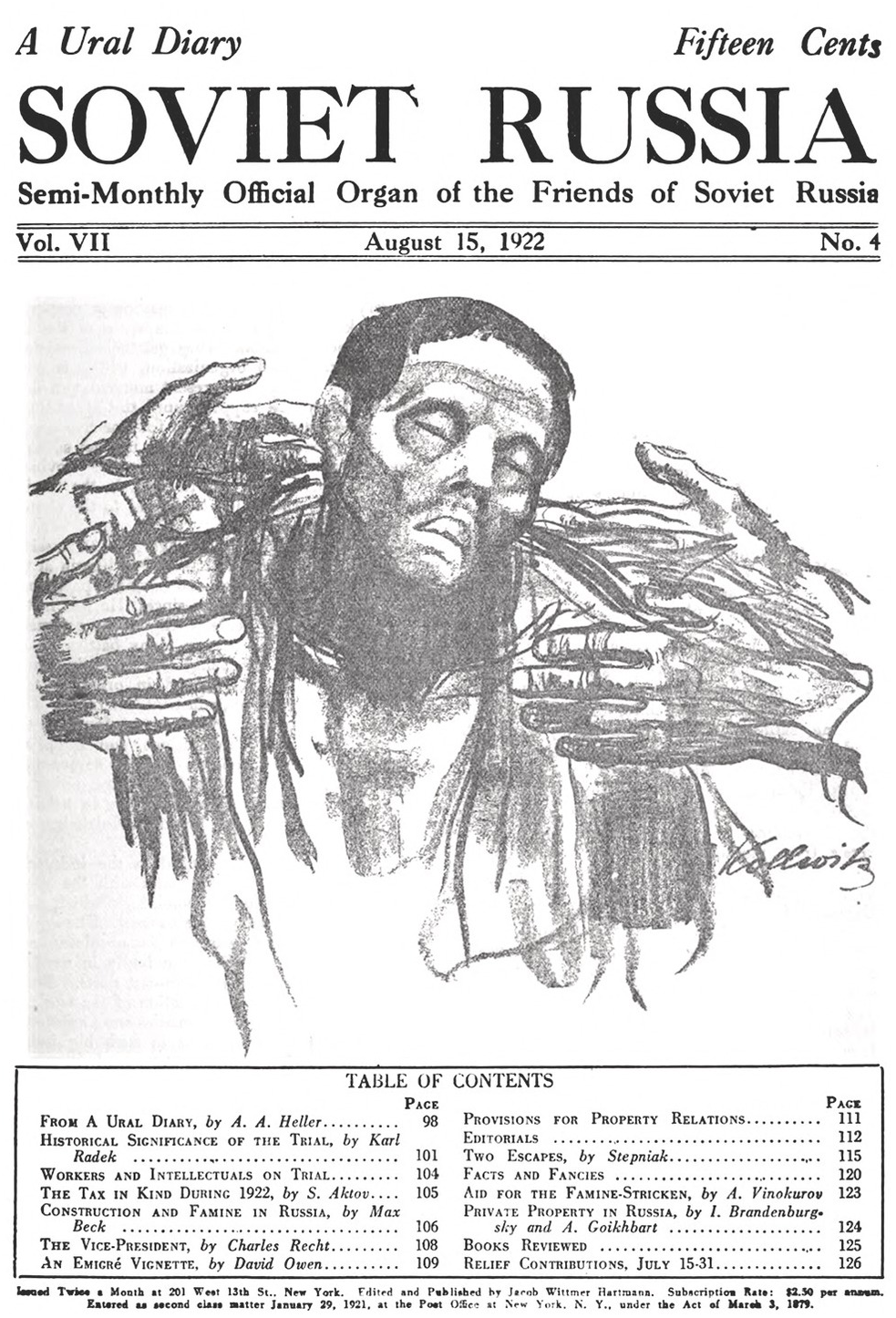
Nevertheless, although they differed in content and vocabulary, appeals by the FSR and WIR show many similarities regarding general motivational techniques to those of non-socialist organisations. Their campaigns suggested that workers’ donations would serve their own self-interest, because Soviet Russia was not an ethnic nation, but a state based on class affiliation. In this context, class was equated with kinship and Russians were described as ‘blood of your blood because they belong to your class’.Footnote 243 Fighting the famine would not only help Russians, but would destroy the hopes of the global bourgeoisie. FSR appeals suggested that whatever US workers would do for their Russian comrades today, the latter would reciprocate tomorrow. Moreover, as Russian workers had fought and died in the October Revolution for the ‘ultimate freedom of all workers from wage-slavery’, an unpaid debt existed that created an obligation to give on the side of workers elsewhere, and a claim to solidarity on the side of Russian workers.Footnote 244
Like the SCF, the FSR encouraged activists to launch fundraising collections on their own, and detailed instructions were given on how to proceed when approaching potential donors.Footnote 245 Similarly, the mainstream slogan in such solicitation was that ‘The future is built upon children.’ In the case of the FSR, however, donations were sought to make sure that the coming generations would defend the world’s first communist state against its enemies. Thus, the FSR was dealing far less diplomatically with the guilt question than other aid agencies; it openly blamed the West for exploiting the calamity, if not for causing it, by refusing Russia credit. Moreover, in accordance with the ideology of class struggle, it was stated that famine orphans ‘suffer today because famine-relief was withheld by the greedy billionaires and millionaires of the world’.Footnote 246
The focus on children was believed to attract donors outside of the realm of communist organisations.Footnote 247 Those organisations also copied bourgeois fundraising innovations, like the adoption scheme of the SCF. Clubs, associations, or employees of a factory could take a specific child under their wing. As in the case of the SCF, lasting bonds between donors and children were envisioned through an exchange of letters and photographs.Footnote 248 A special feature of the WIR campaigns was the participation of artists and celebrities, who supported fundraising activities in different ways. Among them were Käthe Kollwitz (who contributed a famous lithograph, see Figure 3.6), Selma Lagerlöf, Albert Einstein, Henri Barbusse, George Bernard Shaw, Anatole France, and Martin Andersen Nexø.
Campaigning in WIR publications shifted in spring 1922 from soliciting emergency relief to a development approach (see Figure 4.6).Footnote 249 A first step of reconstruction aid was the delivery of machines and tools, partly purchased with donations, partly collected in kind, as during the International Tool Collection Week in May 1922. Appeals claimed that ‘the cry for bread, the struggle for bare existence is being drowned in the cry for production, for working capacity, for labor!’.Footnote 250 It was argued that ‘food and clothing can only alleviate the suffering engendered by the famine, but they cannot exterminate the roots of famine in Russia’.Footnote 251
The FSR regarded ‘capitalist charity’ as a counter-revolutionary means to ‘smother Soviet Russia and re-establish the reign of the over-lords’.Footnote 252 As Braskén points out, from a communist relief organisation’s point of view, it was essential to describe Western efforts as inadequate or as a Trojan horse (or both) in order to make the international proletariat consider its own sacrifices justified.Footnote 253
Direct Appeals from Russians
When in October 1921 the ARA introduced its food remittance programme (see Figure 4.4), which allowed donors to supply friends and relatives in Russia with food parcels worth US$10, relief workers in Russia immediately began distributing appeal forms to be filled in and sent to addressees in the West. This created a situation in which prospective beneficiaries were given the opportunity to contact potential donors directly, thus giving them a chance to affect their own destiny. It contrasted greatly with other famines, where the famine-affected often appear voiceless. Thus, the machinery of organised humanitarianism was supplemented by an ad hoc element of recipient expression.
The first-hand appeals of Soviet citizens to the West vary in form and style, as well as in the background and strategies of their authors. Among the applicants were desperate individuals with starving families asking strangers for help, representatives of villages begging for food rations, and ethnic and religious groups (such as communities of Volga Germans or Orthodox parishes) that specifically applied to their brothers and sisters in blood and faith.Footnote 254 Most appeals, however, flowed between those linked by occupation. For example, teachers of a school, members of an orchestra, or staff of a hospital wrote to their counterparts in the USA directly or asked the ARA to assume the role of ‘philanthropic matchmaker’ and pass their appeals on to suitable parties.
However, successful match-ups between groups who made appeals and donors were the exception rather than the rule. The report of a successful pairing between a Russian training school for nurses and the Nurses’ Home of the Presbyterian Hospital in New York came about after ‘passing many hundreds of such supplications to prospective benefactors in the USA with no apparent result’. For an ARA official in London, it was therefore ‘a distinct pleasure to learn, that out of the multitudinous appeals dispatched from Europe … one, at least, has awakened the sympathies’.Footnote 255
In New York, ARA secretary Page was less enthusiastic and complained that the ‘great number of pathetic appeals’ that came in every day were bound to result in ‘the establishment of hundreds of little campaigns’ that neither served the ARA nor the starving people. The mere fact that the appeals arrived in New York created ‘a certain obligation’ towards the senders, he bemoaned.Footnote 256 But the flood of appeals could not be stemmed. By the end of May 1922, Page’s attitude had turned fatalistic: ‘I wish we had a plan for clearing up these appeals from Russia, but we haven’t.’Footnote 257 Half a year later, he admitted that while few of the appeals could be used for publicity, the majority were simply filed. With resignation he added, ‘I hate to be quite as cold-blooded as that.’Footnote 258
Academics were the principal applicants because they had the skills to write and submit appeals, something that farmers and workers rarely were capable of doing. In many cases, private appeals were the last resort for teachers, librarians, and scientists, as they had limited access to the general feeding programme. Moreover, the ARA considered the Russian intelligentsia, in a broad sense, as particularly worth support, because they could help spread a positive image of the USA and articulate Russian gratitude. Haskell, the ARA director in Moscow, reported that this group was encouraged to send appeals to the USA with the hope of facilitating relief that was outside of Soviet control. Some major donations, for example by the Commonwealth Fund and the Laura Spelman Rockefeller Memorial Fund, were earmarked for the Russian intelligentsia. However, these attempts were slowed down or forestalled when Soviet officials objected to such a specific distribution.Footnote 259
Group appeals usually created or referred to alleged common ground. Attempts to establish a relationship with distant strangers were primarily based on similar educations or professions. References to universal humanity – often applied in individual letters – were of minor importance. Consequently, recipients were addressed as colleagues and told about working conditions and supplies. Doctors depicted the situation of the local health service, academics described the state of affairs in their university, and so on.
Despite the variety of such appeals, certain patterns and elements frequently recurred. A common feature was the promise to repay what was given at some future time, whether with money, by working for the ARA (with obvious motives), or at least with eternal gratitude. A group of Volga Germans made ‘the sacred promise’ to pay back any debt as soon as possible by assisting other victims, and the Corporation of Dentists from Ufa, who had sent an appeal to colleagues in Chicago, considered it their ‘moral duty to refund the value of the food packages’ at a later date.Footnote 260 Others offered a factual, often intellectual, quid pro quo. For example, a biologist from Moscow sent two scientific articles as payment for a food draft, while two mineralogists from Petrograd offered their research results on building stone materials from the Onega Lake region in exchange.Footnote 261
Perhaps applicants hoped to increase their chances of success by offering to settle their debt, although their use of such phrasing may be understood as a symbolic act. At the same time, this approach was important for the applicants’ self-image. No matter how desperate they may have been, they often showed strong aversion to being seen as beggars or recipients of charity. A teacher from Tarsk wrote that he expected ‘least of all to be an object of philanthropy’, and a group of scholars from Kazan University would only accept help ‘as long as they could hope of repaying it’.Footnote 262 An applicant from Odessa confronted his humiliation directly: ‘You see, Gentlemen, it is very hard to get used to be a pauper… After a life full of work, of initiative, I am a beggar.’Footnote 263
The applicants themselves, as well as ARA officials, saw such expressions as indicative of a particular form of Russian pride. For example, in their appeal to colleagues in New York, a group of typists from Ufa explained that the intelligentsia of Russia does not have the habit of begging for help – something only the existential threat of starvation made them do.Footnote 264 An ARA memorandum noted that Russian academics rarely asked for help from abroad and would generally rather suffer than beg for assistance.Footnote 265 In letters accompanying Russian appeals, potential donors were asked to imagine how much pride it cost the writers to beg for help.Footnote 266 When the Boy Scouts of Theodosia (Crimea) asked the Boy Scouts of America for ‘literature of scoutism’ and used uniforms, their timidity was deciphered by the ARA, and it was pointed out to the US recipients of their request that ‘these boys were likely in great need of food’.Footnote 267
3.4 Television, Shame, and Global Humanity: Ethiopia
A BBC television news report on 23 October 1984 was the appeal that launched the large-scale international aid mobilisation for those afflicted by famine in Ethiopia. In the media-driven humanitarianism of the late twentieth century, ‘an emergency begins and ends when the BBC says so’, noted one commentator.Footnote 268 The public’s response had been muted as a result of poor television and press coverage earlier that year, and by October a UK Disasters Emergency Committee (DEC) appeal that had raised some £9 million was on the point of closing down.Footnote 269 At a time when charitable appeals on European radio and television were highly regulated, collaborating with media outlets provided valuable opportunities for voluntary organisations to communicate news of disasters to a wider public.Footnote 270 As a result, many aid agencies had come to depend on the 6 o’clock news as a major fund raiser.Footnote 271
Michael Buerk and Mohamed Amin produced the BBC’s report that day with the assistance of Oxfam and World Vision (see Figure 3.7). The seven-minute piece – unusually long for a single news item – primarily focused on the Korem relief camp in northern Ethiopia. Save the Children had established a supplementary feeding programme there in March 1984, financially supported by the European Economic Community (EEC), and Médecins Sans Frontières (MSF) was providing health care. A graphic film by Amin showed bodies being laid out for burial, malnourished babies being weighed, and in one segment a three-year-old dying while being filmed. Panoramic shots followed people running across the plain when rumours of a grain shipment triggered a stampede. Buerk’s voice-over spoke of a ‘biblical famine, now, in the twentieth century’. The broadcast highlighted the discrepancy between the aid that was needed (food) and the only relief the camp could offer (medical care and clothing). The camera zoomed in as a starving Ethiopian put on a donated suit jacket, many times too big for him, highlighting the absurdity of distributing cast-offs of well-fed Westerners instead of food. In a direct appeal from the camp, Brigitte Vasset of MSF lamented, ‘I don’t know what we are doing here. If there is no food, the medical treatment is a nonsense.’Footnote 272
Mohamed Amin (wearing hat) and Michael Buerk (in white suit) with their news team and Ethiopian children, 26 Oct. 1984.

As a result of Amin’s compelling footage and Buerk’s powerful narration, set against a background of abundant harvests in Europe, the film had a global impact, whereas earlier coverage had been largely ignored.Footnote 273 It was shown worldwide by 425 broadcasting stations, unlike the much smaller number to which the BBC’s famine reports in July had been syndicated.Footnote 274 In the USA, the NBC network broadcast a three-minute version using Amin’s footage, which was still lengthy coverage of a foreign news story so close to a US presidential election. A second report by Buerk, which provided greater detail on the ongoing civil war, was shown by the BBC on 24 October, but by then the story had been picked up by other broadcasters and the print media, and the connections between the civil war and the famine were largely lost in the ensuing coverage.Footnote 275 Renewed attacks by the Ethiopian government on central Tigray in late October 1984 became known as the ‘Silent Offensive’ because of the lack of attention in both the Ethiopian and international media.Footnote 276
Then, on 25 October, Peter Gill’s film Bitter Harvest was televised across the UK.Footnote 277 The documentary exposed the contrast between the famine and the European harvest more explicitly than Buerk’s report. It opened with scenes showing mountainous piles of grain and posed the straightforward question: ‘Why don’t we give our unwanted food to save the lives of those who need it?’ The film interspersed footage of autumn harvest festivals being celebrated in churches throughout Europe with video of Ethiopian relief camps, and featured interviews with staff at MSF, Oxfam, and Save the Children. A British farmer observed on camera that allocating excess grain to famine relief was not only the morally right thing to do, but that ‘in longer-term self-interest, [there is] a real value in making sure that people who are hungry are fed’.Footnote 278 Such moral and economic incentives became topics of public debate in Europe and the USA.Footnote 279 A War on Want report summed up the incredulity of the public in the late twentieth century when it asked, ‘How is it possible to film people dying and send the pictures back by satellite, yet still [be] impossible to bring them the food and the medicines to keep them alive?’Footnote 280
Television news and documentaries conveyed updated appeals for aid in late 1984, reigniting waning interest in the famine and sparking an influx of unsolicited charitable donations. The US-based relief organisation CARE suggested it was the BBC footage that finally legitimised the claims of Ethiopia on the American public.Footnote 281 Buerk, who saw his reports on the famine as appeals for aid, later confirmed that he downplayed the impact of the civil war over fears that he might prevent people ‘from coughing up their money’.Footnote 282 The film’s immediate impact can be seen by looking at Oxfam UK’s income. Oxfam had raised a respectable £51,149 from its appeal for ‘Famine in Ethiopia’ through September 1984. However, this sum was dwarfed by the £600,000 in unsolicited public donations it received in the five days after the film was aired on the BBC.Footnote 283 In Canada, a similar response to the newscast about famine in Ethiopia led one commentator to note, ‘People in High River [in Alberta, Canada] don’t read FAO reports. They do watch television.’Footnote 284 Other broadcasters were encouraged to explore the famine in a series of documentaries and news reports.Footnote 285
In several instances, the Ethiopian government criticised aid appeals that showed conditions in their country, but did not earmark the resulting funds specifically for Ethiopian relief.Footnote 286 On the other hand, voluntary organisations recognised that media attention concentrating only on Ethiopia might detract from other severely affected African nations. As CARE noted, ‘the challenge is to utilize current media awareness, but not to have our fundraising efforts be dictated by its emphasis’.Footnote 287 In the UK, the unanticipated influx of donations resulted in some conflict among voluntary organisations. The five members of the DEC were accused by others of unfairly monopolising airtime. Although War on Want (a DEC founder member) left the alliance in 1979, it and other groups continued to seek an allocation of funds for famine relief in Africa through 1984, although this attempt was rebuffed.Footnote 288
The television broadcasts brought about an increase in media coverage across all platforms. In the UK, the popular press increasingly took the lead from television, and tabloid newspaper column inches devoted to the famine increased from 50 in the first three weeks of October to 1,200 in the last ten days of that month.Footnote 289 Newspaper editorials urged an international response, while feature stories detailed relief work and provided instructions on how to donate.Footnote 290 The Stockholm newspaper, Aftonbladet, for example, included the story of an Ethiopian girl saved by Rädda Barnen (Save the Children, Sweden), followed by a listing of the bank account details for three voluntary organisations.Footnote 291 British tabloid rivalries helped to promote the story of the famine.Footnote 292 The Daily Mirror launched its own appeal and by 5 November had raised over £600,000 to fund its own ‘mercy flights’ to Ethiopia.Footnote 293 Some Western media outlets also alerted readers to the blatant hypocrisy of the Ethiopian Marxist government that would let its people starve while ordering a ‘boat-load of booze’ – half a million bottles of Scottish whisky – to celebrate its ten years in power.Footnote 294 This notorious episode also found its way into generally pro-Ethiopian English-language newspapers in Ghana, Kenya, Nigeria, and Tanzania.Footnote 295
The public response to the famine included thousands of letters from private individuals to voluntary organisations, the Relief and Rehabilitation Commission, United Nation (UN) agencies, and newsrooms in the days and weeks following the broadcasts.Footnote 296 Letters received by the BBC, including many from children, were read out on air or posted in the television studios. In much of this correspondence, themes of shame and guilt dominate, with the looming food mountains of Europe an ever-present backdrop.Footnote 297 The invidious contrast between the commodities of everyday Western life – abundant food, alcohol, cigarettes, and consumer goods – and the situation faced by people in Ethiopia was drawn out by many, who often described their own personal sacrifices.Footnote 298 One woman from the USA wrote to say that seeing the scenes on television ‘left a big lump in my throat, sitting down to a big Thanksgiving meal, knowing there are many starving’. Another reported that the famine had finally led her to quit smoking and to direct the money to relief: ‘I think of that starving child who needs the money a lot worse than I need those cigarettes.’Footnote 299
After October 1984, media coverage of the famine focused as much on such individual acts of giving as on questions of relief.Footnote 300 A New York Times article included stories of two little girls each pledging their US$5 allowance, a Vietnamese man who wanted to repay UNICEF for helping resettle him in the USA, and a baker who arrived at an organisation’s office with a large box of coins collected by his children.Footnote 301 These sentimental giving narratives involved ordinary, relatively powerless people. The point in circulating such stories, as cultural theorist Cheryl Lousley suggests, was not only to celebrate the pleasure of acting as a benefactor, but to ‘reveal and perpetuate a tremendous affective investment in famine relief’.Footnote 302 Such emotional investment, characteristic of expressive humanitarianism, helps explain the popular enthusiasm behind the new, more participatory forms of famine relief that peaked in the mid-1980s, and that are in some ways at odds with the long-standing fundraising techniques utilised by many agencies.
Voluntary Organisations’ Appeals
Although the immediate public response to the television news footage from Ethiopia was unanticipated, the fundraising sections of relief organisations around the world moved quickly to capitalise on it through press and billboard advertising, direct mail campaigns, and other appeals. However, after the high level of spontaneous donations for famine relief in October, some agencies cut back on public appeals because they already had more money than they could responsibly spend.Footnote 303
Reviewing the fundraising advertisements placed in newspapers and magazines in the USA, UK, Italy, and Sweden, along with the campaigns of selected aid agencies, reveals common strategies.Footnote 304 The most prevalent technique in 1984–5 seems to have been to emphasise the magnitude of the crisis in Ethiopia and stress its unprecedented nature.Footnote 305 Hyperbolic language was routinely deployed in press advertisements. World Vision referred to the ‘most devastating human crisis of our time’ and the American Red Cross (ARC) to ‘the worst drought in history’.Footnote 306 Similarly, an Oxfam direct mailing piece in November 1984 stated that ‘Ethiopia is the largest disaster situation we have ever faced’.Footnote 307
For the most part, aid agencies avoided confronting the Cold War complexities of the famine, including Ethiopia’s civil war and concerns over sending aid to a Soviet-backed regime. Many advertisements followed Buerk’s depoliticised description of a ‘biblical famine’, emphasising the failure of rains and crops.Footnote 308 By the mid-1980s, relief organisations were well-practiced in using discretion in choosing what they would stress in fundraising appeals; they had become adept at uncoupling the humanitarian relief of suffering from the geopolitical realities.Footnote 309 However, some organisations, including Oxfam and War on Want, did mention the conflict, and sought to draw attention to the failure of many Western governments to commit aid. War on Want hired a well-known advertising agency with links to the Labour party to develop a hard-hitting campaign on famine in Ethiopia, alongside South Africa, Nicaragua, and the ‘Third World’ debt crisis. The Ethiopia poster stated that crops ‘are being destroyed by another plague’ and showed Derg military jets, depicted as a swarm of locusts, above a war-torn landscape.Footnote 310
As in previous campaigns, aid agencies tried to distinguish between the innocent victims of famine and the unpalatable Marxist regime in Ethiopia by emphasising that aid was mainly targeted at women (specifically mothers) and children. Although relatively few advertisements appearing in print media contained images, those that did generally depicted a group of children or a mother and child.Footnote 311 The images of vulnerable children reinforced the televised pictures of the famine that were replayed throughout the October and November of 1984.Footnote 312 Save the Children’s press advertisements suggested that it would be far less painful for readers to reach for their cheque books than to watch children starve on television.Footnote 313 By autumn 1985, a year after the famine story first appeared, Oxfam addressed potential donors as ironic spectators, asking them if they were ‘fed up with pictures of famine on television?’.Footnote 314 The use of photographs was frequently discussed internally by aid agencies. War on Want was among the few organisations to publicly criticise the spreading of such ‘helpless and powerless’ images, and instead published a series of positive scenes from Eritrea in its own newsletter.Footnote 315
Another technique in press appeals was to stress the aid agency’s record of service to Ethiopia and its ability to provide immediate famine relief. The organisation’s accomplishments in Ethiopia were emphasised in direct mail appeals and advertisements that included extensive data on relief camps, numbers of nurses and aid workers, and quantities of food already shipped.Footnote 316 Such accounting-oriented advertising implied that not all relief organisations could draw on the same knowledge and expertise.Footnote 317 The US-based Catholic Relief Services (CRS), for example, boasted it had already been working in Ethiopia for ten years, and with the famine emergency for sixteen months.Footnote 318 Oxfam America, while it could claim no such history in Ethiopia, proudly stated that it could draw on similar experiences of relief work in Bangladesh and Kampuchea.Footnote 319 These claims were part of a process of establishing trust between the aid agency and potential donors, assuring the latter that their money would directly go where it was most needed, and would be administrated by competent teams.
The need to foster trust was sometimes higher in the case of umbrella organisations or coalitions of voluntary agencies that were often less familiar to ordinary donors. In November 1984, the US-based coalition InterAction, placed a full-page advertisement in twelve major newspapers, seeking donations that would ‘end hunger’ in Africa.Footnote 320 The ads made much of the importance of collaborative work, declaring ‘The experts are ready – For the first time ever, America’s private voluntary organizations have joined in a powerful coalition, 60 of which are already working in Africa.’Footnote 321 This was a common strategy worldwide, but especially in Canada, Australia, and Western Europe. In Sweden, a joint appeal by six ‘Ethiopia organisations’ referred to their ‘necessary connections and many years of experience’ in relief work.Footnote 322
Since the late 1970s, aid organisations working on behalf of their own secessionist liberation fronts had sought to make direct appeals to the West. They did this in an attempt to avoid widespread reluctance on the part of most donor governments to provide aid to areas outside of the control of the government of Ethiopia. The Eritrean Relief Association (ERA), established in 1975, and the Relief Society of Tigray (REST), founded in 1978, believed that public opinion could be mobilised with the help of a network of overseas support committees to counter Western government policy.Footnote 323 Advertisements placed by these groups in late 1984 alerted prospective donors that two million people living outside government-controlled areas were facing famine.Footnote 324 REST’s support committee in the UK, for example, stated its credentials as ‘the only indigenous humanitarian agency’ working in Tigray during a decade of war and four years of drought, and the only group that could guarantee aid would reach starving Tigrayans.Footnote 325 Emphasising the humanitarian record of REST and ERA, while simultaneously downplaying connections with their respective military forces, was an attempt to legitimise these organisations through their association with various intermediaries, including the Sudan-based Emergency Relief Desk (ERD), an ecumenical consortium engaged in cross-border relief operations, that channelled aid to rebel-held areas.Footnote 326 There was also significant fundraising among global Jewish communities, particularly in the USA, in support of Operation Moses, the secret airlift of thousands of Ethiopian Jews to Israel.Footnote 327
At the end of 1984, many appeals were explicitly linked to Christmas, with donors being urged to spread a little goodwill.Footnote 328 This followed long-established patterns of linking fundraising to religious holidays. Christmas had been a key date on the fundraising calendar in the USA and Europe since at least the 1860s. Such appeals were especially lucrative for Christian Aid, whose headquarters was processing £70,000 a day in donations around Christmas 1984.Footnote 329 The holiday prompted a diverse range of appeals that went beyond references to the biblical story and the need to think of others. Solicitations for Ethiopia at this time were framed in morally provocative and challenging terms. In the UK, Help the Aged ran a mock ‘shopping days’ til Christmas’ countdown in a number of newspapers throughout December, marking ‘15 dying days’ til Christmas’, and so on.Footnote 330 YCare International printed a picture of an emaciated child with a spoof four-course Christmas menu listing grass, weeds, berries, and dirty water.Footnote 331 An ARC campaign asked people to stop and think the next time they paid for a restaurant meal, and to ‘pick up the tab’ for someone who really needed it this Christmas.Footnote 332
The strategy of ‘praising the donor’ reflects the notion that aid is essentially donor-driven. As David Williams writes, ‘Aid to Africa is about “us”, not “them.”’Footnote 333 Advertisements and articles repeatedly referred to the generous, concerned, caring public in Sweden, Britain, or the USA, and thanked donors while urging them to give again.Footnote 334 Help the Aged’s November 1984 appeal for Ethiopia was placed in all the major UK newspapers as an advance ‘thank you letter’ to the generous readers of each paper.Footnote 335 The strategy wanted to make donors feel part of a special group and increase the likelihood that they would donate more. The ARC described Americans as ‘the most generous people in the history of mankind’.Footnote 336 Similarly, CARE’s direct mail campaign for famine in Africa addressed supporters as ‘caring Americans’ who ‘share a belief in the value of human beings, whoever and wherever they are’.Footnote 337 This marketing approach was in contrast to CARE’s newspaper ads, where emotive language was avoided in favour of recounting the organisation’s track record in relief work.Footnote 338 The relatively few appeals that were made to the general public in Italy praised the country’s generosity as resulting in part from the recent memory of poverty at home.Footnote 339
Oxfam thanked its supporters for having contributed earlier, but also pleaded for more and it chastised undecided potential donors: ‘None of us has the excuse that a small contribution will achieve nothing.’ However, the organisation expressed its concern that long-term development work would suffer as a result of diverting attention to emergency relief unless some donors gave unrestricted funds, in addition to the famine appeals.Footnote 340 The Swedish Red Cross likewise urged people to share their wealth, deploying moral economic language by stating ‘It is not a matter of buying yourself free from a bad conscience. You are investing in life.’Footnote 341 A billboard advertising campaign in Sweden asked passers-by to remember ‘Ethiopia is starving. What are you doing?’Footnote 342
Another strategy was to try to engage potential donors in wider campaigning and advocacy work on hunger, aid, and development.Footnote 343 War on Want, for example, mounted an effort to secure ‘safe passage’ for relief supplies to Eritrea and Tigray, and used its newspaper advertisements to encourage readers to lobby politicians on this issue. In direct mailings and newspaper ads, Oxfam asked supporters to join its ‘Hungry for Change’ campaign, launched in October 1984 by a cross-party line-up of politicians, journalists, church leaders, and celebrities. Two hundred ‘Hungry for Change’ local groups were formed, and thousands took part in a weekend fast in November 1984.Footnote 344 In the same month, Oxfam led a group of other organisations in promoting a ‘Famine in Africa’ petition directed at the British government.Footnote 345 People were encouraged to cut the petition from the newspaper and solicit signatures from family and friends. When it was submitted to UK Prime Minister Margaret Thatcher in March 1985, over 760,000 had signed it.Footnote 346 The group of six ‘Ethiopia organsiations’ in Sweden published a similar appeal demanding government action.Footnote 347
In the competitive charity marketplace, the primary purpose of newspaper advertisements was to convince would-be donors that they should choose one particular organisation over another. In the UK, charity shops located on almost every high street were significant local sites from which direct appeals were made to the British public in the days before television or Internet advertising.Footnote 348 Leading overseas aid charities like Oxfam and Save the Children had hundreds of shops each – an important network of collection points for revenue ranging from children’s pocket money to the proceeds of local events. Large appeal posters produced by Oxfam for display in shop windows used arresting red-black-and-white images of women and children to urge passers-by to enter the shop and ‘give £1 or more TODAY’ to the famine fund.Footnote 349 ‘Keep the change for Ethiopia’ became a common catchphrase in Save the Children’s shops.Footnote 350
Voluntary organisations adopted a different approach when using direct mail campaigns to address supporters or lists of ‘warm’ contacts. Such appeals were generally longer in format and in language directed at individuals. As relief appeals continued throughout 1985 and into 1986, advertisers had to contact donors repeatedly and persuade them to give again and again, while also trying to recruit new donors. For example, a UNICEF UK advertisement in July 1985 urged those who read it, ‘Don’t stop caring now – we are so close.’Footnote 351
Are We the World? Celebrities and Participative Fundraising
Although celebrity activism had played a role during earlier relief efforts, it assumed increased significance at the time of expressive humanitarianism. It reached its peak in 1984–5 when Band Aid managed to capitalise on popular enthusiasm and inspire imitators around the world. Musicians and celebrities began to initiate fundraising activities in October 1984. In Sweden, musician David Bradish rapidly put together a televised fundraising gala for November 1984 under the banner ‘People Who Care’, raising half a million Swedish kronor, which he followed up with a series of initiatives throughout 1985.Footnote 352 Similarly, Bob Geldof set out to raise a few hundred thousand pounds by writing and recording a charity single. Geldof later justified his personal response to the news in moral economic terms: sending money did not seem enough of a response to the pictures he had seen because to ‘expiate yourself truly of any complicity in this evil meant you had to give something of yourself’.Footnote 353 Band Aid was, therefore, ‘never a charitable impulse, it was a moral imperative’.Footnote 354 Geldof’s approach was to translate his emotion into popular music, attracting a large audience and a powerful support base.Footnote 355
Celebrity humanitarians like Geldof and Bradish have been seen as bridges between Western audiences and distant tragedies; the celebrity is ‘a focus for empathy, an emotional interpreter’.Footnote 356 Further, the celebrity personifies ‘an altruistic disposition’ in which all can share.Footnote 357 Although there had been earlier charity singles – notably the 1971 song ‘Bangladesh’ by George Harrison – none had experienced such success. At the time, therefore, the explosive rise of the song written by Geldof and Midge Ure and recorded by a super-group in November 1984 took everyone by surprise.Footnote 358 ‘Do They Know It’s Christmas?’ became the fastest selling single of all time in the UK and went straight to number one on the charts. By January six million copies had been sold and the song had raised £8 million. The record became a focus for public outrage at the international community’s inaction at a time of abundant harvests.Footnote 359
Like many of the aid agencies’ fundraising appeals, the song spread a compelling message of common humanity, and its repeated chorus of ‘Feed the world/Let them know it’s Christmas time’ contained a simple but seemingly irresistable call to action.Footnote 360 The name Band Aid reflected the idea that this effort ‘would be like putting a tiny plaster on a wound that required twelve stiches’.Footnote 361 The success of the recording reflected widespread desire on the part of many sections of the British public to do something that would put a halt to the pictures of children dying on television. The contrast of ‘us’ and ‘them’, so evident in letters from individuals, was central to the emotive lyrics of the song, which reminded the public that they should ‘thank God it’s them instead of you’. Reflecting on the organisation’s slogan, ‘With Love from Band Aid’, Lousley observes that Geldof’s project can be understood as part of a ‘popular culture of sentimental exchange’ in which donating to famine relief is positioned as a gesture of love, and famine relief images, stories, tears, gifts, and money are exchanged and circulated.Footnote 362
Band Aid’s success was followed by the ambitious Live Aid concerts held on both sides of the Atlantic and elsewhere on 13 July 1985. They were watched by over 1.5 billion people on television and raised US$80 million for the Band Aid Trust.Footnote 363 Of this total, US$25 million came from the USA, where the independent Live Aid Foundation was established to allocate funds. Apart from ticket and merchandise sales, sponsorship, television rights, and mailed contributions, new banking technology enabled credit card donations to be made by telephone during the show in certain countries.Footnote 364 Geldof infamously interrupted the announcer, who was in the midst of giving details for postal donations, to exclaim ‘Let’s fuck the address, let’s get the [phone] numbers, for that’s how we’re gonna get it [money].’Footnote 365 Swedish public television broadcast sixteen hours of Live Aid but was criticised for not organising a call centre to accept telephone donations.Footnote 366 Funds raised by the telethon in various countries were generally remitted to local organisations, including MSF in France and the Red Cross in Thailand.
It was said that Live Aid ‘conveyed a sense of political action without recourse to politicians’.Footnote 367 In one memorable segment, the news footage of the Korem relief camps was used as background to the performance of a rock song by The Cars, the suffering of those projected onto the screens ‘sublimated’ for the audience. Geldof argued at the time that anything he did was morally justified because the horrors of the famine had made it immune to political argument. In subsequent years, the apparent universal solidarity of Live Aid has been widely critiqued as a depoliticising response to the catastrophe that has defined the ways in which the West has conceptualised Africa ever since.Footnote 368 The Band Aid Trust did seek to make political capital out of the concerts, however, citing the decision of the UK development minister that the emergency airlift in Ethiopia would continue as a direct result of Live Aid.Footnote 369
Although the scale and marketing success of Band Aid and Live Aid has tended to overshadow smaller scale initiatives outside the Anglo-American world, celebrity involvement in fundraising in 1984–5 was more diverse and international than retrospective analyses have suggested. There were expressive, emotionally laden initiatives by celebrities, politicians, and public individuals in many countries. In Sweden, figures from the world of sports and fine arts became involved. Athlete Ricky Bruch, for example, organised a series of events, held a fast over Christmas 1984, and lobbied the government for tax relief on charity.Footnote 370 In Italy, seventy members of the Radical party threatened to go on hunger strike until Christmas if the government refused to pass a law giving aid to Ethiopia.Footnote 371
Across Europe, several celebrity-endorsed spectacles were held, with widespread television and media coverage and sales of merchandise. A ‘One for Africa’ day of action organised by the national television and radio networks in the Netherlands in November 1984 raised the equivalent of US$24 million; a survey found that the television broadcast had been watched by two-thirds of the population over the age of 15 years. However, there was also criticism of an apparent disconnect between some of the performances and the subject of famine.Footnote 372 On 23 January 1985, the Federal Republic of Germany held a fundraising marathon known as Ein Tag für Afrika (A Day for Africa) that raised 125 million marks (around US$40 million) to be shared by more than a dozen German voluntary agencies (see Figure 3.8).Footnote 373 After Italian media complained about the absence of their country’s artists at Live Aid, noting sarcastically that Italy had been outperformed ‘even by Yugoslavia’, a benefit concert for Ethiopia was held in Verona in August 1985.Footnote 374 However, involvement in star-studded events could also backfire. In August 1985, the secretary general of the Swedish Red Cross categorised as ‘grotesque’ a charity gala that sought to raise money through a luxury dinner linked to the opening of a new nightclub.Footnote 375
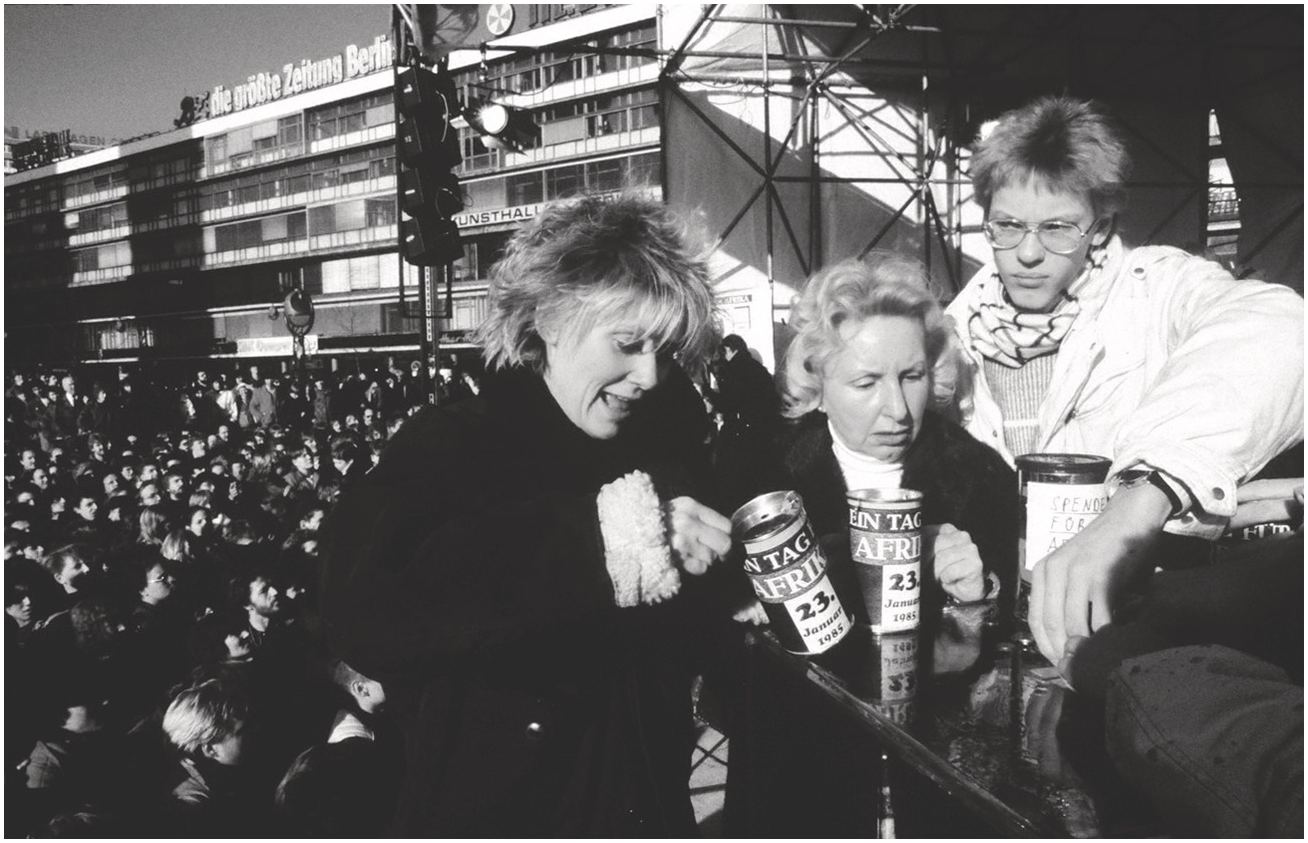
By the summer of 1985, the success of the Band Aid single had inspired the production of at least twenty other charity singles around the world.Footnote 376 Unlike Band Aid, most of these identified specific aid agencies from the outset as beneficiaries. ‘We Are the World’ was put together by US music impresarios Harry Belafonte and Ken Kragen, influenced both by Band Aid and the memory of singer and hunger activist Harry Chapin. The single, written by Michael Jackson and Lionel Ritchie, was released in April 1985 and was quickly followed by an album.Footnote 377 Its sponsor, the United Support of Artists for Africa organisation (USA for Africa), was incorporated in January 1985, and by December 1987 had raised US$58 million for famine relief and long-term development work in Africa. Like the British recording, this song’s lyrics drew on the theme of common humanity, urging that this was a time ‘when the world must come together as one’. The song also contained the notion of empowerment, that ordinary Americans could make a difference by donating, and that by so doing they would be ‘saving their own lives’, as the chorus maintained. A film made about the recording emphasised the ‘choice we’re making’ and contained direct appeals from Jane Fonda and Lionel Ritchie. The song inspired further participatory activities on a number of fronts. It was played on 8,000 radio stations in twenty-five countries on Good Friday 1985, and was said to have made the world ‘momentarily a neighbourhood of concern’.Footnote 378
The double French A-side single ‘Starvation’ and ‘Tam Tam pour l’Ethiope’, which had been in the planning before the Band Aid song, raised money directly for MSF, Oxfam, and War on Want (see Figure 3.9). In contrast to ‘Do They Know It’s Christmas?’, the recording included many Black artists – some from African countries singing in French and a number of African languages. It was less commercially successful than either its British or US counterparts.Footnote 379 Many of the other singles allocated a small proportion of the funds that they generated to domestic charities dealing with hunger and poverty. In France, a group known as Chanteurs sans Frontières recorded a song entitled ‘Ethiopie’ that raised 23 million francs, 90 per cent of which went to MSF and the rest to the charity Restos du Coeur. The Canadian song ‘Tears Are Not Enough’ raised Can$3.2 million for the Red Cross, UNICEF, and CARE, with 10 per cent going to food banks in Canada.Footnote 380 Other singles included the Spanish-language Cantaré, cantarás, which featured a group of Latin American stars known collectively as ‘Hermanos’.

Celebrity activism also sought to channel and shape public sentiment about disaster relief. For example, the chorus of the Austria für Afrika song ‘Why’ (Warum) provided an ironic commentary on the Western response to the famine: ‘We’re sending money so we don’t feel so bad’ (wir schicken Göd – damit’s uns besser geht). Compared to the West German ‘Naked in the Wind’ (Nackt im Wind), which addressed the gravity of the situation and the lack of political consciousness in the West, the Austrian song was political on a deeper level. It referenced the Ethiopian regime’s use of famine as a weapon and alluded to its support from ‘Big Brother’ – the Soviet Union. An Ethiopian folk song was included along with some Ethiopian students based in Vienna.Footnote 381 In communist Yugoslavia, YU Rock Misija contributed to the global famine relief effort through a charity single ‘For a Million Years’ (Za milion godina) and a rock concert that raised over US$400,000. All three songs, alongside other national efforts, were performed and broadcast as part of the Live Aid concerts. An analysis of English-language African newspapers shows that both official and popular responses to celebrity fundraising in 1984–5 were overwhelmingly favourable.Footnote 382
A key difference between earlier forms of celebrity humanitarianism and Band Aid was Geldof’s insistence on retaining control over the disbursement of funds – perhaps alarmed by the financial problems that had plagued Harrison’s 1971 Concert for Bangladesh.Footnote 383 A deep-rooted suspicion of aid agencies as ‘pickpockets’ shaped Geldof’s approach to relief.Footnote 384 Of his single’s £1.35 selling price, 96p went to the Band Aid Trust set up by him and officially registered as a British charity in January 1985.Footnote 385 Although the record industry waived most of the costs of production, the UK government took 18p of the cover price in taxes, which it initially refused to remit despite a public outcry, although it did later quietly allocate an equivalent sum to famine relief. More money was raised through a series of spin-off campaigns, including Fashion Aid, Classical Aid, Food Aid, Visual Aid, Sport Aid, and School Aid, and a series of local initiatives.Footnote 386 Like Band Aid, USA for Africa rejected the ‘traditional foundation game’; both sought to develop models of allocating aid that reflected their self-made origins.Footnote 387
Expressive humanitarianism was evident in other participatory fundraising activities aimed at children and young people. In the UK, this included the 1984 Blue Peter Appeal in which millions of people collected stamps, postcards, and buttons that could be turned into cash for Ethiopia. The appeal built on a growing relationship between the children’s television show Blue Peter and Oxfam, a partnership which the charity was keen to continue. The programmers had responded to pressure from audience members who wrote in the thousands asking ‘Please, please, please can we have an appeal this year for the starving people in Ethiopia? They need the food much more than we do.’Footnote 388 The same kind of enthusiasm in their own countries caused voluntary organisations across the world to create a range of appeals through link-ups with young people’s magazines, television programmes, schools, youth organisations, and student unions.Footnote 389 Save the Children (UK), for example, reported that donations from children and young people in 1984/5 were 476 per cent higher than the previous year.Footnote 390 In Sweden, Lutherhjälpen’s annual fast, in which three million households took part, used a series of daily reminders and simple tasks to motivate children’s giving.Footnote 391 However, War on Want cautioned against ‘cashing in on compassion’ without offering an accompanying educational programme on the political context of aid.Footnote 392 Nonetheless, even War on Want echoed Band Aid’s rhetoric in its 1985 membership recruitment leaflets, noting that ‘If you’ve helped feed the world, then help change the world’ by joining War on Want.Footnote 393
In summer 1985, a Band Aid spin-off programme in the UK called ‘Schools for Africa’ – also known as School Aid – followed a well-established pattern of asking for gifts-in-kind rather than cash contributions from children (see Figure 5.8). The scheme invited schools to apply for special sacks that pupils would fill with sugar, flour, and dried peas or lentils, and would then be shipped to Africa, arriving at ports for free via British Rail’s parcel delivery service. The appeal was ‘on the basis that one more cheap item added onto the shopping list of every family could save thousands of people’.Footnote 394 The Schools for Africa scheme was a success in terms of the numbers participating: even though it was August, the middle of the UK holidays, 200 schools a day were applying to join.Footnote 395 In all, six million school children were enrolled.Footnote 396 School Aid had a French counterpart called ‘Action Ecole’ that raised 4.6 million francs for projects in Mali.Footnote 397
Many commentators agree that Band Aid succeeded in stimulating interest in famine relief and wider development issues among groups previously unreached by overseas aid charities – notably young people and blue collar workers. Humanitarian organisations recognised Band Aid’s pivotal role in heightening public awareness of famine and poverty abroad, leading to discussions on how to tap into this newly awakened interest. Christian Aid conducted a survey that concluded the Band Aid constituency was ‘not ours’, while research commissioned by Oxfam suggested that younger people responded to Band Aid, Live Aid, and Sport Aid because these campaigns offered ‘something more participatory and emotive rather than rational’, unlike Oxfam’s usual messages.Footnote 398 From early on, Oxfam’s campaign manager was eager for the charity to develop strong ties with Band Aid in order to ‘freshen’ its image among young people and to publicise their support in its annual report.Footnote 399
This all had long-term consequences for future fundraising, for it made aid agencies more receptive to novel ideas that they might earlier have dismissed. Notably among these was the ‘Joke Aid’ aid concept proposed to Oxfam and SCF after Live Aid by the comedy writer Richard Curtis. It eventually evolved into a regular UK fundraising telethon known as Comic Relief that featured comedians and entertainers.Footnote 400
There was also soul-searching on the Left. The cultural theorist Stuart Hall argued that the Band Aid and Live Aid movement had mobilised a new, youthful constituency that put international aid onto the political agenda in Britain and created a ‘famine movement’.Footnote 401 Other critics identified this phenomenon as a manifestation of hedonistic 1980s consumer culture.Footnote 402
The UK Ambassador to Ethiopia, Sir Brian Barder, credited Geldof with awakening the conscience of people and keeping that awareness alive.Footnote 403 Backed by what he called ‘a constituency of compassion’, Geldof had prime ministers, presidents, and the EEC in his sights, as his new-found mobilisation force made ‘Western politicians rush for cover’.Footnote 404 Geldof used his unique position to confront those in power with concerns that few aid workers or diplomats dared to raise for fear of jeopardising long-term relations.Footnote 405 The main Sport Aid event, held in May 1986, was a sponsored run called the ‘Race Against Time’ held in eighty-nine countries to coincide with the opening of the UN General Assembly’s first session on Africa and the food crisis. The funds raised were split between Band Aid and UNICEF.Footnote 406
USA for Africa was not involved in organising Live Aid (although the song was performed in Philadelphia). However, in May 1986, it staged its own spin-off mass participation event, ‘Hands across America’, a human chain of 6.5 million people headed by celebrities, politicians, and religious leaders. It raised US$34 million, which largely went to combat hunger in the USA, rather than overseas.Footnote 407 Such initiatives kept the issue of hunger in the public eye far longer than it might otherwise have been, and succeeded in generating substantial funds that were eventually deployed for rehabilitation and development programmes in Africa. Manifestations of celebrity humanitarianism held one idea in common: issues of hunger and poverty in Africa require prominent interpreters or ‘intermediaries’ in order to make them meaningful – even enticing – to Western audiences.Footnote 408 Expressive humanitarianism built on a long-standing tradition of popular engagement with charity in the form of consumption – that is, through sales of ancillary merchandise.Footnote 409 Thus, through tie-ins with McDonalds and other commercial companies, Hands across America and Live Aid also influenced the development of cause-related marketing in the 1980s, more recently conceptualised as ‘Brand Aid’.Footnote 410
The celebrity-endorsed, media-driven fundraising extravaganzas from 1984 to 1986, particularly Live Aid, have assumed iconic status in how the period is remembered in many countries, and have since been widely duplicated. As highly successful instances of a ‘marketised philanthropy’, these one-off, immersive, participatory experiences largely succeeded because they were not seeking any long-term engagement with the underlying issues of global inequalities.Footnote 411 Self-declared ‘band-aids’, they proposed only temporary amelioration of hunger. Nonetheless, such participatory appeals worked not by duping ‘audiences mesmerised by spectacle’, but by tapping into a genuine desire for emotional investment in feeding the world – if it might be achieved without paying too high a price financially and emotionally.Footnote 412
3.5 Arousing Compassion: A Long View on Calls for Famine Relief
Our three case studies take a long view of the evolution of appeals for emergency aid. Stretching over a period of almost 150 years and drawing on source material from a range of donor countries, the cases presented illustrate the trajectory of humanitarian fundraising over time. We identify distinctions between the three examples, noting the differing historical contexts in which relief funds were raised, as well as the similarities and continuities in discourse and practice.
In all three cases, famine conditions had been developing for some time. However, transnational aid mobilisation first gained momentum as a consequence of media events after the crisis had escalated. For Ireland, it was the report from the Skibbereen neighbourhood in December 1846; in the case of Russia, the circulation of Gorky’s appeal in July 1921; and for relief to Ethiopia, the screening of Buerk’s and Amin’s BBC report in October 1984. Once a broader public had become aware of the famine, fundraising, organisations, and the media deployed hyperbolic language to vivify conditions in the afflicted areas. In each of our examples, aid agencies depicted as unprecedented the scale of the crisis, the number of people affected, and the horrors of starvation.
While Irish and Russian representatives appealed directly to donors abroad, Ethiopian recipients depended on brokers in Europe and the USA. Those intermediaries shared images rather than transmitting the voices of those suffering, thereby depriving them of their own voice in the catastrophe. In all three countries, diaspora communities were engaged in fundraising, but their importance for the overall relief effort decreased over time. During the 1840s, Irish communities in the British Empire and the USA played a pivotal role in relief activities, and entreaties originating from Ireland are well documented in publications concerning relief efforts. Still, the largest British campaign calculated that they would receive a greater return in donations by citing officials and humanitarian workers, rather than beneficiaries. A similar strategy can be observed in the 1920s regarding Russia. Even though fundraising campaigns were triggered by Gorky’s appeal, in the two years that followed, aid organisations relied mainly on reports and graphics provided by foreign visitors to the famine region. Russian voices, mostly in the form of letters, were occasionally heard in communications of gratitude or requests for small-scale relief. The role of Russian communities abroad, however, was ambivalent, as some members were active adversaries of the Bolshevik regime. Still, many supported the relief efforts financially and organised collections that were often directed at specific groups. With regard to Ethiopia, individuals were only depicted as famine victims to illustrate the horrors of starvation. The fact that they were given no other identity contributed to a distorted picture of Africans in the Global North that had lasting consequences. Exiled groups allied to the Tigrayan and Eritrean liberation fronts tried to create awareness of the fate of the population in areas outside governmental control, but their overall influence was limited.
Historically, the waning voices of famine victims might appear surprising. It can partially be explained by the increasing spatial and emotional distance between donors and beneficiaries in our three cases. During the Irish Famine, many donors felt closely connected to beneficiaries, either as UK citizens, through their Irish kinship, or as Catholic coreligionists. At the time of organised humanitarianism, appeals on behalf of more distant populations became possible, even for enemies and former enemies, if other bonds appeared meaningful. Accordingly, Gorky described Russians as members of a European family of cultivated nations, and appeals often focused on children as a group presumably untainted by ethnic, religious, or political divisions. Many organisations called on the entire population of their home countries, or even beyond, with appeals in the name of humanity, Christianity, and the idea of reconciliation. Others continued to rely on more narrowly defined religious and ethnic bonds, and the obligations and entitlements they entailed.
By contrast, relief for ethnic was mainly provided by ‘distant strangers’ in a geographical, ethnical, and cultural sense, although the rapid coverage provided by the media gave donors a sense of participating in real time. Appeals relied almost exclusively on notions of urgency and the broader ties of humanity or Christianity, again focusing on children. The role of celebrities as mediators between the donating public in the West and starving Africans, while it had earlier roots (such as the engagement of Gorky and other writers and artists in the early 1920s), is generally seen as a hallmark of modern-day humanitarianism. However, Live Aid is also reminiscent of earlier engagements, such as the Anti-Corn-Law League Bazaar in 1845, which raised an enormous sum of money while politicising the middle classes.Footnote 413 The notion that there can be reconciliation after political rupture, prominently advocated after the First World War, did not play a role in the Ethiopian case.
Worthy Victims and Guilty Governments
Doubts regarding the entitlement of famine victims were handled in various ways. At the time of the Great Irish Famine, the Anglo-Saxon discourse was not only characterised by prejudice against the Irish, but also by a Malthusian logic that considered starving populations at least partly responsible for their own fate. Thus, many appeals suggested a ‘quid quo pro’ moral economy regarding a beneficiary’s entitlement, adjusted to the targeted donor group: Catholic efforts and US campaigns tended to stress historical justifications, such as a debt owed to Ireland for being a stronghold of Catholicism or a nucleus of North American society, while appeals in the British Empire recalled Ireland’s military contributions to imperial expansion. In the case of Russia, a future requital was occasionally promised, if only indirectly, by suggesting that relief to Russia would serve the donors’ economic self-interests in the long run. Only communist relief organisations argued explicitly for reciprocity by referring to Russians as a revolutionary avant-garde who had bled for workers all over the world. During the famine in Ethiopia, notions of reciprocity no longer played a substantial role, even in the abstract; instead, appeals to a common humanity dominated, alongside a vague sense of responsibility to the ‘Third World’.
In the 1840s, many fundraisers presented aid to the Irish as either ethnic, religious, or imperial in-group relief. The breakthrough of the principle of impartiality that followed – anticipated in numerous campaigns during the Great Famine – was a humanitarian milestone. However, it also led to the counterclaim that charity should begin at home, a position that was especially strong when nationalist or ideological tensions were high. Humanitarian appeals, therefore, had to stress that true altruism could not be limited to certain groups, but must be founded on an objective evaluation of need. The existence of deserving people at home was never denied, either during the Russian or the Ethiopian Famine, although humanitarian organisations tried to explain that their own compatriots were far better off than the victims of famine. Descriptive and visual here–there comparisons translated this argument into fundraising appeals. Nevertheless, in many cases, humanitarian agencies were forced to accompany their actions in support of distant sufferers with ancillary campaigns for the local charity market. For example, relief to Ireland was paralleled by relief to Scotland, and during the Russian Famine, the SCF ran a simultaneous fundraising drive for domestic relief. Likewise, USA for Africa and similar Canadian and French celebrity fundraising activities in the 1980s earmarked part of their donations for domestic charities.
While the necessity of objective evaluation and impartiality was promulgated early on, so was the modern criticism heard that such an approach might reduce relief ‘from a moral enterprise to a merely technocratic one’.Footnote 414 Fundraisers realised that solely functional appeals would not result in the desired outcome, as donors rather ‘react to people who have problems than to statistics about people with problems’.Footnote 415 In the case of all three countries examined, appeals sought to individualise suffering by describing or portraying specific outcomes – preferably focusing on children and mothers. Another common campaign feature was engaging holidays, especially Christmas, to inspire giving, while repeating the claim that the scale of the famine was unprecedented.
During the Irish Famine, such strategies tended to move the public away from Malthusian reasoning. At the beginning of the appeals for starving Russia, however, many fundraisers were worried about a possibly desensitised post-war audience. They assumed that more powerful emotional triggers were needed and acted accordingly. Fundraisers for Ethiopia in the 1980s also presumed donor fatigue after the high-profile crises of the 1970s. The three campaigns we analysed confirm modern studies of media responsibility. Such studies claim that the presumption of ‘compassion fatigue’ not only reinforces simplistic press coverage, but also sets the sensationalism bar higher for coming emergencies, which in each case must then be described as ‘more dramatic or more lethal than their predecessors’.Footnote 416
The inclination to blame victims gave way to a modern humanitarian narrative during the late nineteenth century, although the old tendency seems to have reappeared in recent times. However, doubts regarding natural causes of famines – especially claims concerning the responsibility of governments – still hinder relief efforts. The situation in the three settings we examined differed, as Russia and Ethiopia were ruled by regimes hostile to the West, making transnational aid a delicate matter, while Ireland was part of the British Empire. Many Irish people, joined by some Germans and French, spoke out against the failure of the British government. In opposition, UK relief tended to frame the famine as a calamity limited to a discrete area with a problematic population, rather than concede that it was a domestic crisis. Hence, imperial calls for aid during the Irish Famine were careful to explain the safeguards put in place to prevent donations from being abused, as did Western organisations in Russia and Ethiopia.
Contemporary fundraisers understood that the perception of an emergency as a product of human agency might damage otherwise successful campaigns. They denounced any such claim of human causality, despite often knowing better, and attempted to depoliticise the context, either by concealing human causes or by rhetorically separating innocent suffering populations from their leaders. During the 1920s, relief organisations avoided any discussion of communism’s failure and the adverse effects of Western engagement in the Russian Civil War, highlighting instead their co-operation with the Russian population and governmental authorities. Similarly, the well-known broadcaster Buerk admitted he downplayed the civil war in Ethiopia in order not to compromise relief efforts. Another fundraising strategy was to assure donors that aid would not strengthen a country’s hostile ideological order, but that they would rather weaken it by winning the ‘hearts and minds’ of the starving masses.
Despite transnational ambitions and appeals invoking humanity and universal siblinghood, one striking continuity across our three case studies is the framing of campaigns as a national relief effort. During the Irish Famine, many fundraisers abroad drew on feelings of national pride and competition when trying to encourage donors. This partitioning of transnational relief became more prevalent during the Russian Famine, and by the 1980s, most practical and effective campaigns were organised within the framework of the nation-state, such as the various celebrity-endorsed national television rallies during the Ethiopian Famine. However, the success of national campaigns for wider impartial relief efforts cannot only be explained by nationalist feelings, practicalities, or the expectations of higher donations and an economisation of expenditures for logistics. It also has to do with the role charity plays in religious, political, and social power relations. During the Irish Famine, charity was already being used as a means of influencing affected populations, or, alternatively, to counter the attempts of others to do so. In Ireland, the conflict between Catholics and Protestants was most important in this regard, while during the Russian Famine, ideological and political antagonism was decisive. Similar mechanisms were at work in Ethiopia, where a Cold War narrative contributed to national forms of organising aid campaigns.
Ethics, Effectiveness, and Efficiency
Reductionist and paternalistic attitudes during the Ethiopian Famine characterised ongoing discussions about the moral agency of beneficiaries and Northern ‘pornography of pain’ in a fundraising context. The humanitarian organisations of the 1920s were aware of the ethical tensions that resulted from the dependence of relief work on professional advertising agencies and public relations techniques. The SCF had to face the reproach of exploiting the public’s emotions, while the ARA was accused of abusing famine relief for political purposes.
Fundraisers struggled to find a balance between the objective of running an efficient aid operation and the necessity of creating compassion and generating donations. During the Irish Famine, the utilitarian recommendation that relief should ‘give the greatest amount of needful help, with the smallest encouragement to undue reliance on it’ was implicitly part of appeals.Footnote 417 This Victorian approach remained a guiding principle for some organisations during the Russian Famine. However, appeals now followed a business logic, vowing to save as many people as possible with the smallest means possible. More often than in the case of Ireland, Russian appeals put a price tag on human lives – ‘£1 saves one child’ – thereby encouraging people to translate everyday expenditures into rescuing children from starvation – something Singer later did more systematically. During the famine in Ethiopia, such arguments were already well-established and are evident in various calls for aid.
Throughout the whole period, there were appeals that incorporated the three-fold goal of not only feeding the starving, but also fighting the origins of famine and providing long-term aid. The ‘help them to help themselves’ credo was highly regarded at the time of the Irish Famine. During the 1920s, both the FSR and the Quakers anticipated later forms of ‘development assistance’ by sending agricultural equipment and tools as well as instructors to Russia. In Ethiopia, too, some appeals promised to address broader questions of long-term rehabilitation, while continuing to provide aid in the present.
Regarding Flynn’s ideal types of the ‘suffering stranger appeal’ and the ‘causal contribution appeal’, it becomes clear that while the latter remains an exception, it is not a modern phenomenon. Already during the 1840s, the colonial exploitation under English rule was considered a major cause of famine by some Irish commentators. Similarly, US appeals sometimes related Ireland’s agony to profiteering caused by the discrepancy between poor harvests in Europe and New World abundance. During the Russian Famine, Nansen and Hoover pointed in like manner to the large surplus of grain in the Americas. The SCF further called donations ‘blood money’ and an atonement for previous deeds and Gorky’s appeal hinted in a similar direction. That a donor’s capability and culpability often go hand in hand is illustrated by the feelings of shame and guilt many Europeans expressed over the notorious ‘butter mountains’ and ‘milk lakes’ they were taunted with during the Ethiopian Famine. Thus, the moral economy topic of overflow versus need was significant in all three cases, although neither one of the pair was necessarily described as conditioning the other.
The critical observation that relief is often ‘about us, not them’ gained broad recognition towards the end of the twentieth century, having already been noted by commentators on the Irish and Russian famines. Several appeals could be cited that focused on the well-being of the donor rather than the beneficiary by promising salvation for those who gave – a promise meant in a literal, religious sense during the Irish Famine. Fundraisers in the 1920s also invoked spiritual salvation, but sometimes also economic salvation and the promise of a better future in the here and now. The USA for Africa song, ‘We Are the World’, exemplifies this utopian longing for a just global community, its lyrics suggesting that donors would be saving their own lives by contributing to a good cause. Donor-centredness is also apparent in the expressive mixture of consumerism and appeals typified by charity concerts and the sale of recordings.
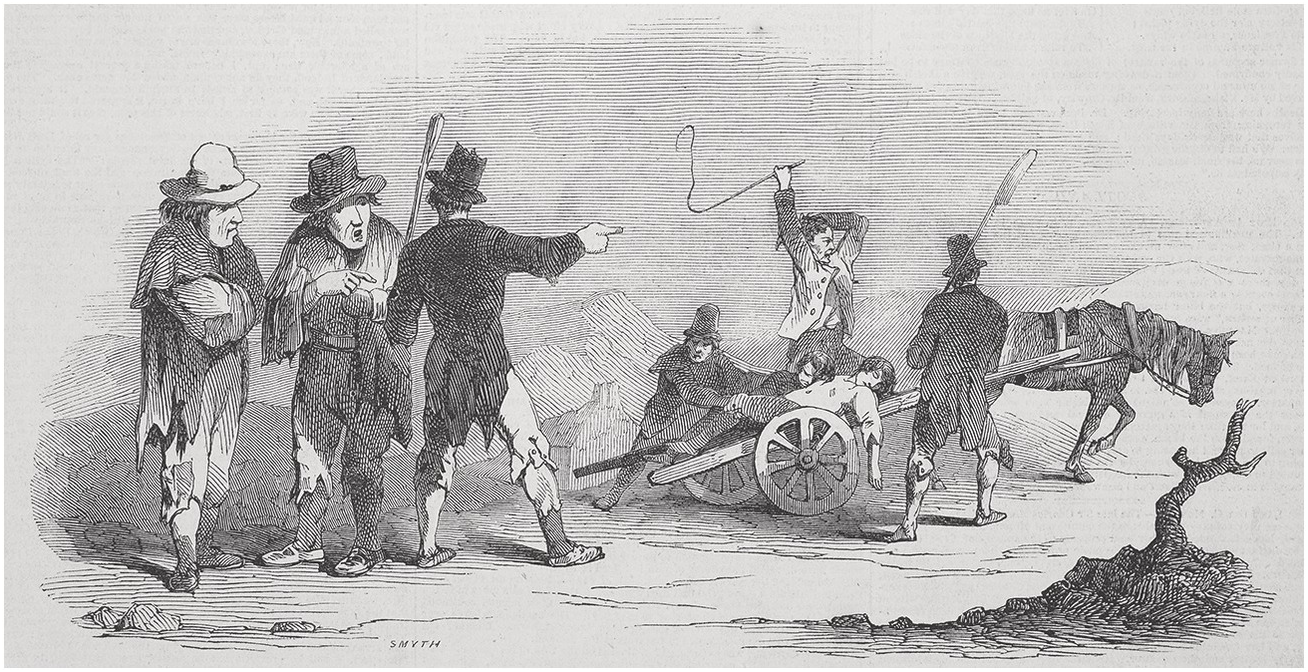
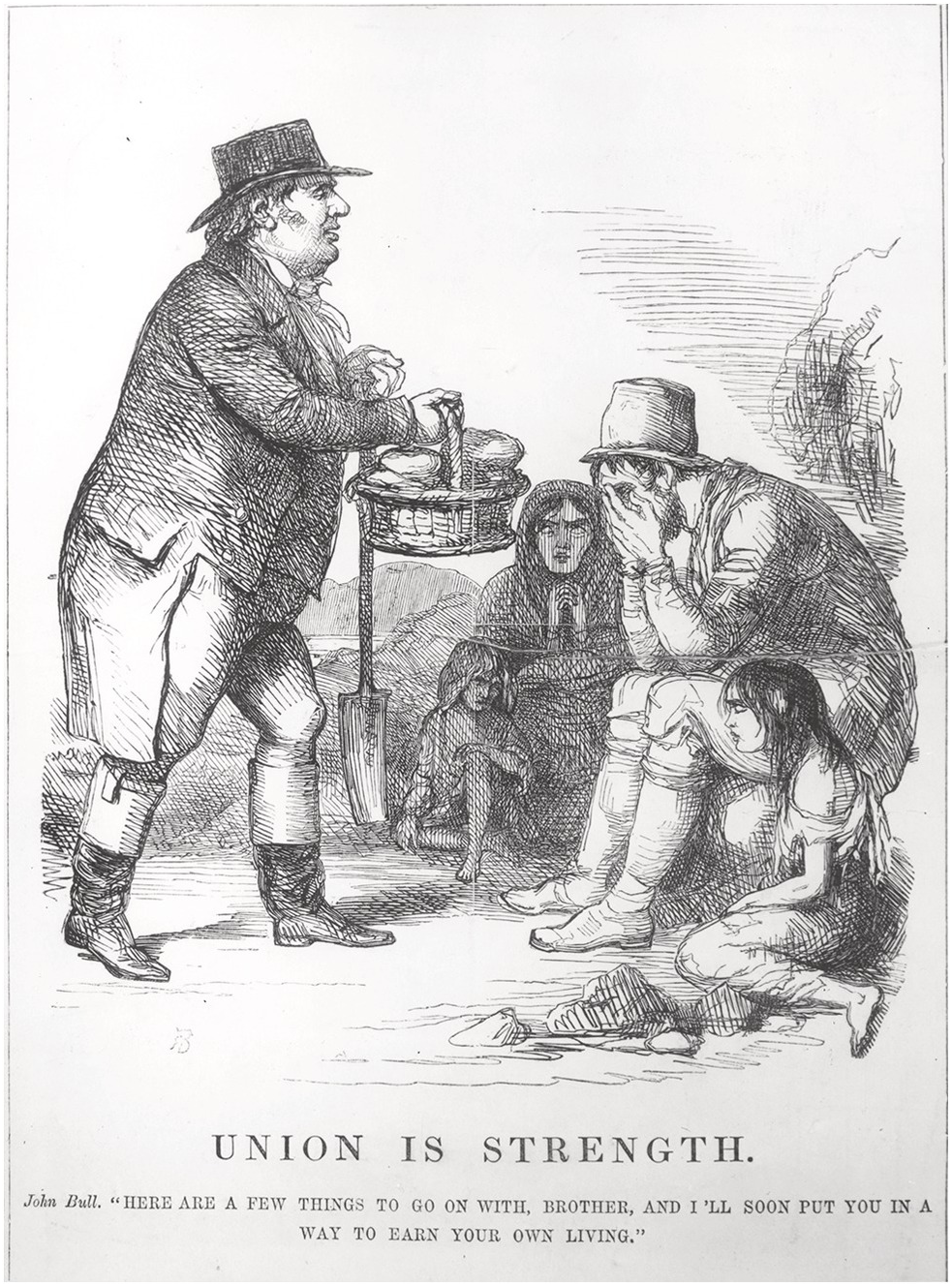


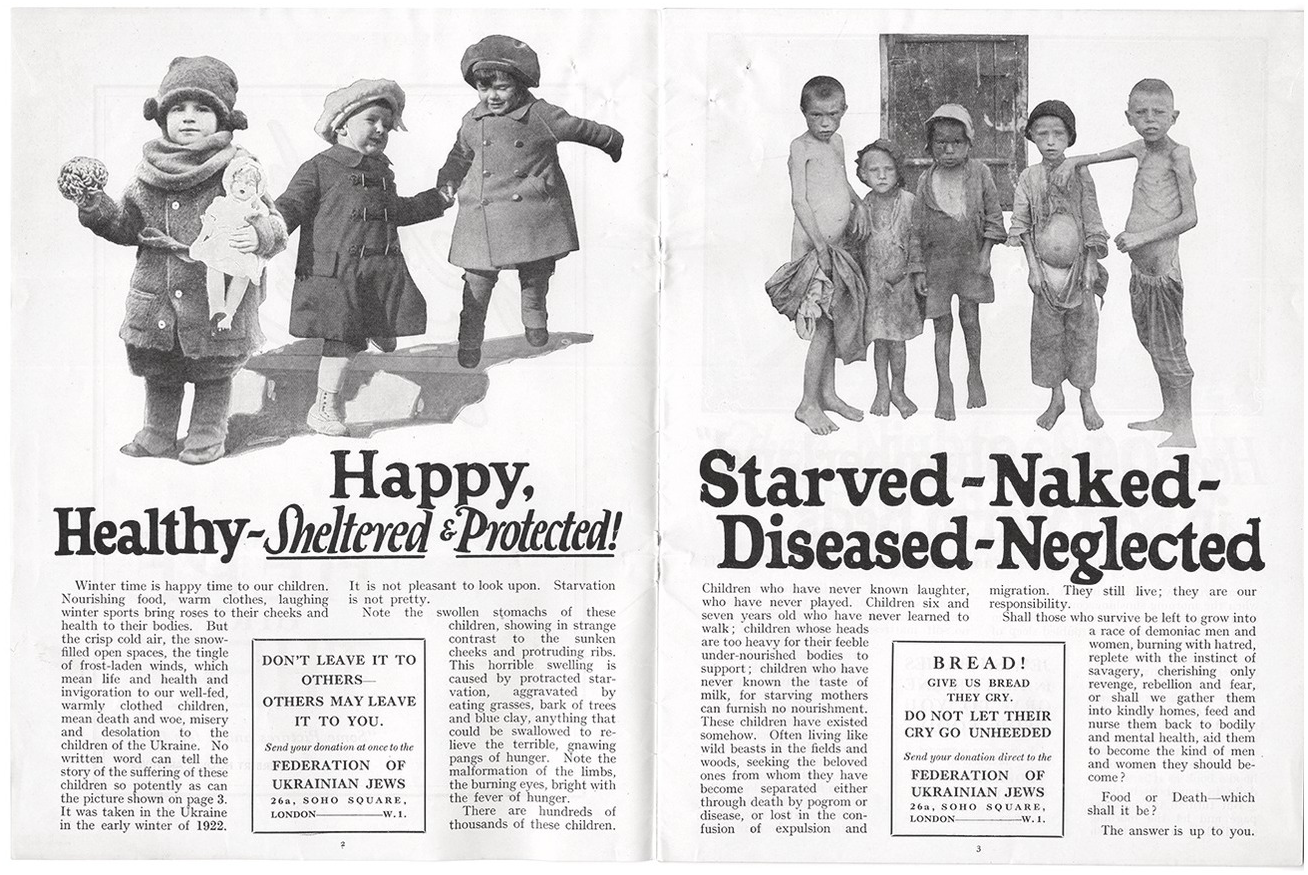


 Open access
