Most studies and records of cleaning symbiosis between reef fish originate from shallow waters ranging 1–28 m depth (e.g. Youngbluth, Reference Youngbluth1968; Johnson & Ruben, Reference Johnson and Ruben1988; Grutter, Reference Grutter1997; Sazima et al., Reference Sazima, Sazima, Francini-Filho and Moura2000; Gasparini et al., Reference Gasparini, Luiz and Sazima2007). However, in the western Atlantic some cleaner species are recorded in depths up to about 60–70 m in north-eastern Brazil (Rocha et al., Reference Rocha, Rosa and Feitoza2000; Feitoza et al., Reference Feitoza, Rosa and Rocha2005) and up to about 100 m in the Caribbean (Humann & DeLoach, Reference Humann and DeLoach2002), which opens the possibility that cleaning interactions would occur at depths greater than previously reported. We present here records of a wrasse (Labridae) and a goby (Gobiidae) cleaning below 60 m depth in the tropical south-western Atlantic, and validate the above suggestion.
The field work was made at Fernando de Noronha Archipelago (03°50′S 32°15′W), off north-eastern Brazil in the tropical south-western Atlantic. The records were made at the shipwreck ‘Corveta Ipiranga’ at 62 m depth with SCUBA gear on 26 June and 27 September 2008, and 25 July 2009, all records between 1200 and 1400 h. Since diving time with conventional SCUBA gear is greatly limited at depths greater than 30 m, cleaning interactions were photographed and briefly recorded with the use of ad libitum and ‘behaviour’ samplings (Martin & Bateson, Reference Martin and Bateson1986), both of which are adequate for transitory behaviours and opportunistic observations. The photographs were used for further analyses of the cleaning behaviour. Copies of the digital photographs are on file at the Museu de Zoologia da Universidade Estadual de Campinas (ZUEC).
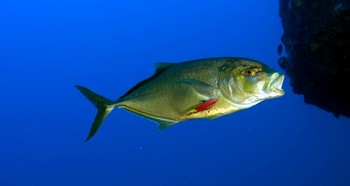
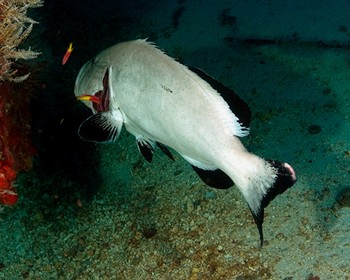
Two to three spotfin hogfish (Bodianus pulchellus) individuals about 10–15 cm total length (TL) were recorded cleaning two piscivorous clients, the yellow jack (Caranx bartholomaei) and the black grouper (Mycteroperca bonaci). The wrasses inspected and cleaned several body parts of the jack (Figure 1) including mouth and gill cover areas. The black grouper was thoroughly cleaned on the body, one wrasse partially entering the gill chamber to clean the gill filaments (Figure 2). The jack hovered in the water column and displayed a bronze sheen, darker than its habitually silvery with yellowish cast colour (Humann & DeLoach, Reference Humann and DeLoach2002; our personal observations). The black grouper was pale except for the fins when first detected, but darkened upon the observers' approach. Even if piscivores are not among the preferred clients of wrasses (e.g. Johnson & Ruben, Reference Johnson and Ruben1988; Francini-Filho & Sazima, Reference Francini-Filho and Sazima2008) perhaps due to predation risk (Francini-Filho et al., Reference Francini-Filho, Moura and Sazima2000), this was not the case for the spotfin hogfish recorded here. The ‘willingness’ of the two clients to be cleaned by the hogfish and the ‘boldness’ of the latter likely are due to the apparent general absence and/or low numbers of cleaners at depths greater than 30 m in the western Atlantic (Johnson & Ruben, Reference Johnson and Ruben1988; Rocha et al., Reference Rocha, Rosa and Feitoza2000; our personal observations).
Spotfin hogfish (Bodianus pulchellus) inspects the base of pectoral fin of a yellow jack (Caranx bartholomaei) near a shipwreck at 62 m depth, Fernando de Noronha Archipelago, off north-eastern Brazil. Photograph: Zaira Matheus.

Spotfin hogfish (Bodianur pulchellus) cleans the gills of a black grouper (Mycteroperca bonaci) at a shipwreck at 62 m depth, Fernando de Noronha Archipelago, off north-eastern Brazil. An individual of this wrasse species nears the grouper's open mouth. Photograph: Zaira Matheus.

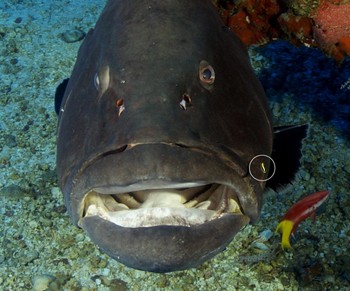
One Noronha goby (Elacatinus phthirophagus) individual with a total length of about 4 cm was recorded cleaning a black grouper (Mycteroperca bonaci) on the head near the mouth (Figure 3), and entering the oral cavity and gill chamber. The grouper remained stationary, hovering close to the bottom, and displayed its dark phase (Humann & DeLoach, Reference Humann and DeLoach2002). Changes in colour and/or pattern (as already noted above) are regarded as signals by the client fish to the cleaner, besides making ectoparasites more visible on the body of the client (Grutter, Reference Grutter and Rohde2005). Cleaners of the genus Elacatinus are known for tending cleaning stations on, or close to, the substratum (Colin, Reference Colin1975; Sazima et al., Reference Sazima, Carvalho-Filho and Sazima2008), whereas wrasses tend cleaning stations higher in the water column (Sazima et al., Reference Sazima, Krajewski, Bonaldo and Sazima2005; Francini-Filho & Sazima, Reference Francini-Filho and Sazima2008), which is the case of our records at the shipwreck. The 62 m depth record of the Noronha goby is the deepest one to date (up to 18 m in the original description, Sazima et al., Reference Sazima, Carvalho-Filho and Sazima2008). However, the barber goby (Elacatinus figaro), also a cleaner (Sazima et al., Reference Sazima, Sazima, Francini-Filho and Moura2000), is recorded up to 57 m off north-eastern Brazil albeit no cleaning was observed in this situation (Rocha et al., Reference Rocha, Rosa and Feitoza2000).
Noronha goby (Elacatinus phthirophagus) cleans the head near the upper jaw (circle) of a black grouper (Mycteroperca bonaci) at a shipwreck at 62 m depth, Fernando de Noronha Archipelago, off north-eastern Brazil. The spotfin hogfish visible in the picture was cleaning the grouper as well. Photograph: Zaira Matheus.

Since the spotfin hogfish is recorded at depths up to 70 m in north-eastern Brazil (Feitoza et al., Reference Feitoza, Rosa and Rocha2005) and up to about 100 m in the Caribbean (Humann & DeLoach, Reference Humann and DeLoach2002), cleaning interactions between deep-reef fish and this wrasse may be expected at depths even greater than that reported here. The same may be surmised for the Noronha goby, and perhaps some other cleaner gobies within the genus Elacatinus.
The cleaning interactions recorded here for Bodianus pulchellus and Elacatinus phthirophagus at deep-reef habitat followed the same general patterns of interactions reported for shallower areas, i.e. cleaning stations tended in accordance to the general habits of the cleaner species, fish clients remaining stationary while cleaned, changes in clients' coloration, and clients' body parts explored by the cleaners (e.g. Johnson & Ruben, Reference Johnson and Ruben1988; Sazima & Moura, Reference Sazima and Moura2000; Francini-Filho & Sazima, Reference Francini-Filho and Sazima2008). However, due mostly to impoverishment of the number of species and individuals of potential client fish at deeper areas (Thresher & Colin, Reference Thresher and Colin1986; Feitoza et al., Reference Feitoza, Rosa and Rocha2005; Luiz Jr et al., Reference Luiz, Carvalho-Filho, Ferreira, Floeter, Gasparini and Sazima2008) a few differences, such as number of interactions and/or clients, as well as clients' species composition, may be expected for cleaning interactions at deep and shallow reefs.
ACKNOWLEDGEMENTS
We thank Zaira Matheus for the superb photographs; the CNPq and FAPESP for essential financial support. An anonymous referee improved the paper.