1 Introduction
Vocabulary is an indispensable element in enabling English learners to communicate successfully (Nation, Reference Nation2001). Similarly, vocabulary is fundamental to the activity of interpreting. It is equally important for student interpreters to have a good knowledge of vocabulary, in order to complete interpreting tasks with a high degree of accuracy. A shortfall in the necessary vocabulary can prevent an interpreter from correctly conveying the complete message from the source language into the target language. It is therefore important for interpreters to be equipped with sound, rich and flexible vocabulary knowledge. Accordingly, interpreters need to create their own vocabulary portfolio in order to learn new terms, and to organize vocabulary for conferences at which multi-disciplinary terminologies are involved.
The objective of this research was to investigate whether a specifically designed multi-interfaced computer-assisted workbench, which we call Computer-Assisted Vocabulary Workbench for Interpreters (abbreviated as CAVWI), can support and engage Chinese EFL student interpreters in vocabulary building for a specific conference in an efficient way. “Efficient” is defined here in terms of the time spent in vocabulary building, which includes searching for and collecting the relevant vocabulary, and organizing this vocabulary in an accessible and useful way. The research question to be studied in this paper is: Can the organized Web portals provided by CAVWI allow users to conduct an efficient search for the required vocabulary?
The results of the analysis help to evaluate the usefulness of CAVWI, and hence determine its potential as a professional working instrument and as a training tool for student interpreters’ vocabulary preparation.
2 Literature review
Over the past decade most research in CALL has emphasized the use of Web-based material as a corpus for enhancing learners’ English learning (Campbell, McDonnell, Meinardi & Richardson, Reference Campbell, McDonnell, Meinardi and Richardson2007; Flowerdew, Reference Flowerdew2012), especially vocabulary development (Hazelbeck & Saito, Reference Hazelbeck and Saito2009; Wu, Witten & Franken, Reference Wu, Witten and Franken2010). Some researchers have focused on the use of the computer workbench to facilitate the learning activities of interpreters (Shandrelli, Reference Shandrelli2001; Lim, Reference Lim2013) or to assist in the tasks of translator/interpreters (Ahmad, Kugler & Thurmair, Reference Ahmad, Kugler and Thurmair1995; Shimohata, Kitamura, Sukehiro & Murata, Reference Shimohata, Kitamura, Sukehiro and Murata2001). Few studies, however, have discussed how a Web search with portals provided by a computer workbench can help student interpreters’ vocabulary collection. We will review issues related to Web-based learning and discuss how CAVWI differs from the existing computer workbench in the next section.
2.1 Web-based language learning
The World Wide Web (WWW) allows information searches to be carried out rapidly and over very large spans of information. It offers a variety of resources that allow easy and free access for information exploration. With voluminous authentic sources, it provides virtually unlimited potential material for language learning (Hwu, Reference Hwu2003). Owston (Reference Owston1997) shows that the Web offers certain advantages for learning. Varied information is widely available on the Web and is easily accessible to learners without the need for them to be physically present at the location where the information source is located. Son (Reference Son2007) studies ESL learners’ perceptions of and attitudes towards their Web-based language learning (WBLL) experiences. His analysis shows that the learners were positively engaged in performing selected English-learning activities on the Web. All of the subjects indicated their enjoyment of the pre-designed Web activities, and noted that they preferred to use the Web for self-directed study. Up to 83% of the subjects stated that they enjoyed the task-based Web activities. This report is analogous to Osuna and Meskill’s (Reference Osuna and Meskill1998) study of learners’ perceptions of using the Web in their Spanish learning activities. Their study reveals a similar result to that by Son, with 85% of the subjects indicating that they enjoyed using the internet and all subjects recognizing that the Web was a useful tool and agreeing that it enabled them to learn Spanish more effectively. Both studies revealed that learners felt less anxious when they worked on their own with the computer. The Web allowed them to access information and authentic materials more easily and more efficiently. The Web-assisted learning environment enables learners to carry out their tasks at a self-controlled pace (Hui, Hu, Clark, Tam and Milton, Reference Hui, Hu, Clark, Tam and Milton2008; MacFarlane, Reference MacFarlane1992) and at their preferred time and location and therefore creates a more learner-centered environment. In addition, Allen & Seaman (Reference Allen and Seaman2006) note that the use of Web-based training has been growing rapidly, because it enables teachers to reserve class time for high-stake tasks (Zhang, Zhao, Zhou & Nunamaker, Reference Zhang, Zhao, Zhou and Nunamaker2004).
The advantages of using the Web apply not only to language learners per se, but also to interpreters. The tasks interpreters undertake mean that they rely heavily on multidisciplinary resources to supplement their knowledge deficits. The knowledge they require covers wide-ranging subject matter, and this enlarges the scope of the required information searches, particularly in the preparation of vocabulary. The features of the Web, which allow wide and easy access to global information, can save interpreters time because they do not need to physically visit different locations to access resources. However, if interpreters are unfamiliar with where and how to search, they can easily become lost in the searching process. This point is supported by the study of Kung and Chuo (Reference Kung and Chuo2002), which shows that the major difficulty encountered by students was spending too much time visiting unrelated websites, and suggests that it is essential to steer students towards the recommended sites (Paulsen, Reference Paulsen2001). This highlights the importance of providing specific Web portals for students, so that they can search the most relevant entries, and reduce the time they spend surfing unrelated websites.
The search section of CAVWI is designed to be a combination of guided search and self-exploration, that is, allowing users to explore their own preferred resources through relevant websites provided in the workbench. Guided search provides a collection of links to different online proceedings, journals, glossaries and term banks with high credibility. Any interpreter needs to do preparatory work (e.g., vocabulary; background information for the speaker and speech) for a specific conference. The guided search section helps users to carry out the preparatory work more easily by narrowing the search scope and determining which websites are particularly useful (the details are revealed in Section 3). With quick access to a greater range of resources, interpreters will be in a better position to tackle the lexical issues of interpreting.
2.2 Computer workbench
The use of the Translation Workbench (TWB) has become more popular over recent decades to assist users in their tasks. TWB offers a similar concept to CAVWI in that it provides users with a vocabulary database. It is a computer-assisted workbench that is designed to help translators with their translation tasks. TRADOS, which is one of the most popular TWBs nowadays, allows users to add material themselves to supplement the stored terms (Seewald-Heeg, Reference Seewald-Heeg2006).
TRADOS Translator’s Workbench provides a space where translators can work with the file to be translated. The major features of TRADOS include conversion of document formats, translation memories and terminology database. The terminology database of TRADOS is managed by its MultiTerm module. It helps to build and maintain the TRADOS terminology database, which can store terms in different languages and also store other items such as synonyms, cross-references and examples (Berry, Reference Berry1996: 287).
Although TRADOS and CAVWI both allow users to perform their task on a workbench, the usage and architecture of the two systems distinguish them from one another. TRADOS is designed to handle general translation tasks, rather than more specific ones. Instead of having users prepare their vocabulary list before the task, the translation process is carried out in interactive mode. In other words, the human translators check the terminology database for the appropriate word to use in their target text. Here, the MultiTerm terminology database acts more like a dictionary than a vocabulary portfolio for users. In building up terminology in TRADOS, users need to identify the possible locations to search for the required vocabulary. MuliTerm merely offers a database record to store their collected vocabulary or information. CAVWI, however, provides a repertoire of Web links dedicated to specific functions. There are portals to search for vocabulary for conferences and portals for checking the definitions of vocabulary terms and vocabulary expansion. CAVWI is designed to engage users in searching for and collecting target vocabulary for specific conferences in a more efficient, systematic and organized way.
In view of the fact that there is still little research on Web-based vocabulary collection using the workbench, this research investigates whether CAVWI, which incorporates organized Web portals, improves student interpreters’ performance in vocabulary collection.
3 Structure of CAVWI
CAVWI is designed to be an all-in-one computer-based workbench with the built-in functions of searching for, analyzing and organizing vocabulary. As shown in Figure 1, it consists of a Search section, an Analysis section and a Vocabulary Management section.
CAVWI Workbench.

The Search section of CAVWI is divided into five subsections: Keyword search, Subject search, Journals and proceedings, Acronyms and Others. All of these subsections consist of websites available on the Internet. Searching for information on the Web often results in information overload, because the design of the Internet does not allow us to automatically locate the “right person” with the “right information” at the “right time” (Turetken & Sharda, Reference Turetken and Sharda2001: 221). The user is thus required to spend more time in exploring the Web to acquire the target information. If a computer workbench can provide users with organized and useful Web portals, this will facilitate the searching process. As mentioned in Section 2.1, CAVWI has a search section that consists of guided search and self-exploration. Referring to Figure 1, the subsection of Subject search in CAVWI is for guided search.
The Subject search section contains five websites that provide a restricted scope for searching. Depending on the nature of the conference task, interpreters can choose the most suitable website from this section to conduct specific searches for vocabulary in a particular discipline. For example, “Computer Glossary” provides a collection of glossaries specifically related to computing and the Internet. “Subject Terminology” and “Subject Directory” provide specific searches on terminology and items related to different disciplines. The “Hong Kong Civil Service Glossary” website stores the Chinese and English versions of key terms used by different Hong Kong Government departments. Since the terminology used by government departments in Macao is similar to that used in Hong Kong, this website allows users to conduct a quick and efficient search for the terminology relevant to different departments, and the associated Chinese or English meanings. The webpage lists the different government departments in alphabetic order, as shown in Figure 2.
Glossary webpage of the Hong Kong Civil Service Bureau.
The subjects in this research were given an interpreting task related to Internet technology. They were therefore able to select the Information Technology category to conduct a specific search for computer terms, as shown in Figure 3.
Glossary list of the Information Technology category.
Figure 3 shows that the contents page lists the selected glossary, which is arranged in alphabetical order from A-Z in the left column. The Chinese and English versions of the terminology are displayed on the right and users are able to collect and store relevant terms accordingly.
“C-E search” is a website developed by the Hong Kong Computer Society, which allows a search for vocabulary stored in terminology databases in both China and Hong Kong. Since the subjects of this research work in Chinese and English for their conference interpreting, this Chinese-English based terminology website offers them a more focused search on the keywords they have entered.
As indicated in Figure 4, when the word artificial is entered, two terms that contain the keyed-in word from the Hong Kong Database are displayed on the left, and five results from the China Database are displayed on the right.
Webpage of C-E search.
Apart from these five websites for guided search, the Search section also provides websites for self-exploration, the design of which is to supplement some of the missing searches in the guided section, and to provide the users with autonomy in the searching process. This subsection entitled Keyword search incorporates popular search engines such as Google and Yahoo. Student interpreters can search freely using these tools, in order to look for words in their target disciplines that are not provided in the guided search area. The search section is particularly useful for interpreters in terms of efficient vocabulary search. If they carry out their vocabulary preparation task without using the computer, it is likely to take them much longer to browse through different books, journals or newspapers for relevant terms. Further, they are limited to the resources available in their local area.
The Analysis section consists of three divisions: Dictionary, Related and Corpus. The Dictionary division allows users to look up the definitions of the words they have collected. The second division, Related, helps users to check for terms related to the collected words (e.g., synonyms, antonyms, hyponyms and hypernyms) through the use of “Synonym”, “WordNet”, “Homophone” and “Net Dict” in the respective subdivisions. The final division Corpus helps users to analyze word collocations by studying authentic examples of usage. The British National Corpus and UK Concordance are included in this section, to give users a better understanding of the usage of the words and explore the syntagmatic relation of the target words to the neighbouring words. Overall, the Analysis section enables users to explore the collected words, not only in terms of collocations but also in relation to the meanings and uses of words in different contexts. Further, users can check for terms related to the collected words to expand their vocabulary portfolio and study the semantic relations of the words.
In CAVWI, the Vocabulary Management section includes the functions of input, modification and printing of the collected vocabulary items by selecting the appropriate choice in the main menu. As shown in Figure 5, the modification screen allows users to alter information in the vocabulary stored in the portfolio. The screens for addition and deletion are similar to those on the modification screen, with spaces provided for related lexis (synonyms, antonyms, hyponyms and hypernyms).
Main menu and Modification Screen of Vocabulary Management System.
In preparing vocabulary for a specific conference, interpreters begin their task in the Search section by searching for words relevant to the topic of the conference, followed by looking up the definitions and checking the usage of words in the Analysis section, and finally organizing the words and expressions using the functions provided in the Vocabulary Management section.
Since this paper focuses on vocabulary searching and collection rather than analysis and organization, the processes of analysis and organization of the vocabulary portfolio will not be discussed here.
4 Methodology
To examine whether CAVWI is able to effectively engage students in the task of vocabulary building, a group of fifteen third-year Chinese student interpreters in the Chinese-English Translation bachelor’s degree program of a tertiary institution in Macao were recruited as subjects. The experiment was carried out in two phases. The first phase was the Pre-CAVWI stage, where the subjects undertook a vocabulary preparation task before being introduced to CAVWI. The second phase was the CAVWI stage. Here, subjects first received instruction and a demonstration of the functions of CAVWI. They were given a trial period to practise using the workbench, and then undertook the vocabulary preparation task. The subjects were assigned the same topic for vocabulary preparation in both stages. During each stage, each subject collected at least 50 vocabulary items relevant to the assigned topic – “Adaptation of Internet technology in mobile phones”. The assigned topic was deliberately selected to be rather technical in nature, so as to examine the efficiency of CAVWI for assisting subjects in their vocabulary building. In the experiment, subjects were allocated two weeks to submit the vocabulary portfolio for the first stage, and one week for the second stage. There was a two-month interval between the two stages. This cooling-off period is used in order to reduce the influence that the first task (the pre-CAVWI stage) may have on the subjects’ performance on the second task (the CAVWI stage). In addition, the subjects were advised not to repeat vocabulary items in stage two that had been collected in stage one. In the pre-CAVWI stage, subjects were allowed to search for the required vocabulary from any source, including paper sources (books, journals and magazines, etc.) and Internet sources; whereas in the CAVWI stage they needed to work with the workbench and their vocabulary search was restricted to Internet sources. They were requested to complete a questionnaire at the end of each stage. They recorded their search time for the total vocabulary collection. In addition, they documented their experience in vocabulary preparation (searching, analyzing and organizing) in the first stage, and provided think-aloud protocols for the second stage. Their think-aloud protocols were recorded while they carried out their vocabulary preparation task with CAVWI. They used the built-in recorder in the workstation to record their description of the working procedures automatically and without any distractions. The subjects’ vocabulary portfolios, questionnaires, written documentation and think-aloud protocols together constitute the data on which the present study is based.
A combination of quantitative and qualitative approaches was used in the data analysis. In the quantitative analysis, the completion times and number of look-ups for the two tasks of each subject are compared. Through this statistical information, the efficiency in terms of search time and information quality achieved for the two stages can be analyzed. In contrast, the transcribed data from the recordings and the content of the questionnaires and vocabulary portfolios were used as qualitative data for analysis.
5 Results and discussion
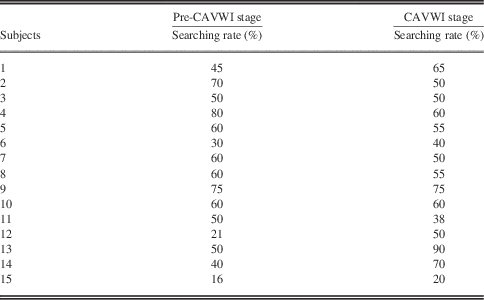
To investigate whether CAVWI assisted the student subjects in their vocabulary building, the search rates in the two stages are taken as an indicator of task efficiency. Search rate refers to the time that subjects spent on their vocabulary search. For example, if the subjects spent four hours searching for vocabulary in their total project time of ten hours, then the search rate is 40% (4/10 * 100%). To facilitate the analysis of search rates in the two stages, the subjects were requested to estimate the total search time they spent on the whole vocabulary collection project, and then to record it (in %) in the questionnaire. For the pre-CAVWI stage, the total project time of the subjects depended on their efficiency and was therefore different across subjects. But for the CAVWI stage, the total project time was a standard six hours for each subject, as they had to complete their tasks in the computer laboratory during class time. The search rate of each subject in the CAVWI stage is therefore calculated by dividing each of their search times by six.
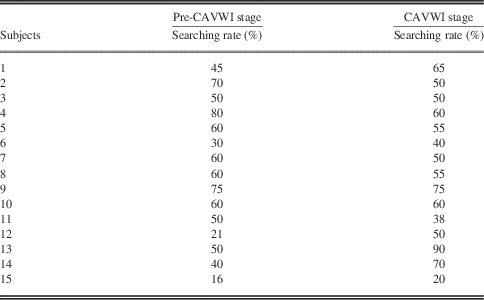
The data indicate that 40% of the subjects had a lower search rate at the CAVWI stage (subjects 2, 4, 5, 7, 8, 11), and 40% of the subjects at the pre-CAVWI stage (subjects 1, 6, 12, 13, 14, 15), with 20% of the subjects having the same rate at both stages (subjects 3, 9, 10). The percentage for efficiency in the search rate is the same for both the CAVWI and the pre-CAVWI stages. This means that the search time of the subjects in both phases is very similar. The comparison of the statistics between the two stages in Table 2 also reveals that their mean is very close: CAVWI stage = 55.2, pre-CAVWI stage = 51.13.
Comparison of the search rates in the two stages
Paired-sample statistics

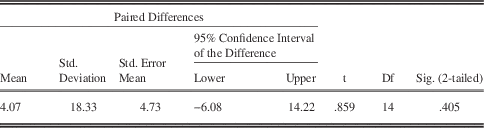
A smaller standard deviation at the CAVWI stage (16.56), compared to 18.57 for the Pre-CAVWI stage, indicates that the search time spent by the subjects is slightly more uniform in the CAVWI phase. The Paired-sample t-Test of the data at the 95% confidence level gives a significance value for the t-Test of 0.405, as shown in Table 3.
Paired samples t-Test for the search rate
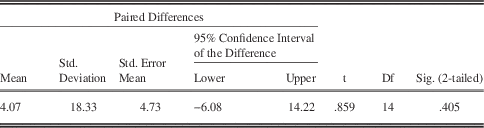
The difference in the search rates between the two stages is not significant. Table 1 shows that 66.7% of the subjects used at least half the total project time for searching as opposed to analyzing and organizing in the pre-CAVWI stage, and 80% in the CAVWI stage. This shows that the search process is the most time-consuming part of the process, which is why there is a need for a tool such as CAVWI to assist students in the task of vocabulary portfolio building, in order to minimize the time they spend on some processes (such as analysis and organizing), if not all processes (e.g., searching). In the pre-CAVWI stage, the vocabulary organization process was also a time-consuming task for students, as they needed to look for their own tools, from their previous experience or from independent searching of the Web, to carry out their analysis and organization of the collected vocabulary terms independently, rather than working with a multi-interfaced workbench.
Compared with the CAVWI stage, the search process also created more problems for the subjects in the pre-CAVWI stage. They may not have known where to search for the required words (bookstore, library or Internet), or they may have had to travel to different locations to find the sources if they were not using the Internet, as subject 9 notes:
“I did not know where to look for the information. I have decided to browse through the books in the Xin Hua Bookstore. But I could not find any new word and so I went to the state library and checked for the needed words.”
The above comment indicates that subject 9 did not use the Internet for the search process, so she needed to travel from one location to another to look for suitable sources and books in order to collect vocabulary. Even those subjects who used the Internet in the pre-CAVWI stage encountered problems, as they needed to identify the appropriate websites for their search, as indicated by the underlined part of subject 1’s comment.
“…To save the time, I changed my search to Internet and used search engines like Google and Yahoo… I found that I had to try many keywords in order to get my targeted result…I also concentrated on finding Japanese mobile information because they are the lead of technology. Nevertheless, I got too many links and topics and some of them were not very useful.”
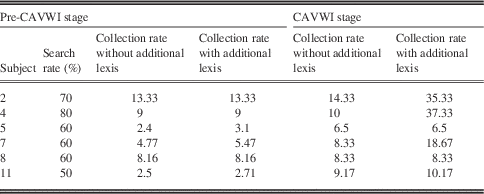
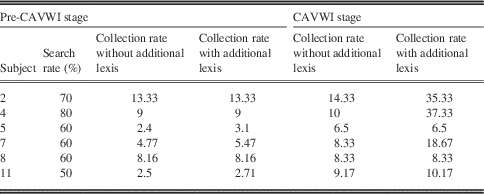
By using CAVWI, however, subjects were able to choose any of the unspecified or specified Web links provided on the workbench for the vocabulary search. This can significantly reduce the time required to search for useful links. Although Table 1 shows that 40% of the subjects had a higher search rate in the pre-CAVWI stage, compared to 33.3% in the CAVWI stage, the collection rates of these subjects, with and without additional lexis, in both phases can be compared to determine their efficiency. The collection rate is the result of dividing the number of total words collected in the task by the total time in hours to complete the task. The rate is expressed in terms of number of words per hour. Additional lexis refers to the related words (synonyms, antonyms, hyponyms, hypernyms) the subjects collected in addition to the target words via the portals of “Synonym” or “WordNet” in the analysis section of CAVWI. A comparison of the vocabulary portfolios of the subjects in the two stages reveals that they collected a total of 1337 vocabulary items or terms at the CAVWI stage, compared to the collection of 1268 at the pre-CAVWI stage, with no repetition of the collected items for the two stages (except for subject 1). The findings also reveal that subjects were able to collect a total of 553 additional lexis at the CAVWI stage, compared to 241 additional lexis collected at the pre-CAVWI stage.
Table 4 shows that the six subjects who had a higher search rate at the Pre-CAVWI stage used more time to search, but that in all cases the number of vocabulary items they collected was lower than at the CAVWI stage. This indicates that, in the Pre-CAVWI stage, spending more time on searching did not necessarily lead to the collection of more vocabulary items by the subjects. The search results depended on their search methods. If the subjects do not have an effective search method (e.g., searching for books or websites that do not contain the required vocabulary), they will collect fewer terms, regardless of how much time they spend on the search process. We can appreciate this more fully from their descriptions of their search methods.
Subjects with higher search rate in the pre-CAVWI stage
In the pre-CAVWI stage some subjects also used the Internet to assist their vocabulary searches by typing in key words relevant to the assigned topic for the search.
Subject 4
“…I confined myself to the wooden chair in front of the computer for a couple of hours to surf the Internet for the related information by using Google or Yahoo…”
Subject 8
“… I started searching for the vocabulary by surfing the Internet. At that time, the only word that I thought of was WAP, so I typed in “WAP Glossary” in some search engines like Yahoo and Google. Then thousands of WAP Glossary websites appeared on the screen. I clicked on the first link of the webpage and had a scan through the glossary. I found that most of the glossaries were exactly what I wanted…”
Subject 11
“… My method for searching is by typing key words in Google. I used different order of the given title as the key words. By doing so, I found many websites…Although I spent much time on the section for searching, the effort I have put is not rewarding…”
Some borrowed books from the library or purchased magazines that listed websites with glossaries or terminology.
Subject 5
“…I spent 1 to 2 hours every evening to search for the vocabulary… I also went to the library with my classmates to seek for the relevant information. I borrowed some books and also copied some websites for searching the Internet at home…”
Subject 7
“…I looked for websites in the mobile magazine, e.g., Nokia, Ericsson, etc. But the websites provided abbreviations only. I could not find the desired vocabulary. I then borrowed from the library two relevant books about internet mobile phones. Based on the websites provided in the books, I entered some key words and found some relevant words. I also found some words in the magazine…”
However, as shown in Table 4, at times the number of vocabulary items collected was not directly proportional to the subjects’ search time, if the resources they used were not appropriate. Subject 11’s comment (above) reveals that he was not satisfied with the results of his vocabulary search based on the effort he had put in.
When using CAVWI, the workbench provided subjects with specific websites for terminology or glossary searches and a search engine for wild card searches. Even though searches on the Internet are sometimes time-consuming, they at least have a destination to search. For example, if students search using keywords, they can go to the Keyword search section and use a familiar search engine like Google or Yahoo. They can also search for specific terminology and the content of related journals or conference proceedings in the Subject search and Journals & proceedings sections respectively. This allows them to minimize the time taken to physically travel to different destinations to find the right resources. On CAVWI they can re-allocate this travelling time to searching for target vocabulary.
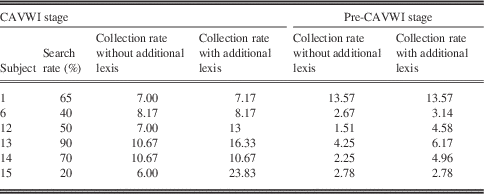
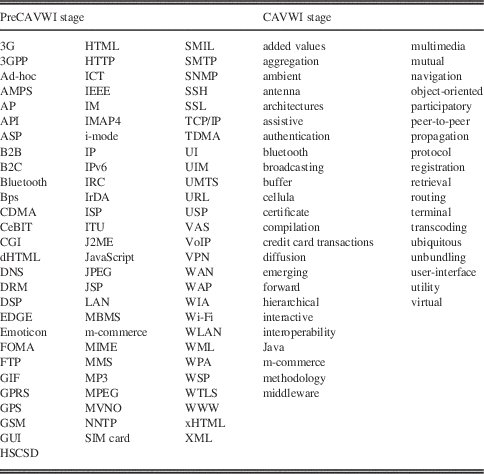
The efficiency of searching using CAVWI is further revealed by the statistics in Table 5. Although these subjects spent more time searching during the CAVWI stage, their collection rate was proportionally higher. Apart from subject 1, all of the subjects had a two- to four-fold increase in their collection of target words, and a two to eight-fold increase in their collection of additional lexis in the CAVWI stage. This shows that CAVWI gave subjects facilities that assisted them to achieve efficiencies in their vocabulary collection. The data of subject 1 shows that his vocabulary collection at the pre-CAVWI stage was almost double that at the CAVWI stage. The collection content of subject 1 can be used to explain why he has a much higher collection rate at the first stage. His number of words collected at the pre-CAVWI stage is 95 in seven hours of work, whereas at the CAVWI stage, the number of words collected is 42 in six hours of work. The content of his word collection in Table 6 shows that at the pre-CAVWI stage 95% of the words are acronyms, but there are no acronyms at the CAVWI stage.
Subjects with a higher search rate in the CAVWI stage

Comparison of content collected by subject 1
His written documentation shows that the reason for his high collection rate is due to the fact that in the pre-CAVWI stage, he collected words from the same sources (e.g., acronym websites or books listing acronyms). In the CAVWI stage, he was provided with specific websites where he had a wider choice for his terminology search. In order to avoid repetition in the CAVWI stage, he did not include acronyms in his collection. Comparison of the collected contents of Table 6 shows that there is no repetition of the words between the two phases except for the words bluetooth and m-commerce. Other subjects also reduced the number of acronyms in their collection. The data showed that the number of subjects including acronyms in their collection has reduced from 93.3% in the pre-CAVWI stage to 60% in the CAVWI stage. This indicates that CAVWI allows them easier access to more computer terminology, and not merely acronyms, as is the case in the pre-CAVWI stage.
The design of CAVWI facilitates not only the search process, but also the non-search processes (analysis, collection and organization). There are specific websites (online dictionaries and corpora) to help subjects in the analysis process, and the Vocabulary Management section helps them with the collection and organization of their vocabulary portfolios. Therefore, even though the value of 0.405 for the t-Test (Table 3) shows that the search process in the CAVWI stage was as time-consuming as in the pre-CAVWI stage, the use of CAVWI offers advantages by requiring less time for vocabulary analysis and organization in the non-search processes, and allows subjects to collect more words and additional related lexis.
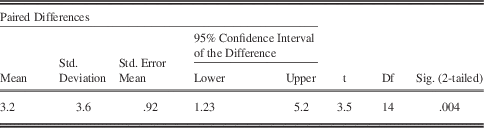
As shown in Table 7, the statistical data reveal that when the paired-sample t-Test was applied to the two sets of data (collection rates in pre-CAVWI and CAVWI stages) with a confidence level of 95%, there was a mean difference of 3.2 in the collection rates between the pre-CAVWI (mean = 5.51) and CAVWI stages (mean = 8.71).
Paired samples t-Test for vocabulary collection rate (excluding additional lexis)
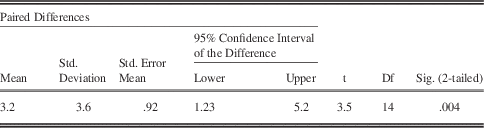
This means that for each hour of searching the subjects collected on average 3.2 words more at the CAVWI stage. In addition, the standard deviation for the CAVWI stage (2.09) shows that the distribution of variables is less spread than for the pre-CAVWI (3.87) stage. In other words, the collection rate is more homogeneous in the CAVWI stage. This may be because the subjects worked for the same number of hours (six class hours) using a similar platform (CAVWI workbench) for searching, collection, analysis and organization. For example, 60% of the subjects (1, 3, and 6 to 12) had a collection rate equal to or close to 50. The t-Test in Table 7 also shows a significance level of 0.004, which indicates a clearly significant difference in collection rates between the CAVWI and pre-CAVWI phases.
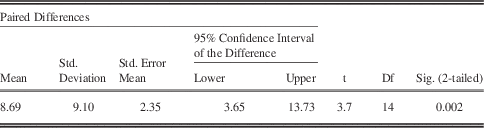
By including the number of extra lexical items (synonyms, antonyms, hyponyms and hypernyms) collected in both stages, the data show that the use of CAVWI enabled nearly three quarters of the subjects (73%) to collect additional lexis related to the target words. At the pre-CAVWI stage, fewer than half the subjects (46%) added extra words to their vocabulary collection. The Paired-sample t-Test of the data in Table 8 shows that the difference of the new mean between the CAVWI (mean = 14.85) and pre-CAVWI phases (mean = 6.16) is 8.69. This indicates that CAVWI facilitates the collection of additional lexis by the subjects, and the collection rate is therefore higher than that for the pre-CAVWI stage by an average 8.69.
Paired samples t -Test for vocabulary collection rate (including additional lexis)

The statistical information reveals that CAVWI promotes higher efficiency in the collection of additional lexis for vocabulary expansion. This is evidenced by the number of extra words collected by subjects 2, 4 and 15, which were 126, 164 and 107 respectively. These three subjects did not record any extra words in the pre-CAVWI stage. The use of CAVWI therefore motivated these subjects and provided them with an easy means to continue to search for additional lexis.
The efficiency of CAVWI is further supported by the subjects’ qualitative feedback in the questionnaire. The data relate to the subjects’ comments on the advantages and disadvantages of using CAVWI for the search process: all subjects commented that there were advantages in using CAVWI for searching. However, some did comment on certain issues relating to the use of CAVWI, which fall into three categories.
Physical conditions
Subject 5
“My eyes are very tired.”
Subject 10
“My eyes feel very tired due to seeing a computer for a long time.”
Computer issues
Subject 2
“The window is too small to afford great deals of information on the internet.”
Subject 3
“The disadvantage is that the windows for different sections are too small. This is inconvenience as time was spent on adjusting the windows.”
Subject 5
“Some sudden computer problems happen and may interrupt the searching. If the data were not saved, then I have to do it again and this wasted my time.”
Web issues
Subject 6
“When I typed the key words in the search engines, numerous websites appeared on the screen, but I found that many websites were only advertisements of mobile phone companies and some websites are forbidden to get access without password.”
Subject 9
“Something on the net might not be reliable. I think that if we go to the library or the bookstore to find information, it is easier for us to collect new things.”
Of the three categories, the Web-related issues are more directly linked to the search process. The comment by subject 9 highlights the question of the reliability of Web information, and subject 6 raises the issues of information overload. These two issues are problems in relation to Web-based language learning in general. Since this study deals with the use of CAVWI for vocabulary building – rather than language learning per se – on the Web, the issues of reliability and information overload are beyond the scope of this study. Further, of the fifteen subjects, only Subject 9 mentioned the issue of reliability. In fact, almost all of the subjects commented that CAVWI made their searching fast and convenient.
The description of the subjects’ search processes in the Think-aloud protocol yields a percentage distribution for usage of all of the portals. The results show that 46.7% of the subjects used the search engine (the Keyword Search section as indicated in Figure 1) to search for words: 71.4% on Google, 14.3% on Hotbot, and 14.3% on unnamed sources in the remainder of the search engine. 53.3% of the subjects used portals in the guided search section other than the search engine for specific searches, and the data reveal that 66.7% of the subjects made use of “Portal” for searching conference proceedings, 13.3% used “Computer Glossary”, 13.3% used “Subject Terminology”, and 6.7% used “HK Civil Service Glossary”. “Portal” was the most popular link for searching, in particular because it includes a search of conference proceedings. This enables subjects to collect not only new words, but also relevant information about specific conferences, which can help them to prepare more effectively for interpreting tasks for conferences on similar topics. 86.7% of the subjects used the “WordNet” portal, 53.3% used “Synonym”, 40% used “Corpus”, 6.7% used “NetDict” and 6.7% used “Dictionary.com”. The semantic structure supported by WordNet meant that it was the most popular tool for analysis.
The results of the analysis also show that in both stages (pre-CAVWI and CAVWI) subjects were able to collect vocabulary related to the assigned conference topics. The subjects collected a larger number of acronyms in the pre-CAVWI stage, which were likely to be less helpful for their conference interpreting task. This also suggests that their vocabulary gathering in the pre-CAVWI stage did not influence or assist their tasks in the CAVWI stage, as the sources they used for vocabulary collection were different. There is no duplication of words in the vocabulary portfolios they compiled during the two stages, except for the aforementioned two items. Further, although the subjects were allowed to use the Internet to conduct searches in the pre-CAVWI stage, the efficiency of their searches was not as high as it was during the CAVWI stage. Therefore, the research shows that a computer workbench such as CAVWI assists student interpreters to become actively engaged in a vocabulary searching activity, and increases the efficiency of their vocabulary collection. This is particularly important in interpreting activities, as it often takes considerable time for interpreters to prepare vocabulary for a specific conference. With the use of CAVWI, student interpreters can be trained to prepare for a conference interpreting task in a more efficient and effective way.
Overall, the above results indicate that the student subjects were actively engaged in the search process using the portal provided by CAVWI. The statistics reveal that the majority of the subjects (53.3%) prefer to use portal in the guided search section. With the specific names assigned to each portal in this section (e.g. “Computer Glossary” in the Subject Search and “Portal” in Journals & proceedings), it is easier for subjects to choose the portals that will be of most benefit in their search by judging the usefulness of the names specified. From the initial demonstration by the teachers, the students learnt that “Portal” in the Journals & proceedings subsection provided similar content to the assigned conference task. This saved them from spending time surfing irrelevant websites. As shown in the percentage distribution, students preferred to use more specific Web portals such as “WordNet” (86.7%) and “Portal” (66.7%), rather than general search engines (46.7%). This reveals that Web portals with content relevant to the assigned task can engage students. This finding is not only important for student interpreters who are collecting vocabulary for specific conference tasks, but also for language learners. In web-based language learning activities, if learners are required to complete exercises by searching the Web without being given guidance about the most relevant websites, they will be discouraged by information overload. This point is echoed by Kung and Chuo’s (Reference Kung and Chuo2002) study, which finds that subjects considered it problematic to have to spend too much time visiting different websites to carry out web-based language learning activities. Our study lends support to Paulsen’s (Reference Paulsen2001) observation that it is essential for teachers to recommend and introduce students to the content of selected websites for language learning. The construction of specific Web portals can enhance students’ efficiency in searching for vocabulary or information relevant to their learning activities.
6 Conclusion
This research studied the usefulness of CAVWI in engaging student interpreters in vocabulary building, with a particular focus on the search process. The results show that CAVWI offers higher efficiency to the subjects, which leads them to access more relevant Web pages to achieve a significantly higher collection rate for target vocabulary items. Even though a few subjects gave negative feedback relating to the mental and physical demands of working with CAVWI over extended periods of time, the advantages of CAVWI outweigh its disadvantages, and all subjects said they would prefer to use CAVWI for future tasks.
Although the study has successfully demonstrated that CAVWI helps subjects in vocabulary building, it has some specific limitations in terms of the work environment and CAVWI’s operational limitations. These include long hours of working on the computer, which can cause eye fatigue or can be mentally tiring. In addition, in this study, the campus network sometimes ran slowly when a number of users were logged in at the same time. This was a source of frustration for the subjects, especially when they needed to use the search engine to search for vocabulary on the Web. In addition, the system sometimes froze and the subjects were forced to reboot the system and start the search process again. The fact that the experiments had to be carried out in the computer laboratory contributed to the limitations of the study. If the subjects had been able to work on their own computers at home, they would have been able to arrange their working time to avoid intensive hours of work on campus. Despite these limitations, based on the current findings, we believe that CAVWI can be an effective training tool for vocabulary building, not only for Chinese-English student interpreters but also possibly for EFL learners.