Introduction
The reproductive success of female parasitoids can be affected by their diet and the importance of finding food sources for somatic maintenance and egg maturation has been well documented (Jervis et al. Reference Jervis, Hawkins and Kidd1996; Heimpel et al. Reference Heimpel, Rosenheim and Kattari1997; Lewis et al. Reference Lewis, Stapel, Cortesero and Takasu1998). Female parasitoids gain access to sugars and some proteins by using floral and extrafloral nectar, pollen, as well as honeydew produced by Homoptera (Jervis et al. Reference Jervis, Kidd and Walton1992). These food sources can be in a different habitat than their hosts and as a result females have to invest time and energy to reach these resources (Jacob and Evans Reference Jacob and Evans2001; Bernstein and Jervis Reference Bernstein and Jervis2008; Jervis et al. Reference Jervis, Ellers and Harvey2008). Female parasitoids can also obtain proteins and lipid by consuming the haemolymph and tissues of their hosts (host feeding) (Jervis and Kidd Reference Jervis and Kidd1986). Nutrients obtained from host feeding appears to be used mainly for egg maturation, although it can be used for somatic maintenance in some species (Jervis and Kidd Reference Jervis and Kidd1986; van Lenteren et al. Reference van Lenteren, van Vianen, Gast and Kortenhoff1987; Collier Reference Collier1995; Heimpel and Rosenheim Reference Heimpel and Rosenheim1995; Heimpel and Collier Reference Heimpel and Collier1996; Giron et al. Reference Giron, Pincebourde and Casas2004; Ferracini et al. Reference Ferracini, Boivin and Alma2006), but it is generally accepted that the role of nonhost food is primarily to supply energy for somatic maintenance (Jervis and Kidd Reference Jervis and Kidd1986; Thompson Reference Thompson1999).
Dynamic state-variable models have been developed to predict how different factors affect the propensity of parasitoids to host feed. These models balance the risk for the parasitoid of becoming egg limited versus time limited in order to maximise lifetime reproductive success (Heimpel and Collier Reference Heimpel and Collier1996). They predict that host feeding should increase when the egg load of females is low, when there is oosorption, when mortality risk is low, when nutrients reserves and gut contents are low, and when host quality is low. Models also predict that host feeding should decrease at older age. We use the terms “concurrent” when oviposition and host feeding take place on a same host and “nondestructive host feeding” when the host is still suitable for progeny development after the meal (Jervis et al. Reference Jervis, Hawkins and Kidd1996). Most models apply to nonconcurrent and destructive host feeding but some include concurrent host feeding. In one such model, tested with Aphytis Howard (Hymenoptera: Aphelinidae) parasitoids, the cost for the progeny developing in a host where host feeding occurred was assumed to be 75% (Heimpel et al. Reference Heimpel, Rosenheim and Adams1994). Such costs occur because host feeding decreases the resources available for the progeny whose size will likely be smaller resulting in a lower fitness (Ferracini et al. Reference Ferracini, Boivin and Alma2006). For a female, the indirect benefits of host feeding must outweigh the immediate fitness cost (Burger et al. Reference Burger, Reijnen, van Lenteren and Vet2004).
Trichogramma wasps are moderately synovigenic species that emerge with some eggs but have the opportunity to produce more during their lifetime (Jervis et al. Reference Jervis, Heimpel, Ferns, Harvey and Kidd2001). Female Trichogramma Westwood (Hymenoptera: Trichogrammatidae) acquire proteins, amino acids, and lipids from feeding on Lepidoptera eggs (Ferracini et al. Reference Ferracini, Boivin and Alma2006). Trichogramma species practice concurrent but nondestructive host feeding. The effect of host feeding on longevity of Trichogramma species varies. Host feeding increases longevity in presence of honey in Trichogramma minutum Riley (Bai and Smith Reference Bai and Smith1993), has a neutral effect in Trichogramma embryophagum (Hartig) (Klomp and Teerink Reference Klomp and Teerink1967), and decreases longevity in absence of honey in Trichogramma euproctidis (Girault) probably because of the cost of producing more eggs (Ferracini et al. Reference Ferracini, Boivin and Alma2006). When female Trichogramma encounter a host, they can lay an egg and invest in current reproduction or lay an egg and host feed, thereby increasing their future reproduction but decreasing the value of the progeny they deposited in that host (Lebreton et al. Reference Lebreton, Darrouzet and Chevrier2009). In T. euproctidis, a significant reduction in progeny tibia length following host feeding occurs but that reduction is <5% (Ferracini et al. Reference Ferracini, Boivin and Alma2006). Contrary to what is observed in most species (Heimpel et al. Reference Heimpel, Rosenheim and Adams1994; Collier Reference Collier1995; McGregor Reference McGregor1997; Thompson Reference Thompson1999; Giron et al. Reference Giron, Riverom, Mandon, Darrouzet and Casas2002), Trichogramma females host feed on the vitellus oozing from the oviposition puncture and therefore oviposit prior to host feeding (Ferracini et al. Reference Ferracini, Boivin and Alma2006). In rare cases, host feeding has been found to occur before ovipositing by inexperienced Trichogramma females on the first egg they encountered (Nurindah et al. Reference Cribb and Gordh1999).
In this paper, we tested if age and hunger level of female T. euproctidis influenced their host-feeding behaviour. Young and old females are expected to use different strategies for maximising their reproductive success and should adjust their host-feeding behaviour in consequence. Young females, with a longer life expectancy, should host feed more in order to invest in future reproduction. We also hypothesised that, if host feeding is used for somatic maintenance, starved females should host feed more than water-fed females, who should host feed more than honey-fed females. The distribution of host-feeding bouts in a sequence of hosts encountered, the time taken to parasitise 10 different hosts, used as an indicator of female's mobility, and the sex ratio (proportion of males) deposited were also investigated.
Material and methods
Insect rearing
The T. euproctidis used in this study originated from Egypt (previously cited as “Trichogramma evanescens strain 20” in Godin and Boivin Reference Godin and Boivin2000) and has been in rearing for more than 20 years. The culture was maintained at 25 ± 2 °C, 50% relative humidity, and light:dark 16:8 hours on eggs of the Mediterranean flour moth Ephestia kuehniella Zeller (Lepidoptera: Pyralidae). These conditions are near the optimum for this species (Carrière and Boivin Reference Carrière and Boivin1997). The egg volume of this host usually allows for the development of a single Trichogramma (Bai et al. Reference Bai, Luck, Forster, Stephens and Janssen1992). Females were isolated at emergence, mated on the day of emergence and were naïve (i.e., they did not have experience with host eggs other than the one from which they emerged). They were kept in Beem® polyethylene capsules (West Chester, Pennsylvania, United States of America) in the same conditions as the rearing until tested.
Effect of age
In order to measure the effect of age on host-feeding behaviour, 19 newly emerged females received daily a drop of diluted honey (50:50) and were kept for five days in their capsule before observation (old females). Another 18 females received a drop of diluted honey (50:50) but were observed in the 10 hours following emergence (young females).
Effect of hunger
To assess the effect of hunger on host-feeding behaviour, 66 females were distributed among three treatments. In treatment 1, 22 females received a drop of diluted honey (50:50), in treatment 2, 22 females were offered a drop of water, and in treatment 3, 22 females had access to neither water nor diluted honey. The drops were placed the day before emergence to make sure females had the opportunity to feed as soon as they emerged. They were kept for 24 hours in their capsule before observations.
Observation
Trichogramma euproctidis females were individually offered a square patch of 16 fresh (<24 hours) E. kuehniella eggs on a filter paper of 12.5 mm diameter under laboratory conditions (25 ± 2 °C, 30% ± 5% relative humidity). The distance between each egg was 3 mm. The behaviours observed were oviposition, walking, resting, and host feeding. The behaviours were recorded using The Observer XT software, a camera, and a binocular microscope. Observations started when the female parasitised its first host and ended after 10 different hosts were parasitised. At the end of each observation on the effect of hunger, parasitised eggs were transferred into Beem® polyethylene capsules and incubated at 25 ± 2 °C, 50% ± 5% relative humidity, and light:dark 16:8 photoperiod until emergence. Progeny wasps were then sexed. Only data from females that performed at least one host feeding were kept for comparisons (zeros were excluded after verifying if the proportion of nonhost-feeding females was similar between young and old females with a χ 2-test). For that reason, three young females were discarded.
The following parameters were obtained: frequency (number of host-feeding bouts per observation), total duration (time spent doing host feeding), number of hosts used for feeding, and time taken to parasitise 10 different hosts (the duration of a sequence excluding host-feeding duration).
Statistical analysis
Statistical analyses were done using R 2.11.1 software (R Foundation for Statistical Computing, Vienna, Austria). The data did not follow a normal distribution (Shapiro–Wilk normality test) and nonparametric statistics were used. Mann–Whitney tests were used for comparisons between young and old females. Kruskall–Wallis tests were run to compare starved, water-fed, and honey-fed females and if significant at P < 0.05, a nonparametric multiple comparisons test between treatments was then used (package “pgirmess” and function “kruskalmc”). Chi-square tests were used to compare proportions of females and males emerging from eggs on which the mother host fed and emerging from host eggs without host feeding.
Results
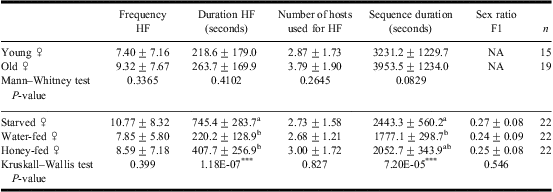
No significant differences in host-feeding frequency, duration, number of hosts used for host feeding, and time taken to parasitise 10 different hosts were observed between young and old females (Table 1). From the 18 young females observed, 15 were kept for the analysis since three young females did not host feed. The proportion of young nonhost-feeding females was not significantly different from the number of old females that did not host feed (0) (χ 2-test: 3 of 18, 0 of 19; P = 0.210).
Effect of each treatment on HF frequency, on HF duration, on the number of hosts used for HF, on time taken to parasitise 10 different hosts (sequence duration), and on sex ratio (proportion of males) in F1 generation.
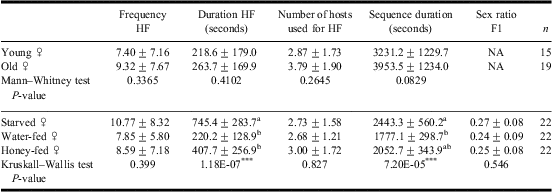
Mean (± SD) durations are expressed in seconds.
a,bDifferent superscript letters within a same column means a significant difference between treatments (***P < 0.001).
HF, host feeding.
Water-fed and honey-fed females host fed for a shorter duration than starved females (Table 1). The time taken to parasitise a sequence of 10 different hosts was longer for starved females than for water-fed females. However, no significant differences were observed in host-feeding frequency, number of hosts used for nutrition, and in total F1 sex ratio.
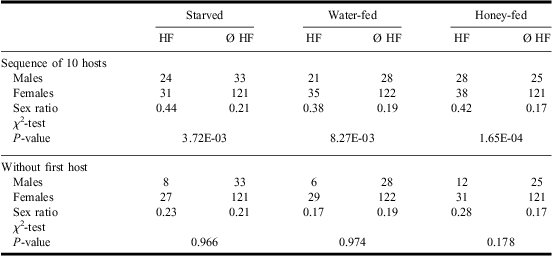
The sex ratio (proportion of males) of the progeny that emerged from hosts with host feeding was higher than in hosts without host feeding for the complete sequence of 10 hosts encountered (Table 2). However, when we removed the first host from calculation, sex ratio was similar between hosts with and without host feeding (Table 2). The majority of females (89%) host fed on the first egg encountered where a male was generally allocated. Furthermore, 75% host fed on more than one host and 85% had more than one frequency of host feeding in the sequence of 10 hosts.
Number of males and females and sex ratio (proportion of males) emerging from eggs subjected or not to maternal HF.
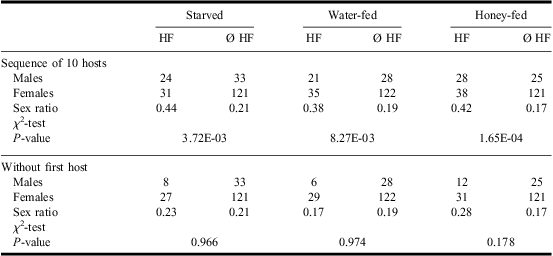
χ 2-tests have been used to compare the proportions of males and females from non-HF and HF host eggs.
HF, host feeding.
Discussion
Age did not affect the host-feeding behaviour contrarily to what was predicted. We found no difference between young and old females in the frequency, duration, and number of host eggs used for nutrition. However, sequence duration was marginally nonsignificant and a larger sample size may have provided statistically different results, although our sample size was comparable to those used in similar studies (Bai and Smith Reference Bai and Smith1993; Collier Reference Collier1995; Ferracini et al. Reference Ferracini, Boivin and Alma2006). According to the predictions of a dynamic state-variable model (Heimpel and Collier Reference Heimpel and Collier1996), host feeding should decrease at older age, as females near the end of their life would gain little by host feeding and investing in future reproduction (Heimpel and Rosenheim Reference Heimpel and Rosenheim1995). Furthermore, host deprivation (time spent without host) should decrease the perception of host availability by the parasitoid (Rosenheim and Heimpel Reference Rosenheim and Heimpel1994) and females should host feed less. In our experiment, older females have been five days in isolation without host and should have been less likely to use hosts for host feeding. However, our results are in line with other studies that failed to verify that prediction: in Aphytis melinus DeBach (Hymenoptera: Aphelinidae) and Aphytis aonidiae Mercet (Heimpel and Rosenheim Reference Heimpel and Rosenheim1995; Heimpel et al. Reference Heimpel, Rosenheim and Mangel1996) and in Trichogramma australicum Girault (Nurindah et al. Reference Cribb and Gordh1999). In the endoparasitoid Itoplectis naranyae Ashmead (Hymenoptera: Ichneumonidae), females were found to increase their host-feeding behaviour but this behaviour was linked to an increase in oviposition in the days following emergence (Ueno and Ueno Reference Ueno and Ueno2007). Female parasitoids may be able to adjust their host preference, acceptance, and patch exploitation strategy when they are aging (Weisser Reference Weisser1994; Goubault et al. Reference Goubault, Outreman, Poinsot and Cortesero2005; Wajnberg et al. Reference Wajnberg, Bernhard, Hamelin and Boivin2006; Lebreton et al. Reference Lebreton, Darrouzet and Chevrier2009), but still not be able to relate their life expectancy to their host-feeding behaviour. In addition, for Trichogramma spp., the cost of host feeding may be low enough that aging females still gain more by host feeding than by not doing so. Host feeding does decrease progeny fitness in Trichogramma but when tibia length is used as proxy of fitness, the cost is <5%, in Trichogramma turkestanicum Meyer (now euproctidis) (Ferracini et al. Reference Ferracini, Boivin and Alma2006).
Mobility of parasitoid females can be used as an indicator of their fitness and their efficiency in host searching and parasitism (Dutton and Bigler Reference Dutton and Bigler1995; Tezze and Botto Reference Tezze and Botto2004; Boivin Reference Boivin2010; Suverkropp et al. Reference Suverkropp, Bigler and van Lenteren2010). The mobility of old and young females T. euproctidis was similar, although decreases in activity and in linear walking speed with age have been observed in Trichogramma brassicae Bezdenko (Pompanon et al. Reference Pompanon, Fouillet and Bouletreau1999). However, T. brassicae females were observed at 22 °C, until they were 7 days old, which is two days older than our females. Their locomotor activities increased for 3–4 days and then started to decline (Pompanon et al. Reference Pompanon, Fouillet and Bouletreau1999). Our female T. euproctidis may see their mobility affected later in live or when exposed to higher temperature.
A female's hunger level and nutrients reserve can strongly affect its behaviours and change its foraging decisions (Heimpel and Rosenheim Reference Heimpel and Rosenheim1995; Jacob and Evans Reference Jacob and Evans2001; Giron et al. Reference Giron, Riverom, Mandon, Darrouzet and Casas2002; Rivero and West Reference Rivero and West2005; Jervis et al. Reference Jervis, Ellers and Harvey2008; Lightle et al. Reference Lightle, Ambrosino and Lee2010). As expected, starved females host fed longer, but the frequency and number of host eggs used for nutrition were the same between the three groups. A higher frequency of host feeding would result in more insertions of ovipositor and more investment in time and energy. In addition, a higher number of hosts used for host feeding would have mean more progeny with a lower fitness, even if the cost is low. To host feed longer but on the same number of hosts can thus be considered a good strategy for the females. However, we did not measure if starved females ingested more host material by increasing the duration of host feeding. Starved females were weak and could have taken longer to ingest the same amount of host material.
We were expecting that water-fed females would host feed more than honey-fed females as honey provides fuel for somatic maintenance and locomotion (Thompson Reference Thompson1999; Jervis et al. Reference Jervis, Ellers and Harvey2008) while it is poor in amino acids and lipids (Jervis et al. Reference Jervis, Ellers and Harvey2008). However, although water-fed females host fed longer than honey-fed females, this difference was not significant. The fact that water-fed females host fed less than starved females suggests that either host feeding serves to acquire water or that the water ingested by the water-fed females took part of the volume of the gut and prevented the female from host feeding as much as starved females.
Honey is normally used for somatic maintenance and as an energy source for the muscular system (Pompanon et al. Reference Pompanon, Fouillet and Bouletreau1999; Jervis et al. Reference Jervis, Ellers and Harvey2008). We could therefore have expected honey-fed females to increase their activity level in the patch but our results showed that honey-fed females were not faster on a host patch. Only starved T. euproctidis females were less mobile compared with water-fed females (Table 1). The importance of water in locomotion has been demonstrated in other insects species such as Locusta migratoria Linnaeus (Orthoptera: Acrididae) (Raubenheimer and Gäde Reference Raubenheimer and Gäde1996) and Nauphoeta cinerea (Dictyoptera: Blaberidae) (Reynierse et al. Reference Reynierse, Manning and Cafferty1972).
Most females host fed on the first host encountered and host fed more than once in the sequence of 10 hosts (only three young females did not host feed). These results suggest that T. euproctidis females have a predetermined pattern of host feeding and always host feed on the first egg encountered in a patch. As they gradually exploit the host patch, they host feed a second and sometimes a third time. Female Trichogramma adjust their sex ratio deposited according to the breeding structure of the parasitoid's population in a host patch (Damiens and Boivin Reference Damiens and Boivin2005). When a single T. euproctidis female exploits a host patch, it is expected to allocate a female-biased sex ratio as predicted by the Local Mate Competition model (Hamilton Reference Hamilton1967). However, the sex ratio allocated to hosts on which the mother host fed was higher than the sex ratio allocated to hosts where no host feeding occurred (Table 2). It appears that this difference in the sex ratio allocated was due to the sex ratio deposited in the first host encountered as the sex ratios allocated to hosts where host feeding occurred or not was similar when the first host encountered was removed (Table 2). The sex ratio allocated was constant between treatments and therefore the hunger level of females did not change the sex ratio allocated in a sequence of 10 hosts encountered (Table 1).
In Trichogramma, egg laying occurs before host feeding and therefore the sex ratio decision is made before host feeding. However, the sex ratio allocated in the first host parasitised in a patch can also be influenced by the sex ratio strategy used by the female. Trichogramma are known to use precise sex allocation (Luck et al. Reference Luck, Janssen, Pinto and Oatman2001) where a male is generally deposited first in a sequence of hosts encountered in order to decrease the probability of depositing a female-only progeny within a host patch (Godfray Reference Godfray1994). As the male-first strategy coincides with host feeding on the first host, it is not possible to determine to which strategy the increase in the proportion of males deposited on the first host encountered responds. While depositing a male early in the oviposition sequence does decrease the risk of female-only clutches, to host feed on a host in which a male was allocated is also less costly in term of fitness (Charnov Reference Charnov1982; King Reference King1987; Luck et al. Reference Luck, Janssen, Pinto and Oatman2001; Santolamazza-Carbone et al. Reference Santolamazza-Carbone, Nieto and Rivera2007) and represents a strategic choice for the female. In addition, host feeding on the first host encountered ensures the female to gain materials for egg production as soon as possible.
Acknowledgements
We would like to thank Josiane Vaillancourt, Danielle Thibodeau, and Julie Frenette for supplying insect material and for technical assistance. This project was funded by Agriculture and Agri-Food Canada and McGill University.