Introduction
This article examines the applicability of the Zomia concept for social scientific studies of what I shall here call the Himalayan Massif, with special reference to the Central Himalayas. I refer both to the Zomia imagined by Willem van Schendel as a geographically defined ‘world area’ that puts highland Asia at its centre,Footnote 1 and that imagined by James C. Scott as a ‘non-state space’ defined in social, political, and economic terms.Footnote 2 In proposing the term ‘Himalayan Massif’, I adapt Jean Michaud’s usage of the term ‘Southeast Asian Massif’ to cover a limited region of his ‘High Asia,’ the western borders of which overlap with the eastern edges of the Himalayan Massif.Footnote 3
While for both empirical and political reasons the term Zomia itself may not be entirely appropriate to the Himalayan Massif, the analytical imperatives that underlie Scott’s usage of it can be of great utility to those working in the Himalayan region, particularly the emphasis on the ethnic, national, and religious fluidity of highland communities, and their agency vis-à-vis the states with which they engage. This is true not only in relation to projects that are cross-border in nature but also for those grounded squarely in a single nation-state whose territories in part comprise the Himalayan Massif: Nepal, Bhutan, India (especially but not exclusively the states of Jammu & Kashmir, Himachal Pradesh, Uttaranchal, Sikkim, and Arunachal Pradesh), and China (especially but not exclusively the Tibetan Autonomous Region).
Here, my discussion focuses primarily on the Central Himalayas. This subregional focus is not intended to exclude the EasternFootnote 4 or WesternFootnote 5 Himalayas from the Himalayan Massif, nor to ignore the Hindu Kush-Karakoram regions still further to the west. On the contrary, while here I make only preliminary suggestions based on empirical experience in the region I know best, I hope that others will in due course augment or refute them with material from other Himalayan contexts.Footnote 6
The current resurgence of interest in ‘High Asia’ as an empirically and theoretically relevant world area provides an opportunity for scholars working in the Himalayas to revisit a crucial aspect of their own scholarly tradition: the early emphasis on regional cultural formations that were perceived to transcend individual nation-states. The ‘regional ethnography traditions’Footnote 7 of Himalayan studies were in many ways ahead of the curve in defining a Zomia-like unit of analysis, which was characterized by its linguistic, cultural, religious, and economic commonalities, rather than by its state-centred political unity.Footnote 8 Relatively early ethnographic work in the region addressed the topics of cultural change and interethnic relations,Footnote 9 trans-Himalayan trade,Footnote 10 and the transnational scope of Hindu, Buddhist, and shamanic practice.Footnote 11 Colonial ‘ethnography’ and surveys also entailed a prominent acknowledgment of the importance of cross-border labour migration in the region.Footnote 12 However, many such studies said little about the existence of nation-states and the importance of their political histories and specific trajectories, leading some contemporary scholars to view the concept of a coherent Himalayan region as the unfortunate inheritance of an earlier era, which must be cast off.
I suggest instead that Scott’s articulation of Zomia provides a new framework within which the historically strong focus of Himalayan studies on highland peripheries may be productively united with a more contemporary concern for the political histories of national formations and their ‘state effects’. At the same time, I argue that the specific ethnographic, historical, and political terrain encountered in the Himalayan Massif raises more general questions, relevant also to those working in the Southeast Asian Massif, about how the Zomia concept may be received by the diverse and intersecting communities whom it purports to encompass. Along these lines, I argue that the proponents of refashioning world areas along ‘Zomianist’ lines must engage carefully – although not necessarily uncritically – with current intellectual and political debates in the multiple locales traversed by their transnational maps. In order to be successful, such engagement will entail presenting Zomia and related concepts such as the Himalayan or Southeast Asian Massifs as additional frameworks for analysis (and perhaps political struggle) that add value to, rather than replace, the now ‘traditional’ frame of nation-states.
My discussion is informed by a decade of ethnographic work with the Thangmi (also known as Thami), an ethnic community of about 40,000, whose population is dispersed across highland areas of central-eastern Nepal (Dolakha and Sindhupalchok districts), north-eastern India (in the Darjeeling district of West Bengal, and Sikkim), and China’s Tibetan Autonomous Region (TAR).Footnote 13 They are a quintessential ‘Zomian’ group, according to Scott’s criteria: middle-to-high altitude cultivators, who supplement their diet with foraged forest products and who maintain a high level of mobility, a relatively egalitarian social structure, and a synthetic, exclusively oral religious tradition.Footnote 14 They speak a distinct Tibeto-Burman language, and rely on indigenous shamans as their primary ritual practitioners. They have also remained largely outside the remit of official state recognition until very recently. They were listed as an Other Backwards Class in India in 1995, and as a janajati (indigenous nationality) group in Nepal in 2001. Many fellow citizens in the three countries in which the Thangmi live have never heard of the group.
I suggest that this lack of recognition is in large part the result of a historically intentional strategy of remaining ‘ungoverned’ (following Scott), but that Thangmi desires for recognition have shifted dramatically over the last half century, and over the last two decades in particular. In this regard, the Thangmi case provides contemporary empirical evidence of the sort of intentionality that Scott accords highland peoples in their historical relations with the state, suggesting that the analysis that Scott claims ‘makes no further sense’ after 1950 may in fact have more currency than he allows.Footnote 15 It is that very currency, and its implications for ongoing struggles for recognition from multiple states, that gives the scholarly concept of Zomia potential political relevance as well. Ultimately, I argue that members of groups such as the Thangmi are engaged in an ongoing process of simultaneously situating themselves to make strategic and political claims vis-à-vis multiple nation-states, while also remaining deeply committed to the ‘ungoverned’ aspects of their identity in cultural and psychological terms.
I do not intend to suggest that the Thangmi are representative of all Central Himalayan populations, let alone all Himalayan Massif populations. Clearly, other communities living in the region have experienced, and continue to experience, very different relationships with the states in question. Some, such as the Lhasa Tibetans or the Kathmandu Newar, may have been agents of the state or cultural elites in certain ethnohistorical contexts, while others, such as the Nagas of north-eastern India, may have long situated themselves in direct opposition to the state, rather than seeking to make strategic claims on it. In this article, I begin the process of examining how the full range of inter-group dynamics that Scott posits for Zomia may also be present in the Himalayan Massif, by introducing an empirically grounded case study that demonstrates some of these possibilities.
Is the Himalayan Massif in Zomia?
Willem van Schendel included parts of what I refer to as the Himalayan Massif in his initial proposal for Zomia. The ten modern nation-states that comprise the region are listed as China, Vietnam, Laos, Cambodia, Thailand, Burma, India, Bangladesh, Bhutan, and Nepal.Footnote 16 However, in Scott’s formulation, the list of Zomia ‘member states’ is reduced to eight, with Bhutan and Nepal – as well as the western portions of the Indian Himalayas – excluded from the fold. Although Scott occasionally mentions Tibet,Footnote 17 there is no sustained consideration of it as an independent pre-modern state, or of contemporary Tibetan citizens of China as part of the Zomian ethnolinguistic mosaic. Scott’s minimalist map of Zomia is therefore equivalent to Michaud’s map of the Southeast Asian Massif, with the Central and Western Himalayas as the missing segments needed to complete van Schendel’s more expansive vision of the Zomia puzzle.
Four other formulations that include portions of the Himalayan Massif in Zomia-like cultural, linguistic, or ecological zones are worth noting here. Stuart Blackburn uses Franz Boas’ notion of ‘culture areas’, defined by shared oral narratives, to argue for an ‘extended Eastern Himalayas’ that encompasses central Arunachal Pradesh, the Naga, Chin, and Chittagong Hills of the India–Myanmar–Bangladesh border, and upland Southeast Asia and south-west China.Footnote 18 Geoffrey Samuel suggests that we might ‘try looking at Tibetan societies as part of Southeast Asia’, along with ‘the other Tibeto-Burman speaking peoples of Nepal, Sikkim and Bhutan’.Footnote 19 George van Driem uses linguistic criteria to define a ‘greater Himalayan region’ that ‘extends from the Hindu Kush and Tianshan mountains in the west to Arunachal Pradesh and upper Burma in the east’.Footnote 20 Finally, as noted by van Schendel, the International Centre for Integrated Mountain Development proposes that the ‘Hindu Kush-Himalayan’ region be considered as a contiguous ecological zone for development purposes.Footnote 21
It is not clear why Scott chooses to detach the Central and Western Himalayan Massif from van Schendel’s Zomia. The apparent arbitrariness of his chosen boundaries highlights the potential pitfalls of designating new ‘world areas’, which may be as exclusive, albeit along different lines, as old ones. Scott himself acknowledges that what we might call ‘Zomia-thinking’ – both as the form of consciousness held by inhabitants of ‘Zomian’ spaces and as the theoretical use of the term to designate a form of ‘non-state space’ – may be productively extended far beyond the geographical boundaries of what he recognizes as Zomia. Conversely, elsewhere in this issue, Michaud argues that not all geographical areas of the Southeast Asian Massif possess the sociopolitical characteristics that Scott attributes to Zomia.
With both of these arguments in mind, I suggest that the Himalayan Massif is best considered as a region whose eastern borders overlap with those of the western borders of the adjacent Southeast Asian Massif, and that both may be productively understood through the analytical framework of ‘Zomia’. Moreover, the overlapping borders, as well as the similarities between the Himalayan Massif and the Southeast Asian Massif, make it particularly important to carry out comparative analyses between the two. The regions share much linguistically, with a large number of distinct Tibeto-Burman speech communities;Footnote 22 religiously, with Buddhism and Hinduism as powerful shaping forces; and economically, with a widespread reliance on rice cultivation and trans-regional trade. These similarities make it all the more important to distinguish the local specificities between and within each region from the outset, so that the characteristics of the Southeast Asian Massif do not come to be presumed as normative for the Himalayan Massif, or vice versa. Rather, the two regions should be seen as complementary sites for a mutually beneficial, but empirically specific, comparative analysis.
The problem of non-postcoloniality: academic and political histories of the Central Himalayas
In 1905, the French philologist Sylvain Lévi wrote, ‘le Népal c’est l’Inde qui se fait’ (Nepal is India in the making).Footnote 23 Nepal was conceptualized as a ‘laboratory’ in which historical hypotheses about India could be tested in the present. In the same year, a British colonial officer, L. Austine Waddell, bragged about his proximity to the Tibetan capital of Lhasa from his vantage point in the then-independent country of Sikkim: ‘I have spent several years studying the actualities of Lamaism … at points much nearer Lhasa than any utilized for such a purpose, and where I could feel the pulse of the sacred city itself beating in the large communities of its natives, many of whom had left Lhasa only ten or twelve days previously’.Footnote 24 These quotations provide an entrée into the process by which early Western writers frequently sought to make one part of the Himalayan region stand in for another – Nepal for India, Sikkim for Tibet, and so on. Such substitutions emerged out of a complex matrix of imperial and theological motivations, which had the collective effect of jettisoning the political histories of individual nation-states in the name of a broadly conceived, timeless and apolitical Himalayan region, in which Hinduism and Buddhism, as well as ‘tribal’ cultural forms, could be observed.
This borderless vision of the Himalayan region as a politically undifferentiated zone of cultural fascination emerged in part out of the colonial perception of the area as one that remained off limits, beyond colonial domination (if not entirely outside of the colonial sphere of influence), and therefore beyond history.Footnote 25 As Mary Des Chene reflects in relation to Nepal, ‘I cannot help but think that a deep-seated presumption that if Westerners were not present and active in a place then history could not really be occurring was at work’.Footnote 26 None of the historical Himalayan states that comprise the central core of the Himalayan Massif (Nepal, Tibet, Sikkim, and Bhutan) were ever fully colonized before 1950, although all of them were strongly shaped by engagement with the British Raj. Others have discussed the very different colonial experiences of both the Eastern and Western Himalayas.Footnote 27 In addition, many would argue that Tibet was colonized by China from 1949 onwards, and remains under colonial occupation today. And some portray Sikkim as having been colonized by India because, although the state was fully incorporated into India in 1975, some Sikkimese continue to view India as a colonial power. All of the countries in question have wrestled with their own forms of internal colonialism, discussed in more detail below. However, without a Western colonial heritage to put the past in context, Des Chene suggests, the early anthropologists who began working in the region in the 1950s tended to describe their ethnographic subjects in a historical and political vacuum. Ironically, it is in this that ‘we find perhaps the most thoroughly colonialist aspect of the early anthropology of Nepal’.Footnote 28
Des Chene suggests that the effects of what she calls ‘non-postcoloniality’ on Himalayan studies have been contrary to what might be expected. Rather than being less compromised by orientalism than Area Studies grounded in the traditions of colonial ethnography found next door, Himalayan Studies remained more resolutely orientalist for much longer, precisely because there was not a robust tradition of colonial ethnography to work against. For this reason, contemporary studies of the Central Himalayas in particular tend to remain separate (sometimes intentionally, sometimes not) from the master narrative of ‘postcolonial studies’. This keeps much important empirical work conducted in the region outside the purview of metropolitan theory. Along similar lines, Carole McGranahan argues that, ‘Tibetan imperial stories … are not composed of familiar categories of empire. Instead, they depart from colonialism, capitalism, and European moorings, and thus from the primary foci of colonial studies and postcolonial theory’.Footnote 29 Peter Hansen suggests that these conditions, exacerbated by the efforts of the Tibetan Government in Exile to create an image of pre-Chinese Tibet as a timeless and peaceful Shangri-La, explain why there has been no sustained effort to generate a ‘subaltern studies for Tibet’.Footnote 30
In terms of the possibilities of Zomia-thinking in the Himalayas, these conditions present a very different academic-historical terrain from that found in the Southeast Asian Massif. While Scott suggests that Southeast Asian Studies has been overly dominated by a focus on the state, Himalayan studies until recently has suffered from the near opposite, an almost complete absence of the state. The paradigm-shaping works on Southeast Asia are ‘histories of states’, which ‘insinuated themselves in the place that might have been occupied by a history of peoples’.Footnote 31 In contrast, at least within Western academia, the paradigm-shaping works on the Central Himalayas (notably Nepal) have, in fact, been ethnographies of highland peoples. With the first Western researchers to enter Nepal in the 1950s focusing on the ethnography of individual highland groups,Footnote 32 an academic map of the region was drawn that focused almost exclusively on its highland peoples. There was little sustained recognition of their relationship to the nation-states in which they lived, or to the cultural worlds of the dominant populations of those states.
This is not to say that no political histories of the region were written. Rather, due to what Pratyoush Onta has called the ‘curious division of labor’ between Western anthropologists and Nepali historians,Footnote 33 the Western anthropological agenda shaped the overall scholarly image of the region much more strongly than did the work of ‘Nepali researchers [who] focused almost exclusively on the life of the Nepali nation-state’.Footnote 34 Indeed, such nationalist histories have long comprised a crucial strand of intellectual discourse in both the Nepali- and Tibetan-language public spheres across the region. Yet as Onta, Des Chene, and others have rightly argued, historical work written in local languages, with a focus on state-centred political history, has at best been poorly integrated into Western anthropological writing on the peoples and cultures of the region.Footnote 35 These divides, and a contemporary desire among intellectuals based in the Central Himalayan metropoles of Kathmandu, Lhasa, Gangtok, and Thimphu to compensate for this historical tendency, may lead to some suspicion of the Zomia concept as an outmoded idea that brings back unwanted memories of a non-colonial, but highly orientalist, scholarly past that subverted the particularities of individual nation-states and their political histories in the service of creating a broader regional analytical framework.
The Himalayas beyond ‘Tibet’ and the ‘Indo-Tibetan interface’
Many ethnographers of the Himalayan region have been primarily interested in the ‘Tibetan’ cultural world, and yet conducted their studies in Nepal or India because Tibet proper remained inaccessible to researchers. This situation only began to change after Chinese liberalization in the 1990s. However, Tsering Shakya suggests that pragmatic obstacles were not alone in keeping Western scholars away from what Melvyn Goldstein has called ‘political Tibet’.Footnote 36 Rather, ‘there was also a residual sense that there was nothing worthy of study in post-1950 Tibet; as if the apparent demise of traditional society rendered further studies valueless and uninteresting’.Footnote 37 This sums up a dynamic that has recently begun to be discussed within Tibetan studies. While ethnographic description of individual highland groups came to dominate the epistemological space of ‘Himalayan studies’, textual studies of religious works came to do the same for ‘Tibetan studies’, in a manner that valorized the textually preserved world before 1950 as the only authentically Tibetan one.Footnote 38 This emphasis created a vision of religious Tibet as somehow detached from the political reality of what George Dreyfus has called a ‘proto-nationalist’ independent state.Footnote 39 In this sense, the scholarship on Tibet developed in a similarly apolitical manner to that on Nepal, albeit for different reasons.
However, Tibetan culture was believed to be alive and well in the erstwhile ‘Himalayan borderlands’ of cultural Tibet, and many ethnographers working in Nepal and India have sought to define their subjects as primarily affiliated with the Tibetan Buddhist cultural world. This effect is achieved in part by downplaying the citizenship of ethnographic subjects in the (until recently) Hindu and secular states of Nepal and India respectively. The anthropologist Stan Mumford provides a paradigmatic example of this tendency in the opening sentence of the preface to Himalayan dialogue, a classic work from the late 1980s on the relationship between Buddhism and shamanism: ‘A thorough ethnography of Tibetan village Lamaism has been possible on the Nepal side of the Himalayas, just below the Tibetan border, which could not have been done in Tibet itself.’Footnote 40 Here, the relegation of ‘Nepal’ to describe a ‘side of the Himalayas’, rather than a politically coherent nation-state, demonstrates the desire to erase national boundaries in order to define the work as legitimately Tibetan, which is further emphasized by Mumford’s invocation of his field site’s proximity to the border. Although in the end he cannot avoid acknowledging that it was not and could not be done in Tibet itself, the ethnography contains little attempt to situate its subjects within the historico-political context of Nepal. Conversely, many ethnographers of Himalayan peoples have been criticized for not interpreting empirical material from highland Nepal within more orthodox Tibetan civilizational frameworks.Footnote 41 By intentionally blurring political boundaries in a manner that echoes the techniques of substitution employed by earlier writers such as Lévi and Waddell (described above), such approaches treat the highland communities of the Himalayan Massif as convenient substitutes for an inaccessible, imagined Tibetan centre, rather than investigating the specificities of their relationships with the states in which they live.
Mumford’s work, along with many other influential Himalayan ethnographies, emerged out of a discursive preoccupation with the ‘Indo-Tibetan interface’ model for understanding the cultural complexities of the Himalayan region. Revisited in light of current proposals for Zomia, this model for understanding cultural mixture and migration in the Himalayas at first appears positively prescient, in essence a mode of Zomia-thinking developed over thirty years ago. However, upon closer examination, it also serves as a cautionary tale to illustrate why such approaches may be more compromised than they initially seem.
In his foreword to the seminal 1978 volume entitled Himalayan anthropology: the Indo-Tibetan interface, von Fürer-Haimendorf summarized the concept:
In the Valleys of this great mountain range Indo-Aryan and Tibeto-Burman languages dovetail and overlap, populations of Caucasian racial features characteristic of North India met and merged with Mongoloid ethnic groups, and the two great Asian religions Hinduism and Buddhism coexist there and interact in various ways. In neither of these spheres are boundaries clear-cut, nor are the sequences of events which brought about the present kaleidoscopic pattern easily discernible … very little is known about the history of the many preliterate tribal societies which for long filled the interstices between the domains of more advanced cultures … for centuries [this area] has been a meeting point of distinct races and two of the great civilizations of Asia.Footnote 42
The volume’s introduction, by the anthropologist James Fisher, continues in this vein by providing a range of somewhat more nuanced epithets to describe the erstwhile ‘interface’, such as ‘fringe region’ and ‘neither fish-nor-fowl contact zone’.Footnote 43 Most intriguing is the assertion that, ‘the Himalayas, thus are not so much a boundary, border, or buffer, as a zipper which stitches together these two densely textured cultural fabrics’.Footnote 44 These descriptions invoke the geographical, linguistic, racial, and religious mixture that define the region, but the histories of state formation that have served as the impetus for such processes of migration and mixture remain under-theorized.
This ‘interface’ model – also known as the ‘ecological model’ because it links ‘Indic’ and ‘Tibetan’ cultural forms to discrete ecological zones on the southern and northern slopes of the Himalayas – has since been critiqued. Geoffrey Samuel argues that it, ‘does not take us very far towards a theoretical understanding of how these societies work … they are not just mixtures of “Tibetan” and “Indian” influences’.Footnote 45 Addressing such ecological determinism within anthropology in general, Bernard Cohen explains that, ‘Forms of social organization were correlated with particular ecological niches, and it was a short step from correlating ecology with social forms to seeing the ecological as generative of these.’Footnote 46
Due to its emphasis on altitude and ecology as primary factors in shaping the cultural worlds of highland groups, the Zomia concept can sound uncomfortably similar to such past attempts at identifying commonalities through ecological association at the expense of examining political histories. Des Chene anticipates this problem, writing, ‘I would not be surprised, for example, to find the Indo-Tibetan interface image rewritten in the language of the borderland’.Footnote 47 A careful reading of Scott’s work belies such potential critiques. Zomia is not the image of the interface rewritten in the language of the ‘borderland’. Rather, Zomia-thinking articulates a regional vision that locates national political histories at its ‘centre’, but is not limited by them in conceptualizing the breadth of the regional frame that the erstwhile citizens of each such state may encounter.
Nevertheless, when I summarized the Zomia idea to several colleagues in Nepal, the responses were variations on the theme of ‘That sounds like the old ecological model, why do we need that?’ This position was shared between internationally educated intellectuals and activists, as well as locally educated individuals from highland communities. Despite the fact that Scott’s vision of Zomia is in fact premised on a careful examination of ‘state effects’ on highland populations, and the ‘highland population effects’ on states, the very act of using a singular term to define an entire region that is shaped by multiple political histories can lead easily to such criticisms. This is especially so in places such as Nepal, where the relations of power between highland peoples and the state remain raw and unresolved questions, central to the country’s contemporary political trajectory.
In such contexts, advocates of Zomia must clarify that Zomia-thinking is not a return to previous models of cultural and ecological determinism, but rather an attempt simultaneously to acknowledge the role of states in shaping highland communities and to investigate indigenous forms of consciousness and agency within such processes. Furthermore, conceptualizations of the ‘Himalayan Massif’ must not once again treat ‘Himalayan’ as a euphemism for ‘Tibetan outside of political Tibet’. Rather, the concept must recognize historical Himalayan polities as distinct political entities with their own histories of state formation, and locate the Himalayan Massif as the region at their shared periphery, the peoples of which have experienced a range of ‘state effects’ emanating from multiple political centres over time. Despite the contemporary perception of Tibet as a victim of Chinese domination, historically the Tibetan capital of Lhasa was itself one of the key centres of power in the region. Dominant political and religious ideologies linked to the Dalai Lama’s Gelugpa sect did not leave much space for dissent, and the antecedents of many of today’s populations in the Himalayan regions of Nepal, India, and Bhutan that skirt Tibet’s southern borders were adherents of other sects (primarily Nyingmapa and Sakyapa, but also Kagyupa and Bönpo) who fled religious persecution in central Tibet.Footnote 48
Acknowledging the historical reality of such relationships of inequality and oppression within the Tibetan Buddhist world allows us to see that the experience of political domination in the Himalayas is not linked exclusively to any particular cultural, religious, or racial identity. For example, it is not only practitioners of Buddhism or shamanism who have had to negotiate their positionality vis-à-vis the Hindu state of Nepal but also practitioners of Hinduism who have had to negotiate a very troubled relationship with the Buddhist state of Bhutan.Footnote 49 Zomia-thinking seeks to understand the entangled dynamics of such experiences for multiple groups across the region, as well as the ways in which political relationships between the states of the region have created the possibility – and often necessity – for Himalayan citizens to engage with many states at once.
Proposing a distinct, yet Zomia-influenced, approach to the Himalayan Massif thus responds productively to Des Chene’s suggestion that ‘The different polities that encompass the Himalayan region have always sat uncomfortably with the idea of Himalayan studies and work that situates itself in this way seems frequently to try to analyze the cultural apart from these divergent political histories. One can imagine a different Himalayan Studies that took the political history of the region as its basis’.Footnote 50 I turn now to look at how such a re-conceptualization of Himalayan studies can articulate with a Zomia-like framework that goes beyond the limitations of individual nation-state boundaries to understand the strategies through which highland populations have maintained their own positionalities vis-à-vis multiple states over time.
‘Over-stating’ the case
In response to the perception that Himalayan studies has been dominated by ethnographic approaches to individual groups, more recent scholarly work has sought to re-centre national histories as foundational to the scholarly discourse on the region. In the Nepali context, this effort has been led by Nepali historians such as Mahesh Chandra Regmi and Prayag Raj Sharma. They have sought to bring well-known writers in the national language (such as Baburam Acharya and Dhanavajra Vajracharya) into the English-language sphere of international scholarly discourse.Footnote 51 Foreign anthropologists have also contributed important work to this project, particularly through their efforts to historicize ethnic identities in relation to processes of state formation.Footnote 52 In the Tibetan context, Western scholars have worked alongside Tibetan writers in exile, with the boundaries between anthropology and history often blurring within the crucible of Tibetology.Footnote 53 Saul Mullard has recently begun a similar project for Sikkim,Footnote 54 while several scholars have highlighted different aspects of Bhutan’s unique history.Footnote 55 Such work departs from the previous trajectory of Central Himalayan studies, in that it seeks to locate individual nation-states as the primary unit of analysis, instead of the ‘ethnic group’, as instantiated in a single village or region.
In many cases, however, a desire to do away with the ‘Himalayas’ as a category of analysis may lead writers to ‘over-state’ their case, focusing on the dynamics of ethnic, national, and other forms of political identity within the narrow confines of single states, entirely bracketing out cross-border movements or connections that had previously been viewed as defining the Himalayan region. In the introduction to Resistance and the state: Nepalese experiences, the anthropologist David Gellner provides a good example of such over-statements: ‘It is impossible to understand how Nepalis view themselves, unless one first realizes that their self-image has nothing to do with Tibet, not even as a point of contrast. Tibet, for most Nepalis, is a faraway country of which they know nothing.’Footnote 56 These statements narrowly circumscribe legitimate ‘Nepali’ identities within a nationalist discourse that does not acknowledge the ways in which many contemporary Nepali identities continue to be shaped by the history of economic, political, and cultural contact with Tibet, and now China in addition to India. These include prolonged encounters during three Tibet–Nepal wars in the eighteenth and nineteenth centuries, for example, and enduring cross-border trading and religious relationships between many citizens of Nepal and the TAR. Indeed, putative historical connections with Tibet, as well as appropriated Tibetan cultural practices, have become important symbolic tools for many proudly nationalist Nepalis. Ethnic communities such as the Sherpa and Gurung deploy such refigured notions of Tibetan-ness as evidence of their status as indigenous minorities, deserving of special rights and benefits within the modern Nepali nation.Footnote 57
While Gellner is right that we must challenge the easy metonymization of Nepal as ‘the Himalayas’ by recognizing the specificities of Nepali national history and contemporary experience, and by acknowledging that Nepal can lay claim to only a small portion of the Himalayan Massif, such agendas are not mutually exclusive with those that recognize the historical and contemporary cultural, political, religious, and economic links between nation-states, or the continued reality of expansive border areas, where individual states assert neither complete cultural nor political hegemony. National histories can simultaneously be cross-border histories, as emerging work demonstrating how both Nepali and Tibetan nationalism were forged in India during the first decades of the twentieth century has begun to show.Footnote 58 Along Nepal’s long borders with both India and China’s TAR, as well as between these two areas, there exist to this day substantial trans-Himalayan flows of citizens, who perceive the very notion of citizenship as a multiple category.
Another mode of over-stating the case is Des Chene’s argument that Nepal in its entirety should be treated as a marginal or subaltern space, since ‘despite the profession of interest in margins, marginalization, subalterns, and so on, one sees relatively little attention to some peripheries, some subalterns – Nepal and Nepalis among them’.Footnote 59 By identifying Nepal as a subaltern totality, this proposition effaces the relations of power between the Hindu Nepali state and its marginal populations, in both the highlands and lowlands, established through the long-standing process of internal colonialism that began with the first Shah king’s violent ‘unification’ of the country in 1769.Footnote 60 As such, this statement appears incongruous with Des Chene’s otherwise strong arguments that Nepali political history should be taken seriously, since a major feature of that history has been the assertion of a civilizational discourse emanating from the ‘core state’ in the hills, which sought to locate both mountain and plains populations as backwards peoples, in need of modernization, education, and assimilation to a national culture and language.Footnote 61
The same may be said of scholarly work on Tibet that valorizes the process of ‘Tibetanization’ in Himalayan border areas as a positive expression of Buddhist state power.Footnote 62 The success of such processes is often used to provide evidence for Tibet’s coherence as an independent political entity before 1950. In contrast to the long-standing critiques of Sanskritization in South Asia, the contemporary politics of exile prevail against attempts to recognize historical Tibetanization projects as civilizing missions that in fact entailed ‘a certain condescending and despising attitude towards the surrounding regions which … could, in modern terms, be compared with a “colonialist” attitude’.Footnote 63 Indeed, such projects of Tibetanization emanating from Lhasa, particularly along Gelugpa sectarian lines, were one of the factors that compelled many Himalayan populations to migrate further south over time. Similarly, beginning in the early nineteenth century, it was in large part such processes of internal colonialism and economic marginalization that prompted mass migrations eastwards from Nepal’s hill districts to what became the north-eastern Indian states.
Although both Nepal and Tibet may indeed be perceived as peripheral to broader scholarly projects in the region, the act of framing the civilizational discourses of these nations as marginalized subaltern perspectives needy of academic recuperation elides the historical inequalities and relations of power between groups within their own state contexts. Such arguments also work to privilege subjects of study located at the state centre over more remote ones. This tendency intersects with an increasingly prevalent anthropological belief that ‘the production of portraits of other cultures, no matter how well drawn, is in a sense no longer a major option’.Footnote 64 This makes the contemporary academic environment relatively inhospitable to ethnographic studies of highland Himalayan populations. It is in this context that Zomia offers a potential path out of the cul-de-sac of attempting to avoid ‘essentializing’ anthropological approaches by over-stating the case.
Acknowledging that Nepal and Tibet both had distinctive political histories before 1950, which Des Chene rightly argues must be better integrated into anthropological studies of any and all of their populations, does not presume that all of the diverse populations living within the boundaries of these states viewed their power as hegemonic, or were fully integrated into single states in a manner that would make it possible to suggest that state histories could in themselves be viewed as subaltern histories. The analytical framework of Zomia at once entails a recognition that ‘state effects’ have been strong components in forging highland identities since long before the magic date of 1950, and that the result of these effects is not always total integration but often intentional self-marginalization (what Scott calls ‘dissimilation’), which in many cases continues into the present. This is not just the ‘resistance’ mentioned in works such as Gellner’s but rather a more complex constellation of consciousness and pragmatic strategy, which has enabled many Himalayan Massif populations to be at once thoroughly influenced by multiple states but not fully claimed or limited by any single one. Such a perspective challenges both overly statist approaches to the Himalayan region and Scott’s assertion that Zomia is in fact a thing of the past, owing to the complete ‘enclosure’ of highland populations by modern states after 1950. Through an ethnographic sketch of the Thangmi, I will now suggest that Zomia-thinking may live on at the subjective level of ethnic consciousness, even if not does not appear evident at the pragmatic level of social, economic, and political relations.
The Thangmi as cross-border citizens: historical background
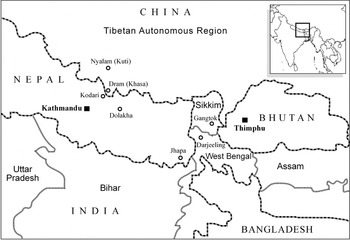
Many contemporary Thangmi divide their year between three countries. There are established patterns of annual circular migration between the Nepali hill districts of Dolakha and Sindhupalchok and the Indian states of West Bengal (especially Darjeeling district) and Sikkim, as well as to border areas of China’s TAR (see Figure 1). The logic of this mobile lifestyle, and its affective results in terms of cultural and political identity, emerge out of the equally peripatetic history and mythology of the Thangmi community.
Areas of Thangmi residence.

The ethnonym ‘Thangmi’ may mean either ‘people of the border’ or ‘people of the plains’ in Tibetan and other Tibeto-Burman languages. From a linguistic perspective, Thangmi is a Tibeto-Burman language, with close genetic links to Baram, a nearly extinct language spoken in Nepal’s Dhading district, as well as intriguing connections to Early Classical Newar and the Rai-Kiranti languages to the east.Footnote 65
Some Thangmi origin stories claim that they came to Dolakha as an established group from Simraungadh, an ancient settlement on the modern Nepal–India border. Other myths trace the migrations of the semi-divine Thangmi forefather and foremother up the Sunkoshi and Tamakoshi rivers to the village of Suspa. Still other tales talk of ancient links with Tibet, claiming a northern origin for the group. According to several authors, it is possible that there was a link between an early Mithila king and the Dolakha region.Footnote 66 When his kingdom ‘straddling the Bihar–Tarai border’Footnote 67 was conquered by Muslim forces in 1324–25 CE, King Hari Simha Deva fled towards Dolakha, but died en route. His sons and entourage apparently did reach their destination, only to be imprisoned by Dolakha’s rulers. One wonders if it was Hari Simha Deva’s Tarai principality that the Thangmi refer to as Simraungadh. Even if some Thangmi ancestors did indeed migrate from the Tarai, it seems likely that they intermarried with other peoples once they reached Dolakha.
A group called ‘Thangmi’ were already established in Dolakha by 1568 CE, when a stone inscription still visible today lists them as one of the area’s three significant social groups, and codifies Thangmi tax obligations to the Newar rulers of Dolakha. Oral histories suggest that, despite this subordinate relationship to the Dolakha Newar, the Thangmi were once the holders of large swathes of kipat land, ancestral properties understood to be the domain of specific ethnic groups, which they began to lose only over the last 200 years, as caste Hindus originating from regions further west migrated to Dolakha and appropriated Thangmi holdings. Today, the Thangmi are one of the poorest and most disenfranchised groups in Nepal.Footnote 68 Most Thangmi families own only very small plots that do not provide enough to feed their families for more than six months of the year.
This imbalance in land ownership appears to have emerged over time as the relationship between Dolakha and the central Nepali state changed. Although the principality of Dolakha remained nominally independent, its villagers came under the jurisdiction of King Jagajjaya Malla’s tax collectors from Kantipur by the middle of the eighteenth century. Documents show that several villagers registered complaints of harassment against his tax-collecting officials.Footnote 69 After Prithvi Narayan Shah incorporated Dolakha into the fledgling Nepali state in 1769, the practice of awarding military officials and civil servants land tracts in lieu of cash payment became commonplace; many of these fields were previously farmed by Thangmi. The redistribution of land accelerated under the rule of Prime Minister Bhimsen Thapa, who in 1805–06 confiscated a large swathe of rice-farming land in Dolakha as payment for army officers.Footnote 70
Thangmi narratives identify the early nineteenth century as the period when they began to lose land most rapidly to army and state officials. After first settling in the area, many of the less scrupulous new migrants began appropriating further lands by acting as moneylenders to their Thangmi neighbours. Charging high interest rates of 60% per annum or more, such moneylenders made it difficult for Thangmi farmers to pay back their loans, and, when the borrower defaulted, the lender would foreclose on the land. Thangmi landholdings therefore diminished drastically over the century, and many Thangmi either went deeply into debt or became tenant sharecroppers on portions of the land that they had previously owned. However, most families were able to hold on to enough arable land to feed themselves for several months of the year. With insufficient land to survive, but too much to abandon, the economic scenario in Nepal’s Thangmi villages by the end of the nineteenth century encouraged circular migration as a means of maintaining traditional lands, while augmenting agrarian yields with cash income.
At roughly the same historical moment, new income-generating opportunities began to emerge in Darjeeling. In 1835, the British took control of this virtually uninhabited tract of forested land. Building infrastructure required workers, and the tea industry founded in the mid 1850s called for vast human resources. This labour came overwhelmingly from Nepal. Many of the earliest Thangmi migrants came to work on tea estates. First one or two men from a single village would establish themselves as trusted workers, eventually being promoted to the role of overseer. Travelling back to Nepal every few years, they would return to the plantations with fresh labour procured through kinship networks. In Darjeeling, almost all large tracts of land were owned either by the government or by private tea companies, with small allotments granted to plantation workers on which they had temporary rights but which they could not own.Footnote 71 This meant that there was no prospect of property ownership for Thangmi migrants, who encountered for the first time a mode of economic production different from the subsistence farming that they had known in Nepal.
Besides tea, Darjeeling’s other major attraction was the British army recruitment centre, which opened in 1857. Enlistment in the Gurkhas became a prize objective for many young men from Nepal’s so-called ‘martial races’, a group from which the Thangmi were excluded. The recruitment officers Northey and Morris dismissed the Thangmi as ‘coarse in appearance, and the inferior of the other races in social and religious matters, they do not merit further description’.Footnote 72 But this did not stop some Thangmi from joining up under assumed names and living a double life as Rai, Gurung, or Magar.
The development of Darjeeling and its environs, through the powerful combination of tea, resorts, roads, and a strategic border to defend, led to ‘the most rapid rate of growth on record for nineteenth-century Bengal’, with 88,000 Nepali-born residents in Darjeeling district by 1881.Footnote 73 The 1872 Census of India lists 13 Thangmi speakers in Darjeeling, a number that had risen to 319 by 1901.Footnote 74 However, these numbers are just the beginning of the contentious politics of the census for Thangmi in both India and Nepal. Due to self-misrepresentation as members of other groups and the preference for the Nepali language as a lingua franca in Darjeeling’s multi-ethnic context, it is likely that these census figures, which are based on language rather than ethnicity, substantially under-represent the real numbers of Thangmi.
The Thangmi as cross-border citizens: contemporary dynamics
I have argued elsewhere that notions of ‘Thangminess’ are grounded in a transnational economy of belonging, in which experiences or knowledge of the particularities of multiple locations makes one’s identity complete.Footnote 75 Put simply, and ignoring the diversity of individual experiences, Thangmi are ‘richer’ in Nepal than in India, in terms of property ownership and cultural resources, but ‘poorer’ in terms of social inclusion and political resources, to which Thangmi in India have far greater access. Notions of belonging as a whole are premised upon the simultaneously occurring experiences of property ownership and land-based exploitation in Nepal, and the social mobility made possible by the comparative lack of private property and rigid land-based social hierarchies in India. Time spent in the TAR adds another dimension to Thangmi experiences, which, although typically short (for most not more than one month at a time because of Chinese regulations), provides a reflective vantage point from which many Thangmi consider their long-term options in the other two countries. By continuing to move between Nepal, India, and the TAR, circular migrants make the best of three different but equally challenging worlds.
The experience of moving between these worlds and the interaction with multiple states that such movement entails become in themselves paradigmatic features of Thangmi identity in action, both for those who move and for those who stay put in one country or another. Kinship and community networks bring settled and migrant Thangmi into regular contact and, in the bazaars of Darjeeling and Dram (or Khasa, the TAR border town adjoining Nepal), ‘Thangmi’ is often used as a generic term to refer to migrant porters, just as the term ‘Sherpa’ has come to mean ‘mountaineer’. Despite the fact that none of the countries in question recognize dual citizenship, holding documents that establish aspects of citizenship in at least two countries has become the norm for many Thangmi.
This strategic relationship with multiple nation-states on the part of a highland population with distinctly Zomian characteristics complicates Scott’s suggestion that such groups have historically sought to remain ‘ungoverned’ by effecting strategies of ‘dissimilation’, which entail ‘the assertion, “we are a non-state people”’.Footnote 76 For groups engaged with the ever-changing ‘politics of recognition’,Footnote 77 control over the ‘terms of recognition’Footnote 78 can be an essential implement in the Zomian toolkit. Although the desire for political recognition from the state is a relatively new phenomenon for many Thangmi, recognition from other sources outside the realm of Thangmi social relations, particularly from the divine world, has long been a key force in constituting those relations and the identities that they produce. Contemporary Thangmi encounter a range of ‘recognizing agents’, from territorial deities to the Nepali, Indian, and Chinese states, and from (international) non-governmental organizations and anthropologists to members of other ethnic groups, each of which reaffirm different aspects of Thangmi identity. I suggest that we might see the ability to control the terms of recognition that govern such encounters, rather than emphasizing a lack of desire for such recognition, as an important feature of Zomia-thinking. In other words, the fact that some Thangmi (especially relatively well-educated and younger members of the group) now desire political recognition from the states in which they live does not contradict their continued recognition of themselves, or other members of the wider community, as a ‘non-state’ people (to use Scott’s term) in subjective terms. Rather, a self-conscious awareness of both the diversity of opinions within the group and the strategic opportunities that such multiple positionalities can create contributes to Thangmi capacities to seek recognition when it is politically and pragmatically useful, while maintaining techniques of ‘dissimilation’ at other times and places.Footnote 79
As described above in relation to army recruitment, Thangmi have been complicit in fomenting their own misrecognition over time. Mistrust of the state, which primarily manifested itself as a tax collector, encouraged the insular maintenance of cultural practices, with the intentional avoidance of public forms of cultural objectification that might attract curious outsiders. Many older Thangmi with whom I worked actually counted themselves lucky not to have been listed in the 1854 legal code of the Muluki Ain, which codified Nepal’s ethnic communities within an orthodox Hindu caste framework.Footnote 80 This lacuna, which meant that the Thangmi name remained little known outside their localized area of residence, encouraged Thangmi to misrepresent themselves as members of better-known ethnic groups in encounters with authority.
One of the common reactions to negative experiences in Nepal was to migrate to India and beyond, either temporarily or permanently. But in India a different set of dynamics shifted desires away from recognition as the discrete group ‘Thangmi’. Until the early 1990s, most Indian citizens of Nepali heritage in Darjeeling were focused on building a pan-Nepali identity and agitating for the separate Nepali-speaking state of Gorkhaland within India.Footnote 81 Seeking recognition as ‘Thangmi’ made little sense in that political moment, in which inter-group difference was played down, and the long-standing practice of interethnic marriage in Darjeeling was valorized as the means of creating a pan-Nepali identity that transcended hierarchy and ethnic difference.
The violent Gorkhaland movement ended in 1989 with the creation of the Darjeeling Gorkha Hill Council (DGHC), an ostensibly autonomous body, which was intended to cater to the specific needs of Darjeeling’s Nepali-speaking community. The creation of the DGHC was followed in quick succession by the causally unrelated, but equally important, implementation of the Mandal Commission report in 1990, which revised India’s existing reservations system to create a new and improved set of benefits for those groups classed as Scheduled Tribes, Scheduled Castes and Other Backward Classes. With the promise of Gorkhaland fading, and a sense of disillusionment that the leadership had settled too quickly for the DGHC instead of a separate state, many groups of Nepali heritage at that time began to pursue the possibility of gaining recognition as Other Backward Classes or Scheduled Tribes, as a new way of making claims on the Indian state. This strategy, however, required a complete turnabout in attitude towards ethnic identity: during the Gorkhaland movement, the fight had been for recognition of ‘Nepali’ as a unitary ethnic category, but now the battle was on for recognition of each individual group as a separate ‘tribal’ unit. Meeting the state-mandated criteria for tribal recognition on a group-by-group basis proved challenging for many communities of Nepali heritage in India, since they had long been invested in subsuming their cultural differences into a universal pan-Nepali identity, but now sought instead to unearth and reclaim distinctive ‘tribal’ cultural characteristics.Footnote 82 Things changed again when the call for Gorkhaland was revitalized in 2008 and, at the time of writing, tripartite talks with the Indian central and West Bengal state governments were pending.
1990 also marked the return to democracy in Nepal, which made it possible for the first time to discuss ethnic identity and difference in the public sphere. Many Thangmi who have come of age since that date have begun to make conscious decisions to valorize Thangmi identity at the national level, rather than retreating from it. Until recently, the Nepali state has had no comprehensive system of affirmative action or benefits for those who could demonstrate ethnic uniqueness, but the situation is now changing rapidly. In May 2008, the first-ever elected Constitutional Assembly met for the first time, with the objective of propagating a new constitution by May 2010. The major items on the agenda for deliberation included federal restructuring along ethnic lines, and developing a system of affirmative action based primarily on ethnic, caste, and regional identities.Footnote 83 In these circumstances, seeking recognition from the state has become a new strategy for many members of groups such as the Thangmi, in preparation for state restructuring along ethnic lines. What use is it to remain ungoverned and invisible once the central state begins offering options for self-governance, since the state can only provide ‘autonomy’ to those groups who are already officially recognized at the point of devolution?
Despite the newfound Thangmi desire for state recognition in both Nepal and India since 1990, disclaiming Thangminess – one means of controlling the terms of recognition – remains a common strategy to forestall an uncomfortable barrage of questions from those unfamiliar with the Thangmi name. When I first began working in the Thangmi area in rural Nepal in the late 1990s, I would approach people whom I heard speaking the Thangmi language in the district headquarters, only to be met with a quick switch into Nepali to answer my question ‘Are you Thangmi?’ with a definitive ‘No’.
This defensive reaction, which initially seeks to avoid recognition, suggests that Thangmi may evaluate the different ‘terms of recognition’ offered by various ‘recognizing agents’, such as states, researchers, and their own deities. They weigh up the pros and cons of being recognized at each historical and individual moment. Why point yourself out to the state if it only extracts resources from you rather than offering them? Why identify yourself to a researcher who may fail to contribute anything of use to you, despite taking up your time?
The point of departure for understanding how Thangmi have historically controlled the terms of recognition in their interactions with outsiders is the manner in which Thangmi guru (shamanic practitioners who also serve as community leaders and cultural knowledge holders) and other community elders tend to respond to questions about Thangmi culture. They assert that there is no such thing. Such statements deny that the Thangmi have sanskriti – a Nepali term that evokes the ‘high culture’ end of the ‘culture’ continuum, as defined in particular by the ‘great traditions’ of Hinduism and Buddhism with their perceived purity, historical longevity, and textual authority. In the every day life of Thangmi villages, there is indeed little material culture, whether icons, art, architecture, texts, or costumes, that are recognizable as distinctively Thangmi, nor any written tradition.
These apparent absences are belied by a rich cultural presence enacted through practice within the Thangmi community itself. Individuals who are quick to refute the notion of ‘Thangmi culture’ in discourse, spend their lives engaged in the production of it through the practice of myth, ritual, kinship, migration, and daily life. Primarily conducted in the Thangmi language, by Thangmi guru in conversation with localized territorial deities, these practices are deeply synthetic, in the sense that they incorporate both Buddhist and Hindu motifs within the framework of shamanic practice but result in a compound that is uniquely Thangmi.
This is just one of the many ways in which Thangmi cultural life is shaped by motifs of religious syncretism, linguistic creolization, and racial hybridity. Such forms of mixture become definitive ethnic markers in themselves, resulting in a self-consciously synthetic mode of cultural production. Thangmi not only speak openly of the common processes of synthesis that other groups vehemently deny but actively draw upon such mixture as a source for establishing their own sense of distinctiveness and identity.
This emphasis on synthesis of all sorts, however, does not help in establishing a cultural presence within either Nepali or Indian national frameworks for categorizing ethnicity. Nepal’s 1854 Muluki Ain enshrined Hindu ideological principles that emphasized essentialist notions of cultural and religious purity, while India’s colonial classification projects reified pre-existing notions of ‘caste’ and ‘tribe’. Paradoxically, while Western social science has now gone to considerable lengths to disavow an essentialist understanding of culture, ethnic activists in Nepal and India have appropriated these very concepts of purity and autochthony and deployed them as political tools in their campaigns for indigenous rights vis-à-vis the states in which they live, which are perceived to require such essentialist self-representations in exchange for official recognition.
Thangmi self-representations as ‘lacking culture’, then, are voiced in acknowledgement of the lack of obvious cultural objects that would make the Thangmi easily recognizable within national systems that have advanced overly essentialized notions of ‘culture’ as a static, pure, and clearly bounded thing, which is maintained by discrete, homogeneous, and easily identifiable groups. The statement that ‘there is no Thangmi culture’, then, is not absolute but contextual, taking on meaning only at the level of the nation-state in relation to perceived nationalist visions of ‘culture’ as inherent only in widely recognizable, objectified forms that can be used to easily classify discrete ethnic groups for state purposes. Such statements articulate an alternative ‘nation-view’Footnote 84 of what it is to be a citizen of Nepal or India. They make explicit the otherwise implicit hybridity underlying the very existence of these nations. In this regard, Thangmi epistemologies have long recognized the nation-state’s formula for ethnicity, but ethnic consciousness has not been exclusively delimited by it or defined in opposition to it.
With this in mind, we can see how, at certain historical moments, claiming to have ‘no culture’ can be a strategy of dissimilation, which allows groups such as the Thangmi to remain ‘ungoverned’ in Scott’s sense. Such strategies may be particularly effective in a situation in which, as suggested above, individuals are aware of multiple, equally powerful recognizing agents. But when the situation changes and recognition from the state becomes perceived as substantially more efficacious than other forms of recognition, a historical reliance on synthetic cultural forms can be a pragmatic liability. This is the juncture at which many Thangmi find themselves today, and the gap between the synthetic cultural practices that they know to be what makes them who they are, and their desire for a pure, distinct form of culture that can be easily objectified for political purposes can generate notable subjective tension.
Through this brief ethnographic foray, I hope to have demonstrated several points. First, that the processes of ‘enclosure’ that Scott identifies as already complete by 1950 in the Southeast Asian Massif are still very much ongoing in the Himalayan Massif, with substantial acceleration only after 1990 as a result of the changing political landscape. Second, as a consequence of their history, groups such as the Thangmi now find themselves in a challenging but potentially productive position of negotiating the terms of recognition in an agentive and intentional manner. This may allow them to maintain aspects of an ‘ungoverned’ subjective sensibility on the one hand, while gaining pragmatic benefits from the state on the other. Third, when such processes unfold simultaneously in multiple states, a scenario emerges that may allow highland populations to maintain even greater control over the resources of recognition by manipulating the benefits of multiple citizenships. Finally, it is precisely because such campaigns for recognition are presently ongoing that it is worth considering how scholarly paradigms may articulate with comparable activist concepts.
Zomia and the politics of territory
The currency of these issues suggests that the Zomia concept must be carefully introduced into scholarly work that touches upon issues of cultural politics, citizenship, and state policy, if indeed it is to be used at all. The scholarly appropriation of an ethnonym used by several linguistic groups in a limited area of Zomia as a descriptor for a much larger geographical region that is home to hundreds of different minority peoples, each with their own names for themselves and their own political projects, may cause consternation among community ranks. Although it may be convenient for academic purposes, using the term Zomia in such a broadly conceived manner that emphasizes the status of border populations as ‘non-state’ peoples has the potential to hinder political projects oriented towards achieving rights and resources for minority groups within the policy frameworks of specific states.
To pursue further the implications of the Zomia concept in such politicized contexts, let us explore Nepal’s current politics of territory in more depth. Since a 2006 peace agreement, which ended a ten-year civil conflict between Maoist insurgents and state security forces, and the ensuing 2008 election of a Constituent Assembly, Nepal has been in the process of ‘federal restructuring’. Most of the proposed frameworks for the country’s devolution from a unitary to a federal state rely heavily upon versions of what the anthropologist Donald Moore has called the ‘ethnic spatial fix’.Footnote 85 In other words, the presumed historical relationships between putatively bounded ethnic communities and distinct pieces of territory are in the process of being reified through the establishment of new semi-autonomous administrative units, ranging in number from eight to twenty-five in the plans of various political parties and other civil society groups.Footnote 86 All of these plans call for the creation of discrete ethnolinguistic units, to be named according to the ethnonym of the majority ethnic population of the area. In a country in which 59 different ethnic communities are currently recognized by the state, but which has over 100 linguistic groups, even plans that propose more numerous provinces cannot possibly offer a distinct territory for each community.
This situation causes great frustration among numerically smaller ethnic communities such as the Thangmi, many of whom imagine that being subsumed within a state dominated by a more populous ethnic group would be a less desirable fate than maintaining the status quo, in which relative control of the terms of recognition vis-à-vis the state of Nepal has already been achieved. Thangmi ethnic activists have therefore begun calling for their own autonomous state of Thambuwan. Most Thambuwan proponents acknowledge in private that they have no expectation that their demands for a separate state will be met, but they feel that they have no choice but to continue their campaign in public. Given the enormity of what is perceived to be at stake, suggesting to such activists that they might conceive of themselves as inhabitants of Zomia, an ostensibly generic term derived from the ethnonym of a discrete group elsewhere, is not likely to be a popular proposition. This is despite the fact that contemporary Thangmi often maintain a high degree of subjective awareness of the more expansive cross-border aspects of their own identity, as well as an interest in learning about how highland populations elsewhere in the region conceptualize their identities in relation to the states in which they live. Again, we must recall that, at the subjective level, many Thangmi indeed continue to think of themselves as a ‘non-state’ people with important historical and contemporary links to other such groups elsewhere. However, at the level of pragmatic politics they are heavily invested in demonstrating their existence as a discrete culturally and territorially bounded community deserving of special rights within several specific nation-states. These two perspectives are not mutually exclusive, and it remains an open question as to how we can devise a scholarly terminology that adequately deals with both aspects of such subjectivities at the same time.
Conclusion: reclaiming the Himalayan Massif
I hope that this article has taken initial steps towards closing the ‘generational chasm’ that van Schendel suggests ‘has opened up in the study of Zomia’,Footnote 87 particularly with reference to the central portions of the Himalayan Massif. I have attempted to explore some of the scholarly trajectories in Himalayan studies that have generated this chasm, and have argued that the Zomia concept might provide a path out of its depths. Before that path becomes too well worn, however, I believe that it requires additional refinement if it is to be applied successfully, not only to the central Himalayas but also to the Himalayan Massif as a whole. Ultimately, scholars will be well served by continuing to develop the concept of the Himalayan Massif as a regional unit of analysis, particularly when empirical studies from the region are placed in comparative conversation with those emerging from the Southeast Asian Massif and other such broadly defined world areas.