Introduction
Since 1999 – the first democratic election was 1955 – Indonesia has had the best democratic record of any Southeast Asian country, according to Freedom HouseFootnote 1, which annually assesses civil liberty and political freedom throughout the world. From 2006 to 2013, Indonesia was labelled fully Free, only slipping into the Partly Free category in 2014 as a result of a 2013 law restricting the activities of non-governmental organizations. From 1999 to 2005, during the transition process, it had also been labelled Partly Free. This record contrasts with its nearest competitors in the region, Thailand and the Philippines, both of which have been only Partly Free since the mid-2000s.
Despite this recognition by the widely respected Freedom House and other objective observers, many students and democratic activists, especially in Indonesia itself, assert that Indonesia's democratic performance has been poor or unsatisfactory (e.g., Samadhi and Warouw, Reference Samadhi and Warouw2009; Aspinall and Mietzner, Reference Aspinall and Mietzner2010; Hadiz, Reference Hadiz,Vedi2010; Winters, Reference Winters2011). Performing poorly or unsatisfactorily are of course relative terms. In the global context, Indonesia's performance is indeed worse than the highest performing European, Anglo-Saxon, or East Asian countries such as Japan, Korea, or Taiwan, but seen regionally its record is commendable, even extraordinary. Malaysia and Singapore have never been more than Partly Free, while Vietnam, Burma, Cambodia, and Laos are Not Free.
How do Indonesian citizens themselves evaluate the level of their country's democratic performance? Citizens’ evaluations are important because citizens are democratic actors; by their actions, they determine to a great extent the quality of a country's democratic life. In addition, their evaluations can be considered one form of legitimation: if citizens evaluate democratic performance positively, their country's democracy may be regarded as legitimated.
It is also valuable to test propositions about democratic performance that have emerged. At the aggregate level, democratic performance, especially democratic stability, is influenced by domestic economic development (Lipset, Reference Lipset1959; Przeworski et al., Reference Przeworski2000). A more recent study verifies this claim. Popular assessment of democratic performance in advanced industrial democracies is better than in new democracies (Norris, Reference Norris2011). However, education, a component of economic development, tends to have a negative impact on performance (Norris, Reference Norris2011). Education tends to increase the democratic deficit, or to create ‘critical citizens’ (Norris, Reference Norris1999, Reference Norris2011). This group, according to Norris, ‘aspires to democracy as their ideal form of government, yet at the same time they remain deeply skeptical when evaluating how democracy works in their own country’ (Norris, Reference Norris2011).
In individual countries, democratic performance is also determined to a great extent by citizens’ assessments of government performance, especially their assessments of the condition of the economy. The more positive citizens’ assessments are of the economy, the more positively they value democratic performance as well (Clarke et al., Reference Clarke, Dutt and Kornberg1993; Mishler and Rose, Reference Mishler and Rose1997; Bratton et al., Reference Bratton, Mattes and Gyamah-Boadi2004).
How important is government performance for evaluation of democratic performance in Indonesia? How important is the influence of the critical citizen? Might the presence of critical citizens in our research constitute a link with or at least help us to better understand the intellectuals and activists who have been so strongly dismissive of Indonesia's democratic achievements? In comparative terms, might the Indonesian case contribute to our more general cross-national understanding of the presence of many citizens who value democracy as a principle but are dissatisfied with it in practice? This article attempts to answer these questions while describing how citizens evaluate Indonesia's performance as a democracy.
Measures and data
In mass opinion surveys, there are a number of ways to measure democratic performance. First, democratic performance can be measured by citizens’ satisfaction with democratic implementation to the present and also general evaluations about the workings of democratic processes and practices (Norris, Reference Norris2011). In this study, the measures include: democratic satisfaction; assessment of democraticness of the country; and evaluation of the implementation of the most recent general election, how democratic it was, and to what extent it is perceived as having been conducted freely and fairly. In addition, we also include citizens’ evaluations of freedom of expression, assembly, and religion; the level of arbitrary behavior by law enforcement authorities toward citizens; and the extent to which actions of government deviate from or are in opposition to the constitution.Footnote 2 Finally, government performance (as distinguished from democratic performance) is measured by citizens’ assessment of the national economic and political condition, whether it is considered very good, fairly good, acceptable, poor, or very poor (Clarke et al., Reference Clarke, Dutt and Kornberg1993; Mishler and Rose, Reference Mishler and Rose1997; Bratton et al., Reference Bratton, Mattes and Gyamah-Boadi2004). Footnote 3
As stated above, evaluations of democratic performance are influenced to a considerable extent by the factor of education. Education increases preference for democracy but reduces support for democratic performance. Education in this study is level of education, from no education to university education. We expect that the higher the level of education the more negative the evaluation of the performance of democracy.
This article is based on a series of post-election surveys after Indonesia became a democracy in 1998. Data were collected from post parliamentary election surveys conducted in the months of April in 1999, 2004, and 2009, and also first round post presidential elections in July 2004, second round presidential elections in September 2004, and in July 2009, when there was only a one-round presidential election.Footnote 4
The 1999 election
How was democracy implemented in Indonesia, and how did the Indonesian people evaluate that implementation? In April 1999, at the dawn of the restoration of Indonesian democracy, the authors conducted a national random-sample survey exploring public opinion concerning the implementation of democracy. Because the 1999 general election was the crucial boundary dividing the previous autocratic regime from the future democratic regime, the evaluation of democratic performance was framed as a comparison of the condition at the time the survey was conducted, immediately after the 1999 election, and the condition of Indonesia as experienced and recalled by respondents under the authoritarian New Order.Footnote 5
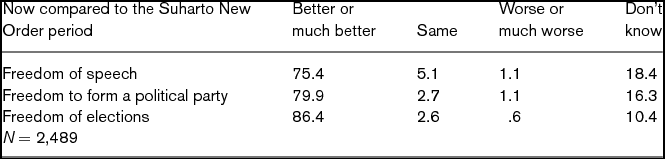
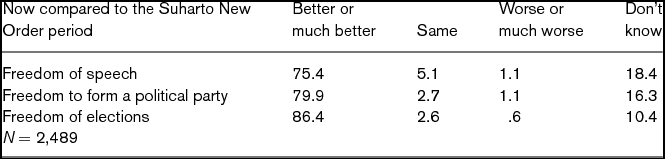
Table 1 shows that the majority of the public judged freedom of expression, freedom to join political parties, and the free and fair quality of the election itself as better or much better after reformasi, reform, the term used in Indonesia to refer to the transition to democracy, compared to the previous authoritarian regime. This feeling of greater freedom compared to the New Order was felt by nearly the whole citizenry, that is, it was close to a consensus. In other words, perceptions of greater freedom were not only expressed among the higher educated and political elites.
Freedom at the beginning of reformasi compared with the Suharto New Order period, 1999 (%)
Source: Authors’ 1999 survey.
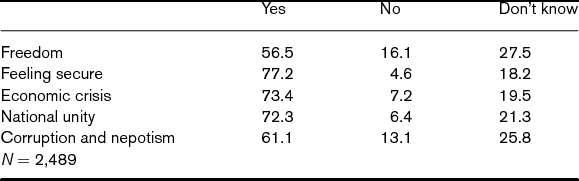
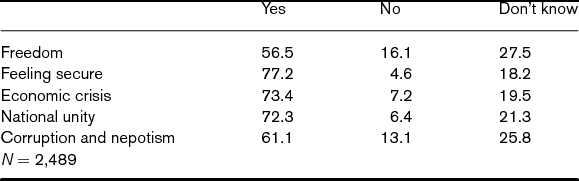
To make more meaningful whether this comparison is relevant or not we also asked respondents how concerned they were with the provision of freedom of speech, and also other problems faced by Indonesians at that time (Table 2).
Are you concerned with the problem of ... in our country? 1999 (%)
Source: Authors’ 1999 survey.
In general, citizens were concerned with freedom of speech. Nonetheless, the results in Table 2 show that more citizens in 1999 were concerned with the problem of personal security, followed by the economic crisis and national unity. This hierarchy of concerns was valid in the context of the time. In 1999, when the survey was conducted, Indonesia had just experienced serious rioting leading up to the fall of the New Order regime in May 1998. Many thought that Indonesia would collapse because of the 1997–8 economic crisis that was followed with regime collapse and mass rioting and turmoil. For this reason, security concerns, the economic crisis, and national unity received more attention than concerns about democratic progress.
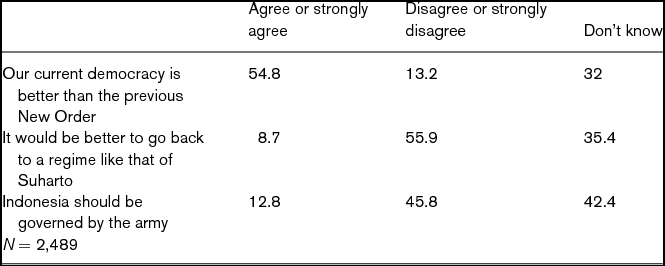
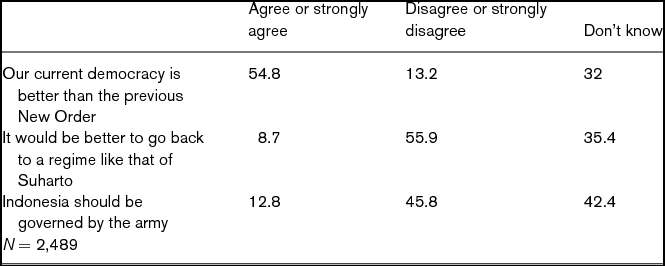
Even though Indonesians had a number of significant concerns about economic and political security, Table 3 shows that in general citizens: agreed with the claim that the democratic regime was better than the previous authoritarian New Order; disagreed that the army should govern the country; and also did not agree that Indonesia should return to the Suharto authoritarian regime. All of this indicated that citizens desired and supported political change even in the face of political and economic uncertainty. Throughout this period of instability, post-reformasi, Indonesians did not feel that a return of the New Order, the army-backed regime, while responsible for more than 30 years of political stability and also for almost three decades of economic growth, would be preferable to democracy.
Support for democratic government today relative to previous non-democratic governments, 1999 (%)
Source: Authors’ 1999 survey.
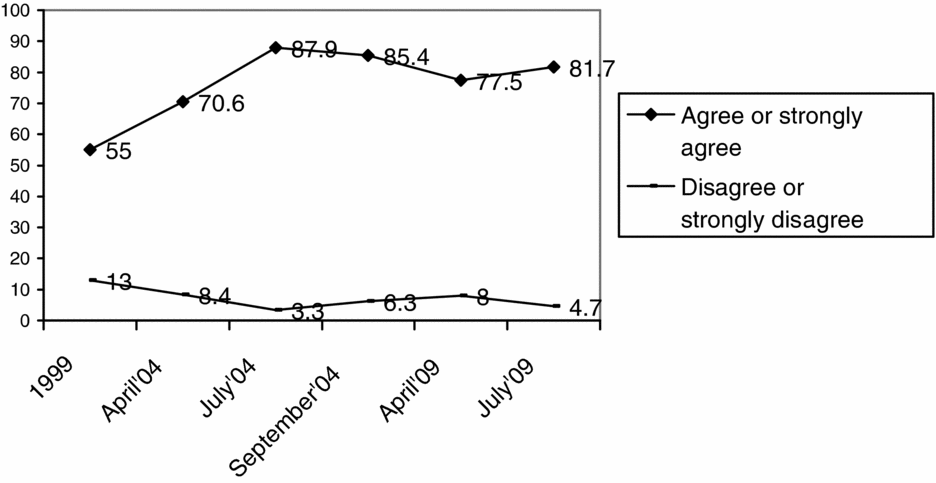
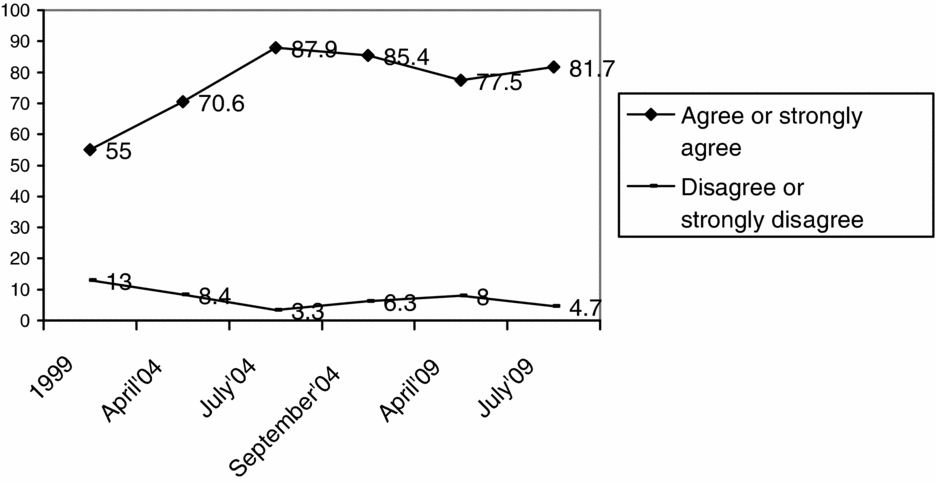
Support for democracy as the best form of government compared with other regime types in the 1999 post-election survey was about 55%. Five years later this preference increased to about 71% in April 2004, 88% in July 2004, and 85% in September 2004. Support for democracy in April 2009 was 78% and in July 2009 82%. In other words, citizen support for democracy had increased since democracy was readopted in 1999, almost half a century after its initial adoption in the early 1950s (see Figure 1).
Democracy is the best form of government for Indonesia, 1999–2009 (%)
Source: Authors’ surveys, 1999, 2004, 2009.
Democratic satisfaction
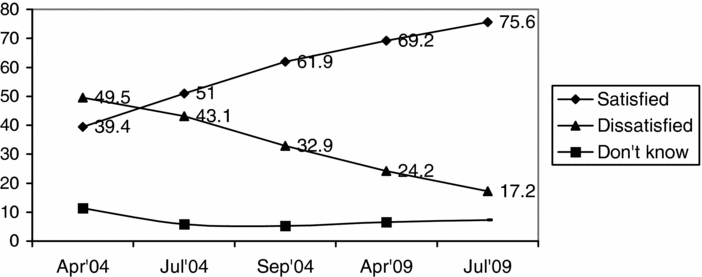
In the later surveys, democratic performance was measured by public assessments of the level of satisfaction with how democracy was implemented throughout Indonesia (satisfaction with the way democracy works in Indonesia).Footnote 6Figure 2 shows that in the earlier period, citizens were in general dissatisfied or less than satisfied with democracy in Indonesia. Subsequently, there was a growing tendency for very satisfied or fairly satisfied responses. This latter tendency is consistent with Freedom House ratings, but differs from qualitative assessments made by some Indonesianists and Indonesian critical citizens who argue that the quality of democratic performance has not increased (e.g., Samadhi and Warouw, Reference Samadhi and Warouw2009; Aspinall and Mietzner, Reference Aspinall and Mietzner2010; Hadiz, Reference Hadiz,Vedi2010; Winters, Reference Winters2011).
Satisfied or not satisfied with the implementation of democracy in Indonesia, 2004–2009 (%)
Note: For exact question wording see Footnote 1.
Source: Authors’ surveys, 2004 and 2009.

In April 2004, only 39% of citizens said that they were very or fairly satisfied with how democracy worked in Indonesia. However, after the 2004 presidential election the level of satisfaction increased, and again after the parliamentary election of April 2009 (69%) and the presidential election of 2009 (77%). Therefore, evaluations of democratic performance in this period became more positive, at least if popular satisfaction with the way democracy works in Indonesia is used as the indicator of Indonesian democratic performance.
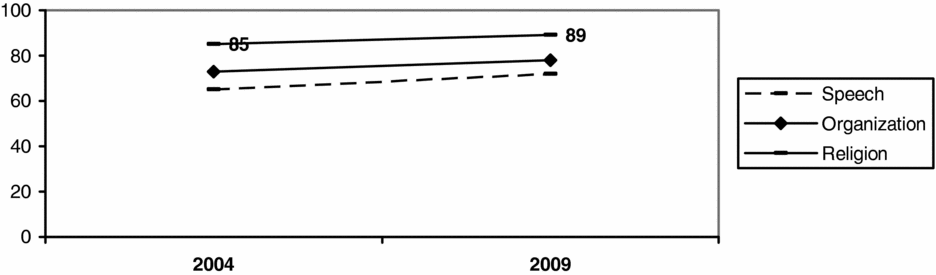
Democratic performance can also be seen in the public's assessments of freedom. In the post-election survey of April 2004, citizens were asked how often they felt afraid to talk about politics, to participate in organizations or assemble, and to practice the religion to which they adhere.Footnote 7Figure 3 shows that in 2004–09, between 84% and 89% of citizens felt that they had enough freedom to talk about politics, join an organization, or practice their religion.
Assessments of various freedoms, 2004–2009 (% rarely and never afraid)
Source: Authors’ surveys, 2004 and 2009.
Concerning freedom of religion, an observer might well argue that the public is less critical than it should be. Observers and religious freedom activists still see many hurdles to successful implementation of the principle of freedom of religion in Indonesia. Minorities, both Muslim and non-Muslim, are frequently prevented from exercising their religious rights by members of other groups who take the law into their own hands. Ahmadiyah Muslims are treated violently by other Muslims. Members of the Indonesian Ahmadi community have even been murdered, something that has frequently happened in Pakistan, but is a new, post-Suharto, phenomenon in Indonesia. For whatever reason, the democratically elected Indonesian government often fails to act to protect some of its citizens’ most fundamental rights.
Elections
Democracy defined as political freedom characterizes both parliamentary and presidential elections. How honest and just (jujur and adil, frequently shortened and combined in Indonesian as jurdil) has been the conduct of these elections?
In a national survey conducted just after the 1999 parliamentary election, Indonesians evaluated the level of honesty and justice. A very high 86.4% viewed the 1999 election as more honest and just than the previous New Order elections, as we saw in Table 1 above. In subsequent surveys, a high proportion of respondents also judged the parliamentary and presidential elections in which they had participated to have been conducted in a very or sufficiently democratic way.
Notably, there were differential evaluations of the democratic quality of the parliamentary and presidential elections both in 2004 and in 2009. A larger number of people tended to believe that the implementation of the presidential election was more democratic than those who believed that the implementation of the parliamentary election was democratic (see Figure 4).Footnote 8 Readers will recall from the introduction that the parliamentary elections were conducted in April 1999, April 2004, and April 2009, while the presidential elections were held in July 2004, September 2004, and July 2009. Nonetheless, a majority of citizens concluded that both the parliamentary and presidential elections were conducted in a very democratic or sufficiently democratic way. Of course these results do not imply that the elections were problem free, only that most Indonesians saw them as democratic.
Was the most recent general or presidential election democratic or not? 1999–2009 (%)
Sources: Authors’ surveys, 1999, 2004, 2009.
Most Indonesians have felt satisfied with the implementation of democracy in their country from the beginning of reformasi. This level of satisfaction increased in 2004–09. If the level of satisfaction with the implementation of democracy may be taken as an indicator of democratic performance in general, we may consider that citizens are becoming more satisfied with democratic performance.
More specifically, citizens also rated freedom after reformasi in 1998 as much greater compared to the authoritarian New Order. In general, citizens understood that Indonesians are less afraid to talk about politics, join organizations, and worship according to the religion of their choice than in the previous New Order period.
In addition, citizens believe that the implementation of recent parliamentary and presidential elections had been conducted in an honest and just way. To be sure, this does not mean that the process has been entirely smooth or trouble-free. Indeed, we know from newspaper accounts that several politicians who have lost elections have accused the winners of stuffing the ballot box or falsifying the counting. Most of these charges, however, appear to have little substance.
Government performance
What factors have influenced citizens’ assessments of democratic performance? As pointed out at the beginning of this article, assessments of government performance are believed to constitute an important factor influencing assessments of democratic performance (Clarke et al., Reference Clarke, Dutt and Kornberg1993; Mishler and Rose, Reference Mishler and Rose1997; Bratton et al., 2004). If government performance is considered successful, citizens tend also to evaluate democratic performance positively. Citizens feel satisfied with democratic performance, with their positive evaluations of the condition of freedom, and with the implementation of elections, if they also value positively the condition of the economy.
Government performance is operationalized as citizens’ assessments of the general condition of the national economy and polity. These post-election assessments vary, but in general the trend has been toward more positive evaluations.Footnote 9 Indeed, both political and economic condition evaluations reveal a rising curve.
This finding is consistent with various macro-economic indicators, especially inflation, the level of unemployment, and the level of poverty. In 1999, economic growth was only 0.8%, after plunging the previous year to minus 13% as a result of the 1997–98 monetary crisis. Inflation in 1998 soared to 77.6%; unemployment rose from 5.46% to 6.36%. The level of poverty – a closely watched statistic from the early Suharto years – jumped from 17.5% in 1996 to 24.2% in 1998 (Figure 5).
Some of Indonesia's economic indicators, 1996–2009
Source: Central Statistical Bureau, Government of Indonesia.
Five years later, in 2004, economic growth was once again relatively healthy (5.7%), but declined in 2009 to 4.3% as a result of the 2008 global economic crisis. Inflation also declined to 6.4% in 2004 and was at 2.7% in 2009. Unemployment in 2004 was 9.8% and in 2009 7.87%. The percentage of poor people in this period also declined, from 16.7% in 2004 to 14.2% (Figure 5).
In the first year after the democratic transition, popular assessments of the quality of government under President Habibie were not negative, a very different pattern from the assessment of economic conditions. Citizens welcomed political change. Pro-democracy euphoria was ubiquitous and almost palpable. President Habibie successfully managed the first democratic election in 44 years, according to many analysts and observers, both domestic and foreign (Liddle, Reference Liddle and Reynolds2002).
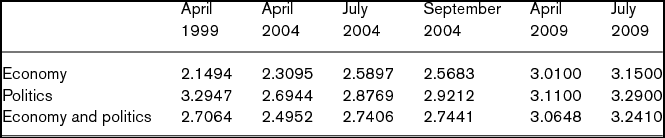
During Megawati's presidency, evaluations of the national political condition experienced a slight decline, but increased again at the outset of President Yudhoyono's second term in 2009. Despite these nuances, in general, during the ten years after democratization, citizens had positive assessments of the state of politics and the economy (see Table 4).
Citizens’ assessment of the national political and economic condition, 1999–2009 (mean scores: 1 = very bad, 5 = very good)
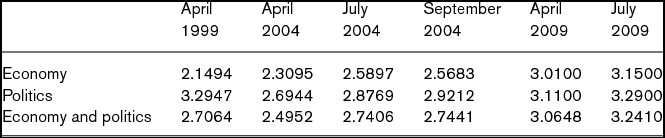
Source: Authors’ surveys, 1999, 2004, 2009.
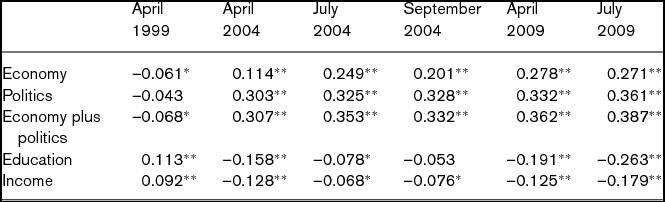
In general, throughout the reformasi period, assessments of government performance correlate positively and significantly with assessments of democratic performance in Indonesia (see Table 5 below). The 1999 survey, however, shows a different pattern that must be examined in a more specific context.
Correlations of democratic performance, government performance, education, and income, 1999–2009 (Pearson's r)
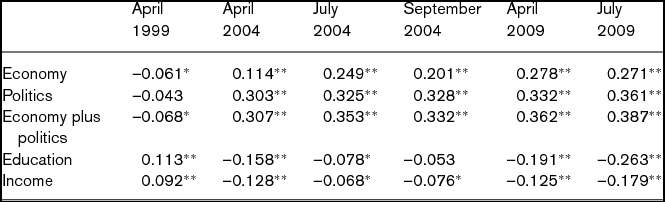
Notes: **P < 0.01, and *P < 0.05.
Remembering the caveat that we cannot directly compare the 1999 findings with more recent surveys because of measurement instrument differences, the correlation between government performance and democratic performance in 1999 was negative but weak. Citizens who evaluated negatively the economic condition at that time as compared to the Suharto era tended to evaluate democratic performance positively. Conversely, citizens who evaluated the economic condition at that time as better than the Suharto period tended to pronounce democratic performance as negative.
This pattern is not surprising. Almost all citizens perceived the economic condition at the beginning of reformasi to be worse, as indeed it was, than the Suharto period. In 1998, economic growth was a negative 13.1%, and inflation an astronomical 78%. In 1999, economic growth was still exceedingly low though positive at 0.8% and inflation was also low, mainly because of declining consumer purchasing power (Figure 5). Nonetheless, citizens who felt that the national economic condition was poor preferred democracy to Suharto's authoritarianism, and perceived that the condition of political freedom or democracy in 1999 was better than during Suharto's rule.
Consistent with that analysis are evaluations of the political condition under President Habibie. Many citizens, who rated the condition of freedom at that time as better than during the Suharto years, rated the performance of the Habibie government as less satisfactory. Recall that Habibie had been a senior and highly visible figure in the Suharto government, and that anti-Suharto sentiment in 1999 was extremely strong. So it certainly makes sense that assessments of the performance of the Habibie government and of the condition of freedom do not correlate significantly.
Evaluations of the condition of freedom in 1999 compared with the Suharto government also correlate positively and significantly with education and income. This also demonstrates that at the time of the democratic transition, citizens who had a higher level of education and income tended to assess the condition of freedom in 1999 as better than the Suharto period, even though the economic condition at that time was worse than during most of the Suharto years.
Further surveys (since April 2004) show a markedly different pattern, where government performance (i.e., economic and political condition) is positively and significantly related to democratic performance. Citizens who evaluate positively the national economic and political condition tend also to evaluate positively democratic performance, as we see in many studies of democracies worldwide.
Government performance, that is the political and economic condition, is important for democratic performance from the public's perspective. A positively valued political and economic condition will strengthen citizens’ judgments about democratic performance, whether that performance has so far been positive or negative. Positive judgments will strengthen the perception of legitimacy that democracy can be maintained in a complex country like Indonesia. Support for democracy becomes strong not only normatively or as an ideal but also as a practical matter if government performance is also evaluated positively. In consequence, democracy as a practical matter is strengthened as well.
Critical citizens
The relationship between government performance and democratic performance differs from the relationship between socio-economic factors and democratic performance. If the first tends to be positive, the second tends to be negative. It is this second pattern that represents the critical citizen pattern as described above.
Table 5 displays a pattern confirming the existence of critical citizens. Citizens with better education or higher incomes, who are relatively free from fears related to personal security or material survival, tend to evaluate negatively democratic performance in Indonesia up to the present. The proposition that citizens with a better socio-economic background tend to be more critical of democratic performance finds empirical confirmation here.
Citizens in better socio-economic circumstances, relatively free from threats to personal security and physical survival, are no longer as concerned with political order or formal legal governmental authority. They are more open to threats to the realization of post-materialist values, such as freedom and equality. In politics, these values can only be accommodated in a democracy, at least normatively. For that reason, citizens who are more concerned with those values tend to be critical about their realization in daily life, how democracy creates those values as a practical matter. In any society, there is of course a gap between the values as ideals and in daily practice (Norris, Reference Norris2011).
Does the significant and consistent correlation between government performance and democratic performance remain after weighing demographic factors such as education, income, rural versus urban residence, age, ethnicity, and religion?
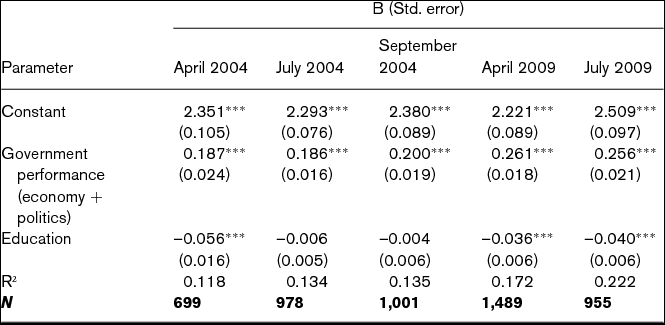
The multivariate analysis below demonstrates that the correlation remains significant and consistentFootnote 10 (see Table 6). Indonesian citizens who evaluate positively government performance – the national economic and political condition – tend also to evaluate positively democratic performance. This includes men and women, older and younger people, those who live in cities and villages, ethnic Javanese and others, Muslims, Christians, Hindus, and Buddhists. Moreover, the effect of government performance on democratic performance at the level of the individual citizen is still significant and consistent whatever the educational background or income level.Footnote 11
Regression analysis: effect of government performance and education on democratic performance, 2004–2009
Notes: Effect of government performance and education on democratic performance controlling for gender (male = 1, female = 0), age, rural–urban cleavages (urban = 1, rural = 0), ethnicity (Javanese = 1, otherwise = 0), and religion (Islam = 1, otherwise = 0).
***P < 0.001, **P < 0.01, *P < 0.05.
Put differently, democratic performance in Indonesia from the public's perspective is highly dependent on government performance in the economy and polity in general. If the economic condition, including economic growth, employment opportunities, level of unemployment, and inflation, and the political condition, including security, public order, and the administration of justice, are evaluated positively by the citizen, that citizen will also evaluate positively democratic performance. However, the reverse seems to be true among those with higher socio-economic backgrounds.
The negative effect on democratic performance of education, as one of the important variables shaping the critical citizen, however, is less consistent after weighing government performance and demographic factors. Nonetheless, it is clear enough that level of education has a negative influence on citizens’ evaluations of democratic performance, apart from economic and political and demographic factors. The higher the level of a citizen's education, the more negative his or her evaluation of democratic performance, and vice versa.
As stated above, this pattern means that more educated citizens, who also tend to be citizens with better jobs and higher incomes, tend to have higher expectations of democratic performance. For this reason, they tend to be critical of the way in which democracy is conducted. They are critical citizens who tend not to be easily satisfied with what has been achieved in the implementation of democracy.
Conclusion: critical citizens and further democratic reform
At the outset of the transition from authoritarianism to democracy, in 1998–1999, Indonesian citizens rated a range of political freedoms, including freedom of speech, association, and organization, and also freedom to worship, as greater than they had experienced during the New Order regime. Citizens also ranked the 1999 election as freer and fairer than New Order elections.
Greater freedom and freer elections in 1999 were meaningful to the Indonesian people because they considered those freedoms important, that is, they believed that democracy is the best system for Indonesia compared to all others available. They positively valued freedom and democracy even though democracy was implemented on the foundations of an economy severely weakened by the seismic shock of monetary and fiscal crisis in 1997–1998. However, the economic difficulties faced by citizens did not make them long for a return to the New Order, even though that regime had been politically stable and economically successful for decades. Nor did they turn to the army to restore order and the previous rate of economic growth.
At the dawn of democracy in 1999, most people believed that the condition of the economy was worse than it had been during the last several years before Suharto fell. This view was especially strong among those who were also supporters of democracy. It is no doubt anomalous that a commitment to democracy could be built on a brittle economic foundation. But this attitude and accompanying behavior are perhaps the unique product of a moment of political transition. Perhaps Indonesians had come to believe that economic prosperity and political stability cannot continue forever if freedom is neglected as was the practice of the New Order for more than 30 years. Put differently, perhaps enough citizens dared to place a large bet on democracy, to speculate on a system that they knew would be full of uncertainty.
After the 1999 election, the economy gradually recovered and a normal democratic political process began to take shape. Horizontal conflicts based on religious and ethnic solidarities that had consumed thousands of victims in Maluku and Poso, for example, were slowly overcome. Even the decades-long separatist movement in Aceh was soon resolved. At the same time, citizens’ appreciation for the condition of the economy and polity, at least until after the 2009 presidential election, was more and more positive. It was this appreciation that gave birth as well to positive attitudes toward democratic performance.
Citizens in general feel satisfied with the way in which democracy is conducted in Indonesia. The number of citizens who share this positive evaluation has tended to increase together with the increase in citizens who have a high regard for the condition of the Indonesian polity and economy as currently perceived. Most citizens also rate Indonesia as sufficiently democratic. They believe that most citizens have freedom. Every parliamentary and presidential election that has been held in the 1999–2009 period has been regarded as sufficiently democratic.
Citizens’ evaluations that are reasonably positive, and becoming more positive over time, toward Indonesian democratic performance are consistent with the judgments of Freedom House experts, who also point to a trend of strengthening freedom in Indonesia. Indonesia has become the freest country in Southeast Asia.
At the same time, we have witnessed the birth of a significant number of critical citizens, as defined previously by Norris: Indonesians with higher levels of education and income who tend to be more skeptical of the quality of democratic performance. This discovery replicates the findings of other scholars for many contemporary democracies (Norris, Reference Norris1999, Reference Norris2011). In Indonesia, it is perhaps this group of critical citizens who constitute the link with, or the empirical evidence for, the existence of the Jakarta elites and other political observers who denigrate or are dismissive of Indonesia's democratic achievements. Hopefully, they are balanced by a sufficient number of other citizens who, while critical, are also prepared to act in a positive way to improve the quality of Indonesian democracy.
Returning to our main argument, because the effect of government performance on democratic performance is so significant and consistent, evaluations of Indonesian democratic performance will in the future be highly dependent on government performance, on perceptions of the condition of the economy and the polity, including security, order, and law enforcement. To be sure, our results have shown that Indonesians are willing to put up with some economic instability in the short term in their hope for a better future. In the long term, however, if the economic and political condition does not continuously improve, the legitimacy of democracy as a political practice will almost certainly weaken.
In Southeast Asia, one frequently hears voices idealizing Singapore and Malaysia as countries that are successful because of their ostensibly greater governability; they are ranked higher in governability than Indonesia by some analysts even though that higher level of governability comes at the price of democracy or freedom. Among Indonesian citizens, this idealization of the neighboring countries may well become more widely shared if good governance, that is, creating a government that is clean, stable, and efficient, is not enhanced in the relatively near future.
Indonesia could certainly become more like Thailand, whose democracy has long been unstable, or the Philippines which has not made much progress in democratic performance since returning to democratic institutions more than two decades ago. Alternatively, Indonesia might improve its overall government performance, following the trajectory of stable and successful Asian democracies such as Japan, Korea, and Taiwan.
The choice is in the hands of Indonesians themselves, both the political elites and the voters who put them into and remove them from office. Voters can demand and politicians can offer clean, efficient, and stable government during and between elections. On our evidence, it is the critical citizens, perhaps both among the voters and the candidates for office, who are the best prepared and motivated to push Indonesia to a higher level of democratic achievement.
About the authors
Saiful Mujani is associate professor of political science at Universitas Islam Negeri in Jakarta, Indonesia. The founder of Lembaga Survei Indonesia (LSI, Indonesian Survey Institute) and owner of Saiful Mujani Research and Consulting (SMRC), Dr Mujani's areas of interest are political behavior, democratization, and religion and politics. He was awarded the Burdette Phi Sigma Alpha prize for the best paper at the Annual Conference of the American Political Science Association. Dr Mujani's works in academic journals include the American Journal of Political Science, Comparative Political Studies, Journal of Democracy, and Asian Survey. He is currently conducting research on the Indonesian voter.
R. William Liddle is professor emeritus of political science at Ohio State University and affiliate of the Mershon Center at Ohio State. A student of Southeast Asian and Indonesian politics for more than half a century, his current research interests include political leadership and electoral behavior in the region. He is completing a book on the Indonesian voter and conducting a comparative analysis of the performance of recent democratic presidents. Professor Liddle has received research grants from the National Science Foundation, the Smith-Richardson Foundation, and the Mershon Center. He has served as chair of the Indonesia Studies Committee and the Southeast Asia Research Council of the Association for Asian Studies.