In Latin America, more than two decades after Argentina became the first country in the world to pass a gender quota law, and following the enactment of similar legislation in another 11 countries, the positive impact of such measures is undeniable: countries with quota laws have on average increased their representation of women in parliament by 13.5 per cent.Footnote 1 However, these laws have not had a positive effect in all the countries where they have been adopted.Footnote 2 This is because their effectiveness depends both on how the law is formulated and on the characteristics of the electoral system within which the quota is applied (see Dahlerup Reference Dahlerup2006; Franceschet et al. Reference Franceschet, Krook and Piscopo2012; Krook Reference Krook2009). Even in those countries where quotas have had a positive effect in numerical terms, they do not appear to have generated the more profound transformation promised by their formulation as temporary measures. As Franceschet (Reference Franceschet2008: 62) argues, ‘in order for quota requirements to be of a temporary nature, it must be assumed that as more women enter politics, their power in political parties will also increase, so that, when quotas are abandoned, they can compete on an equal footing for candidacies’ (compare Marx et al. Reference Marx, Caminotti and Borner2008: 113). In short, it is far from clear whether quotas have produced the modifications in the gender regimes which inform internal party power structures and dynamics that would allow women to participate – as aspirants or selectors – on an equal footing with their male counterparts in the processes of candidate selection.
The starting point for this article, then, is the need to subject to an in-depth analysis the processes of legislative recruitment and candidate selection used by Latin American political parties in countries both with and without quotas. Specifically, it seeks to identify critical nodes where the interplay between the different institutions of candidate selection intersects with gendered power relations to facilitate or hinder not only women’s access to elective posts, but the terms of their access. This article does this by presenting the findings from my qualitative case study research on candidate selection in Uruguay and situating them within the existing body of studies of gender and legislative recruitment in Latin America.
So far there have been few gender analyses of candidate selection in the region (for exceptions see Borner et al. Reference Borner, Marx, Caminotti and Rodríguez Gustá2009; Escobar-Lemmon and Taylor-Robinson Reference Escobar-Lemmon and Taylor-Robinson2008; Hinojosa Reference Hinojosa2012; Roza Reference Roza2010). Other studies address women’s political representation or the impact of quotas more generally, but provide relevant data and reflections for the discussion of candidate selection procedures in the region (see, for example, Archenti et al. Reference Archenti, Tula and Albaine2009; Archenti and Tula Reference Archenti and Tula2007, Reference Archenti and Tula2008; Jones Reference Jones2010; Piscopo Reference Piscopo2006). By discussing the results of my own research in Uruguay in the light of these other findings I hope to broaden understanding of how candidate selection is gendered in Latin America by highlighting common causal mechanisms – of power, of continuity and change – that operate in different countries and institutional contexts (cf. Mackay et al. Reference Mackay, Kenny and Chappell2010). In particular, the discussion explores the interaction between different formal and informal institutions operating at normative, systemic and practical levels (Krook Reference Krook2010). The ‘secret garden’ (Gallagher and Marsh Reference Gallagher and Marsh1988) nature of candidate selection requires researchers to look beyond the formal rules laid out in party statutes and identify those informal practices whereby actual nomination takes place (see Bjarnegård and Kenny Reference Bjarnegård and Kenny2016, in this issue).
The article is organized as follows. The first section presents my conceptual and analytical framework for the study, which draws both on Joni Lovenduski and Pippa Norris’s original ‘supply and demand’ model of legislative recruitment and on recent theoretical developments in feminist institutionalism. In the second section of the article I describe the Uruguayan case, providing information about the party and electoral systems and the recently introduced quota law, as well as specifying the scope of my qualitative research into candidate selection processes. In the third section I examine the formal systemic and informal practical institutions underpinning the ‘male power monopolies’ (Hinojosa Reference Hinojosa2012) that control candidate selection in many cases, as well as the discursive configuration of their hegemony. The fourth section explores how those male monopolies’ discursive strategies, exploitation of systemic loopholes and use of certain informal practices of candidate selection restrict the impact of the quota law. Finally, in the conclusions I reflect on the implications of my findings for advancing women’s political representation in Uruguay and for understanding the gendered causal mechanisms operating within candidate selection processes in the region, as well as signalling possible directions for future research.
A FEMINIST INSTITUTIONALIST APPROACH TO STUDYING CANDIDATE SELECTION
The empirical research was undertaken from a feminist institutionalist perspective, centred on analysis of what Lovenduski and Norris refer to as the ‘demand-side’ factors of the legislative recruitment process; that is, those associated with the filters – both procedural and attitudinal – that operate within parties, in particular, the role of party gatekeepers (Lovenduski and Norris Reference Lovenduski and Norris1993; Norris Reference Norris1997; Norris and Lovenduski Reference Norris and Lovenduski1995). In order to understand women’s continued marginalization from elective posts, it is necessary to explore the strategies used by party gatekeepers which enable them to maintain male hegemony even in the face of changes to the formal rules governing candidate nomination, such as the introduction of quotas. Recent theoretical developments within feminist institutionalism (Kenny Reference Kenny2014; Krook and Mackay Reference Krook and Mackay2011a; Mackay et al. Reference Mackay, Kenny and Chappell2010) provide useful analytical frameworks for exploring the relevance and interaction between three types of formal and informal institutions – systemic, practical and normative (Krook Reference Krook2010) – and how they are underpinned by discursive strategies (Freidenvall and Krook Reference Freidenvall and Krook2011; Kenny Reference Kenny2013; Schmidt Reference Schmidt2010).
Since the focus of this study is on the nomination stage of candidate selection, it is primarily concerned with practical institutions. These include both the criteria ‘that shape perceptions as to who is a “qualified” or “desirable” candidate’ (Krook Reference Krook2010: 712) and those nomination-stage procedures by which candidates are selected or electoral lists drawn up, including who does the selecting and how. Nevertheless, the development of candidate selection practices are also shaped by systemic institutions, such as the type of electoral system and candidate lists, or district and party magnitudes, which create specific incentives or restrictions. Normative institutions, for their part, are the principles that ‘shape beliefs about “equality” and “representation” in the context of candidate selection’ (Krook Reference Krook2010: 712) and are often disputed concepts open to different interpretations.
I will also argue the relevance of discursive practices that serve to legitimize informal procedures and criteria and limit the potential scope and impact of mechanisms, such as the quota, designed to produce formal institutional change. Following Freidenvall and Krook (Reference Freidenvall and Krook2011: 49), I seek to identify ‘the ways in which power operates through discourse to fix certain constructions of gender relations as dominant and to marginalize or exclude counter-discourses’. While I do not regard discourses as institutions per se, it is clear that they are crucial both as the primary means by which normative disputes that emerge at junctures of institutional change unravel, and as means for communicating and validating practical institutions.
Finally, in observing the potential for change generated by formal institutional reform, such as the adoption of legal quotas, it should be borne in mind that ‘formal rules may change overnight as the result of political or judicial decisions, [but] informal constraints embodied in customs, traditions, and codes of conduct are much more impervious to deliberate policies’ (North Reference North1990: 6). This leads in practice to the phenomenon of institutional ‘layering’, which means that even when new normative criteria and practical rules are formally introduced, ‘some elements of existing institutions are renegotiated but other elements remain’ (Krook and Mackay Reference Krook and Mackay2011b: 13), often ‘leaving power relationships intact’ (Leach and Lowndes Reference Leach and Lowndes2007: 186).
CASE SELECTION AND METHODS
Uruguay provides an interesting case for exploring the gendered effects of candidate selection since it has very stable electoral and party systems and in the 2014 parliamentary elections applied a legal gender quota for the first time. Since the return to democracy in 1984 following an 11-year civil-military dictatorship, Uruguayan politics has been dominated by three political parties. The two ‘traditional’ parties founded in the nineteenth century, namely the liberal Colorado Party (Partido Colorado – PC), which won three of the six post-dictatorship presidential elections, and the conservative National Party (Partido Nacional – PN), which has triumphed only once since the return to democracy. The third party is the left-wing Broad Front (Frente Amplio – FA) coalition founded in 1971, which came to power for the first time in 2004. The Broad Front retained control over national government in the two subsequent elections (2009 and 2014), with a small parliamentary majority in all three periods. One significant feature of the party system is that these parties are made up of internal factions (called ‘sectors’, ‘groups’ or even ‘parties’) that have their own internal structures and operative rules, which vary significantly even within parties.
Simultaneous presidential and parliamentary elections are held in Uruguay every five years, with all seats in both the lower and upper houses being contested. The Senate is elected in a single 30-seat national-level constituency, while members of the Chamber of Representatives are elected in 19 multi-member departmental districts, which vary in magnitude from 2 to 41 seats. The electoral reform of 1996 established that four months prior to national elections, constitutionally regulated internal elections be held simultaneously to define political parties’ presidential candidates and elect members to parties’ national and departmental conventions. In all elections a proportional representation system is used, with closed and blocked electoral lists, which are not party lists, but rather faction lists, meaning that electors cast a ‘double simultaneous vote’, opting at the same time for both the party and, within it, the faction they choose to support. It is, therefore, at the faction level that candidate selection takes place. A final relevant feature of the ballot structure is that ballot papers present lists of ‘titulares’, or principal seat-holders, and up to three ‘suplentes’, deputy candidates who replace the principal on a temporary (during illness, holidays or official missions) or permanent (on death or resignation) basis.
In 2009, 21 years after the first gender quota bill was presented, a law was passed requiring parties to include both women and men among every three consecutive positions on their candidate lists and establishing that lists that do not comply will not be registered by the electoral authorities (see Johnson and Pérez Reference Johnson and Pérez2011). This quota is applicable as a permanent measure for the five-yearly internal elections to party conventions and all other elections to party decision-making bodies. However, at parliamentary level the law only provides for a one-off application in 2014. Figure 1 shows the evolution of women’s representation in parliament over the post-dictatorship period (1985–2015). Despite the fact that the Uruguayan electoral system has features that the comparative literature identifies as favouring women’s access – namely proportional representation, multi-member districts and closed lists – in the pre-quota period women’s presence in parliament stood below 15 per cent, and even the 2014 elections with quota application produced only a small rise (see Figure 1). Overall, women’s representation rose from 14.6 to 20 per cent, albeit with a considerably greater impact in the Senate than in the Chamber of Representatives.
Women’s Parliamentary Representation in Uruguay, 1985–2015 Source: Own elaboration based on data from the Uruguayan Parliament.

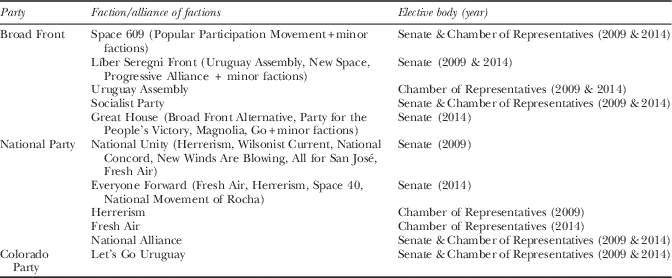
This article draws on research carried out in 2009 and 2014 which explored the impact that diverse types of selection processes had on women’s access to electable candidacies to the Senate and the Chamber of Representatives in the main factions of the three largest Uruguayan parties, as listed in Table 1. The findings presented here, based on in-depth interviews with male and female politicians, and analysis of electoral data, candidate lists, faction documents, and press coverage of the electoral campaign, focus on the gender-biased effects of the different institutions of candidate selection, which operate to keep men in while shutting women out. With the application in 2014 of the quota law it is also possible to evaluate the extent to which this formal reform of the normative and systemic institutions of legislative recruitment actually changed the practical institutions of candidate selection on the ground.
Party Factions or Alliances of Factions Studied
Note: Unit of analysis is the faction or alliance of factions that share a single electoral list. Some factions present their own lists to the Chamber of Representatives but a consensus list with allied factions to the Senate.
Source: Information from faction lists and interviews with faction leaders and women candidates in 2009–10 and 2014.
The Uruguayan case provides rich material for exploring how the interplay between the three types of institutions identified in Krook’s model mediates women’s nomination as candidates. The structure of the party system, with candidate selection taking place at faction level, allows cross-party and also within-party comparisons, illustrating how not only a similar systemic context, in terms of electoral rules, but even a common ideological framework at party level may not necessarily spawn similar formal and informal practices in candidate nomination processes at faction level.
THE INSTITUTIONS AND DISCOURSES UNDERPINNING MALE POWER MONOPOLIES IN CANDIDATE SELECTION
The implicit normative claim underpinning the practices that seek to restrict women’s access to and influence in sites of political power is that men are ‘natural’ political actors and by extension the unquestioned ‘owners’ of the seats, whereas women are regarded as alien interlopers who have to prove their worth, and whose access is mediated by male gatekeepers. In Uruguay, as in other countries of Latin America, this male-biased normative claim is both grounded in the systemic and practical institutions of candidate selection and configured discursively.
The majority of Uruguayan party factions do not have formal rules governing candidate selection processes, and the dominant model is what Norris and Lovenduski (Reference Norris and Lovenduski1995) call ‘recruitment by patronage’. This model is based on ‘criteria of acceptability . . . on informal, implicit and “subjective” judgements . . . the key question by these criteria is whether the aspirant is “one of us”’ (Norris and Lovenduski Reference Norris and Lovenduski1995: 238, original emphasis). In its most informal version the faction leader acts as gatekeeper, perhaps accompanied by close associates, while a more formal version involves selection by the faction’s highest executive organ, which in the Uruguayan case is in general exclusively or predominantly male. Given that women are virtually absent from the inner circles of party power, their visibility as potential candidates is reduced, since they are clearly not ‘one of us’. Therefore, in most Uruguayan parties ‘male power monopolies’, operating at both national and subnational levels, closely control both the procedures and results of candidate selection, as has been found in other countries in the region (see Borner et al. Reference Borner, Marx, Caminotti and Rodríguez Gustá2009 and Jones Reference Jones2008 on Argentina; and Hinojosa Reference Hinojosa2012 on Chile and Mexico).
The reproduction of the status quo in the processes of candidate selection is linked to the faction-based architecture of the Uruguayan party system in two ways. First, most factions are informal and highly personalistic groupings clustered around strong leadership figures, and they operate with the support of an elite circle of close associates and clientelistic networks at the subnational level. These structures and the lack of formal channels to dispute leadership positions or candidacies make staying in power fairly straightforward: ‘our criterion is very simple: they are the same [candidates] as last time . . . The criterion is to not make trouble . . . Our leader doesn’t need problems, he needs solutions. And the best way to avoid problems is to maintain everything the way it is.’Footnote 3
The second dimension relates to the fact that many factions are actually coalitions of smaller political groups, while others may forge alliances – and present consensus lists – as a short-term electoral tactic or for long-term strategic reasons. When the time comes to draw up candidate lists, then, the primary criterion is the so-called ‘political quota’, or distribution according to the faction’s or alliance’s internal balance of power, which effectively precludes consideration of any other democratically relevant criteria. Since the leaders of factions and their smaller subgroupings are usually men, it is they who are automatically allocated a place on the list. As one National Party senator stated: ‘It’s a matter of internal checks and balances, that has nothing to do with sex.’Footnote 4 These criteria make up the basic normative, practical and systemic institutions preserving the dominance in Uruguayan parties of male power monopolies which control candidate selection at national and subnational levels.
Hinojosa (Reference Hinojosa2012) identifies the decentralized, exclusive selection practices employed by local male power monopolies as one of the major obstacles to the selection of women candidates in Chile and Mexico. Similarly, in the Uruguayan case, decentralized power monopolies play a central role in the perpetuation of male hegemony in the 17 small districts in the Chamber of Representatives, nine of which have just two seats. Given that legislative competition occurs not only at interparty but also intra-party level, in these small districts the electoral dispute takes the form of a run-off between leading candidates on faction lists. Since most party factions in these districts have male leadership and selectorates, their leading list positions are also generally held by male candidates: 90.7 per cent of winning lists in these districts in 2009 and 88.4 per cent in 2014 were headed by men. Women, therefore, must both self-select and have access to exceptional resources, in the form of either personal or political capital (financial resources, family ties to current or former political leaders, or a clear electoral constituency) in order to break through into this circuit of political power.
In contrast, based on evidence from the selection procedures used by the Chilean Independent Democratic Union (Unión Demócrata Independiente – UDI) in municipal elections, Hinojosa (Reference Hinojosa2012) argues that if selection is centralized, even when it is exclusive, this can benefit women, since it bypasses the need for women to self-select and neutralizes local power monopolies.Footnote 5 However, centralized, exclusive procedures do not favour women’s access in Uruguay. Five of the factions studied in 2009 used centralized, exclusive procedures, controlled by the faction leader or a select group who decided on the procedures to be followed and the final composition of the list. Of these, three (National Unity (Unidad Nacional), National Alliance (Alianza Nacional)-Senate list and Let’s Go Uruguay (Vamos Uruguay)-Senate list), which won between three and five seats, did not elect a single woman. In the other two cases (Líber Seregni Front (Frente Líber Seregni) and Uruguay Assembly (Asamblea Uruguay)) just one woman was elected among their five successful candidates, although in neither case was this female candidate placed in a safe list position, both occupying the last place elected.
There are several plausible explanations for why my research on Uruguay and Hinojosa’s on Chile reach different conclusions regarding the effect of centralized and exclusive selection procedures on women’s election. For a start, there are evident differences of hierarchy in each case: the Chilean Independent Democratic Union was nominating candidates at municipal level, while in the Uruguayan case factions were selecting candidates for parliamentary posts which are higher status and more powerful, and thus more likely to be coveted and defended as a male prerogative. Furthermore, Hinojosa’s description (2012: 106–7) of the procedures used by the Independent Democratic Union suggests a centralized and exclusive but also highly bureaucratized system; in Uruguay, in contrast, nominations are patronage-based, decided by an ‘all-powerful’ figure or elite group, according to subjective and non-explicit criteria.
In addition, differences can be identified with respect to the normative orientation of the recruitment process. In Chile the Independent Democratic Union’s selection procedure was informed by the rationalist goal of maximizing votes in contexts in which the party had not only no incumbents, but not even a strong party base. Therefore a woman candidate who could bring in votes was as valuable and low-risk as a man. In contrast, the Uruguayan party factions were sharing out a limited number of electable candidacies among a group of aspirants in all cases more numerous than their winnable seats, and where the values at stake had as much to do with the payment of political debts, the securing of future party loyalty or the negotiation of complex systems of internal power-sharing as with vote-winning capacity. In this context, choosing a woman candidate meant leaving out a man, which could have costs not measurable in terms of votes.
My analysis from the 2014 Uruguayan elections sheds further light on the question of whether centralized selection processes favour women. In the 2014 elections an alliance of factions emerged in support of Constanza Moreira, the first woman to compete (unsuccessfully) for the Broad Front’s presidential nomination, who subsequently stood for the Senate. Moreira’s campaign speeches and policy proposals included gender parity in representation as a central issue and she strongly urged the groups supporting her in both the internal and parliamentary elections to go beyond the minimum 33 per cent quota required by law, although she did not intervene directly in their selection processes. As a result, the vast majority of lists that backed her (87 per cent) were either zipper lists (lists that alternated male and female candidates) or included more female than male candidates. In other words, it seems more likely that centralized selection processes alone are not enough to account for women-friendly results. Rather, if gender equality champions are present at the highest decision-making levels within parties and either participate directly in or can influence the selection process, women’s chances of being selected will increase. This may particularly prove to be the case when centralized procedures are non-bureaucratic, which should allow for greater margin for agency by such actors.
The lists presented by the factions supporting Moreira belie the discursive claim commonly articulated by male selectors that the lack of female candidates on their lists is due to the fact that there are simply no women to occupy those places. Thus, Senator da Rosa from the National Alliance stated in interview, ‘we did not have many women to alternate in the first places’ on the list to the Senate in 2009, despite at the time having three women MPs, one of whom had occupied legislative and executive posts at departmental and national level since 1990. As a result, the list fielded only two female candidates, in slots 8 and 10, both unelectable positions, which nonetheless da Rosa described as having ‘a certain symbolic importance’.Footnote 6 A similar claim shifts the onus on to the women themselves, because they do not put themselves forward as candidates: ‘one factor that has as much influence as male cliques is self-exclusion by women, in fact, of the two, I’d say that self-exclusion is a much more important factor’.Footnote 7 In contrast, women politicians dismiss these as unfounded excuses when in fact there are plenty of women aspirants: ‘Some colleagues supposedly didn’t have any women to put on their lists. I had to draw up two lists because I had more women than men, so I presented two lists, because I didn’t want to leave any women out.’Footnote 8
The adoption of apparently ‘neutral’ and ‘objective’ criteria for candidate selection has done little to break male monopolies’ hold on party power. Primaries are becoming an increasingly popular mechanism for candidate selection in Latin America, hailed by party leaders as the most democratic and transparent form of nomination. However, recent research has found that selection by primaries tends to favour male candidates (Baldez Reference Baldez2007; Hinojosa Reference Hinojosa2012; Jones Reference Jones2010; Roza Reference Roza2010). In Uruguay, women candidates face similar constraints in competing in primaries. As a result of their exclusion from top party decision-making bodies and their limited presence in public office, women are less visible as party figures. They also generally have less political capital than men, in terms of access to party apparatus resources, support or direct association with leadership figures. Since none of the factions provides financial backing to aspirants in the internal elections, unless candidates have private sources of income, they must fundraise. However, as one ex-MP from the National Party pointed out, many of the policy issues on which women tend to focus – women’s and children’s rights, poverty, violence, among others – ‘are not attractive for potential campaign funders’ (Beatriz Argimón, in La República 2009).
Since 2004 the order of candidates on the National Alliance’s list to the Chamber of Representatives in Montevideo has been determined by aspirants’ performances in the June internal elections, with aspirants allowed to present multiple lists in order to accumulate votes and places on the list being allocated by proportional representation. In 2009 two women MPs from the National Alliance questioned whether this was the fairest system, given aspirants’ differential access to political and economic capital. The National Alliance’s national leader, Jorge Larrañaga, answered that it was based on ‘the principle of democracy’ (Ultimas Noticias 2009), while the most-voted aspirant in Montevideo, Jorge Gandini, declared that: ‘Lists are not drawn up according to gender, but according to representativeness. Drawing up a list is a complicated matter . . . It must be done according some kind of criterion, and if it is not related to vote-winning capacity it is very subjective and arbitrary; using the voting record of aspirants is always more objective.’Footnote 9 By appealing to democracy as the underlying principle of the chosen selection procedure, these male leaders precluded further opposition by implying that any objections would be anti-democratic, rather than opening up a substantive discussion about what could be considered ‘democratic’ or ‘representative’ in the context of candidate selection. Neither of the two women MPs was re-elected.
In contrast, in 2014 the MP Verónica Alonso, who had defected to the National Alliance from another National Party sector in 2013, managed to win the most votes in Montevideo, by applying a dual strategy of building a broad constituency base among socially active religious groups and presenting multiple lists. Confronted by the fact that Alonso had outvoted him, Gandini resorted to publicly questioning her victory. First he claimed that the lists Alonso had headed were not really ‘her’ lists – ‘she is not their leader, her group won very few votes, the votes were won by a great mass of 70-something groups’.Footnote 10 He then went on to question her constituency base, which he claimed ‘had entered politics in an unorthodox fashion’ and that it was necessary to ‘discuss their composition, affiliation and interests’ (quoted in El País 2014). Gandini made these criticisms despite the fact that in 2009 he too had accumulated votes among various lists and, moreover, had ceded the sixth place on the National Alliance’s list to an alliance of groupings with direct links to religious organizations. Thus male resistance to the emergence of a successful female candidate is configured in a discourse that assigns differential value and meaning to the electoral strategies used by men when they are employed by female candidates.
DISCURSIVE AND PRACTICAL LIMITS TO THE IMPACT OF GENDER QUOTAS ON CANDIDATE SELECTION
To what extent do quota laws counteract the de facto control that male power monopolies wield over candidate selection? Studies from Argentina (Archenti et al. Reference Archenti, Tula and Albaine2009; Archenti and Tula Reference Archenti and Tula2007, Reference Archenti and Tula2008; Borner et al. Reference Borner, Marx, Caminotti and Rodríguez Gustá2009; Piscopo Reference Piscopo2006) show that the impact of the quota tends to be restricted to its purely quantitative dimension and it has done little to modify the underlying normative bases of political representation and candidate selection. Argentine faction leaders resort to rhetorical tactics by which the minimum legal list position is discursively reframed as ‘the woman’s place’ or more negatively as the ‘price’ that the weakest faction in any electoral alliance must pay (Borner et al. Reference Borner, Marx, Caminotti and Rodríguez Gustá2009: 37). Therefore, rather than being regarded as a positive mechanism that democratizes party politics, the quota is transformed into an irritating obligation for party ‘bosses’ and a signifier of inferiority for the women who ‘free ride’ on the quota.
As in Argentina, male rhetoric around the quota law in Uruguay has had important symbolic implications for women’s political participation. One faction leader predicted that the application of the quota would be disastrous for the party: ‘The Colorado Party has only three senators – take one away and you destroy the party’, implying that having a woman senator is the same as having no senator, and by extension that women are not capable of representing the party. Another argued: ‘If parties must place women on their electoral lists according to a quota then it is very important that the party or faction may choose which female candidates it wishes to promote. It shouldn’t be the candidates that the women want, but those that the party nominates’ (cited in Garcé Reference Garcé2008). Not only does this affirmation exclude women party members a priori from the selectorate, but it also illustrates how apparently gender-neutral references to the ‘party’ are in fact highly gendered. Male politicians discursively construct women as something ‘other’ than the ‘party’, leaving men by default as the only actors legitimately constituting the ‘party’ and with the unquestioned right to decide who is fit to represent it.
Once parties faced the obligation of applying the quota in their electoral lists to parliament in 2014, the discourse of leading male politicians anticipated the minimalist trend that would later characterize application of the law. In interviews women politicians from all parties mentioned how male gatekeepers would constantly refer to the third place as ‘the woman’s place’, when in fact the formulation of the law is gender neutral (‘every three places on candidate lists should include persons of both sexes’, Art. 2).Footnote 11 These claims were further reinforced by their replication in many media – ‘the law obliges parties to include one woman for every two men on their lists’ or ‘the third place must be held by a woman’ (Gil and Isgleas Reference Gil and Isgleas2014) – and in this way a gender-equitable normative institution was reframed to legitimize gender-biased practices, by interpreting the law’s requirements in minimalist terms.
When male faction leaders came to draw up their lists for those medium or large electoral districts where the quota could in principle have a significant impact, this discursive reframing of the quota translated into exclusionary practices. Table 2 presents data by party of quota application in the first three places on lists to the Senate and the Lower House districts of Montevideo and Canelones in the 2014 parliamentary elections. In all but two cases both the National Party and Colorado Party not only included just one woman – the minimum required by law – but also applied the quota in a minimalist fashion, placing that female candidate in the third place. While the Broad Front performed better, still two-thirds or more of its winning lists included the minimum number of women permitted and at least half placed them in position number three. The only two lists within the Broad Front to go beyond the law’s minimum baseline were the list presented by Moreira’s main faction and the Socialist Party, which has applied a voluntary quota to all its electoral lists since 1992.
Application of the Quota in the First Three Places on Winning Lists in Large and Medium Electoral Districts (percentage of total lists)

Note: Only the first three places are considered. Low faction magnitudes mean that very few lists win more than three seats (only three of the 11 lists to the Senate; three of the 17 lists in Montevideo; one of the seven lists in Canelones).
Source: Own elaboration based on data from the Uruguayan Electoral Court.
Some factions went further, seeking ways to evade the quota while respecting the letter of the law. One practice used by factions was the replication of female candidates on the same list (in a titular and suplente slot) or on different lists (to the Senate and Lower House). This can be seen as a deliberate tactic to avoid ‘paying the cost’ of the quota, which moreover can be seen to be ‘legitimized’ ex ante by the ‘lack of women candidates’ discourse, as discussed above. Fielding repeated candidacies is a fairly common practice in the internal elections, and male national party leaders often figure among the first places on a faction’s lists in the different departments of the country as token candidates whose function is to attract votes to the faction’s local candidates. In 2014 it was extensively used by the largest Broad Front faction, Space 609 (Espacio 609), with all its 19 lists to the Broad Front’s National Convention headed by the senator and wife of then President José Mujica, Lucía Topolansky. In all cases but one her suplente was a man. As a result, while on paper 45.2 per cent of the Space 609’s winning list positions were occupied by female candidates, in practice only 27.4 per cent of the faction’s elected convention members were women.
Other cases which had the effect of reducing the number of women in arenas of greater power were identified in both 2009 and 2014. Following the first quota-regulated elections to the National Party’s 15-strong National Directorate in 2009, one of the five women elected as a titular member resigned her seat in the first session in favour of her faction leader, who had figured on the list in a suplente spot. While this manoeuvre passed virtually unnoticed in Uruguay, a similar case on a much larger scale, dubbed the ‘Juanitas’ scandal, rocked Mexico in the same year (see Piscopo Reference Piscopo2011, Reference Piscopo2016, in this issue), alerting women politicians and gender equality activists to this tactic, used by parties to circumvent quota laws.
In the run-up to the 2014 parliamentary elections a former Broad Front member, Graciela Bianchi, defected to the National Party and was subsequently placed third on the lists of the National Party’s majority faction, Fresh Air (Aire Fresco), to both the Senate and the Chamber of Representatives in Montevideo. In both cases her suplente was a man. Given that even before the election it was clear that she would be elected to both Houses, this was publicly condemned by feminist organizations as a tactic to by-pass the quota law. But the male faction gatekeepers were not solely responsible: Bianchi publicly admitted that she herself had offered to fill both places on the lists in order to ‘facilitate its complex architecture’ and ensure entry to the Senate of the faction leader’s right-hand man. She justified this move by saying that she was ‘the last one to join [Fresh Air] and the one with the least rights’ and therefore ‘had to show gratitude towards those who, having longer records of militancy and service within the National Party, generously gave me a place’ (quoted in Barquet Reference Barquet2015). What she did not acknowledge was that by her action she effectively rode roughshod over the women party members who also had many more years of party service than she had and who furthermore had for years been fighting for their right to equal access to electable candidacies.
Although one can also find repeated male candidacies on lists to the Senate and Chamber of Representatives in the Uruguayan parliamentary elections, in these cases this practice represents a fail-safe when it is uncertain that the candidate will be elected to the Upper House. By contrast, the use of repeated female candidacies in an electoral context in which the quota is being applied is clearly problematic, in that it allows parties to not increase their supply of female candidates, without actually contravening the law. Thus certain formal features of systemic institutions can provide male power monopolies with opportunities to annul the impact sought by the institutional reform (quota law).
CONCLUSIONS
One conclusion of my research that coincides with the findings from other Latin American countries is that the candidate selection procedures used by political parties have a decisive effect on women’s political representation, whether quotas are in place or not. And this is true with respect to not only the numerical dimension of women’s representation, but also the terms of their access, which apparently remains – even in cases where their presence has reached significant levels – highly subject to male control. In line with earlier case-specific and comparative studies that explore candidate selection processes in the region, the Uruguayan case highlights key ways in which the interaction between systemic, practical and normative institutions constitute obstacles to women’s access or favour male privilege in spatially and temporally specific contexts.
Since candidate quota laws are designed only to control the distribution by sex of candidates, rather than how they are nominated or whether they will be effectively elected, institutional layering proves to have a restrictive effect on the law’s potential impact as far as women’s election is concerned. The introduction of a quota law does not automatically modify selection practices (who decides and how), which means that existing party gatekeepers – mostly men – continue to enjoy considerable leeway in the nomination process, allowing them to maintain men’s hegemonic presence while keeping women at the margins. In contexts of quota application, gendered discourses play an important role in blocking the normative shift sought by the reform of the institutions of candidate selection and in legitimizing gender-biased practical institutions.
One clear implication of these findings is the need for quota laws to be revised to take into account more carefully the specific characteristics of the electoral and party systems that can limit their impact. In the Uruguayan case, while implementation of the quota law at national and departmental levels was in principle restricted to a one-off application in 2014–15, Article 5 of the law establishes the obligation for the legislature elected in 2014 to ‘evaluate the application of the law and possible modifications for future elections’. Whether the law might be extended to future elections or modified to ensure greater impact is not, however, in any way certain, owing to the fact that any electoral reform requires a two-thirds majority in the Chamber of Representatives and the Senate, both of which remain male-dominated. Nonetheless, one positive development is that the cross-party women’s caucus in the Uruguayan Parliament has unanimously agreed to draft and present a bill to not only extend the quota, but to apply a parity criterion, as recommended in the regional 2007 Quito Consensus and already adopted by seven Latin American countries.
Finally, in line with what is being suggested by researchers of women’s political representation (Dahlerup and Leyenaar Reference Dahlerup and Leyenaar2013) and gender and candidate selection (Bjarnegård Reference Bjarnegård2013; Kenny Reference Kenny2013) in other regions, these findings highlight the need for studies of candidate selection processes in Latin America to pay more attention to the structures and dynamics of male privilege (see also Bjarnegård and Kenny Reference Bjarnegård and Kenny2016, in this issue). While the dispute around the mechanism of the quota has placed under the microscope the political career paths, personal abilities and access channels of women candidates and office-holders, men enjoy a certain exemption from scrutiny – both in political practice and in research on candidate selection – which derives from their supposedly inherent status as political actors. In view of the evident persistence of male control over access to politics even in those countries where the spaces of politics have become notably more feminized, research on candidate selection in Latin America would do well to pay more attention to what keeps men in.
Acknowledgements
This article draws on research carried out in 2009 and 2014. In both cases the research on candidate selection was part of a broader project undertaken in partnership with the feminist NGO Cotidiano Mujer, in 2009 with funding from UN Women and in 2014 with funding from the Dutch Foreign Ministry’s Funding Leadership and Opportunities for Women Programme. I am grateful to the anonymous reviewer, the editors of this special issue, Meryl Kenny and Tània Verge, and the participants in the ECPR Joint Sessions Workshop on Gender and Candidate Selection, Salamanca, 2014, for their useful input in the process of elaboration of this article.