Introduction
The objects of modern enterprise safety management have the characteristics of interactive complexity and tight coupling (Pidgeon, Reference Pidgeon2011). Complex production systems may generate various forms of variation. Still, existing safety protocols cannot cover all combinations of scenarios, so organizations need to have some feedback capability and the ability to adjust to ensure their safety (Weick, Arbor, & Roberts, Reference Weick, Arbor and Roberts1993). From an iterative perspective, employee safety voice can help companies obtain safety information from accidents or near-misses to continuously optimize safety measures for accident prevention purposes. Studies concluded that the main reason for safety incidents was the reluctance of employees to convey their thoughts and concerns related to job safety to their superiors, preventing the organization from identifying and eliminating safety hazards promptly (Morrow, Gustavson, & Jones, Reference Morrow, Gustavson and Jones2016; Okuyama, Wagner, & Bijnen, Reference Okuyama, Wagner and Bijnen2014). As a form of employee feedback on workplace safety hazards, safety voice can effectively avoid accidents and play an essential role in accident prevention. Hence, safety voice has attracted the attention of many scholars (Morrow, Gustavson, & Jones, Reference Morrow, Gustavson and Jones2016; Okuyama, Wagner, & Bijnen, Reference Okuyama, Wagner and Bijnen2014).
Studies of safety voice had an early start, and scholars have made many research results. In terms of measuring safety voice, many scholars have developed safety voice scales (Conchie, Taylor, & Donald, Reference Conchie, Taylor and Donald2012; Tucker, Chmiel, Turner, Hershcovis, & Stride, Reference Tucker, Chmiel, Turner, Hershcovis and Stride2008; Tucker & Turner, Reference Tucker and Turner2011). However, these scales are based on Western social contexts. Under such a cultural context in China, the behavior of employees in organizations is significantly different from that in Western countries (Farh, Zhong, & Organ, Reference Farh, Zhong and Organ2004). China is a society with a strong sense of relationship and face (Cao & Zhang, Reference Cao and Zhang2021; Mak, Ho, Wong, Law, & Chan, Reference Mak, Ho, Wong, Law and Chan2015; Nolan, Reference Nolan2020). Chinese culture is not individual-based, not social-based, but relationship-based (Law, Wong, Wang, & Wang, Reference Law, Wong, Wang and Wang2000). Currently, the focus of intra-organizational relationship research is the link between superiors and subordinates. Safety voice is primarily targeted at leaders, and leadership behaviors are an essential factor (Conchie, Taylor, & Donald, Reference Conchie, Taylor and Donald2012; Herachwati, Sulistiawan, & Alfirdaus, Reference Herachwati, Sulistiawan and Alfirdaus2018; Tucker et al., Reference Tucker, Chmiel, Turner, Hershcovis and Stride2008). For example, close relationships with supervisors may facilitate employees to convey views that are good for organizational safety, but poor relationships may deter employees from making safety suggestions. Moreover, in China's unique face-conscious culture, similar concerns may be more prevalent (Chen, Ren, Gu, & Zhang, Reference Chen, Ren, Gu and Zhang2019; Mak et al., Reference Mak, Ho, Wong, Law and Chan2015). Because of avoiding losing face by the leader's rejection or preserving the leadership's face, employee safety voice behavior, especially safety voice to superiors will be more inhibited.
Employee behavior strongly relates to the cultural context of the organization (Farh, Zhong, & Organ, Reference Farh, Zhong and Organ2004). In Western countries, where individualism is more prominent (Nisbett & Miyamoto, Reference Nisbett and Miyamoto2005), employees are not overly concerned that their behaviors will offend others and further jeopardize their workplace survival. Hence, they are more likely to raise safety issues straightforwardly. On the other hand, in Chinese culture, people follow collectivism and think voicing different opinions will create conflicts with others, and damage relationships with others (Kim & Ishikawa, Reference Kim and Ishikawa2020; Meng, Wong, & Chan, Reference Meng, Wong and Chan2021). Therefore, Chinese employees tend to hide their safety views to maintain harmony with others. In addition, the Chinese mindset is deeply influenced by Confucianism. The Confucian culture emphasizes the importance of not overstepping hierarchy (Chen, Xu, Yu, Ke, & Zhao, Reference Chen, Xu, Yu, Ke and Zhao2022). This means that there is high power distance in the Chinese organizational environment and that superiors have absolute authority over subordinates (Farh, Tsui, Xin, & Cheng, Reference Farh, Tsui, Xin and Cheng1998). Safety voice means not being satisfied with the current status. It will be perceived as a challenge to the leaders' authority, so employees choose to remain silent for fear of offending the leaders (Kim & Ishikawa, Reference Kim and Ishikawa2020; Manapragada & Bruk-Lee, Reference Manapragada and Bruk-Lee2016). In Western organizational contexts, where power distance is low and employees are less bound by their roles (Farh, Zhong, & Organ, Reference Farh, Zhong and Organ2004), they are less likely than Chinese employees to consider their relationship with their leaders and choose courageously to express safety concerns (Wang, Wu, Liu, Hao, & Wu, Reference Wang, Wu, Liu, Hao and Wu2019). In conclusion, due to cultural differences, Chinese employees' safety voice behavior is significantly different from those in Western countries. The new safety voice scale for Chinese employees can be used to assess employees' willingness to talk about safety for Chinese corporate practice and to expand theoretical research on the safety voice field.
Safety voice means to raise safety concerns or suggestions to others through formal or informal channels to avoid personal injury (Tucker et al., Reference Tucker, Chmiel, Turner, Hershcovis and Stride2008; Tucker & Turner, Reference Tucker and Turner2011). Safety voice is beneficial to the organizations because it is critical to identify and eliminate safety hazards in the organization's work and introduce measures to prevent possible future safety incidents, and improve the level of organizational safety (Hofmann & Morgeson, Reference Hofmann and Morgeson1999; Kath, Marks, & Ranney, Reference Kath, Marks and Ranney2010; Tucker & Turner, Reference Tucker and Turner2015). However, there is a lack of safety voice scales applicable to Chinese employees. Therefore, this research aims to explore the structure of employee safety voice and develop a measurement scale based on the Chinese organizational context. The scale developed in this paper subdivides safety voice into two dimensions: promotive and prohibitive safety voice. The former emphasizes new safety initiatives and reflects the constructive nature of safety voice, while the latter has a prohibitive connotation and is intended to discourage unsafe behaviors in the workplace. This scale can be used to investigate safety voice of Chinese employees and to study the relationship between the two types of safety voice and other work variables. Depending on the characteristics of the two types of safety voice, companies can take appropriate measures to encourage employees to express more safety opinions.
Literature review
Conceptual definition and connotation of safety voice
When studying employee voice, scholars have gradually focused on the concept of safety voice (Morrison, Reference Morrison2011, Reference Morrison2014; Van Dyne, Ang, & Botero, Reference Van Dyne, Ang and Botero2003). Among the seminal studies of voice, Hirschman (Reference Hirschman1970) proposed the exit, voice, loyalty model. The model gave a clear definition of voice: voice is a behavior expressed to management that aims to bring about changes or improve an existing undesirable state. It considered voice as a positive and optimistic adaptive behavior. Later, Rusbult, Farrell, Rogers, and Mainous (Reference Rusbult, Farrell, Rogers and Mainous1988) put forward the ‘Exit-Voice-Loyalty-Neglect’ model, in which employees are involved in passive voice behavior only when they are dissatisfied with the organization and their jobs. Later on, voice was introduced into organizational behavior (Van Dyne & LePine, Reference Van Dyne and LePine1998). Van Dyne and LePine (Reference Van Dyne and LePine1998) defined voice behavior as the active behavior of coming up with unique ideas with the intention of changing the working state; Premeaux and Bedeian (Reference Premeaux and Bedeian2003) proposed a definition in which employees initiate suggestions or opinions closely related to their job content to their leaders. Scholars have classified various dimensions of voice based on different criteria and have developed scales to measure voice. Van Dyne and LePine (Reference Van Dyne and LePine1998) were the first to develop a single-dimensional scale of voice behavior, which includes six items. Van Dyne, Ang, and Botero (Reference Van Dyne, Ang and Botero2003) classified voice into prosocial, defensive, and acquiescent categories based on employees' motivation. Liu, Zhu, and Yang (Reference Liu, Zhu and Yang2010) divided voice into voice to peers and voice to supervisors, and designed a 9-item voice scale by adapting Van Dyne and LePine's (Reference Van Dyne and LePine1998) voice scale and Morrison and Phelps's (Reference Morrison and Phelps1999) taking-charge scale. Liang, Farh, and Farh (Reference Liang, Farh and Farh2012) argued that voice included promotive and prohibitive voice and they further developed a 10-item scale, which was widely used.
The study of safety voice is based on the literature of voice. Voice and safety voice are both extra-role behaviors (Noort, Reader, & Gillespie, Reference Noort, Reader and Gillespie2019a). Organizations do not force employees to give their opinions about their work, so employees may hide their work-related ideas for a variety of reasons. In addition, both voice and safety voice ask the organization to make changes and are a challenge to the status quo (Morrison, Reference Morrison2014; Xu et al., Reference Xu, Wu, Wang, Liu, Jiang, You and Ji2022). This may either challenge the authority of the leaders, which is detrimental to the employee's workplace survival, or be seen as a troublemaker by colleagues, which deteriorates the employee's interpersonal relationships (Morrison, Reference Morrison2014; Morrow, Gustavson, & Jones, Reference Morrow, Gustavson and Jones2016). Therefore, there are certain risks associated with both voice and safety voice. Employees often remain silent because of these risks (Burris, Reference Burris2012; Noort, Reader, & Gillespie, Reference Noort, Reader and Gillespie2021b). Although voice and safety voice have common features, the particular focus on safety makes safety voice very different from general employee voice (Tucker et al., Reference Tucker, Chmiel, Turner, Hershcovis and Stride2008). First, because of the particular concerns about organizational safety, a lack of safety voice can lead to severe consequences in terms of injuries and deaths. Many major accidents occur because employees failed to report safety issues timely (Reader & Oconnor, Reference Reader and Oconnor2014). The loss of employee voice prevents the organization from operating more efficiently, mainly resulting in a loss of long-term economic benefits for the companies (Burris, Reference Burris2012). Thus, the absence of safety voice often has more serious consequences than the absence of voice. In addition, voice can help companies improve organizational operations and therefore their performance and brings economic benefits (Liu, Zhu, & Yang, Reference Liu, Zhu and Yang2010). In contrast, safety voice does not directly improve the company's performance and may even cause a short period of reduced productivity, making it more likely to cause resentment from colleagues than employee voice (Noort, Reader, & Gillespie, Reference Noort, Reader and Gillespie2019b).
At the beginning of the study of safety voice, lots of academics did not make a distinction between safety voice and safety participation. Such studies considered safety voice as a form of safety participation. However, some scholars later found a big difference between safety participation and safety voice. Therefore, they began to study safety voice separately from safety participation. Tucker et al. (Reference Tucker, Chmiel, Turner, Hershcovis and Stride2008) considered safety voice as the behavior of speaking to others about safety concerns through various channels to reduce personal injury or death from safety hazards. Bienefeld and Grote (Reference Bienefeld and Grote2012) considered safety voice as the act of expressing opinions to avoid physical harm from hazardous situations. The role of safety voice in curbing accidents has been recognized by academics. Although safety voice is vital to organizational safety, employees are often afraid to speak up about safety hazards due to concerns about negative impacts (Mathisen, Tjora, & Bergh, Reference Mathisen, Tjora and Bergh2022). Much of the literature focuses on how and what motivates employees to speak up. Scholars mainly study the antecedent variables of safety voice at the organizational and individual levels. At the organizational level, supportive leadership behaviors (e.g., safety-specific transformational leadership; Conchie, Taylor, and Donald, Reference Conchie, Taylor and Donald2012) promote employees' expression of safety concerns. Tucker et al. (Reference Tucker, Chmiel, Turner, Hershcovis and Stride2008) showed that employees were brave enough to express safety ideas when they felt supported by their leaders. Turner, Tucker, and Deng (Reference Turner, Tucker and Deng2020) found that adult workers were more willing to make safety voice when faced with an explicit leadership commitment to safety. Hu and Casey (Reference Hu and Casey2021) surveyed employees of disability healthcare organizations in Australia, verifying that organizational identity and management's commitment to safety interacted to facilitate employees' expression of safety concerns. The desire of employees to speak up safely is also closely related to individual factors. Tucker and Turner (Reference Tucker and Turner2015) revealed that young workers with safety ideas and affective commitment to the organization were more likely to make safety suggestions. Turner, Tucker, and Kelloway (Reference Turner, Tucker and Kelloway2015) found differences in safety voice behavior by gender, with men being more active than women in speaking out about safety issues. Tucker and Turner (Reference Tucker and Turner2014) also verified that the greater the employees' psychological safety, the greater their willingness to make safety suggestions. Hu and Casey (Reference Hu and Casey2021) found a positive relationship between employees' safety motivation and safety voice. Safety voice can function as an antecedent variable. In a survey of bus drivers, Herachwati, Sulistiawan, and Alfirdaus (Reference Herachwati, Sulistiawan and Alfirdaus2018) found that safety voice negatively affected employee satisfaction with the company. The results of the experiment by Zhang, Mei, and Liu (Reference Zhang, Mei and Liu2019) showed that safety voice could significantly enhance the safety performance of companies when there is a labor shortage or when employees have high values. Mathisen, Tjora, and Bergh (Reference Mathisen, Tjora and Bergh2022) analyzed questionnaire data from oil workers and discovered that safety voice significantly inhibited safety risk and personal injury. Overall, there is relatively limited literature that examines the impact of safety voice as an antecedent variable.
According to the relevant studies, we identified three main characteristics of the concept of safety voice: first, from the behavior itself, it is a communication behavior that requires communicating safety information and ideas with superiors and colleagues; second, from its purpose analysis, it is an improvement need to solve safety problems arising in the organization and work so that the organization can have safer operations; third, from the content analysis, it is a job need to improve employees' safety performance and their value.
Measurement of safety voice
Regarding measuring safety voice, scholars have now developed several safety voice scales. Tucker et al. (Reference Tucker, Chmiel, Turner, Hershcovis and Stride2008) designed a 5-item safety voice scale when examining the effect of perceptions of organizational support on employee safety voice; Tucker and Turner (Reference Tucker and Turner2011) developed a 6-item scale to evaluate the safety behaviors of young workers, and Tucker and Turner (Reference Tucker and Turner2015) used three of the items when investigating the influencing factors of young employees' safety voice behavior, and Turner, Tucker, and Deng (Reference Turner, Tucker and Deng2020) also used three items from this scale to explore the different safety voice intentions of young and adult employees under different conditions of leadership safety commitment; Conchie, Taylor, and Donald (Reference Conchie, Taylor and Donald2012) developed a 13-item employee safety voice scale based on a safety citizenship scale which was designed by Hofmann, Morgeson, and Gerras (Reference Hofmann, Morgeson and Gerras2003). In analyzing the effects of safety leadership style on safety voice, Bazzoli, Curcuruto, Morgan, Brondino, and Pasini (Reference Bazzoli, Curcuruto, Morgan, Brondino and Pasini2020) developed a 15-item safety voice scale with four dimensions: promotive safety voice, prohibitive safety voice, preventive safety voice, and aggressive safety voice. To conclude, the current measurement tools of safety voice are mainly unidimensional scales, and the scales are applicable to a wide range of people rather than limited to a certain occupation. The emergence of the four-dimensional scale means that safety voice can be subdivided into several aspects according to certain criteria, which is an innovation of the safety voice scales and a reference for the new dimensional division of safety voice in the future. A summary of the dimensional division of safety voice is shown in Table 1.
Safety voice dimension division

It can be seen that there are currently some shortcomings in the measurement of safety voice. First, most current safety voice scales are single-dimensional. They have fewer items, which is not conducive to a comprehensive and in-depth study of safety voice. Second, most of the existing safety voice scales were adapted from scales in other fields (e.g., the whistleblowing scale; Bazzoli et al., Reference Bazzoli, Curcuruto, Morgan, Brondino and Pasini2020), and the design process lacked a research methodology that combined qualitative and quantitative aspects. Although Tucker and Turner (Reference Tucker and Turner2011) used focus group interviews, their scale is only applicable to young workers. Third, most of these scales were developed based on Western organizational contexts, and it is uncertain whether they apply to Chinese employees. There is, therefore, a lack of safety voice scales developed based on Chinese organizational contexts.
Chinese organizational culture background
The unique organizational context in China is also likely to contribute to the different safety voice behavior of employees in Chinese organizations than in the West. The study of safety voice in the Chinese organizational context cannot ignore the cultural values of the Chinese people. In Western countries, people are individualistic and value personal interests and spiritual needs rather than relationships with others in the groups (Hong, Romans, Koch, & Ramakrishnan, Reference Hong, Romans, Koch and Ramakrishnan2022). In contrast to Western individualism, in Chinese culture, social relationships determine individual behavior, and people behave differently when interacting with people in different relationships (Chang, Reference Chang2012). Face and favor are important behavioral rules for Chinese people to maintain relationships in social interactions (Chang, Reference Chang2010). Face is a social prestige, social value, or social respect given to an individual by others (Leung & Chan, Reference Leung and Chan2003). In China, which emphasizes the concept of face and is highly sensitive to face gain or loss, face is not only related to the status of an individual in their network, but also to the possibility of being accepted by others, so face is considered as one of the most delicate rules that Chinese people must follow in social interactions (Zhang, Cao, & Grigoriou, Reference Zhang, Cao and Grigoriou2011). People can feel a loss of face because of the negative comments they receive (Leung & Chan, Reference Leung and Chan2003). Safety voice may not be taken seriously by leaders, and may even be criticized and dismissed as a wrong idea (Noort, Reader, & Gillespie, Reference Noort, Reader and Gillespie2021a). Employees fear they will lose face if they speak up about safety and are rejected, so they keep silent. Employees in Western countries like to center their claims on their interactions, and they tend to express their ideas straightforwardly without thinking about saving face (Rhee, Alexandra, & Powell, Reference Rhee, Alexandra and Powell2020). Therefore, face has been a greater impediment to Chinese employees' safety voice than the West. Also, speaking up may expose employees to embarrassment as they are seen as troublemakers (Milliken, Morrison, & Hewlin, Reference Milliken, Morrison and Hewlin2003). This is because safety voice implies that employees are asking for changes to existing safety measures (Conchie, Taylor, & Donald, Reference Conchie, Taylor and Donald2012). Such a change would cause changes in workflow that other employees would find troublesome and thus anger the employee who made the suggestion (Morrow, Gustavson, & Jones, Reference Morrow, Gustavson and Jones2016). As a result, safety voice can damage the employee's relationship with other colleagues, which hinders the employee's safety voice. In addition, Chinese people are good at giving face to others and taking care of others' face to maintain harmony in their relationships with others (Seligman, Reference Seligman1999). An employee raising safety issues indicates that he is not satisfied with the current state of organizational safety. This may be perceived as questioning the leader's competence and making the leader lose face (Liu, Zhu, & Yang, Reference Liu, Zhu and Yang2010). Employees often hide their views to preserve the leader's face (Ren, Ma, Chen, Wang, & Ju, Reference Ren, Ma, Chen, Wang and Ju2021). In companies in Western countries, supportive leadership behaviors (e.g., leaders' safety commitment, safety-specific transformational leadership; Conchie, Taylor, & Donald, Reference Conchie, Taylor and Donald2012; Turner, Tucker, & Deng, Reference Turner, Tucker and Deng2020) motivate employees to make safety voice, but the face of the leaders is not an influential factor in employee safety voice.
Favor is a set of behavioral rules for individuals to express their emotions and maintain interpersonal relationships under the premise of ‘repayment’ and ‘gratitude’ (Hwang, Reference Hwang1987). As a social exchange behavior, it consists of three behavioral rules: to give, to receive, and to repay. The exchange of favor causes the recipient to feel psychologically indebted to varying degrees. In Chinese relational culture, individuals behave in accordance with their moral and ethical responsibilities to the people they interact with. Once they feel indebted, they need to repay this psychological indebtedness in the future (Chang, Reference Chang2012). Safety voice can offend others (e.g., make leadership authority challenged and make colleagues' jobs more complicated) (Morrow, Gustavson, & Jones, Reference Morrow, Gustavson and Jones2016). Employees will forgo expressing safety ideas for fear of indebting others. However, individualistic cultures advocate the independence of character and the ability of individuals to exist apart from the organization, so Western employees' behavior is based primarily on formal contracts or rules rather than on the exchange of resources in interpersonal relationships (Cho & Kim, Reference Cho and Kim2017; Farh, Zhong, & Organ, Reference Farh, Zhong and Organ2004). Therefore, Western employees do not give up safety voice because of favor.
In short, Chinese people advocate collectivism, while Westerners insist on individualism. The cultural difference causes Chinese employees to behave differently from Western employees in safety voice. Therefore, it is vital to develop specialized measurement tools to study the safety voice behavior of Chinese employees.
Method
Development of the safety voice scale
This paper explored the specific processes building on the research of scale construction by Churchill (Reference Churchill1979), including (1) concept definition. The conceptual definition of safety voice was based on the organization and generalization of the literature. (2) Generating question items. Based on the existing studies of safety voice at home and abroad, the initial scale of safety voice in the Chinese context was compiled through literature review, grounded interviews, inductive analysis, organization and refinement, and content summary. (3) Initial collection. The initial data collection was only for small-scale typical target groups, and questionnaires were administered to obtain valid data. (4) Purification of question items. Based on the small sample survey, the initial question items were refined by exploratory factor analysis (EFA) and other methods to analyze the multidimensional structure and measurement items of safety voice in the Chinese context. (5) Secondary collection. The retained question items were optimized through data analysis of large sample data. (6) Reliability testing. The scale's reliability was tested by confirmatory factor analysis (CFA) to construct a formal measurement scale of safety voice in the Chinese context. (7) Scale generation. We used the Likert 5-point scale, with scores from 1 to 5 indicating ‘strongly disagree’ to ‘strongly agree.’ Then, demographic variables were added to obtain the final safety voice scale.
Acquisition of the initial items of the scale
There are two main sources for the scale items in this paper: (1) the in-depth interview method. To understand the content of safety voice in China deeply, this paper used the in-depth interview method to conduct in-depth research in enterprises, and through interviews and research with employees, initially determined the dimensions and some of the items of the scale; (2) literature research method. We used the database resources to collect literature related to safety voice and added the items in the existing safety voice scales to the above scale to supplement, enrich and improve the scale items.
In-depth interviews
This study used the coding technique of grounded theory to process the interview data. Grounded theory, the method of qualitative research, is mainly concerned with the process of data collection and analysis (Glaser & Strauss, Reference Glaser and Strauss1967), using factual data as the basis for theory construction, getting information from it and building a theory appropriate to the data. The process of analyzing information in grounded theory is called coding. Coding is a process in which decomposing the collected or transcribed textual information, referring to the phenomenon, and gradually conceptualizing it. Grounded theory analysis consists of three main steps: open coding, axial coding, and selective coding. In this study, we used the in-depth interview method to construct a safety voice scale in the Chinese context.
Data collection
First, we conducted data collection, which is mainly done through direct observation, in-depth interviews, documentary records, and film analysis. In this paper, the data collection was set to in-depth interviews. The interviewees were selected mainly by theoretical sampling following the analytical framework and conceptual development. Since the selection of interviewees has an important impact on the analysis results, the interviewees selected must have certain knowledge and understanding of safety voice. In this paper, the interview subjects were limited to employees of companies with 1 or more years of current employment. We determined the number of interviewees according to the theoretical saturation principle. That is, the sample can be stopped if the new sample extracted no more presents new important messages.
In this paper, 32 interviewees from Beijing, Hebei, and Tianjin were selected. These interviewees were employees in the construction and service industries. More of the interviewees were male, accounting for 62.5%. The average age was 32 years old. In total, 59.38% of the interviewees had a bachelor's degree or above, and 62.5% had more than 3 years of work experience. Basic information about the respondents is shown in Table 2.
Basic information statistics of interviewees

To obtain the most original and real information on safety voice, this paper understood the language and thinking habits of the interviewees through interviews, based on which the language of the scale and the way of asking questions were improved. In the early stage, we ensured that the interviews were conducted in a friendly manner through topic selection, time arrangement, location determination, outline preparation, question preparation, process development, and interview response. The main content of the interview outline includes ‘What do you think are the behavioral characteristics of safety voice,’ ‘Based on your work experience, how do you feel you have done in terms of safety voice,’ and ‘What do you usually include when you make a safety voice.’ Each interview generally lasted 1.5–2 h. The researcher created a relaxed atmosphere and pleasant conversation to understand the interviewees' views on what safety voice in the Chinese context and took notes throughout the interview.
Data analysis methods
Open coding: Open coding involves organizing, labeling, and conceptualizing the collected interview data literally to derive initial concepts and categories from them. The grounded theory emphasizes that ‘the interviewer's self-reporting is the main focus’ (Božič, Siebert, & Martin, Reference Božič, Siebert and Martin2020). Therefore, in the open coding phase, an open mind is kept. A large amount of data is conceptualized and categorized item by item. To further reduce the influence of the researcher's mindset, we chose interviewees' original words as labels as much as possible to uncover initial concepts from them as labels to uncover initial concepts from them.
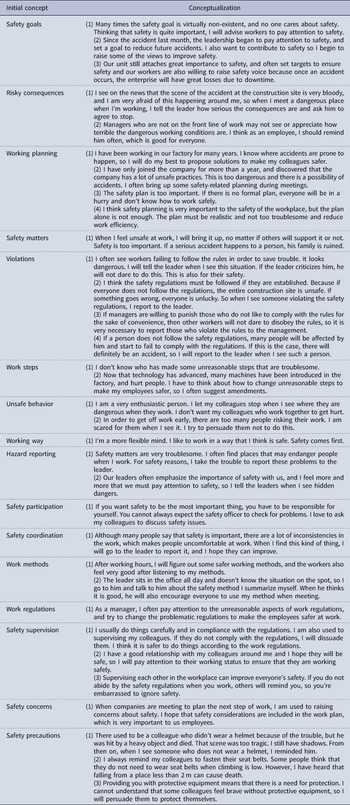
We eliminated the simple and ambiguous responses from the interview transcripts. First, simple responses were short and less informative statements. For example, ‘I usually work safely,’ ‘We rarely get hurt on the job,’ and ‘We only have one safety officer in the company.’ Second, ambiguous responses referred to unclear or inconsistent descriptions. For example, ‘I really hope that my workers are safe and sound, and I don't care if one of them is injured occasionally’ and ‘I often chat with my colleagues about who is stubborn and doesn't even listen to the boss.’ In total, we finally obtained more than 300 original statements and the corresponding initial concepts. Due to the large number and crossover of initial concepts, we chose the initial concepts that were repeated more than three times for categorization and excluded the inconsistent initial concepts. The open coding was started after the first interview. Table 3 reflects the process of conceptualization and scoping of the original interview transcripts. Considering the limitation of space, we selected only representative original phrases and initial concepts for listing, as shown in Table 3.
Open coding results

Axial coding: Axial coding is to obtain important categories and reintegrate these categories into a logical whole based on open coding. The researcher analyzes one category at a time, explores the correlations of this category, and determines whether the categories have similar concepts. Next, the levels of the categories within the group are identified, that is, the main categories and subcategories are identified, and then the linkages between the main categories and subcategories are established under continuous comparative analysis. In this study, 16 previous categories were further analyzed and re-categorized through axial coding into a logical whole that includes two major categories of relationships: promotive safety voice and prohibitive safety voice (shown in Table 4).
Axial coding results

Selective coding: Selective coding is to dig deeper and systematically deal with the relationships among the main categories to identify the core categories that can override all the main categories.
In this paper, we found that the concept of safety voice can be used as a core category to overlap other categories and the two subcategories of safety voice are promotive safety voice and prohibitive safety voice obtained by axial coding. Promotive safety voice means coming up with new ideas or suggestions to enhance organizational safety; prohibitive safety voice is to proactively point out the problems in existing work in order to avoid accidents.
Theoretical saturation test: Theoretical saturation is the point at which no further information can be obtained to develop a theoretical idea and is used as a criterion for terminating the survey sampling (Fassinger, Reference Fassinger2005). To avoid conceptual omissions to reach theoretical saturation, we continuously compared and iteratively mined the original data, labels, concepts, and categories, used the remaining three uncoded interviews to test the theory, and found no new concepts or categories emerged. Therefore, theoretical saturation can be considered to have been reached.
Initial scale development
Based on the grounded coding results above, two dimensions of the safety voice scale were obtained: promotive safety voice and prohibitive safety voice. Combined with the literature analysis related to safety voice, we defined promotive safety voice as the behavior that employees make innovative suggestions and approaches to improve corporate safety performance; and prohibitive safety voice as the behavior that employees make defensive suggestions and measures for issues that hinder the safety performance and achievement of safety goals of the organization (e.g., behaviors that are detrimental to the organization, and inappropriate work procedures or norms, etc.) Liang, Farh, and Farh (Reference Liang, Farh and Farh2012) separated voice into two dimensions of promotive and prohibitive voice and developed the corresponding scale. For safety voice, although few current studies have explicitly proposed different dimensions, it can be concluded from them that safety voice has promotive aspect and prohibitive aspect. On the one hand, employees will propose new procedures, work methods, etc., intended to improve organizational safety (i.e., promotive safety voice) (Reader, Mearns, Lopes, & Kuha, Reference Reader, Mearns, Lopes and Kuha2016; Tucker & Turner, Reference Tucker and Turner2015). Rather than complaining about the inadequacy of the current state of safety, such improvement suggestions emphasize the enhancement of the state of safety (Hu et al., Reference Hu, Parker, Lipsitz, Arriaga, Peyre, Corso and Greenberg2016). This type of facilitation-based safety voice is more moderate and more acceptable. On the other hand, employees raise concerns about unsafe elements at work, known as prohibitive safety voice, such as when they discover that a colleague is not working in accordance with safety regulations (Noort, Reader, & Gillespie, Reference Noort, Reader and Gillespie2019a; Okuyama, Wagner, & Bijnen, Reference Okuyama, Wagner and Bijnen2014). Such safety concerns are often the key to avoid accidents (Kines, Andersen, Spangenberg, Mikkelsen, Dyreborg, & Zohar, Reference Kines, Andersen, Spangenberg, Mikkelsen, Dyreborg and Zohar2010; Noort, Reader, & Gillespie, Reference Noort, Reader and Gillespie2021b). But safety concerns accentuate dissatisfaction with the state of safety and may give others a mean-spirited impression, which in turn causes resentment. These risks can hinder rewards, promotions, or even cause employees to lose their jobs, so employees often choose to remain silent out of these risks (Fischer & Orasanu, Reference Fischer and Orasanu2000; Krenz, Burtscher, & Kolbe, Reference Krenz, Burtscher and Kolbe2019).
To improve the reliability and validity of the scale, the base framework was to refer to the concepts obtained from the coding of axial under the two dimensions and introduce the items from the maturity scale of safety voice in the academic field appropriately when designing the questionnaire items. We invited two PhD students in management for the discussion and gave them one item for each category to describe. Then, one professor and 16 middle/senior managers were invited to participate in the questionnaire revision meeting, during which the participants discussed merging and removing the items. Finally, an initial scale of safety voice including 26 items measured on a 5-point Likert scale was obtained. In order to ensure the accuracy of information collection, the initial questionnaire was given guiding words such as ‘anonymous’ and ‘for academic research only,’ and then the pre-testers were asked to answer according to the actual situation.
Data collection and analysis
To test the developed scale empirically, we released initial questionnaires and formal questions, which were divided into two parts: the first part consisted of basic information, specifically gender, age, education level, position, and work experience; the second part consisted of scale items, and items were rated on a 5-point Likert scale ranging from 1 to 5. We asked participants to choose from ‘strongly disagree’ to ‘strongly agree’ according to the degree of conformity of the listed behaviors or situations with themselves. The participants were employees from large companies in the service, construction, and technology industries in Hebei and Tianjin.
In the initial test, we sent out 262 questionnaires. After excluding the missing answers and invalid questionnaires with concentrated answers, a total of 205 valid questionnaires were recovered, with an effective recovery rate of 78.24%. In the formal test, we sent out 490 questionnaires, and recovered 420 valid questionnaires; the valid recovery rate is 85.71%. The sample size of the initial and formal questionnaires met the requirements (Aleamoni, Reference Aleamoni1976; Carpenter, Reference Carpenter2017). The basic information about the subjects of the two tests is shown in Tables 5 and 6.
Basic information statistics of the initial test sample

Basic information statistics of the formal test sample

Based on the recommendations of Hinkin (Reference Hinkin1998), we used the first sample (N = 205) for EFA and the second sample (N = 420) for CFA. By clarifying the principles of reliability analysis and EFA, item analysis, reliability, and validity analysis were conducted on the data collected from the initial questionnaire. Based on results of the analysis, we revised the initial scale and streamlined the measurement items to establish the formal questionnaire. We conducted a CFA and internal consistency analysis test on the formal questionnaire to further test the stability and validity of the scale. Statistical Product and Service Software Automatically was used to perform item analysis, EFA, CFA, and reliability test on the data to determine the final scale.
Results
Results of stage 1: initial test
Item analysis
The study conducted an EFA on the structure of the initial scale of employee safety voice. Before factor analysis, we conducted item analysis to purify the measurement items. In this study, we conducted item analysis on the first data collected, and the results show that each item reaches the significance level, which indicates that all 26 items of the scale developed in this study have a high level of differentiation and can effectively distinguish between high and low subgroups without the need for deletion.
Exploratory factor analysis
In this study, the first collected data (N = 205) was used for EFA. Bartlett's sphericity test (Tabachnick & Fidell, Reference Tabachnick and Fidell2007) should be performed first. In this paper, the Bartlett's spherical test showed significant values (p < .001) and the value of Kaiser–Meyer–Olkin was .911, which was much greater than .7, indicating that the study data were well suited for EFA.
Then EFA was performed. In this paper, we used principal component analysis for exploratory analysis and extracted factors according to the principle of factor eigenvalues greater than 1. The rotation method was a great variance orthogonal rotation. The advantage of orthogonal rotation is that the information provided by the factors does not overlap, and it is a very common rotation method in principal component analysis (Norris & Lecavalier, Reference Norris and Lecavalier2010). Researchers use orthogonal rotations when the set of factors underlying a given item set are assumed or known to be uncorrelated (Worthington & Whittaker, Reference Worthington and Whittaker2016). In this article, we assumed that promotive and prohibitive safety voice have no influence on each other, so we used orthogonal rotations. After EFA, the factor loading matrix was obtained, and items with factor loadings less than .50 and cross-loadings over .40 should be removed (Heckler, Reference Heckler1996). After three EFAs, 5, 7, and 1 items were removed successively and a factor structure with good convergent and discriminant validity was obtained, and the factor naming and the degree of variance explained are shown in Table 7. We judged the factor number by the trend of steepness and smoothness of the scree plot. According to Table 6 and Figure 1, we can see that two factors were extracted from the factor analysis. The explained variance of these two factors after rotation was 29.572 and 27.717%, respectively. The cumulative variance explained after rotation was 57.288%, which meets the criterion that the variance explained should be at least 50% (Beavers, Lounsbury, Richards, Huck, Skolits, & Esquivel, Reference Beavers, Lounsbury, Richards, Huck, Skolits and Esquivel2013), which indicates that the factor structure of the safety voice is desirable.
Scree plot.

Principal component and factor loadings

Reliability analysis
It is necessary to test the scale's reliability after EFA (Hinkin, Reference Hinkin1998). Generally, researchers believe that a reliability coefficient of .70 or higher for subscales is considered highly desirable (Nunnally, Reference Nunnally1994). We found that the Cronbach's alpha of the total scale, promotive safety voice and prohibitive safety voice were .901, .858, and .860, which were higher than .70. Hence, the scale passes the reliability test.
Results of stage 2: second test
Confirmatory factor analysis
After the EFA, validity tests were conducted using CFA to verify the correspondence between each factor and the measured items (Floyd & Widaman, Reference Floyd and Widaman1995). The CFA of the formal scale revealed that some items had small factor loading coefficients. According to Fornell and Larcker (Reference Fornell and Larcker1981), the factor loading coefficients should be greater than .7. To improve the quality of the fit and to further modify the model, we deleted the two items with factor loading coefficients less than .7.
For the CFA, we determined the best model by comparing the fit of a competing model (Jackson, Gillaspy, & Purc-Stephenson, Reference Jackson, Gillaspy and Purc-Stephenson2009). We primarily compared two competing models: (1) a single-factor model, in which 11 entries shared a common factor, and (2) a two-factor model, in which the corresponding entries were loaded on two independent factors based on EFA results. After debugging, the best fits of the two models are shown in Table 8.
Result of the CFA

PSV1, promotive safety voice; PSV2, prohibitive safety voice.
The fit metrics commonly available for the CFA are χ2/df, GFI, NFI, CFI, TLI, and RMSEA (Schreiber, Nora, Stage, Barlow, & King, Reference Schreiber, Nora, Stage, Barlow and King2006). The results of the CFA shows that the two-factor model fit better (χ2/df = 4.238, GFI = .925, NFI = .938, CFI = .952, TLI = .938, RMSEA = .087) and is significantly better than the one-factor model (χ2/df = 7.310, GFI = .857, NFI = .891, CFI = .904, TLI = .880, RMSEA = .058), and each goodness-of-fit indicator is largely within the acceptable range (Browne & Cudeck, Reference Browne and Cudeck1993; Kline, Reference Kline2015), which suggests that the model is reasonable.
Hinkin (Reference Hinkin1998) noted that the convergent and discriminant validity of self-administered scales could be tested by comparing the correlation coefficients between the results of a scale and other scales measuring another construct. Theoretically related measures should have similar results (i.e., high correlations), which would indicate convergent validity. Theoretically different measures should have high differences (i.e., low correlations), indicating that the scale has discriminant validity (DeVellis, Reference DeVellis2012).
The results of convergent validity can be judged based on AVE (average variance extraction) and CR (combined reliability). An AVE greater than .5 and a CR value greater than .7 for all factors proves high convergent validity (Fornell & Larcker, Reference Fornell and Larcker1981). From Table 9, it is clear that the convergent validity of the two factors is good.
Convergent validity results

The diagonal line in Table 10 shows the AVE square root values, and the remaining value is the correlation coefficients. The discriminant validity of the scale is acceptable if the maximum correlation coefficient is less than the minimum value of the AVE square root value (Fornell & Larcker, Reference Fornell and Larcker1981). As shown in Table 10, the study data have good discriminant validity.
Discriminant validity results

Internal consistency reliability test
The reliability test in this study used Cronbach's alpha coefficient to evaluate the internal consistency of the multidimensional scales and combined with the corrected item-total correlation (CITC) to purify the measurement items. According to the relevant criteria, Cronbach's alpha coefficient of the scale is greater than .6, and the CITC index is not less than .5 to be retained. Otherwise, the corresponding items should be deleted (Nunnally, Reference Nunnally1978). We found that all items had CITC values above .5 and reliability greater than .8 (.930 for the total scale, .869 for the promotive safety voice dimension, and .905 for the prohibitive safety voice dimension), which indicates good internal consistency of the formal scale.
Taken together, these analyses and studies indicate that the empirically derived two-dimensional scale of safety voice has the same dimensions as expected and has good convergent and discriminant validity. Therefore, the formal scale has strong stability and is definitive, reliable, and scientific.
In the past, safety voice was thought to be unidimensional (Conchie, Taylor, & Donald, Reference Conchie, Taylor and Donald2012; Tucker et al., Reference Tucker, Chmiel, Turner, Hershcovis and Stride2008; Tucker & Turner, Reference Tucker and Turner2011); Bazzoli et al. (Reference Bazzoli, Curcuruto, Morgan, Brondino and Pasini2020) argued that safety voice could be divided into four dimensions based on function. This scale explains for the first time two dimensions of safety voice – promotive and prohibitive – depending on their content. Both safety voices can improve workplace safety, but differ in content. Promotive safety voice is when employees come up with new ideas and innovate on existing safety efforts, and prohibitive safety voice is when they dismiss existing safety deficiencies. Therefore, this scale provides a new perspective and a comprehensive picture of employees' safety voice. In addition, previous safety voice scales were developed with samples of employees from Western countries (Bazzoli et al., Reference Bazzoli, Curcuruto, Morgan, Brondino and Pasini2020; Conchie, Taylor, & Donald, Reference Conchie, Taylor and Donald2012; Tucker et al., Reference Tucker, Chmiel, Turner, Hershcovis and Stride2008; Tucker & Turner, Reference Tucker and Turner2011), while the survey respondents in the development of this scale were all Chinese employees. This scale can be used to measure employee safety voice behavior in Chinese organizational contexts.
Discussion
Summary of major findings
In this research, we collected the items of the safety voice scale through in-depth interviews and then extracted, combined, and categorized the collected data through coding analysis to obtain the safety voice scale. The initial structure of the scale was established by axial coding, which consisted of two dimensions. After expert discussion and analysis, we developed the initial scale of safety voice and extracted two common factors by principal component analysis in EFA, which could explain 57.288% of the total variance. Based on the content of the items corresponding to each metric factor, we named the two factors as promotive safety voice and prohibitive safety voice. CFA found that the first-order two-factor structural model fitted better than all other models. The reliability analysis revealed that the internal consistency coefficients of two dimensions exceeded the psychometric requirement of .7, and the correlation coefficients between each item and the corresponding dimension were higher than .7. The deletion of any of the items did not increase the reliability of the dimension in which it was used, thus ensuring the rationality and validity of the questionnaire design. The analysis of content validity, convergent validity, and discriminant validity revealed that the safety voice scale has good validity.
The newly developed scale is unique in several ways compared to the existing safety voice scales. First, we used qualitative research in the item generation process. Most of the existing safety voice scales are adapted from scales in other domains. Although Tucker and Turner (Reference Tucker and Turner2011) received the items for safety voice through focus groups, the focus groups were composed of young workers and lacked a sample of adult workers. In this article, in-depth interviews were used to obtain primary data, and coding techniques of grounded theory were used to initially obtain the two dimensions of safety voice and the initial scale items. Second, we divided safety voice into two dimensions: promotive and prohibitive safety voice. Many scholars currently study safety voice as a single-dimensional variable (Conchie, Taylor, & Donald, Reference Conchie, Taylor and Donald2012; Tucker et al., Reference Tucker, Chmiel, Turner, Hershcovis and Stride2008; Tucker & Turner, Reference Tucker and Turner2011). Bazzoli et al. (Reference Bazzoli, Curcuruto, Morgan, Brondino and Pasini2020) first classified safety voice into four sub-dimensions based on their different functions: preventive safety voice, passive safety voice, hostile safety voice, and promotive safety voice. But this scale has not been validated by the EFA. We conducted two questionnaires after obtaining the initial items according to Churchill's (Reference Churchill1979) suggestion, and determined the factor structure of safety voice by EFA, and then validated the validity of the scale by CFA to ensure the normality of the scale development. Third, this new safety voice scale has universal applicability. The current scales were developed by selecting a sample of specific occupations (Conchie, Taylor, & Donald, Reference Conchie, Taylor and Donald2012; Tucker et al., Reference Tucker, Chmiel, Turner, Hershcovis and Stride2008) and age groups (Tucker & Turner, Reference Tucker and Turner2011). Bazzoli et al.'s (Reference Bazzoli, Curcuruto, Morgan, Brondino and Pasini2020) survey respondents are blue-collar workers. The sample in this paper covered the construction, service, and manufacturing sectors and was distributed across a wide range of ages. Therefore, this scale is somewhat generalizable (Tabachnick & Fidell, Reference Tabachnick and Fidell2007).
In occupational safety, the potential risk of personal injury in the workplace has prompted many employees to voice. Then a growing number of scholars are focusing on such safety voice (Curcuruto, Strauss, Axtell, & Griffin, Reference Curcuruto, Strauss, Axtell and Griffin2020; Liang & Zhang, Reference Liang and Zhang2019; Tucker et al., Reference Tucker, Chmiel, Turner, Hershcovis and Stride2008). Noort, Reader, and Gillespie (Reference Noort, Reader and Gillespie2019a) summarized the literature on safety voice and found that safety voice had a role in avoiding personal injury by communicating safety issues to others. Current research on safety voice is more focused on employees raising concerns about safety issues and neglects the constructive nature of safety voice (Hu et al., Reference Hu, Parker, Lipsitz, Arriaga, Peyre, Corso and Greenberg2015), where employees can voice new ideas or approaches to their work that can improve workplace safety. Thus, safety voice has both a promotive effect on organizational safety (i.e., employees make safety-related suggestions to improve workplace safety) and a prohibitive effect on situations that are harmful to prevent safety (i.e., raising safety issues in the workplace to avoid accidents) (Herachwati, Sulistiawan, & Alfirdaus, Reference Herachwati, Sulistiawan and Alfirdaus2018), which is consistent with the two dimensions of safety voice obtained in this paper: promotive safety voice and prohibitive safety voice.
We define promotive safety voice as the behavior of employees who make innovative suggestions and approaches to improve corporate safety performance; and prohibitive safety voice as the behavior of employees who make defensive suggestions and measures for issues that impede organizational safety performance and the achievement of safety goals (e.g., inappropriate work procedures or norms, etc.). Both promotive and prohibitive safety voice are extra-role behaviors that are beneficial to the organization's long-term survival. However, there are some differences between them. Based on a comprehensive understanding and grasp of the characteristics of the two types of safety voices, this paper summarizes their differences in the following aspects: first, the focus is different: promotive safety voice is suggestion-oriented, and tends to maintain and protect the existing organizational safety policies or practices, express ideas and opinions to improve the current work and organizational processes, and focus on the benefits; prohibitive safety voice is problem-oriented, in which employees find problems with existing safety practices and rules and regulations in the organization, and give their views about the threat of accidents and inadequacies in the organization to modify or even change the existing work environment, and focus on stopping losses. Second, the time point is different: promotive safety voice points to the future, cannot immediately impact the organization; prohibitive safety voice mainly points to the past or the current problems, and can play a timely stop-loss effect. Third, the degree of challenge to the organization is different: promotive safety voice is based on the improvement of the existing safety work of the company, its good intentions are easily perceived by the organization, so the degree of challenge to the organization is less; although also based on good intentions, prohibited safety voice challenges existing management practices and procedures and is a rejection of corporate safety practices. Organizations tend to feel the challenge of this kind of safety voice, thinking that safety voice is challenging the authority of the leader, and it is easy to be seen by colleagues as causing trouble, with a higher risk of controversy and interpersonal conflict (Li, Barnes, Yam, Guarana, & Wang, Reference Li, Barnes, Yam, Guarana and Wang2019). Fourth, different resource consumption: promotive safety voice often proposes some creative ideas, which requires more cognitive resources of employees; prohibitive safety voice may bring personal risk, and employees will constantly self-regulate and control this kind of safety voice, which requires more self-regulation resources of employees. Fifth, the information is presented in different ways: promotive safety voice presents information in a positive way; prohibitive safety voice presents information in a negative way. Sixth, for the solution, promotive safety voice suggests ways to improve. In contrast, prohibitive safety voice does not offer solutions to the identified problems.
Implications
Theoretical implications
First, this study developed a scale of employee safety voice applicable to the Chinese context and named the two dimensions as promotive safety voice and prohibitive safety voice, respectively. Previous safety voice scales have been developed in Western contexts. Little research has shown that these scales apply to employees in Chinese organizational contexts. Chinese culture is rich in connotations, and employee behavior is influenced by Chinese culture even in modern societies that have undergone dramatic changes. Relationship, face, and favors are all cultural concepts with Chinese characteristics that impact on Chinese thinking and behavior (Chee, Harrison, McKinnon, & Wu, Reference Chee, Harrison, McKinnon and Wu1999; Mak et al., Reference Mak, Ho, Wong, Law and Chan2015). China is a society that emphasizes ‘private feelings,’ and ‘private feelings’ need to be guaranteed by personal relationships, and leadership–subordinate relationships are strongly ‘extra-organizational’ and ‘private emotions.’ The leadership–subordinate relationship is strongly ‘extra-organizational’ and ‘personal,’ and this relationship can penetrate the normal organizational work, thus playing a role in the context of organizational system (Chen, Chen, & Xin, Reference Chen, Chen and Xin2004; Farh et al., Reference Farh, Tsui, Xin and Cheng1998). The relationship between superiors and subordinates and colleagues in an organization is a mixed relationship, and favor and face play a key role in the interaction between the two parties with a mixed relationship. Close relationships between superiors, subordinates, and colleagues can facilitate employees' expression of ideas that are beneficial to organizational safety. However, poor relationships may cause employees to be cautious in what they say and do (Herachwati, Sulistiawan, & Alfirdaus, Reference Herachwati, Sulistiawan and Alfirdaus2018; Tucker et al., Reference Tucker, Chmiel, Turner, Hershcovis and Stride2008). Therefore, the closeness of relationships between superiors and subordinates and the subtlety of colleague relationships in Chinese organizations have a complex impact on safety voice behavior. This study offers a valid measurement tool for safety voice in the Chinese cultural context.
Second, we expanded the definition of safety voice by adding the concepts of promotive safety voice and prohibitive safety voice. We obtained two dimensions through grounded interviews and named them as promotive safety voice and prohibitive safety voice according to the content of each dimension containing the questions. The two dimensions were identified through EFA. The former involves employees proposing new thoughts or advice proactively to improve organizational safety performance and operations. In contrast, the latter refers to the behavior of employees who take the initiative to point out the problems in the organization that may endanger organizational safety to prevent personal injuries caused by accidents in the organization. Previous studies on safety voice have mostly considered the aspects of safety voice that point out organizational safety problems, and less attention has been paid to the innovative suggestions and approaches in safety voice to improve the overall safety of the organization (Herachwati, Sulistiawan, & Alfirdaus, Reference Herachwati, Sulistiawan and Alfirdaus2018; Tucker et al., Reference Tucker, Chmiel, Turner, Hershcovis and Stride2008; Turner, Tucker, & Deng, Reference Turner, Tucker and Deng2020). This study divided safety voice into two parts: promotive safety voice and prohibitive safety voice, which more comprehensively and accurately elaborated the concept of safety voice and expanded the connotation of safety voice.
Finally, in the previous measurement of safety voice, many studies used single-dimensional scales (Conchie, Taylor, & Donald, Reference Conchie, Taylor and Donald2012; Tucker et al., Reference Tucker, Chmiel, Turner, Hershcovis and Stride2008; Tucker & Turner, Reference Tucker and Turner2011, Reference Tucker and Turner2015). By referring to the maturity scale and in-depth interviews, we redesigned the two-dimensional safety voice scale, including promotive safety voice and prohibitive safety voice. Its credibility and rationality have been verified, providing more comprehensive measurement of safety voice tools, and enriching the theoretical research of safety voice measurement.
Practical implications
The findings of this study have important practical significance to enhance enterprise safety decision and optimize safety management system. Combining promotive and prohibitive aspects of safety voice, there are three ways for an organization to motivate employees to engage in safety voice behavior. First, the organization formulates and implements an incentive mechanism for employees' prohibitive safety voice to convey to employees that the safety issues are positively recognized by the company or leadership. For example, leaders can give reasonable spiritual rewards or material rewards to employees who clearly point out safety issues and increase the courage of employees to suppress safety suggestions. Second, leaders should pay attention to promotive safety voice from their subordinates, carry out more internal organization building, and provide employees with channels to put forward constructive opinions on safety. For example, regular safety discussion meetings can be organized to encourage employees to speak freely and put forward new ideas and methods to improve workplace safety. Finally, the organization should create a good atmosphere and system for safety voice, advocate a healthy face culture, and eliminate employees' face concerns. The superiors should also show a positive image of being willing to accept words and encourage employees to make safety voice.
Limitations
As an exploratory study, there are some limitations in this study. First, this study used a convenience sampling method due to the limitation of social resources. The sample was mainly from Hebei, Beijing, and Tianjin, lacking data from enterprises in other places, making it difficult to control the influence of geographical and cultural factors. Future studies should fully consider the above factors, expand the sample size and adopt a more rigorous design to avoid the above problems. Second, our scale development process only used the coding technique of grounded theory and did not satisfy the complete grounded theory study. For example, some of the interview questions contained presuppositions, which did not meet the requirements of grounded theory (Turner & Astin, Reference Turner and Astin2021). In the future, subsequent studies can strictly follow the criteria of grounded theory in the scale design to ensure the rigor of the study. Finally, the safety voice measurement tool developed in this study was not used to explore the effects of safety voice on other work behaviors, and future research needs to investigate the influence of safety voice on other important organizational outcomes through the collection of different samples in order to further clarify the role of safety voice.
Conclusion
In this study, we first conducted a literature review and in-depth interviews to obtain a theoretical conceptualization of the structure of safety voice. Then, we formed the initial scale based on the theoretical conceptualization, improved the scale structure and validated the composition of the items by item analysis, EFA and CFA, and finalized the formal scale with two dimensions (promotive and prohibitive safety voice) and 11 items. The scale was developed for employees in Chinese organizational contexts, filling a theoretical gap in the study of employee safety voice in China. And the scale can also be used in corporate practice to help companies obtain ongoing safety information in order to identify activities to focus on in managing employee safety voice and thereby improve corporate safety.
Acknowledgements
This work was supported by the Fundamental Research Funds for the Central Universities of China (grant numbers 2-9-2019-073).
Conflict of interest
The authors declare none.
Yunfeng Sun is a graduate student of the China University of Geosciences (Beijing) and has obtained a bachelor's degree in safety engineering. Her research interest is organizational behavior and organizational safety management.
Yifeng Jiang is a researcher in China Electric Power Research Institute.
Xiaowei Luo is a researcher at the College of Engineering, City University of Hong Kong.
Yongbao Zhang is a graduate student of the China University of Geosciences (Beijing) and has obtained a master's degree in safety engineering. His research interest is organizational behavior and organizational safety management.
Xiang Wu is a researcher at the School of Engineering and Technology of China University of Geosciences (Beijing). His main research interest is organizational safety psychology and behavior.
Appendix A
Final scale of safety voice