Implications
Young stock management practices have changed considerably over the years and can have different effects on animal growth. This study demonstrates a method of analysing dairy heifer growth using a single heart girth measurement. The results show that weights of breeding age (12 to 15 months) heifers are highly variable among farms. Moreover, farms able to achieve high pre-weaning growth rates achieved higher weights for breeding age heifers, illustrating the importance of early calf management.
Introduction
Dairy heifer-rearing practices have begun to change. For example, the traditional practice of restricted feeding for pre-weaned calves is losing favour as the advantages of providing calves more milk become better known (Khan et al., Reference Khan, Weary and von Keyserlingk2011). Unfortunately, there is little work investigating the effects of feeding and management practices on growth rates of older heifers (see review by DeVries, Reference DeVries2010).
Management practices vary greatly among farms. Heifers are often regrouped, even though this practice can reduce feed intake and growth (Bøe and Færevik, Reference Bøe and Færevik2003). Poor growth rates can result in heterogeneous breeding groups, and this variation within a farm can cause other problems including increased number of services per pregnancy, delayed calving and lower milk production during the first lactation (e.g. Mohd Nor et al., Reference Mohd Nor, Steeneveld, van Werven, Mourits and Hogeveen2013).
BW of replacement dairy heifers can be accurately estimated using heart girth measurements (Heinrichs et al., Reference Heinrichs, Rogers and Cooper1992; Heinrichs et al., Reference Heinrichs, Erb, Rogers, Cooper and Jones2007). Despite the availability of this practical method, heifer growth, the most basic indicator of performance, is rarely measured on commercial dairy farms (Bach and Ahedo, Reference Bach and Ahedo2008), making it difficult to assess the success of different management practices.
The objectives of this study were to describe variation among farms in BWs of breeding age heifers and identify management practices associated with higher BW.
Material and methods
In all, 33 dairy farms were selected through convenience sampling in the lower Fraser Valley in British Columbia, Canada. Selection criteria included purebred Holstein herds using a computerized recording system (Dairy Herd Improvement), a minimum of 90 lactating cows and seven breeding age heifers at the time of the farm visit. Producers that fit the selection criteria were contacted by phone and volunteered to participate in the study. All farms were visited once by the same individual between June and October 2010. All methods used to collect data were approved by the University of British Columbia’s Animal Care Committee.
On each farm, all heifers 48 to 70 weeks of age were included in the study. Birth dates were recorded from farm records. Heifers were restrained in headlocks and heart girth circumference was measured using tape (The Coburn Company, Inc., Whitewater, WI, USA). These measures were then used to estimate BW following the equation proposed by Heinrichs et al. (Reference Heinrichs, Rogers and Cooper1992):
 $$\eqalignno{{\rm BW}\,{\rm (kg)}=\,&{\rm 65}.{\rm 36}-({\rm 1}.{\rm 966}{\times}{\rm HG}){\plus}(0.0{\rm 1959}{\times}{\rm HG}^{{\rm 2}} )\cr &{\plus}(0.0000{\rm 1691}{\times}{\rm HG}^{{\rm 3}} )$$
where HG is the heart girth measurement (in cm).
One potential predictor of rates of BW gain for heifers is the rate of gain for the pre-weaned calves on the same farm. Thus, heart girth circumference was also measured for all calves of 0 to 8 weeks of age. Heifer management practices, specifically grouping and feeding practices, were also expected to affect BW trajectories for heifers. Therefore, all producers were asked to describe heifer management practices, such as the number of animals in the heifer group after weaning, the frequency of regrouping heifers after weaning, daily frequency of provision of fresh feed to heifers and if heifers were provided access to a total mixed ration (TMR).
Samples from the heifer diets were collected when fresh feed was available, during the farm visit. Five subsamples were collected from different equidistant points at the feed trough and mixed to form a single sample. Intakes of these diets were not measured on any farm. The samples were stored in a −20°C freezer and later dried and ground for analysis at a commercial laboratory (A&L Canada Laboratories, Inc., London, ON, Canada).
Estimated BW was regressed against age using PROC REG in SAS (SAS 9.4 Institute, Inc., Cary, NC, USA) for breeding age heifers and milk-fed calves separately. The resulting line equation was used to estimate expected BW based on age. Heifer and calf BW residuals were calculated by subtracting the actual BW from the expected BW at the respective ages. Individual animal residuals were then averaged by farm to calculate age-corrected calf and heifer growth in each farm. Negative farm residuals indicate that animals on that farm were lighter than predicted for their age. The milk-fed calf BW residuals were averaged for each farm (0 to 8 weeks of age; n=425 calves from the same 33 farms).
The univariable associations between residual heifer BW and farm average residual calf BW, and each of the heifer management practices were tested in SAS using PROC REG for continuous variables and PROC LOGISTIC for categorical variables.
Results
The final database contained 33 farms with an average herd size of 205±118 milking cows (±s.d., ranging from 94 to 700). We measured a total of 576 heifers, on average 11±6 heifers/farm. Farms varied considerably in heifer management practices. The majority of farms (88%) reported that calves were moved to a new pen <14 days after weaning. Most farms (73%) also reported not regrouping heifers during the post-weaning period. Farms typically fed heifers once a day (61% of farms), but some (18%) fed less than once a day, and others (21%) more than once a day. The majority of farms (76%) provided heifers a TMR. A subset of 15 farms had fresh feed available for sampling at the time of the visit. Analyses from these samples indicated that heifer diets were similar. Average nutrient composition was 13.3% CP, 34.7% ADF, 53.3% NDF, 61.9% TDN, 94.8% DM, 0.79 Mcal/kg NEG and 1.53 Mcal/kg NEM.
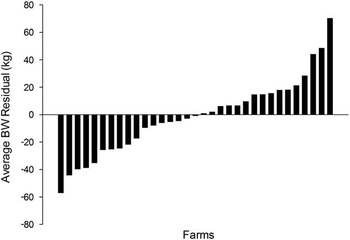
The estimated BW for breeding age heifers ranged from 221 to 575 kg, with BW increasingly linearly with age (Figure 1; BW (kg)=116+5×age (weeks)). Farm average residuals from this regression were used to provide an age-corrected estimate of weights for each farm. These farm averages ranged from −54 kg on the farm with the lowest rate of BW gain to +72 kg on the farm with the highest gains (Figure 2).
The relationship between BW (kg) and age (weeks) of 576 heifers 48 to 70 weeks of age. Measures are from 33 dairy farms in the lower Fraser Valley of British Columbia, Canada.

Average residual BW (kg) from the regression illustrated in Figure 1. Residuals from the heifers on each farm were averaged to generate a farm average residual heifer BW. The 33 participating dairy farms are ranked on the x-axis from lowest to highest.

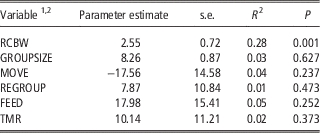
A linear increase with age was also found for pre-weaned calf BW (BW (kg)=42+4.8×age (weeks)). Farms also differed in the rate of gain for pre-weaned calves; farm average residual calf BW varied from −9 to 18 kg. Farms that had higher rates of BW gain for the pre-weaned calves also had higher rates of BW gain for breeding age heifers (Table 1). None of the heifer management variables we recorded related to BW gains for breeding age heifers.
Univariable associations between farm average residual heifer BW, animal measurementsFootnote 1 and management practicesFootnote 2

Data are from 33 dairy farms in the lower Fraser Valley of British Columbia, Canada.
1 Animal measurement: RCBW=pre-weaned calf residual BW.
2 Management practice: GROUPSIZE=size of post-weaned heifer group; MOVE=time between weaning and moving to a new pen; REGROUP=frequency of regrouping heifers; FEED=times per day heifers were provided fresh feed; TMR=total mixed ration was offered to heifers.
Discussion
Farms with higher rates of heifer BW gain were also farms that achieved higher rates of BW gain for pre-weaned calves. This result indicates that practices that allow for more rapid gains during the pre-weaning period are important in determining longer term BW gains for older heifers. Previous work has shown a positive relationship between pre-weaning gains and later growth (e.g. Heinrichs and Heinrichs, Reference Heinrichs and Heinrichs2011). A positive relationship between early and later gains might also be expected if the more successful farms adopt certain management practices that are favourable for both calves and heifers on the farm. Heifer management practices varied considerably among farms, as reported in other surveys (United States Department of Agriculture, 2010). However, none of the factors we considered in the current study predicted farm-to-farm variation in weight gains. We suggest that future work should consider variation in the quality of solid feed provided and solid feed intake of the growing heifers.
The use of BW variation to estimate growth is not common in production animal studies. Animal growth rates are typically derived from longitudinal studies in which BW is measured repeatedly over time (e.g. Van Amburgh et al., 1998; Bartlett et al., 2006). Cross-sectional studies cannot be used to measure growth rates for specific individuals, but the method used in the current study describes the growth trajectory for the study population and allows for an assessment of divergence from this trajectory. Moreover, by generating a growth trajectory for this study population, our results contribute to the limited literature describing Holstein heifer growth rates worldwide. The median BW in the current study was 45 kg higher than that reported by Heinrichs and Lammers (Reference Heinrichs and Lammers1998) for 12- to 17-month-old heifers. The higher weights likely reflect changes in genetics, nutrition and management between populations of animals observed in these two studies, and perhaps especially the adoption of higher milk rations for calves adopted by some of the farms in the current study.
Growth estimates based on the local population allow us to draw more meaningful comparisons when examining the results from specific farms within the region. We suggest that this method may be particularly useful when considering animal growth as a measure of biological functioning in on-farm welfare assessment protocols, as the data can be collected during a single visit.
In conclusion, this study illustrates a simple method to assess farm-specific growth rates, and demonstrates considerable variation on heifer growth across farms. We suggest that routine monitoring of heifer BW will allow producers to better evaluate the success of their heifer management. Farms with the heaviest calves before weaning were those with the heaviest heifers, indicative of long-term effects of early calf management on later performance.
Acknowledgements
The authors thank the producers who participated in this study. This research was funded by the Westgen Endowment Fund and the Investment Agriculture Foundation of BC through programmes it delivers on behalf of Agriculture and Agri-Food Canada and the BC Ministry of Agriculture. G. B. B. was supported by a scholarship from CAPES (Brazil). UBC’s Animal Welfare Program is supported by Canada’s Natural Sciences and Engineering Research Council (NSERC), Industrial Research Chair Program with industry contributions from the Dairy Farmers of Canada (Ottawa, ON, Canada), British Columbia Dairy Association (Burnaby, BC, Canada), Westgen Endowment Fund (Milner, BC, Canada), Intervet Canada Corporation (Kirkland, QC, Canada), Zoetis (Kirkland, QC, Canada), BC Cattle Industry Development Fund (Kamloops, BC, Canada), Alberta Milk (Edmonton, AB, Canada), Valacta (St. Anne-de-Bellevue, QC, Canada) and CanWest DHI (Guelph, ON, Canada).